
AI and Quantum the Race With China Just Accelerated
New frontier models, a trillion dollars of compute, real fault-tolerant quantum milestones and a resurgent China — plus how KXCO built the trust layer this convergence needs. By Shayne Heffernan.
Part of theAI Stocks Center
Every few weeks in 2026 the ground shifts under the two most important technologies of our era. Artificial intelligence and quantum computing are no longer running on separate tracks or separate timelines — they are accelerating together, and the summer has delivered the clearest evidence yet that we are in the steepest part of the curve. New frontier models, custom silicon, a genuine quantum error-correction breakthrough, and a Chinese surge that refuses to be contained by export controls have all landed within weeks of each other.
This is the state of play as of late July 2026, why China matters more than the headlines admit, and — in the second half — why the company I founded, KXCO, has spent the last year building precisely the layer this convergence will need. Let me walk through it.
The frontier-model wave keeps breaking
The pace of model releases has become almost impossible to track, which is itself the story. In the space of a few weeks the market absorbed Anthropic's Claude Sonnet 5 (30 June), the staged rollout of OpenAI's GPT-5.6 family from late June, and xAI's Grok 4.5 on 8 July. Anthropic's Fable 5 returned to public access on 1 July after a remarkable nineteen-day federal suspension under export-control law, and it re-entered the market still carrying one of the highest reasoning scores anyone has measured. Google's Gemini 3.x line sits right behind the leaders, with a further release cleared for launch that could reset the rankings again.
Read the pattern rather than the individual names. Each of these labs is now shipping frontier capability on a rhythm measured in weeks, not years. GPT-5.6's flagship tier is tuned for the hardest math, science and cybersecurity reasoning, and — tellingly — is being run on Cerebras wafer-scale hardware at up to 750 tokens per second. OpenAI took an unusually cautious, partner-gated path to release; Anthropic and xAI pushed to general availability faster. The competitive dynamic is no longer "who has the smartest model" but "who can ship, serve and monetise frontier intelligence fastest, on hardware they can actually get their hands on."
That last clause is the whole game. Intelligence is abundant. The binding constraint is compute — and the ability to secure it.
There is a deeper shift underneath the version numbers, and it is the one that will actually change the economy: these models have crossed from answering questions to doing work. The frontier of 2026 is agentic. A modern model does not simply return a paragraph; it plans a multi-step task, calls tools, writes and executes code, browses, and checks its own output before handing back a result. GPT-5.6's cautious, partner-gated release was explicitly about the risks that come with that autonomy in math, science and cybersecurity. Cloud agents that can be handed a long-running task and left to grind on it for hours are now a product category rather than a demo. This is why the enterprise adoption curve — which barely exists yet — is the real prize. The overwhelming majority of businesses on earth have not rebuilt a single core workflow around an autonomous agent. When they do, each of those agents will need an identity, permissions, an audit trail and a way to transact. Hold that thought; it is where the second half of this article lands.
The capex numbers are the real signal
If you want to know whether the people closest to this technology think it is a bubble, watch what they do with their own balance sheets. The answer is unambiguous.
The four largest US hyperscalers — Amazon, Alphabet, Microsoft and Meta — have collectively guided toward roughly $725 billion of capital expenditure in 2026, up around 77% from the prior year's already record $410 billion. Amazon alone is pointing at ~$200 billion, Microsoft toward ~$190 billion, Alphabet $175–185 billion, and Meta $115–135 billion. Layer in the ~$500 billion Stargate build-out and the long tail of neoclouds and sovereign programmes, and total AI infrastructure investment for the year comfortably clears $1 trillion. One widely cited baseline puts cumulative spend at $7.6 trillion between 2026 and 2031.
Nvidia is the clearest beneficiary: its data-centre segment generated roughly $197 billion in fiscal-2026 revenue, nearly doubling year on year. When companies with the best information in the world commit a trillion dollars in a single year, "early-stage bubble" is the wrong mental model. This is an industrial build-out, and industrial build-outs run for a decade.
The spending also reveals where the next bottlenecks are, and they are physical. A GPU is useless without a chip to make it, memory to feed it, a building to house it and power to run it. Every one of those has become a chokepoint. At the leading edge, essentially all of this silicon is fabricated by TSMC on 3nm and below, using extreme-ultraviolet lithography that only ASML can supply — a two-company gate the entire industry must pass through. Advanced packaging, which stitches multiple dies and high-bandwidth memory into a single accelerator, has become its own scarce resource, as has the HBM itself. And the constraint that has crept up on everyone is electricity: the 2026 data-centre wave is now large enough that power availability, not chip supply, is increasingly the gating factor on how fast the build-out proceeds. Nuclear restarts, dedicated gas turbines and grid upgrades are being negotiated by companies that, five years ago, thought of themselves as software firms. When people ask me whether AI is over-hyped, I point at the power grid: you do not rewire national energy infrastructure for a fad.
This is also why I keep returning to the same conclusion. The investable layer of AI is not only the models — it is the entire physical column beneath them, and the trust column that has to sit alongside it. The models get the headlines; the infrastructure gets the profits.
China is not being contained
Here is the part of the story that too much Western coverage still gets wrong. The export-control regime was designed to slow China's AI ascent. It has instead compressed China's timeline for self-reliance — and the results are arriving.
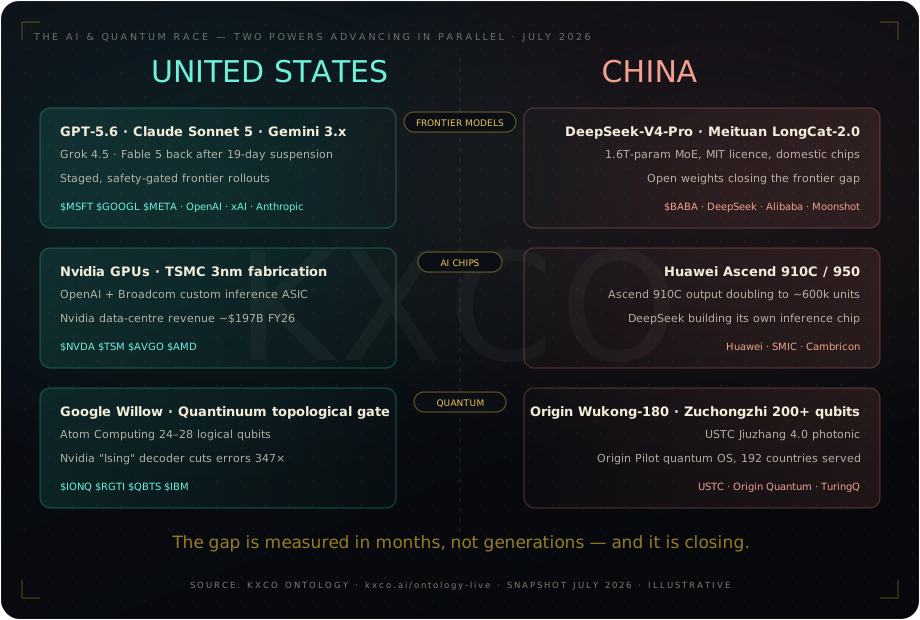
Start with models. DeepSeek, already the country's most celebrated AI lab, is now reportedly developing its own inference chip to reduce its dependence on both Nvidia and Huawei. A research team including Huawei used the firm's Ascend 910C chips to complete post-training of the DeepSeek-V4-Pro model — a step up from mere inference into the far harder work of training. Huawei is reportedly nearly doubling Ascend 910C output toward around 600,000 units for the year, with orders for the newer Ascend 950 surging. Meanwhile Meituan's LongCat-2.0, a 1.6-trillion-parameter mixture-of-experts model released under an MIT licence, was trained entirely on domestic Chinese chips and posts competitive scores on demanding engineering benchmarks.
Then look at quantum, where China has been investing at national scale for years. Origin Quantum released the 180-qubit Wukong-180 and, earlier in the year, Origin Pilot, billed as the first publicly downloadable quantum operating system spanning superconducting, ion-trap and neutral-atom hardware. USTC's Zuchongzhi superconducting series has pushed past 200 qubits, and its Jiuzhang 4.0 photonic machine continues a distinct, hard-to-sanction line of attack. Origin's commercial Wukong system has now fielded tens of millions of remote sessions from users in 192 countries.
There is a strategy behind China's open-weight releases that Western investors consistently underestimate. By publishing capable models under permissive licences, Chinese labs do two things at once: they undercut the pricing power of closed US frontier labs, and they seed the global developer base — particularly across the Global South — with Chinese technology. A 1.6-trillion-parameter model trained on domestic chips and given away under an MIT licence is not a charity project; it is a bid to set the default. Standards follow adoption, and adoption follows whatever is free, capable and available. This is the same playbook that has worked in telecoms and electric vehicles, now aimed at the foundational layer of the AI economy.
The self-reliance push extends to the physical layer too. SMIC continues to advance domestic fabrication despite being cut off from the most advanced ASML machines, and the fact that DeepSeek — the country's AI champion — is now designing its own inference silicon tells you the strategic goal is a fully domestic stack, from wafer to weights. Export controls raised the cost and slowed the timeline; they did not stop the direction of travel.
The uncomfortable truth for anyone modelling this as a one-horse race: the gap between the United States and China is now measured in months, not generations — and in several sub-fields it is closing. That has enormous implications for investors, for security, and for the standards the world's institutions will eventually have to adopt. It also raises a question most portfolios are not built to answer: when two rival technology spheres both reach frontier AI and fault-tolerant quantum at roughly the same time, whose cryptographic standards, whose settlement rails and whose definition of "trusted" wins? That contest is only beginning.
Quantum computing finally turned the corner
For a decade, quantum computing's critics had one devastating point: the machines were too error-prone to be useful, and adding qubits made the noise worse, not better. In 2026 that argument collapsed.
The single most important shift is that error correction now scales the right way — logical error rates fall as you add physical qubits, rather than rising. Google's Willow processor, a 105-qubit superconducting chip, demonstrated logical error rates dropping by roughly 2.14× with each increase in the surface-code lattice, the first hardware-scale proof that fault-tolerance obeys the curves theorists predicted. Atom Computing reported creating and entangling 24 logical qubits from 112 physical ones and running algorithms on 28 logical qubits.
Two July developments stand out. On 13 July, Nvidia released "Ising," an open family of neural-network decoders that suppress quantum error rates by a claimed 347× — a reminder that the AI and quantum stories are literally the same companies now. And on 17 July, Quantinuum and academic partners demonstrated the first universal topological gate set using non-Abelian anyons on its H2 processor, published in Nature with a 54-qubit entangled state. That approach sidesteps the resource-hungry "magic state distillation" that has bottlenecked fault-tolerant designs. These are not incremental papers. They are the difference between "someday" and "this decade."
Two consequences follow, and investors should hold both in mind. The first is upside: a fault-tolerant quantum computer is a genuinely new kind of machine, with early commercial value in materials science, drug discovery, logistics optimisation and — through the AI connection — in generating training data and accelerating certain model workloads. The capital is arriving to match: the US and China are running rival national investment drives, and the pure-play quantum names ($IONQ, $RGTI, $QBTS) trade with the volatility of an industry that has finally proven its physics but not yet its economics. That is a stock-picker's minefield and an asymmetric opportunity in equal measure.
The second consequence is the one that keeps security professionals awake. The same machine that optimises a supply chain will eventually run Shor's algorithm at scale and break the RSA and elliptic-curve cryptography that protects essentially every bank transfer, identity record, secure website and blockchain wallet on earth. You do not need the quantum computer to exist today to be harmed by it: adversaries are already running "harvest now, decrypt later" campaigns, capturing encrypted data in bulk to unlock once the hardware matures. Every milestone above shortens the fuse. The rational response is not panic — it is migration to post-quantum cryptography, on the standards bodies have already published: NIST's FIPS 203, 204 and 205. This is precisely the seam where the AI and quantum stories stop being two subjects and become one, and it is where I will pick up in the second half.
Below is how the frontier stack lines up as the summer closes.
Layer | United States | China | Cashtags to watch |
|---|---|---|---|
Frontier models | GPT-5.6, Claude Sonnet 5, Gemini 3.x, Grok 4.5, Fable 5 | DeepSeek-V4-Pro, Meituan LongCat-2.0 (1.6T MoE), Alibaba Qwen line | |
AI chips | Nvidia GPUs on TSMC 3nm; OpenAI–Broadcom custom ASIC | Huawei Ascend 910C/950; DeepSeek in-house inference chip; SMIC | |
Compute spend | ~$725B hyperscaler capex; ~$500B Stargate; >$1T total | State-directed programmes; domestic-chip mandates | |
Google Willow, Quantinuum topological gate, Atom Computing, Nvidia Ising | Origin Wukong-180, Zuchongzhi 200+, USTC Jiuzhang 4.0 |
And the quantum milestones that defined the first half of the year:
Milestone | Who | Result | Region |
|---|---|---|---|
Universal topological gate set | Quantinuum + academia | Non-Abelian anyons on H2, 54-qubit state in Nature (17 Jul) | US / UK |
Neural error-correction decoder | Nvidia "Ising" | ~347× error-rate suppression, open-sourced (13 Jul) | US |
Surface-code scaling proof | Google Willow | Logical errors fall ~2.14× per lattice step, 105 qubits | US |
Logical-qubit entanglement | Atom Computing | 24 logical qubits entangled, algorithms on 28 | US |
Downloadable quantum OS | Origin Quantum (Origin Pilot) | Cross-hardware OS; Wukong-180 launched | China |
Photonic quantum advantage | USTC (Jiuzhang 4.0) | Continued photonic scaling, sanction-resistant path | China |
The one insight that ties it together
Step back from the individual milestones and a single structural fact emerges. Every one of these threads — bigger models, custom silicon, a trillion dollars of data centres, fault-tolerant quantum machines, a resurgent China — increases the value of coordination and trust while simultaneously attacking it.
More AI agents transacting autonomously means more decisions made without a human in the loop. More compute concentrated in fewer hands means more systemic single points of failure. And a fault-tolerant quantum computer is, among other things, a machine that eventually breaks the public-key cryptography protecting essentially every financial system, identity record and blockchain on earth. The same breakthroughs that make the future valuable also make it fragile. That is the problem worth solving. It is also, not coincidentally, the problem I have spent the last year building a company around.
Why KXCO built for exactly this moment
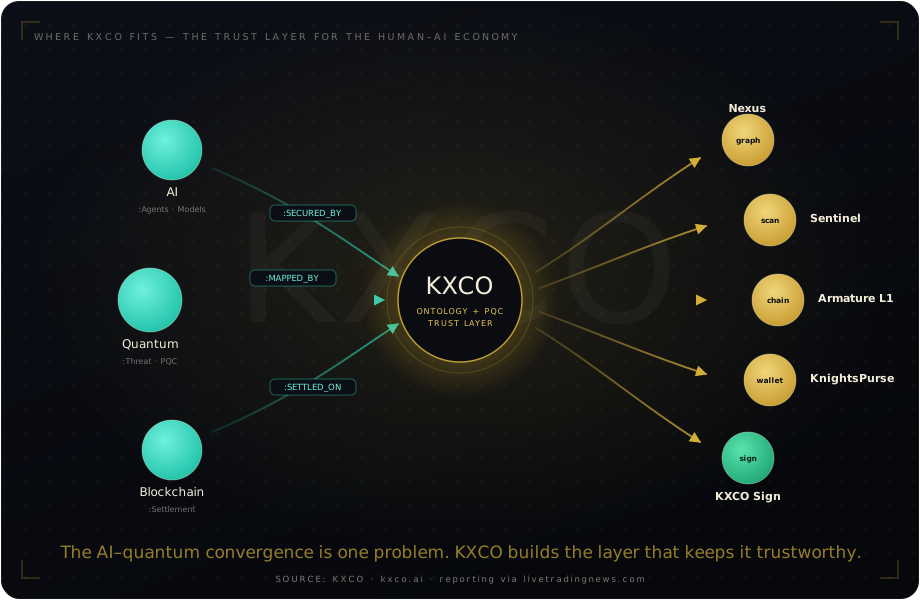
I have argued in these pages before that the AI–quantum convergence is one problem, not two, and it needs one environment. KXCO is that environment: a software company, headquartered across the UK and US, building the trust layer for an economy in which humans and AI agents transact side by side. We hold no customer assets and require no licences of our own — we build the infrastructure that licensed institutions run on. Everything below has been documented in detail on Live Trading News over the past year, and I will link the source pieces as I go.
We put the cryptography in the open. Most security vendors ask to be trusted. We did the opposite: KXCO has published thirteen post-quantum security packages open-source on npm, mirrored on GitHub and independently indexed by supply-chain scanners. Anyone can read, run and scrutinise the code that implements the named NIST standards — ML-DSA-65 for signatures and ML-KEM-768 for key exchange. A datasheet can claim anything; a public, inspectable, independently scanned codebase cannot be faked. That is what native post-quantum cryptography for the AI and blockchain era actually looks like in practice, rather than in a marketing deck.
We built a quantum-safe blockchain, not a whitepaper. KXCO's Armature L1 is a live chain whose identity and settlement rails are designed around post-quantum signatures from the start. It is the settlement layer beneath the rest of the stack, and — as I have written on how Armature L1 and the ontology work as enterprise infrastructure — it exists to let regulated institutions issue, tokenise and settle real-world assets on rails that will still be secure when a cryptographically relevant quantum computer arrives.
We built the ontology the AI economy is missing. This is the piece I care about most. An ontology is the missing layer in agentic AI: a structured, machine-readable map of who is who, what depends on what, and which claims are backed by evidence. Without it, autonomous agents transact into a fog. KXCO's public AI-sector ontology already maps 199 entities, 470 sourced claims and more than a trillion dollars of capital flows, every relationship traceable to a public filing. It is the same discipline finance, banking and regulation have always needed and never had — the reason I keep saying ontology is the operating system of the AI and quantum economy.
We made quantum-safe security something you can just use. The theory only matters if people deploy it. KXCO's Sentinel and PQC hosting turn post-quantum protection into a service a developer can switch on in minutes — I wrote about using it myself in free quantum-secure hosting is a thing now. On the document side, KXCO Sign brings the same post-quantum guarantees to signatures and confidential data rooms, the mundane-but-critical plumbing of real business.
We gave AI agents a way to transact. Recall the point from the first half: the coming wave of autonomous agents will each need an identity, permissions, an audit trail and a way to move value. KXCO's KnightsPurse is a self-custodial, multi-chain wallet built for exactly that — a rail on which both people and machines can hold and settle value, with post-quantum protection where it matters. Pair that with the Armature L1 settlement layer and the ontology's map of who-is-who, and you have the missing plumbing for an economy where a human and an AI agent can transact with each other and both be verifiable. This is the substance behind the framing I have used before: KXCO as the economic operating system for the human–AI economy.
We turned the ontology into a live product surface. Nexus is the trust-graph front end — the place where the relationships, dependencies and evidence in the ontology become something an analyst or an institution can actually query and act on. It is the difference between owning data and owning understanding. In a world where a trillion dollars a year flows through a handful of interdependent companies, knowing the shape of the graph — who depends on whom, where the single points of failure are — is not a nice-to-have. It is risk management. The ontology I described earlier is the engine; Nexus is the dashboard.
And we built for the deadline, because there is one. This is not a someday concern. As I set out in what the quantum deadline means and why KXCO was built for it, the migration to post-quantum cryptography is now a matter of federal policy and institutional timelines, not futurism. The organisations that wait until a quantum computer can break their keys will be too late — the "harvest now, decrypt later" attacks are already happening, with encrypted data being stored today to be broken tomorrow.
How I am thinking about positioning
None of this is investment advice — do your own work — but the map suggests where the value pools are, and the tables above are a starting point rather than a recommendation.
The first pool is the compute column, and it is the most crowded and the most proven. It runs from the fabrication gate ($TSM, and by extension the equipment that feeds it) through the accelerators ($NVDA, $AVGO, $AMD) to the hyperscalers writing the $725 billion of cheques ($MSFT, $GOOGL, $AMZN, $META). The risk here is not demand; it is valuation and concentration. When one company sits at a chokepoint the whole industry depends on, its pricing power is the shareholder's friend — but crowded trades punish any wobble in the capex narrative. Scale in on weakness; do not chase strength.
The second pool is power and the physical build-out — the utilities, grid operators and energy projects being dragged into the AI story. This is the least glamorous and, over a decade, possibly the most durable. You cannot run a trillion dollars of data centres on a grid built for the twentieth century.
The third pool is quantum, and it is the most speculative. The physics is now proven; the economics are not. The pure-plays ($IONQ, $RGTI, $QBTS) offer asymmetric upside and real risk of dilution and disappointment, while the diversified giants ($IBM, $GOOGL, $NVDA) let you own the theme with a floor under it. Size these positions like the venture bets they are.
The fourth pool is the one most portfolios ignore entirely: the trust layer. Every dollar that flows into the first three pools increases the value of verifiable cryptography, quantum-safe settlement and machine-readable trust. It is the least understood and, I would argue, the most mispriced. It is also the pool KXCO was built to occupy — which brings me to the honest disclosure that I am not a neutral observer here. I founded the company because I believe this layer is inevitable, not the other way around.
And China sits across all four pools as both competitor and catalyst. $BABA and the broader Chinese complex are not accessible or appropriate for every investor, and carry political risk that has nothing to do with the technology. But ignoring China's trajectory does not make it go away; it just means being surprised by it.
What it all adds up to
Put the two halves of this article together. In the first, we have an AI and quantum landscape inflecting simultaneously, a trillion dollars a year flowing into compute, genuine fault-tolerant quantum milestones, and a China that export controls have made more self-reliant, not less. In the second, we have a category of risk — trust, coordination, and cryptographic fragility — growing in exact proportion to the opportunity.
The investable insight is not just "own the chipmakers," though the cashtags in the tables above are where the compute build-out lands first. It is that every wave of this build-out increases demand for the boring, essential layer that keeps it trustworthy: verifiable cryptography, a settlement chain that survives the quantum transition, and an ontology that lets humans and machines agree on what is true. Picks and shovels for the AI gold rush are not only the GPUs. They are the trust infrastructure underneath them.
Look at the next twelve months and the pattern will only sharpen. Expect another wave of frontier models on the now-familiar weeks-not-years cadence, the first serious enterprise agent deployments moving from pilot to production, hyperscaler capex guidance climbing again rather than falling, and at least one more quantum error-correction milestone that moves the fault-tolerant timeline forward. Expect China to answer each US release within weeks, and expect the conversation about cryptographic standards — whose post-quantum algorithms, whose settlement rails, whose definition of a trusted machine identity — to move from security conferences into boardrooms and regulators. Each of those developments is bullish for compute, and each one quietly raises the value of the trust layer underneath it.
That is the bet KXCO is making, and — as the news of the last few weeks keeps confirming — the timing is not early. It is exactly right. You can explore the live map of this whole landscape yourself at kxco.ai, and trace every dependency in the KXCO ontology.
Shayne Heffernan is the founder of KXCO. This article is market and technology commentary and reflects the author's opinion. It is not investment advice; do your own research and consider your own circumstances before making any investment decision. Company and product developments referenced above are documented in prior coverage on Live Trading News.
The 2030 Compute Landscape: GPUs, Power and the Architecture of Intelligence
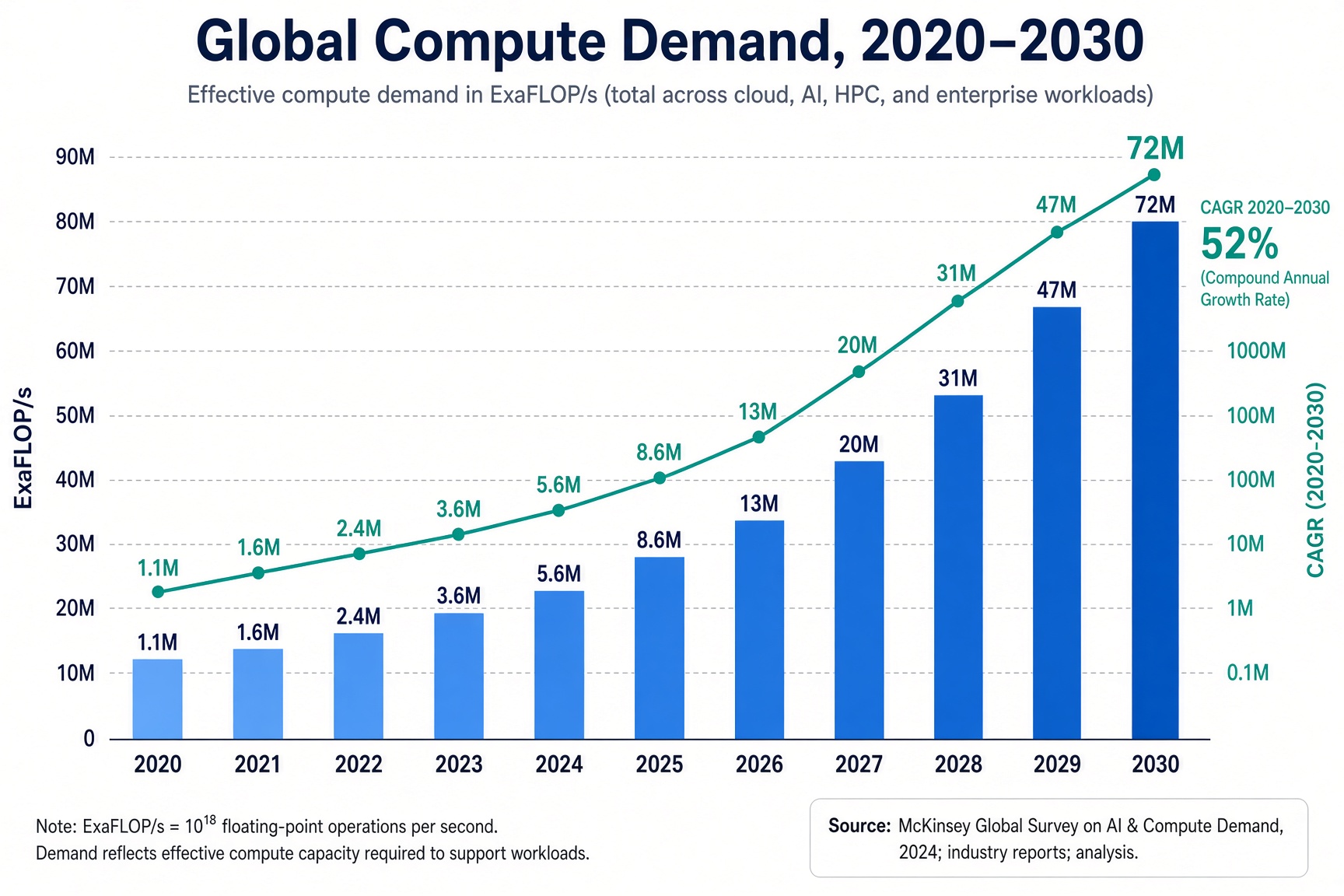
The constraint on AI is no longer ideas or data but compute and the power to run it. Frontier training compute has grown about five times a year since 2020, and the leading AI supercomputer of June 2030 is on course for about 2 million chips and 9 gigawatts. Shayne Heffernan sets out the 2030 arithmetic, the power problem, who has already contracted the gigawatts, and how GPUs, custom ASICs, wafer-scale engines and quantum machines divide the work.
How Can You Trust AI When You Cannot Trust Humans?
Can you trust AI? Can you trust humans? More often than we like to admit, the answer is no. AI inherits its failures from the human records it is trained on. Sheikh Mohammed bin Rashid wrote this month that the currency the UAE is betting on is trust. This piece sets out what a trust layer has to do, shows the method on three public knowledge graphs, and lays out the post-quantum work KXCO has published so that an institution can check the claim rather than take it.
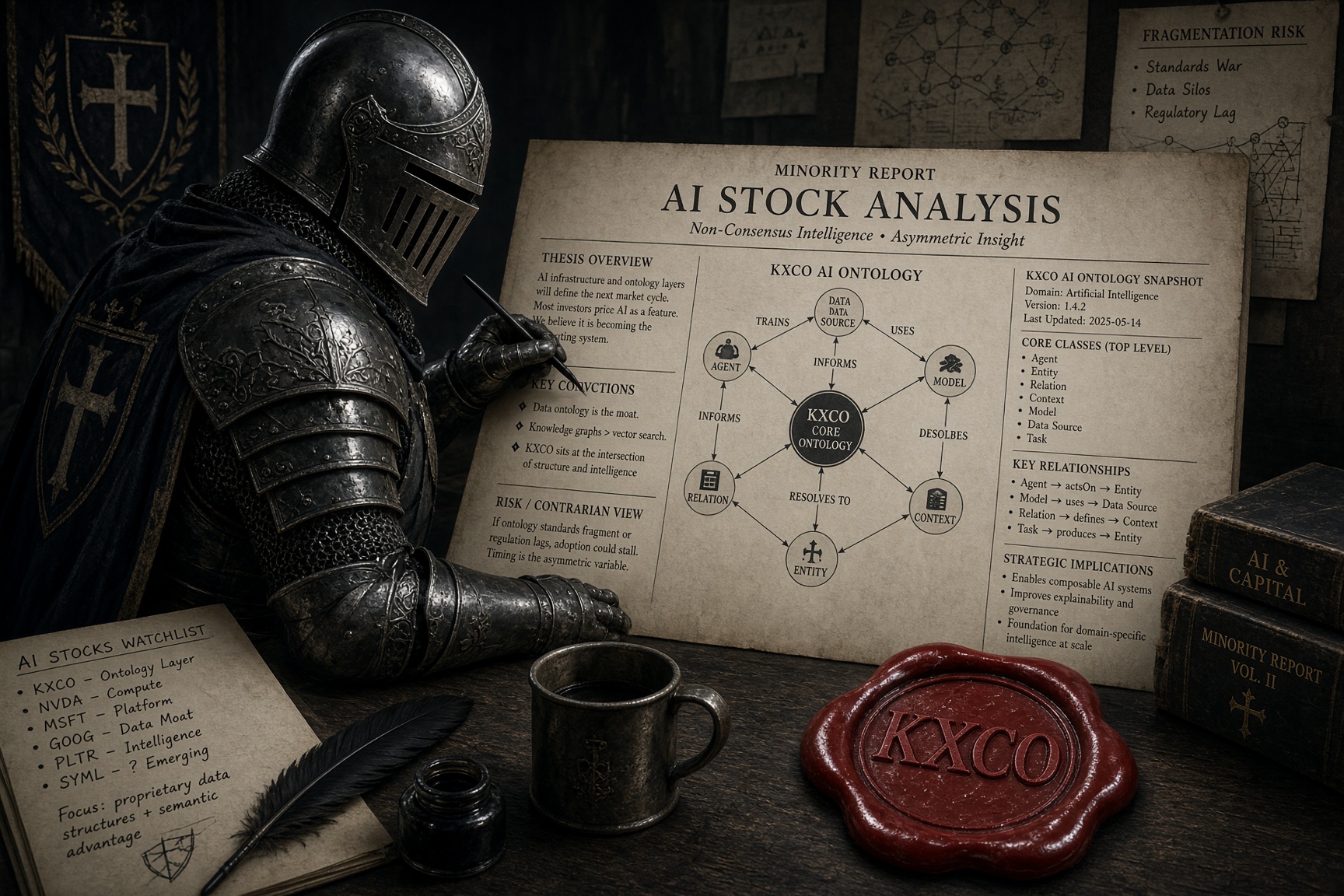
KXCO AI Ontology at 3 Months: What It Called and What Comes Next
On 19 July 2026 the Round Table's AI room published its first Analyst Outlook. To the 16 October 2026 close its 13 names rose 2.6% on an equal weight against 2.1% for QQQ, per StockAnalysis closes, and the six it opened with 35% or more of upside rose 8.6%. This piece lists the six names up more than 5%, the ten names I rate as opportunities now, the month's results in AI and quantum computing, and the official data showing that four in five firms have not yet started using AI.

SpaceX: The Road to 10 Gigawatts
SpaceX did not add an AI business. A company whose processes run on compute built its own computing plant, then built the power to run it. The 10-Q reports 1.4 gigawatts of nameplate compute at 30 June 2026, four leases worth about $41 billion a year and $100 billion of cash. The target is closer to 10 gigawatts than 5 by the end of 2027. This piece sets out the build sequence, the four layers of power in Memphis, and why Terafab is the act after 2027, not the road to it.
Every story, signed and delivered.
Subscribe to the kxco channel and get the headline, the AI-written key takeaways, and the chain-anchor link the moment we publish. Audio versions and per-ticker subscriptions arrive in the next iteration.