
KXCO: Native Post-Quantum Cryptography for the AI and Blockchain Era
How KXCO builds NIST-standardised post-quantum cryptography natively into hosting, document signing and identity — including verifiable identity for AI agents.
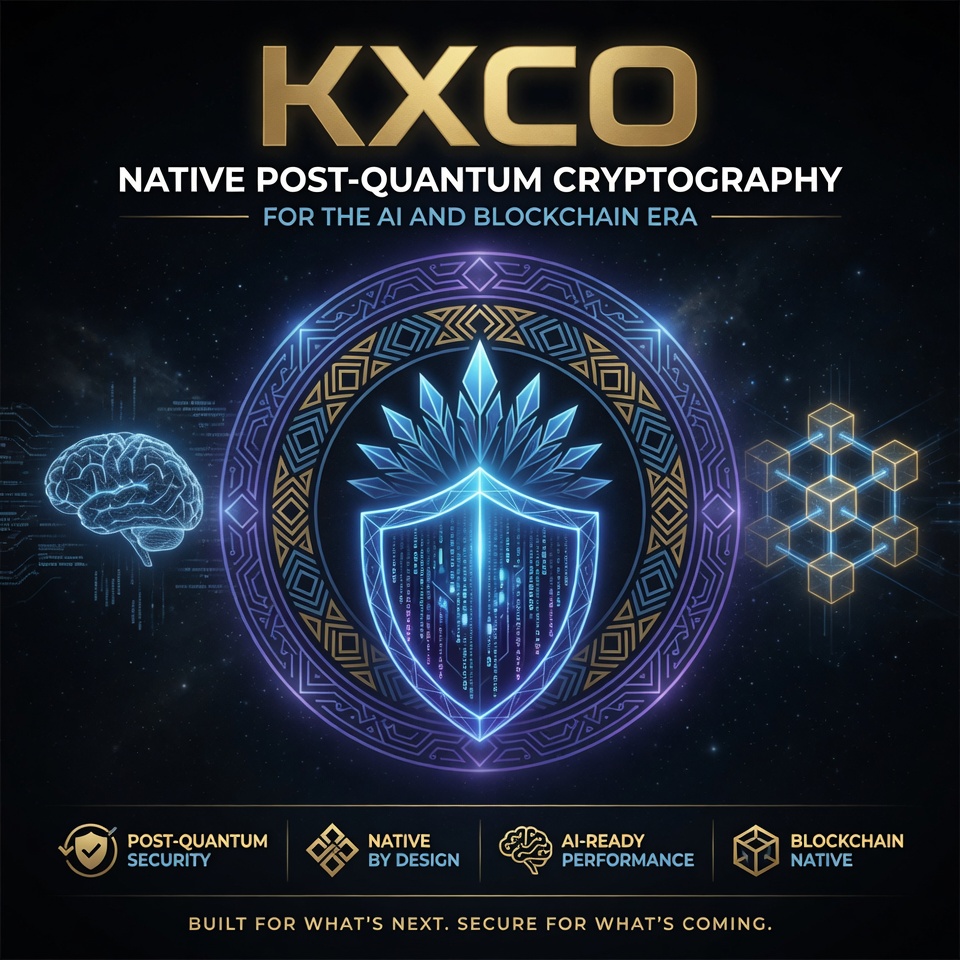
The quantum threat to today's cryptography has moved from research papers into law and procurement rules. In August 2024, the U.S. National Institute of Standards and Technology finalised its first post-quantum standards, including FIPS 204, the Module-Lattice-Based Digital Signature Standard (ML-DSA, formerly CRYSTALS-Dilithium), published alongside FIPS 203 and FIPS 205 in the Federal Register. NIST now advises organisations to move off RSA and elliptic-curve cryptography by 2030, and U.S. federal systems are directed to complete the transition to quantum-resistant cryptography by 2035 under National Security Memorandum 10 and the CISA post-quantum initiative. The Quantum Computing Cybersecurity Preparedness Act, signed in December 2022, already requires federal agencies to inventory vulnerable systems and plan their migration.
Most organisations are approaching this as a retrofit — bolting post-quantum cryptography (PQC) onto systems that were never designed for it. KXCO has taken a different path. It has built post-quantum cryptography natively into its infrastructure platform from the ground up, combining it with on-chain settlement on KXCO Chain (Armature L1) and identity for AI agents.
A unified post-quantum foundation
KXCO operates as a blockchain, AI and quantum infrastructure platform. Every signature, attestation and identity operation uses ML-DSA-65 — the NIST FIPS 204 parameter set at security category 3 — and key exchange and encryption use ML-KEM-768 (NIST FIPS 203). This is not an optional add-on or a hybrid afterthought; it is the default cryptographic primitive across the platform.
Those primitives are not home-grown. KXCO's cryptography is built on the open-source `@noble/post-quantum` library, which was independently audited by Cure53 in 2024, and is published for public inspection as the `kxco-post-quantum` package on npm (with the wider `kxco-pq` family covering identity, attestation, encryption, HSM-backed key management and tamper-evident audit logging).
This native approach delivers three core advantages:
Long-term cryptographic validity — documents and signatures are designed to remain verifiable and unforgeable against future quantum attacks, which matters most for records that must hold evidentiary value for decades.
Independent verifiability — counterparties can verify proofs themselves, using open-source tooling, without having to trust or even contact KXCO.
AI-agent readiness — the same infrastructure issues verifiable identity and signed actions for autonomous software agents, not just people and institutions.
This is not a roadmap claim. The platform's post-quantum stack is documented and running today, and its credentials are independently checkable at verify.kxco.ai.
PQC Host + Bastion: verifiable, quantum-safe deployments
One of KXCO's most practical strengths is its PQC Host service combined with Bastion, both available at pqc.kxco.ai.
Traditional hosting platforms offer no cryptographic proof of what was actually deployed. KXCO changes that:
Developers connect a GitHub repository (static sites or Node.js applications).
Before deployment, Bastion scans the code and configuration for quantum-vulnerable cryptography — RSA, elliptic-curve keys, weak or expiring TLS certificates, and vulnerable dependencies.
Critical findings can block the deployment; lower-severity issues are reported with clear remediation guidance.
On a successful deploy, KXCO issues an ML-DSA-65 attestation recording the commit, a timestamp, the Bastion scan result and the live URL.
That attestation is a self-contained, signed envelope that anyone can verify independently using the open-source `kxco-verify` library — no need to trust the platform.
Bastion also runs as a standalone, no-setup quantum-vulnerability scanner. It inspects live URLs and TLS, package.json, Python, Go, Ruby, Rust, Java/Maven, .NET and PHP dependency manifests, plus Dockerfiles, Terraform, Kubernetes manifests, web-server and SSH configuration, and source code. It produces ML-DSA-65-signed reports and exports a CycloneDX 1.6 Cryptography Bill of Materials (CBOM) — the emerging standard for cryptographic inventory — making its output suitable for compliance and audit workflows, including the cryptographic inventories that the U.S. preparedness act now requires.
This combination — pre-deployment quantum scanning plus a cryptographically signed, independently verifiable deployment record — gives teams something rare: provable evidence that their web and AI infrastructure was deployed in a quantum-safe manner.
KXCO Sign: long-term document integrity
KXCO Sign lets organisations sign contracts, agreements and other important documents using ML-DSA-65 signatures, with verification anchored on KXCO Chain (Armature L1).
Unlike classical RSA or ECC signatures — which NIST and the NSA now expect to be retired well before 2035 — ML-DSA-65 signatures are designed to stay secure against quantum attack. That is particularly valuable for:
long-term legal agreements,
financial and compliance documentation, and
records that must retain evidentiary value far into the future.
Because each signature is anchored on-chain, verification can be performed independently by any party, without relying on KXCO's continued availability.
KXCO Verified: identity for people, institutions and AI agents
KXCO's most forward-looking capability is KXCO Verified, which provides post-quantum cryptographic identity not only for people and organisations but also for autonomous AI agents.
Using ML-DSA-65 key pairs registered on KXCO Chain through the on-chain KXCO Verified registry, any entity — a human, an institution, or an AI agent — can hold an identity that others verify directly on-chain. This creates a single trust layer that spans human and machine actors.
For organisations building AI agents — especially in financial services, compliance and enterprise automation — this matters. It lets an agent:
prove its identity to other systems or agents,
bind its actions and outputs to a verifiable identity, and
operate with a level of auditability and non-repudiation that is difficult to achieve with classical cryptography.
Why this matters for enterprise AI
As enterprises move from experimentation to production deployment of AI agents and Model Context Protocol (MCP) integrations, security and governance requirements tighten sharply. The recurring concerns are:
the long-term integrity of agent outputs and decisions,
auditability and compliance evidence,
protection against future cryptographic attacks, and
a verifiable record of what infrastructure was deployed, and when.
KXCO's PQC infrastructure speaks directly to these needs. By layering ML-DSA-65 signing, deployment attestations and verifiable agent identity on top of AI systems, organisations can reach a higher standard of security and trust than classical cryptography allows — and demonstrate cryptographic due diligence to auditors, partners and regulators.
The strategic advantage
KXCO's real strength is integration. Rather than a box of isolated PQC tools, it offers a coherent platform where:
infrastructure can be attested as quantum-safe,
documents and outputs can be signed with future-proof signatures,
AI agents can operate with verifiable identities and signed actions, and
identity and document proofs are anchored on a post-quantum blockchain for independent verification.
In a period where AI capability is advancing quickly and quantum migration has become a regulatory deadline rather than a thought experiment, this combination of native post-quantum cryptography, on-chain verifiability and AI-agent support positions KXCO as infrastructure built for the next era rather than the last one.
Organisations serious about long-term security, regulatory readiness and trustworthy autonomous systems now have a practical way to move beyond classical cryptography without sacrificing usability or verifiability.
KXCO by Knightsbridge is a software company; it builds quantum-safe infrastructure that licensed institutions and enterprises run themselves. To discuss a deployment, contact KXCO.

NIST Graded Our Post-Quantum Cryptography. Zero Failures.
NIST's Algorithm Validation Test System generated test vectors nobody had seen, we answered them over the ACVP protocol, and NIST graded the result: 2,130 cases across ML-KEM, ML-DSA and SLH-DSA in every parameter set offered, zero failures, demo certificate A11025. This is what that proves, where we deliberately drew the claim narrower than NIST's own matrix, and why the FIPS 140-2 sunset on 21 September makes the distinction between being graded and grading yourself worth understanding.

What KXCO Is, and Why the Hard Problem Was Never Intelligence
The prevailing enthusiasm assumes the hard problem is intelligence. It is not. It is that banks, hospitals, courts and governments are being asked to let software act on their behalf with no way to establish who decided, on what basis, or whether the record will still read in a decade. KXCO founder Shayne Heffernan sets out the architecture that answers those questions, drawn as a graph, and argues that properly constructed AI is an amplifier of human judgement rather than a replacement for it.
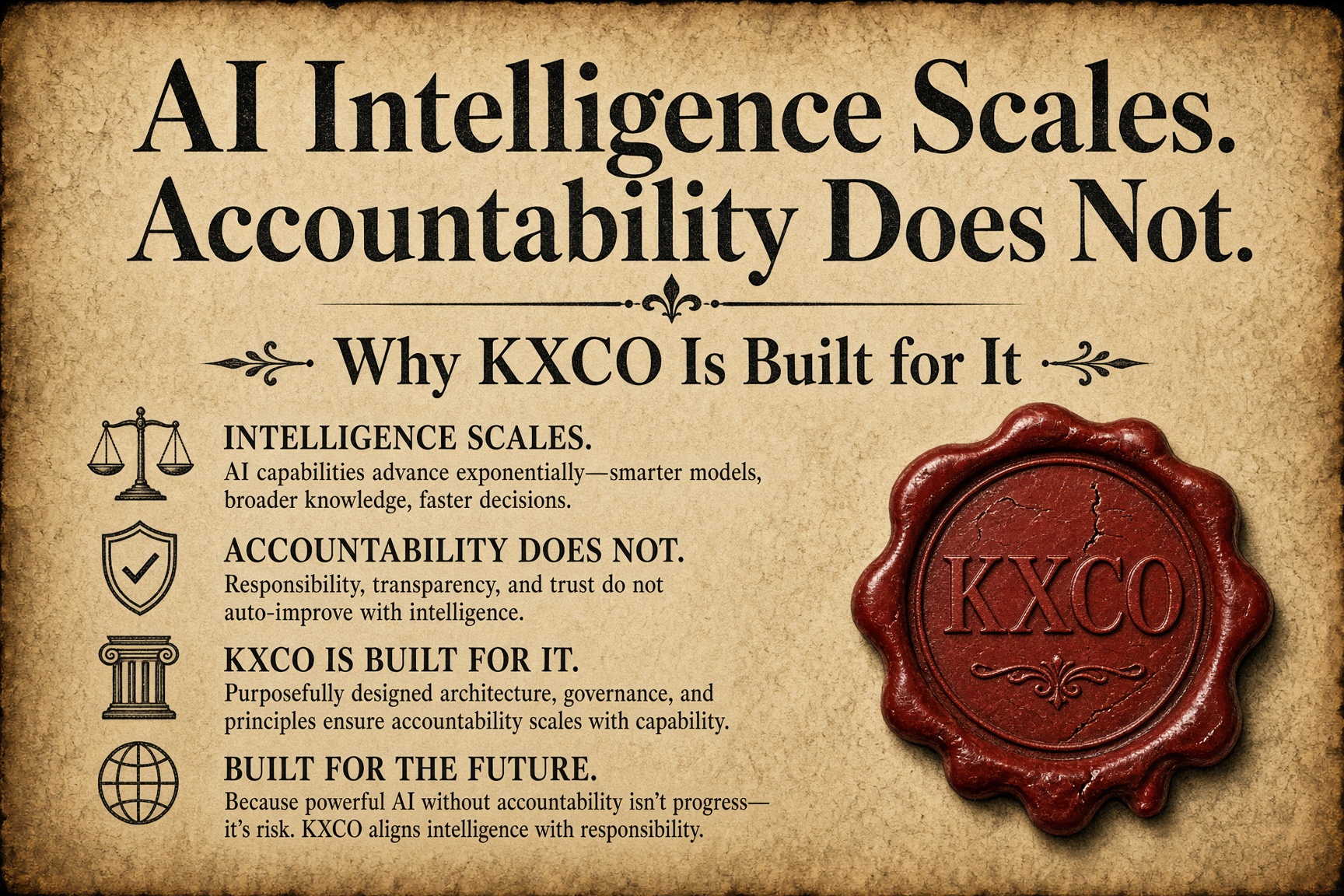
AI Intelligence Scales. Accountability Does Not. Why KXCO Is Built for It.
Capability is becoming abundant and everything abundant gets cheap. What does not get cheap is the person who has to sign, and they can only carry what they can see. Four conditions follow from that, and four independent authorities reached the first of them last month without knowing it.
KXCO Quantum Toolkit: The Cryptography You Did Not Choose Is Already in Your Software
Almost no company can say what cryptography actually runs inside its own software, and auditors have started asking. KXCO publishes five free packages that find it, replace it with the NIST post-quantum standards, and fail the build when someone gets it wrong.
Every story, signed and delivered.
Subscribe to the kxco channel and get the headline, the AI-written key takeaways, and the chain-anchor link the moment we publish. Audio versions and per-ticker subscriptions arrive in the next iteration.