
Understanding the US China AI and Quantum Landscape
Not a scoreboard but a field guide: two very different systems building AI and quantum by different roads, bound together by a supply chain neither controls. Shayne Heffernan maps the landscape against the KXCO AI Sector Ontology.
Part of theQuantum Computing Center
Artificial intelligence and quantum computing are usually reported as a two-horse race, a scoreboard on which the United States and China trade the lead each quarter. That framing is easy to write and mostly wrong. What is actually taking shape is something more interesting and more useful to understand: two very different systems, built on different assumptions about capital, openness and the role of the state, arriving at overlapping capabilities by very different roads — and increasingly dependent on one another through a shared supply chain neither fully controls. This is a field guide to that landscape, not a running tally of who is winning.
To keep the picture honest, this analysis is mapped against the KXCO AI Sector Ontology — a live, independently verifiable graph of the AI sector's companies, models, capital flows and dependencies. The ontology is useful precisely because it resists the scoreboard instinct: it shows a sector that resolves to a handful of chokepoints and a web of mutual reliance, rather than two self-contained national champions.
Two roads to AI leadership
On the American side, the story is one of frontier capability and private capital. OpenAI's GPT-5, reportedly codenamed Orion, is expected to consolidate the company's o-series reasoning models and the GPT family into a single architecture. The wider shift is from chatbots to agents: systems that carry out multi-step work with limited supervision. Adoption has broadened fast — McKinsey's 2025 State of AI survey found 88% of respondents now use AI in at least one business function, up from 72% a year earlier. The capital is extraordinary: US private AI investment reached $285.9 billion in 2025, and Meta alone committed $14 billion to Scale AI, a bet that high-quality training data — not raw compute — is now the binding constraint.
China's road runs the other way: toward efficiency, openness and scale. DeepSeek's V3, released in late 2024, showed frontier-level performance at a fraction of Western training cost, and its MIT-licensed R1 matched leading reasoning models while using far less inference compute. The latest V3.2 continues that efficiency push. Making capable models fully open has proven a potent strategic choice — it seeds a global developer ecosystem that is increasingly independent of US-origin stacks. Domestically, China's generative-AI user base is estimated near 570 million, and the State Council's 2025 "AI Plus" directive pushes adoption across manufacturing, healthcare, agriculture and public administration, backed by an $8.2 billion national fund and provincial matching.
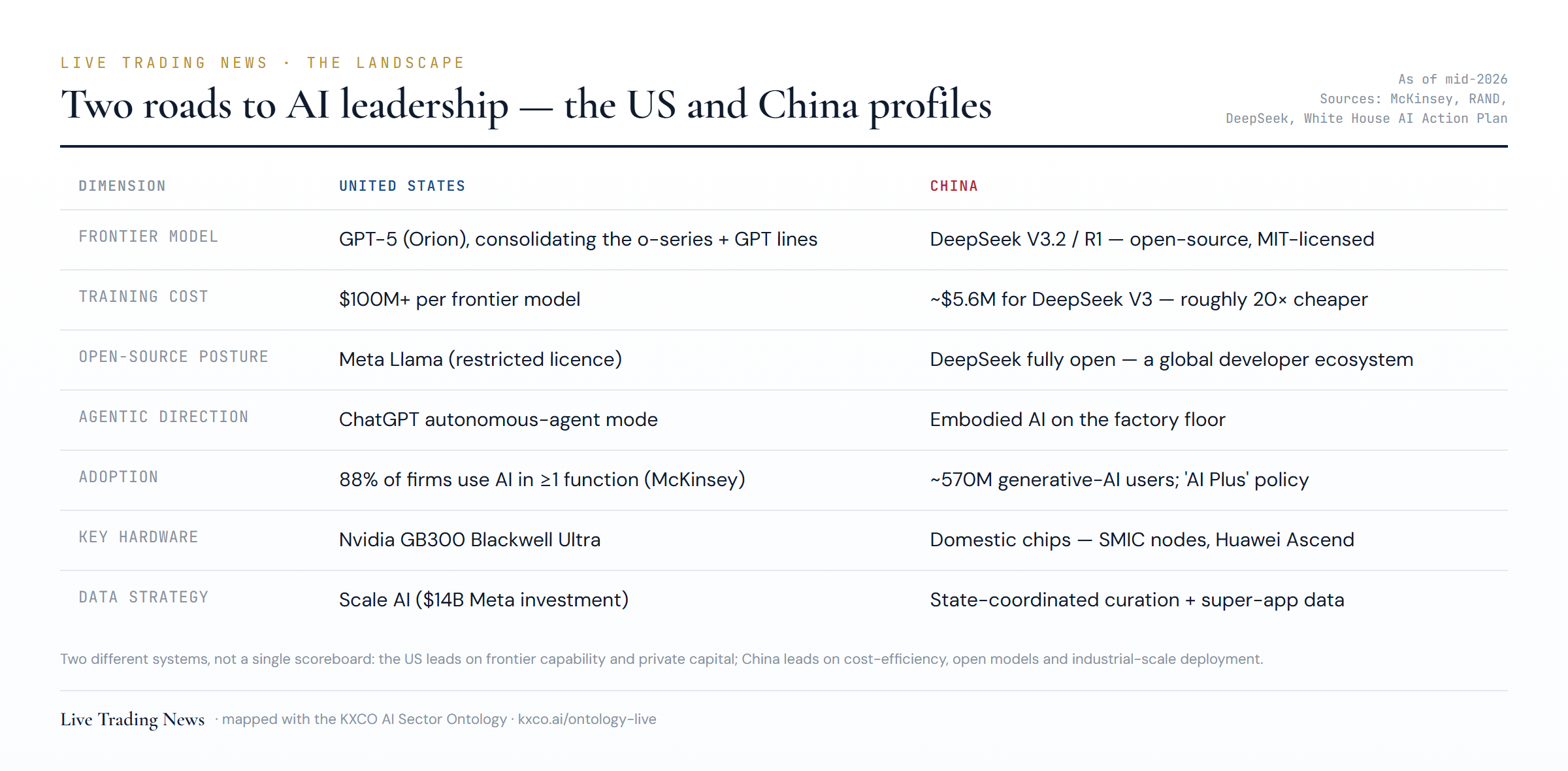
The point is not that one road is better. The US leads on frontier capability and the depth of its capital markets; China leads on cost-efficiency, open models and the ability to deploy at industrial scale. Each approach has a different failure mode and a different strength, and the ontology's mapping of the sector shows the two are more entangled than the race framing admits.
Two roads through quantum, too
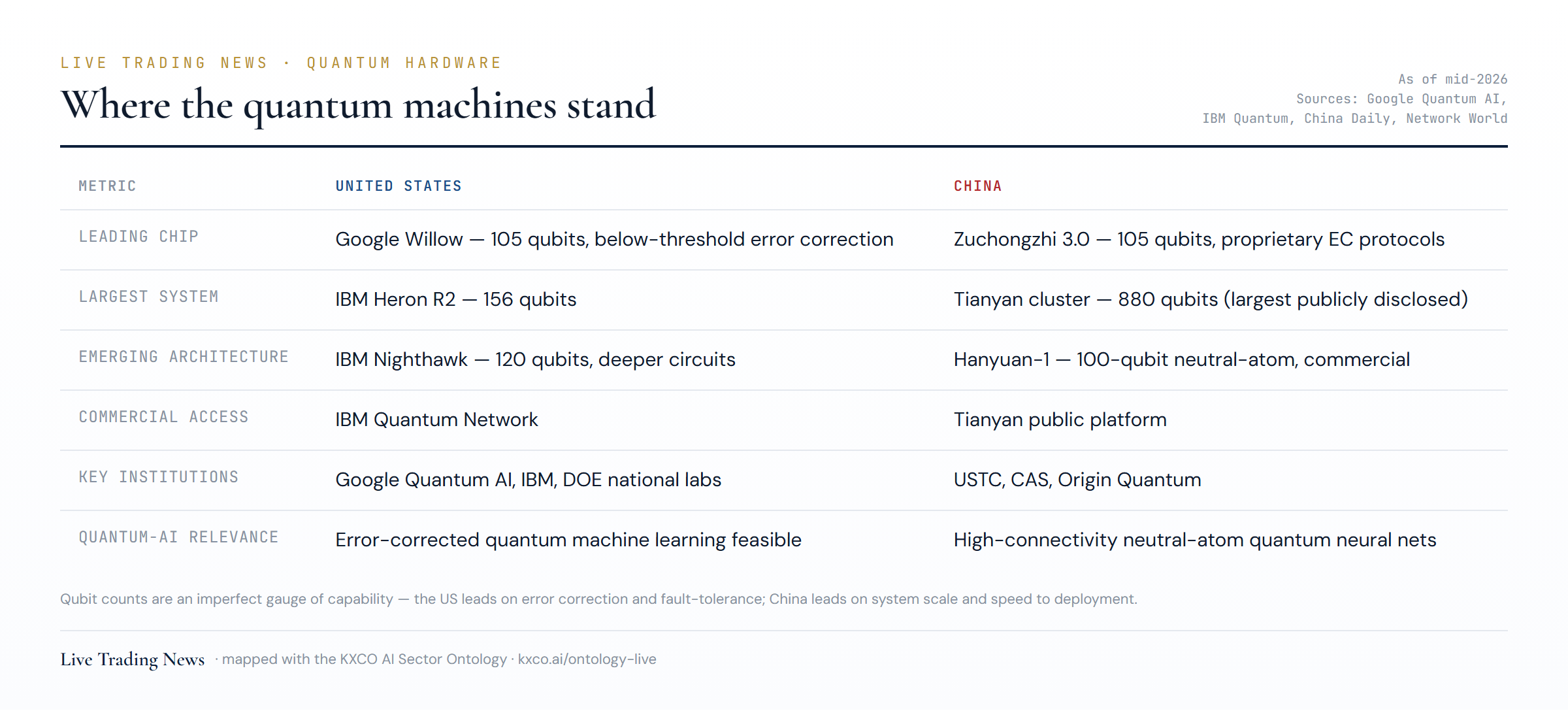
The same pattern repeats in quantum hardware. In the US, Google's Willow processor — 105 superconducting qubits — demonstrated below-threshold error correction, the property where adding qubits lowers the overall error rate, long considered the gateway to useful machines. IBM has pushed its roadmap with the 156-qubit Heron R2 and announced Nighthawk, a 120-qubit chip built for deeper circuits, while the Department of Energy's national labs anchor the fundamental research.
China has pursued a deliberately multi-architecture strategy. Zuchongzhi 3.0 matches Willow's 105 qubits with different error-correction protocols; the Hanyuan-1 neutral-atom system became China's first commercially deployed quantum computer in late 2025; and the Tianyan platform has been reported hosting an 880-qubit superconducting cluster, the largest publicly disclosed system by qubit count. Raw qubit numbers are a crude measure — but the contrast is telling. The US holds an edge in error correction and fault-tolerance theory; China leads on system scale and speed from lab to deployment.
Following the capital
Money reveals the structural difference most clearly. The US model is private-capital-led and IP-protected: venture and growth equity, federal grants through the reauthorised National Quantum Initiative, and the concentration of frontier labs on American soil. China's is state-coordinated: a $55 billion 2025 R&D allocation prioritising semiconductors, AI and quantum, layered with national and provincial funds — a capital-deployment mechanism no Western government has replicated. Public investment in quantum technology alone reached roughly $10 billion in early 2025, with the two countries accounting for most of it.
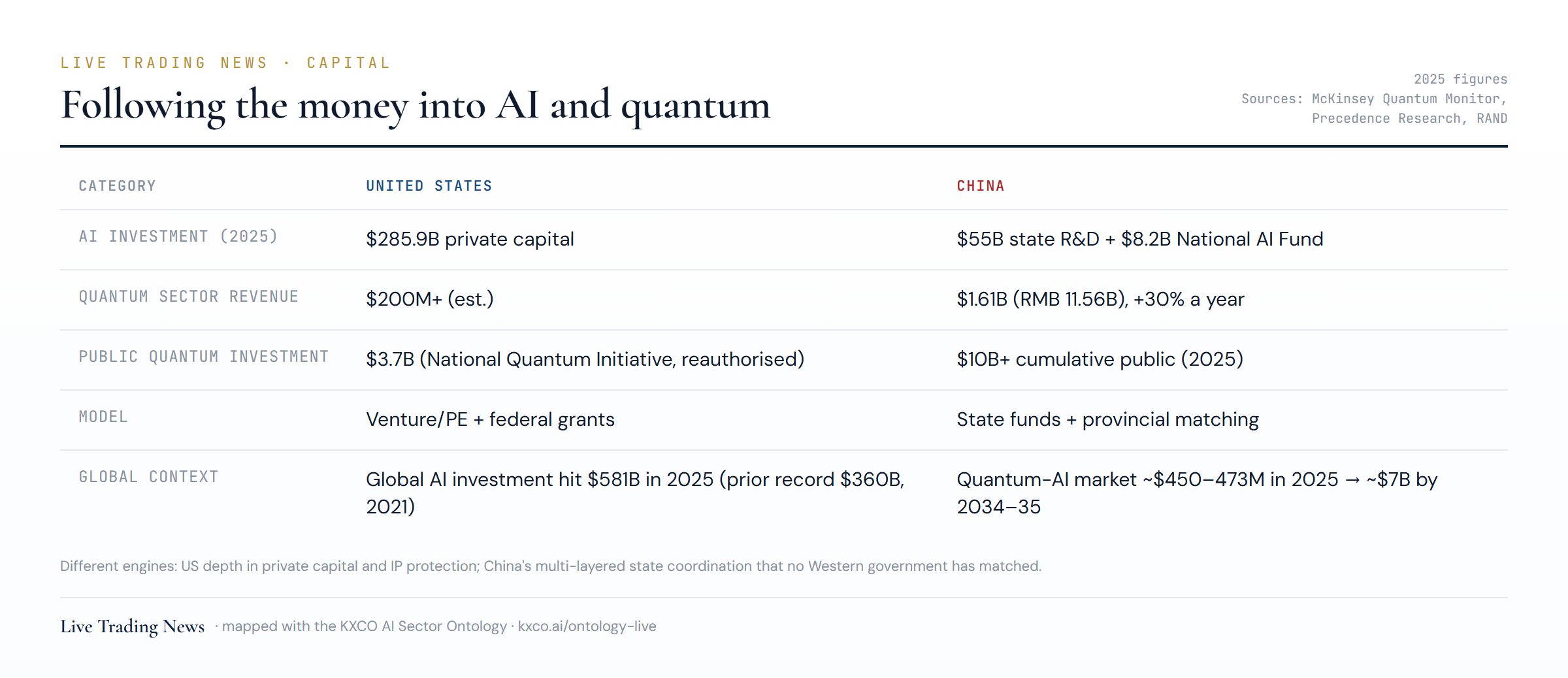
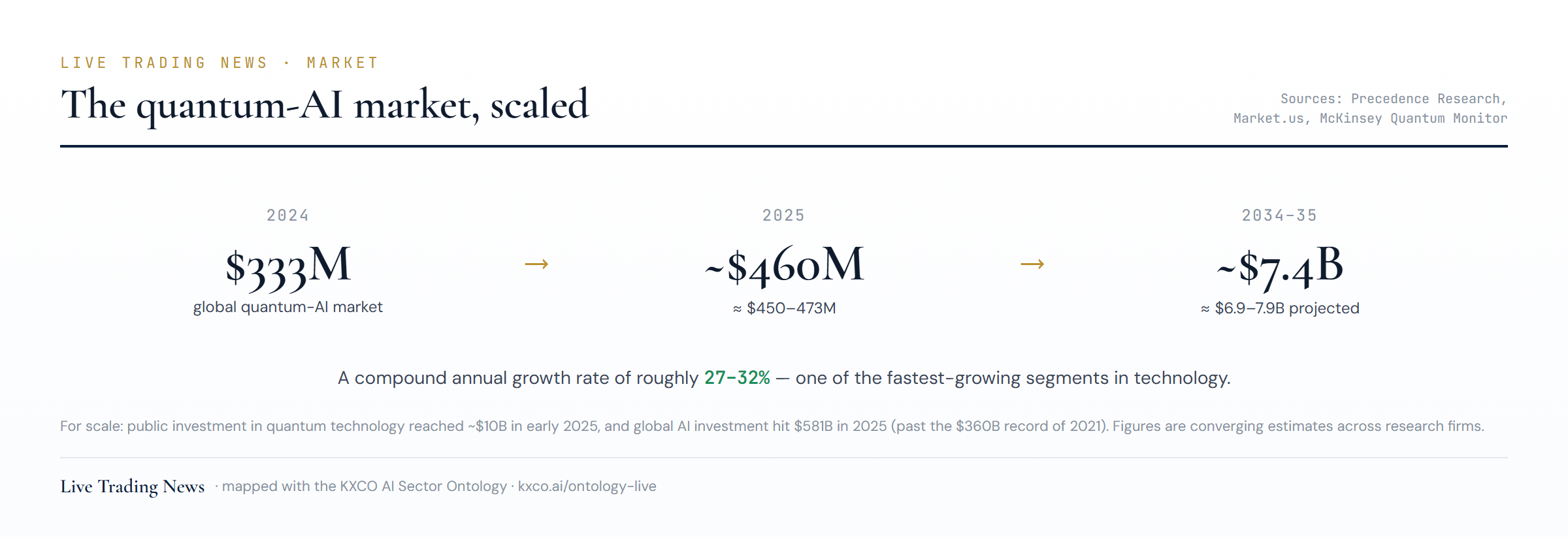
Zooming out, the sector these flows are building is still young in revenue terms even as the ambition is vast. The global quantum-AI market was around $333 million in 2024 and $450–473 million in 2025, with converging projections toward roughly $7 billion by 2034–35 — a ~27–32% compound growth rate that outpaces almost any other technology segment. Set against $581 billion of total global AI investment in 2025, quantum-AI is a small, fast-moving frontier riding on top of a much larger AI build-out.
The seam that binds them: semiconductors
Nowhere is the interdependence clearer than in chips, and this is where "landscape" beats "war" as a description. Since 2018 the US has expanded controls on China's access to advanced semiconductors and the tools to make them, most recently restricting Nvidia's top AI training chips. But the effect has been double-edged: US firms lost their largest growth market, China accelerated domestic alternatives at SMIC and Huawei, and — as a Brookings analysis captured via a New York Times headline — a degraded China-specific chip satisfied no one ("Trump Approved a Nvidia Chip for Sale in China. Beijing Doesn't Want It."). In June 2025 Beijing moved from rhetoric to formal trade measures targeting US technology firms, shifting the relationship from one-sided restriction to a two-way sanctions environment.
The KXCO ontology is blunt about the underlying dependency: Nvidia is the single most critical node, "through which every major lab, cloud and sovereign programme routes," and a shock to it "stalls the entire stack." ASML and TSMC form the other chokepoint — a single Dutch lithography supplier feeding a single Taiwanese foundry for the most advanced chips. Export controls do not remove that dependency so much as pressure both sides to route around it: China toward indigenous chips and alternative computing paradigms, the US toward domestic fabrication. Understanding the landscape means seeing the chip layer as a shared vulnerability, not simply a weapon.
Talent, deployment and defence, briefly
Three further dimensions round out the picture. On talent, the US still attracts the world's top researchers and has the deeper bench bridging AI and quantum; China produces more STEM PhDs and directs them centrally, and now approaches parity in several quantum subfields, leading in quantum communications and satellite-based key distribution. On commercial deployment, US adoption clusters in knowledge-work automation and finance (IBM's Quantum Network counts JPMorgan and ExxonMobil among members), while China's concentrates in manufacturing, where embodied AI on factory floors generates the data that improves the models — a self-reinforcing loop. On defence, both treat AI and quantum as critical, and both are racing to deploy post-quantum-resistant encryption ahead of the day a quantum machine can break today's public-key cryptography — a shared deadline that, again, binds rather than separates them.
What an investor can actually hold
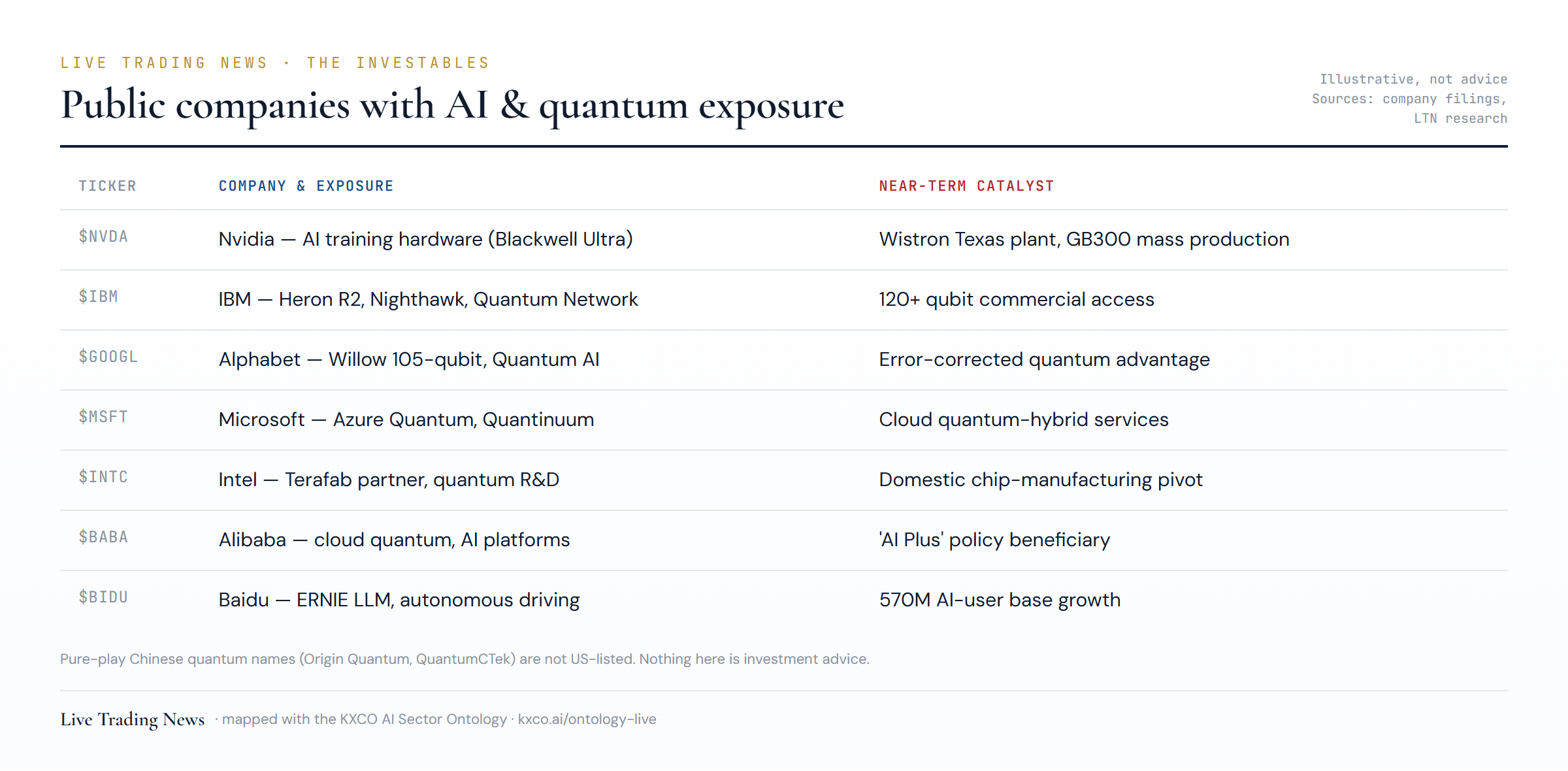
For readers who want exposure rather than abstraction, the sector maps onto a familiar set of listed names — most of them US-traded and directly investable. Nvidia is the AI-hardware backbone; IBM and Alphabet offer the most direct quantum exposure; Microsoft builds through Azure Quantum and Quantinuum; Intel is the higher-risk manufacturing play. On the China side, Alibaba and Baidu are the most accessible Western-listed proxies; the pure-play Chinese quantum firms remain private.
How to read what comes next
The most useful way to hold this landscape is not as a leaderboard but as two systems whose next moves are worth watching independently. On capability, the launch of GPT-5 and the commercial arrival of IBM's Nighthawk will reset the benchmarks. On policy, China's 15th Five-Year Plan implementation and the evolving export-control regime will shape how far the two stacks diverge. And the deeper question sits underneath all of it: whether AI and quantum settle into one interoperable global ecosystem or split into two parallel, incompatible ones. The June 2025 shift to bilateral sanctions raised the odds of the second outcome, which is why the shared chokepoints — Nvidia, ASML, TSMC — matter so much. They are the threads that, for now, still stitch the two systems together.
The honest summary is the one the scoreboard framing misses: the United States holds a narrow lead in AI and quantum software, China a narrow lead in hardware scale and deployment speed, and both depend on a supply chain neither controls alone. Quantum-AI has crossed from research curiosity into an investable, strategically central domain — and understanding it means holding both systems, and their entanglement, in view at once.
Sources and References
White House, "America's AI Action Plan," July 2025. Link
McKinsey & Company, "The State of AI: Global Survey 2025." Link
McKinsey & Company, "The Year of Quantum: From Concept to Reality in 2025" (Quantum Technology Monitor). Link
Google Quantum AI, "Meet Willow, Our State-of-the-Art Quantum Chip," December 2024. Link
IBM, "IBM Delivers New Quantum Processors, Software, and Roadmap Updates." Link
China Daily, "China Opens Its Superconducting Quantum Computer for Public Use," October 2025. Link
RAND Corporation, "Full Stack: China's Evolving Industrial Policy for AI," 2025. Link
Brookings Institution, "Ball Game's Over: The US Is Out of the AI Chip Market in China." Link
Precedence Research, "Quantum AI Market Size, Share and Trends 2025 to 2034." Link
Market.us, "Quantum AI Market Size to Surpass USD 7.93 Billion by 2035." Link
Quantumrun, "AI Investment by Country Statistics 2026." Link
DeepSeek, "API Documentation and Change Log." Link
Wikipedia, "DeepSeek." Link
Kharon, "China's New Sanctions Arsenal Is Challenging the U.S.," 2026. Link
Semrush, "9 Biggest SEO Trends of 2025." Link
KXCO, "KXCO AI Sector Ontology." Live interactive map: kxco.ai/ontology-live
United States vs China: AI Models, Compute, Quantum and Electricity
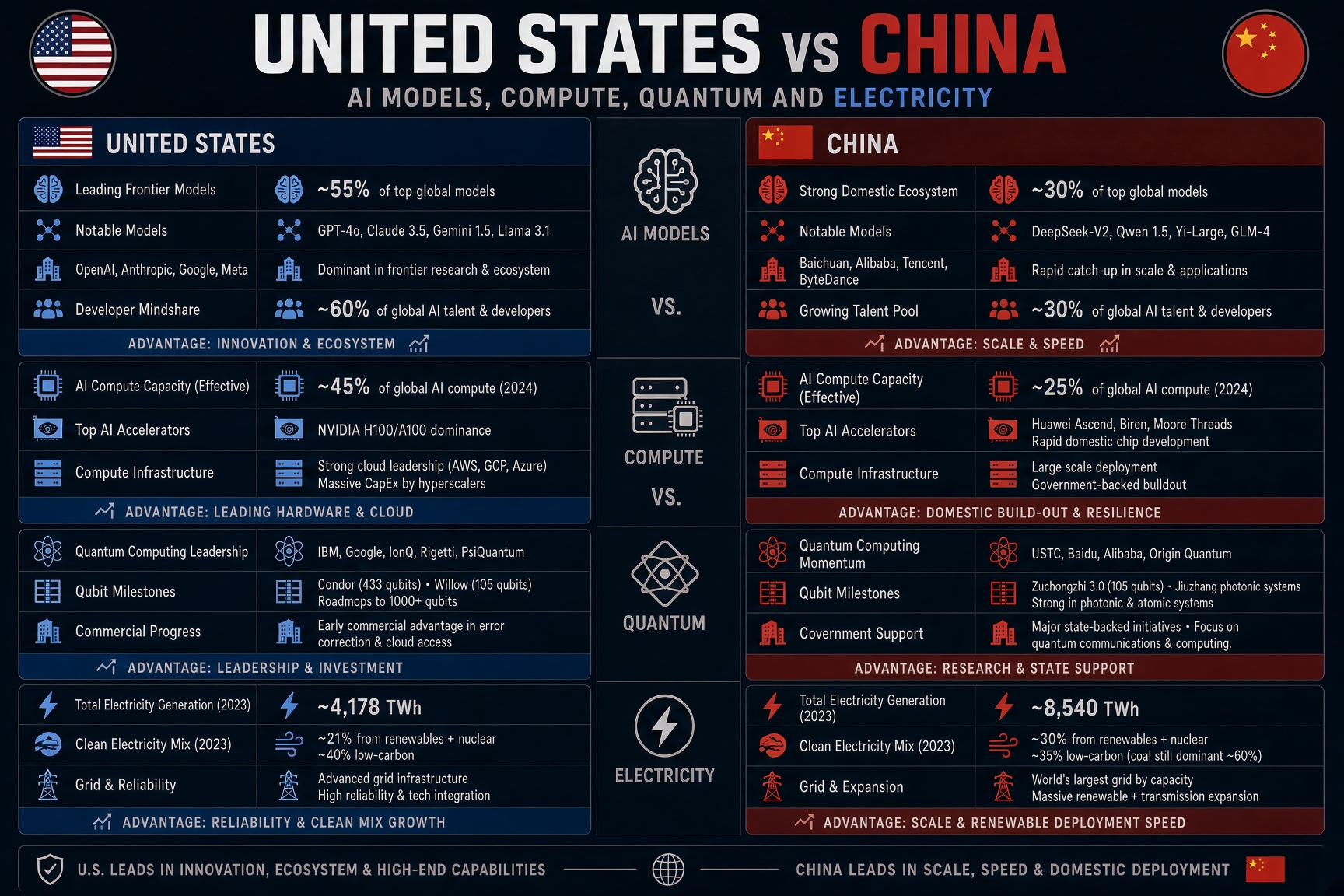
The United States still leads in frontier model capability, total AI compute and quantum error correction, while China has narrowed the gaps in model performance, open-weight adoption and domestic chip volumes, and holds a structural advantage in power for data centres. Shayne Heffernan sets out the developments from July to October 2026 across models, compute, quantum and electricity, and how fast China is catching up.
The 2030 Compute Landscape: GPUs, Power and the Architecture of Intelligence
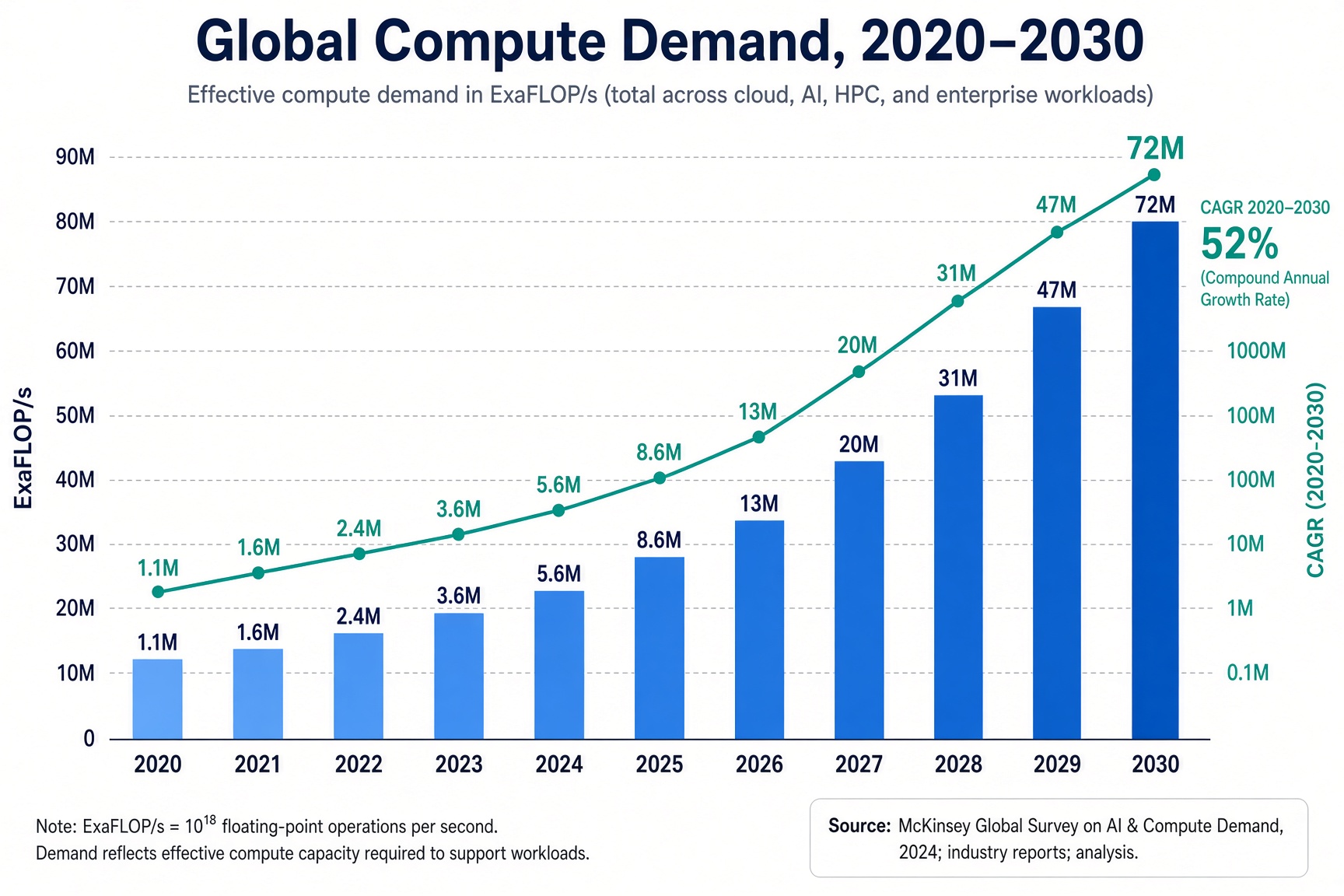
The constraint on AI is no longer ideas or data but compute and the power to run it. Frontier training compute has grown about five times a year since 2020, and the leading AI supercomputer of June 2030 is on course for about 2 million chips and 9 gigawatts. Shayne Heffernan sets out the 2030 arithmetic, the power problem, who has already contracted the gigawatts, and how GPUs, custom ASICs, wafer-scale engines and quantum machines divide the work.
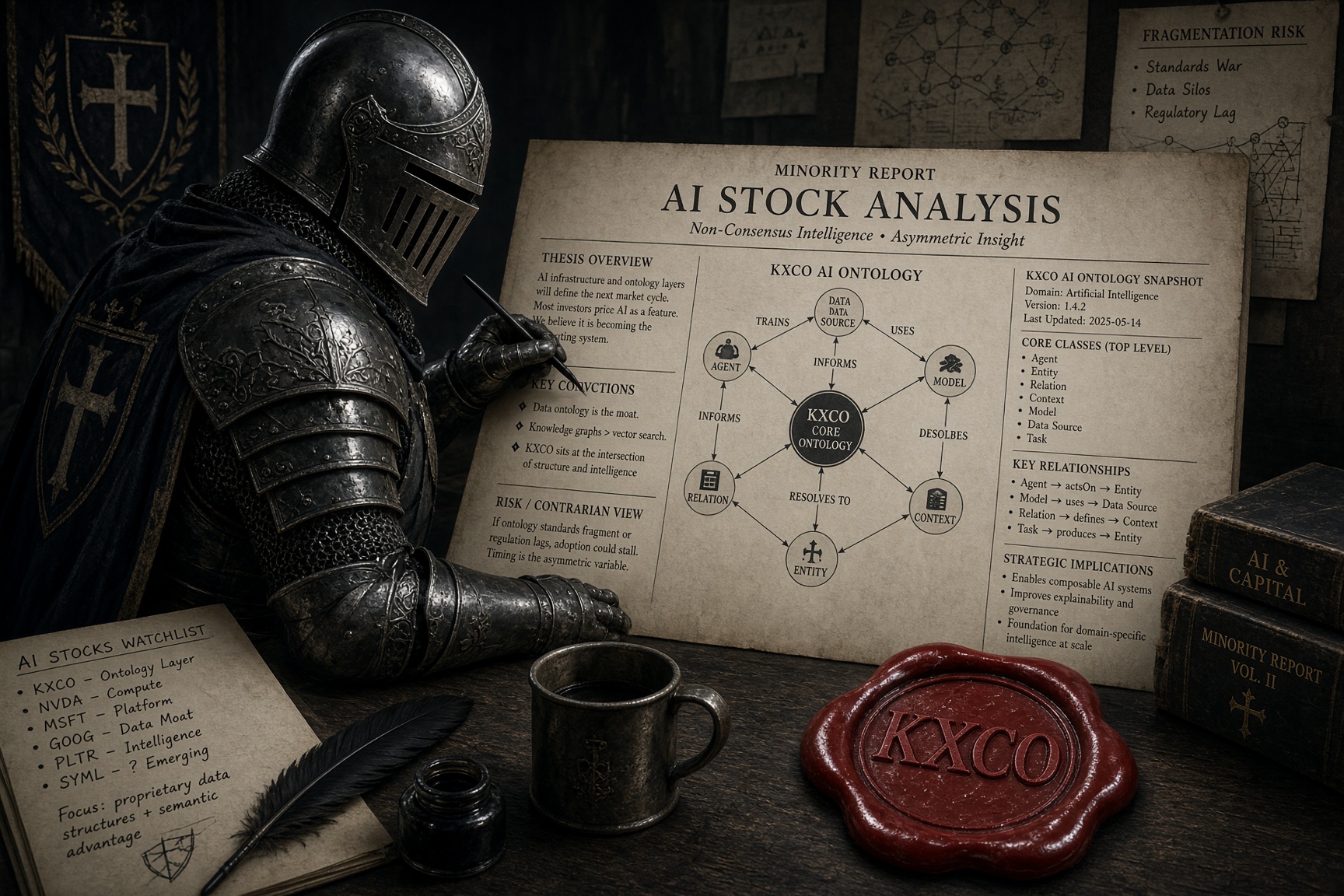
KXCO AI Ontology at 3 Months: What It Called and What Comes Next
On 19 July 2026 the Round Table's AI room published its first Analyst Outlook. To the 16 October 2026 close its 13 names rose 2.6% on an equal weight against 2.1% for QQQ, per StockAnalysis closes, and the six it opened with 35% or more of upside rose 8.6%. This piece lists the six names up more than 5%, the ten names I rate as opportunities now, the month's results in AI and quantum computing, and the official data showing that four in five firms have not yet started using AI.
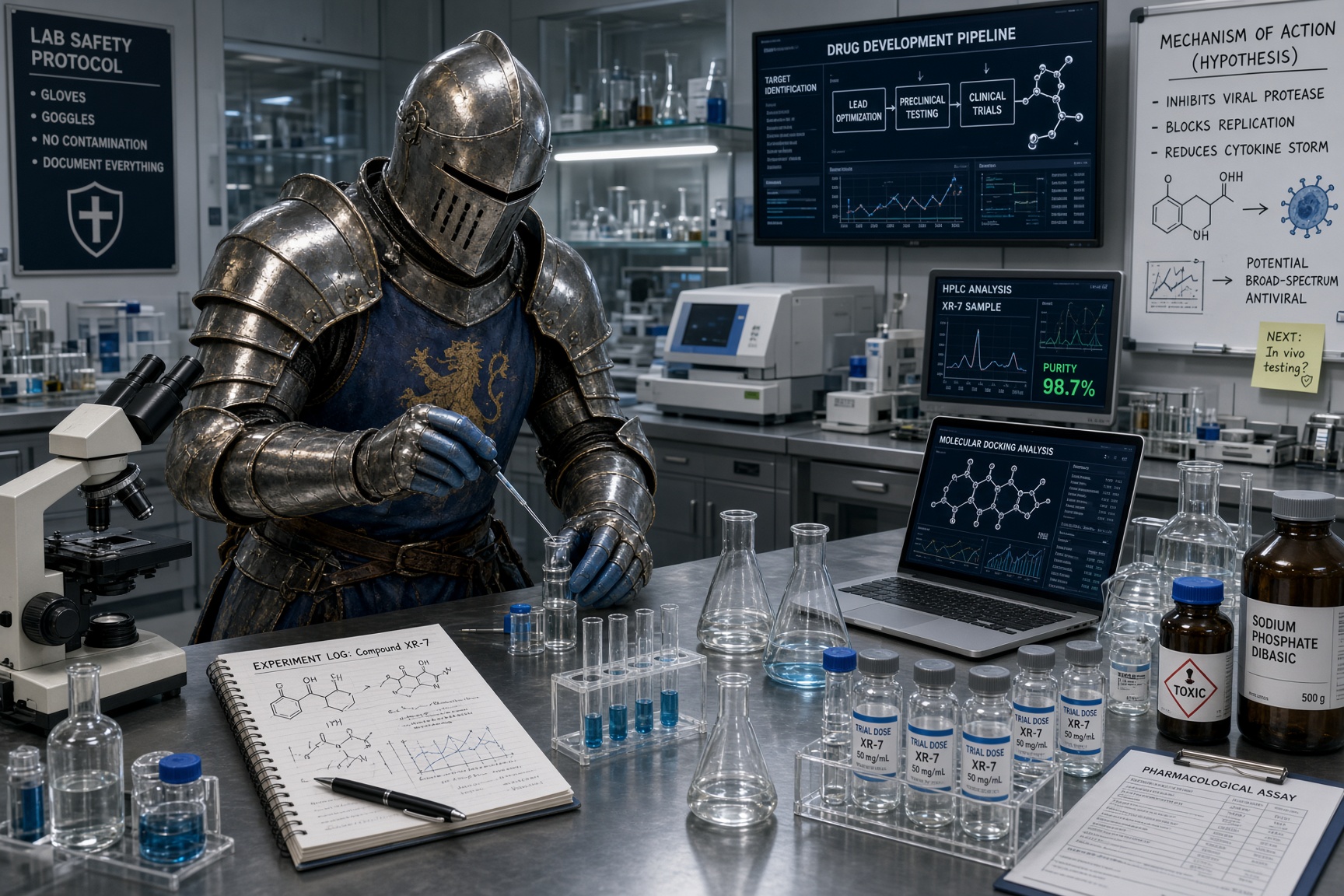
What the Round Table Is Predicting in Biotech Markets
Seventeen FDA decisions fall due between 30 October 2026 and 29 June 2027, and KXCO's Round Table has called every one. Its model portfolio holds the thirteen Nasdaq companies behind them, led by BridgeBio, Cogent Biosciences and Praxis, and was signed with ML-DSA-87 and anchored on chain before the FDA acts. The first test is Inovio's INO-3107 on 30 October.
Every story, signed and delivered.
Subscribe to the kxco channel and get the headline, the AI-written key takeaways, and the chain-anchor link the moment we publish. Audio versions and per-ticker subscriptions arrive in the next iteration.