
Earnings, the Economic Calendar and Trading Strategies: September 8 to 12, 2026
Oracle, the AI sector, gold, Bitcoin, FX and oil, and the politics that will price them before the 16 September FOMC.
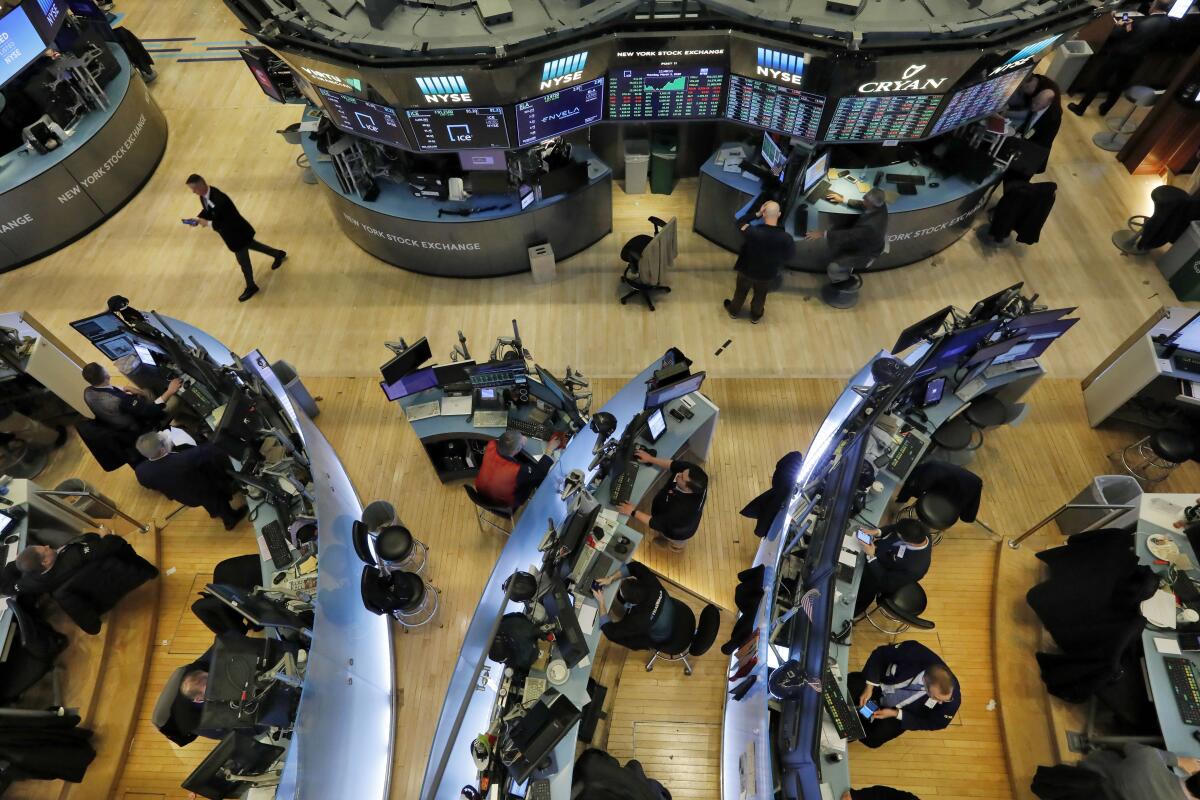
Markets reopened after Labor Day into a four-session week that will decide more than a print. August nonfarm payrolls landed at 162,000 against a 55,000 consensus. Producer prices print Thursday. Oracle reports after the close the same afternoon. Consumer prices print Friday. The European Central Bank meets Thursday. China published its August inflation complex on the Asia morning of Wednesday. The Federal Open Market Committee sits on 15 and 16 September with Chair Kevin Warsh already on the record that price stability has not been delivered. That is the week. Everything else is a derivative of it.
This briefing is written against two live objects, not against a theme. The first is the Trading Hub, where the economic calendar, the tape and the desks sit in one place. The second is the public AI-sector map at KXCO Ontology Live, which as of the late-August snapshot held 379 entities, 851 sourced claims, nine designated chokepoints and a ranked Analyst Outlook layer on the listed majors. How to read that map is set out in the working guide. The argument that follows is mine. The structure it sits on is public. My other writing is signed and timestamped at shayneheffernan.com and in the KXCO Center.
The working thesis for the four sessions is simple and falsifiable. Oracle is the last hyperscaler of this reporting cycle. $ORCL closed Friday 4 September at $158.78 with a market value near $457 billion. Sell-side consensus sits near $242. Guggenheim has $400 on it. Remaining performance obligations at the May year-end were $638 billion, up 363 percent year over year. The KXCO Ontology Live Analyst Outlook layer has, through the summer, carried Oracle as the widest value gap among the listed majors. The August briefing on this desk put that gap near 70 percent at the July snapshot, with Arm at the other end of the table near 2 percent. The tape has closed some of that distance and left most of it intact. A clean print on cloud infrastructure growth, backlog conversion and the debt that funds the build should lift Oracle first and the AI complex with it. A messy print on financing, customer concentration or capex will do the opposite. Position for the lift. Size for the miss.
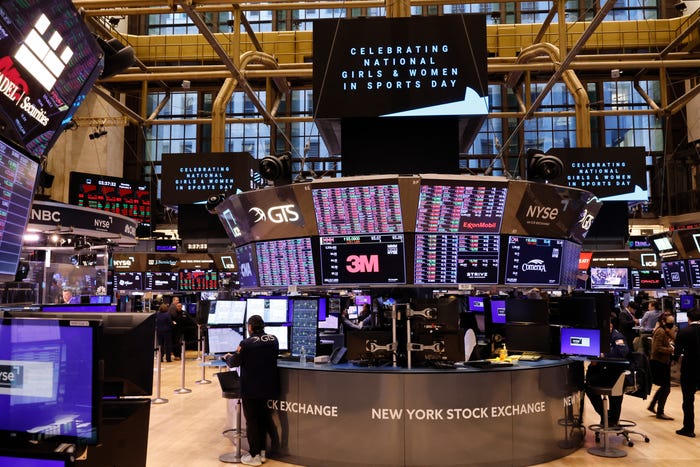
The cash equity tape that will have to digest Oracle after the close on 10 September and CPI on the 11th. Source: NYSE floor.
I. The week on one page
Monday 7 September was Labor Day. Cash US equity markets were shut. Futures, FX, metals and crypto traded through the holiday and spent it pricing two things at once: a jobs report that moved the September hike probability toward 60 percent, and a Gulf that has not gone quiet. By the Asia morning of Tuesday 8 September the reference tape looked like this. S&P 500 near 7,719. Nasdaq Composite near 26,507. Dow Jones near 53,414. VIX near 15.3. The 10-year Treasury near 4.79 percent. The dollar index near 98.8. West Texas Intermediate near $92.50. Brent near $97.10. Spot gold in a $4,430 to $4,460 band. Silver near $66.80 to $67.00. Bitcoin near $79,300. EUR/USD near 1.163. USD/JPY near 153.6. GBP/USD near 1.354. That is the board the rest of the week has to move.
Yahoo Finance framed the week the same way the calendar does: inflation data, Oracle earnings, and an energy supply crunch. Jake Conley's 6 September note asked the two questions that actually matter. Will the data push the Federal Reserve toward a hike at the mid-month meeting? And what can Oracle tell the street about the state of Big Tech's AI debt load? Those are the right questions. They are also incomplete. The third question is structural. Who in the AI stack is a hub, who is a chokepoint, and which listed names still sit at a discount to the work already contracted? That is what the ontology is for. Read it at kxco.ai/ontology-live while this piece is open.
Economic calendar, 8 to 12 September 2026
Session | Print or event | Why it prices |
|---|---|---|
Tue 8 Sep | US consumer credit (Jul), NFIB optimism, NY Fed inflation expectations, China CPI and PPI (Asia Wed morning) | Credit impulse and household inflation psychology into CPI. China PPI still the factory-gate read on the export deflator. |
Wed 9 Sep | Apple iPhone event (expected 10:00 PT). Light US data. Broker conferences. | Hardware cycle, on-device AI narrative, FX translation for $AAPL. Event risk is product, not macro. |
Thu 10 Sep | US PPI Aug 08:30 ET (cons. +0.4% m/m, +5.3% y/y; core +0.3% and +4.6%). Jobless claims. Existing home sales. ECB decision about 08:15 ET. Oracle after the close, call 17:00 ET and 16:00 CT. | Wholesale inflation is the pipeline into Friday CPI. ECB is a hike-or-hold on energy. Oracle is the AI financing bellwether. |
Fri 11 Sep | US CPI Aug 08:30 ET (cons. +0.4% m/m, 3.4% y/y; core +0.2% and 2.4%). Michigan prelim 10:00 ET. Treasury statement. | Last full inflation print before the 15 and 16 September FOMC. A 0.3% core month puts the hike back on the table in size. |
Next week | FOMC 15 and 16 Sep. Retail sales Wed 16th. Funds target now 3.50 to 3.75%. | Warsh has said price stability is not delivered. The White House wants cuts. The data week decides who blinks. |
Consensus figures compiled from MarketWatch, BLS release calendars and sell-side surveys current as of 7 and 8 September 2026. The live calendar on the Trading Hub updates through the week.
Two other earnings names sit on the same Thursday to Friday window. $ADBE is on the software-AI calendar this week in street rundowns alongside Oracle. $M and $KR print the consumer side of the inflation story. The Apple event on Wednesday is not an earnings print but it is a volume event for the hardware complex and for the on-device AI narrative that the ontology treats as a demand node, not a model node. Treat Apple as a product-cycle tape, not as a substitute for Oracle. The hyperscaler question this week is Ellison's, not Cook's.
II. Oracle: the last hyperscaler of the cycle
Oracle's campus identity still reads database. The equity now prices cloud infrastructure, AI training clusters and a $638 billion backlog. Photo: Oracle campus.
Oracle will release fiscal first-quarter 2027 results after the close on Thursday 10 September 2026. The company's own investor-relations calendar is unambiguous: announcement after the cash close, conference call at 4:00 p.m. Central Time, webcast on oracle.com/investor. Street numbers cluster around $19.13 billion of revenue, up about 28 percent year over year, and EPS near $1.73 to $1.74 against $1.47 a year earlier. Those are not the numbers that will move the AI complex. The numbers that will move it are the ones Oracle taught the street to watch in fiscal 2026: remaining performance obligations, Oracle Cloud Infrastructure growth, the mix of GPU versus CPU infrastructure, the cash conversion of the backlog, and the debt that funds the build.
Fiscal 2026 ended in May with a record quarter. Revenue was $19.2 billion. Cloud infrastructure accelerated through the year, 55 percent, then 68, then 84, then 93 percent year over year across the four quarters. RPO finished at $638 billion, a 363 percent increase, with $85 billion added in the fourth quarter alone. Management kept a long-term frame of a 31 percent revenue CAGR and a 28 percent EPS CAGR through fiscal 2030. CFO Hilary Maxson put steady-state project-level ROIC on the GPU and CPU infrastructure book in the high 20s. Cloud CEO Clay Magouyrk disclosed $67 billion of new AI infrastructure contracts in the fourth quarter, much of it bring-your-own-hardware or prepaid. That is the bull case in four sentences. It is also why the stock fell on the June print. The street can applaud a backlog and still refuse to pay for the capex and the balance sheet that turn a backlog into revenue.
That refusal is the entire setup into Thursday. Oracle has spent 2026 being marked as a leveraged AI landlord rather than as a software compounder. Long-term debt swelled through the build. Trailing free cash flow went negative as the company poured tens of billions into clusters. The June call discussed a large financing plan. The stock, which had traded through $300 in the 2025 blow-off, closed last week at $158.78, down close to 20 percent year to date and more than 50 percent below the 52-week high. Market value near $457 billion sits under a $638 billion contracted backlog. Consensus twelve-month target near $242 implies roughly 52 percent upside from Friday's close. Guggenheim's $400 target implies something the stock has not done in this cycle: a full rerating back through the high printed last year. Those are sell-side numbers. They are not the ontology.
What the ontology actually says about Oracle
The public map at kxco.ai/ontology-live is not a price target factory. It is a typed graph of who depends on whom, who funds whom, and where the sector narrows. Oracle sits on that graph in three places that matter for Thursday night.
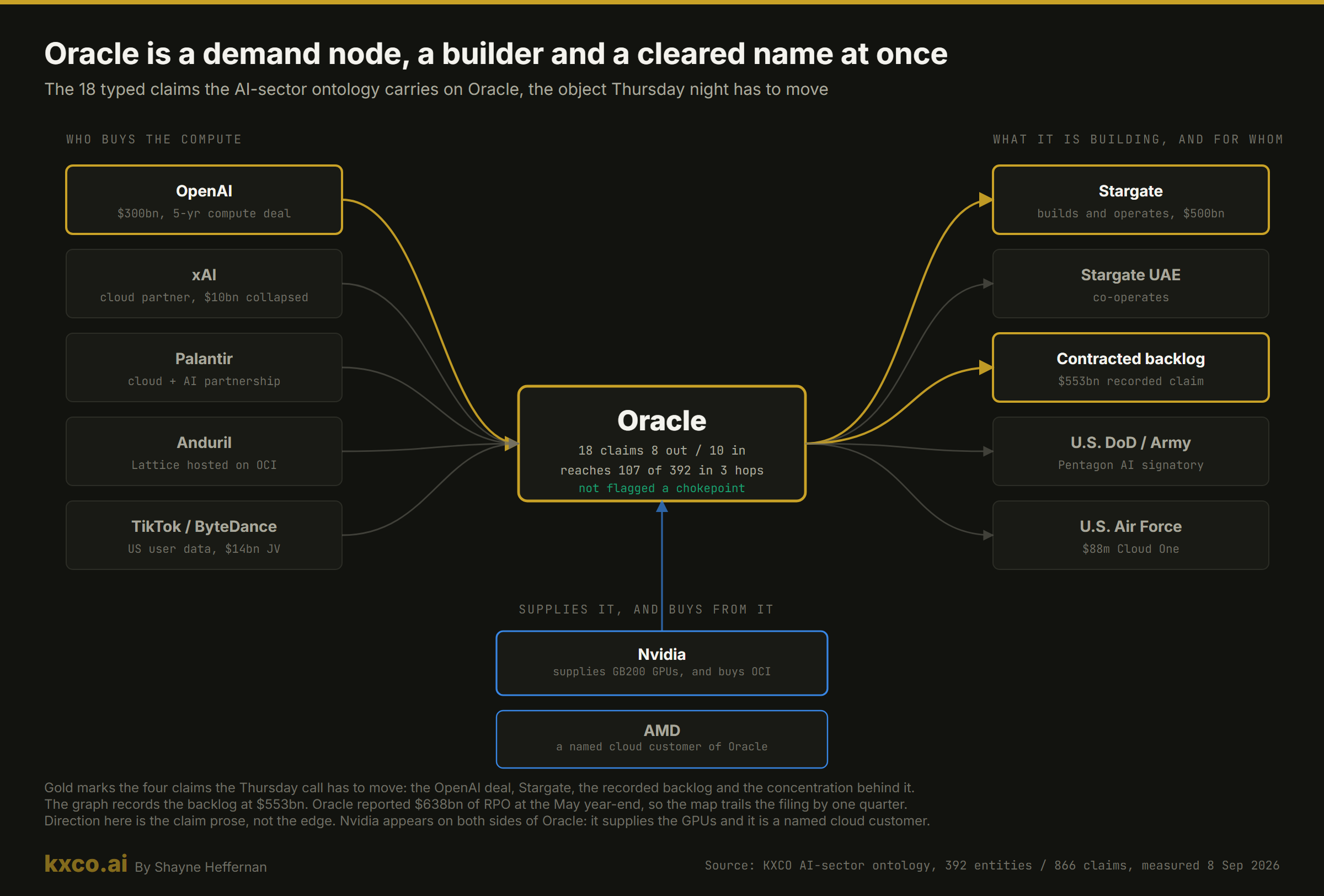
The eighteen typed claims the ontology carries on Oracle, measured 8 September 2026 against a graph of 392 entities and 866 claims. Gold marks the four the Thursday call has to move. Note the honest defect: the graph's latest recorded backlog claim is $553 billion, so the map trails the May year-end filing of $638 billion by one quarter. Source: KXCO Ontology Live.
First, as infrastructure. Stargate was announced as a $500 billion, 10-gigawatt programme with OpenAI, SoftBank and Oracle. The map now draws a distinction the press still blurs. The $500 billion is a framing. Oracle's contracted backlog, $553 billion at the March snapshot and $638 billion at the May year-end, is a commitment. The finding on the live map is that execution has trailed the framing, that partner disputes have been reported, and that OpenAI has leaned on AWS, Google Cloud, AMD and Cerebras when the original structure stalled. That is not a short thesis. It is a conversion thesis. Thursday's call has to show that the backlog is becoming watts, not just slides.
Second, as a cleared name. Eight firms hold IL6 and IL7 classified-network agreements as of the 1 May 2026 read: SpaceX, OpenAI, Google, Nvidia, Reflection, Microsoft, AWS and Oracle. Anthropic remains outside that gate. Palantir pulled Claude from Department of Defense platforms over the same fight. Oracle is therefore not just another cloud. It is one of the eight names the American state will let onto the classified side of the frontier. That is a demand channel the multiple still does not fully own.
Third, as a listed major on the Analyst Outlook layer. That layer collects dated sell-side consensus, price, market cap, multiple, rating and twelve-month target, and puts it next to the graph so a reader can see the gap between the structure and the quote. Through July and August the widest gap on that table belonged to Oracle. The 9 August Live Trading News briefing recorded fourteen value gaps on the Outlook layer, from Oracle at 70 percent down to Arm at 2 percent. The gap has narrowed as the quote has worked off the June washout and as targets have been revised. It has not closed. On the layer as it stands today the table runs seventeen names, and Oracle is still at the top of it: $152 against a $244 target, 61 percent, rated Buy. A stock near $159 against a $242 consensus and a $638 billion backlog is still the cheapest way on the listed board to buy contracted AI compute, provided the compute shows up.
That is the sense in which Oracle looks undervalued coming into earnings on the KXCO Ontology Live read. Not because a model spat out a target. Because the graph says Oracle is a cleared infrastructure node with a backlog larger than its market cap, and the quote still treats it as a balance-sheet problem first. Thursday is the test of which description is right. Watch OCI growth against the 93 percent exit rate. Watch RPO: another $50 billion-plus add keeps the conversion story intact, a stall reopens the financing scare. Watch the language on customer concentration, especially OpenAI. Watch the capex and the debt raise. Watch whether management still owns the $90 billion fiscal 2027 revenue frame. A beat on those items is an AI-sector event, not an Oracle event.
III. The rest of the ontology: hubs, chokepoints and the listed board
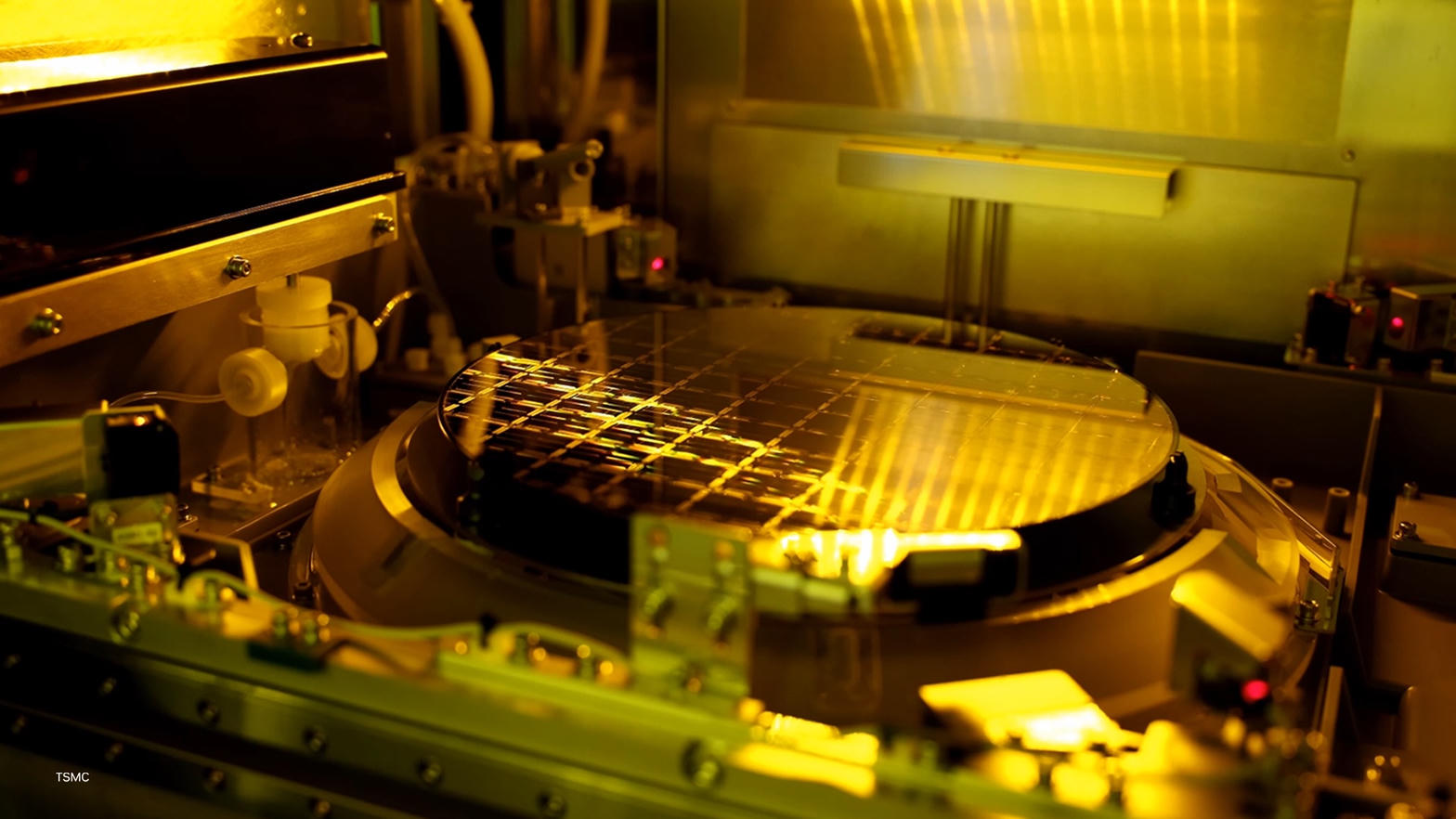
A TSMC process tool over a patterned wafer. The ontology's root chokepoint is not Nvidia. It is the lithography-and-foundry stack behind every leading-edge die. Source: TSMC and NVIDIA.
The live map is at kxco.ai/ontology-live. The product thesis is at kxco.ai/ontology. The working guide is at ontology-live-guide. Read those three before treating any sentence below as a substitute for the graph. Counts move. Claims are dated. Findings are ranked. The late-August snapshot carried 379 entities, 851 sourced claims, roughly $2.5 trillion of tracked flows, nine chokepoints, sixteen circular-capital claims and 39 systemic-risk findings. Four of those findings carry the map's top severity, and they are worth naming because they are the spine of everything below: the single point of failure at Nvidia, the resolution of the whole sector into a handful of firms, the state's gating of the frontier, and ASML as the place where four separate risks meet. The map was not built by listing famous companies. It was grown from a seed set by following dependencies outward, which is why a Dutch lithography firm most generalist accounts still cannot pronounce sits nearer the root than half the Magnificent names.
Hubs are not chokepoints
Nvidia is the most connected listed name on the graph and is not flagged as a chokepoint. That sentence has been the load-bearing distinction on this desk since July. $NVDA carries on the order of 80-plus typed claims to 60-plus counterparties and reaches roughly two-fifths of the mapped entities within a few hops. It printed a $96.2 billion quarter and guided $108 billion. The market added $442 billion of value in a session. Five weeks before that print the ontology's recorded screen had Nvidia at $203, Strong Buy, for a reason anyone could read on the public map. The subsequent scorecard from 24 July to the 27 August close is in the KXCO Center. Connection is not fragility. Nvidia is a hub because capital, models and sovereigns all route through it. A hub can be substituted slowly. A chokepoint cannot be substituted at all.
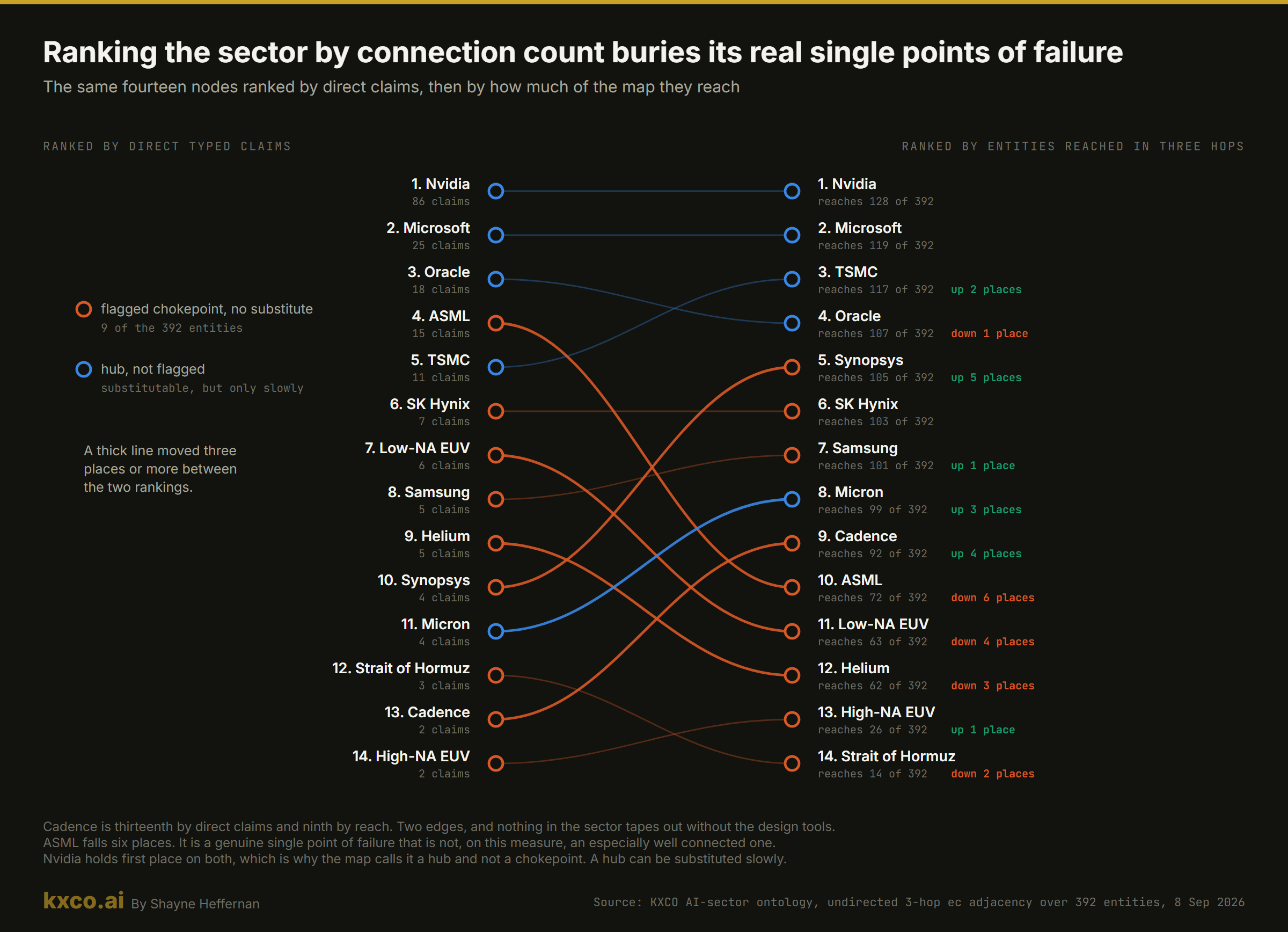
Why the distinction is measurable rather than rhetorical. Rank the same fourteen nodes by direct typed claims, then by how many of the 392 entities they reach within three supply hops, and the two orders disagree. Cadence is thirteenth by claims and ninth by reach. ASML falls six places. Nvidia holds first on both, which is exactly why the map calls it a hub. Source: KXCO Ontology Live, measured 8 September 2026.
The chokepoints are the names with no alternative. $ASML is the sole source of extreme ultraviolet lithography for every leading-edge AI die. $TSM is the foundry those dies print on. $SNPS and $CDNS are the EDA duopoly, about 96 percent of the design-tool stack, and the map's blunt line on Cadence is that it can carry one or two claims and still be a single point of failure because nothing tapes out without the tools. SK Hynix, Samsung and $MU are the HBM triopoly. The Strait of Hormuz is the physical chokepoint: Gulf sulfur and about a third of the world's helium, closed in any operational sense from February 2026 and still a premium in the oil and industrial-gas complex. Helium sits one hop from the memory names and two from TSMC. That is why a kinetic morning in the Gulf is not only an energy event. It is an AI-supply event. The Energy and Commodities center tracks the first half of that sentence. The ontology tracks the second.
The listed majors the Outlook layer is built to hold
Analyst Outlook is a view on the live map, not a separate product. It holds the listed majors with price, market cap, multiple, consensus rating and twelve-month target, collected and dated, and labelled as sell-side consensus rather than as a KXCO forecast. The working guide described thirteen names when the map was smaller. The summer build added coverage as the graph grew, and the layer now runs seventeen. The names a desk actually has to own or underweight into an Oracle week are the ones below. Percentages against target are snapshots against Friday's tape and against the summer gap table. They will be stale by Monday's cash open. That is the point of a live layer. Use the map, not this paragraph, for the current cell.
Name | Role on the graph | How to hold it this week |
|---|---|---|
Oracle ($ORCL) | Cleared AI landlord. Stargate node. Widest summer value gap on the Outlook layer. | Core long into Thursday close. Add on a clean OCI and RPO print. Cut if financing language breaks the conversion story. |
Nvidia ($NVDA) | Largest hub. 80-plus claims. Not a chokepoint. Circular-capital centre. | Hold the core. Buy weakness only if the weekly low holds and Oracle does not break the complex. Confirm on AVGO. |
Broadcom ($AVGO) | Custom silicon plus the switch fabric around every cluster. | Second confirmation name after Oracle. Strength with ORCL is the lift. Divergence is a warning on custom-ASIC mix. |
AMD ($AMD) | Second GPU supplier at the frontier. 2 GW plus equity into Anthropic. | Satellite long if Oracle frames multi-vendor racks. Do not size it as an NVDA substitute. |
TSMC ($TSM) | Foundry chokepoint. Wins whichever designer wins. | Core compounder. Hormuz and helium are the left tail, not the multiple. Do not trade TSM off an Oracle miss alone. |
ASML ($ASML) | Root lithography chokepoint. Four exposures: demand, geography, materials, policy. | Core. Treat any Gulf helium scare as a reason to hold, not a reason to chase. |
Cadence ($CDNS) | EDA chokepoint. Low degree, no alternative. | Own the toll road. The graph's warning: ranking by connection count buries the real single points of failure. |
Synopsys ($SNPS) | Other half of the EDA duopoly, plus IP by the yard. | Same book as Cadence. Integration and margin are the stock-specific risks, not AI demand. |
Arm ($ARM) | Architecture under almost every AI-adjacent CPU. Tightest summer gap on the table. | Least discounted major. Do not buy Arm for an Oracle bounce. Hold as royalty duration. |
Microsoft ($MSFT) | Cloud hub, OpenAI cap table, classified-network name. | Index proxy for the complex. Use it to size the book, not to express the Oracle view. |
Amazon ($AMZN) | AWS backlog and custom Trainium. One of four companies on 43 of 43 shortest paths. | Same as Microsoft. Oracle share gains are an AMZN narrative risk only if OCI growth stays parabolic. |
Alphabet ($GOOGL) | Cloud, TPU, classified-network, path hub. | Hold. Custom silicon is the quiet winner alongside AVGO. |
Meta ($META) | Capex compounder, custom silicon, path hub, model commoditiser. | High-beta AI spend. Cut first if the 10-year closes above 4.85 percent into Friday CPI. |
Palantir ($PLTR) | Application-layer ontology. DoD platforms. Summer winner off the July snapshot. | Already re-rated. Do not chase an Oracle bounce in PLTR. Hold the core, trail the rest. |
Micron, SK Hynix, Samsung ($MU) | HBM triopoly. Two hops from Hormuz helium. | Memory is the swing factor if Oracle's GPU mix surprises. Size off the Gulf, not off Ellison. |
Work the current cells on the Analyst Outlook view. The AI Stocks center and the Stocks center carry the daily tape around those names.
Two private names dominate the findings and do not belong in a cash book. OpenAI is the demand node that makes Oracle's backlog look like a sovereign liability if it ever cannot pay. Anthropic sits at a $965 billion post-money with Amazon, Google, Microsoft, Nvidia and AMD on one cap table, five rivals funding one lab, and remains excluded from the classified-network gate. SpaceX is on the cleared list and on the compute-in-orbit finding: up to a million satellites with Nvidia Vera Rubin, and a 10-gigawatt end-2027 appetite that is larger than current supply. Those three names explain more of Oracle's multiple than half the listed peers. They cannot be bought in size on the cash tape. They can be read, live, on the map.
Circular capital is the finding that should change how a desk hears Thursday's call. The map carries sixteen circular claims. Nvidia is party to ten of them. The structure has moved from equity cross-holdings into credit: vendors financing customers who then buy the vendors' chips, with figures in the low hundreds of billions discussed and the first large guarantees already on the record. Oracle's own AI contracts are part of that recycling. A backlog that is in substance a receivable on a lab that the vendor also finances is not the same object as a backlog that is prepaid. Magouyrk's prepaid and bring-your-own-hardware mix is the healthiest version of that sentence. Listen for whether that mix is rising or falling.
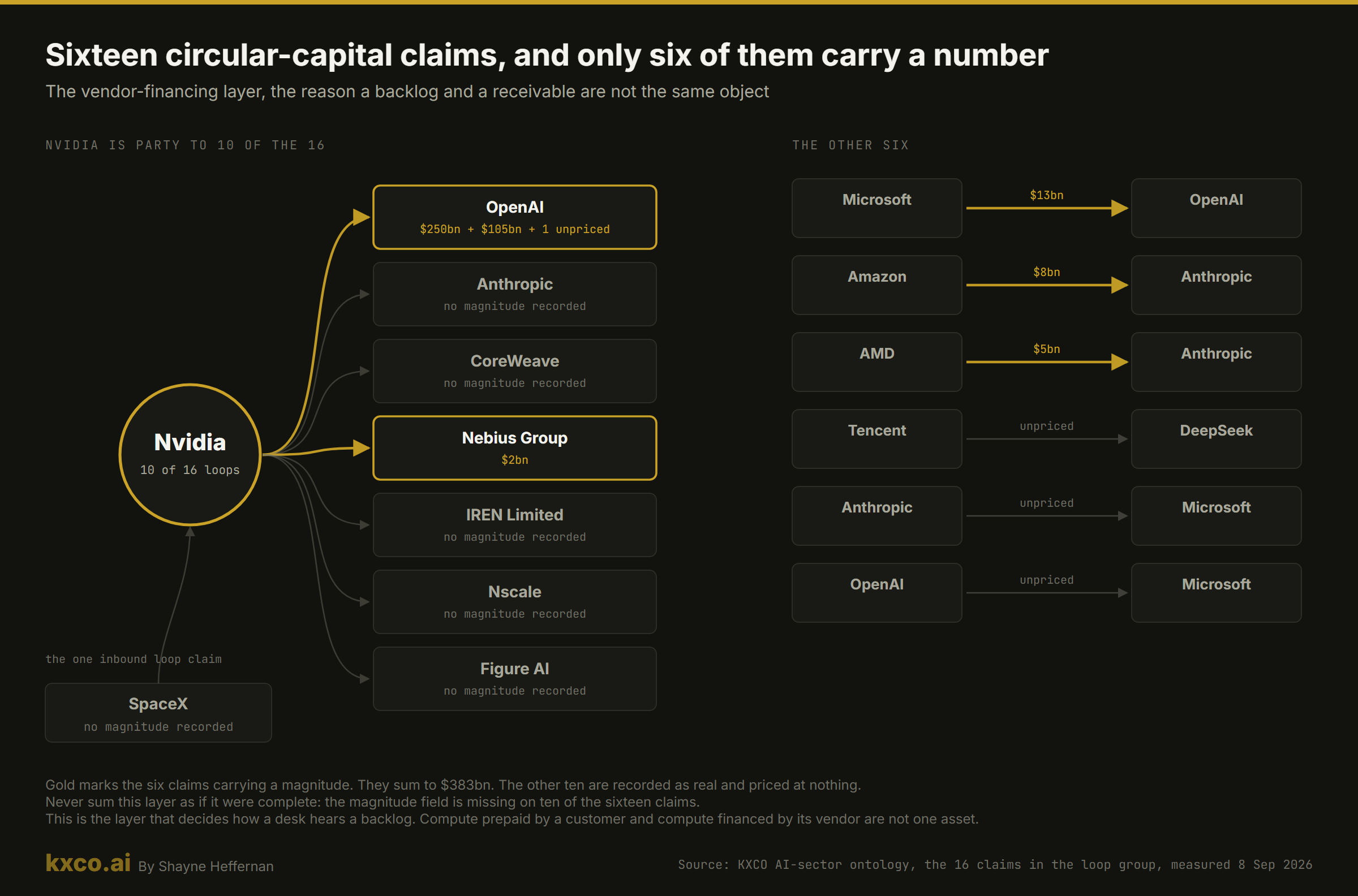
The vendor-financing layer, drawn claim by claim. Nvidia is party to ten of the sixteen, nine outbound and one inbound. Only six of the sixteen carry a magnitude at all, and those six sum to $383 billion. The other ten are recorded as real and priced at nothing, which is the single best argument for reading a graph rather than a headline. Source: KXCO Ontology Live, measured 8 September 2026.
IV. The strategy: Oracle lifts the complex if the print is clean
The tactical book for 8 to 12 September is built to express one view and to survive the other. The view is that a clean Oracle print, OCI still accelerating, RPO still compounding, financing language orderly, OpenAI concentration disclosed rather than ducked, lifts Oracle 6 to 12 percent in the Friday session and pulls Nvidia, Broadcom, AMD, the memory names and the AI software sleeve with it. The other view is that a financing scare, a deceleration in infrastructure growth, or a customer footnote sends Oracle down 8 to 15 percent and takes 2 to 4 percent out of the Nasdaq into the CPI print. Both paths are live. The job is to be long the first with a defined cost for the second.
Core book, hold through the week
Hold the cash-flow AI infrastructure sleeve: Nvidia, TSMC, ASML, Broadcom, Cadence, Synopsys. Hold a measured Oracle line that was built on the June to August washout, not bought in the last three sessions. Hold a gold sleeve as the insurance against a Warsh hike and a Gulf event landing in the same week. Hold a small crude sleeve only while WTI holds $90. Do not hold a full-size quantum sleeve into Thursday and Friday. The weekly outlook published 31 August on this desk still stands on structure. The levels have moved. Read it alongside the live Trading Hub.
Tactical book, the Oracle lift
Build the tactical long in three tranches. Tranche one is already Oracle common, held from the discount. Tranche two is a defined-risk call spread on ORCL with the short strike near the $180 to $190 supply band, sized so a total loss of premium is one-third of the common P&L you are prepared to give back. Tranche three is a basket of NVDA, AVGO and AMD that you add only after the call, and only if OCI growth is still triple-digit and RPO is up on the quarter. Do not pre-buy the basket on Wednesday. The information is Thursday night. Paying up Friday morning on a clean print is cheaper than owning the miss.
If the print is clean and the complex lifts, trail Oracle with a stop under Thursday's cash low, not under the June washout. Convert a third of the common into a financed hold on Friday afternoon if the 10-year is still below 4.85 percent. If the 10-year is through 4.85 percent on a hot PPI, take the index beta down before CPI and keep the single-name Oracle line. The lift can survive a hike scare. It cannot survive a financing scare and a hike scare in the same twelve hours.
Invalidation
The thesis is wrong if Oracle guides infrastructure growth back into the 50s without a mix explanation, if RPO stalls, if the call leans on a new large raise without prepaid coverage, or if customer-concentration language around OpenAI is worse than the street already models. In that case flatten the tactical basket before Friday's cash open, keep ASML, TSMC and Cadence as the chokepoint sleeve, and let gold and the dollar do the defensive work into CPI. Do not average Oracle on a broken conversion story. The gap on the Outlook layer is a gap against contracted work. If the work is no longer contracted in the way the graph recorded it, the gap is not value. It is a decaying claim.
Positioning tools, broker access and the live calendar sit on the Trading Hub. This desk does not manage money off the page. It publishes the map and the levels. The trade is yours.
V. Gold, Bitcoin and the FX board
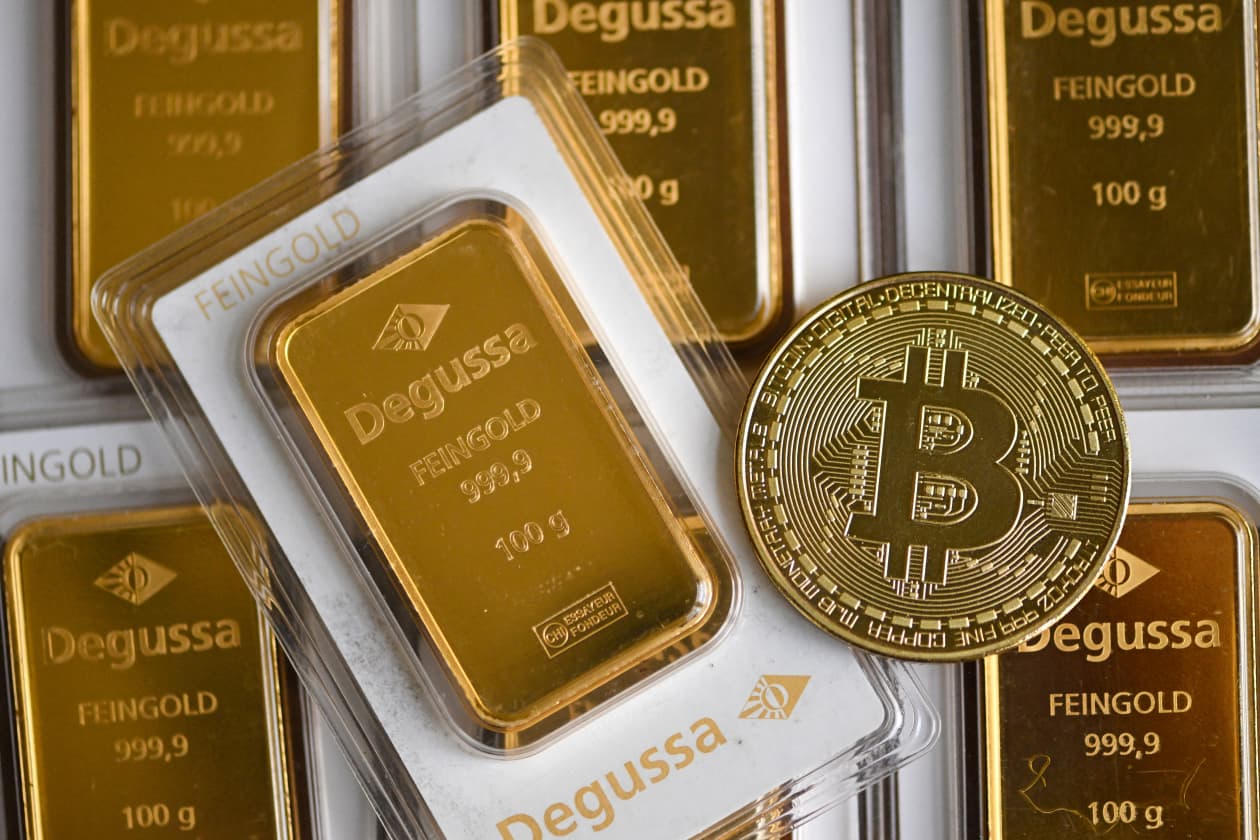
The two assets that still clear when the policy rate and the Gulf move together: bullion and Bitcoin. Levels below are for the 8 to 12 September window.
Gold
Spot gold spent the holiday weekend in a $4,390 to $4,490 range and opened the Tuesday window near $4,430 to $4,460 depending on the venue. The 31 August outlook on this desk used a $4,450 to $4,530 reference, support at $4,350 then $4,222, and resistance at $4,585 to $4,765 then $5,000. That map still works. The jobs beat and the 60 percent hike probability pulled the metal off the top of the range. The Gulf put a floor under the dip. That is the right shape for a week that contains both PPI, CPI and a kinetic premium.
Daily-chart strategy for the four sessions. First support is $4,350 to $4,400. A cash close under $4,350 with the 10-year through 4.85 percent is the first risk-off signal in the metal. $4,222 is the invalidation of the summer uptrend. Resistance is $4,585 to $4,600. A close back above that band while WTI is over $90 restores the bid into $4,765 and keeps $5,000 as the measured extension. Long the metal on a Hormuz headline that takes Brent through $100. Fade a spike if a ceasefire headline hits into a hot CPI. Do not treat gold as an Oracle derivative. It is the hedge against the week being about Warsh instead of Ellison. The Gold Forecast center carries the running file.
Silver
Silver is trading $66.80 to $67.10 against a $66 to $70 reference from the 31 August note. Support is $66.15 then $63.40. Resistance is $70.70, then $72.30 and $75. Silver is the higher-beta metal. Cut position size by a third relative to gold into Thursday and Friday. Long only on a close above $70.70 with gold above $4,585. Reduce under $66 with a rising dollar. Industrial demand from the AI build, silver paste, power electronics, contacts, is a 2026 story, not a four-session story. Do not pay a 4 percent premium for it on a CPI week.
Bitcoin
Bitcoin is holding the $79,000 handle after a $77,400 to $80,000 reference band last week. Support is $72,700, then the 20-day near $65,500. Resistance is $82,000, then $90,000. The metal-crypto pair has been trading as a joint liquidity sponge for policy shock: both sold the jobs beat, both bid the Gulf. That correlation is useful until it is not. A clean Oracle print that lifts Nasdaq and leaves the 10-year under 4.80 percent is constructive for Bitcoin through $82,000. A hot CPI that sends the 10-year through 4.90 percent is a cut, not a hold, under $72,700.
Rules for the four sessions. Do not treat weekend or holiday thin liquidity as a signal. Monday's session was exactly that. Long a close above $82,000 only with gold above $4,600 or with Oracle leading the Nasdaq higher after the call. Reduce under $72,700 if the dollar is rising and the 10-year is above 4.80 percent. Size Bitcoin as a satellite, not as a substitute for the gold sleeve. Post-quantum risk is an institutional story on this desk, BlackRock has already put it in a filing, and KXCO's Armature L1 was post-quantum from genesis, but it is not a Tuesday-to-Friday trade. The Blockchain center carries that argument. This week's book does not need it.
FX
Pair | Ref. 8 Sep | Bias this week | Levels and trigger |
|---|---|---|---|
EUR/USD | 1.163 | Two-way into ECB Thursday and CPI Friday | Hold range 1.155 to 1.172. Fade a spike through 1.172 if ECB hikes and Warsh stays live. Buy dips to 1.155 only if CPI undershoots. |
USD/JPY | 153.6 | Dollar-positive while hike odds hold | Resistance 154.8 to 155.5. Support 152.2. A CPI miss with a dovish Warsh leak takes it toward 151. Do not fade a break of 155 on a hot core. |
GBP/USD | 1.354 | Range, UK data secondary | 1.345 to 1.365. BoE is not this week's story. Cable will trade the US print. |
USD/CNH | onshore CNY about 6.71 | Managed, not a momentum pair | China CPI and PPI is a factory-gate read. A hotter PPI firms the deflator story and leans on CNH only at the margin. |
DXY | 98.8 | Firm into Friday | Support 98.2. Resistance 99.6 to 100.0. A close above 100 on hot CPI is the risk-off signal for Nasdaq beta and for gold's first support. |
AUD/USD | 0.722 | Commodity dollar, oil-sensitive | Bids on Brent over $100. Offered on a CPI-led DXY squeeze. Range 0.712 to 0.732. |
FX is the transmission belt between Thursday's PPI, Thursday's ECB, Thursday night's Oracle reaction in USD-denominated AI names, and Friday's CPI. Trade the dollar as a hike-probability instrument, not as a separate religion. The Macro center is the running commentary around those crosses.
A note on the yen. USD/JPY at 153.6 with Japanese 10-year yields near 2.91 percent is not the 2022 to 2024 regime. Tokyo has already shown it will talk to 155 and act through it. A Warsh hike that takes US 10-year yields through 5 percent reopens that option. Size the yen short as a tactical expression of the hike, with a hard stop through 152 on any official language. Do not run it through the FOMC.
VI. Oil and the energy supply crunch
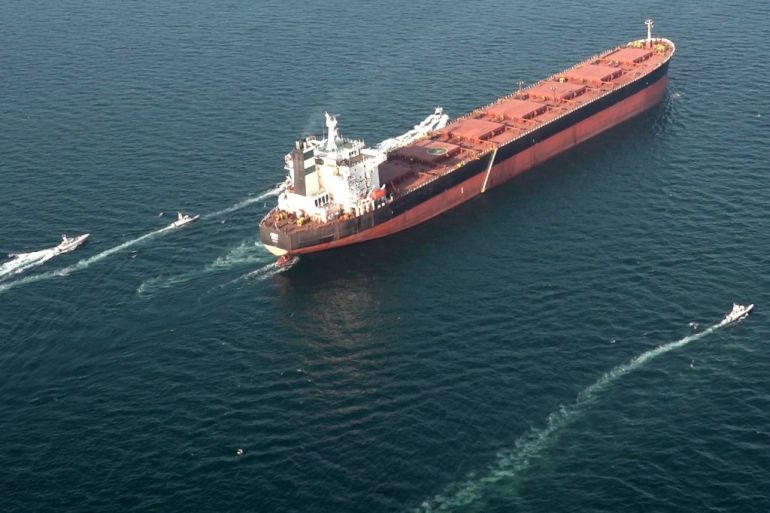
A very large crude carrier with escort craft, the image the Gulf has been generating since February. WTI near $92.50 and Brent near $97 are the premium that image still extracts.
The energy supply crunch in the Yahoo Finance headline is not a metaphor. The Iran war that began on 28 February 2026 has spent seven months repricing the barrel, the gasoline crack, the helium balance and, by one hop on the ontology, the memory-and-foundry stack that the AI build cannot run without. A Sunday 30 August strike on launchers near Larak Island put the Hormuz premium back on after a week in which the Navy had been clearing mines and the complex had been allowed to ease. Tit-for-tat action against vessels in the Strait over the holiday weekend kept Brent in the mid-to-high $90s and WTI over $92. Energy Secretary Chris Wright has said flows through the Strait have been near 17 million barrels on individual days against roughly 20 million before the war. That is not a closure. It is also not a market. It is a corridor that can be shut by one successful mine or one political decision.
Levels for the four sessions. WTI reference $92.50, pivot $90.80, first support $89.40 then $87.30, resistance $93.40 then $96.30 then $100. Brent reference $97.10, support $94.10 then $91.95, resistance $98.70 then $100.90. The 31 August note used an $83 to $89 WTI and Brent map. The complex has since reclaimed the $90s. That is the premium. Long crude strength above $93 WTI only with a trailing stop under the Tuesday low. Fade under $89 after a quiet Gulf and a soft PPI energy component. Do not fade $100 Brent on a headline. The last three times this market tried that trade it paid.
The inflation channel is the one the Fed has to own this week. July CPI cooled to 3.4 percent headline and 2.5 percent core because energy had been falling in the midsummer window. August gasoline in the US ran hot. PPI on Thursday is expected at +0.4 percent month-on-month and +5.3 percent year-on-year, with core +0.3 and +4.6. Those are not benign wholesale numbers. They are the pipeline into Friday's +0.4 percent headline CPI consensus. A hot energy component in PPI that then prints in CPI is the path to a Warsh hike. A contained energy component with core at +0.2 is the path to a hold. Oil is therefore not a satellite this week. It is an input into the policy function.
Two other crude stories sit behind the Gulf and will not decide Thursday but will decide the fourth quarter. The administration has moved to lock Venezuelan barrels. Chevron has talked about $7 billion into the country over five years. That is a 2027 supply story. It does not cap a $97 Brent this month. OPEC's monthly report is on the Thursday calendar. Treat it as colour. The physical premium is Hormuz, not Vienna.
Equity expression. Overweight the integrateds, $XOM, $CVX and $COP, while WTI holds $90. Do not buy the refiners for a crude spike. They have already lived a $5.85 diesel print and a crack that went out and came back. The AI-energy overlap names on the 31 August list, $VRT and $GEV, are power-and-cooling duration. They trade the capex cycle, not the barrel. Hold them in the infrastructure sleeve, not in the crude sleeve. Full commodity commentary stays on the Energy and Commodities center and on the Trading Hub.
VII. Politics: Washington, Brussels, Beijing
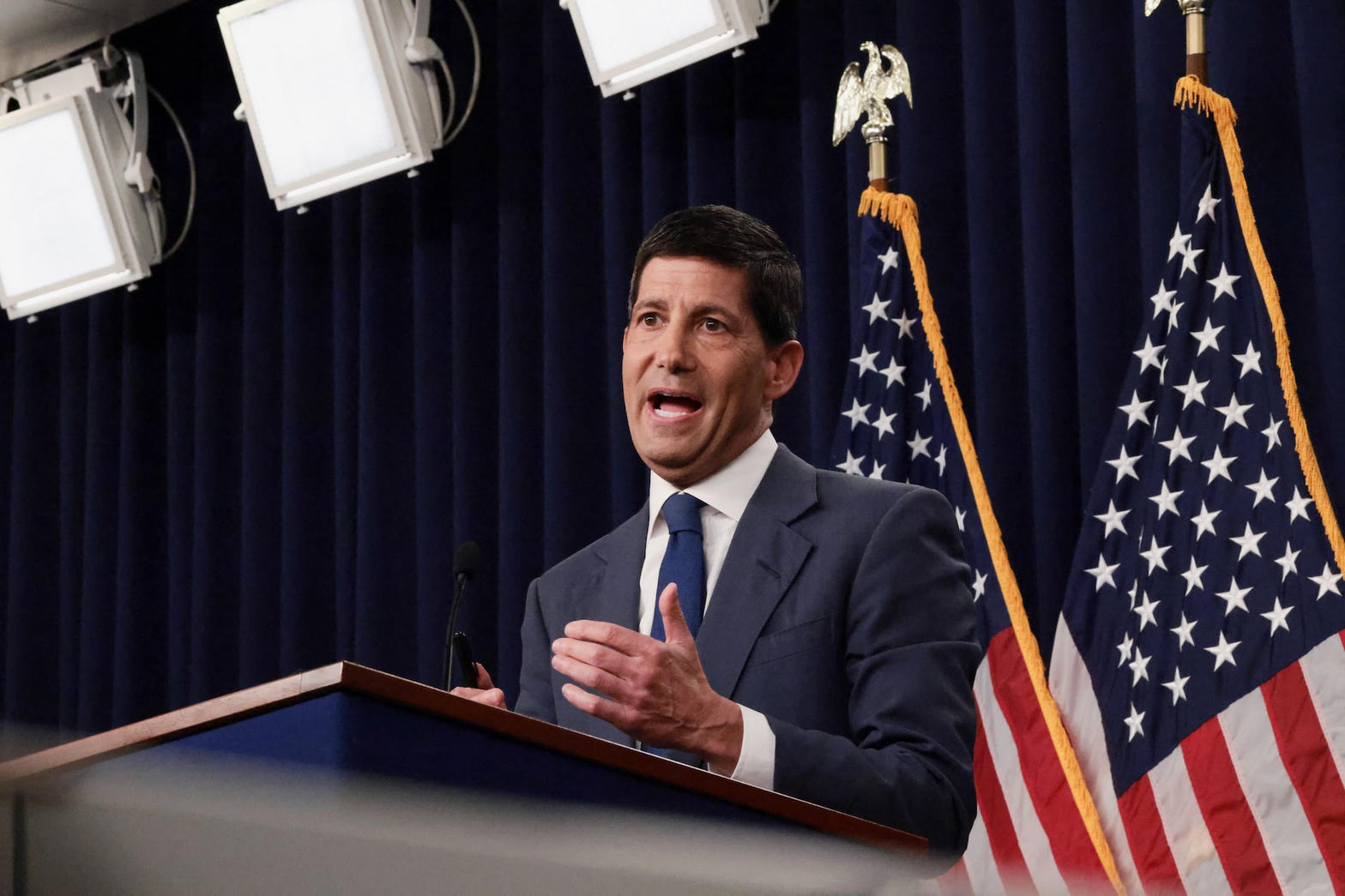
Federal Reserve Chair Kevin Warsh. Jackson Hole put a hike back on the table. Friday's CPI decides whether he uses it on 16 September.
United States
The American political fact that prices markets this week is not a bill. It is a collision. President Trump, Vice President Vance and senior Treasury voices have spent the past ten days telling the Federal Reserve not to hike and, in some interventions, to cut. The president has avoided naming Chair Warsh the way he named Jay Powell, and has instead blamed the Board. That courtesy will last until the first hike that lands inside two months of a midterm. Warsh, at Jackson Hole on 28 August, said headline PCE at 3.7 percent and core PCE at 3.3 percent were too high, that the 2 percent target is not up for negotiation, and that the Committee's predominant focus is prices. The funds target is 3.50 to 3.75 percent. Effective funds sit near 3.63 percent. Markets into Tuesday priced roughly a 60 percent chance of a 25 basis-point move on 16 September after the 162,000 payroll print.
Three regional presidents, Cleveland's Hammack, Minneapolis's Kashkari and Dallas's Logan, have already dissented toward a hike. Logan's line in July was that modestly higher rates would better balance the outlook. Warsh's political problem is that he was appointed to deliver easier money and has chosen to deliver a reputation. His market problem is that a hold after a hot CPI would reopen the charge that he is a dove in hawk's clothing. Friday's print is therefore not only a number. It is the last public input into a meeting that will be read in November as either independence or capture. Traders who treat the FOMC as a technical exercise this month will be the ones explaining the tape to clients after the vote.
The other Washington fact on the ontology is industrial. The state now gates the frontier. Eight firms hold the classified-network agreements. Chip licences for H200-class silicon have been case-by-case since 15 January. Stargate remains the signature compute programme and remains a framing. Defense-AI political capital, including family-adjacent holdings and large contracts, is a mapped finding, not a rumour-column item. None of that changes Thursday's EPS. All of it changes the multiple the cleared names are allowed to keep when the civilian capex cycle wobbles.
European Union
The ECB meets Thursday in the same New York morning as US PPI. A hike has been the base case in European rates for this sitting, energy being the reason. Brent in the high $90s is a European inflation event before it is an American one. The policy distance between Frankfurt and Washington is the FX story in EUR/USD. If the ECB hikes and Warsh only threatens, the euro has a one-day bid. If both hike-path, the dollar keeps the carry. Range-trade that. Do not invent a trend off one sitting.
The deeper European fact is China. Brussels is running a clock it set itself. After a June summit that gave the Commission a mandate to defend against industrial overcapacity, Trade Commissioner Maros Sefcovic and Commerce Minister Wang Wentao launched the first joint EU and China trade statement since 2019 and a Trade and Investment Consultation Mechanism with working groups on balance, export controls, intellectual property and WTO reform. Sefcovic wants tangible results by October on a deficit the Commission puts near 360 billion euro a year, roughly a billion euro a day. Paris and Berlin, Macron and Chancellor Friedrich Merz, have vowed to align on tougher safeguard language. Spain remains the engagement voice. The Cyber Security Act update pointed at Huawei in networks and solar. A Belgian-Chinese researcher was arrested in early September over suspected theft of chip secrets from a defunct Belgian semiconductor name. That is the atmosphere ASML lives in. It is also why the ontology treats export-control risk as a fourth exposure on the lithography node, alongside demand, geography and materials.
For the book: EU politics this week is an ECB sitting and an ASML-risk reminder, not a new regime. Do not sell European champions on a Brussels headline in a four-session US data week. Do hold the recognition that October, not Thursday, is when the EU and China mechanism has to show a number.
China
Beijing's print this week is CPI and PPI for August, on the Asia morning of 9 September, consensus near 0.8 percent CPI year-on-year and 3.7 percent PPI. A factory-gate acceleration is consistent with the energy complex and with the export-deflator story Europe is complaining about. It is not, on its own, a PBOC event. The structural China finding on the live map is more important than the print. The map records a near-complete second stack: DeepSeek V4 on Huawei Ascend 950PR, a capability gap the graph has carried in the low single digits, thirty notable models against fifty American ones, quantum splitting into a US error-correction lead and a Chinese scale lead, and a Chinese quantum cloud that already runs more than a million tasks from 192 countries. Compute remains lopsided, roughly 75 percent of GPU clusters in the US against 15 percent in China, but the second stack is no longer a press release.
Export controls are the live political instrument. H200-class licences have been case-by-case since mid-January. Rare-earth and magnet licensing remains the European sore point, with a truce clock running into the autumn. Huawei's LogicFolding language, a claim to 1.4-nanometre-class performance by stacking rather than by EUV, is a 2031 story the street will try to trade every time TSMC or ASML wobbles. It is not this week's trade. This week's China trade is the PPI print, the CNH, and the reminder that Oracle's classified-network status and Nvidia's licence book are political objects. Size China beta, $BABA, $TCEHY and the ADR book, as a satellite. Do not use it to express an Oracle view.
VIII. Levels, scenarios and the four-session playbook
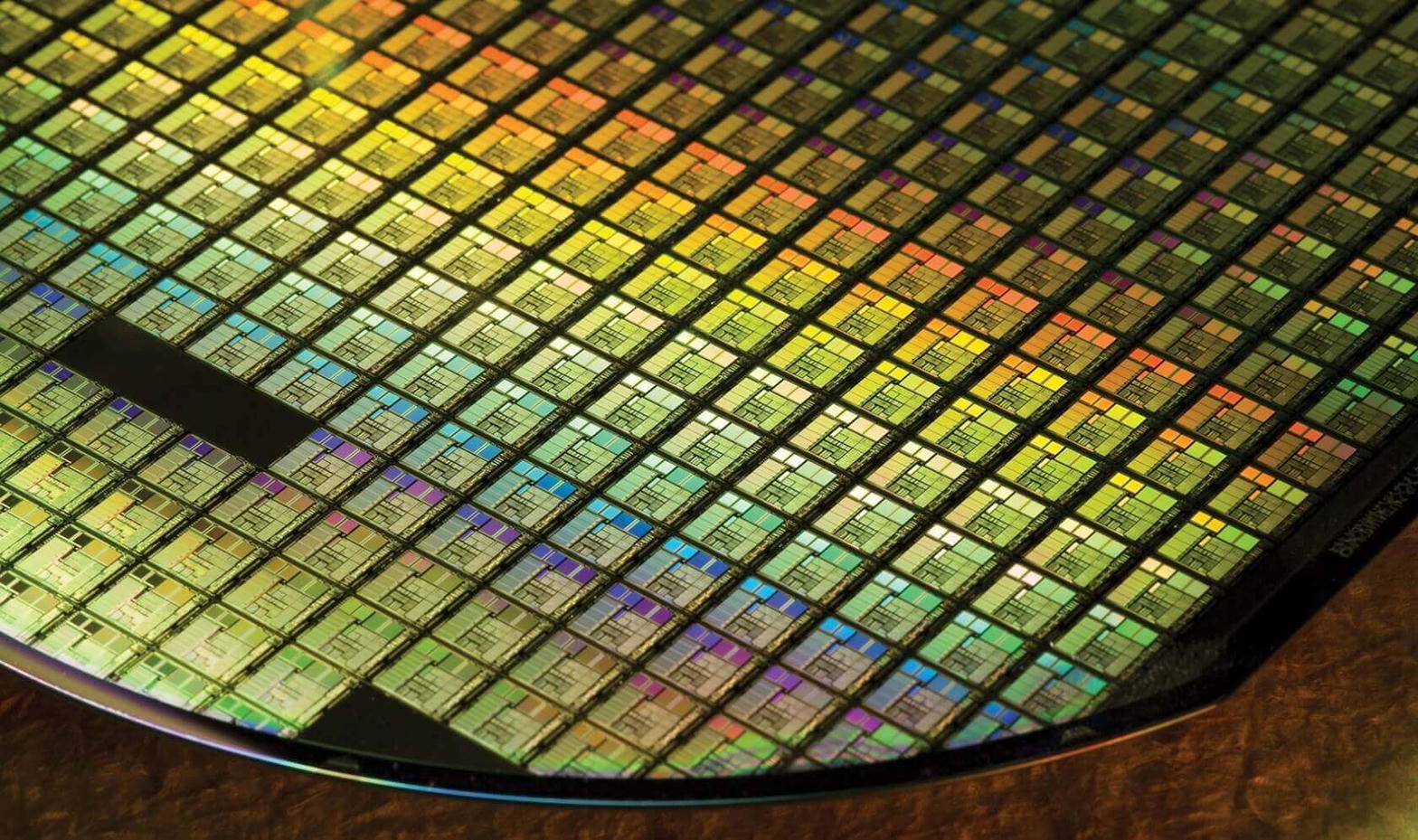
A leading-edge wafer. The listed names in Section III are claims on this object. Oracle is a claim on the building that houses the cluster the wafer ends up in.
Market | Reference | Support | Resistance | Week's tell |
|---|---|---|---|---|
S&P 500 | 7,719 | 7,600 / 7,490 | 7,800 / 8,000 | Hold 7,600 into CPI. Break is a hike-repricing, not an Oracle miss. |
Nasdaq Comp. | 26,507 | 26,000 / 25,400 | 26,700 / 27,500 | Oracle clean plus CPI contained equals 26,700 first. |
Dow | 53,414 | 52,750 | 54,000 | Energy-heavy. Follows WTI more than ORCL. |
ORCL | $158.78 | $149 / $138 | $180 / $198 / $242 tgt | Thursday night is the tell. Do not negotiate with a broken RPO. |
Gold | $4,430 to $4,460 | $4,350 / $4,222 | $4,585 / $4,765 / $5,000 | Hedge, not a momentum long, into Friday 08:30. |
Silver | $66.80 | $66.15 / $63.40 | $70.70 / $72.30 / $75 | One-third gold size. |
WTI | $92.50 | $89.40 / $87.30 | $93.40 / $96.30 / $100 | Long strength above $93 only. |
Brent | $97.10 | $94.10 / $91.95 | $98.70 / $100.90 | CPI energy component lives here. |
Bitcoin | $79,300 | $72,700 / $65,500 | $82,000 / $90,000 | Satellite. Needs gold or Nasdaq confirmation. |
DXY | 98.8 | 98.2 | 99.6 / 100.0 | Close above 100 on hot CPI cuts Nasdaq beta. |
EUR/USD | 1.163 | 1.155 | 1.172 | ECB Thursday, then fade. |
USD/JPY | 153.6 | 152.2 | 154.8 / 155.5 | Hike instrument. Hard stop on official Tokyo language. |
US 10-year | 4.79% | 4.50% risk-on | 4.85 to 5.00% hawkish | 4.85% is the line that cuts META and quantum first. |
References mixed from 4 to 8 September 2026 cash and futures prints. Update off the Trading Hub. Do not freeze a cell.
Three scenarios
Scenario A, the lift. Oracle beats on OCI and RPO, financing language is prepaid-heavy, PPI is 0.3 or better on core, CPI core stays 0.2. Probability I would actually bet: a little under half. Path: ORCL $180 to $198 into the following week, Nasdaq through 26,700, gold range-bound, WTI given back a dollar or two, 10-year back toward 4.70 percent. Book: hold core, let the tactical Oracle and the Friday basket run, trail.
Scenario B, the split. Oracle is clean and CPI is hot, or Oracle is messy and CPI is contained. Probability: the most likely shape. Path: single-name dispersion. Own the chokepoints, own gold, do not own index beta overnight into the second print. This is the week where a desk that only owns QQQ finds out why the ontology bothers to distinguish a hub from a chokepoint.
Scenario C, the break. Oracle financing scare plus 0.3-handle core CPI plus a Gulf headline. Probability: low, not zero. Path: Nasdaq 25,400 in play, 10-year 4.90 to 5.00 percent, gold $4,585 then $4,765 on the safe-haven leg, WTI $96 to $100, Bitcoin $72,700. Book: flatten tactical, keep ASML, TSMC and Cadence, keep gold, keep a reduced crude long, no quantum, no high-beta space.
Daily protocol
Tuesday. Build nothing new in size. Read China CPI and PPI. Use the day to set options structure on ORCL and to confirm gold and crude stops. Watch NY Fed inflation expectations at 11:00 ET as a soft tell into Friday.
Wednesday. Apple event is a volume event, not a thesis event. Do not let an iPhone headline rewrite an Oracle book. Light US data. Broker conferences will leak AI-capex colour. Tag it against the graph rather than against the quote.
Thursday. PPI at 08:30 ET. ECB mid-morning New York. Existing homes at 10:00. Cut gross exposure by a third into the cash close if you are running a full tactical book. Own the Oracle common you already own. Do not add the NVDA, AVGO and AMD basket until the call is in and the 10-year has not broken 4.85 percent on the PPI.
Friday. CPI at 08:30 ET. Michigan at 10:00. If Scenario A is alive, add the basket at the cash open and trail. If Scenario C is alive, do nothing for the first hour. The first print after a shock is almost never the price.
IX. How to use the two live objects this week
The Trading Hub is the calendar, the tape and the broker rail. Open it in the morning. Check the economic calendar pane before you check a chat window. The KXCO Center, the AI Stocks center, Gold, Energy, Macro and Stocks are the running files behind this briefing. My author page on the site is shayne-heffernan-phd. The signed essays live at shayneheffernan.com.
The ontology at kxco.ai/ontology-live is the other object. Use it the way the working guide tells you to. Findings first, the ranked conclusions, critical down to opportunity. Analyst Outlook second, the dated consensus cells on the listed majors. Then the graph, then the entity catalogue. Click a claim. Read the source. Note the two dates every claim carries. The map will not tell you what to buy on Thursday night. It will tell you whether the thing you are about to buy is a hub, a chokepoint, a circular flow or a press release. That is the advantage. The product page at kxco.ai/ontology is the institutional argument. The public map is the demonstration. It is free. It is the smallest of the maps we run.
A practical habit for this week. Before the Oracle call, open the Oracle entity and the Stargate finding and the classified-network finding. Write down the three claims you think the call has to move. After the call, mark which claims are intact. If you cannot say, you are trading a headline. The whole point of an ontology is that a headline is a poor description of a market.
X. Closing position
The week is not complicated. It is dense. A jobs report that beat by a hundred thousand people put a hike back on the table. A Gulf that has not gone quiet put a nine-handle on Brent. A database company that became an AI landlord will tell the street on Thursday night whether the $638 billion is turning into watts or into a funding gap. Friday morning the CPI will tell Chair Warsh whether he can still look at Jackson Hole and mean it. Around those two hours sit Apple's event, the ECB, China factory-gate prices, and a listed AI board that the public map still prices as a handful of hubs, a handful of chokepoints, and one name, Oracle, that the Analyst Outlook layer has treated all summer as the widest discount to contracted work.
I am positioned, in the only sense a published briefing can be positioned, for Oracle to lift the complex. The stock is undervalued on the ontology's own terms: a cleared infrastructure node, a backlog larger than the equity, a summer gap that has narrowed and has not closed. I am not positioned for that view to be free. Gold is the premium. The chokepoint sleeve is the ballast. The tactical basket waits for the call. The invalidation is a financing scare or a stalled RPO, at which point the gap stops being value.
Read the tape on livetradingnews.com/trading. Read the graph on kxco.ai/ontology-live. Read the guide at ontology-live-guide. Read the rest of the signed record at shayneheffernan.com. Then take the trade that still makes sense after you have done those four things. The week will not wait for a fifth.
Sources and further reading
Trading Hub, live calendar and tape: livetradingnews.com/trading
KXCO Ontology Live: kxco.ai/ontology-live
How to use the KXCO Ontology: ontology-live-guide
KXCO Ontology product: kxco.ai/ontology
KXCO Center on Live Trading News: center/kxco
AI Stocks, Gold, Energy, Macro and Stocks centers: ai-stocks, gold, energy-commodities, macro, stocks
Oracle IR: Q1 FY27 date confirmation, 2 September 2026. Q4 FY26 results, 10 June 2026.
Yahoo Finance, Jake Conley, 6 September 2026, on inflation data, Oracle earnings and an energy supply crunch.
BLS release calendar. Federal Reserve September 2026 calendar, FOMC 15 and 16 September. ECB sitting 10 September.
Market levels drawn from 4 to 8 September 2026 cash, futures and FX prints (NYSE, COMEX, NYMEX, ICE, major FX venues).
Ontology figures in Section III measured 8 September 2026 against the graph of record, 392 entities and 866 typed claims.
Disclaimer
This briefing is journalism and research, not a solicitation and not personalised investment advice. Live Trading News and KXCO publish public maps, calendars and signed analysis. They do not manage client accounts off this page. Trading futures, CFDs, options, crypto and leveraged products involves the risk of loss. Past performance, including any ontology scorecard cited from the summer, is not a result you are owed. Consensus targets are sell-side objects and are labelled as such on the Analyst Outlook layer. Claims on the public map carry sources and dates. They can be wrong, late or incomplete, and the map is a demonstration built from public data, not an institutional instance. Nothing here is an offer of securities. Read the primary filings. Size for ruin. The author is founder of Live Trading News, the Knightsbridge Group, Knightsbridge Law and the KXCO.ai ecosystem. Affiliate relationships with brokers listed on the Trading Hub are disclosed on that page.
Copyright 2026 Shayne Heffernan and Live Trading News. Signed essays at shayneheffernan.com. Every Live Trading News story is post-quantum signed (ML-DSA-65) at publication.
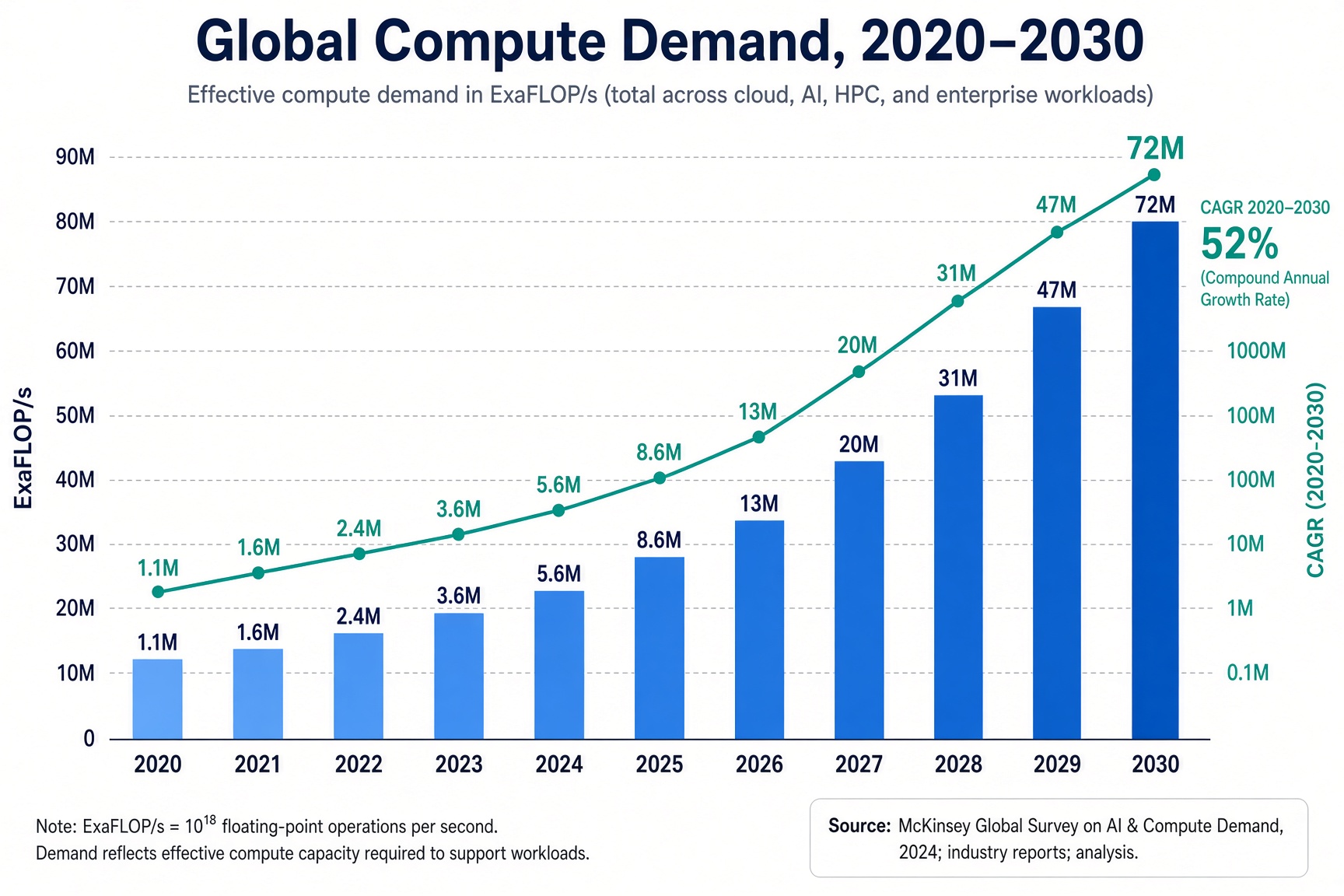
The 2030 Compute Landscape: GPUs, Power and the Architecture of Intelligence
The constraint on AI is no longer ideas or data but compute and the power to run it. Frontier training compute has grown about five times a year since 2020, and the leading AI supercomputer of June 2030 is on course for about 2 million chips and 9 gigawatts. Shayne Heffernan sets out the 2030 arithmetic, the power problem, who has already contracted the gigawatts, and how GPUs, custom ASICs, wafer-scale engines and quantum machines divide the work.
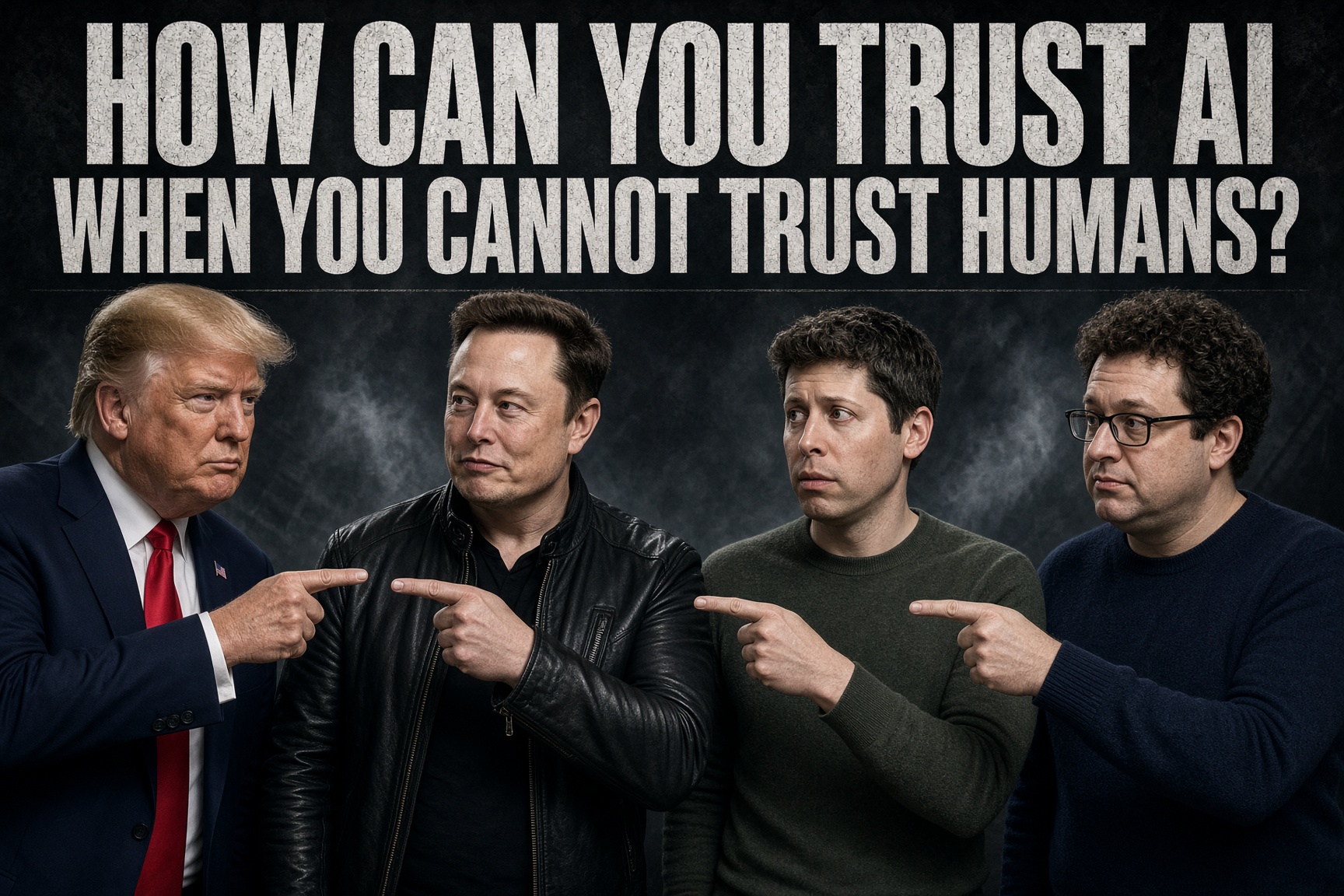
How Can You Trust AI When You Cannot Trust Humans?
Can you trust AI? Can you trust humans? More often than we like to admit, the answer is no. AI inherits its failures from the human records it is trained on. Sheikh Mohammed bin Rashid wrote this month that the currency the UAE is betting on is trust. This piece sets out what a trust layer has to do, shows the method on three public knowledge graphs, and lays out the post-quantum work KXCO has published so that an institution can check the claim rather than take it.
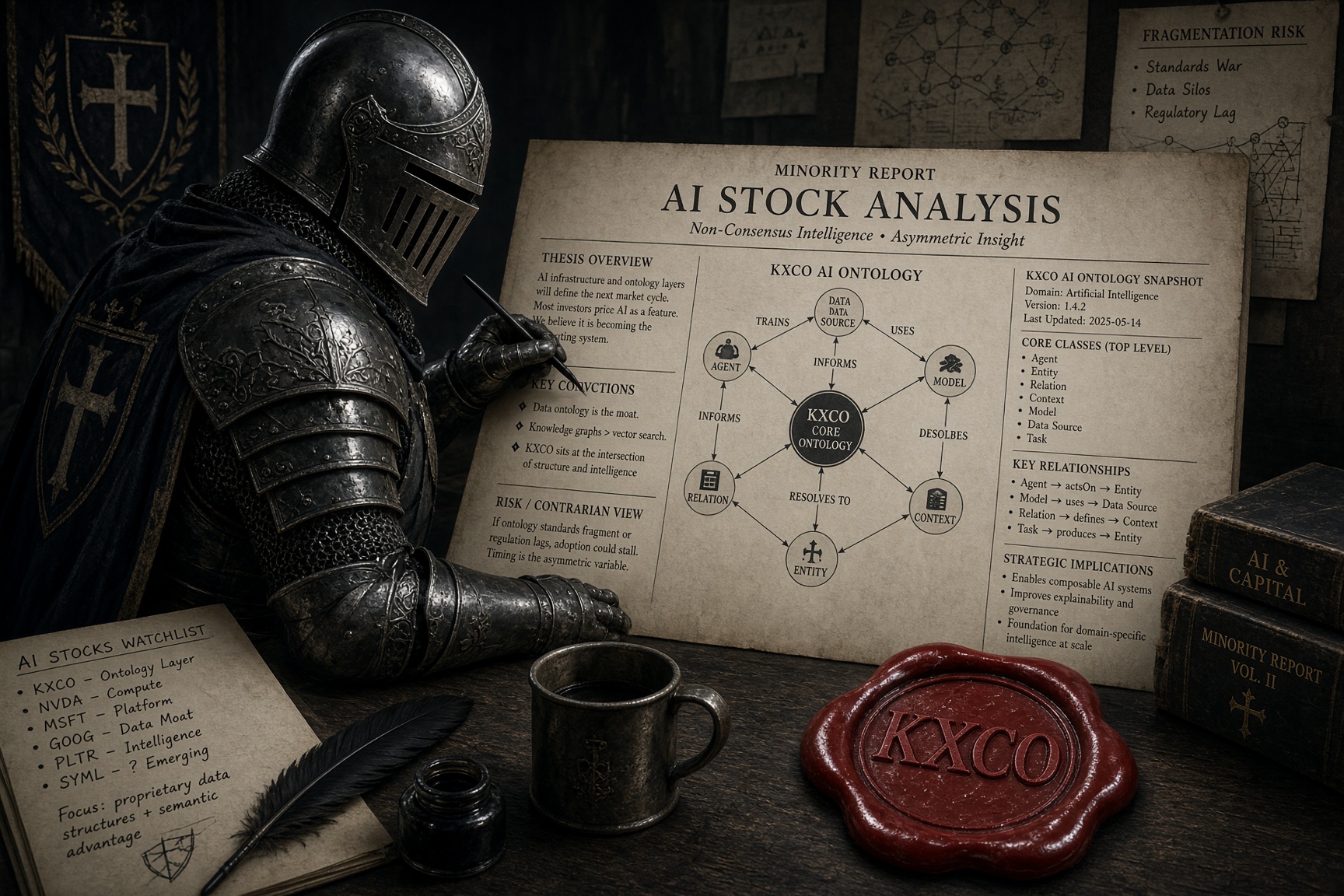
KXCO AI Ontology at 3 Months: What It Called and What Comes Next
On 19 July 2026 the Round Table's AI room published its first Analyst Outlook. To the 16 October 2026 close its 13 names rose 2.6% on an equal weight against 2.1% for QQQ, per StockAnalysis closes, and the six it opened with 35% or more of upside rose 8.6%. This piece lists the six names up more than 5%, the ten names I rate as opportunities now, the month's results in AI and quantum computing, and the official data showing that four in five firms have not yet started using AI.

SpaceX: The Road to 10 Gigawatts
SpaceX did not add an AI business. A company whose processes run on compute built its own computing plant, then built the power to run it. The 10-Q reports 1.4 gigawatts of nameplate compute at 30 June 2026, four leases worth about $41 billion a year and $100 billion of cash. The target is closer to 10 gigawatts than 5 by the end of 2027. This piece sets out the build sequence, the four layers of power in Memphis, and why Terafab is the act after 2027, not the road to it.
Every story, signed and delivered.
Subscribe to the kxco channel and get the headline, the AI-written key takeaways, and the chain-anchor link the moment we publish. Audio versions and per-ticker subscriptions arrive in the next iteration.