
Semiconductor Stocks to Own Now
The sector resolves to a handful of machines, three memory houses, one foundry island, and a circular book worth $429 billion
Part of theStocks Center
The sector does not resolve to Nvidia. It resolves to a handful of machines, three memory houses, one foundry island, and a circular book of capital that is smaller than the shorthand suggests and more concentrated than the shorthand admits.
Here is the ownership stack first, because that is what the question asks. ASML at the root. TSMC as the conversion step. Micron, SK Hynix and Samsung as the binding input. Synopsys and Cadence as the rules layer. Nvidia and AMD held as the demand hub, not mistaken for the machine. The reasoning is below, and every number in it traces to a dated claim on the public map at kxco.ai/ontology-live.
What the graph is for
Most semiconductor writing arrives as a list. Nvidia printed. Micron guided. TSMC raised capex. ASML sold out 2027. The reader is invited to treat each print as an independent event and rank tickers by multiple or momentum. That fills a column. It is a poor way to own the sector.
The useful questions are the ones a graph can answer and a column cannot. If one firm stops shipping, what breaks. Who funds whom. Where announced demand recycles inside a closed cohort. Which listed names sit on a dependency with no second source.
The public map now holds 392 entities and 866 sourced claims, 44 findings ranked by severity, 30 entries on the Revelations panel, and 17 listed majors carrying sell-side consensus. It grows by following dependencies outward, not by listing famous companies. That is why one of the most important entities on it is a Dutch firm in Veldhoven that most people outside semiconductors have never heard of.
The weighting applied here is not a factor model. Upstream first. Single points of failure second. Circular capital third.
How to read a claim instead of a conclusion
The smallest unit on the map is not a company. It is a claim.
Every edge carries a predicate in plain words, a relationship group (physical supply, capital, control, circular flow, government, legal, rivalry, talent, data), a magnitude where one exists, a discovery method, a confidence, a source URL, and two dates: valid from and valid to. That last pair is the part most research desks skip. A graph that cannot tell you what it believed six months ago is a prettier newsletter.
This is also why the ontology does not issue buys. Consensus targets sit on the Analyst Outlook surface as sell-side furniture, dated and attributed. They are not KXCO forecasts. What the structure surfaces is the gap: the dependency with no second source, the layer commoditising while value migrates upstream, the thing everybody needs and nobody has priced. If you want a ticker call you still have to make one. The graph tells you whether that call stands on a monopoly, a triopoly, a circular cheque, or a press release.
Criticality is not connectedness
This is the distinction that decides the whole ownership question, and the graph settles it.
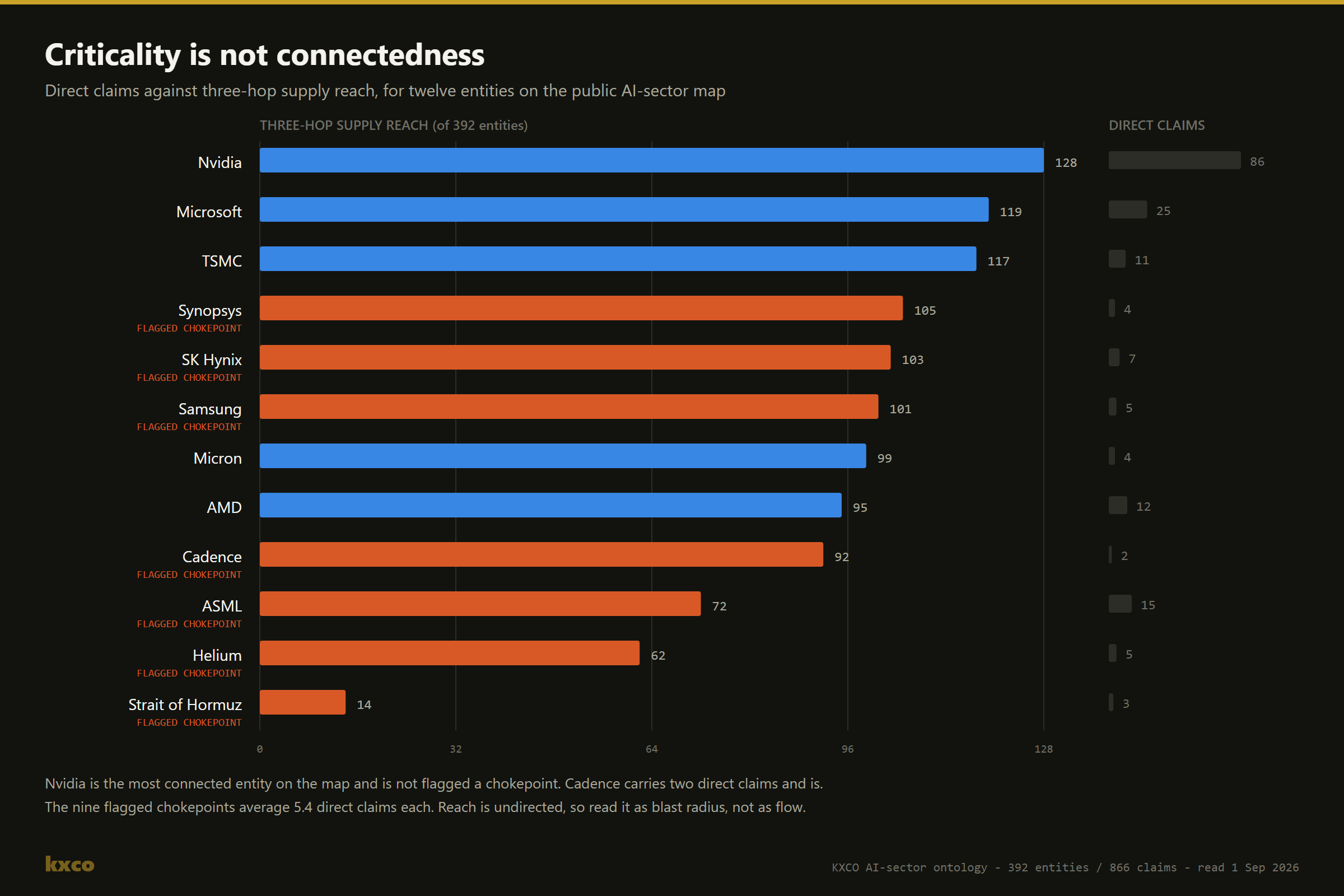
Figure 1. Three-hop supply reach against direct claim count, twelve entities on the public AI-sector map. Chokepoints in orange. KXCO Ontology, 392 entities and 866 claims, read 1 September 2026.
Nvidia is the most connected entity on the map. It carries 86 claims to 65 counterparties, the highest degree by a wide margin, and it reaches 128 of 392 entities within three supply hops. It is not flagged a chokepoint.
Cadence carries two direct claims and reaches 92. It is flagged a chokepoint.
The nine entities the map flags as chokepoints average 5.4 direct claims each. The demand hubs run an order of magnitude above that. Markets pay the hub because it is visible on a screen. The graph pays the chokepoint because nothing prints without it. Those are different measures and the last three years have rewarded confusing them. The next three will not.
Read the reach column as blast radius, not as flow. Direction on these claims lives in the prose, so the traversal is undirected by design.
The tape since late July
Through mid-July the companies that actually make the boom kept printing records. TSMC raised 2026 revenue-growth guidance above 40 percent and lifted capex to about $62 billion. ASML reported second-quarter net sales of €9.3 billion, raised full-year guidance to €43 to €45 billion, and said it is adding roughly 30 percent more Low-NA EUV and DUV capacity for 2027, with 2027 essentially sold out. Memory houses described HBM as allocated through 2027.
Then, in the week ending 29 July, the listed chip complex gave back more than a trillion dollars of market value. SK Hynix shed about $176 billion. Samsung about $173 billion. Micron about $113 billion. AMD and TSMC each gave back more than $100 billion.
That is not the AI trade dying. It is what a market does when capex compounds faster than reported revenue, with 2026 sector capex near $725 billion and up about 77 percent, and when circular capital migrates from equity slogans into credit.
Nvidia then reported fiscal second quarter 2027 on 26 August. Revenue $96.2 billion, up 106 percent, against consensus near $92.2 billion. Data centre $89 billion, up 117 percent. Gross margin held at 75 percent. Third quarter guided to $108 billion. Colette Kress said customer forecasts implied something like 140 percent growth for fiscal 2028 and that Nvidia's own guide of roughly 70 percent was supply-constrained. Jensen Huang said the bottleneck runs at least through fiscal 2028.
The sentence that matters for memory owners is the commitment line. Supply commitments jumped from $119 billion to $279 billion in one quarter, primarily to lock HBM for Vera Rubin. The demand hub reserved three years of the scarcest input in the stack and said so in a filing.
HBM4 on Nvidia platforms has been reported in the low thirties of dollars per gigabyte, nearly double HBM3E. Gartner's late-August forecast put 2026 DRAM revenue growth above 240 percent and had total memory revenue crossing $1 trillion in 2027. Micron, up more than 200 percent year to date, previewed a record fiscal fourth quarter near $50 billion of revenue with gross margin around 86 percent for the 30 September print.
Broadcom reports on 2 September. TSMC prints in mid-October. Top-five hyperscaler capex is tracking toward some $800 billion in 2026. Nvidia cites cloud backlog above $2 trillion. SpaceX sits on the map with a 10-gigawatt end-2027 target. Meta, Amazon and Microsoft appear as counterparties contracting nuclear capacity in gigawatts. The energy layer has entered the semiconductor graph.
Stocks on the move
On the move is not a compliment. It describes where price and narrative have been forced to catch up with a physical constraint.
Nvidia (NVDA), the hub. The commercial expression of the stack, not the machine that prints it. Revenue per gigawatt stepped from about $18 billion in Hopper to about $25 billion on Grace Blackwell and about $40 billion on Vera Rubin. That is pricing power and a bill payable in HBM, CoWoS, EUV wafers and megawatts. Gross margin is guided down a few points into the low seventies as memory runs through the bill of materials. The stock gained on the order of 20 percent year to date while memory names compounded several times that. The market started paying the constraint instead of the brand.
Micron (MU), SK Hynix, Samsung, the HBM triopoly. One hundred percent of merchant high-bandwidth memory sits with three firms, and HBM is sold out through 2027. SK Hynix leads qualification into Rubin on most matrices. Samsung is recovering from yield trouble. Micron is a rising third with leverage from a smaller base: more than 200 percent year to date, a trip through a trillion-dollar market cap, a July drawdown of about $113 billion, then a grind back once the $279 billion commitment made the memory bid official. All three moved because the constraint moved into their fabs.
TSMC (TSM), the island foundry. Still the leading-edge foundry the Western AI stack actually uses. CoWoS-class 2.5D packaging is overwhelmingly its product, and Nvidia has been described as locking on the order of 60 percent of 2026 CoWoS capacity. July monthly sales printed records. Arizona pulled forward: Fab 21 Phase 2 equipment in the third quarter of 2026, N3 targeted late 2026, N2 from 2028, plus an incremental $100 billion on an already large United States pledge. Geography is the residual, and a second listing does not diversify an island.
ASML (ASML), the root. The only maker of EUV tools that print leading-edge logic and the HBM-class DRAM the build needs. High-NA is a monopoly inside a monopoly. A 30 percent capacity add for 2027 and another step in 2028 is what a monopolist does when the book is already sold. It is where four separate risks meet: sole source, demand, geography and policy.
AMD (AMD) and Broadcom (AVGO), the second source and the custom house. AMD is the second frontier GPU supplier the graph can now draw with a straight face, with a two-gigawatt-class Anthropic commitment and Helios moving from slideware into production. AMD also sits inside Anthropic's cap table alongside Amazon, Google, Microsoft and Nvidia, which is five rivals in one cap table. Broadcom is the other diversification path, custom ASICs for hyperscalers who would rather not send every incremental watt through one GPU catalogue. Its 2 September print tests whether custom silicon absorbs demand or rides the same HBM and packaging shortage Nvidia already disclosed.
The rules layer and the tools. Synopsys and Cadence still look like about 96 percent of the relevant design-software market. They are not on the move in the memory-stock sense. They are the rules. Lam Research crossed a $400 billion market-cap conversation in August on the etch and deposition intensity that HBM and gate-all-around require, with Applied Materials, KLA and ASM International on the same side of the bill. Intel remains the political foundry: 18A, IFS, and an industrial-policy bid the graph treats as a government relationship rather than leading-edge share. It can matter without being the constraint.
Name | Role on the map | What moved | Why the graph cares |
|---|---|---|---|
Nvidia | Demand hub, highest degree | $96.2bn Q2, $108bn Q3 guide, $279bn supply commits | 86 claims to 65 counterparties, and no substitute for lithography or HBM |
Micron | HBM triopoly | +200% YTD, $50bn Q4 guide, ~86% GM talk | Binding memory constraint through 2027 |
SK Hynix | HBM leader, flagged chokepoint | July -$176bn market value, Nasdaq raise, sold-out book | Qualification lead into Rubin-class stacks |
Samsung | HBM plus foundry optionality, flagged chokepoint | July -$173bn market value, HBM4 recovery | Only name that is both memory and an alternative foundry |
TSMC | Leading-edge foundry plus CoWoS | Record monthly sales, US pledge expanded | Taiwan concentration, ~95% of leading 2.5D class packaging |
ASML | Sole EUV and High-NA, flagged chokepoint | FY guide €43 to €45bn, +30% tool capacity 2027 | Root node, four risks meet |
AMD | Second GPU source | Helios production path, Anthropic compute | Sits inside the circular cap table |
Broadcom | Custom ASIC and networking | 2 September earnings as the next tape test | Hyperscaler attempt to route around one GPU catalogue |
The circular layer, priced
Circular capital is the part of this cycle most likely to reprice violently, and it is the part most often quoted as a round number. The graph carries it as sixteen typed claims, so it can be priced rather than gestured at.
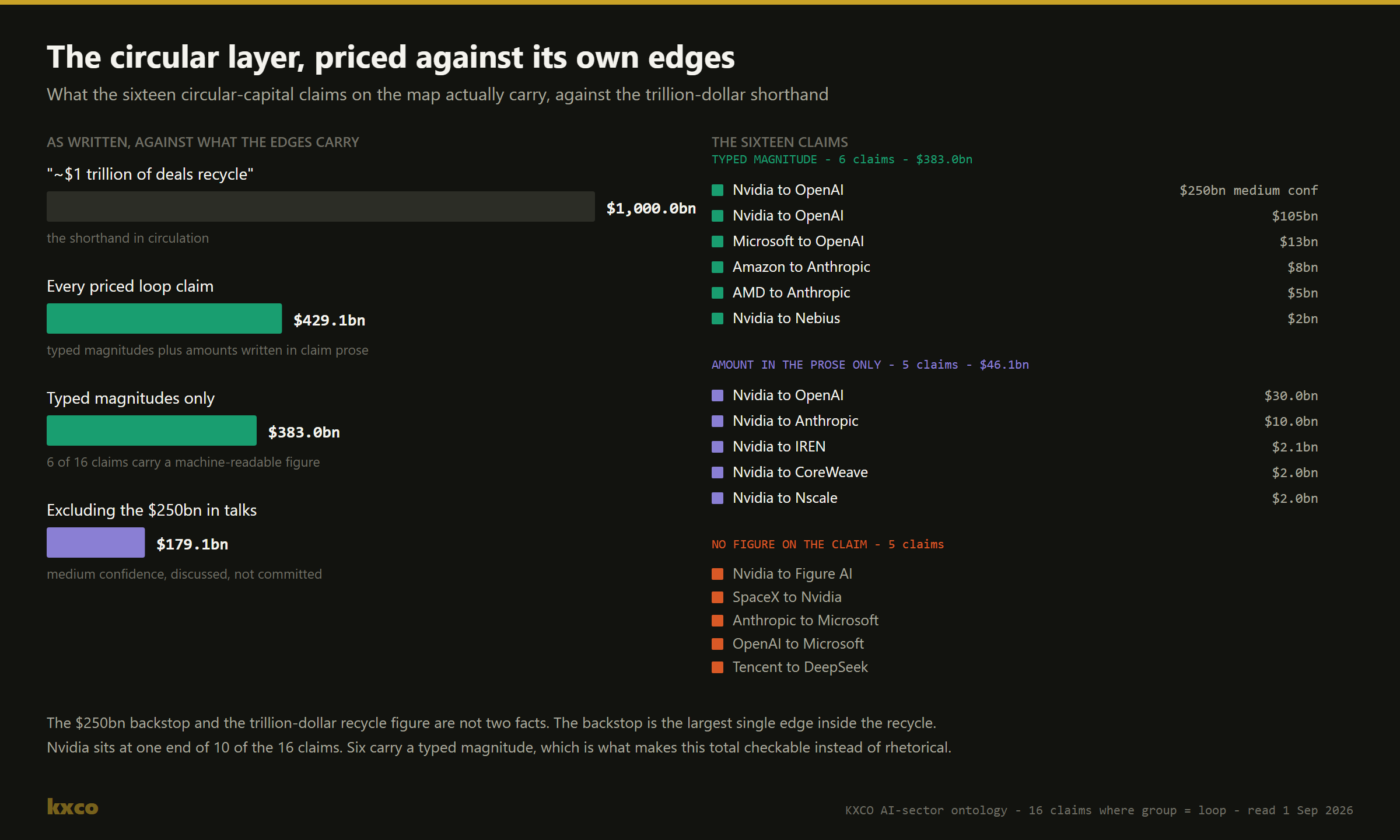
Figure 2. The sixteen circular-capital claims priced against their own edges. Six carry a typed magnitude. KXCO Ontology, read 1 September 2026.
Six of the sixteen claims carry a machine-readable magnitude, and they sum to $383 billion. Five more state an amount inside the claim prose without typing it, worth a further $46.1 billion. Five carry no figure at all. Every priced loop on the map therefore totals about $429 billion.
Two facts fall out of that, and both matter to anyone holding this sector.
The first is concentration. Nvidia sits at one end of ten of the sixteen claims. This is not a diffuse web of mutual investment. It is one balance sheet appearing over and over.
The second is that the largest single component is not committed money. The $250 billion Nvidia-to-OpenAI edge is recorded at medium confidence with the predicate "in talks to backstop debt of." Strip it out and the priced circular book is $179 billion. The $250 billion backstop that circulates as its own headline and the trillion-dollar recycle figure are not two separate facts. The backstop is the largest edge inside the recycle. A dollar counted in both places is still one dollar.
That is the whole argument for keeping this in a graph. Announced, discussed, guaranteed and committed are four different states, and prose flattens them into one.
What the ontology says the sector is
Follow the dependencies down from any frontier training run and the same narrowing appears. Models sit on clouds. Clouds sit on accelerators. Accelerators sit on TSMC wafers and TSMC CoWoS. Those wafers sit on ASML EUV. HBM stacks sit on three memory companies and one packaging calendar. Design sits on Synopsys and Cadence.
Then it keeps going, past where most equity research stops. Helium and process gases sit on geographies the market still treats as footnotes. The map carries the Strait of Hormuz as a flagged chokepoint one hop from semiconductor-grade helium and two hops from TSMC, SK Hynix, Samsung and Micron, on high-confidence claims that name helium a non-substitutable input. The state appears as shareholder and rent-taker across roughly 30 equity positions, with about 15 percent of some chip revenue still touching China. Eight firms cleared the frontier gate.
China is on the map, not absent from it. Roughly 30 Chinese models against 50 American. Compute still lopsided, around 75 percent of GPU clusters on the United States side against 15 percent on China's. The second stack is real, thinner at the leading lithography node because of export control, and SMIC is not a like-for-like substitute for N3 and N2.
OpenAI and Anthropic appear as valuation objects more than as scarce assets. Anthropic's post-money figure sat at $965 billion with October 2026 IPO talk. The model layer is the layer the ontology keeps describing as commoditising. Value sits upstream.
The findings surface ranks 44 items: 4 critical, 13 high, 22 elevated and 5 opportunities. The four criticals are Nvidia as a single point of failure, the sector resolving to a handful of firms, the state gating the frontier, and ASML as the point where four separate risks converge.
The ownership stack
The ontology does not tell you what to buy and is not trying to. Anyone who converts a knowledge graph into a strong-buy list is doing a different job. What follows applies the weighting named above, upstream first and single points of failure second. It is a map of scarcity, not a ticket.
First weight, the root. ASML. If the only test is whether the rest of the industry can ship leading-edge silicon when this firm goes quiet, ASML fails that test in the direction that matters. There is no second EUV franchise. High-NA concentrates the same fact. Capacity adds of 30 percent are what a monopolist does when the book is already sold. Policy risk is real, since the Netherlands sits inside a United States-led control regime and still sells into China at permitted nodes. Four problems on one ticker. A contested monopoly beats a contested commodity.
Second weight, the conversion step. TSMC. A foundry with mid-70s percent share of the leading edge and something like 95 percent of relevant 2.5D packaging is not a vendor. It is a condition of existence for Nvidia, AMD, Broadcom's custom parts, Apple and the first in-house inference dies. Arizona is insurance, not a replica of Hsinchu. Hold it as the scarce conversion step between an ASML tool and a shippable accelerator, with a geopolitical residual you are not paid enough to ignore. Intel, Rapidus and Samsung Foundry are hedges and politics. They are not yet substitutes.
Third weight, the binding input. Micron, SK Hynix, Samsung memory. Nvidia said in a filed number that it had to more than double supply commitments in a quarter to secure memory. That is the cleanest confirmation the binding constraint moved out of GPU design and into stacked DRAM. Mid-80s gross margins on a $50 billion quarter, if Micron delivers the preview, are what rationed product looks like. Take the basket rather than the single name, because one house can lose a qualification and leave the constraint intact. The July drawdowns of $176 billion, $173 billion and $113 billion were the market offering that constraint at a discount. Whether the discount is still on screen is a price question. The structure has not changed.
Fourth weight, the rules layer. Synopsys and Cadence. A duopoly at roughly 96 percent is the least cinematic chokepoint on the map and one of the most durable. Every advanced node, 3D stack and chiplet partition runs through those toolchains. They need no HBM allocation and they do not sit on the Taiwan Strait. They raise prices when complexity rises, and complexity is the one thing this cycle guarantees. Cadence reaching 92 entities on two direct claims is the cleanest illustration on the whole map of why degree and criticality are different things.
Fifth weight, the hub held as a hub. Nvidia, then AMD. Own Nvidia for the demand function and the software lock-in around CUDA, NVLink and the rack. Do not own it as though it were ASML. The company just said it cannot convert all the demand it can see because memory will not allow it. That sentence caps the bull case and improves the memory case in the same breath. AMD earns its place as diversification inside the hub layer, not as a replacement for the hub.
Sixth weight, the process tools. Lam, Applied Materials, KLA, ASM International and Tokyo Electron are not single points of failure in the same way. They are the industrial capacity that has to grow if ASML's 30 percent add, TSMC's $62 billion budget and Micron's United States build are going to become wafers. They are how you own the capex finding without picking which memory house wins the next qualification. This is also the layer the public map covers most lightly today, which is exactly where a demonstration graph grown outward from a seed set goes next. Second-order is where a lot of the compounding lives once the obvious monopolies are fully priced.
Weight | Names | Ontology reason | Principal risk |
|---|---|---|---|
1 Root | ASML | Sole EUV and High-NA, flagged chokepoint | Export policy, Low Countries politics, High-NA execution |
2 Conversion | TSMC | Leading-edge wafers plus CoWoS-class packaging | Taiwan Strait, customer concentration, capex cycle |
3 Binding input | MU, SK Hynix, Samsung memory | HBM triopoly, Nvidia $279bn commitment | Qualification loss, capex overbuild into 2028 and 2029 |
4 Rules | Synopsys, Cadence | EDA duopoly near 96%, both flagged chokepoints | Antitrust, AI-native design tools |
5 Hub | Nvidia, AMD as second source | Demand function plus software lock-in | Memory tax on margin, custom ASIC share shift |
6 Tools | Lam, AMAT, KLAC, ASMI | Capacity to realise the capex and lithography findings | WFE downcycle if AI capex pauses |
What not to treat as scarce
Frontier labs as though they were foundries. Model companies can raise at nine-hundred-billion-dollar post-money figures and still sit downstream of every chokepoint on this list. Cloud multiples that assume infinite tokens while the token factory is memory-constrained. China-only substitutes that have not cleared EUV. Any thesis that needs the circular cohort to keep writing cheques to itself at last quarter's pace.
The risks that are not filed under geopolitics
Circular capital. Sixteen loops and $429 billion of priced commitments is a real number attached to real counterparties, and one balance sheet is on ten of those loops. When that book meets a credit market it becomes a price event. July was the rehearsal.
Energy. SpaceX at 10 gigawatts, with Amazon and Meta contracting nuclear capacity, means the accelerator is now an electricity derivative. A thesis that stops at the server-hall door is unfinished.
Materials. Helium and sulphur do not trade like NVDA. They have shipping lanes. An interruption upstream of Veldhoven is an ASML problem, then a TSMC problem, then an Nvidia problem, and the map already carries those hops.
Price. HBM in the low thirties of dollars per gigabyte with mid-80s gross margins is a rationing rate, not a resting rate. Hold the triopoly with an exit condition written in units of capacity. When the sold-out stamp comes off 2028, date the claim.
Two questions for the next fortnight
After Broadcom reports on 2 September, does custom silicon show up as incremental HBM demand or as a substitute for Nvidia racks? Only one of those predicates keeps being true.
When Micron reports at the end of September, does the $50 billion-class quarter arrive with 2027 still sold out, or does allocation language soften? That sentence tells you whether the triopoly finding is still a 2027 fact.
How to use the live map this week
Open kxco.ai/ontology-live beside this article. Do not start with Nvidia. Start with ASML and walk downstream, then walk upstream from a hyperscaler capex number and see where the two walks meet. Click an edge. If it does not show a source, a date and a confidence, treat it as decoration. Read the findings surface before the entity surface. You may disagree with the ranking. You may not pretend you assembled it from a single 10-K. Analyst Outlook carries sell-side consensus on 17 listed majors, not our forecast. If a target and a finding disagree, protect the finding.
Closing
The semiconductor market in the first week of September 2026 is not mysterious. It is concentrated. A Dutch lithography monopolist, a Taiwanese foundry, two California design-software firms, three memory companies and one Santa Clara demand hub are the spine. Everything else is commentary, politics, or a second source trying to get born.
Nvidia's $96.2 billion quarter and $279 billion of memory commitments did not change that spine. They published it.
I built the public ontology with John Heffernan because market research kept arriving as prose. Prose persuades. It does not check. You cannot query a column for every position that routes through one Dutch lithography vendor, and you cannot ask a newsletter what it believed in March. A graph answers both. If you own this sector, own the parts the rest of the sector cannot route around. Check the claim. Date it. When the constraint moves, move the weight.
Stocks mentioned in this article: $NVDA, $TSM, $MU, $ASML, $AMD, $AVGO, $SNPS, $CDNS, $LRCX, $AMAT, $KLAC, $INTC, $MSFT, $AMZN, $META and $GOOGL.
Shayne Heffernan, Ph.D., is the founder of Live Trading News, the KnightsBridge Group, Knightsbridge Law and the KXCO.ai ecosystem spanning post-quantum cryptography, identity, attestation and enterprise ontology. The live AI-sector ontology is at kxco.ai/ontology-live and the working guide is at kxco.ai/developers/blog/ontology-live-guide.
Nothing here is investment advice, a solicitation or a rating. The KXCO Ontology is a public demonstration built from public sources that records typed, dated, sourced claims. Figures are drawn from the 1 September 2026 snapshot alongside company filings and contemporaneous market reports. Figures will date. The structure will date more slowly.
KXCO AI Ontology at 3 Months: What It Called and What Comes Next
On 19 July 2026 the Round Table's AI room published its first Analyst Outlook. To the 16 October 2026 close its 13 names rose 2.6% on an equal weight against 2.1% for QQQ, per StockAnalysis closes, and the six it opened with 35% or more of upside rose 8.6%. This piece lists the six names up more than 5%, the ten names I rate as opportunities now, the month's results in AI and quantum computing, and the official data showing that four in five firms have not yet started using AI.

SpaceX: The Road to 10 Gigawatts
SpaceX did not add an AI business. A company whose processes run on compute built its own computing plant, then built the power to run it. The 10-Q reports 1.4 gigawatts of nameplate compute at 30 June 2026, four leases worth about $41 billion a year and $100 billion of cash. The target is closer to 10 gigawatts than 5 by the end of 2027. This piece sets out the build sequence, the four layers of power in Memphis, and why Terafab is the act after 2027, not the road to it.
The China Chip Shock
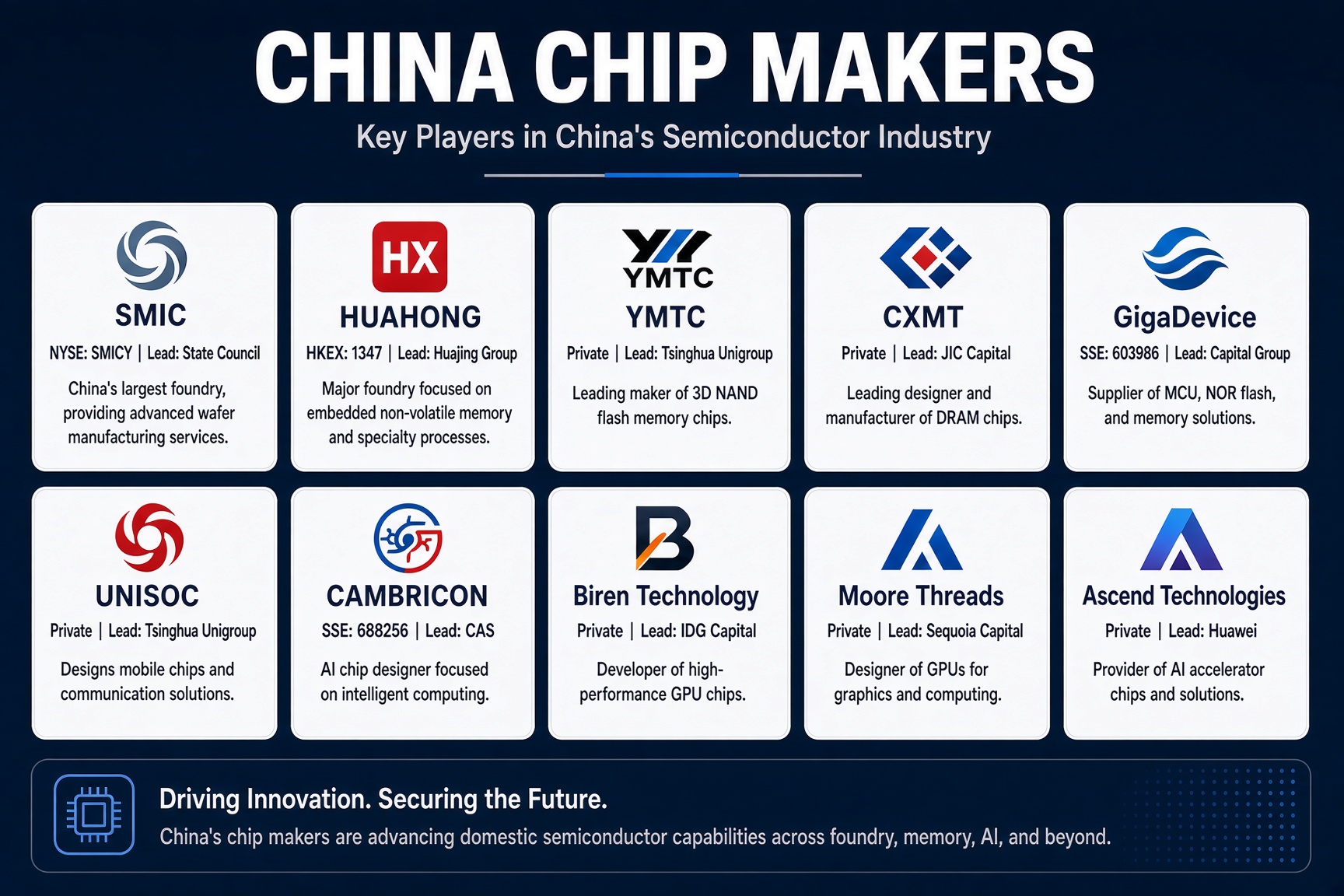
On 10 October CXMT said it will ship DDR5 server modules on a 4F2 cell by year-end. Micron, SK Hynix, Samsung and Sandisk sold off for two sessions and Elon Musk said China scales faster than the rest of the world combined. This piece sets out China's memory makers, foundries, AI chip designers and toolmakers, with two knowledge graphs drawn from the KXCO AI Sector Ontology, and says what the sell-off prices and what it does not.

China's Coordinated Push in AI, Quantum Computing and Blockchain
On 9 October 2026 Beijing called for a nationally integrated computing-power network and a national blockchain network. DeepSeek is scaling on Huawei Ascend chips, China's intelligent computing reached 2,185 EFLOPS by June, per the industry ministry, and quantum communications remain a strength. This analysis explains the strategy and sets out the Hong Kong and US listed companies with exposure, from Tencent and Alibaba to China Mobile, HashKey and Nvidia.
Every story, signed and delivered.
Subscribe to the kxco channel and get the headline, the AI-written key takeaways, and the chain-anchor link the moment we publish. Audio versions and per-ticker subscriptions arrive in the next iteration.