
The China Chip Shock
CXMT's server memory plan took SK Hynix down more than 10% on 13 October 2026, per CNBC. Who makes what in China, on whose tools, and what each piece is measured against, from the KXCO AI record.
On Saturday 10 October the president of ChangXin Memory Technologies, Cao Kanyu, told an industry conference in Shanghai that CXMT will ship DDR5 registered server modules built on a 4F2 memory cell by the end of 2026, per TechNode citing Yicai. A 4F2 cell takes less wafer area than the 6F2 cell the industry uses today, so more memory fits on each wafer. The market read it as a Chinese supplier arriving early in the one memory product that pays for the AI build-out.
The reaction was fast. At the Monday close on 12 October 2026 Micron was down 3.8% and Sandisk 5.9%, per Wall Street Pit. On Tuesday 13 October SK Hynix fell more than 10% and Samsung Electronics 7.4%, both to their lowest since August, and Seagate and Western Digital also fell, per CNBC. Micron was another 5% lower in Tuesday morning trade on 13 October 2026, per 24/7 Wall St.
Elon Musk added to the selling on Monday with a post on X. "When China figures out how to manufacture a product, their ability to scale is often greater than the rest of the world combined. We saw this with lithium batteries and solar, for example." He called SpaceX a counter-example on mass to orbit, then came to memory. "RAM was a low margin commodity only ~3 years ago. LP5 and LP6 are designed to a common standard that China seems to be solving fast." Newer HBM architectures, an SRAM layer under the logic and RAM stacked on top of it "will be harder to solve", per Invezz.
That is the right frame. Where the product is a standard, China scales it. Where the product needs a tool China cannot buy, China is still behind. This piece sets out who makes what in China, on whose tools, and what each piece is measured against. The supply chain is drawn from the KXCO AI Sector Ontology, the public record of the AI sector that KXCO keeps at kxco.ai, as of 12 October 2026.
Memory is where the scale shows first
CXMT is China's DRAM maker. It listed on Shanghai's STAR Market on 27 July 2026 as 688825, priced at RMB 8.66 a share, and raised RMB 57.919 billion. At the close on 27 July 2026 it was RMB 49, up 465.8%, with a market value of about RMB 3.28 trillion, per TrendForce. That close put it past ICBC as the most valuable company listed on the mainland, per CNBC. Its first-half revenue was 150.31 billion yuan, up 874%, with net profit of 77.61 billion yuan, per the unaudited interim report read by Stockhub. The state is in the register: the second phase of the national chip fund held 8.73% at listing, the third-largest holder, per NBD reading the prospectus. Live Trading News profiled the company at the time: CXMT: Inside ChangXin Memory Technologies.
The share figures are the point. CXMT took 9.5% of global DRAM revenue in the second quarter of 2026, fourth behind Samsung at 39.4%, SK Hynix at 24.9% and Micron at 23.3%, per TrendForce via TweakTown and the TrendForce release of 7 September. The industry's DRAM revenue rose 59.5% in the quarter to nearly $154.73 billion, per the same release. CXMT grew its share inside a market that was itself growing at a record pace.
High-bandwidth memory is the harder product, and CXMT has started on it. The company has begun small-scale HBM3E production and has supplied samples to Alibaba's chip unit T-Head and to Cambricon for testing, with a ramp planned for 2027, per The Information via Korea JoongAng Daily. Its interim report discloses no HBM product. The KXCO record carries CXMT with HBM2 in mass production and HBM3 in development as of July 2026. That is where Musk's "harder to solve" lands. SK Hynix held 50% of HBM revenue in the second quarter, Samsung 33% and Micron 18%, per Counterpoint via Edaily, and the gap to CXMT is measured in generations.
NAND is the second memory story. Yangtze Memory Technologies passed Kioxia in the second quarter to rank third in the world by NAND bit shipments at 14%, behind Samsung at 25% and SK Hynix at 22%, while ranking fifth by revenue, per Caixin. Its parent, CCSH Corporation, had its STAR Market application accepted in August. It seeks 33 billion yuan for 10% to 12% of its enlarged capital, which implies a value of up to 330 billion yuan, with 20.8 billion yuan earmarked for production lines and 12.2 billion yuan for research, per Caixin. The first two phases of the national chip fund hold 11.97% and 11.38% of it, per Sina Finance reading the prospectus.
Exhibit 1 draws the week: the statement, the post, the names it hit, and the HBM3E work behind the worry. Each numbered link is a sourced claim, and links 13 to 15 are read from the KXCO AI record.
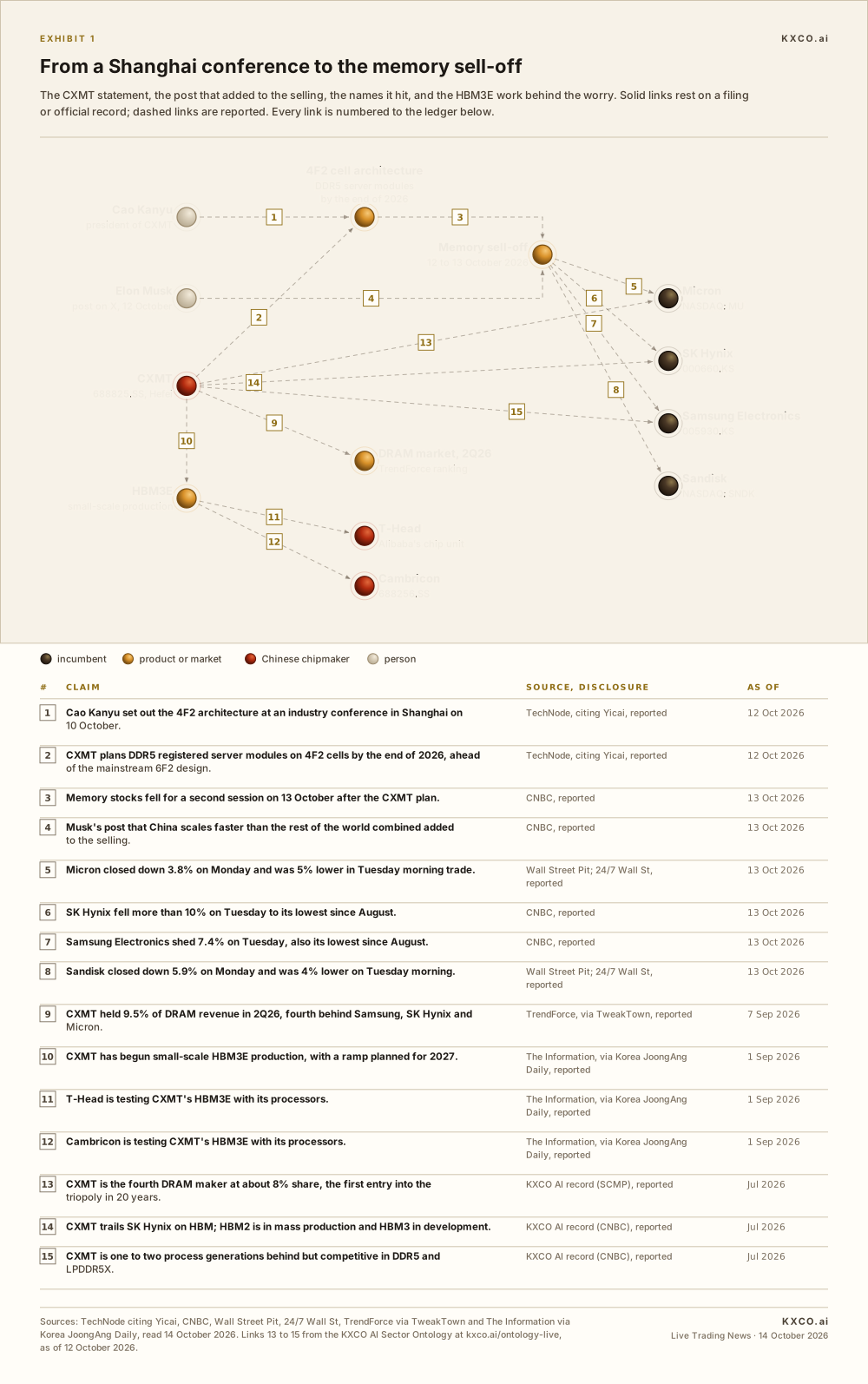
Exhibit 1. From a Shanghai conference to the memory sell-off. Each numbered link is a sourced claim, listed under the graph. Links 13 to 15 are from the KXCO AI Sector Ontology.
Foundry: third place without EUV
Semiconductor Manufacturing International Corporation is China's largest contract chipmaker, listed in Hong Kong as 0981 and in Shanghai as 688981. In the second quarter of 2026 it ranked third among pure-play foundries with 5.4% of revenue, behind TSMC at 72.5% and Samsung Foundry at 5.9%, per TrendForce. The top 10 foundries earned $53.49 billion in the quarter, a record, per the same release. SMIC's own figures for the quarter were revenue of $3,005.6 million, up 20% on the first quarter, utilisation of 93.7% and a gross margin of 25.3%, with third-quarter revenue guided up 2% to 4%, per its results announcement.
SMIC has done this without extreme ultraviolet lithography, which ASML has never shipped to China. The KXCO record holds ASML as the sole maker of EUV and the supplier of the deep ultraviolet immersion scanners that Chinese fabs can still buy. SMIC's N+3 process, which makes Huawei's Kirin 9030, is a scaled evolution of its 7 nm-class technology made without EUV, per TechInsights. The yields and costs sit generations behind TSMC's EUV nodes.
Hua Hong, listed in Hong Kong as 1347, is China's second foundry. It ranked sixth in the world in the quarter with revenue of $1.27 billion, up 3.5%, per TrendForce. Its own second-quarter figures were revenue of $717.5 million, up 26.8% on a year earlier, at 102.8% utilisation, per its results announcement. It makes power devices, embedded non-volatile memory, analogue, radio frequency and image sensors on mature nodes. Nexchip, listed on the STAR Market as 688249 since May 2023, ranked ninth at $447 million, up 6.4%, per the same TrendForce release. It is a display-driver and mature-node fab, with 28 nm in trial production since June, per a Gelonghui broker note.
The newest entrant listed on Monday. Guangzhou CanSemi Technology listed on Shenzhen's ChiNext board as 301660 on 13 October at 12.01 yuan a share and opened more than 270% higher, the first wafer fabrication company on that board, per Dealroom and The Standard. It is a 12-inch fab in South China on nodes from 180 nm to 55 nm, for analogue chips, power devices and silicon photonics.
AI chip designers: fed by substitution
Cambricon, listed on the STAR Market as 688256, is the listed name that stands in for China's answer to Nvidia. In 2025 it posted its first annual profit since listing, 2.06 billion yuan on revenue of 6.5 billion yuan, per Yicai via the Shanghai Stock Exchange. Its first-half 2026 revenue was 5.996 billion yuan, up 108%, and net profit 2.311 billion yuan, up 123%, with inventory of 8.25 billion yuan at the end of June, larger than the half's revenue, per Caixin. Huawei's and Cambricon's chips went on the government procurement list in December 2025, per the FT via Huawei Central. The KXCO record has Cambricon's parts made at SMIC on older nodes after the TSMC cut-off, which is the constraint on the whole group.
Moore Threads and MetaX, the two GPU designers, listed on the STAR Market in December 2025 as 688795 and 688802. At the close of its first day, 5 December 2025, Moore Threads was 600.50 yuan against an offer price of 114.28 yuan, up 425%, per Yicai. MetaX ended its first day in December 2025 at 829.90 yuan from 104.66 yuan, per Yicai. In the first half of 2026 Moore Threads' revenue was 1.73 billion yuan, up 147%, at a net loss of 11.56 million yuan, and MetaX's revenue was 1.324 billion yuan, up 44.67%, at an attributable net profit of 612 million yuan, per CNFIN.
Hygon, 688041, makes x86-compatible processors and data-centre accelerators. Its merger with the supercomputer builder Sugon was called off in December 2025 before any vote, per The Register. Biren, Enflame and Iluvatar CoreX sit behind them. Huawei's HiSilicon is the largest domestic designer by volume and is not listed. The KXCO record has DeepSeek training its V4 model end to end on Huawei's Ascend 950PR, and Tencent, ByteDance and Alibaba ordering the same part. That is the demand that feeds Cambricon and SMIC alike.
Nvidia's own China business is small now. Its H200 shipments to China were less than 1% of data-centre revenue in the quarter to July, under licences granted in February and sales the Chinese government restricted, per its 10-Q.
Equipment: the part that is still being built
NAURA Technology Group, listed in Shenzhen as 002371, is China's largest chip equipment maker, in etch, deposition, thermal processing and cleaning. Its 2025 revenue was 39.353 billion yuan, up 30.85%, per Wallstreetcn, and it ranked fifth in the world by 2025 sales behind ASML, Applied Materials, Lam Research and Tokyo Electron, per Nikkei via TrendForce.
Advanced Micro-Fabrication Equipment, AMEC, listed on the STAR Market as 688012, makes plasma etch and chemical vapour deposition tools. Its first-half 2026 revenue was 6.691 billion yuan, up 34.89%, per CLS, and SMIC has bought at least 800 of its machines, per TrendForce. CXMT is qualifying NAURA and AMEC tools beside its ASML DUV scanners, per the KXCO record.
Piotech, ACM Research Shanghai and Hwatsing are the other listed toolmakers, JCET the packaging house, and OmniVision, Rockchip, Allwinner and VeriSilicon the specialist designers. None of them makes a lithography tool at the leading edge. That is the gap the export controls were written around, and it is the one that has not closed.
The stack, and what each piece is measured against
Exhibit 2 draws the supply chain as the KXCO record holds it. ASML is the sole maker of EUV and the maker of the DUV immersion scanners China can still buy. About 20% of its 2026 revenue comes from China, DUV only, down from 33% in 2025, per Caixin. ASML is the sole EUV supplier to TSMC, and TSMC makes Nvidia's leading-edge silicon. Intel is the first to run High-NA EUV in volume production, on selected 18A layers, and TSMC plans High-NA from 2030, per TechNews. Huawei has its Ascend chips made at SMIC, and so do Cambricon and Moore Threads. The rankings on the right of the graph are the measurement: TSMC at 72.5% of foundry revenue, SMIC at 5.4%, Hua Hong sixth, Nexchip ninth, and YMTC third in NAND by shipments.
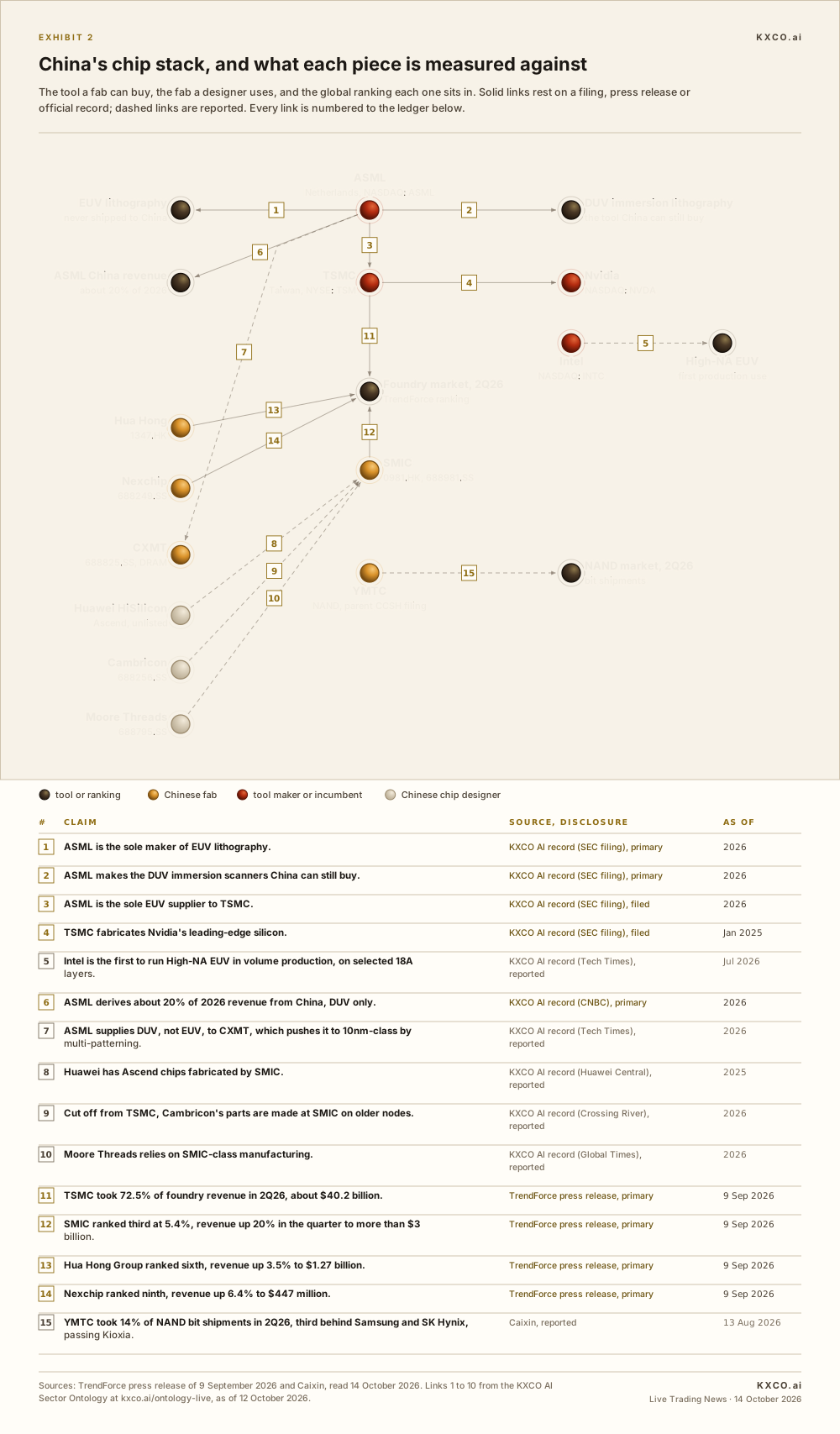
Exhibit 2. China's chip stack, and what each piece is measured against. Links 1 to 10 are from the KXCO AI Sector Ontology, links 11 to 15 from TrendForce and Caixin.
The record behind both exhibits is public. The explorer is at kxco.ai/ontology-live, the machine-readable file is data.json, and the guide explains the claim shape: who owns, funds and depends on whom, each claim with its source, its disclosure class and the date it was recorded. Live Trading News explained the method in Inside the KXCO AI Sector Ontology and set out the memory case in AI Makes Storage and DRAM Strategic Assets.
What the sell-off prices, and what it does not
The sell-off prices commodity DRAM. A 4F2 DDR5 server module from a supplier with 9.5% of the market and RMB 57.9 billion of fresh capital is a real threat to DRAM pricing in 2027. Micron sells the same product and fell hardest for that reason. Samsung's own 4F2 timetable is reported at 2028, so CXMT would be first if it ships on schedule, per TweakTown. Micron did not name CXMT on its 30 September call. It said it is "at least 2 nodes ahead of the China competition", per the transcript.
The sell-off does not price HBM, and it should not yet. SK Hynix supplies more than half of HBM3E and is Nvidia's launch partner for HBM4, per the KXCO record. CXMT's HBM3E is in small-scale production and in testing at two domestic designers. The product China is solving fast is the one built to a common standard. The product that needs a stacked, cooled, custom part is years out, and the one that needs EUV is further still.
For investors the exposure runs two ways. The Chinese names are the memory makers, CXMT and the coming CCSH listing, the foundries SMIC, Hua Hong, Nexchip and CanSemi, the designers Cambricon, Moore Threads, MetaX and Hygon, and the toolmakers NAURA and AMEC. The names that sold off are the incumbents those companies are measured against: Micron, SK Hynix, Samsung and Sandisk in memory, and ASML, which carries about a fifth of its revenue from China on DUV tools that a proposed US bill, the MATCH Act, would restrict further, per the KXCO record.
The next facts to watch are CXMT's first 4F2 DDR5 server module shipment, due by the end of December, the CCSH listing date on the STAR Market, and SMIC's third-quarter results in November, which will show whether utilisation held through the quarter the sell-off is now pricing.
Stocks mentioned: $MU (NASDAQ), $SNDK (NASDAQ), $WDC (NASDAQ), $STX (NASDAQ), $NVDA (NASDAQ), $INTC (NASDAQ), $ASML (NASDAQ), $TSM (NYSE), $AMAT (NASDAQ), $LRCX (NASDAQ), $SPCX (NASDAQ). Also mentioned, by local code. Memory: CXMT 688825.SS, SK Hynix 000660.KS, Samsung Electronics 005930.KS. Foundry: SMIC 0981.HK and 688981.SS, Hua Hong 1347.HK, Nexchip 688249.SS, CanSemi 301660.SZ. Designers: Cambricon 688256.SS, Moore Threads 688795.SS, MetaX 688802.SS, Hygon 688041.SS. Equipment: NAURA 002371.SZ, AMEC 688012.SS.
Sources: TechNode citing Yicai, CNBC, Wall Street Pit, 24/7 Wall St and Invezz on the sell-off; TrendForce's releases of 7 and 9 September 2026 and its DataTrack note of 28 July; SMIC's and Hua Hong's results announcements on HKEXnews; Nvidia's 10-Q; Caixin, Dealroom, The Standard, Korea JoongAng Daily, Edaily, TweakTown, Yicai, CNFIN, NBD, Sina Finance, Stockhub, Gelonghui, Wallstreetcn, CLS, TechInsights, TechNews, The Register, Huawei Central and the Motley Fool transcript; and the KXCO AI Sector Ontology as of 12 October 2026, all read on 14 October 2026.
Shayne Heffernan, Ph.D., is the founder of Live Trading News, the KnightsBridge Group, Knightsbridge Law and the KXCO.ai ecosystem spanning post-quantum cryptography, identity, attestation and enterprise ontology.
This commentary is for informational purposes and does not constitute investment advice.

China's Coordinated Push in AI, Quantum Computing and Blockchain
On 9 October 2026 Beijing called for a nationally integrated computing-power network and a national blockchain network. DeepSeek is scaling on Huawei Ascend chips, China's intelligent computing reached 2,185 EFLOPS by June, per the industry ministry, and quantum communications remain a strength. This analysis explains the strategy and sets out the Hong Kong and US listed companies with exposure, from Tencent and Alibaba to China Mobile, HashKey and Nvidia.

Week Ahead on Wall Street: CPI, Banks and Oil
September CPI lands on Wednesday after a Fed hike and a 10-year yield at its highest since 2002. JPMorgan, Goldman and Citi open bank earnings on Tuesday, ASML and TSMC report midweek, and Saudi pipeline attacks kept Brent at $104.72 on 9 October 2026, per CNBC. The KXCO AI Sector Ontology still shows contracted demand. This week ahead sets out the calendar, the three facts that would change the call, and why dips in the AI leaders remain buying opportunities.
AI Is Being Powered by Tech That Looks Almost Alien
Every frontier AI model runs on chips printed by one Dutch machine. ASML's extreme-ultraviolet scanner fires a laser at up to 50,000 droplets of molten tin a second, per ASML, and bounces the light off mirrors whose deviations are tens of picometres. Veritasium called it the closest thing we have to alien technology. This piece takes the film as the brief and checks it: the machine, High-NA, and the wafer-scale chips and liquid-cooled racks downstream of it.

There Is No AI Bubble
There is no AI bubble. A bubble is capacity nobody uses, demand nobody signs for and a glut when the building stops. KXCO's AI sector ontology, refreshed on 7 October 2026, finds the reverse: adoption rising on six independent measures, about $2.35tn of contracted backlog at the four largest sellers of compute per their own reports, and supply rationed at every layer. It keeps the bear case in the same record, 20 circular capital claims, and answers it.
Every story, signed and delivered.
Subscribe to the kxco channel and get the headline, the AI-written key takeaways, and the chain-anchor link the moment we publish. Audio versions and per-ticker subscriptions arrive in the next iteration.