
There Is No AI Bubble
A bubble is capacity nobody uses, demand nobody signs for and supply nobody wants. KXCO's AI sector ontology, refreshed on 7 October 2026, finds the reverse on all three, and keeps the bear case in the same record.
Part of theAI Stocks Center
There is no AI bubble. A bubble is capacity built for buyers who never arrive, and it leaves three marks: the thing being built goes unused, nobody signs to pay for it, and when the building stops there is a glut. KXCO's AI sector ontology was refreshed on 7 October 2026 with the latest adoption readings and the week's deals. It now holds 401 entities and 937 claims, each with its source and the date it was true, per its public page. On all three marks it finds the reverse. It also keeps the evidence against the thesis in the same record, and this article draws that too.
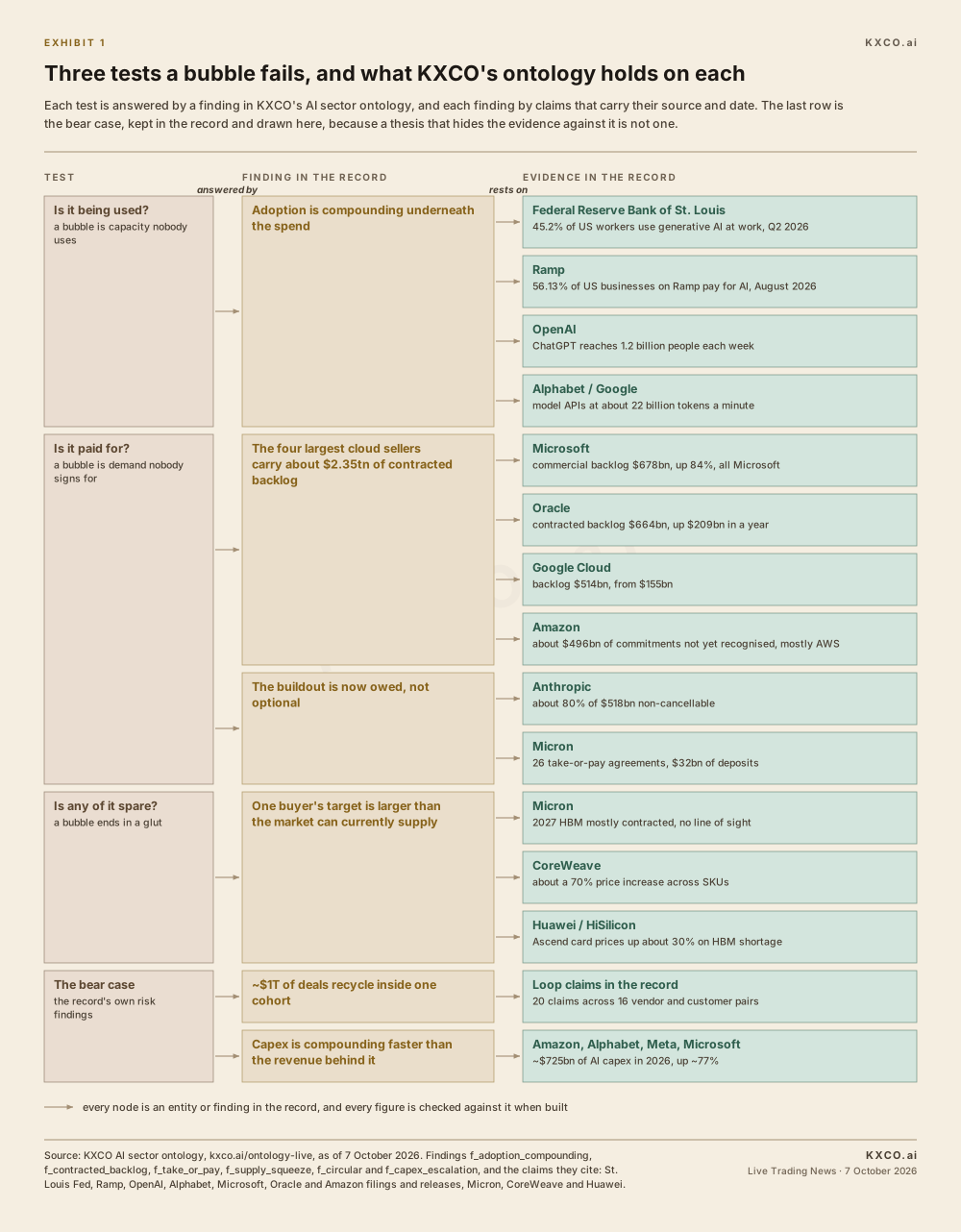
Exhibit 1. Every node is an entity or finding in KXCO's AI sector ontology, and every figure was checked against the record when the exhibit was built.
Adoption is compounding
The ontology now carries an AI Adoption measure, and every reading in it is its own claim with its own date, so the growth is read across claims rather than asserted in one. Six independent series, taken by different methods of different populations, all move the same way.
US workers. The share of employed US adults using generative AI for work rose from 33.3% in Q3 2024 to 45.2% in Q2 2026, per the St. Louis Fed's Real-Time Population Survey. It has risen in every quarter since Q1 2025.
US businesses paying for it. 56.13% of US businesses on Ramp paid for AI tools in August 2026, per the Ramp AI Index. A year earlier it was 44.98%, and two years earlier 34.21%.
European enterprises. 19.95% of EU enterprises used AI in 2025, up from 13.48% in 2024, per Eurostat.
Organisations. 88% of surveyed organisations used AI in at least one business function in 2025, up from 78% in 2024, per the Stanford AI Index 2026.
Adults. 44% of US adults used ChatGPT in February 2026, against 18% in 2023, per the Pew Research Center.
The platforms. OpenAI says "ChatGPT reaches 1.2 billion people each week", up from 800 million a year earlier. Google's model APIs processed about 22 billion tokens a minute in Q2 2026, from about 7 billion three quarters before, per Alphabet.
None of these is a forecast, and none is averaged with another. Ramp's customers lean towards smaller, tech-forward firms. The Census Bureau changed its business question in November 2025 and now reads 19.8% of US employer businesses using AI, per the Census Bureau. Pew changed its wording in 2026. The direction survives every one of those caveats.
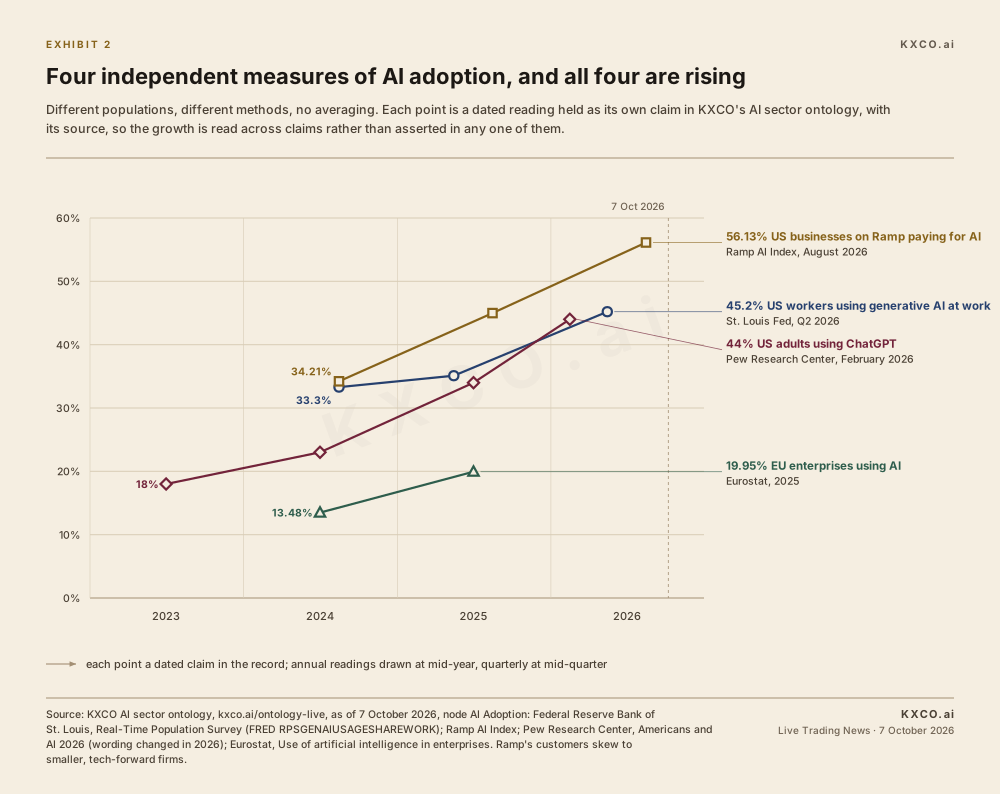
Exhibit 2. Each point is a dated reading held as its own claim in the ontology, with its source.
The demand is signed for
Backlog is revenue already contracted and not yet recognised. It is the opposite of a story. Microsoft's commercial backlog is $678bn, up 84%, per its 8-K. Oracle's is $664bn, up $209bn in a year, per its 8-K. Google Cloud's backlog is $514bn, from $155bn three quarters earlier, per Alphabet. Amazon reports about $496bn of commitments not yet recognised, mostly AWS, per its 10-Q.
That is about $2.35tn of contracted backlog at the four largest sellers of compute, per the ontology's new backlog finding. It includes business that is not AI, and much of it is owed by a few large buyers. What it rules out is the claim that the capacity is being built for demand nobody has signed for.
The buyers' side of the ledger reads the same way. Anthropic has at least $518bn of infrastructure commitments over a decade, per Reuters. About 80% of it is non-cancellable, by Reuters' reading of the confidential prospectus. Akamai added $11.6bn over seven years from Anthropic on 24 September, per Akamai's 8-K as the ontology records it. Micron has 26 take-or-pay supply agreements, per the ontology's take-or-pay finding. They are backed by $32bn of customer commitments, most of them cash deposits, per the same finding. The labs' commitments sit inside the sellers' backlog, so the two are never added together.
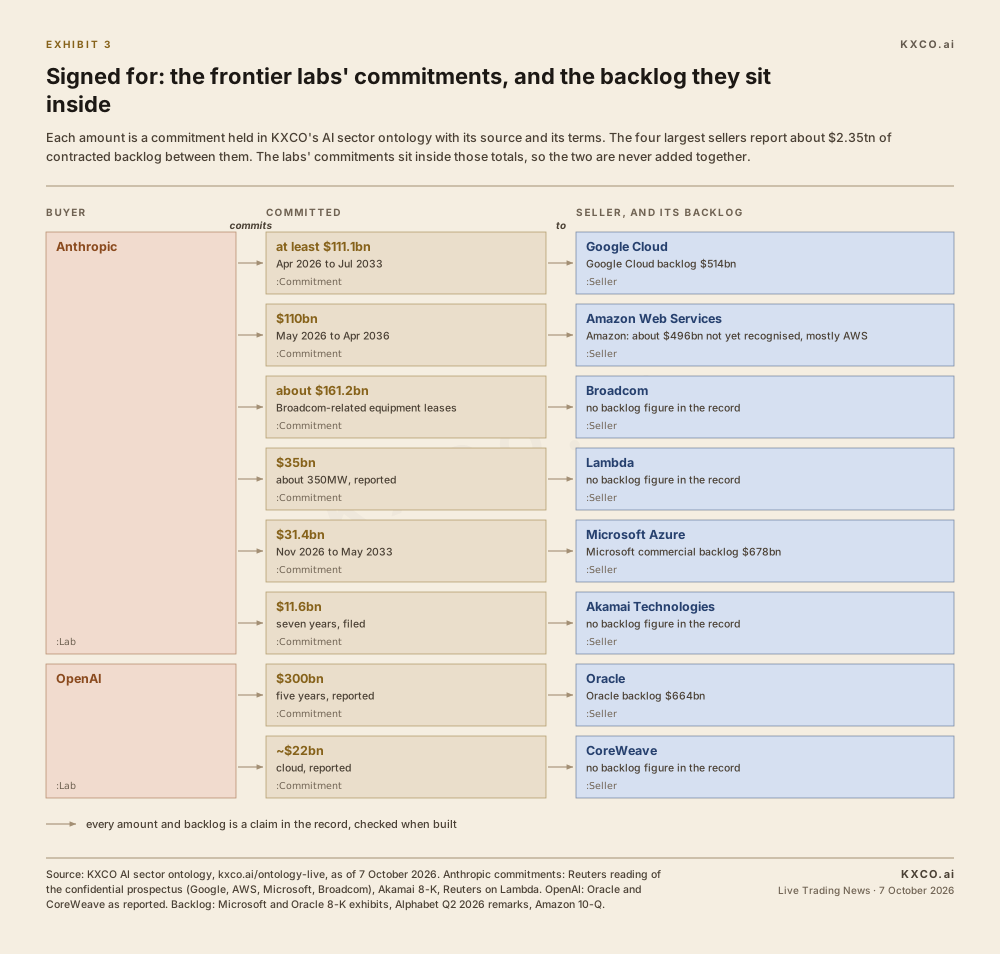
Exhibit 3. Each amount is a commitment held in the ontology with its source and terms.
The revenue is arriving with the spend
In a bubble, revenue trails the capital for years. Here it is accelerating with it. Nvidia's Data Center revenue was $89.0bn in its latest quarter, up 117%, per Nvidia. The growth rate was 56% a year earlier and 92% the quarter before, per Nvidia's earlier releases.
Google Cloud revenue rose 82% to $24.8bn, per Alphabet's 8-K. Azure grew 43%, from 40% a quarter earlier, per Microsoft. AWS grew 37%, per Amazon, its fifth straight quarter of faster growth.
The labs that rent the capacity are growing faster still. Anthropic's run-rate revenue crossed $47bn in May 2026, from about $9bn at the end of 2025, per Anthropic.
The capacity is short, not spare
A glut is how a bubble ends. Every layer of this market is rationing instead.
Micron says most of its calendar 2027 HBM supply is already contracted at significant increases, per its prepared remarks. It also says it has no line of sight to when supply and demand return to balance. Huawei raised Ascend card prices by about 30%, per Reuters, citing a shortage of high-bandwidth memory. CoreWeave's filed presentation shows its prices up about 70% across SKUs in July 2026, per the ontology's supply finding.
At Google, demand for its models is turning into token usage. Sundar Pichai told shareholders "we continue to be supply constrained", per Alphabet. Rising prices and rationed supply are the signature of a shortage, and a shortage is the opposite of a bubble.
The bear case, kept in the same record
A thesis that hides the evidence against it is not one. The ontology holds the bear case, and Exhibit 4 draws all of it.
The loops are real. The record holds 20 loop claims across 16 vendor and customer pairs, per the ontology. In each, a vendor funds a customer, and the customer spends it with the vendor. Nvidia has put $30bn of equity into OpenAI, per the ontology. It has also guaranteed leases at an Ohio campus where OpenAI is the tenant, with its payments capped at $105bn and owed only if OpenAI defaults, per Nvidia's 8-K. The Bank of England warned in July that AI companies' revenue forecasts may reflect "circular financing arrangements", per its Financial Stability Report.
The spending is real too. The four largest hyperscalers guide to about $725bn of AI capital spending in 2026, up about 77%, per the ontology's capex finding. Oracle's free cash flow was negative $5bn in its quarter to 31 August 2026, per its 8-K. At Alphabet it was negative $5.9bn in Q2 2026, per its 8-K.
Both are funding questions. Neither is a demand question. A vendor's equity can buy a customer's GPUs. It cannot make 45.2% of employed Americans use generative AI at work, per the St. Louis Fed. It cannot put ChatGPT in front of 1.2 billion people a week, or move 56.13% of Ramp's businesses onto a paid plan, per OpenAI and Ramp. The loops decide who carries the risk if adoption slows. The adoption readings say it is not slowing.
When the market did test the thesis, more than $1tn came off chip market values in the week ending 29 July 2026, per CNBC. The ontology recorded the follow-through: the repricing reversed rather than extended, which reads as volatility around an intact spending thesis.
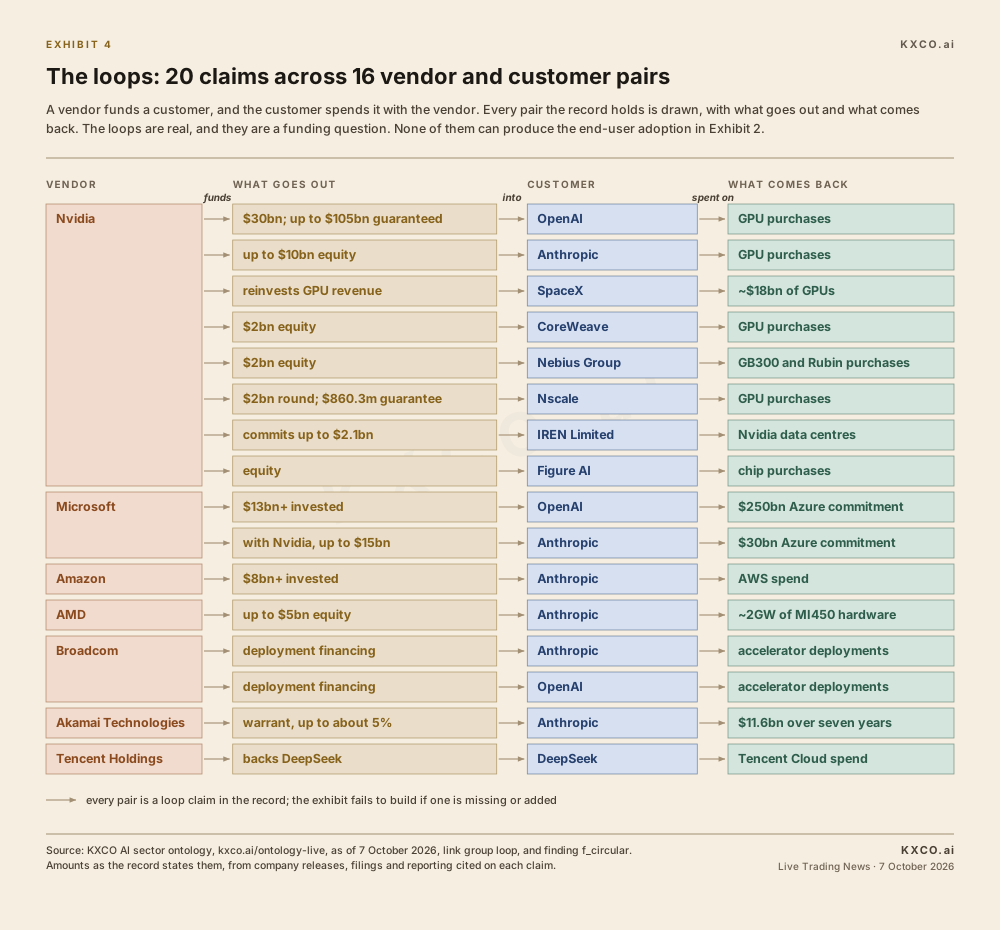
Exhibit 4. Every loop pair the record holds is drawn, and the exhibit fails to build if one is missing.
What would change the answer
Four things would, and each is already a dated claim in the ontology. The adoption series turning down for two readings in a row. Backlog shrinking at the four largest sellers. GPU rental and HBM prices falling. Capex cut rather than raised at two guidance cycles running. The day any of them turns, the record shows it, with its source and its date.
How the ontology knows
KXCO's ontology engine keeps every claim with its source, the date it was true and the date it was recorded. Those are two independent time axes, so nothing can be backdated, and a claim that stops being true is marked superseded and dated rather than deleted. The public AI sector map is the engine pointed at public data. The same engine runs against private books of record for funds, family offices and institutions. To discuss it, contact KXCO.
What to watch
The hyperscalers' third-quarter results in late October, for backlog and capex guidance. Nvidia's next quarter, guided at $108.0bn of revenue, per Nvidia. The next Census reading of business AI use. Micron and SK Hynix pricing on HBM for 2027.
Stocks mentioned: $NVDA (NASDAQ), $MSFT (NASDAQ), $GOOGL (NASDAQ), $AMZN (NASDAQ), $ORCL (NYSE), $MU (NASDAQ), $CRWV (NASDAQ), $AMD (NASDAQ), $AVGO (NASDAQ), $AKAM (NASDAQ) and $META (NASDAQ).
Shayne Heffernan, Ph.D., is the founder of Live Trading News, the KnightsBridge Group, Knightsbridge Law and the KXCO.ai ecosystem spanning post-quantum cryptography, identity, attestation and enterprise ontology.

Weekly Market Outlook: Fed Minutes, Anthropic and OpenAI IPOs, Gold, Bitcoin, FX
The Fed raised rates in September and payrolls rose 29,000, per the Labor Department. This week the FOMC minutes, three Treasury auctions and a 10-year near 5.3 percent test that gap. Anthropic's IPO clock runs toward a 14 October investor day while OpenAI's chief executive says not 2026. Gold sits 26 percent below its record, bitcoin near $85,500, the dollar up three weeks running. Two knowledge graphs from KXCO's records map the IPO backers and the FDA board.
Thoughts on Thinking in an AI World
A model will write an answer about anything in seconds. What an AI world makes scarce is everything around the answer: what you believed last month and why you changed it, the link between fields nobody reads together, and a decision a named person can stand behind. Three knowledge-graph exhibits from the KXCO record show each one, from a reported Nvidia deal that became a signed 8-K to a war five links from a data centre.

AI Development: The Token Got Cheaper, the Building Did Not
The useful fact on 28 September is a split, not a benchmark. Gartner puts 2026 AI spending at $2.67 trillion, and 56 percent of it is infrastructure against about 1 percent on the models. Inside one week the frontier cut the price of a token in half, Nvidia signed for the shelf the open weights sit on, and three closed labs proposed to run the test. What shipped, what it costs and where the money goes, with the AI sector checked against KXCO Ontology Live.

The Week the Discount Rate Gets a Vote
The Fed hiked on 16 September and left the door open. This week the August PCE deflator on Wednesday, September payrolls on Friday, the RBA on Tuesday and euro-area CPI set the discount rate. Gold, Bitcoin, the dollar, the AI complex and the quantum pure plays share that rate and diverge everywhere else. This is the map of what depends on what, the three regimes the book should already have written down, and the stop that belongs to each node on KXCO Ontology Live.
Every story, signed and delivered.
Subscribe to the kxco channel and get the headline, the AI-written key takeaways, and the chain-anchor link the moment we publish. Audio versions and per-ticker subscriptions arrive in the next iteration.