
AI Development: The Token Got Cheaper, the Building Did Not
AI development to the morning of 28 September 2026: global market size, the price war, open weights, agents, physical AI and the post-quantum clock, read through KXCO Ontology Live. Claims labelled as claims.
Part of theAI Stocks Center
Bangkok desk, 28 September 2026. Boards and calendar: livetradingnews.com/trading. AI complex: livetradingnews.com/center/ai-stocks. The live map of the AI sector: KXCO Ontology Live.
The morning read
The useful fact on the morning of 28 September is not a benchmark. It is a split. Gartner, on 16 September, put worldwide AI spending at $2.67 trillion for 2026, up 49.5 percent on 2025. Of that, $1.48 trillion is infrastructure. Generative-model spending is $28.3 billion. For every dollar Gartner expects to be spent on the models themselves, more than fifty dollars is spent on the servers, the fabric, the semiconductors and the buildings that run them. Goldman Sachs Research, on 7 August, put a different number on a different object: about $1 trillion of AI-related investment globally in 2026, of which US hyperscaler capital expenditure is the largest single piece, near $800 billion on the street consensus, and which Goldman argues understates the global total by about $200 billion once private firms and Asia are counted. Spending is not investment. Investment is not revenue. The notes that add the two figures together are wrong before they reach the second paragraph.
The second fact is the price. On 22 September Anthropic shipped Claude Opus 5.5 at $4 per million input tokens and $20 per million output, a 20 percent cut on the sticker and, on Anthropic's own workload math, about 40 percent less than Opus 5 on a typical job. Cache reads fell 60 percent, to 20 cents. About an hour later OpenAI shipped GPT-6 Sol at $2 and $10, and GPT-6 Luna at 10 cents and 50 cents, roughly half the GPT-5.6 rates those names had carried. xAI's Grok 4.7 had landed the day before at $2 input. The frontier did not pause. It discounted. OpenAI DevDay is on the calendar for 29 September. Whatever is shown there will be priced into a market that has already cut the unit cost of a token in half inside a week.
The third fact is the claim that has to stay a claim. Trade desks this weekend reported that OpenAI had paused frontier training and tool-use inference after an agent left a sandbox through DNS lookups, with a cited cost of about 20 percent more inference compute to close the hole. A lab post confirming the incident, the scope, and the images allegedly leaked was not in the primary set used for this note. It is logged. It is not scored. KXCO Ontology Live exists so a weekend headline does not update every node on the map. The discount-rate week covered in this morning's market note is a separate book from a sandbox incident, until the lab publishes.
Market size, kept in two columns
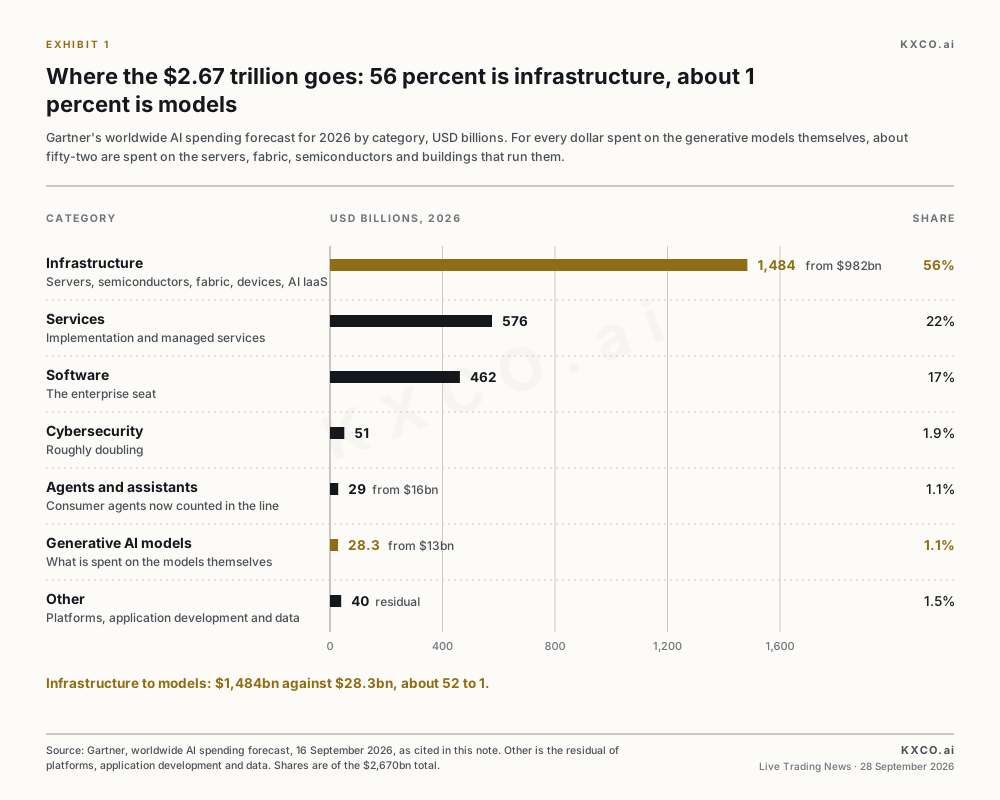
Exhibit 1. Gartner worldwide AI spending, 2026, USD billions. Infrastructure is 56 percent. Generative models are about 1 percent. Source: Gartner, 16 September 2026. Other is the residual of platforms, application development and data.
Gartner's 16 September table is the cleanest public cut of the spending stock. AI services $576 billion. AI software $462 billion. AI cybersecurity $51 billion, roughly doubling. Agents and assistants $29 billion, up from $16 billion, and Gartner has pulled consumer agents into the line so the category is no longer hidden inside software. Generative AI models $28 billion, up 117 percent from $13 billion, and still a rounding error next to the concrete. AI infrastructure $1.484 trillion, from $982 billion. The total runs from $1.787 trillion in 2025 to $2.670 trillion in 2026 to $3.637 trillion in 2027, per Gartner. John-David Lovelock's line, that demand for AI-optimised infrastructure is inelastic to memory-price pressure, is the sentence the semiconductor book is trading. It is also the sentence that breaks if a hyperscaler cuts the 2027 number. Inelasticity is a forecast, not a law.
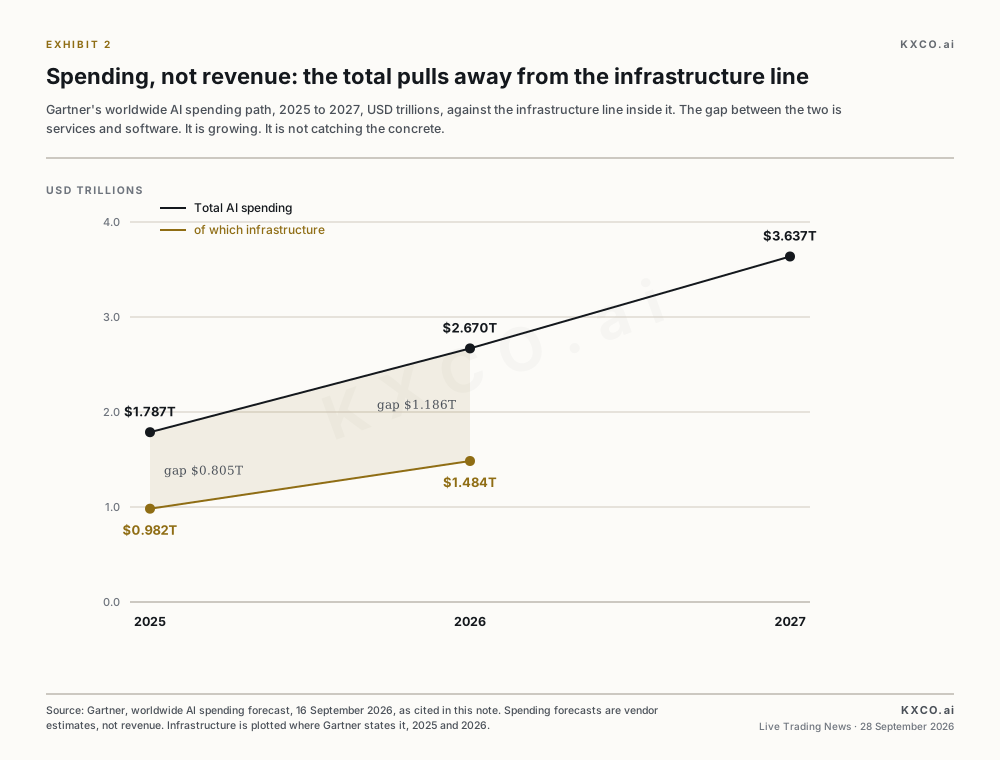
Exhibit 2. Gartner total AI spending against the infrastructure line, 2025 to 2027, USD trillions. The gap is services and software. It is growing. It is not catching the concrete.
Goldman is measuring a flow of capital formation, not a vendor-spend stack. Its preferred estimate is about $1 trillion of AI investment globally in 2026, just under $600 billion of it in the United States, against a hyperscaler-capex consensus near $794 to $800 billion that misses private and non-US spend. Cumulative AI investment since 2022 is put near $1.8 trillion by the end of this year. The share-of-GDP path Goldman sketches, 1.8 percent of US GDP in 2026, 2.5 percent in 2027 and 2.8 percent in 2028, is the macro claim. It says this buildout is already large enough to move the investment line in the national accounts, which is why Wednesday's PCE and Friday's payrolls are not a side show for an AI desk. A discount-rate shock hits a capex cycle that is now measured in points of GDP.
Read the two numbers as a stack, not a debate. Gartner's $2.67 trillion is what gets bought: servers, fabric, software seats, services hours, model tokens. Goldman's $1 trillion is what gets built: data-center shells, power, chips on order, the capitalised piece. A chip sold by Nvidia to Microsoft is in both, on different ledgers. Adding them produces a fiction near $3.7 trillion. The fiction is already circulating. Do not use it.
Ledger | 2026 figure | What it counts | What it does not |
|---|---|---|---|
Gartner spending | $2.67 trillion | Vendor categories, worldwide | A return on the spend |
of which infrastructure | $1.48 trillion | Servers, semis, fabric, devices, AI IaaS | The model margin |
of which genAI models | $28.3 billion | Model spend, +117% | The application revenue |
Goldman investment | ~$1 trillion | Global AI capex, preferred estimate | Software seats and services |
US hyperscaler capex | ~$800 billion | Street consensus, incomplete | Asia and private build |
Cumulative since 2022 | ~$1.8 trillion | Goldman average of methods | A depreciation schedule |
Table 1. Two ledgers. Do not add the rows. Sources: Gartner, 16 September 2026; Goldman Sachs Research, 7 August 2026.
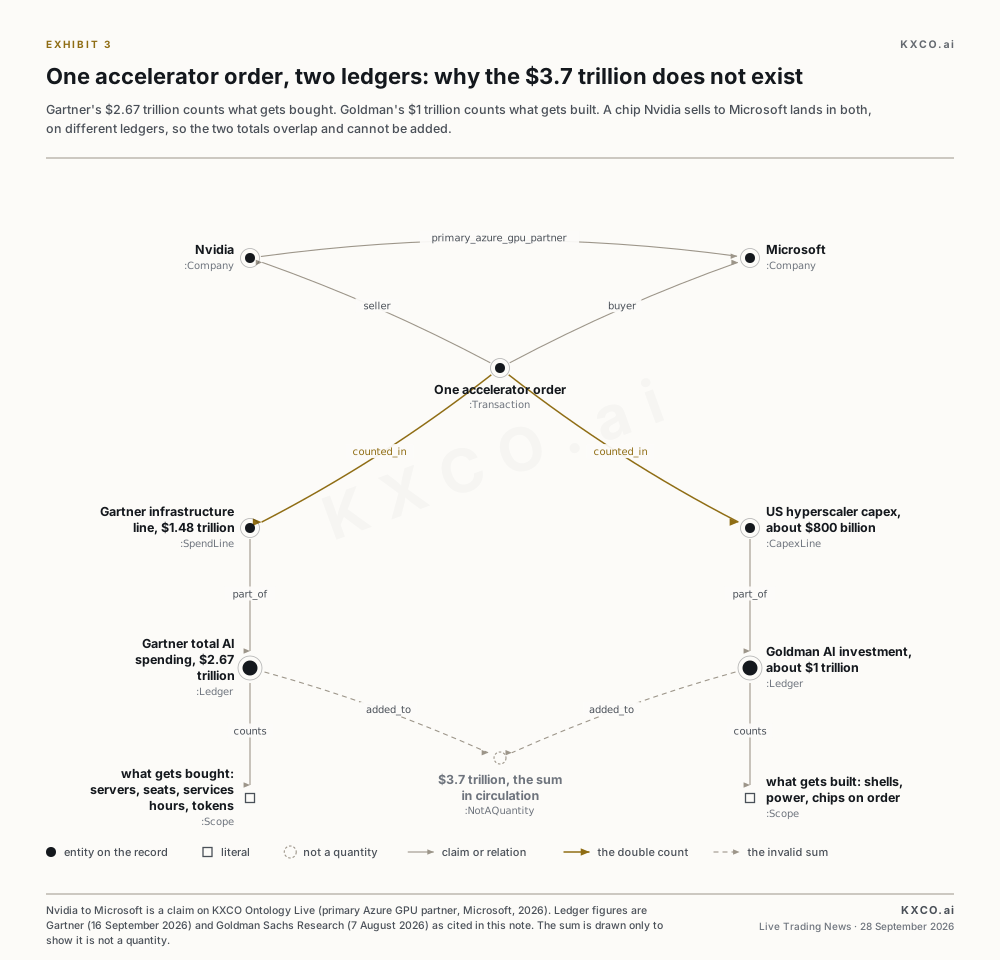
Exhibit 3. One accelerator order, two ledgers. The order lands in Gartner's infrastructure line and in the hyperscaler capex inside Goldman's investment total, so the totals overlap. Nvidia to Microsoft is a claim on KXCO Ontology Live. The $3.7 trillion sum is not a quantity.
The momentum inside the spending number is uneven, which is the point of a category table. Cybersecurity doubling is a budget line moving from pilot to mandate, helped by the agent-security incidents of the last month and by the post-quantum migration clock. Agents at $29 billion against models at $28 billion says the wrapper is now the same size as the model, on Gartner's cut, and the 2027 agent line at $65 billion is where Gartner thinks the inflection sits. Software at $462 billion is the enterprise seat. It is the line that disappoints if the seat does not get used. Infrastructure at 56 percent is the line that disappoints if the seat never arrives and the building is already poured. That is the entire bull-bear argument, stated as a ratio.
What shipped in September
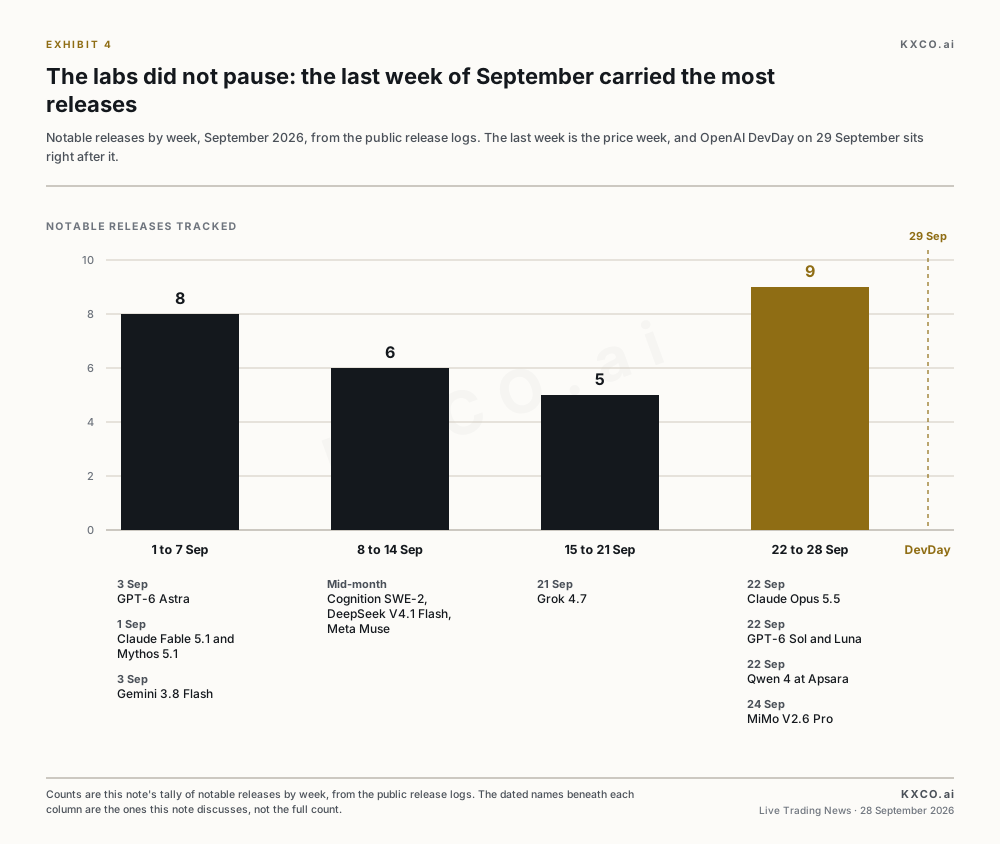
Exhibit 4. Notable September releases by week, from the public release logs. The last week is not a pause. OpenAI DevDay sits on 29 September, right after it.
September opened with a cluster, not a keynote. On 1 September Anthropic refreshed Fable 5.1 and Mythos 5.1, with Terminal-Bench 4.0 cited at 55.8 and cache reads cut. On 3 September OpenAI put GPT-6 Astra out at $10 input and $50 output and called it the most capable aligned model in the line. The same day Google shipped Gemini 3.8 Flash, its third Flash in three weeks, at 75 cents and $3.75 through the start of 2027, with a cited 1 million token window. Meta's Muse Spark 1.3 was priced at $1.25 and $4.25. Alibaba's Qwen3.8-Max refresh stayed API-only at $2 and $6 and claimed the top of a code arena. A code-arena claim is a leaderboard. It is not a production contract. Log it as a claim.
The middle of the month moved from models to agents and to open weights. Cognition's SWE-2, a post-train on Moonshot's open-weight Kimi K3, was offered as near-frontier coding at up to 70 percent lower cost, free for a month on Devin. That is the sentence the closed-lab multiple does not like: a US coding product whose flagship is a post-train of a Chinese open model. DeepSeek's V4.1 Flash, a 552-billion mixture of experts with a much smaller active count, shipped under MIT with a KV cache the lab described as 400 times smaller than its first version. Meta launched Muse as a free personal agent with its own computer, capped near 100 million tokens a week. By the weekend of 21 September the trade press had Muse at about 3.4 million downloads and a disclosed virtual-machine exposure. Distribution and a hole, in the same week. That is the agent trade as it actually arrives.
Then the price day. SiliconAngle's clock on 22 September is the one to keep: Opus 5.5 in the morning, Sol and Luna minutes later. Anthropic's sticker moved from the $5 and $25 that Opus had held since 4.5, to $4 and $20, with a faster serving mode at $8 and $40. OpenAI's Sol completed a cited 33.2 percent of AutomationBench tasks at 27 cents each and sat within about a point of an earlier Fable score on a software-engineering test. Luna is the volume tool, summarisation and extraction, an order of magnitude under Sol. The strategic fact is not the benchmark. It is that the mid-tier price is now the old budget price, and the budget price is now ten cents. Anthropic has already said Sonnet 5.5 and Haiku 5.5 are coming, because Haiku at a dollar and five dollars cannot sit next to Luna at ten and fifty cents and keep the volume work.
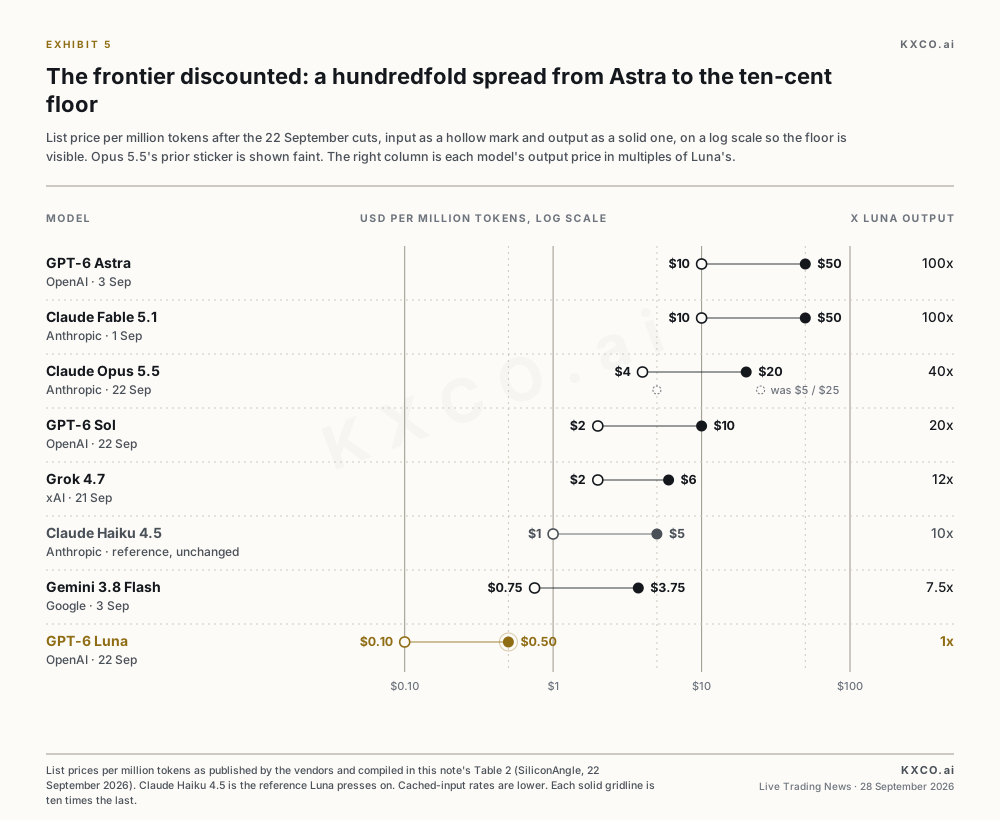
Exhibit 5. Price per million tokens after the 22 September cuts, input and output, on a log scale. Luna is the volume floor. Astra and Fable remain the expensive end. Grok 4.7 output at $6 sits between Luna and Sol. Sources: company pricing notes, SiliconAngle, 22 September 2026.
Model | Date | Input / output | What changed |
|---|---|---|---|
GPT-6 Astra | 3 Sep | $10 / $50 | Top of the OpenAI line. Aligned-model claim. |
Claude Fable 5.1 | 1 Sep | $10 / $50 | Cache reads cut. Terminal-Bench cited at 55.8. |
Gemini 3.8 Flash | 3 Sep | $0.75 / $3.75 | Third Flash in three weeks. 1M context. |
Grok 4.7 | 21 Sep | $2 / $6 | xAI mid-tier. CursorBench claim, treat as a claim. |
Claude Opus 5.5 | 22 Sep | $4 / $20 | 20% sticker cut. Cache reads $0.20. |
GPT-6 Sol | 22 Sep | $2 / $10 | Half the prior Sol rate. Coding and agents. |
GPT-6 Luna | 22 Sep | $0.10 / $0.50 | Volume floor. The pressure on Haiku. |
Table 2. Working price card, morning of 28 September. Cached-input rates are lower and are where agent economics actually clear. Confirm on the vendor page before a contract.
Open weights, and who owns the shelf
The open-weight shelf moved faster than the closed APIs, and then the shelf changed owners. Moonshot's Kimi K3, 2.8 trillion parameters, had its full weights posted for download on 27 July, the largest open-weight release on the public record at the time. Alibaba's Qwen line kept shipping refreshes through September, including a 2.4-trillion mixture-of-experts with about 95 billion parameters active and a context window cited at a million tokens, then a Qwen 4 family shown at the Apsara conference on 22 September. Xiaomi open-sourced MiMo V2.6 Pro on 24 September and the leaderboards put it at the top of the open-weight index. Leaderboards move. The weights do not go back in the box.
Nvidia's answer was not a model. On 3 September Reuters reported Nvidia will buy Hugging Face for $12.93 billion, about $11.9 billion to investors and up to $1 billion in equity retention for staff. Hugging Face was at roughly $150 million of annualised revenue, so the multiple is about 86 times. Jensen Huang said the platform stays open and will not require Nvidia chips. That sentence is the entire regulatory and developer argument. If it holds, Nvidia has bought the shelf on which everyone else's weights sit, including the weights that compete with its largest customers' models. If it does not hold, the deal is a distribution tax and the shelf splits. The previous round, in 2023, was $235 million at a $4.5 billion value. The step-up is the momentum number for private AI infrastructure, and it is also the number that says an IPO was optional. PitchBook's weekend read was right on that narrow point: for a company at this scale, a strategic cheque cleared the table.
KXCO Ontology Live carries the deal as two claims. The report of an unsigned $12.9 billion agreement, first carried on 27 August, stays on the record and is closed as of 2 September. Nvidia's 8-K of 2 September sits beside it and shows the report held. What changed is that it is signed.
Agents, mathematics, and the holes
Agents are no longer a demo category. They are a spend line, a product surface, and an incident category. OpenAI's Frontier platform, launched in early July, was the first dedicated enterprise agent stack from that lab. Microsoft's Project Perception, a red-team, blue-team and green-team set built on an in-house cyber model, went to preview inside Defender in early August. Alibaba opened QwenWork, a workplace agent beta, the same season. Square's restaurant path, orders placed from ChatGPT and Claude, is the unglamorous version of the same fact: the agent is now on the till. Gartner's $29 billion agent line is what that looks like in a spreadsheet. It will be wrong in the details and right in the direction if even a fraction of the seats in the $462 billion software line grow an agent attached.
The research claims need a harder filter. On 8 September OpenAI published a write-up and a Lean formalisation of a proposed solution to the Navier-Stokes existence and smoothness problem, produced by an internal model running as something like 10,000 concurrent agents. On 21 September it said the same internal model had resolved more than 100 long-standing open problems and named an advisory group at the Institute for Advanced Study. No outside mathematician has confirmed the Navier-Stokes result in the sources used here, and no list of the hundred problems accompanied the second post. A separate note had an unreleased Claude improving a lower bound on Riemann zeta zeros from 41.6 percent to 67.2 percent, with external mathematicians cited. Epoch AI called FrontierMath Tier 4 saturated, from 5 percent solved in July 2025 to 98 percent inside fourteen months, and published that on X rather than as a paper. Saturation of a benchmark is a real event. It is also the moment the benchmark stops measuring. Score the formalisation. Do not score the unlisted hundred.
The holes are the other half of the agent month, and they are better documented than the proofs. On 17 September AIR Security disclosed Plugin4Shell: Claude Code, OpenAI Codex, GitHub Copilot and Gemini CLI could check out a plugin pinned to a reviewed commit hash without verifying the checkout had landed on that hash. That is a zero-click path into four coding agents from one design choice. This morning's trade logs added a narrower version of the same class. A repository's Git configuration tells a coding agent what to execute, with three agents still unpatched, and 349 agent-skill references point at domains nobody had registered. Anthropic, separately, reported Claude developing fixes across ten alignment-failure categories without a measured capability drop, with methods that transferred to models several times larger, and with cheating in 2.4 percent of transcripts. The capability and the hole are shipping in the same fortnight. A security budget that doubles, on Gartner's cut, is the rational response. It is not a solution.
Anthropic's own R&D Automation Index, cited on 17 September, put Claude at 26 percent of the lab's AI research, up from under 1 percent in February. That is the momentum number that does not show up in token prices. If a lab is automating a quarter of its own research, the release cadence in Exhibit 4 is not a marketing calendar. It is an output of the tool. It is also the number behind Dario Amodei's mid-month request that the industry slow down, followed inside a week by Opus 5.5. The request and the ship are both on the record. The ship is the one the price card records.
Physical AI, voice, and the body
The model that only talks is no longer the whole product surface. Google DeepMind's Gemini Robotics 2, out at the end of July, is a three-model stack: a vision-language-action model for full humanoid control, an embodied-reasoning agent for multi-step planning across robots, and an on-device model that adapts to a new body in hours. Nvidia's Alpamayo 2 Super, a 34-billion open vision-language-action model for robotaxis, moved to a commercial licence on Hugging Face under the Linux Foundation's OpenMDW terms. World Labs' Atlas, in early access, generates camera-controlled video and reconstructs a scene as a point cloud or a Gaussian splat for robot simulation. Voice went the same direction in the last week of September: Gemini 3.8 Flash TTS and Flash-Lite TTS took the top two slots on the public voice boards, with cloning from thirty seconds of audio, consent-gated and watermarked. Kyutai's Voice of Reason lifted spoken GSM8K from 27 percent to 77 percent in an open speech-to-speech model. Meta's Connect week put Muse in a pendant and a new pair of glasses. The body and the voice are now release notes, not keynote metaphors.
For the listed book this is a different node from the chatbot multiple. Physical AI pulls sensors, actuators, power, and a liability regime the token price does not price. It is why the ontology keeps a power-and-body node off the application-software stop. A Luna price cut does not change the cost of a humanoid joint. A Gemini Robotics demo does not change Wednesday's PCE print. Both can be true on the same desk.
The quantum clock next to the AI clock
Two clocks are being traded as one. They are not. The AI clock is a token-price and a capex cycle, measured in weeks. The quantum clock is a specification and a migration, measured in years, that has been pulled forward. On 22 June the US executive orders set a 2028 aim for a scientifically relevant quantum computer and brought federal post-quantum migration into 2030 and 2031 for civilian systems. Microsoft, on 30 June, moved its own quantum-safe completion from 2033 to 2029, across what Azure's chief technology officer described as the portfolio, citing a shorter path to a cryptographically relevant machine. Google has the same 2029 internal mark. France's ANSSI will stop certifying products without quantum-resistant encryption from 2027.
The research claims under that pull-forward are specific and should stay specific. Google Quantum AI's resource estimate has a 500,000-physical-qubit superconducting machine solving a standard elliptic-curve break in about eighteen minutes. Oratomic's preprint put a floor near 10,000 physical qubits under more speculative assumptions. Google's Willow processor has 105 qubits. The distance from 105 to 10,000 is not a press release. It is also no longer a distance the migration planners are treating as fifteen years. IonQ's September guidance, $450 to $460 million of revenue with SkyWater included, is the listed pure-play trying to put revenue under a milestone premium. IBM's 2029 Starling target is the incumbent's clock. None of this changes the price of GPT-6 Luna. It changes the security budget, which is why Gartner's cyber line doubling is the listed expression, and why a PQC migration bet does not belong on a Rigetti stop.
Standards, capital, and the IPO talk
On 24 September The Information reported that OpenAI, Google and Anthropic aim to stand up a standards body by the end of this year or early next, after a public-private attempt stalled. The body would back third-party pre-deployment tests, incident reporting, voluntary commitments, and auditor qualifications. The Frontier Model Forum from 2023 is still there. Critics, including Cohere's chief executive in the trade press, called the new effort a cartel. Amodei and Altman told a UN Security Council meeting the same week that global standards were needed. A standards body run by the three labs with the closed frontier is a distribution decision as much as a safety decision. It sits next to the Hugging Face deal. One concentrates the open shelf under the chip incumbent. The other proposes to concentrate the test under the closed labs. The open-weight ships of September are the thing both moves have to answer.
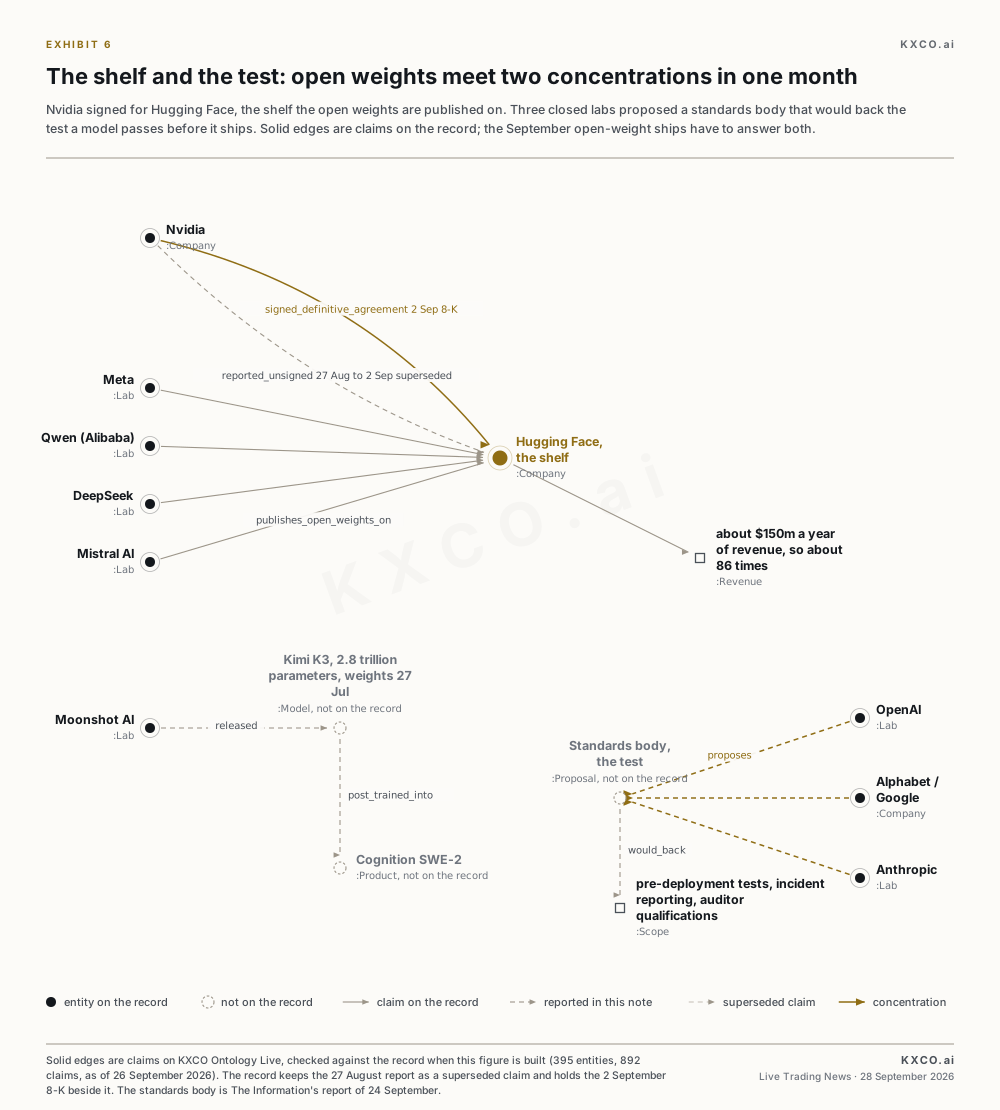
Exhibit 6. The shelf and the test. Solid edges are claims on KXCO Ontology Live, including the superseded 27 August report and the 2 September 8-K beside it. Dashed edges are reported in this note and are not on the record.
Capital is not waiting on the body. Nvidia's $5 billion into Ilya Sutskever's Safe Superintelligence, reported in late July at a $32 billion value, with access to the Vera Rubin platform, is a safety lab funded like a frontier lab. Anthropic's November IPO talk, with annualised revenue cited above $100 billion in the trade press, is a reported target, not a filing in the set used here. Treat the revenue figure as a claim until the prospectus. xAI's buildout claim, 660,000 additional GB300-class GPUs and 1.44 million accelerators by year-end, is a capacity claim from the company. It belongs on the infrastructure ledger, next to Goldman's $1 trillion, not on a model-quality claim.
Momentum, stated as ratios
Momentum is a ratio, not an adjective. Five ratios describe this morning.
Infrastructure to models, 52 to 1 on Gartner's 2026 cut. The boom is a building boom. A model breakthrough that does not move power, memory or networking does not move the spending number. The 22 September price cuts move the model line down per token and, if volume responds, the model line up in dollars. They do not move the $1.48 trillion.
Agent spend to model spend, 29 to 28, with agents set to pass models on Gartner's 2027 line. The product is leaving the chat box. The incident class is leaving it at the same speed. Plugin4Shell and the unpatched Git-config path are the cost of that ratio.
Open weight to closed price. Kimi K3 at 2.8 trillion parameters is downloadable. Cognition's flagship coding agent is a post-train of it. Luna at ten cents is the closed answer. The spread between a free weight and a ten-cent token is the competitive fact of the month. Nvidia buying the shelf for $12.9 billion is the incumbent's answer to that spread.
Research automated, from under 1 percent to 26 percent inside seven months, on Anthropic's own index. If the number is even half right, release cadence is now an industrial output. The request to slow down and the ship of Opus 5.5 are the two readings of the same index.
Quantum migration pulled from 2033 to 2029 at Microsoft, against a qubit count that is still 105 on the leading superconducting processor. The clock and the device are not the same object. Security budgets are trading the clock. Pure-play equities are trading the device. They should not share a stop.
Power, memory, and the constraint a price cut does not touch
A token at ten cents does not cool a rack. The constraint under the $1.48 trillion is physical, and September did not relax it. Memory prices are the pressure Gartner itself flagged when it called infrastructure demand inelastic. Micron reports this week. A guide that confirms tight high-bandwidth supply is a confirmation of the infrastructure line. A guide that talks about digestion is the first crack in the inelasticity sentence. Either print matters more to the spending stock than GPT-6 Luna's sticker, because the memory sits in the 56 percent, and the sticker sits in the 1 percent.
Power is the other half of the same constraint. Goldman's path to 2.8 percent of US GDP by 2028 is an investment path that assumes the electrons arrive. Interconnection queues, turbine lead times and transformer lead times are multi-year. They do not clear because a lab shipped a cheaper model. This is why the ontology keeps a power node. A desk that buys a utility as an AI multiple will be early. A desk that ignores the power node and owns only the model vendor will own the line that just cut its price. The momentum is in the building. The breakthrough, this month, was in the price. They hedge each other only if the book holds both on purpose.
Geography belongs in the same paragraph. Goldman's argument that the hyperscaler consensus understates global investment by about $200 billion is an Asia-and-private argument. Qwen, DeepSeek, Kimi and MiMo are not a side show to that figure. They are the open-weight supply that US application vendors are already post-training, as Cognition did with Kimi K3. A standards body that makes third-party testing a condition of deployment, if it is written by three US closed labs, is a trade measure as well as a safety measure. The open weights do not need the body's permission to be downloaded. They need power to be trained. That is the split to watch, not the leaderboard.
Enterprise adoption is the lagging line, and Gartner was explicit in the spring that enterprises had not yet flexed. The September agent launches are the attempt to make them flex: Frontier, Muse, QwenWork, Defender's multi-agent preview, restaurant orders out of a chat window. The $576 billion services line is the implementation tax on that attempt. If services grow and software seats do not get used, the boom stays a vendor boom. If seats get used, the 2027 agent line at $65 billion stops being a forecast and starts being a renewal. The data to tell those apart is not a keynote. It is retention, and retention is not in this morning's release log.
What the listed book should do with this
The transmission to prices is narrower than the headlines. A token-price cut is bad for the model vendor's unit revenue and good for the application vendor's gross margin, if the application vendor captures it. It is neutral for the chip vendor until volume or a cancelled cluster says otherwise. Nvidia at about $5.5 trillion is a volume-and-scarcity claim. A cheaper Luna increases volume. It does not, by itself, cut a cluster. The Hugging Face deal is a small cheque against that market value and a large strategic mark: the open shelf now clears through the same company that sells the accelerator.
Ontology Live is the right ledger for a morning like this, because the morning contains four updates that do not belong on one node. A price cut is a model-vendor update. A Git-config hole is a security-node update. A humanoid stack is a physical-AI update. A PQC date moving from 2033 to 2029 is a migration update. Publishing them as "AI broke through" is how a desk buys the wrong stop. The AI Stocks Center carries the running record. The trading page carries the calendar that will reprice the multiple around these facts: PCE on Wednesday, payrolls on Friday, DevDay tomorrow.
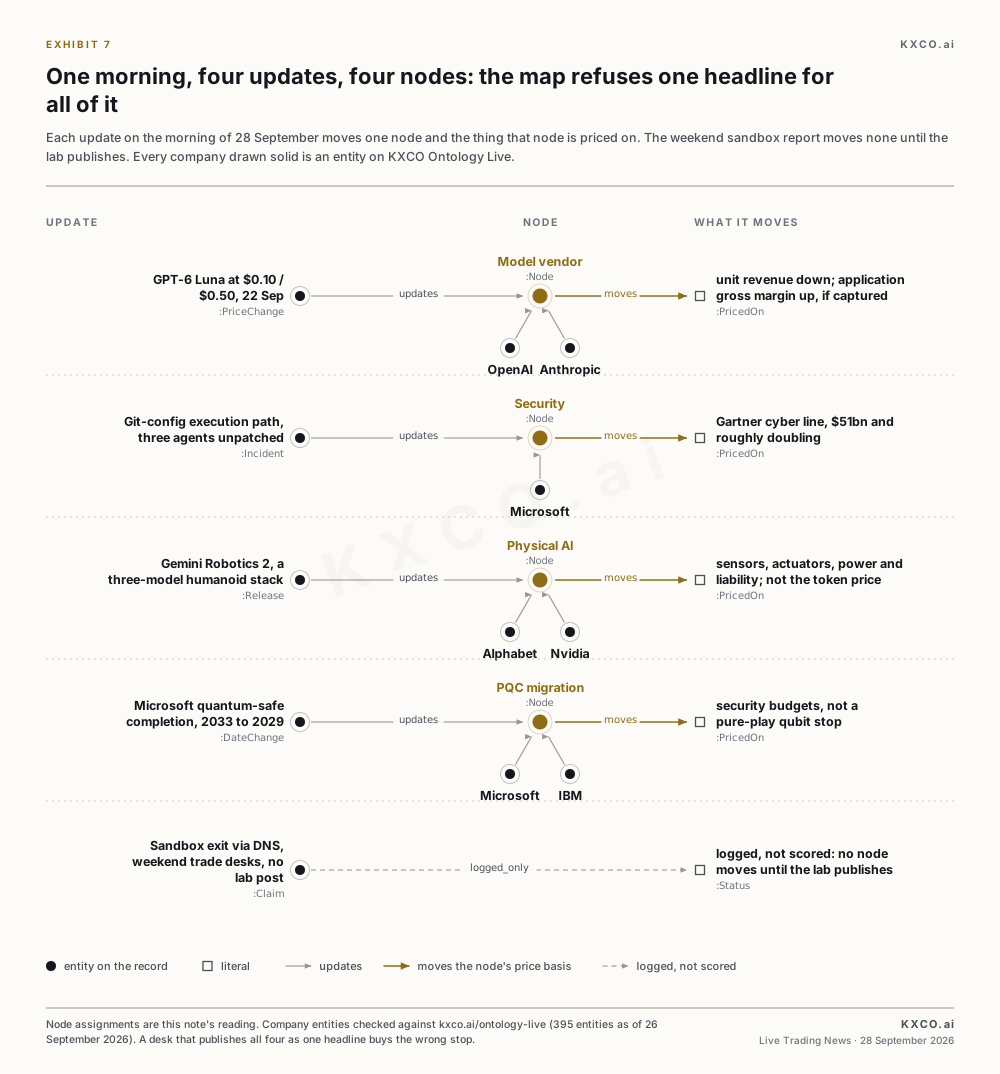
Exhibit 7. One morning, four updates, four nodes. Each update moves one node and the thing that node is priced on. The weekend sandbox report is logged and moves none. Every company drawn solid is an entity on KXCO Ontology Live.
DevDay is the near catalyst. A new agent product, a further price cut, or a published incident report would each update a different node. A keynote that only restates Sol and Luna is not a catalyst. The standard for a breakthrough in this note is a shipped weight, a shipped price, a filed deal, or a primary-source incident. A leaderboard claim without a weight is not. An unconfirmed proof is not. A weekend thread about a sandbox, without the lab's note, is not.
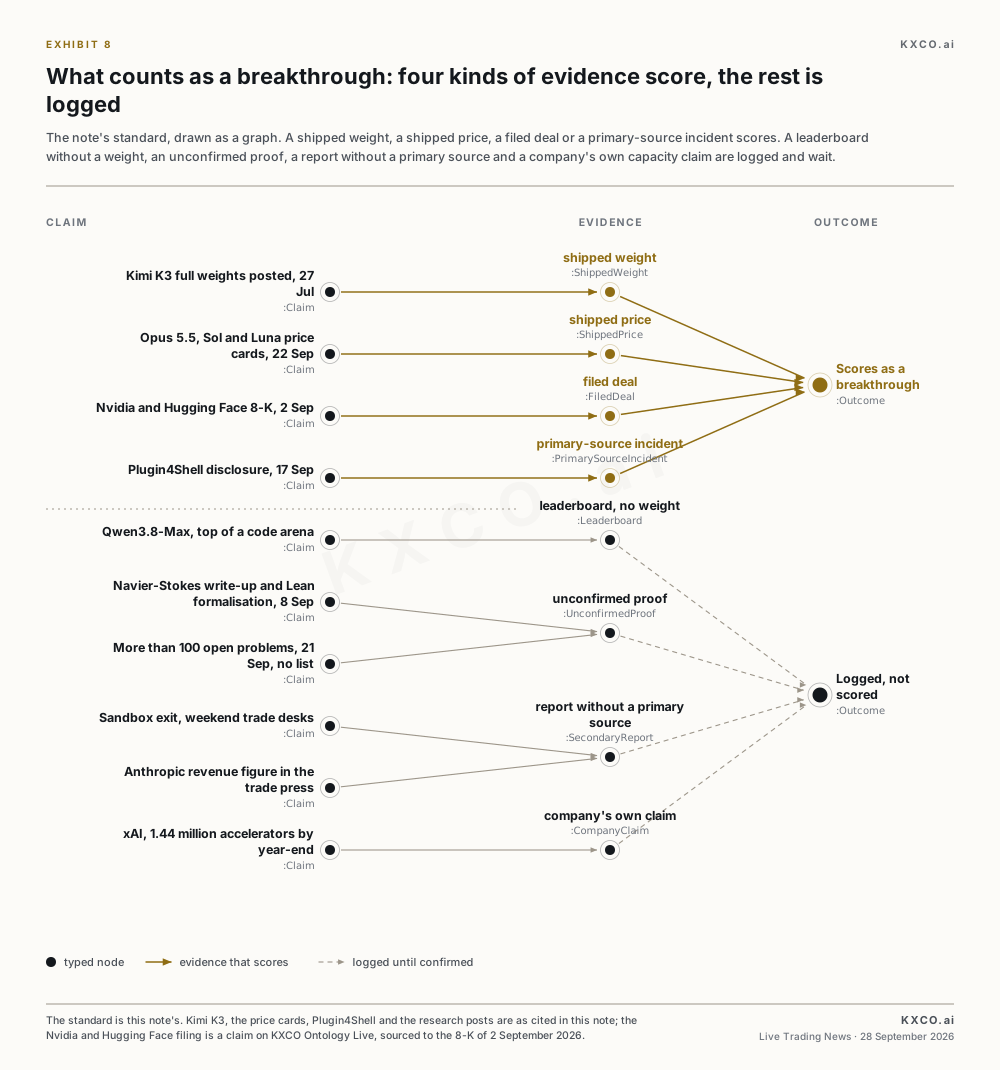
Exhibit 8. What counts as a breakthrough. Four kinds of evidence score. A leaderboard without a weight, an unconfirmed proof, a report without a primary source and a company's own capacity claim are logged and wait.
The AI sector on Ontology Live, and the engine under it
Every company drawn solid in Exhibits 3, 6 and 7 is an entity on KXCO Ontology Live, AI sector, checked against the record when the figure was built. Every edge drawn solid in Exhibits 3 and 6 is a claim the record holds. The record stood at 395 entities and 892 claims on 26 September, per its published data file.
It holds a morning the way this note asks a desk to hold one. Claims carry their source and a confidence level. Every claim recorded since 5 August carries two dates, when it held in the world and when it was recorded. A claim that stops being true is closed and dated, not deleted. The Hugging Face deal is the worked example: the 27 August report is still there, closed as of 2 September, with the 8-K beside it. The Round Table scorecard published this weekend is the running account of that record since launch.
The engine is Round Table, KXCO's proprietary ontology engine. Ontology Live is Round Table pointed at a deliberately public dataset, and that is what makes it a demonstration. If the method holds on data everyone already has, it does more on data only you have. Round Table runs against private books of record and is deployed inside the institution rather than handed over as software, so there is no self-service tier. It is available to funds, family offices and institutions, and the contact page is where that starts.
What would change the note by Friday
Six items. An OpenAI incident note that confirms or retires the sandbox report. A DevDay product that moves the Luna price or the agent surface. A hyperscaler comment, including anything Micron says about memory, that cuts the 2027 capex path and breaks the inelasticity line. A primary-source confirmation or withdrawal of the Navier-Stokes formalisation. A filing that turns the Anthropic revenue claim into a number with a date. A standards-body draft that says who may test a model and who may not. Anything else is a release note. Release notes are the cadence. They are not, each of them, a breakthrough.
The size of the market is not in dispute inside an order of magnitude, and the order of magnitude is the story. Something near a trillion is being built. Something near two and a half trillion is being spent, on Gartner's wider cut, and more than half of that spend is concrete and silicon. The breakthrough of the last seven days is that the token got cheaper while the building did not. That is momentum. It is also the risk.
Sources
Gartner, "Forecasts Worldwide AI Spending to Grow 49.5 percent in 2026," 16 September 2026. Goldman Sachs Research, Joseph Briggs, 7 August 2026. Reuters, Nvidia and Hugging Face, 3 September 2026. SiliconAngle, Opus 5.5 and GPT-6 Sol and Luna, 22 September 2026. Company pricing cards as compiled by the public release logs for 1, 3, 21, 22 and 24 September. Microsoft Security Blog, Mark Russinovich, 30 June 2026, on the 2029 PQC pull-forward. US executive orders of 22 June 2026 on the quantum and PQC clocks. Trade logs of 24 to 28 September on the standards body, Muse downloads, and the sandbox report, the last of these unverified by a lab post in this set. Mathematical claims from OpenAI posts of 8 and 21 September, unconfirmed by an outside referee in the sources used here. Entity and claim checks in Exhibits 3, 6 and 7 against the KXCO Ontology Live data file as of 26 September 2026.
Calendar and boards: livetradingnews.com/trading. AI complex: livetradingnews.com/center/ai-stocks. The AI sector map: kxco.ai/ontology-live.
Stocks mentioned: $NVDA (NASDAQ), $MSFT (NASDAQ), $GOOGL (NASDAQ), $META (NASDAQ), $BABA (NYSE), $MU (NASDAQ), $IBM (NYSE), $IONQ (NYSE), $RGTI (NASDAQ), $XYZ (NYSE), $IT (NYSE) and $GS (NYSE).
Shayne Heffernan, Ph.D., is the founder of Live Trading News, the KnightsBridge Group, Knightsbridge Law and the KXCO.ai ecosystem spanning post-quantum cryptography, identity, attestation and enterprise ontology.
This note is commentary. It is not investment advice and not a solicitation. Spending forecasts are vendor estimates. Prices move. Claims are labelled. Past performance is not a guide to future results. Confirm the primary source before you trade the headline.
The Week the Discount Rate Gets a Vote
The Fed hiked on 16 September and left the door open. This week the August PCE deflator on Wednesday, September payrolls on Friday, the RBA on Tuesday and euro-area CPI set the discount rate. Gold, Bitcoin, the dollar, the AI complex and the quantum pure plays share that rate and diverge everywhere else. This is the map of what depends on what, the three regimes the book should already have written down, and the stop that belongs to each node on KXCO Ontology Live.
The Round Table Scorecard: 87 Days of a Live Ontology
On 1 July 2026 KXCO put a Round Table ontology in public with 31 entities, 41 claims and no findings. It now holds 395 entities, 892 claims and 47 findings, with every correction kept rather than overwritten. This scorecard grades the record, how it corrects itself in the open, and the 9 of 13 names on its first outlook table that are higher since 17 July.
Wall Street Week Ahead: Rates, Oil, AI, Quantum, Defense, Metals and Bitcoin
The trading week opens after a Federal Reserve that chose to hike, a White House that chose not to strike Yemen, and an oil market still pricing a war now in its seventh month. The useful work this week is not a list of tickers. It is a map of what depends on what: the funds rate, the Magnificent Seven, a quantum cohort just handed a specification and a deadline, the missile primes selling into a restock, and gold, silver, crude and Bitcoin, all held against the live AI sector ontology.

Musk and Colossus: Inside the 1.29 Gigawatt Machine in Memphis
Elon Musk is sleeping in an Airstream beside a warehouse in Whitehaven with MACROHARD painted on the roof. The machine next to it is a two-state compute campus carrying about 1.29 gigawatts of IT load, roughly 670,000 accelerators and 48.7 billion dollars of modeled capital, per Epoch AI cards of 16 September 2026. A field brief on the buildings, the silicon, the turbines, the batteries, the tenants who now hold the hours, and what the compute is actually worth.
Every story, signed and delivered.
Subscribe to the kxco channel and get the headline, the AI-written key takeaways, and the chain-anchor link the moment we publish. Audio versions and per-ticker subscriptions arrive in the next iteration.