
Musk and Colossus: Inside the 1.29 Gigawatt Machine in Memphis
SpaceXAI's Memphis compute campus: the buildings, the GPUs, the gigawatts, the batteries, the tenants, and why the richest man in the world is living in an Airstream beside a warehouse painted MACROHARD.
Part of theKXCO Center
Elon Musk is living in an Airstream trailer beside a warehouse in Whitehaven, Memphis. The roof of that warehouse is painted MACROHARD in letters you can read from a light aircraft. SpaceX president Gwynne Shotwell told the All-In audience this week that he is on the factory floor again. He called the trailer his palace.
The joke works because the machine next to it is not a prototype. Colossus is a two-state compute campus carrying about 1.29 gigawatts of information-technology load, roughly 670,000 physical accelerators, and a modeled capital stack near 48.7 billion dollars, per Epoch AI's directory cards of 16 September 2026. Its tenants are Anthropic, Google, Cursor and SpaceXAI's own Grok training runs.
This is a field brief on that machine. Size, compute, power, equipment, ownership, method and price. Figures come from SpaceXAI disclosures, Tennessee Valley Authority and Memphis Light, Gas and Water records, Mississippi and Tennessee permit files, and the Epoch AI building-level model updated 16 September 2026. Where sources disagree, the disagreement is stated.
Why Musk is sleeping in the yard
His pattern is not mysterious. When a production system becomes the constraint on a company he controls, he moves to the constraint. He slept at Twitter headquarters after the 2022 acquisition. He lived near Starbase through the early Starship campaign. He has described the same instinct in Tesla's production hell years.
Colossus is now that constraint. After SpaceX closed its acquisition of xAI in early 2026 and folded the lab into an operating arm branded SpaceXAI, the campus stopped being a private training rig. It sells time.
Three clocks are running at once.
Colossus 2, Minihard and Macrohardrr are still being filled with Blackwell systems while a permanent 1.2 gigawatt gas plant is stood up in Southaven, Mississippi.
All 69 temporary mobile turbines must come off under an agreed order with the Mississippi Department of Environmental Quality signed 30 July 2026. Removals begin as early as August 2026 and finish by July 2027.
The commercial clock has started. Google's agreement, per its disclosure of 5 June 2026, rents about 110,000 GPUs from SpaceX from October 2026 through June 2029 at 920 million dollars a month.
Those are not research-budget numbers. They are factory-utilization numbers, and a factory that misses an energization date misses an invoice. Musk is in Memphis because the next 90 days couple civil works, high-voltage interconnection, liquid-cooling commissioning, rack bring-up and contract start dates into one schedule.
What Colossus actually is
It is not one building. It is a cluster of halls and generation assets straddling the Tennessee and Mississippi line.
Colossus 1 occupies the former Electrolux appliance plant at 3231 Paul R. Lowry Road, about 785,000 square feet on 81 acres per independent site descriptions. Construction started in spring 2024. About 25,000 Hopper H100 GPUs were visible to trackers by 11 August 2024. By 2 September 2024 the company had 100,000 H100s online. The official claim still on the SpaceXAI Colossus page is that it was built in 122 days after the firm was told a conventional schedule would take 24 months, then doubled in 92 days to 200,000 GPUs.
Colossus 2 is the sequel. An xAI affiliate bought the warehouse and adjacent parcels at 5420 Tulane Road in early 2025 for about 80 million dollars. The principal building runs near 1.0 million square feet on roughly 79 acres. A denser hall called Minihard is rising next door. A Southaven site at 2400 Stateline Road West is called Macrohardrr, or Colossus 3, depending on who is speaking. Power for the newer halls comes behind the meter from a former Duke Energy site on Stanton Road South, operated through an affiliate reported as MZX Tech.
Taken together the campus is on the order of 2.6 million square feet of building and yard.
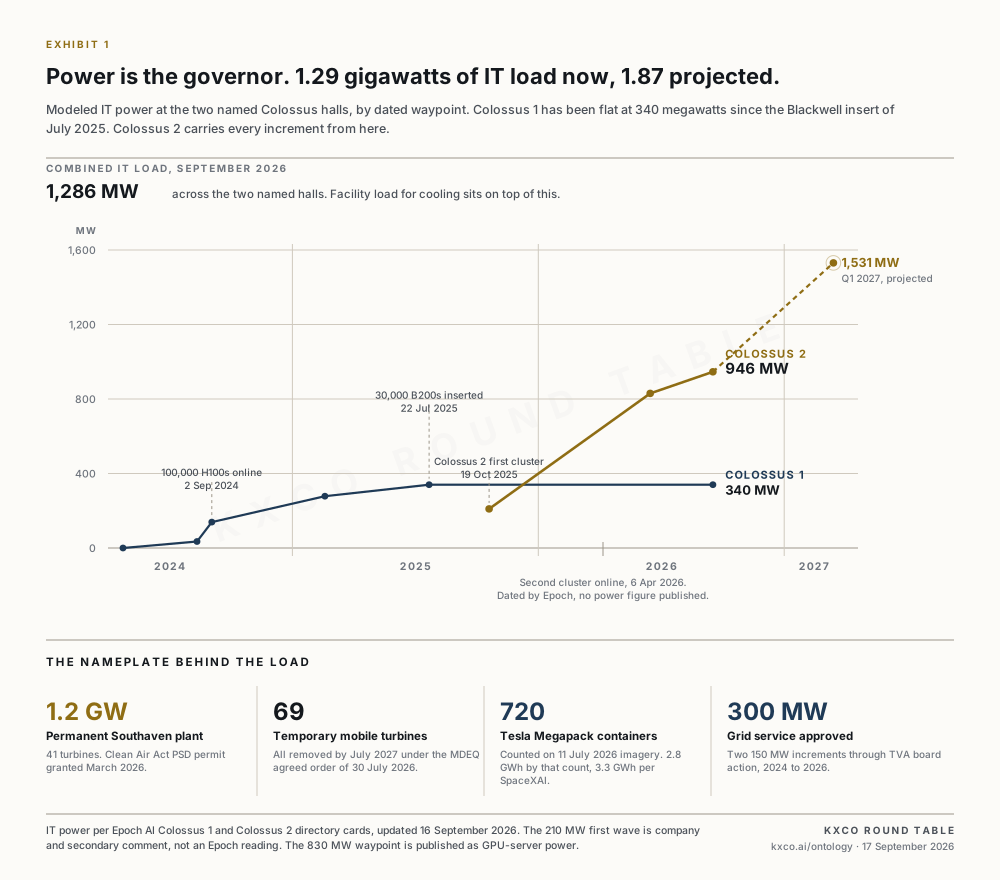
Colossus 1 runs 340 megawatts on 3 chip generations
Epoch models Colossus 1 at 276,000 H100-equivalents, or 5.46e20 eight-bit operations per second, on 340 megawatts of IT power, at a modeled capital cost of 12.9 billion dollars. Those three figures have been stable since the first Blackwell tranche landed in July 2025.
The hall is a fossil record of its own build. 150,000 H100s are the 2024 factory that made Grok competitive. 50,000 H200s, online by 17 February 2025, nearly doubled memory per card, 141 gigabytes of HBM3e against the H100's 80. That matters for long-context training and for inference batches that would spill to host memory without it. 30,000 B200s arrived in GB200 configuration on 22 July 2025. They are 13 percent of the card count and 28 percent of the compute, which is the entire point of a process-node jump.
The site arrived with almost no grid. The inherited interconnection was about 8 megawatts against a 340 megawatt load. So xAI paid to build substations and parked gas turbines in the yard at the same time. SpaceXAI has said it invested 35 million dollars in the first substation and would put another 20 million into a second. TVA board action was required once requests crossed 100 megawatts.
Cooling tells the same story of a hall that outgrew its first design. Epoch counts 33 evaporative cooling towers with 310.4 megawatts of thermal capacity. By 11 February 2026 the air-cooled chillers that carried the early phases had been disconnected and removed.
Colossus 2 is a Blackwell hall and it is 3 times the size
Epoch models Colossus 2 at 1,112,000 H100-equivalents, 2.20e21 eight-bit operations per second, 946 megawatts of IT power and 35.8 billion dollars of modeled capital. The Q1 2027 projection on the same card is 1,824,000 H100-equivalents, 1,531 megawatts and 58.0 billion dollars.
The silicon is Blackwell only, per the same card: 110,000 B200s and 330,000 B300s today, 440,000 physical accelerators. The projection holds B200 flat and lifts B300 to 612,200.
Cooling is a different kit list. Epoch counts 217 air-cooled chillers with 412.3 megawatts of capacity and 144 condensers. Per SemiAnalysis, 119 chillers were up by 22 August 2025, which they treated as roughly 200 megawatts of cooling and enough for about 110,000 GB200 NVL72 GPUs. For a reader who will never see a rack, that is the useful method: in a campus this dense, cooling equipment visible from orbit is a better leading indicator of live compute than a press release.
The rack is the computer
NVIDIA's GB200 NVL72 changed data-center civil engineering. Seventy-two Blackwell GPUs and thirty-six Grace CPUs sit in one liquid-cooled cabinet, tied by a fifth-generation NVLink fabric NVIDIA rates at 130 terabytes per second inside the rack. Cards stop behaving like independent servers sharing a switch. They behave like one memory-coherent domain for the parts of a training step that used to spill across InfiniBand and pay a latency tax.
A GB200 NVL72 rack is commonly discussed in the 120 kilowatt class. That is why a 210 megawatt first wave of 110,000 GPUs is a plausible pairing. 110,000 GPUs at 72 per rack is about 1,530 racks, and 210 megawatts is about 137 kilowatts per rack including a share of the row's electrical overhead. The arithmetic is approximate. The density is not.
Separate what is confirmed from what is inferred. Confirmed at company level: Hopper and Blackwell accelerators in the H100, H200, GB200 and GB300 families, a single interconnected cluster as the design goal, aggregate memory bandwidth described as petabytes per second, and more than an exabyte of training storage. Confirmed by partners: Dell Technologies and Supermicro as early integrators on Colossus 1. Inferred, and not independently audited in public: the scale-out fabric, named as NVIDIA Spectrum-X 800G Ethernet in some cluster anatomies and InfiniBand in others.
What is audited, in the only way that counts commercially, is that Grok models trained, that newer Grok generations moved to Colossus 2, and that Anthropic and Google were willing to rent the result.
Power is the real architecture
The campus consumes electricity in three layers that are expensive to confuse.
IT load. The GPUs, CPUs, NICs and storage. 340 megawatts at Colossus 1 and 946 at Colossus 2, so about 1.29 gigawatts across the two named halls.
Facility load. Chillers, towers, pumps, transformers, lighting. On a campus this size in a Memphis summer, cooling adds hundreds of megawatts on top.
Generation and storage nameplate. Turbines that can start, batteries that can discharge, grid tickets that can be called. Nameplate always exceeds simultaneous IT load, because the operator wants reserve, turbines derate in heat, and an interconnection is a political object as well as an electrical one.
MLGW delivers local service and TVA generates the bulk power MLGW buys. CTC Property LLC, the utility customer of record for the Lowry Road hall, requested successive 150 megawatt increments. A first 150 megawatts was energized through a sliver of legacy service plus a new tenant-funded substation. A second 150 megawatts was approved in later board actions, including a February 2026 increment. In August 2026 the TVA board approved a direct grid hookup relevant to the Colossus 2 and battery complex.
The visible politics have been about turbines. Early Colossus 1 coverage described about 14 temporary gas units, then a peak near 35 capable of about 420 megawatts. The Southaven yard grew from the mid-twenties to 46 in May 2026, 60 in June and 69 by July. They sat on trailers and ran in place. Mississippi regulators had granted a temporary window that treated mobility as a permitting category. Neighbors, the NAACP and environmental litigators treated them as a stationary plant that skipped the Clean Air Act's front door.
The off-ramp is now written down. All 69 go by July 2027. In their place, a permanent 1.2 gigawatt simple-cycle plant of 41 turbines, authorized under a Prevention of Significant Deterioration permit granted in March 2026. A joint venture owned 50.1 percent by Solaris Energy Infrastructure and 49.9 percent by the SpaceXAI side is a primary turbine counterparty.
The other half of the answer is electrochemical. Canary Media counted 720 Tesla Megapack containers on Colossus 2 grounds in 11 July 2026 imagery and converted that to about 2.8 gigawatt-hours of storage. SpaceXAI energy lead Riley Trettel told the TVA board on 20 August 2026 that it was the biggest battery in the nation and cited 3.3 gigawatt-hours, enough to power all of Memphis for two hours. Per MLGW chief executive Doug McGowan, it is the world's largest grid-connected battery system, with as much as 2,000 megawatts of batteries behind the meter to cover curtailment.
The figures do not all reconcile, which is expected at this stage of commissioning. The direction does. Reporting on filings and purchase orders puts Tesla battery spend near 1 billion dollars from 2024 through mid-2026, including a 269 million dollar order in April 2026.
A few solar arrays have appeared at the edge of Colossus 1. They are a garnish, not a power source.
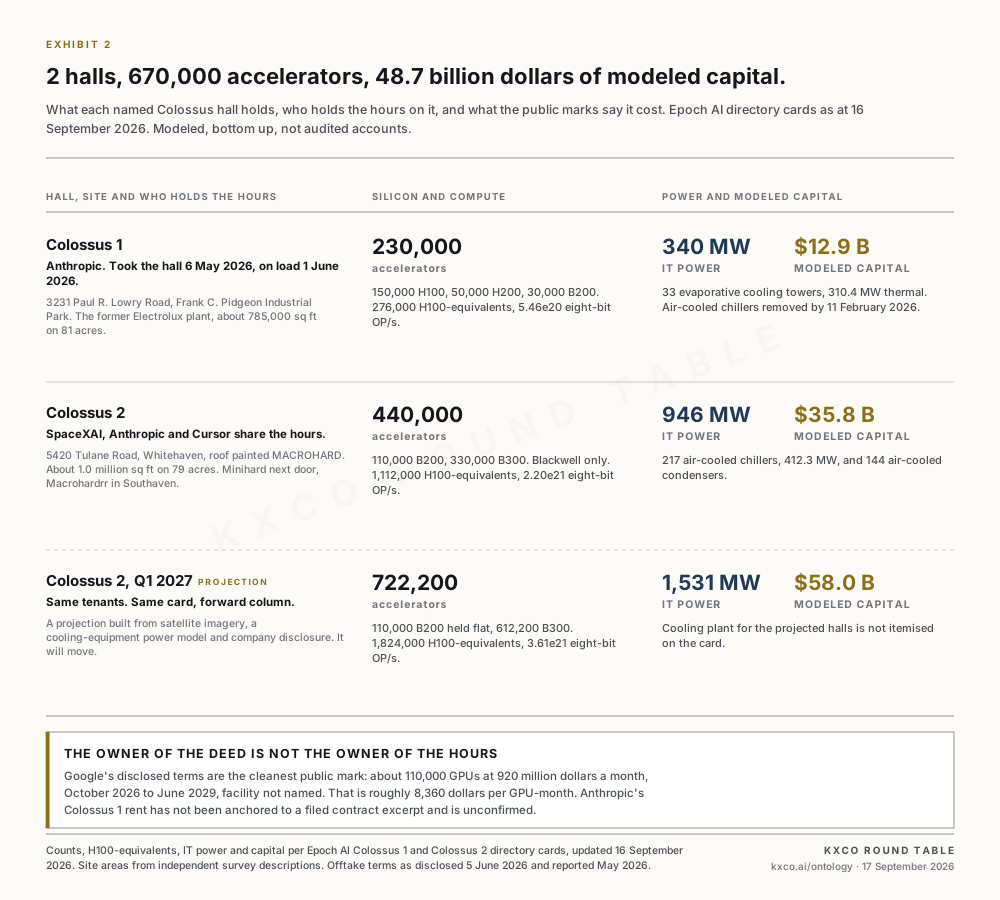
The owner of the deed is not the owner of the hours
Beneficial control is not mysterious. Musk controls SpaceX. SpaceX controls SpaceXAI. SpaceXAI owns the chips and the offtake contracts. Tesla supplies a large fraction of the batteries. NVIDIA supplies the accelerators.
Beneath the brand sits a stack of special-purpose vehicles, which is how American industrial projects are actually owned. CTC Property LLC appeared as the MLGW customer. An affiliate reported as MZX Tech is associated with the Southaven generation site. In May 2026 a SpaceX subsidiary was reported to have bought the Colossus 1 real estate for 185 million dollars from a Phoenix Investors affiliate, pulling the original shell fully inside the perimeter.
The interesting question is not who holds the deed. It is who holds the hours. Anthropic holds the hours on Colossus 1. SpaceXAI, Cursor and Anthropic share Colossus 2. Google takes a 110,000 GPU slice of SpaceX capacity from October, per the announcement, which does not name the facility.
What the compute is worth
There is no single price for a flop. There are three, and they disagree, which is information.
Replacement cost. 12.9 billion dollars for Colossus 1 and 35.8 billion for Colossus 2, so 48.7 billion for the two named halls, rising toward 70.9 billion if the Q1 2027 projection lands. Those bundle chips, systems, networking, cooling and build-out. They are the best public bottom-up reconstruction, not audited accounts.
Contracted offtake. Google's disclosed terms are the cleanest public mark. About 110,000 GPUs at 920 million dollars a month is 11.04 billion dollars a year if the monthly figure runs flat, and roughly 30 billion over a 33 month term. On a per-GPU-month basis that is about 8,360 dollars. Whether that is cheap depends on the SKU mix Google actually receives and whether the hours are interruptible. The public document does not say.
Anthropic's Colossus 1 agreement is less transparent. Company and tracker language says Anthropic took essentially all of the hall, more than 220,000 GPUs and more than 300 megawatts in the May wording. Some secondary outlets have printed a figure as high as 1.25 billion dollars a month. That number is not anchored to a filed contract excerpt and should be treated as unconfirmed.
Strategic option value. The third price does not print on an invoice. In June 2026 the Department of Justice moved to intervene in Mississippi environmental litigation around the Southaven turbines and argued the case implicated national, economic and energy security, including military-related AI applications. Whatever that means as environmental law, it is a revelation as industrial policy. Washington now treats a Memphis warehouse as a strategic asset.
The Round Table reads the campus as a 50 billion dollar class capital stock generating a multi-billion dollar annual revenue stream on disclosed and reported offtake, before internal Grok training is costed at all. Internal consumption is not free. It is the product. External consumption is how the product gets financed between funding rounds.
What is new in Memphis right now
A reader returning after six months would not recognize the plot.
The battery is real and counted. 720 Megapacks are on the ground, TVA has approved a direct hookup, and the temporary turbines have a death date. Storage up, trailers off, this winter and next summer.
The tenant stack flipped. The hall that trained the first competitive Groks is now Anthropic's rented floor. Grok training moved to the Blackwell halls. Google starts in October.
The silicon flipped with it. Epoch's current mix implies most new flops in the cluster are B300 class. This is the first time in the project's life that the median accelerator is not an H100.
The legal stack hardened. The NAACP's April 2026 Clean Air Act suit, the June 2026 Justice Department intervention, the July agreed order, the August TVA votes and a September University of Memphis air-quality briefing to City Council are how a gigawatt campus becomes permanent in a democracy.
The principal is on site. When the owner sleeps in the yard, commissioning problems get solved at 2 a.m. rather than in a Tuesday steering committee.
On 15 September University of Memphis researcher Chunrong Jia told Council that satellite comparisons before and after launch showed no significant deterioration in nearby neighborhood air quality or surface temperature, while warning that satellite methods are weather-bound and that the work is not a health-impact study.
The cost of speed
No honest account omits the neighborhoods. Southwest Memphis and Whitehaven are not empty industrial parks. Boxtown and the communities around it have lived with freight, plants and highway noise for generations. They now live with turbine hum, truck traffic and an argument in which their air and their aquifer are inputs to someone else's training run.
The Mississippi allegations are specific: that the Southaven gas operation ran without the permits a permanent plant of that size would need, and that the burden falls disproportionately on nearby Black communities. SpaceXAI's position is that it operates by the book, that day-to-day operations draw from the grid, that batteries do not emit, that retained turbines have emission controls, and that substations were built at no cost to MLGW. Both descriptions can be excerpted honestly. A court, a regulator and an election will decide how they combine.
Water is the quieter constraint. Evaporative cooling at hundreds of megawatts drinks. xAI paid for larger taps and floated an 80 million dollar recycling plant, later reported paused. Memphis sits on the Memphis Sand aquifer, and groups have asked the company to get off it faster.
None of that makes the engineering less impressive. It makes it expensive in a currency that does not appear on a cost card.
The road to 2 gigawatts
The public roadmap has said one million GPUs since the first doubling. That is not the current cluster count and should not be printed as if it were. What is current, per Epoch's September cards, is about 670,000 physical accelerators across the two named halls and about 1.39 million H100-equivalents. The Q1 2027 projection alone would lift the pair toward two million H100-equivalents if Colossus 1 stays flat.
Power is the governor. A permanent 1.2 gigawatt Southaven plant, a growing TVA ticket and a multi-gigawatt-hour battery can support a two gigawatt class IT campus if the cooling behaves and the political settlements hold. They cannot support an unlimited campus. Musk has talked about orbital compute as a distant answer to terrestrial power and permitting. That is not a 2026 delivery item. Memphis is.
The competitive frame is Stargate, Meta's Blackwell estates, Google's TPU campuses and Microsoft's Azure build. Colossus is smaller than the largest of those roadmaps and faster than most of their first phases. SemiAnalysis compared six months to a cooling field against roughly fifteen months to reach the same point at Abilene. That is the comparison the Memphis team wants remembered. The comparison tenants care about is simpler: whose cluster is up, coherent, and for sale this quarter.
Method
This brief is a synthesis, not an audit. Chip counts, H100-equivalents and dollar costs for privately held halls are modeled. Satellite imagery can miss indoor density and can over-read a cooling field installed ahead of silicon. Company roadmaps inflate. Neighborhood testimony and lawsuit complaints carry their own selection.
The honest way to hold those tensions is to put every consequential claim next to its source and keep a living map of the entities as they change. That is the purpose of the KXCO Ontology, a public sourced graph of the AI sector covering labs, foundries, clouds, data centres, investors and regulators. Colossus, SpaceXAI, NVIDIA, TVA, Anthropic, Google, Tesla Energy and the Southaven generation vehicles are exactly the objects it is built to hold, each line with a date and a document. The live ontology is at kxco.ai/ontology.
Stocks mentioned: $TSLA (NASDAQ), $NVDA (NASDAQ), $GOOGL (NASDAQ), $MSFT (NASDAQ), $AMZN (NASDAQ), $ORCL (NYSE), $DELL (NYSE), $SMCI (NASDAQ), $SEI (NYSE) and $DUK (NYSE).
Shayne Heffernan, Ph.D., is the founder of Live Trading News, the KnightsBridge Group, Knightsbridge Law and the KXCO.ai ecosystem spanning post-quantum cryptography, identity, attestation and enterprise ontology.
Quantum Is Accelerating
Quantum is accelerating. Not toward a machine that breaks RSA next quarter, which is still five orders of magnitude away on the first honest cross-platform yardstick the field has ever had, but toward foundries, clouds, logical qubits and government deadlines that are already fixed. Two clocks are running. Only one of them is slow, and it is not the one that decides what a bank, a court or a ministry has to do this year.

Ignore the Noise: AI Is Not Slowing Down
Commentators pointed at a flat Nasdaq, a few missed prints, the cost of a megawatt and a safety letter, and called it a slowdown. It is not. Between 12 August and 16 September 2026 nine labs shipped frontier or near-frontier models, and the contest moved from one leaderboard to two stacks. What actually slowed is accountability. Enterprises still cannot put any of it into a court file. That gap, not the capability curve, stops deployment inside banks, hospitals, courts and ministries.

Quantum Cybersecurity: The KXCO Chain Is Already Running
The World Economic Forum warned on 11 September that the quantum-safe race has changed gears. It is right about the direction and late about the work. Every KXCO product already runs on NIST's post-quantum algorithms, and all of them run on the same implementation: 42 package manifests declare one library. The chain verifies ML-DSA-65 on-chain at precompile 0x0b, tested live with three negative controls. NIST's own grader marked the library at 2,130 cases and zero failures.

What the KXCO Ontology Exposed While the Market Stood Still
On 25 August the KXCO AI Sector Ontology stamped a fresh set of rows. Sixteen days later the Nasdaq had gone nowhere and ten of those names were up: Intel 14.68%, Meta 13.04%, SpaceX 7.42%, Oracle 5.65%. This is what a record of 393 entities and 869 sourced claims surfaces that a screen cannot: who is genuinely irreplaceable rather than merely large, which obligations sit off every balance sheet in the sector, and where the strongest bull case on the page runs into a variable no graph contains.
Every story, signed and delivered.
Subscribe to the kxco channel and get the headline, the AI-written key takeaways, and the chain-anchor link the moment we publish. Audio versions and per-ticker subscriptions arrive in the next iteration.