
Our Consciousness Is Linked to Our Humanity, and AI Should Extend It
Every system with strong evidence of consciousness is a living animal, and the one we know from the inside is human. The case for building AI as an instrument of human minds.
Part of theAI Stocks Center
The only systems in which science has strong evidence of consciousness are living animals, and the only consciousness any of us knows from the inside is human. That is not an accident of where we have looked. My argument is that our consciousness is linked to our humanity: it grows out of a living body keeping itself alive, and a human upbringing turns it into a self that can say "I" and answer for what it does. Artificial intelligence (AI) can extend that consciousness. On the evidence we have today, AI does not share it, and we should build AI on that basis.
The hard problem is still open
In a 1995 paper the philosopher David Chalmers set out the hard problem of consciousness: the problem of experience. When we think and perceive there is "a whir of information-processing", he wrote, but there is also a subjective aspect: "there is something it is like to be a conscious organism", in a phrase he takes from Thomas Nagel. Science can map the processing. It has not explained the experience.
Thirty years later the best experiments have not settled it. In April 2025 the Cogitate Consortium published in Nature a head-to-head test of two of the most prominent theories, global neuronal workspace theory and integrated information theory, run on 256 participants measured with fMRI, MEG and intracranial EEG and preregistered with both theories' proponents. The results aligned with some predictions of each theory while "substantially challenging key tenets of both theories".
So nobody can yet say how experience arises. We can say where it has been found. The New York Declaration on Animal Consciousness of 19 April 2024 finds "strong scientific support" for conscious experience in other mammals and in birds, and "at least a realistic possibility" in all vertebrates and many invertebrates. Every entry on that list is alive. In August 2023 a report by 19 researchers, Yoshua Bengio among them, assessed recent AI systems against the best-supported neuroscientific theories and reported that its analysis "suggests that no current AI systems are conscious".
What the public story gets wrong
The public story treats consciousness as a software milestone: scale the model, and one day it wakes up. A model says it feels, and the transcript travels.
Speech is poor evidence in a machine, because language models are trained on human speech about consciousness. Chalmers set out the problem in his 2023 paper on large language models. Google's LaMDA told Blake Lemoine, a software engineer at Google, that it was "a person". A test on GPT-3 changed one word in the question and got, across different runs, "That's correct", "Yes, I'm not sentient" and "Well, I am sentient". Chalmers' verdict was plain: "When reports of consciousness are as fragile as this, the evidence for consciousness is not compelling." A model that has learned to imitate human claims about experience has learned the claims.
John Searle made the deeper point in Minds, Brains, and Programs in 1980. No one supposes "that a computer simulation of a rainstorm will leave us all drenched", he wrote. To confuse simulation with duplication "is the same mistake, whether it is pain, love, cognition, fires, or rainstorms."
Consciousness starts with staying alive
The evidence on where feeling comes from points at the body, not at the program.
Antonio Damasio and Gil Carvalho put it in one line in Nature Reviews Neuroscience in 2013: "Feelings are mental experiences of body states." Hunger signals need, pain signals injury, fear and anger signal a threat to the organism, and compassion, gratitude and love signal social interaction. Feelings, they write, are a component of "the mechanisms of life regulation, from simple to complex".
Anil Seth of the University of Sussex describes emotion as interoceptive inference in a 2013 paper. The brain predicts the signals arriving from inside the body, and subjective feeling arises from those predictions. The model, he argues, sheds new light on the mechanisms behind the experience of owning a body and of being a conscious self.
The anatomy points the same way. Björn Merker argued in Behavioral and Brain Sciences in 2007 that a "highly conserved upper brainstem system", which kept a key role as the forebrain expanded through evolution into the cerebral cortex of mammals, is integral to the conscious state. He cites evidence that children born without a cerebral cortex are conscious.
The organ that does all this is expensive biology. The adult male human brain holds about 86 billion neurons, per Azevedo and colleagues in 2009. It is 2% of the body's weight and 20% of its metabolic load, and it writes poetry and designs spacecraft on about 20 watts, per Vijay Balasubramanian in PNAS in 2021. On this evidence, feeling is part of how a living organism regulates its life.
Seth draws the conclusion in his 2025 paper in Behavioral and Brain Sciences. Consciousness, he argues, "depends on our nature as living organisms", a position he calls biological naturalism, and real artificial consciousness "is unlikely along current trajectories but becomes more plausible as AI becomes more brain-like and/or life-like".
The human part: a self takes years to form
The start of experience is still debated. A 2023 review in Trends in Cognitive Sciences by Tim Bayne and colleagues argues that recent research favours early-onset accounts, under which consciousness is likely in place at birth or shortly after and may arise in the third trimester. A 2023 paper by Joel Frohlich and colleagues, Bayne among them, puts the earliest possible start at about 26 weeks of gestation, when the connections between the thalamus and the cortex are established.
The self comes later. Philippe Rochat of Emory University describes five levels of self-awareness that unfold from birth to about four or five years of age. Over the same years children come to understand that other people hold beliefs of their own, including false ones. A meta-analysis of 178 studies by Wellman and colleagues found a consistent developmental pattern across countries and task designs, which they read as genuine conceptual change in the preschool years.
I read that as the sense in which our consciousness is linked to our humanity. The feeling arrives with a living human body. The self that knows other people have minds takes the first years of a human life to form, and those years are spent among other humans. In September I put the last step this way: "A model can store and learn, and it cannot occupy the place where a person answers for a choice." Even the feelings Damasio lists include the ones that signal social interaction: compassion, gratitude and love.
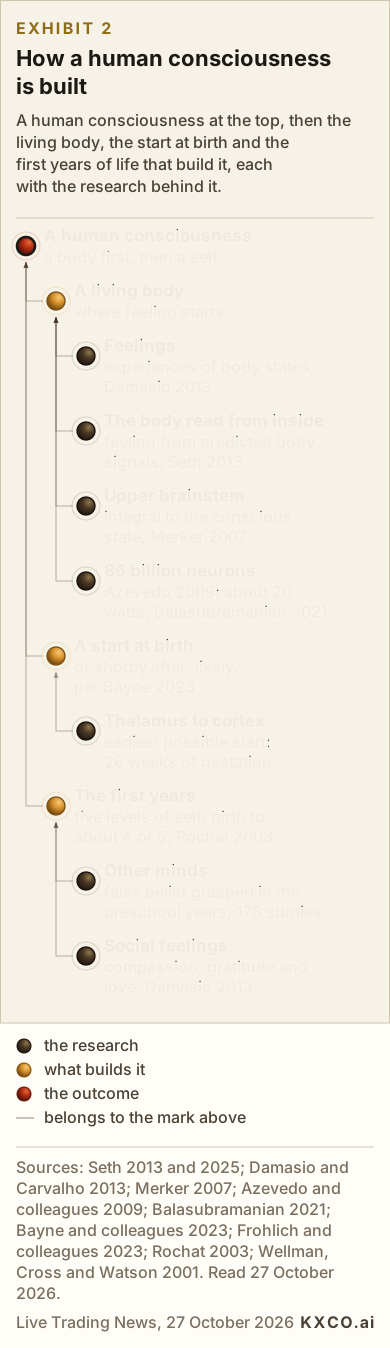
Exhibit 2, its links and their sources.
Seth makes the case that consciousness depends on our nature as living organisms. (Seth, Behavioral and Brain Sciences, 21 April 2025, paper)
Feelings are mental experiences of body states, and a component of the mechanisms of life regulation. (Damasio and Carvalho, Nature Reviews Neuroscience, February 2013, paper)
Interoceptive inference treats subjective feeling states as arising from predictive models of signals from inside the body, and bears on body ownership and conscious selfhood. (Seth, Trends in Cognitive Sciences, November 2013, paper)
A highly conserved upper brainstem system is integral to the conscious state, and children born without a cortex show evidence of consciousness. (Merker, Behavioral and Brain Sciences, February 2007, paper)
The adult male human brain holds on average 86.1 billion neurons; Balasubramanian puts its energy budget at about 20 watts. (Azevedo and colleagues, Journal of Comparative Neurology, 10 April 2009, paper)
Bayne and colleagues argue that recent research points in favour of early-onset accounts, under which consciousness is likely in place at birth or shortly after. (Bayne and colleagues, Trends in Cognitive Sciences, 12 October 2023, paper)
The earliest possible time for subjective experience to begin is likely the establishment of thalamocortical connectivity at 26 weeks of gestation. (Frohlich and colleagues, NeuroImage, 30 March 2023, paper)
Five levels of self-awareness unfold from birth to about 4 to 5 years of age. (Rochat, Consciousness and Cognition, December 2003, paper)
Across 178 studies, false-belief understanding showed a consistent developmental pattern and genuine conceptual change in the preschool years. (Wellman, Cross and Watson, Child Development, May 2001, paper)
Feelings signify specific social interactions, for example compassion, gratitude or love. (Damasio and Carvalho, Nature Reviews Neuroscience, February 2013, paper)
What is still not proven
The opposing case deserves its strongest form. Chalmers rejects what he calls biological chauvinism: in his view "silicon is just as apt as carbon as a substrate for consciousness", and what matters is "how neurons or silicon chips are hooked up to each other". On mainstream assumptions he arrives at "confidence somewhere under 10 percent in current LLM consciousness", and at 25 percent or more for successor systems built within a decade, with a warning not to take the numbers too seriously. His own credences, he adds, are "somewhat higher", because his views "lean somewhat more to consciousness being widespread". The 19-author report's analysis also "suggests that there are no obvious technical barriers to building AI systems which satisfy these indicators".
Other theories cut the other way. Integrated information theory ties consciousness to the causal properties of a physical system, not to biology, yet Giulio Tononi and Christof Koch wrote in 2015 that it implies digital computers, "even if they were to run faithful simulations of the human brain, would experience next to nothing". They add that hardware-level, neuromorphic models of the human brain, which do not rely on software running on a digital computer, could, one day, approximate our level of consciousness. Stuart Hameroff and Roger Penrose, in their theory of orchestrated objective reduction (Orch OR), place consciousness in quantum processes "in collections of microtubules within brain neurons", inside living cells. Max Tegmark calculated in 1999 that such quantum states decohere in a ten-trillionth of a second or less, far faster than the thousandths to tenths of a second over which neurons act, so that theory remains contested.
No experiment has yet decided between these views, and the Cogitate test put two of the most prominent theories under strain. Only the functional theories, which treat consciousness as function whatever the material, allow it in the digital computers we run now. Integrated information theory would allow it in neuromorphic hardware, and Seth as AI becomes more brain-like or life-like: both ask the machine to become more like a brain or a living body. The theories that tie consciousness to life or to causal structure deny it to today's computers, and Orch OR places it inside living neurons. Every case any of them can point to is a living one.
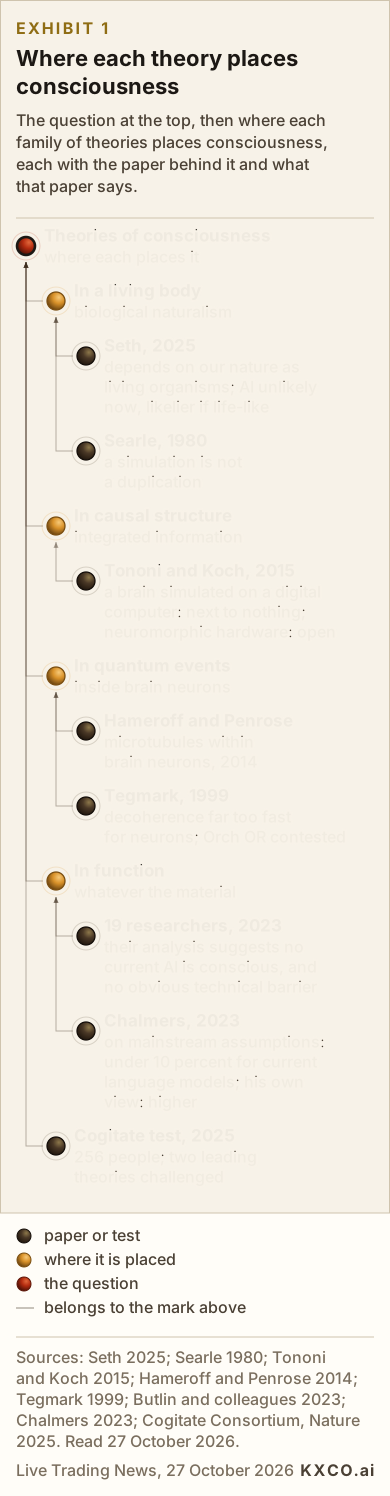
Exhibit 1, its links and their sources.
Searle: whatever else intentionality is, it is a biological phenomenon, and any mechanism capable of producing it must have causal powers equal to those of the brain. (Searle, Minds, Brains, and Programs, 1980, paper)
Seth makes the case that consciousness depends on our nature as living organisms, and finds real artificial consciousness unlikely along current trajectories but more plausible as AI becomes more brain-like or life-like. (Seth, Behavioral and Brain Sciences, 21 April 2025, paper)
Searle wrote that no one supposes a computer simulation of a rainstorm will leave us all drenched, and that to confuse simulation with duplication is the same mistake for pain, love and cognition. (Searle, Minds, Brains, and Programs, 1980, paper)
Integrated information theory starts from the essential properties of experience and asks what physical mechanisms could account for them. (Tononi and Koch, Phil. Trans. R. Soc. B, 19 May 2015, paper)
Tononi and Koch write that the theory implies digital computers, even running faithful simulations of the human brain, would experience next to nothing, while hardware-level, neuromorphic models of the human brain are not ruled out from approaching our level of consciousness in future. (Tononi and Koch, Phil. Trans. R. Soc. B, 19 May 2015, paper)
Orchestrated objective reduction (Orch OR) proposes that consciousness depends on orchestrated quantum processes in microtubules within brain neurons. (Hameroff and Penrose, Physics of Life Reviews, March 2014, paper)
Hameroff and Penrose review Orch OR, proposed in the mid 1990s, in light of criticisms and developments in quantum biology, neuroscience, physics and cosmology. (Hameroff and Penrose, Physics of Life Reviews, March 2014, paper)
Tegmark calculated decoherence timescales of about 10^-13 to 10^-20 seconds against neural dynamics of about 0.001 to 0.1 seconds, and disagreed that quantum coherence is related to consciousness in a fundamental way. (Tegmark, arXiv, later Physical Review E, 5 July 1999, paper)
The 19-author report derives indicator properties from theories including global workspace, recurrent processing, higher-order, predictive processing and attention schema theories, stated in computational terms. (Butlin and colleagues, arXiv, 17 August 2023, paper)
Their analysis suggests that no current AI systems are conscious, and also suggests that there are no obvious technical barriers to building AI systems which satisfy these indicators. (Butlin and colleagues, arXiv, 17 August 2023, paper)
On mainstream assumptions Chalmers arrives at confidence somewhere under 10 percent in current language-model consciousness; his own credences are somewhat higher, and he holds silicon as apt as carbon. (Chalmers, arXiv, 4 March 2023, paper)
In a preregistered adversarial test on 256 participants, the results aligned with some predictions of integrated information theory and global neuronal workspace theory while substantially challenging key tenets of both. (Cogitate Consortium, Nature, 30 April 2025, paper)
Build AI to extend human consciousness
If consciousness is linked to our humanity, the useful question about AI changes. It stops being when the machine will wake up. It becomes how much more of a human mind the machine can carry.
I set out my answer in KXCO is Enhanced Intelligence, Not Artificial in September: "Artificial means the machine does the thinking and hands you the answer. Enhanced means I do the thinking, with more of my own mind in the room than I have ever had at one time." What the machine extends is recall, learning that compounds and the patterns that sit between fields. Experience, stakes and the decision stay with the person, because the person is the one who lives with the result. The danger on the other side is the one I described in AI is the Neat Handwriting of the Illiterate: a finished page produced on behalf of someone who does not know.
Others who build and study these systems have reached the same line. Mustafa Suleyman of Microsoft AI wrote on 19 August 2025: "We must build AI for people; not to be a person." He warns that "Seemingly Conscious AI", a system that imitates consciousness convincingly while "internally it is blank", can be built in the next few years, and that many people will come to believe in it. Seth's 2025 paper carries the same caution: if we sell our minds too cheaply to our machines, we overestimate them and underestimate ourselves.
A machine with no experience has nothing at stake in a decision, and a decision needs someone who answers for it. The human stays in the loop because that is where the consciousness is, and with it the stakes and the answerability. I covered the biology of thought itself in Thoughts on Thinking, and the conclusion there was the same: the work is still the person.
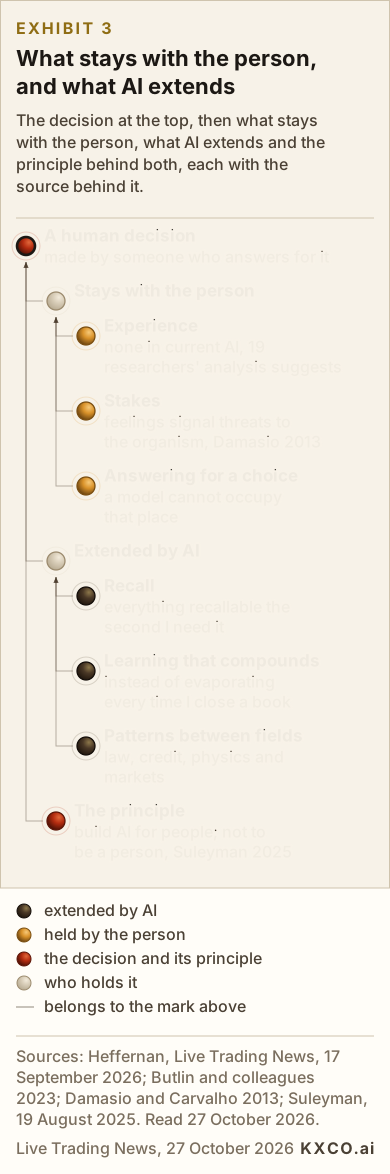
Exhibit 3, its links and their sources.
The human decides, and I want it that way for reasons that have nothing to do with a regulator. (Heffernan, KXCO is Enhanced Intelligence, Not Artificial, 17 September 2026, own text)
The 19-author report assessed recent AI systems against indicator properties from the best-supported theories, and its analysis suggests that no current AI systems are conscious. (Butlin and colleagues, arXiv, 17 August 2023, paper)
Feelings signify physiological need, tissue injury and threats to the organism. (Damasio and Carvalho, Nature Reviews Neuroscience, February 2013, paper)
A model can store and learn, and it cannot occupy the place where a person answers for a choice. (Heffernan, KXCO is Enhanced Intelligence, Not Artificial, 17 September 2026, own text)
Enhanced means I do the thinking, with more of my own mind in the room than I have ever had at one time. (Heffernan, KXCO is Enhanced Intelligence, Not Artificial, 17 September 2026, own text)
A lifetime of reading and experience, the work of great men, the history of everything recallable the second I need it. (Heffernan, KXCO is Enhanced Intelligence, Not Artificial, 17 September 2026, own text)
Learning that compounds instead of evaporating every time I close a book. (Heffernan, KXCO is Enhanced Intelligence, Not Artificial, 17 September 2026, own text)
Patterns across law, credit, physics and markets that no specialist sees, because the useful ones sit between the fields rather than inside them. (Heffernan, KXCO is Enhanced Intelligence, Not Artificial, 17 September 2026, own text)
We must build AI for people; not to be a person. (Suleyman, Microsoft AI, 19 August 2025, essay)
What to watch
Watch for the results of INTREPID, an adversarial collaboration led by the University of Amsterdam and funded by the Templeton World Charity Foundation. It tests integrated information theory against two predictive-processing theories, neurorepresentationalism and Karl Friston's active inference, in three experiments, each designed to test incompatible predictions. Predictive processing is the framework behind Seth's account of the body read from inside, so those results bear on the case made here.
No experiment has yet solved the hard problem, and this is the case the evidence supports today.
Stocks mentioned: $MSFT (NASDAQ) and $GOOGL (NASDAQ).
Shayne Heffernan, Ph.D., is the founder of the KnightsBridge Group (shayneheffernan.com).
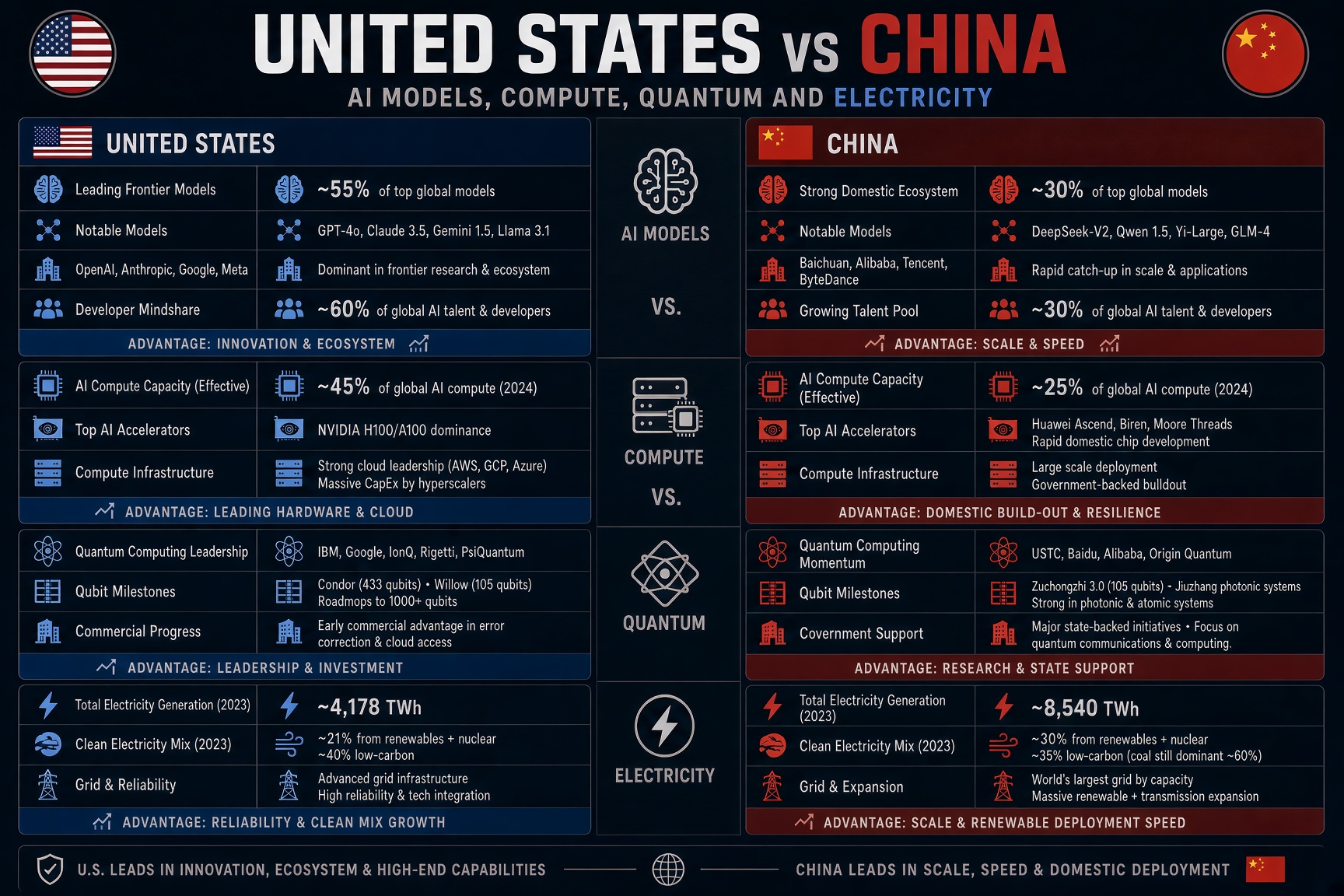
United States vs China: AI Models, Compute, Quantum and Electricity
The United States still leads in frontier model capability, total AI compute and quantum error correction, while China has narrowed the gaps in model performance, open-weight adoption and domestic chip volumes, and holds a structural advantage in power for data centres. Shayne Heffernan sets out the developments from July to October 2026 across models, compute, quantum and electricity, and how fast China is catching up.
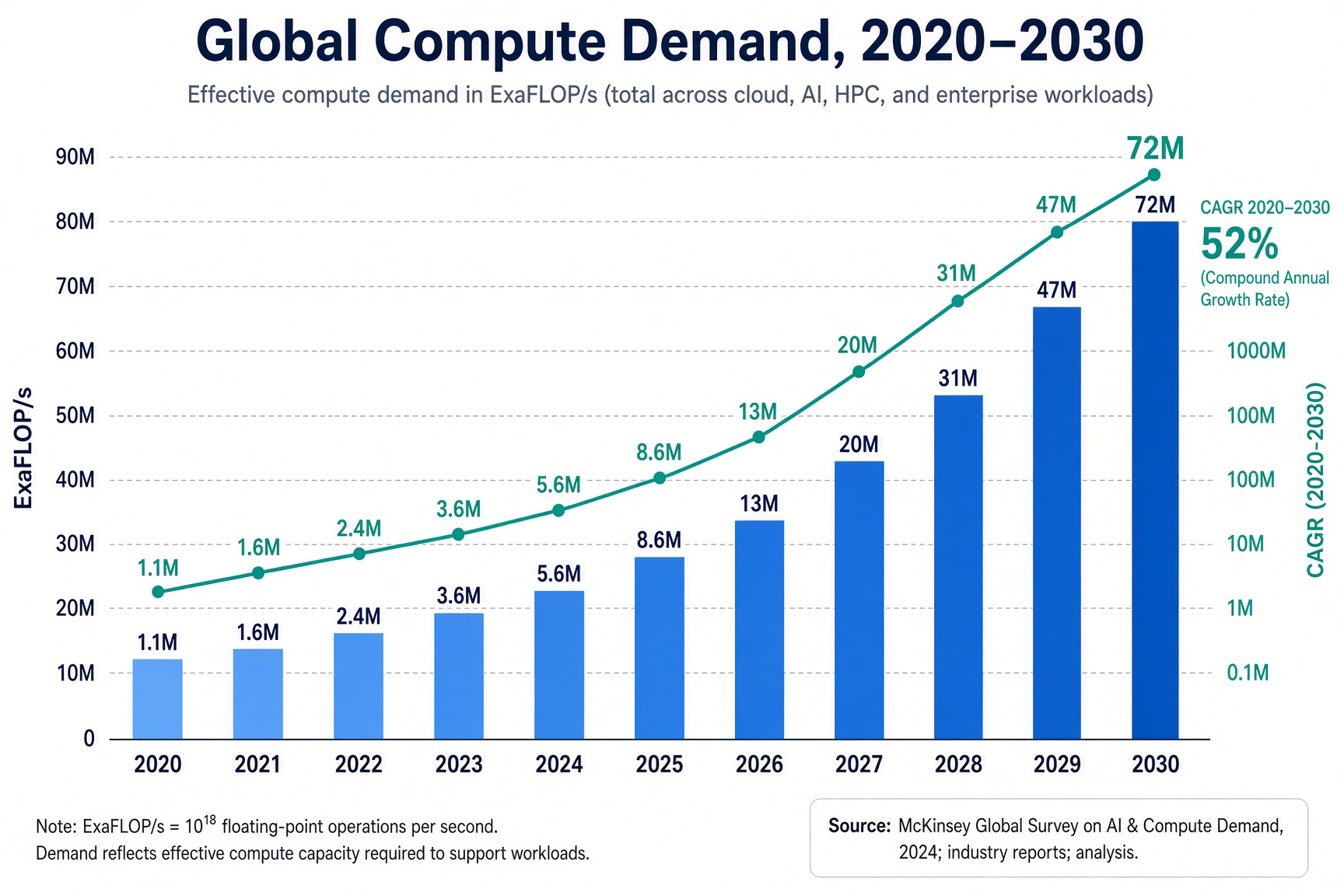
The 2030 Compute Landscape: GPUs, Power and the Architecture of Intelligence
The constraint on AI is no longer ideas or data but compute and the power to run it. Frontier training compute has grown about five times a year since 2020, and the leading AI supercomputer of June 2030 is on course for about 2 million chips and 9 gigawatts. Shayne Heffernan sets out the 2030 arithmetic, the power problem, who has already contracted the gigawatts, and how GPUs, custom ASICs, wafer-scale engines and quantum machines divide the work.

How Can You Trust AI When You Cannot Trust Humans?
Can you trust AI? Can you trust humans? More often than we like to admit, the answer is no. AI inherits its failures from the human records it is trained on. Sheikh Mohammed bin Rashid wrote this month that the currency the UAE is betting on is trust. This piece sets out what a trust layer has to do, shows the method on three public knowledge graphs, and lays out the post-quantum work KXCO has published so that an institution can check the claim rather than take it.
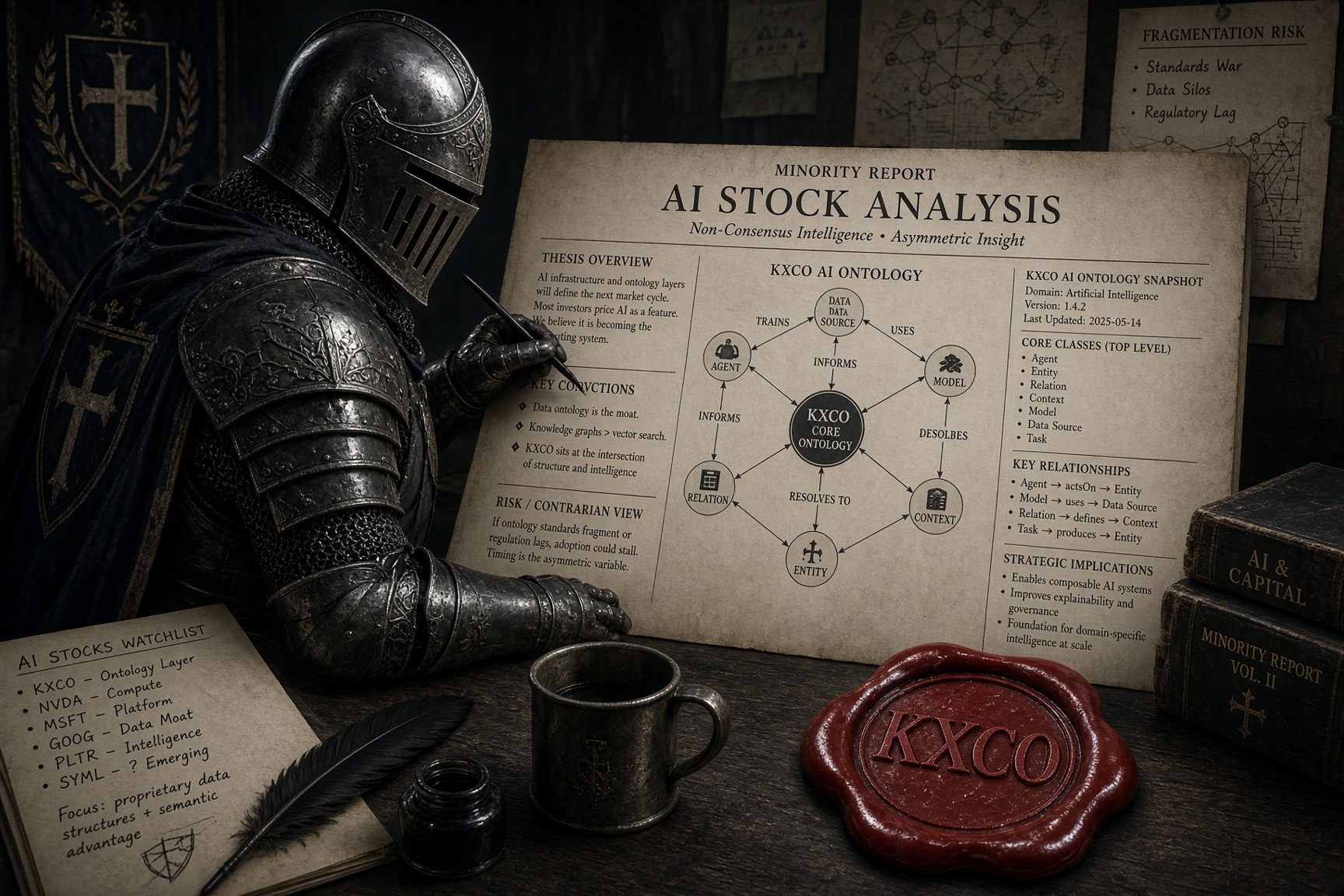
KXCO AI Ontology at 3 Months: What It Called and What Comes Next
On 19 July 2026 the Round Table's AI room published its first Analyst Outlook. To the 16 October 2026 close its 13 names rose 2.6% on an equal weight against 2.1% for QQQ, per StockAnalysis closes, and the six it opened with 35% or more of upside rose 8.6%. This piece lists the six names up more than 5%, the ten names I rate as opportunities now, the month's results in AI and quantum computing, and the official data showing that four in five firms have not yet started using AI.
Every story, signed and delivered.
Subscribe to the kxco channel and get the headline, the AI-written key takeaways, and the chain-anchor link the moment we publish. Audio versions and per-ticker subscriptions arrive in the next iteration.