
The 2030 Compute Landscape: GPUs, Power and the Architecture of Intelligence
Training compute is growing five times a year and the power behind it is doubling. What the arithmetic says about 2030, who has already contracted the gigawatts, and which silicon will carry the load.
Part of theAI Stocks Center
Artificial intelligence has entered a phase in which the primary constraint on capability is no longer ideas or data, but raw computational power and the energy required to deliver it. Graphics processing units (GPUs), once tools for rendering, have become the dominant substrate for training and serving the models that now shape research, industry and public life. Their performance has scaled faster than classical Moore's Law, yet the trajectory is bending under physical and economic pressure. By 2030 the leading systems are projected to require multi-gigawatt power loads, while specialised alternatives (custom ASICs, wafer-scale engines and early quantum processors) carve out distinct roles.
Compute, in the sense used here, is counted in floating-point operations, or FLOP: the total a training run performs, and the rate per second a chip or a cluster sustains. Power is counted in gigawatts, the load a site draws from the grid or from its own generation. The 2030 compute landscape is where those two numbers meet.
This article examines the measured growth rates, the arithmetic of the 2030 outlook, the power problem that may prove binding, the performance of alternative processors, and the consequences for how AI is used and what it costs. Two knowledge graphs set out who has already contracted the power and who builds the silicon, with every link numbered to its source.
The measured growth of GPU and AI compute
The acceleration of AI hardware is well documented. Epoch AI's analysis of machine-learning accelerators finds that peak performance, measured in 16-bit floating-point operations, has grown about 36% a year, doubling every 2.3 years over the longer historical record, per its data insight on hardware performance of October 2024. Examinations focused on NVIDIA's data-centre GPUs find steeper rates. A study by Del Sozzo, Fleming, Flamm and Thompson finds doubling times of 1.43 years for dense FP16 and 1.67 years for dense FP32 operations, per the paper on arXiv first posted in January 2026. The drivers are tensor cores, reduced precision and architectural specialisation rather than pure transistor density.
At the system level the picture is steeper still. Training compute for frontier language models has grown about five times a year since 2020, doubling every 5.2 months, per Epoch AI's trends dashboard as updated in February 2026. Over the longer record from 2010 the rate is four to five times a year, per Epoch AI's May 2024 study of frontier models.
That growth is the product of three factors, which Epoch AI has decomposed for frontier models trained since 2018: more chips per cluster, at about 1.7 times a year; longer training runs, at about 1.5 times; and faster chips, at about 1.4 times. The leading AI supercomputers have grown about 2.5 times a year in 16-bit performance, doubling every nine months, with chip counts and performance per chip each rising about 1.6 times a year, per Trends in AI Supercomputers by Pilz, Sanders, Rahman and Heim, published in April 2025. The performance a dollar buys in AI chips has risen about 49% a year since 2023, per Epoch AI's data insight on chip performance per dollar of August 2026. Energy efficiency has advanced more slowly, about 1.34 times a year, per the same supercomputer study.
These rates already produce large absolute jumps. A training run that once required months on thousands of GPUs can now be completed on denser, better-connected clusters in a fraction of the time. The installed base of AI accelerators continues to expand, and the share of compute devoted to inference has grown as models move from research into production. Inference will account for roughly two-thirds of all AI compute in 2026, up from a third in 2023 and half in 2025, per Deloitte's TMT Predictions 2026 of November 2025.
The drivers are not mysterious. Lower-precision arithmetic (FP8, FP4 and mixed formats) multiplies effective throughput for the matrix multiplications that dominate transformer workloads. High-bandwidth memory stacks keep data closer to the compute units. High-speed interconnects, NVLink and its equivalents, allow thousands of accelerators to behave, imperfectly, as a single machine. Software stacks, from CUDA to optimised kernels and distributed training frameworks, raise utilisation. Each of these levers has been pulled repeatedly, and none has yet been exhausted.
The 2030 arithmetic
Extending observed trends to 2030 yields numbers that are large but still within the range of engineering discussion rather than pure speculation. Epoch AI's August 2024 report, Can AI Scaling Continue Through 2030?, concludes that training runs of up to 2 × 10²⁹ FLOP will be feasible by the end of this decade if capital, chip production and power can be mobilised. That is about 10,000 times GPT-4, and about 5,000 times Llama 3.1 405B, which Meta trained on about 3.8 × 10²⁵ FLOP. Of the four constraints the report examines, power binds first. Chip production alone would allow about 9 × 10²⁹ FLOP, per the same report, so the larger scenarios are the ones in which the power problem has been solved.
A transparent extrapolation of the training-compute trend from a 2024 baseline illustrates the scale. At four times a year over six years, the multiplier is 4⁶, or 4,096 times. At five times a year it is 5⁶, or 15,625 times. Epoch AI's own footnote uses 4.1 times a year, which takes Llama 3.1 405B to about 2 × 10²⁹ FLOP, per the same report of August 2024.
Hardware efficiency improvements partially offset the raw multiplier. The Epoch AI report starts from the Llama 3.1 405B run, about 16,000 H100 GPUs drawing about 27 megawatts, and sets the 5,000-fold scale increase against a 24-fold efficiency gain: four times from hardware, twice from FP8 precision and three times from longer runs. The net power multiplier is 5,000 divided by 24, about 208, which the report rounds to 200 times and about 6 gigawatts for a single on-trend frontier training run in 2030, per Epoch AI in August 2024. Its August 2025 update with EPRI, Scaling Intelligence, puts the largest runs of 2030 at 4 to 16 gigawatts.
Cluster-level performance has grown near 2.5 times a year in the leading systems. Continued compounding at that rate produces, by June 2030, a leading AI supercomputer of about 2 million chips, $200 billion of hardware and 9 gigawatts of power, per the Pilz study of April 2025. Physical limits on field-effect transistor density are expected to begin constraining per-chip gains between 2027 and 2035. Epoch AI's 2022 forecast places the plateau of today's transistor-based GPUs between 10¹⁴ and 10¹⁵ FLOP per second in FP32 within that window. After it, further improvement depends on packaging, memory systems, interconnect topology and software, or on new device physics.
The 2026 checkpoint sits on the line. The largest run in Epoch AI's models database, as read on 22 October 2026, is OpenAI's GPT-6 Astra, released on 3 September 2026 and estimated by Epoch AI at about 9.4 × 10²⁶ FLOP. That is about 25 times the Llama 3.1 405B run two years earlier, which is five times a year. OpenAI pretrained the model on more than 100,000 GPUs at its Stargate site in Texas, per Fortune on launch day.
These figures are not predictions of what will certainly be built. They are statements of what remains technically feasible if the observed growth rates persist and the necessary capital and infrastructure are supplied. Several independent analyses converge on the same order of magnitude.
The power problem
Power is the constraint most frequently identified as binding. The power needs of the leading AI supercomputers have doubled about every year, per the Pilz study of April 2025, slower than their performance but fast enough. Extrapolating that trend produces a largest system of about 9 gigawatts by mid-2030. The authors put it as the equivalent of nine nuclear reactors, "a scale beyond any existing industrial facility".
Broader estimates of total AI data-centre capacity, training plus inference, put US demand above 50 gigawatts and global demand above 100 gigawatts by 2030, per EPRI and Epoch AI in Scaling Intelligence of August 2025. Inference is expected to take most AI compute, even while frontier training runs remain the largest single loads. Multi-gigawatt campuses are no longer under discussion. They are under construction. OpenAI's seven US Stargate sites add up to more than 9 gigawatts of planned capacity, per Epoch AI's review of the Stargate sites of April 2026. Meta's Hyperion campus in Louisiana will provide more than 5 gigawatts at full capacity, per SiliconANGLE in July 2026. Realising them requires coordinated generation, transmission upgrades and cooling systems that do not yet exist at the required density.
The engineering response has been rapid. A GB300 NVL72 rack draws up to 142 kilowatts, and air cooling becomes impractical above roughly 50 kilowatts a rack, per Data Center Knowledge in August 2026. Liquid cooling, once reserved for the densest high-performance computing installations, is therefore becoming standard. Direct-to-chip cold plates, immersion systems and rear-door heat exchangers are all in deployment or trial. The next racks go further: Nvidia's Kyber rack for Rubin Ultra is specified at roughly 600 kilowatts in the second half of 2027, per the same report.
On-site generation is under active evaluation, from gas turbines to small modular reactors and co-located solar and storage, because grid connection queues in many regions stretch for years. The median project built between 2018 and 2024 took more than four years from interconnection request to commercial operation, per Berkeley Lab's Queued Up 2025 report. Geographic distribution of training runs can aggregate power that no single site can supply, at the cost of additional networking complexity and latency.
The largest buyers have stopped waiting for the grid to come to them, and Exhibit 1 sets out the contracts they have signed. Constellation alone has agreements with all four of the largest cloud buyers. Microsoft's 20-year agreement restores Three Mile Island Unit 1, about 835 megawatts. Alphabet signed on 6 October 2026 for 890 megawatts of new nuclear capacity from uprates at 11 units, per Constellation that day. Amazon took 690 megawatts at Calvert Cliffs on 30 September 2026, and Meta contracted the output of Clinton in Illinois.
Meta holds the largest nuclear book, with Vistra, TerraPower and Oklo beside Constellation, per the Carnegie Endowment's review of hyperscaler nuclear commitments of June 2026. Alphabet has signed for a 2.7-gigawatt resource mix in Wyoming through 2048, per Black Hills' filing with the SEC on 6 October 2026. Microsoft agreed on 16 October 2026 to fund about 1,100 megawatts of new generation for its Indiana campus, per NiSource that day. OpenAI has secured about 8 gigawatts of IT capacity at the PORTS-Pike campus in Ohio with SB Energy, per OpenAI in August 2026.
The state is in the chain as lender. The US Department of Energy offered Vistra a conditional loan of up to $4.2 billion on 5 October 2026 for 433 megawatts of nuclear uprates at three plants, per the department's release that day. It is also providing $275 million of a $643 million package for Kairos Power's reactor programme in Tennessee, per Runtime Wire on 14 October 2026.
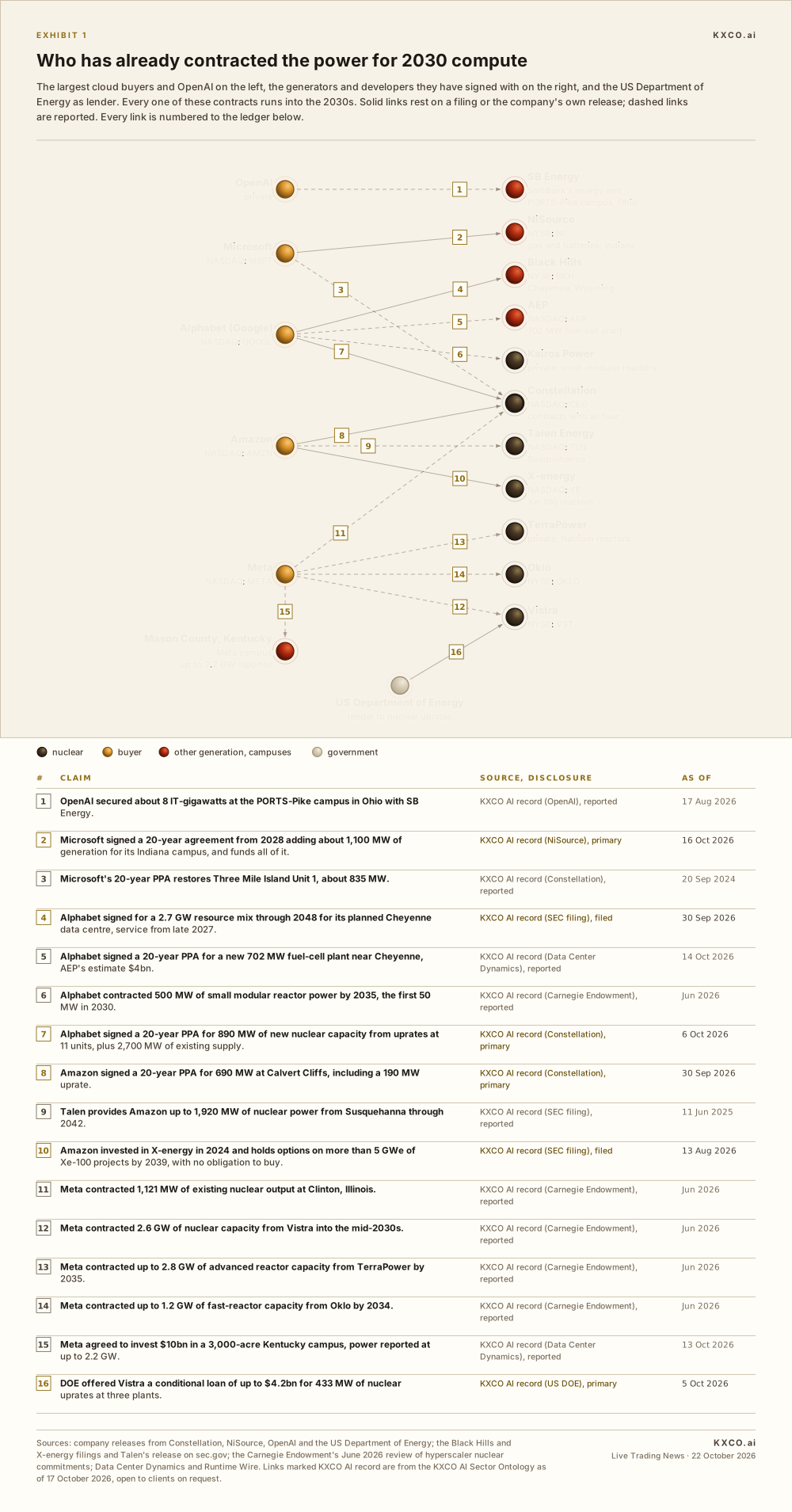
A contract is not yet a kilowatt. On 24 September 2026 Oracle sent a force majeure notice on its 2.45-gigawatt Project Jupiter campus in New Mexico, part of Stargate, seeking the right to defer payments if the campus misses its 2028 opening, per TechCrunch that day. Oracle said the project remains on its planned schedule. Many of the nuclear contracts in Exhibit 1 deliver in the 2030s, and several are new reactor designs whose delivery risk sits a decade out.
None of these measures removes the fundamental arithmetic. If training compute keeps growing at four to five times a year while efficiency improves at only about 1.3 times, net power demand rises. The gap between silicon capability and deliverable electricity is the central planning problem for the remainder of the decade.
Alternative processors
GPUs remain the most versatile and widely available AI accelerators, yet they no longer operate in isolation. Several other architectures are scaling in parallel, each optimised for a different point on the performance, efficiency and flexibility spectrum. Nvidia still sets the pace for the general-purpose chip: production shipments of Vera Rubin begin this autumn, per Nvidia's release of 31 May 2026, with Rubin Ultra due in the second half of 2027.
Custom ASICs and tensor processing units designed by the hyperscalers represent the largest near-term shift. Google's TPUs, Amazon's Trainium, Microsoft's Maia and Meta's MTIA are all built around large matrix-multiply arrays matched to neural-network workloads. Google announced TPU 8t for training and TPU 8i for inference in April 2026, per its technical post on the two chips, after Ironwood became generally available in November 2025. Amazon's Trainium3, built on 3 nm, is generally available, per Amazon at its launch. Meta has MTIA 300 in production and MTIA 400 rolling out, per its newsroom in March 2026. Microsoft said on 12 October 2026 that it will scale its Maia family to multi-gigawatt deployments from 2027 and make Maia the primary inference system for its own products, per its announcement that day.
Recent benchmark results show Google's TPUs delivering better performance per dollar than high-end Nvidia rack systems on certain inference tasks. On SemiAnalysis's agentic inference benchmark, Google's own TPUv7 submission showed 1.42 times the performance per dollar of a GB300 NVL72, revised from an initial 1.67 times, per Crypto Briefing on 19 October 2026. In SemiAnalysis's own InferenceX runs, Ironwood cost about $0.181 per million tokens against $0.222 for Nvidia's B200 and $0.276 for its B300, per its September 2026 report on TPU inference.
Hyperscaler ASIC shipments are growing faster than merchant GPUs. TrendForce expects ASIC-based servers to reach 27.8% of AI server shipments in 2026, the highest share since 2023, per its January 2026 forecast of AI servers. The commitments are now counted in gigawatts. Broadcom expects Anthropic to deploy 5 gigawatts of TPU 8i in 2027, and has OpenAI's own custom accelerator on track for 1.3 gigawatts the same year, per its third-quarter call of 2 September 2026. These chips excel inside the organisations that design them. Outside those environments, portability and software maturity remain limited.
Cerebras occupies a distinct niche with its wafer-scale engines. The WSE-3, fabricated on TSMC's 5 nm process, places about 4 trillion transistors and 900,000 AI-optimised cores on a single 46,225 mm² die, together with 44 GB of on-chip SRAM, per Cerebras at its 2024 launch. Vendor-rated peak performance is 125 petaflops for the base WSE-3 and double that, 250 petaflops of sparse FP16, for the higher-powered WSE-3 Turbo. The CS-4, launched on 18 August 2026, puts three Turbo wafers in one system for 750 petaflops of sparse FP16. It cuts wafer-to-wafer latency to 2 microseconds, which Cerebras says delivers more than 1,000 tokens per second on models of more than 10 trillion parameters, per its CS-4 datasheet of August 2026.
The architecture's advantage is on-wafer bandwidth and reduced communication overhead for inference. Its limitations include constrained on-chip memory capacity, supplemented by external streaming for the largest models, and a narrower software base than CUDA. Future generations aim to raise token rates further and add capacity: CS-5, targeted for 2027, is designed for up to 10,000 output tokens per second per user, and CS-6 adds 3D-stacked DRAM, per Cerebras's Hot Chips 2026 presentation in August. Cerebras has secured large multi-year capacity commitments, including from OpenAI, which agreed in January 2026 to deploy 750 megawatts through 2028 in a deal valued at more than $20 billion, with an option on 1.25 gigawatts more, per the company's prospectus of May 2026. Cerebras listed on Nasdaq on 14 May 2026. It remains a specialised inference platform rather than a general replacement for GPU training clusters.
Other merchant accelerators, notably AMD's Instinct series, compete primarily on memory capacity and bandwidth, which benefits long-context and memory-bound inference. The current MI355X carries 288 GB of HBM3E at 8 TB/s, about level with Nvidia's GB300 per GPU, per AMD's MI355X product page. The next generation opens a gap: AMD's MI455X carries 432 GB of HBM4, and its Helios rack offers 50% more HBM capacity than Nvidia's Vera Rubin rack, per AMD on 23 July 2026. OpenAI has agreed to deploy 6 gigawatts of AMD GPUs, the first gigawatt of MI450 from the second half of 2026, per AMD's announcement of October 2025.
Intel's Gaudi 3 integrates 24 ports of 200-gigabit Ethernet on the chip, per its product page at Habana, and other entrants offer Ethernet-native clustering and competitive price-performance in selected segments. None has displaced CUDA for general-purpose development, yet the gaps on pure throughput and efficiency are narrowing for targeted workloads.
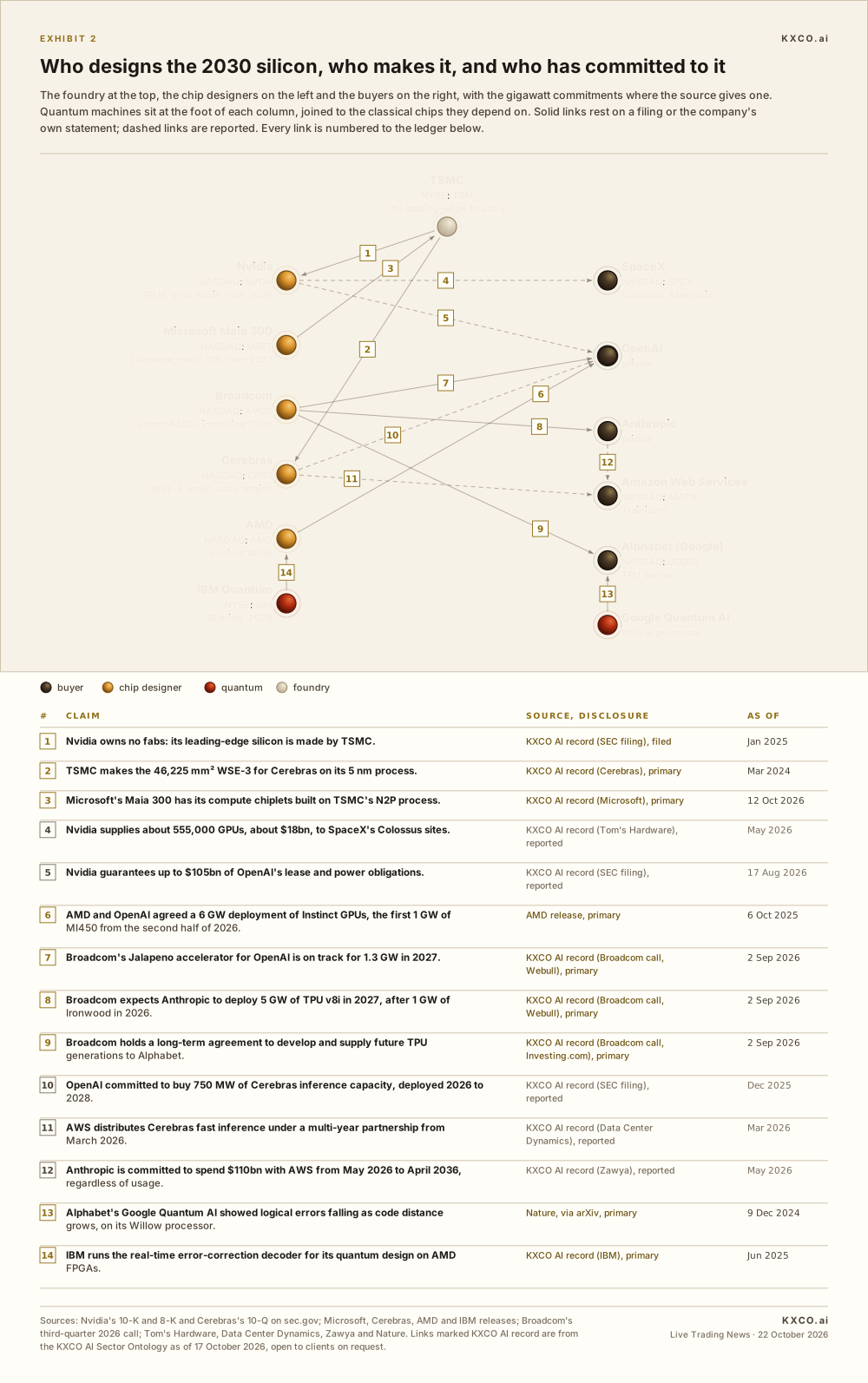
Exhibit 2 maps the silicon. TSMC makes the chips for Nvidia, Cerebras and Microsoft's Maia 300. OpenAI is the buyer with the most suppliers: Nvidia, AMD, Broadcom and Cerebras. Nvidia has also guaranteed up to $105 billion of OpenAI's lease and power obligations, per its filing with the SEC of 17 August 2026, which joins the chip chain in Exhibit 2 to the power chain in Exhibit 1.
Traditional CPUs continue to improve through higher core counts and wider vector units, but they lag far behind accelerators on dense matrix arithmetic. They remain essential for orchestration, data preprocessing and low-volume tasks where accelerator overhead is not justified.
Quantum processors have demonstrated clear progress on error correction. On 19 October 2026 Quantinuum reported logical memory error rates as low as about 5 × 10⁻⁶ on its Helios computer, with logical errors falling by a factor of 12 for each step up in code distance from three to seven, per its press release and the preprint behind it. Google's Willow processor showed logical errors falling as code distance grows, with a logical qubit outliving its best physical qubit, per the Nature paper announced in December 2024. Together they are evidence that the field has passed the break-even point for certain encodings.
Roadmaps from multiple groups target fault-tolerant machines with hundreds to low thousands of logical qubits in the late 2020s and early 2030s. IBM plans Starling for 2029 with 200 logical qubits, per its fault-tolerance roadmap of June 2025, and a 2,000-qubit Blue Jay from 2033. Quantinuum expects its universal fault-tolerant Apollo by 2029, per the same Quantinuum release. Current useful logical-qubit counts remain small. Gartner predicts that no enterprise AI workload at scale will run on quantum hardware by 2028, and that fault-tolerant quantum computing will remain in the research and development phase for AI through 2030, per its press release of 4 August 2026.
Practical advantage is more likely first in chemistry, materials science and certain optimisation problems than in the dense linear algebra that dominates current AI training and inference, per Hoefler, Häner and Troyer in Communications of the ACM in 2023. Hybrid quantum-classical workflows may appear, and they already depend on classical silicon: IBM runs the real-time decoder for its fault-tolerant design on AMD FPGAs, per the same IBM roadmap. Classical accelerators will continue to supply the overwhelming majority of AI FLOPS.
Consequences for AI use and cost
The combination of continued GPU scaling, rising ASIC and wafer-scale deployment, and multi-gigawatt power requirements will reshape both the economics and the practical use of AI.
On cost, two opposing forces operate. Hardware efficiency gains and competition among GPU vendors, ASICs and specialised systems tend to reduce the price of a given quantity of compute. At the same time, the absolute scale of frontier systems concentrates capability among organisations that can finance and site such infrastructure. Microsoft, Alphabet, Amazon and Meta have guided to more than $700 billion of combined capital expenditure in 2026. Meta narrowed its range to $135 billion to $145 billion in its results on 21 October 2026. Amazon expects about $220 billion, per Fortune in July. Alphabet guides to $195 billion to $205 billion, per The Motley Fool on 19 October, and Microsoft to about $175 billion for the calendar year, per CFO Dive in July.
Inference costs, measured in dollars per million tokens, have already fallen sharply. Epoch AI finds price declines of between 9 and 900 times a year, depending on the level of performance held constant. The Stanford AI Index 2025 found that the cost of GPT-3.5-level performance fell more than 280-fold between November 2022 and October 2024. Prices are expected to keep declining for standard workloads as ASICs and optimised GPU software improve utilisation. Frontier training and the largest agentic or long-context inference jobs will remain expensive, but the cost of "good enough" models for most commercial applications should keep falling.
Usage patterns will bifurcate. High-volume, relatively stable inference (recommendation, search, customer support, code completion) will migrate towards the lowest-cost specialised silicon. Research, rapid model iteration and novel architectures will continue to favour the flexibility of GPUs. Real-time or high-token-rate applications, such as interactive agents and low-latency reasoning systems, will favour architectures such as Cerebras that minimise communication overhead. Scientific and industrial simulation workloads that map well onto quantum algorithms may begin to offload selected sub-problems once logical-qubit counts reach the low hundreds, but these will remain complementary rather than substitutive for the majority of AI compute through 2030.
Power constraints will also alter deployment geography and business models. Regions with abundant generation capacity, streamlined permitting and cool climates will attract a disproportionate share of new AI capacity. Power availability is already the deciding variable: CBRE's 2026 outlook says power strategy "now is site selection", per Data Center Frontier in January 2026. Operators that can secure long-term power contracts or co-locate generation will hold structural advantages, and Exhibit 1 shows the largest of them doing exactly that. The shift towards inference-heavy workloads will favour architectures that maximise tokens per watt over peak training FLOPS.
For most organisations the practical outcome is continued improvement in capability at falling marginal cost for standard tasks, alongside rising barriers to entry for the absolute frontier. The models available through APIs in 2030 will be substantially more capable than those available today. The organisations that train the next generation of frontier systems will be fewer, and will operate under tighter energy and capital constraints than the pure silicon trend lines suggest.
Conclusion
GPU and AI accelerator performance will be materially higher in 2030 than in 2026. Frontier training runs on the order of 2 × 10²⁹ FLOP remain feasible under continued scaling, and leading systems are projected to draw several gigawatts. The arithmetic is straightforward: multi-year compound growth of four to five times a year in training compute, or about 2.5 times in cluster performance, moderated by efficiency gains that only partially offset the power multiplier. The binding constraint is shifting from transistor density towards the delivery and cooling of multi-gigawatt loads, and the ability to keep a heterogeneous mix of GPUs, custom ASICs and wafer-scale engines busy.
Cerebras adds a specialised high-bandwidth inference option. Quantum systems are advancing on error correction but will not displace classical accelerators for general AI workloads by 2030. The result is not a single exponential curve but a set of branching performance trajectories. How those trajectories are financed, powered and allocated will determine both the cost and the practical reach of AI over the remainder of the decade.
The engineering problems are concrete: packaging yields, high-bandwidth memory supply, liquid cooling at scale, grid interconnection, and software that keeps heterogeneous hardware busy. They are solvable in principle. Whether they are solved at the required speed and volume is the open question that will shape the AI landscape through 2030 and beyond.
Questions and answers on the 2030 compute landscape
How fast is AI training compute growing?
Training compute for frontier language models has grown about five times a year since 2020, doubling every 5.2 months, per Epoch AI's trends dashboard. From 2010 to 2024 the rate was four to five times a year.
How large could an AI training run be by 2030?
Epoch AI finds training runs of up to 2 × 10²⁹ FLOP feasible by 2030 if capital, chips and power are supplied, per its 2030 scaling report. That is about 5,000 times the training compute of Llama 3.1 405B.
How much power will the largest AI systems need in 2030?
On the 2019 to 2025 trend, the leading AI supercomputer in June 2030 needs about 2 million chips, $200 billion of hardware and 9 gigawatts, per Pilz and co-authors in Trends in AI Supercomputers. EPRI and Epoch AI put the largest single training runs of 2030 at 4 to 16 gigawatts.
Why do AI racks need liquid cooling?
A GB300 NVL72 rack draws up to 142 kilowatts, and air cooling becomes impractical above roughly 50 kilowatts a rack, per Data Center Knowledge in August 2026.
What is a wafer-scale engine?
A wafer-scale engine is a single processor built across a whole silicon wafer rather than cut into separate chips. Cerebras's WSE-3 has about 4 trillion transistors, 900,000 cores and 44 GB of on-chip memory on a 46,225 mm² die made on TSMC's 5 nm process, per Cerebras at its launch in March 2024.
What share of AI servers use custom ASICs?
TrendForce expects ASIC-based servers, built on chips such as Google's TPUs and Amazon's Trainium, to reach 27.8% of AI server shipments in 2026, with GPUs at 69.7%, per its January 2026 forecast of AI servers.
Will quantum computers run enterprise AI workloads by 2030?
Gartner predicts that no enterprise AI workload at scale will run on quantum hardware by 2028, and that fault-tolerant quantum computing will remain in the research and development phase for AI through 2030, per its press release of 4 August 2026.
Stocks mentioned: $NVDA (NASDAQ), $AMD (NASDAQ), $AVGO (NASDAQ), $INTC (NASDAQ), $TSM (NYSE), $CBRS (NASDAQ), $MSFT (NASDAQ), $GOOGL (NASDAQ), $AMZN (NASDAQ), $META (NASDAQ), $ORCL (NYSE), $IBM (NYSE), $SPCX (NASDAQ), $CEG (NASDAQ), $VST (NYSE), $TLN (NASDAQ), $OKLO (NYSE), $XE (NASDAQ), $NI (NYSE), $BKH (NYSE) and $AEP (NASDAQ). OpenAI, Anthropic, Quantinuum, TerraPower, Kairos Power and SB Energy are private.
Sources: Epoch AI's trends dashboard, data insights, models database and the reports "Can AI Scaling Continue Through 2030?", "Predicting GPU performance" and, with EPRI, "Scaling Intelligence"; Pilz, Sanders, Rahman and Heim, "Trends in AI Supercomputers"; Del Sozzo, Fleming, Flamm and Thompson on NVIDIA data-centre GPUs; Deloitte, the Stanford AI Index 2025, Berkeley Lab, the Carnegie Endowment, Data Center Knowledge, Data Center Frontier, SiliconANGLE, Fortune, TechCrunch, Runtime Wire, The Motley Fool and CFO Dive.
Company releases and filings from Constellation, NiSource, Black Hills, OpenAI, Meta and the US Department of Energy. Nvidia, AMD, Microsoft, Google Cloud, Amazon, Meta, Cerebras, IBM, Quantinuum and Gartner releases; Cerebras's prospectus and Nvidia's 8-K; Broadcom's third-quarter call; SemiAnalysis, TrendForce and Crypto Briefing; the Willow paper in Nature and Hoefler, Häner and Troyer in Communications of the ACM. Links marked KXCO AI record in the exhibits are from the KXCO AI Sector Ontology as of 17 October 2026. All read on 22 October 2026.
Shayne Heffernan, Ph.D., is the founder of Live Trading News, the KnightsBridge Group, Knightsbridge Law and the KXCO.ai ecosystem spanning post-quantum cryptography, identity, attestation and enterprise ontology.
This commentary is for informational purposes and does not constitute investment advice.

How Can You Trust AI When You Cannot Trust Humans?
Can you trust AI? Can you trust humans? More often than we like to admit, the answer is no. AI inherits its failures from the human records it is trained on. Sheikh Mohammed bin Rashid wrote this month that the currency the UAE is betting on is trust. This piece sets out what a trust layer has to do, shows the method on three public knowledge graphs, and lays out the post-quantum work KXCO has published so that an institution can check the claim rather than take it.
KXCO AI Ontology at 3 Months: What It Called and What Comes Next
On 19 July 2026 the Round Table's AI room published its first Analyst Outlook. To the 16 October 2026 close its 13 names rose 2.6% on an equal weight against 2.1% for QQQ, per StockAnalysis closes, and the six it opened with 35% or more of upside rose 8.6%. This piece lists the six names up more than 5%, the ten names I rate as opportunities now, the month's results in AI and quantum computing, and the official data showing that four in five firms have not yet started using AI.

SpaceX: The Road to 10 Gigawatts
SpaceX did not add an AI business. A company whose processes run on compute built its own computing plant, then built the power to run it. The 10-Q reports 1.4 gigawatts of nameplate compute at 30 June 2026, four leases worth about $41 billion a year and $100 billion of cash. The target is closer to 10 gigawatts than 5 by the end of 2027. This piece sets out the build sequence, the four layers of power in Memphis, and why Terafab is the act after 2027, not the road to it.
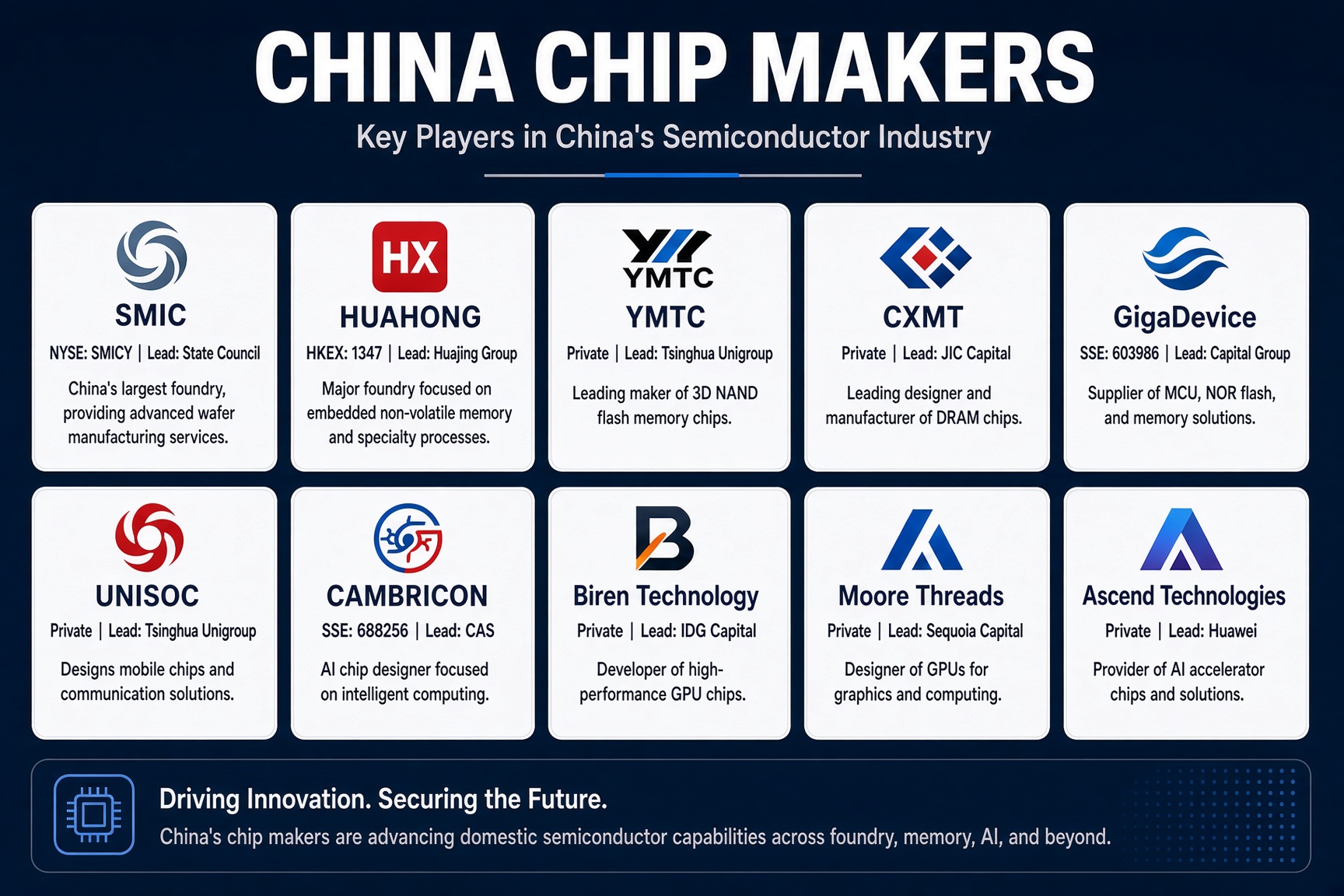
The China Chip Shock
On 10 October CXMT said it will ship DDR5 server modules on a 4F2 cell by year-end. Micron, SK Hynix, Samsung and Sandisk sold off for two sessions and Elon Musk said China scales faster than the rest of the world combined. This piece sets out China's memory makers, foundries, AI chip designers and toolmakers, with two knowledge graphs drawn from the KXCO AI Sector Ontology, and says what the sell-off prices and what it does not.
Every story, signed and delivered.
Subscribe to the kxco channel and get the headline, the AI-written key takeaways, and the chain-anchor link the moment we publish. Audio versions and per-ticker subscriptions arrive in the next iteration.