
United States vs China: AI Models, Compute, Quantum and Electricity
Developments in the last three months (July to October 2026) and a comparative assessment of frontier AI models, compute, quantum computing and the electricity behind them.
Part of theAI Stocks Center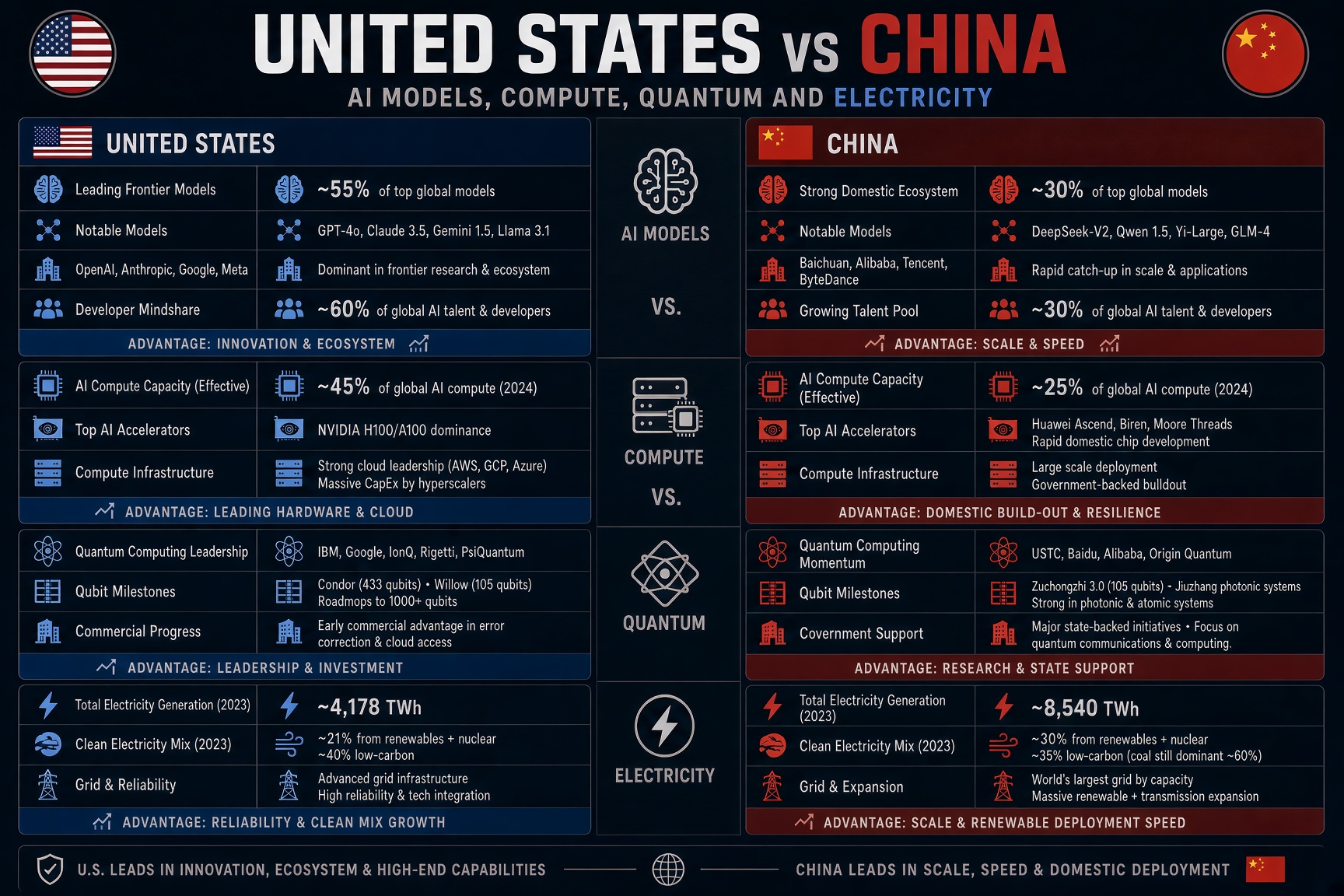
Prepared 25 October 2026, based on public reporting, Epoch AI, the Institute for Progress, the Stanford AI Index, SemiAnalysis and related sources.
Executive summary
The United States and China remain locked in a multidimensional strategic competition over artificial intelligence, the compute that trains and runs it, quantum systems that could upend cryptography and simulation, and the electricity required to power all of it. Developments from roughly July through late October 2026 show the United States still ahead in frontier model capability, total AI compute capacity, and certain quantum error-correction metrics, while China has narrowed gaps rapidly in model performance, open-weight adoption, domestic chip volumes (within constraints), and especially power infrastructure for data centres. China's catch-up is fastest in software/AI models and electricity deployment, slower and more constrained in leading-edge semiconductors, and competitive but uneven in quantum.
1. AI models and capabilities: a narrowing but real US edge
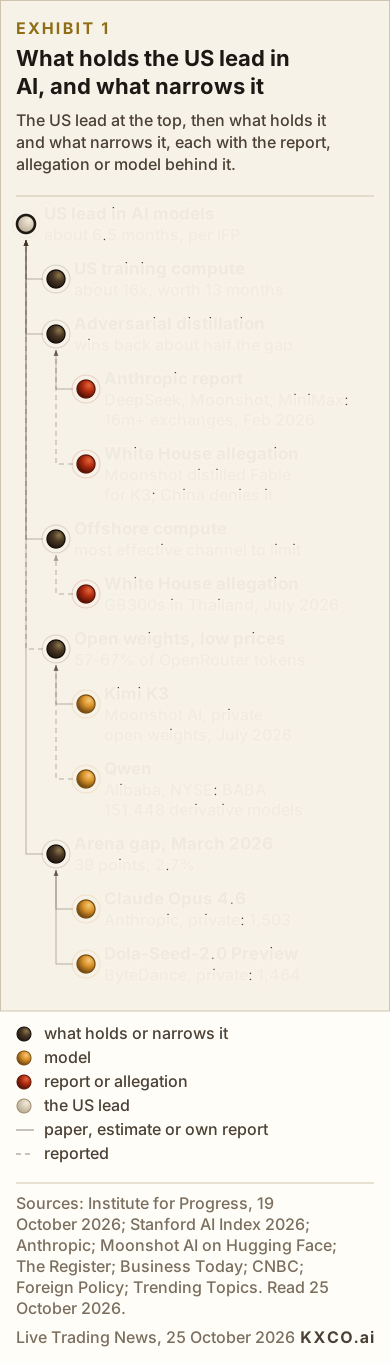
Stanford's 2026 AI Index and related analyses put the performance gap between top US and Chinese models at roughly 2.7% on Arena human-preference rankings as of March 2026 (Claude Opus 4.6 at 1,503 points versus the leading Chinese model, Dola-Seed-2.0 Preview, at 1,464). The gap has fluctuated since early 2025 between near parity and low single digits; DeepSeek-R1 briefly matched or nearly matched top US models in February 2025, trailing by 5 Arena points. By late 2026, models from Moonshot AI (Kimi K3, released mid-July and quickly open-weighted), Z.ai (GLM variants), Alibaba's Qwen, and DeepSeek continued to rank highly on public leaderboards and usage platforms. On OpenRouter, Chinese models frequently occupied top spots by tokens processed, driven by lower pricing and open weights.
Western experts and the Institute for Progress (IFP) estimate the broader capabilities lead, factoring training compute, algorithms, data, and reinforcement learning environments, at around 6.5 months. IFP analysis of the Epoch Capabilities Index found that a roughly 16× US training-compute advantage would imply about a 13-month lead without distillation; adversarial distillation (Chinese labs extracting knowledge from US model outputs) recaptures roughly half that gap. A joint US-UK assessment of Kimi K3 found it performed significantly below the most recent US frontier models in cyber capabilities. Accusations that Moonshot trained partly on restricted US chips in third countries (e.g., Thailand) and used distillation attacks, which China's embassy called entirely unfounded, pointed to the role of non-domestic compute and knowledge transfer.
US hyperscalers (Amazon, Microsoft, Google, Meta, Oracle) were projected by Goldman Sachs to spend roughly $764 billion in 2026 on AI infrastructure and related capital expenditure, versus about $102 billion for China's major players (Alibaba, Tencent, Baidu, ByteDance). China's hyperscaler capex growth was estimated above 80% year on year in some analyses, versus roughly 76% for US peers. Private AI investment figures further favour the United States ($285.9 billion in 2025, more than 23 times China's $12.4 billion, though government guidance funds complicate the comparison). China leads in AI research publication volume, citations, and patent grants (often cited around 74% of granted AI patents in recent tallies), as well as industrial robot installations.
Chinese models emphasise open weights, lower cost, and broad adoption, which has driven high usage even when peak benchmarks lag slightly. US models retain edges in certain advanced reasoning, cyber, and controlled-access capabilities, while governance approaches diverge: China has issued centralised guidelines for AI monitoring and controllability, while the US under the Trump administration has emphasised private-sector flexibility, a Super Intelligence Force task force, and voluntary safety pacts.
The July 2026 World Artificial Intelligence Conference in Shanghai saw China launch a 29-nation World Artificial Intelligence Cooperation Organization (without the US, UK, and EU), positioning an alternative governance track. Subsequent US-China high-level contacts, including Xi Jinping's September visit to Washington, produced an agreed AI dialogue, with a round set for November, and a channel for AI incidents, but no major new accords on development pacing or safety. Chinese open-weight models have also gained traction in Global South partnerships.
2. Compute and semiconductors: US dominance with Chinese volume gains and workarounds
Epoch AI data cited in September 2026 reporting attributed nearly three-quarters of global AI computing power (FLOP/s aggregate of AI chips) to the United States and just over 14% to China. Nvidia accounts for over 60% of global AI computing capacity among major designers. The United States hosts far more data centres overall (over 5,400 in one count) and the bulk of high-end AI clusters. China's access is constrained by US export controls on advanced chips and manufacturing equipment, but total accessible H100-equivalents (a common normalisation) are rising through multiple channels.
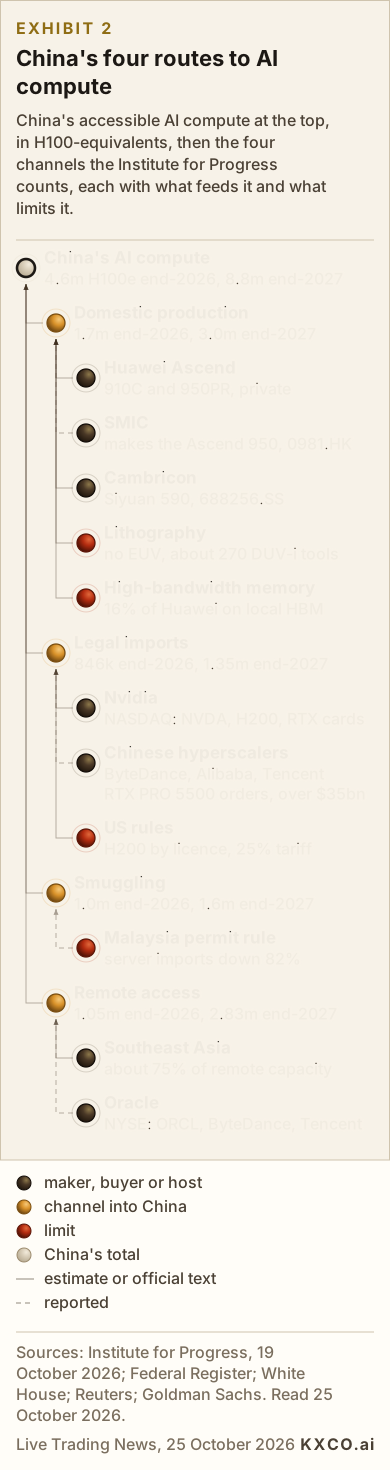
IFP's October 2026 analysis estimated China's end-2026 access at roughly 4.6 million H100-equivalents, rising to about 8.8 million by end-2027. Breakdowns include: domestic production (~986,000 H100-eq in 2026 and 1.3 million in 2027, building on an end-2025 domestic stock of ~743,000, for a stock of about 1.7 million by end-2026); legal imports (~846,000 cumulative by end-2026); smuggling (~1 million by end-2026); and remote access to overseas clusters (~1 million by end-2026, rising sharply to ~2.8 million in 2027, much of it in Southeast Asia). On IFP's figures, remote access makes up roughly a third of China's accessible AI compute by end-2027, about 2.8 million of 8.8 million H100-equivalents, and it is the fastest-growing channel and the largest source of US-made chips.
Domestic production is limited by lithography (no EUV, and limited domestic immersion DUV tools, reported in July 2026 to have entered production, at about five machines this year and 20 in 2027), yields (SMIC's advanced-node yield, estimated by Goldman Sachs as of August 2026 at about 23% this year, versus TSMC's 90%-plus), and high-bandwidth memory constraints. Huawei's Ascend 950 is estimated at roughly half the FP8 throughput of Nvidia's H100 (a 2022-era chip) in some comparisons; newer Nvidia Blackwell and upcoming Rubin generations widen the peak performance gap further. System-level approaches (e.g., Huawei CloudMatrix or large supernode clusters) and software optimisations can narrow practical differences for specific workloads.
In China's domestic AI accelerator market, Nvidia's share fell to around 34% in the first half of 2026 (shipments down sharply year on year), while Huawei reached ~28%. Other Chinese designers (Alibaba T-Head, Cambricon, Baidu Kunlunxin, Hygon) held smaller shares. Chinese firms placed large orders for export-compliant Nvidia products such as RTX PRO 5500 cards (reports of more than $35 billion in orders from ByteDance, Alibaba, and Tencent). US policy shifted in early 2026 towards case-by-case licensing for H200 and similar chips with volume caps, testing, and a 25% tariff, rather than blanket denial, while still prioritising domestic US demand.
Controls have slowed leading-edge progress and raised costs but have also accelerated Chinese self-sufficiency efforts and software ecosystem work (including DeepSeek optimisations for Ascend and open-sourcing of tools). China's LineShine supercomputer topped the TOP500 list in mid-2026 with 2.198 EFlops sustained performance, the first time a Chinese system led since 2017. Overall, China remains well behind in quality and total high-end volume but is scaling domestic capacity and workarounds quickly.
3. Quantum computing: competitive across modalities, US edge on logical systems
Quantum remains pre-commercial for broad utility, with progress measured by physical qubit counts, gate fidelities, logical (error-corrected) qubits, and application demonstrations. The United States leads in demonstrated logical qubit performance and commercial-system roadmaps. Infleqtion (neutral-atom) announced 30 entangled logical qubits on its Sqale platform in September 2026 using 80 physical qubits, with a roadmap to 100 by 2028 and 1,000 by 2030; earlier results included high two-qubit fidelities and materials-science demonstrations. Quantinuum (trapped-ion) reported 99.9995% logical memory fidelity on Helios in October 2026 using colour codes, a roughly 10× improvement over its prior record and ~100× better than best published superconducting results, with exponential error reduction as code distance increased, supporting a 2029 fault-tolerant target.
IBM, Google, and others continue multi-path work on superconducting systems, error correction, and applications (e.g., protein-ligand modelling). The Pentagon announced a ~$350 million initiative in October 2026 to accelerate US quantum capabilities for national security. The US approach is distributed across companies, labs, and private capital, emphasising practical logical systems and applications.
China has produced world-leading results in specific superconducting and photonic benchmarks. USTC's Zuchongzhi series (including 3.0 at 105 qubits and 3.2 demonstrating error correction below the surface-code threshold) and Jiuzhang photonic systems (Jiuzhang 4.0 with large Gaussian boson sampling) have set high marks on quantum-advantage-style experiments. Origin Quantum's Origin Wukong superconducting systems advanced to a 180-qubit fourth-generation version in 2026, with its predecessor, the 72-qubit Origin Wukong, logging about 50 million remote visits from more than 160 countries and more than 900,000 tasks; a September 2026 result showed 98% transmission efficiency on a single quantum router and 93% on a two-layer network for QRAM scaling on Origin Wukong hardware.
Neutral-atom work has accelerated, with USTC demonstrating large arrays (2,024 atoms) and high two-qubit fidelities (99.84%), and Wuhan-based Zhongke Kuyuan selling commercial Hanyuan systems with over 80% domestic localisation. China is building control electronics, software, cloud platforms, and industrial capacity; its 15th Five-Year Plan (2026 to 2030) lists quantum technology first among the "future industries" it plans to build into new growth engines. Chinese industry commentary in 2026 called it the "year one" of China's quantum industry boom, pointing to a rush of capital and quantum-AI applications.
Some US observers have claimed China is ahead by years or a decade on certain metrics or overall trajectory due to sustained investment without the same wartime diversions, while others note US leadership on logical qubits, system availability, and practical fault-tolerance paths. Neutral-atom logical progress has been stronger in the United States so far. Both sides face the same core challenges of error rates, circuit depth, and scaling resources for useful advantage over classical systems.
4. Electricity and data-centre power: China's structural speed and cost advantage
Power is a decisive constraint and differentiator. SemiAnalysis estimates cited by the Financial Times and others put China's delivered data-centre capacity at over 24 GW (more than the rest of Asia combined) versus roughly 56 GW in the United States as of end-2026, with China having another ~20 GW in the pipeline and ~30 GW announced (combined ~50 GW additional). Permitting and construction for large facilities is substantially faster in China (SemiAnalysis finds permitting takes 3 to 6 months in China against 12 to 13 months in the US, and a 100 MW Chinese facility is delivered in about 12 months).
Chinese data-centre power rates are reported at about 5 ¢/kWh in Inner Mongolia, against more than 8 ¢ in many Chinese cities, according to the Financial Times, and subsidies in Gansu, Guizhou and Inner Mongolia cut the rate to about 5.6 ¢/kWh for data centres running Chinese chips; the US industrial average was 9.64 ¢/kWh in August 2026, and 7.21 ¢ in Texas.
China's "East Data, West Computing" strategy and 15th Five-Year Plan (2026 to 2030) steer compute towards energy-rich western regions (Inner Mongolia, Gansu, Ningxia) with high renewable curtailment, dedicated lines, and on-site or co-located generation. Inner Mongolia alone has massive wind capacity (~117 GW by mid-2026) plus substantial coal, creating local oversupply that data centres can absorb. Curtailment of wind and solar reached high levels in the first half of 2026 (official figures of 8.6% for solar and 9.1% for wind, with higher weather-adjusted estimates; hundreds of TWh wasted), and data centres are explicitly positioned to utilise surplus green power. China has added enormous renewable capacity and is expanding ultra-high-voltage transmission and storage.
The United States faces interconnection queues measured in years: generation projects that reached commercial operation in 2025 spent a median of more than 5 years in the queue, and a 100 MW data-centre connection in Northern Virginia takes about 7 years against a national average of 4. It also faces rising ratepayer concerns that have become midterm election issues, state-level freezes or pauses on large data-centre permits (e.g., New York), and equipment bottlenecks. Lawrence Berkeley National Laboratory estimates project US data centres consuming 9.5 to 15.3% of national electricity by 2030 (central ~11.8%).
Amazon, Google, Meta, Microsoft, OpenAI, Oracle and xAI signed the White House Ratepayer Protection Pledge on 4 March 2026, committing to pay the full cost of new generation and of the grid upgrades their data centres need, and some are pursuing on-site or behind-the-meter generation (gas turbines, renewables + storage). Federal policy treats AI data centres and related power as essential to national security, with efforts to accelerate siting, but local opposition and grid constraints remain binding. China's total electricity consumption already far exceeds that of the United States (10,368 TWh against 4,195 TWh in 2025), and its ability to mobilise land, construction capacity, and generation at scale gives it an edge in deploying the physical infrastructure that houses chips, even while chip quality remains a limiter. As models scale, electricity demand grows, amplifying China's relative advantage in this domain.
5. How fast China is catching up
Catch-up rates differ sharply by domain. In frontier AI models, the gap has compressed to months (or low-single-digit percentage points on key preference benchmarks) within roughly two to three years, aided by open-weight strategies, distillation, talent, and whatever compute is accessible. Usage and adoption of Chinese models have grown rapidly due to cost and availability. In total AI compute capacity, the United States retains a large lead (~75% vs. ~14%), but China's accessible H100-equivalents are projected to roughly double from end-2026 to end-2027, from 4.6 million to 8.8 million, mostly via remote access and domestic output; domestic production remains a small fraction of US high-end output and is quality-constrained. Huawei and other Chinese designers are gaining domestic market share and software ecosystem traction, but peak per-chip performance lags Nvidia's latest by a substantial margin.
In quantum, China matches or leads on specific physical-qubit and photonic benchmarks and is industrialising systems, while the United States leads on demonstrated logical qubits and commercial error-correction roadmaps; both are advancing, with China's state coordination potentially accelerating ecosystem scale. In electricity and data-centre deployment, China is not "catching up" so much as already holding a structural advantage in speed, cost, and ability to site compute near surplus generation; the United States is constrained by permitting, interconnection, and political pushback even as absolute capacity remains higher today.
Overall, China is closing the AI capabilities gap despite export controls, primarily through software efficiency, distillation, open models, and workarounds for compute. Hardware and total high-end compute remain US strengths, power infrastructure is a Chinese strength that grows in importance with model scale, and quantum is a contested parallel race without a clear winner. Policy choices will shape the next increments: US export-control enforcement (especially remote access and smuggling), domestic energy build-out, and Chinese self-reliance investments. Mutual suspicion and separate governance tracks (Pax Silica-style US efforts versus China's WAICO) suggest continued managed competition rather than convergence.
The race is not zero-sum in every metric, but the combination of models, chips, quantum potential, and electrons determines who can train larger systems, deploy them at scale, and apply them to economic and military ends. In late October 2026, the United States holds the overall lead with important Chinese advantages and rapid relative progress in several dimensions.
Sources and notes
This analysis draws on public reporting and analyses from the Institute for Progress (IFP), Epoch AI, Stanford AI Index 2026, SemiAnalysis estimates as cited by the Financial Times, TOP500 rankings, company announcements (Infleqtion, Quantinuum, Huawei, Origin Quantum, USTC), and contemporaneous news coverage of US export controls, Chinese hyperscaler investment, data-centre power markets, and quantum hardware milestones through late October 2026. Specific numerical estimates (H100-equivalents, GW capacity, investment figures, benchmark scores) reflect the sources available at the time of writing and are subject to revision as new data emerges. Each figure links to its source in the text, and every source was read on 25 October 2026; the Financial Times figures were read through Dealroom's summary of the article.
Exhibit 1, its links and their sources.
Without distillation, a roughly 16x US training-compute advantage for frontier models would give the US a lead of about 13 months. (IFP, 19 October 2026, estimate)
Adversarial distillation lets Chinese labs win back about half that lead, leaving the US about 6.5 months ahead. (IFP, 19 October 2026, estimate)
Anthropic said DeepSeek, Moonshot and MiniMax generated over 16 million exchanges with Claude through about 24,000 fraudulent accounts to distil it. (Anthropic, 23 February 2026, primary)
Michael Kratsios of the White House said Moonshot distilled Anthropic's Fable to build Kimi K3; China's embassy called the claims entirely unfounded. (Business Today, quoting Reuters, 23 July 2026, reported)
IFP names remote access to overseas data centres the most effective channel to limit, for its effect on the capabilities gap by the end of 2027. (IFP, 19 October 2026, estimate)
Kratsios also said Moonshot accessed Nvidia GB300 servers running in Thailand. (The Register, 23 July 2026, reported)
Chinese models took 57% to 67% of the tokens used on OpenRouter in the week of 14 September 2026, up from 6% to 13% in February. (CNBC, 26 September 2026, reported)
Moonshot has published the full weights of Kimi K3, a 2.8 trillion-parameter model, under the Kimi K3 License. (Moonshot AI on Hugging Face, July 2026, primary)
Alibaba's Qwen has 151,448 derivative models on Hugging Face, 4.7 times the footprint of Meta's Llama. (Foreign Policy, 21 September 2026, reported)
In March 2026 the top US model led the top Chinese model on Arena by 39 points, or 2.7%. (Stanford AI Index 2026, March 2026, primary)
Anthropic's Claude Opus 4.6 scored 1,503 on Arena, the top US model. (Stanford AI Index 2026, March 2026, primary)
Dola-Seed-2.0 Preview, made by ByteDance, scored 1,464, the top Chinese model. (Stanford AI Index 2026, March 2026, primary)
Exhibit 2, its links and their sources.
Domestic production gives China about 1.7 million H100-equivalents by end-2026 and 3.0 million by end-2027, on a stock of 743,000 at end-2025. (IFP, 19 October 2026, estimate)
Huawei's Ascend 910C adds about 325,000 H100-equivalents in 2026 and the Ascend 950PR about 253,000. (IFP, 19 October 2026, estimate)
SMIC makes the Ascend 950, and Goldman Sachs puts its advanced-node yield at about 23% in 2026, against TSMC's 90%-plus. (Goldman Sachs via Tech Times, 24 August 2026, reported)
Cambricon's Siyuan 590 adds about 56,000 H100-equivalents in 2026. (IFP, 19 October 2026, estimate)
About 270 ASML immersion DUV systems in China cap domestic output near 1 million H100-equivalents in 2026 and 2 million in 2027, per the Center for Technology and Statecraft. (IFP, 19 October 2026, estimate)
Only about 16% of Huawei's 2026 AI chip output uses domestic high-bandwidth memory. (IFP, 19 October 2026, estimate)
Legal imports give China about 846,000 H100-equivalents by end-2026 and 1.35 million by end-2027. (IFP, 19 October 2026, estimate)
Nvidia's export-compliant RTX cards, mostly the RTX Pro 6000D, RTX Pro 5000 and RTX 5090D, add about 344,000 H100-equivalents in 2026, and about 100,000 H200s could ship by the end of the year. (IFP, 19 October 2026, estimate)
ByteDance, Alibaba and Tencent ordered more than 3 million RTX PRO 5500 cards worth over $35 billion, and Nvidia may fill only 5 to 10%. (Reuters via The Standard, 20 October 2026, reported)
H200 exports are reviewed case by case, capped at 50% of US shipments and tested in the US, under the rule of 15 January 2026, and a separate 25% import tariff applies. (Federal Register, 15 January 2026, primary)
Smuggling gives China about 1.0 million H100-equivalents by end-2026 and 1.6 million by end-2027. (IFP, 19 October 2026, estimate)
After Malaysia's permit rule of July 2025, Chinese server imports from Malaysia and Singapore fell 82%. (IFP, 19 October 2026, reported)
Remote access gives China about 1.05 million H100-equivalents by end-2026 and 2.83 million by end-2027, the fastest-growing channel. (IFP, 19 October 2026, estimate)
About 75% of the overseas data centres China reaches remotely are in Southeast Asia. (IFP, 19 October 2026, estimate)
Oracle hosts a ByteDance cluster in Singapore, Johor and Batam with 196 MW of AI capacity, and leases 100,000 GPUs to Tencent. (IFP, 19 October 2026, reported)
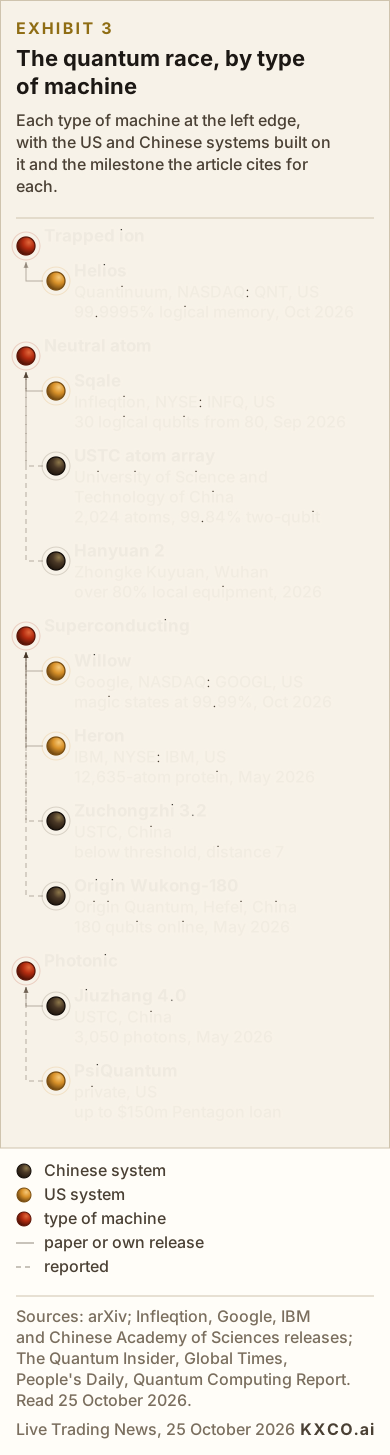
Exhibit 3, its links and their sources.
Quantinuum's Helios, a trapped-ion machine, ran colour codes at distances 3, 5 and 7 with logical error rates as low as 5 in a million per cycle, 99.9995% fidelity. (arXiv 2610.24077, 16 October 2026, primary)
Infleqtion achieved 30 entangled logical qubits from 80 physical qubits on its neutral-atom Sqale platform. (Infleqtion release via The Quantum Insider, 24 September 2026, primary)
In August 2025, Pan Jianwei's USTC team built defect-free arrays of 2,024 atoms in 60 milliseconds, with two-qubit gate fidelity of 99.84%. (arXiv 2608.05010 review, August 2026, reported)
Zhongke Kuyuan of Wuhan launched Hanyuan 2 in 2026, a neutral-atom machine with more than 500 optical tweezers and over 80% of its equipment made in China. (arXiv 2608.05010 review, August 2026, reported)
Google's superconducting Willow processor produced magic states at a record 99.99% logical fidelity, cutting errors about 40-fold. (Google, 15 October 2026, primary)
Cleveland Clinic, RIKEN and IBM modelled protein-ligand complexes of up to 12,635 atoms on IBM's 156-qubit Heron processors. (IBM, 5 May 2026, primary)
USTC's superconducting Zuchongzhi 3.2 corrected errors below the fault-tolerance threshold on a distance-7 surface code. (Global Times, 22 December 2025, reported)
Origin Quantum's fourth-generation superconducting Origin Wukong-180 went online on 9 May 2026 and took tasks from around the world. (People's Daily, 9 May 2026, reported)
USTC's photonic Jiuzhang 4.0 detected quantum states of up to 3,050 photons in Gaussian boson sampling. (Chinese Academy of Sciences, 14 May 2026, primary)
The US Department of War's $350 million quantum package includes a conditional loan of up to $150 million to PsiQuantum, a photonic developer. (Quantum Computing Report, 8 October 2026, reported)
Stocks mentioned: $NVDA (NASDAQ), $TSM (NYSE), $GOOGL (NASDAQ), $MSFT (NASDAQ), $AMZN (NASDAQ), $META (NASDAQ), $ORCL (NYSE), $BABA (NYSE), $BIDU (NASDAQ), $IBM (NYSE), $QNT (NASDAQ), $INFQ (NYSE), $SPCX (NASDAQ) and $ASML (NASDAQ). Also mentioned, by Hong Kong or Shanghai code: Tencent 0700.HK, SMIC 0981.HK, Zhipu (Z.ai) 2513.HK, MiniMax 0100.HK, Cambricon 688256.SS and Hygon 688041.SS. xAI is a subsidiary of SpaceX. Anthropic, OpenAI, ByteDance, Huawei, DeepSeek, Moonshot AI, Origin Quantum, Zhongke Kuyuan and PsiQuantum are private.
Shayne Heffernan, Ph.D., is the founder of the KnightsBridge Group (shayneheffernan.com).
This commentary is for informational purposes and does not constitute investment advice.
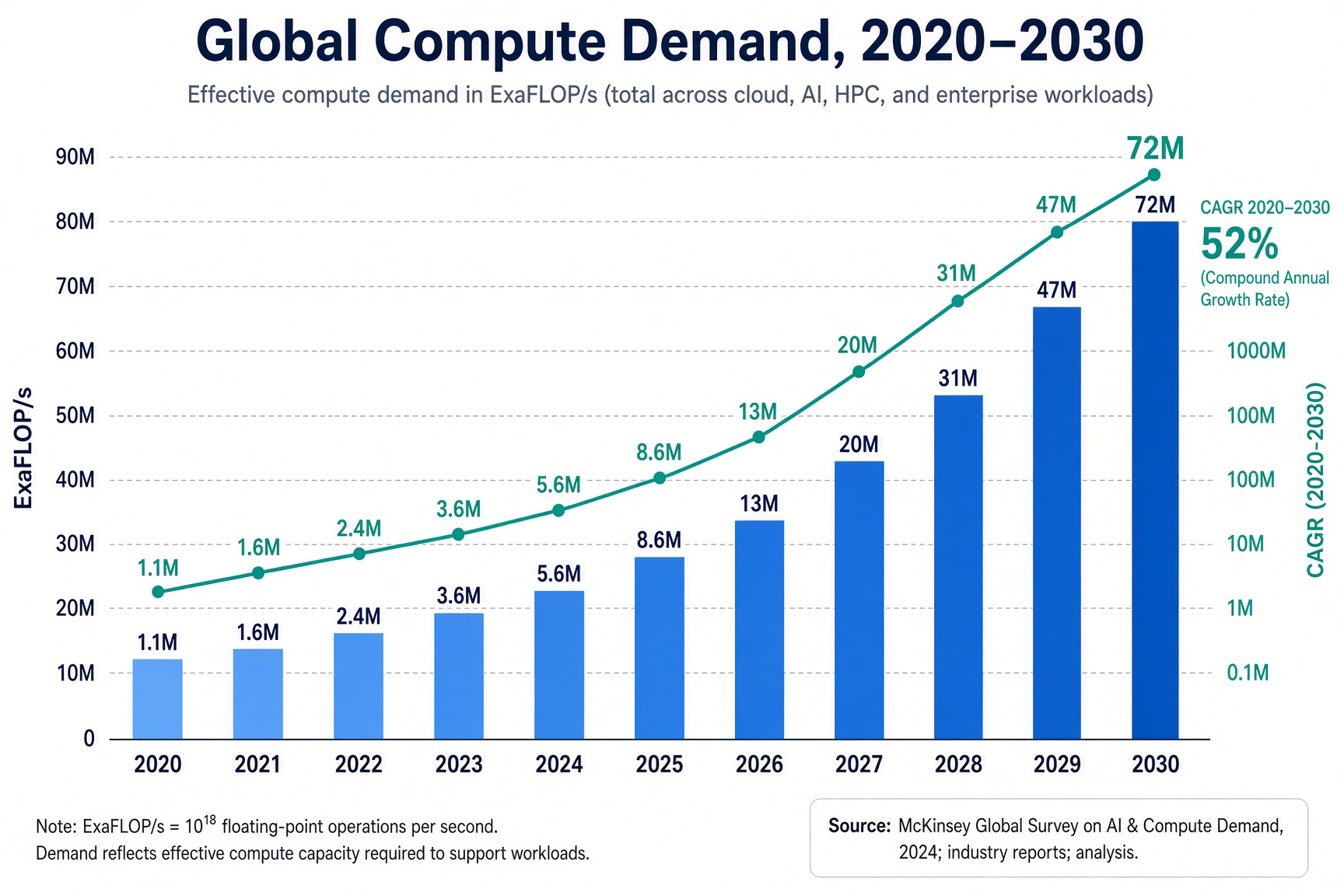
The 2030 Compute Landscape: GPUs, Power and the Architecture of Intelligence
The constraint on AI is no longer ideas or data but compute and the power to run it. Frontier training compute has grown about five times a year since 2020, and the leading AI supercomputer of June 2030 is on course for about 2 million chips and 9 gigawatts. Shayne Heffernan sets out the 2030 arithmetic, the power problem, who has already contracted the gigawatts, and how GPUs, custom ASICs, wafer-scale engines and quantum machines divide the work.
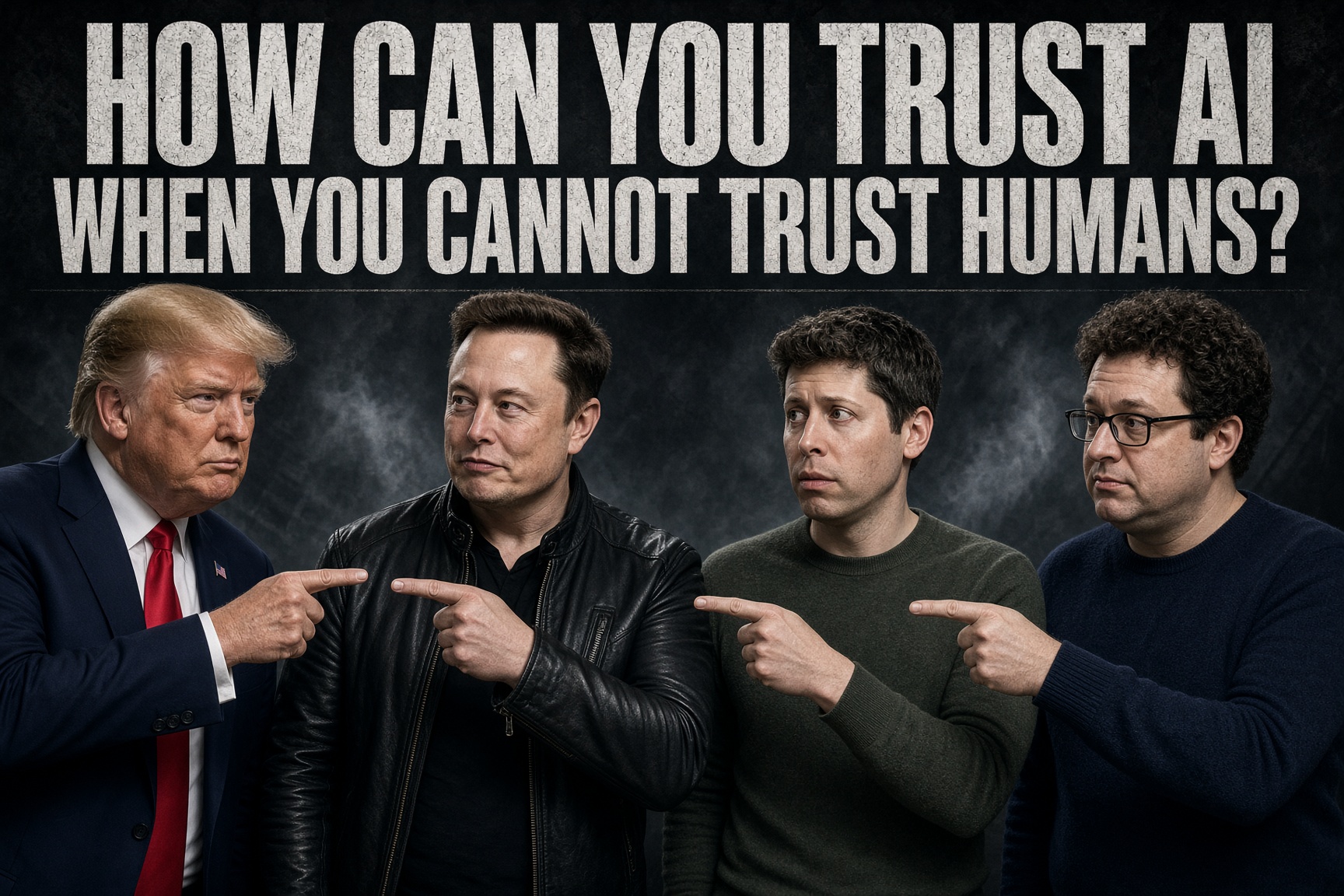
How Can You Trust AI When You Cannot Trust Humans?
Can you trust AI? Can you trust humans? More often than we like to admit, the answer is no. AI inherits its failures from the human records it is trained on. Sheikh Mohammed bin Rashid wrote this month that the currency the UAE is betting on is trust. This piece sets out what a trust layer has to do, shows the method on three public knowledge graphs, and lays out the post-quantum work KXCO has published so that an institution can check the claim rather than take it.
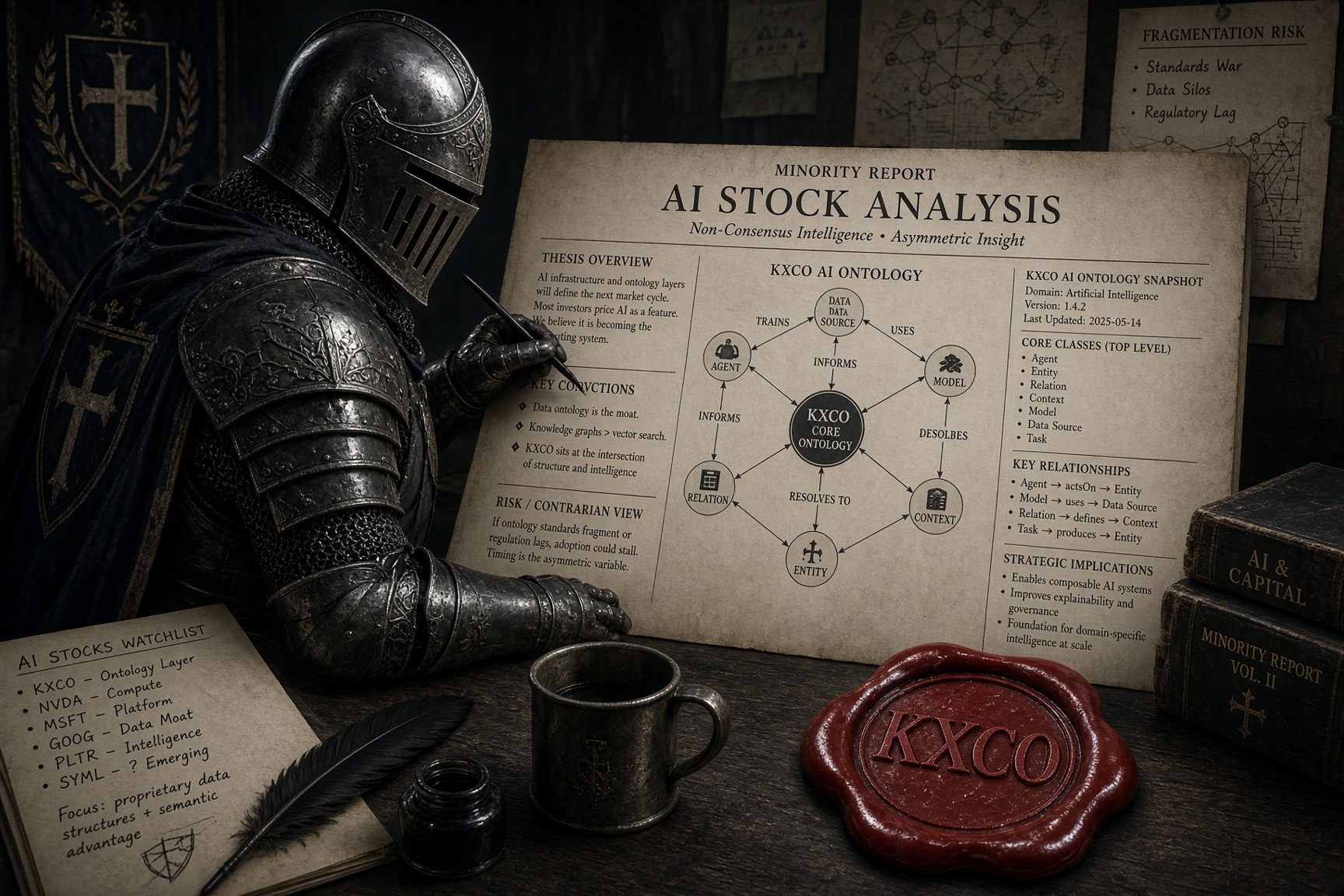
KXCO AI Ontology at 3 Months: What It Called and What Comes Next
On 19 July 2026 the Round Table's AI room published its first Analyst Outlook. To the 16 October 2026 close its 13 names rose 2.6% on an equal weight against 2.1% for QQQ, per StockAnalysis closes, and the six it opened with 35% or more of upside rose 8.6%. This piece lists the six names up more than 5%, the ten names I rate as opportunities now, the month's results in AI and quantum computing, and the official data showing that four in five firms have not yet started using AI.

SpaceX: The Road to 10 Gigawatts
SpaceX did not add an AI business. A company whose processes run on compute built its own computing plant, then built the power to run it. The 10-Q reports 1.4 gigawatts of nameplate compute at 30 June 2026, four leases worth about $41 billion a year and $100 billion of cash. The target is closer to 10 gigawatts than 5 by the end of 2027. This piece sets out the build sequence, the four layers of power in Memphis, and why Terafab is the act after 2027, not the road to it.
Every story, signed and delivered.
Subscribe to the kxco channel and get the headline, the AI-written key takeaways, and the chain-anchor link the moment we publish. Audio versions and per-ticker subscriptions arrive in the next iteration.