
Wall Street Week Ahead: Rates, Oil, AI, Quantum, Defense, Metals and Bitcoin
Monday 21 September 2026. A Fed that hiked into a war, a White House that loaded the planes for Yemen and then stood them down, and an oil market still pricing a supply shock in its seventh month. The week held against the live AI sector map.
The trading week opens after a Federal Reserve that chose to hike, a White House that chose not to strike Yemen, and an oil market still pricing a war now in its seventh month. The useful work this week is not a list of tickers. It is a map of what depends on what.
That map, for the artificial intelligence complex that now dominates the weight of the S&P 500 and a growing share of corporate capex, is public. It lives at kxco.ai/ontology-live. The trading desk that sits under this briefing, with the live futures tape and the Live Trading News economic calendar, is at livetradingnews.com/trading. The rest of this piece is what those two pages look like when you hold them against Yemen, the funds rate, the Magnificent Seven, quantum hardware, the missile primes, gold, silver, crude and Bitcoin as of Monday morning, 21 September 2026.
The system does not pick stocks and it does not allocate. It assembles a sourced, dated, typed picture of a sector and puts it in front of people. The people argue with it and decide. That is the only claim worth making at the open of a week that can be rewritten by a single strike on a pumping station or a single sentence from the Chair.
1. Start with the map, not the tape
Most week ahead notes begin with futures and a calendar. That is the wrong order when the largest companies in the index are bound together by a small set of physical and contractual chokepoints. The live AI sector ontology built by KXCO is the working map of those bindings. Per the public stamp on kxco.ai/ontology-live as of 21 September 2026, it holds 380 entities and 853 sourced claims, with 30 findings ranked by severity. Every line carries a source, a date and a confidence. If you disagree with a conclusion you can walk back to the exact claim you think is wrong. That is the entire design.
The map was not assembled by listing famous companies. It was grown from a seed set by following dependencies outward, which is why some of the most important nodes are firms most generalist desks still treat as vendors. ASML for extreme ultraviolet lithography. TSMC for leading edge foundry. The high bandwidth memory triopoly at SK Hynix, Samsung and Micron. NVIDIA as the most connected commercial node in the graph. A chokepoint is a company with no alternative at any price. It tends to look modest in a connection count precisely because there is only one route through it.
The findings that matter for this week are structural rather than new. Per the ontology, sector capex is compounding faster than revenue, on the order of $725 billion of planned 2026 spend against a prior year base near $410 billion. A meaningful share of the demand signal is financed by the party that books the revenue from it. The largest commitments in the chain are guarantees rather than cash, and no stock screen in existence has a field for who else is on the hook when a counterparty misses. Circular capital that used to look like equity loops has shifted toward credit, including a backstop measured in the tens of billions between NVIDIA and OpenAI. Compute demand is still outrunning memory and power. The United States is putting a rising share of generation into training and inference clusters, while China builds a sanction resistant stack on Huawei silicon and a grid with unused headroom.
The ontology also records a physical chokepoint the equity tape treats as weather. The Strait of Hormuz, constrained since February, and now a second maritime risk at Bab al-Mandab and the Red Sea as the Houthis push along the west coast of Yemen. Helium, sulfur, refined product and crude all sit on those waterways. The graph does not decide whether the White House strikes Sana'a. It records who is exposed if the waterway closes further. That is a different and more useful question.
Read the live map yourself at kxco.ai/ontology-live. The companion working guide is at kxco.ai/developers/blog/ontology-live-guide. What follows is the week that map is about to be tested against.
2. The Middle East, a second front the tape already prices
President Trump spent the weekend reversing himself. After a Camp David session and a call with Saudi Crown Prince Mohammed bin Salman, the Pentagon prepared target lists against Houthi infrastructure in Yemen. Aircraft were loaded. By Sunday midday the decision had flipped again. There would be no U.S. offensive strikes, for now. Intelligence sharing with Riyadh continues. A senior official gave the expected line, that the United States has a defense agreement with Saudi Arabia and will always defend its allies. That sentence is not a strike package.
The underlying military facts did not flip with the President. The Houthis have taken the Red Sea coast of Yemen in a lightning advance, including the port of Mokha, and have pushed toward the Bab al-Mandab strait. They have struck Riyadh and Saudi energy infrastructure, including Aramco linked sites and the East to West pipeline that exists precisely so the Kingdom can export crude without using Hormuz. Loadings at Yanbu were suspended. Repair estimates have ranged from days to six weeks.
The mid-September commentary from the International Energy Agency is the clean statement of the oil balance. Per the IEA, Hormuz flows averaged 7.6 million barrels a day in August, roughly 13 million below pre-war levels, cumulative lost exports through the waterway approach 2.8 billion barrels, and the bypass routes that partially offset the loss have themselves been attacked.
This is not the 2024 Houthi campaign against commercial shipping, and it is not the U.S. campaign of last spring that ended in an Oman brokered pause. It is a new front inside a war with Iran that began in February and has not ended. Iranian guidance and supply to the Houthis is the working assumption across CENTCOM, Riyadh and the IEA. The Saudis have asked Washington to do what Washington did in 2025 and does not want to do again while interceptor inventories are already drawn down against Iranian and proxy fire.
According to the Congressional Budget Office, U.S. operations against Iran ran above $38 billion through early August, of which roughly $22 billion is munitions that must be replaced, and $13 billion of that is missile defense interceptors. Patriot, THAAD, SM-3 and SM-6 are not abundant. That is a stock story as well as a strategy story, and it is taken up below.
The market question for Monday through Friday is narrower than the war. It is whether any headline this week converts no offensive strikes for now into either a U.S. package or a Houthi demonstration against Yanbu, Jeddah, Riyadh or a very large crude carrier. Per the week's settlement prints, Brent tagged the high $108s after the pipeline strikes and was back near $103 as of the close on Friday 18 September 2026, with WTI oscillating through the high $90s into the $107 handle depending on the session. A print is not a position. The position is the inventory path. If commercial stocks keep drawing while Gulf exports stay impaired, the warning from the IEA stands, and higher prices with demand destruction close the gap. That is an inflation input the Federal Reserve has just acknowledged with a hike.
Watch three names on the energy tape and two on the defense tape if Yemen headlines hit the wire. $XOM and $CVX (NYSE) for the integrated book, $COP (NYSE) for the shale swing, and $RTX and $LMT (NYSE) for the interceptor restock. Watch shipping equities and tanker rates if Bab al-Mandab tightens. The physical node in the ontology does not care which ticker you own. It cares whether the molecule can leave the Gulf.
3. Interest rates, the first hike in three years and the next one
On 16 September the Federal Open Market Committee raised the target range for the federal funds rate by 25 basis points to 3.75 to 4.00 percent, per the statement released that afternoon. The vote was 12 to 0. It was the first hike since 2023.
The statement is worth reading as written rather than as a pundit paraphrased it. These are the sentences of the Committee, in order. Economic activity is expanding at a solid pace. Uncertainty remains elevated owing, in part, to geopolitical developments. Domestic spending has been resilient. Productivity growth is strong and capital investment is robust. Job gains have kept pace with the workforce. Inflation remains elevated. Today's policy action will support a timelier return to the 2 percent goal of the Committee. The Committee will deliver price stability.
The Summary of Economic Projections that accompanied the decision is the more honest document. Per the projections released 16 September 2026, median PCE inflation for 2026 was marked up to 3.7 percent and core PCE to 3.4 percent. The year end funds rate midpoint moved to 4.1 percent, which is one more hike from here if the midpoint is treated as a plan rather than a weather vane. The 2027 and 2028 dots also moved up.
Private desks such as the macro team at KKR are willing to say the quiet part. Two additional hikes, December and March, and a hold near 4.375 percent for longer than the Committee wants to advertise. Whether that path is realised is a function of oil, rents and the labor market, not of the prose in the statement.
The ten year finished in the high 4.9s as of the close on Friday 18 September 2026. Real yields remain restrictive. That combination is why duration sensitive growth books cannot pretend the hike was a sideshow, and that includes quantum hardware names with revenue still measured in the tens of millions, unprofitable software, and any equity whose investment case is a 2030 cash flow statement. It is also why gold did not collapse on the hike. A central bank that hikes into a war premium is not the same object as a central bank that hikes into a clean cycle. The market is allowed to hold both thoughts.
This week's data will not decide the December meeting. It will decide whether the December meeting stays live. The flash PMIs on Wednesday, jobless claims, the current account and new home sales on Thursday, and the durable goods print plus the final University of Michigan sentiment survey on Friday are the domestic tape. The more important input may be the oil tape and any Warsh or Williams speech that treats triple digit crude as a constraint rather than a blip. Chair Kevin Warsh has described inflation as a choice. The Committee has just made one. The next choice is whether energy is geopolitical uncertainty or a second inflation regime.
The week of 21 to 25 September, the calendar that actually matters
Monday 21. Chicago Fed National Activity Index for August. Goolsbee remarks. Bill auctions.
Tuesday 22. Richmond Fed manufacturing. Redbook weekly sales. Quiet on the official calendar, loud on the war calendar.
Wednesday 23. S&P Global flash PMIs, manufacturing, services and composite. EIA crude inventories. MBA mortgage applications.
Thursday 24. Initial jobless claims. Second quarter current account. August new home sales. Williams and Barkin speak.
Friday 25. August durable goods, headline, ex transport and ex defense. University of Michigan sentiment final. Williams again.
The next real inflation print is personal income and spending with the PCE deflator on 30 September. This week is the rehearsal. Release times, consensus and revisions for every line above run live on the Live Trading News economic calendar.
4. The Magnificent Seven, concentration is the feature
Call them the Mag Seven or, if you prefer the desk shorthand that keeps showing up in inboxes, the mango stocks. Apple, Microsoft, Alphabet, Amazon, NVIDIA, Meta and Tesla still set the temperature of the S&P 500.
Per market value snapshots as of the close on Friday 18 September 2026, $NVDA (NASDAQ) is carried near $5.4 trillion, $AAPL (NASDAQ) near $4.9 trillion, $GOOGL (NASDAQ) near $4.3 trillion, $MSFT (NASDAQ) near $3.7 trillion, $AMZN (NASDAQ) near $2.7 trillion, $META (NASDAQ) near $1.7 trillion and $TSLA (NASDAQ) near $1.4 trillion. Combined, that is the mid twenties of trillions of dollars. Those figures move every session. The structure does not.
Valuation inside the group has dispersed. Alphabet screens as the cheapest on trailing earnings, in the high teens. The forward multiple at Meta is the most compressed of the consumer internet pair. The PEG at NVIDIA remains the growth adjusted bargain of the group if you accept the earnings path the sell side is still writing. Apple trades like a luxury franchise with a hardware cycle rather than like a compute vendor, on a trailing multiple in the high 30s, with the iPhone 18 Pro in stores at a price increase the company has blamed on memory and AI related components. Tesla remains a multiple in search of a delivery and robotaxi argument, carrying a trailing earnings multiple that is not an earnings multiple in any ordinary sense of the word.
Alphabet was the standout of the week, helped by legal relief around advertising technology. Apple ground higher into the iPhone launch. Amazon gave a little back. No member of the seven reports earnings this week. That is the point. In a week without prints, the seven trade as a single factor: duration, AI capex credibility, and oil into inflation. If crude settles and claims stay quiet, the group can drift. If crude rips or a Yemen headline implies a wider U.S. role, the group will be sold as a rate sensitive proxy even when the underlying businesses are net beneficiaries of defense and energy spend. The tape does not always honor the income statement in the same session.
The useful correction the ontology makes to Mag Seven worship is simple. These seven are not a closed system. They are downstream of ASML, TSMC, high bandwidth memory and power. They are upstream of a circular financing web that now includes credit as well as equity. NVIDIA remains the most connected commercial node. Microsoft, Amazon, Alphabet and Meta are the universal paths for demand. Apple is a device and services franchise trying to rent inferencing without becoming a foundry. Tesla is a manufacturing and autonomy bet that sits only loosely on the same graph. Treat them as seven tickers and you will be late to every bottleneck. Treat them as a graph and the Oracle lesson of last quarter repeats, because the stock can be marked down while the contracted book compounds underneath it, and the divergence is legible while it is happening if the record holds both facts with dates attached.
5. AI stocks, capex, power and the names the map actually flags
Ignore the noise. AI is not slowing down. What is slowing, in places, is the willingness of the market to pay any price for any story that contains the letters. That is a healthier market and a larger industry, not a smaller one.
The capex finding in the live ontology is the one to carry into the week. Per the ontology, planned 2026 spend near $725 billion, up on the order of 77 percent year over year, is not a narrative. It is a set of purchase orders, leases, power purchase agreements and, increasingly, guarantees. Cloud growth rates at the hyperscalers remain in a band that runs from the high thirties to the low eighties depending on the name and the quarter. That band is not free. It is paid for in megawatts and in high bandwidth memory.
The names the map keeps putting in front of a desk are not a mystery list. $NVDA (NASDAQ) for the accelerator and the networking attach. $AVGO (NASDAQ) for custom silicon and the switching fabric. $TSM (NYSE) for the leading edge. $ASML (NASDAQ) for the machine that has no substitute. On memory, $MU (NASDAQ) on the U.S. tape, with SK Hynix and Samsung where you can reach them. $SMCI (NASDAQ) and $DELL (NYSE) for the rack. $EQIX (NASDAQ), $DLR (NYSE) and the power adjacent utilities and turbine vendors for the site. $ORCL (NYSE) for the contracted backlog the stock spent a season refusing to believe. $PLTR (NASDAQ) for the government and enterprise layer that actually sits on the data. $ARM (NASDAQ) for the design licensing that sneaks into more of this stack than a casual holder notices.
Two political facts sit on the same graph and are easy to misread as stock tips. The United States is now a shareholder in a growing list of industrial firms, Intel among them. Export controls continue to gate frontier access, with a short list of labs cleared and a short list not. The domestic stack in China, DeepSeek class models on Huawei silicon and a grid build without the same interconnection queue, is the hedge the map was built to keep visible rather than fashionable. We overrode Chinese names in a prior quarter for reasons the graph cannot score: jurisdiction, sanction path, and the inability to take the profit home. That override is still the right one for most Western accounts. It is also the reason the map has to keep the Chinese nodes rather than delete them. You cannot manage a risk you have removed from the page.
What to watch this week in AI paper is not an earnings date. It is any further detail on the Quantum Genesis competition run by the Department of Energy, because the same procurement state that writes those checks writes the AI for science checks, and it is any hyperscaler commentary at conferences about power, delayed campuses, or memory allocation. A single delayed gigawatt is a second order hit to the visibility at NVIDIA that will not show up in this week's revenue and will show up in next year's multiple.
6. Quantum, a $215 million contest and a long duration book
On Thursday the Department of Energy put up to $215 million behind a milestone contest, according to its announcement, for a fault tolerant, scientifically relevant quantum computer by 2028. That is not a market. It is a specification. The specification is what the listed pure plays have been selling to investors for three years, and it is why those names moved when the announcement hit even as the Fed was hiking the rate that punishes them.
Per market value snapshots as of the close on Friday 18 September 2026, the listed complex runs $IONQ (NYSE) near $15 billion, Quantinuum near $13.6 billion after its mid year listing, $QBTS (NYSE) near $6.4 billion, $RGTI (NASDAQ) near $5.3 billion, Infleqtion near $3 billion, and Xanadu further down the board. These are not NVIDIA. Annual revenue is still measured in the tens of millions, in some cases the single digit millions. Runways are long because the last financing cycle was generous. Multiples are a statement about 2030, not about September.
The hike is a headwind for that statement, because higher real yields compress the present value of a cash flow stream that has not started. The contest is a tailwind for the same statement, because it is a funded milestone with a date. Both things are true. The modality split remains the analytical work: trapped ion at IonQ and Quantinuum, superconducting at Rigetti, annealing plus a gate model roadmap at D-Wave, neutral atom at Infleqtion, photonic at Xanadu. Government buyers do not need to pick a winner this week. They need to write statements of work that a lab can fail honestly. That is closer to how KXCO thinks about post-quantum cryptography than it is to how a momentum account thinks about a ticker.
A note on the adjacent stack, because this publication has spent the year on it. Quantum computing and post-quantum cryptography are not the same trade. The first is a hardware and algorithm race with a 2028 science goal. The second is a migration already underway under NIST FIPS 204 and 203, ML-DSA-65 and ML-KEM-768 at Category 3, and it is the layer on which KXCO signs and settles. Harvest now, decrypt later is not a research theme. It is an inventory of records that will still matter when a cryptographically relevant quantum machine exists. Defense and finance buyers who confuse the two will buy the wrong thing. The ontology is the place that confusion gets expensive, which is why the security layer and the semantic layer were built in that order.
7. Military stocks, the restock is the earnings stream
U.S. interceptor inventories have been burned down by as much as two thirds in some classes since mid-2025. That sentence is the entire bull case for the missile primes, and it does not require a new war this week to remain true. It requires the old war to keep using the stockpile. Per the CBO, the replacement bill runs on the order of $21.7 billion of munitions, with $13.1 billion of it missile defense, which is a multiyear production schedule rather than a one line item in a continuing resolution.
$LMT (NYSE) makes PAC-3 MSE and THAAD interceptors and still runs the F-35. Per the agreement with the Pentagon, it lifts THAAD capacity from 96 to 400 interceptors a year under a seven year award worth up to $35 billion, and the stock sat in the low to mid $530s as of the close on Friday 18 September 2026, with a dividend covered by a backlog in the high $100 billions. $RTX (NYSE), in the mid to high $190s as of the same close per the same snapshots, makes Patriot GEM-T, SM-3 and SM-6, and has agreed to take SM-6 above 500 missiles a year. Its backlog is the fattest in the group, split between commercial aerospace and defense, and it has been the better performer on a twelve month basis.
$NOC (NYSE) is the B-21 and Sentinel name, a different duration of program and a different political risk. $GD (NYSE) is hulls, armor and Gulfstream. $LHX (NYSE) is the electronic warfare and radio layer. $HII (NYSE) is the only builder of U.S. nuclear carriers.
Yemen is the near term catalyst and also the trap. A U.S. offensive package would be a one or two session bid for the interceptor names and a risk off bid for crude. A continued intelligence only posture is a slower grind higher in the same names, as Saudi and Israeli demand, U.S. restock and European procurement toward 2 to 3 percent of GDP do the work. The baseline U.S. defense budget is already above $850 billion, per the enacted national defense topline. That number does not need a new headline to stay large. It needs Congress to fund the restock rather than assume the inventory will refill itself.
The honest risk in the defense book is not demand. It is fixed price legacy work, powder metal issues in narrow engine programs, and the political cycle around a midterm that will be fought, in part, on the price of gasoline. A prime with a record backlog can still miss a quarter on a reach forward charge. Read the filings. Do not rent the multiple from the last successful intercept.
8. Gold, oil and silver, three prices and one constraint
Per Friday's snapshots, as of the close on 18 September 2026, gold sat near $4,420 to $4,425 the ounce, silver near $67, Brent near $103, and WTI anywhere from just under $100 to $107 depending on the print you catch. Into the Asia hours of Monday, WTI was offered nearer $99 and gold a little softer near $4,368. Those are not forecasts. They are the last marks a week ahead note is allowed to use.
The 52 week ranges tell you the regime. Per the same snapshots, gold has seen $3,705 to $5,627, silver $44 to $122, and Brent $59 to $126. We are not in the middle of those ranges by accident. We are in a war premium that has been partially digested and a monetary premium the first hike in three years did not erase.
Oil is the binding constraint, and the arithmetic from the IEA is ugly enough to repeat. Per the IEA, Hormuz is at 7.6 million barrels a day against a pre-war run rate more than 13 million higher, with the bypass via the East to West pipeline and Fujairah impaired by attacks. Strategic and commercial stocks have done more work than a casual reader of the headline deficit would guess, which is why the world is not in a 1974 style shortage even though the supply shock is larger than the Iranian Revolution, the Arab embargo or Kuwait on a barrels lost basis. Resilience wears thin. CSIS put it correctly last week, that another hit to Yanbu or to remaining Gulf loading is a different oil price than the one the Fed has just looked through.
The job of gold in this mix is not to track oil tick for tick. It is to hold the residual of three things the funds rate cannot cancel: a fiscal authority that is still issuing, a monetary authority hiking into a supply shock, and a set of official buyers who do not mark their books to a New York close. A hike understood as credibility can be gold negative for a session. A hike understood as the Committee admitting the 2 percent goal is receding can be gold positive on the same print. Gold barely budged last week. That is the tell. Silver is the higher beta cousin with an industrial bid from photovoltaics and electronics that oil shock demand destruction can take away. It outperformed into the weekend. It can give that back in a single risk off hour.
Trading ranges a desk can defend without pretending at prophecy, per the settlement record for the two weeks to 18 September 2026. Brent $97 to $110 as the working band while Yanbu is in the repair queue, with a fresh attack restoring the $110 handle and inviting $120 talk, and a clean restoration of the pipeline plus a quiet Bab al-Mandab inviting $97 and then the mid $90s. Gold $4,270 to $4,550 as the near term box, with the 2026 high far above that box if official demand and a second energy spike arrive together. Silver $60 to $71, with $65 as the line that keeps the September breakout honest. None of those bands is a recommendation. They are where the price action of the past fortnight already told you the argument is happening.
9. Bitcoin, the $81,000 handle and the rate path
Bitcoin spent the week in the familiar trough and recovery that has defined 2026. Per the exchange tape, it tagged $75,000 when ETF outflows and a blocked CLARITY Act vote hit on Tuesday, then reclaimed $80,000 on Friday as oil eased from the spike, short covering ran, and Washington sent two quieter constructive signals, an SEC exemption path around tokenised securities and a CFTC proposal packet toward the White House. Weekend marks sat near $81,000 to $81,200 as of Sunday 20 September 2026. The 52 week range runs from the high $50,000s to $126,000. Spot ETFs took in several hundred million on the strong session. Fear and greed in crypto printed greed while equity sentiment printed fear. That divergence is allowed. It is also unstable.
The analytical error is to treat Bitcoin as digital gold on days oil rips and as a Nasdaq proxy on days the Fed hikes. It is both and neither. It is a scarce bearer asset with a regulated U.S. wrapper, a leveraged futures complex, and a political beta to whatever Congress does with market structure legislation. A funds rate at 4 percent is not 2021, and it is not the hiking cycle of 2023 either. Real yields near 2.6 percent on TIPS are the hurdle rate every non-yielding asset has to clear, per the real yield curve published by the Treasury. Bitcoin has cleared it this month by not breaking $75,000 when it should have if the only model was higher for longer kills crypto. That is information. It is not a reason to borrow $126,000 back out of memory.
The crypto specific calendar this week is thin. The macro calendar is the crypto calendar, and it runs live on the Live Trading News economic calendar. Claims, durables, PMIs and any Yemen headline will move Bitcoin through the same risk valve that moves the Nasdaq. A constructive path is a hold of $80,000 with oil contained and no midweek liquidation cascade. A destructive path is a return to the $75,000 shelf if crude takes out $110 and the dollar firms. Miners and the listed proxies, the usual $MSTR (NASDAQ) style duration trades, will amplify whichever path prints. They are not Bitcoin. They are a levered claim on Bitcoin plus a capital markets story. Keep them in separate columns.
The interest KXCO takes in this asset class is not a price target. It is settlement, identity and the post-quantum signing of records that will still have to be true when the hardware in section 6 exists. Tokenisation of equities, exchange traded funds and Treasuries is no longer a thought experiment, and the SEC has already moved. The firms that treat a token as a picture of an asset rather than as the asset with an owner, an authority and a restriction set will discover the difference the first time an agent tries to move it. That sentence is the bridge from this section back to the ontology.
10. How to sit the week, a desk checklist rather than a portfolio
A four session week after a hike and a non-strike is a week in which people will over trade the last decision and under trade the next constraint. The constraint is still barrels, interceptors, power and memory. The decisions are still human.
First, keep the ontology open. If a name you hold does not appear as a node with sourced claims, you are holding a story the map has not been asked to test. That is allowed. It should be conscious. The public map is at kxco.ai/ontology-live. The trading hub that frames live futures, the economic calendar and the broker rails we publish for readers is at livetradingnews.com/trading.
Second, separate the Yemen headline from the Yemen position. A flash that says the United States has struck the Houthis is a one day bid for crude, defense and gold, and a one day offer for duration and the Mag Seven. A flash that says talks in Oman is the opposite for a session. Neither flash changes the interceptor restock, the balance at the IEA or the 3.7 percent PCE projection from the Fed. Trade the flash if that is your mandate. Do not confuse it with the book.
Third, respect the rate path without worshipping it. One more hike is in the dots. Two more are in some private forecasts. Zero more are in the hopes of anyone long unprofitable duration. The incoming PCE on 30 September will do more than the durables print on Friday to sort those three camps. This week you are watching the oil input into that print, not trying to front run it.
Fourth, inside AI, prefer the chokepoints the graph cannot route around, which are lithography, foundry, high bandwidth memory, accelerators with networking attach and power, over the application layer names whose revenue is a press release. Inside quantum, prefer balance sheet runway and actual national lab relationships over slide deck qubit counts. Inside defense, prefer the interceptor and munitions restock over the platform narrative that needs a new authorisation bill. Inside metals, let oil lead and gold confirm. Inside Bitcoin, let the eighty thousand handle be a line and not a personality.
Fifth, write down what would change your mind before the week starts. For this desk the list is short. A U.S. offensive package that expands to Iranian soil. A restoration of Yanbu plus a visible increase in Hormuz transits that the IEA can score. A Warsh speech that treats 3.7 percent as acceptable. A hyperscaler that cancels a campus. A quantum milestone that is a paper rather than a machine. Anything not on that list is noise that will feel like signal for an hour.
11. The narrow point
Wall Street likes a week ahead note that ends with a recommendation. This one ends with a method, and the method is the thing on offer here. A live, sourced graph of the AI complex. A Fed that has resumed hiking into a war. A White House that loaded the planes for Yemen and then stood them down. An oil market that has already given up billions of barrels through a strait and is now being asked to give up more through a pipeline and a second strait. A seven stock complex that is really a three chokepoint complex. A quantum cohort that has just received a specification and a deadline. A missile industry sold out of the one product the past eighteen months actually used. Gold that refused to collapse on a hike. Bitcoin that refused to stay under the eighty thousand handle once the shorts were forced to cover.
None of that is a trade. All of it is a picture. The picture will be wrong in places, because every picture is. The test is whether you can find the wrong line and replace it with a sourced one before the market does the replacing for you. That is what the ontology is for. That is what this page is for. The rest is Tuesday.
Stocks mentioned: $NVDA, $AVGO, $TSM, $ASML, $MU, $SMCI, $DELL, $EQIX, $DLR, $ORCL, $PLTR, $ARM, $AAPL, $MSFT, $GOOGL, $AMZN, $META, $TSLA, $XOM, $CVX, $COP, $LMT, $RTX, $NOC, $GD, $LHX, $HII, $IONQ, $QBTS, $RGTI and $MSTR.
The AI sector map referenced throughout is public at kxco.ai/ontology-live. Live markets, the economic calendar and the trading hub are at livetradingnews.com/trading.
Shayne Heffernan, Ph.D., is the founder of Live Trading News, the KnightsBridge Group, Knightsbridge Law and the KXCO.ai ecosystem spanning post-quantum cryptography, identity, attestation and enterprise ontology. Forty years in global capital markets, venture and emerging technology. More of his writing and research is at shayneheffernan.com.
Disclaimer. This briefing is market commentary prepared 21 September 2026. It is not investment advice, a solicitation, or an offer to buy or sell any security, commodity, currency or digital asset. The KXCO ontology does not pick stocks and does not allocate. Prices, market values, multiples and inventory figures are snapshots drawn from public sources available at the time of writing and will be stale before the New York open. Past performance is not indicative of future results. Trading involves substantial risk of loss. Contracts for difference, futures and leveraged products may not be suitable for all investors. Geopolitical descriptions summarise published reporting by the New York Times, Reuters, the IEA, CSIS, the Federal Reserve and others. They are not inside information and they are not a prediction of military action. Live Trading News may have commercial relationships with brokers listed on its trading hub. Every new story on the site is cryptographically signed at publication and anchored to an independent ledger.

Musk and Colossus: Inside the 1.29 Gigawatt Machine in Memphis
Elon Musk is sleeping in an Airstream beside a warehouse in Whitehaven with MACROHARD painted on the roof. The machine next to it is a two-state compute campus carrying about 1.29 gigawatts of IT load, roughly 670,000 accelerators and 48.7 billion dollars of modeled capital, per Epoch AI cards of 16 September 2026. A field brief on the buildings, the silicon, the turbines, the batteries, the tenants who now hold the hours, and what the compute is actually worth.
Quantum Is Accelerating
Quantum is accelerating. Not toward a machine that breaks RSA next quarter, which is still five orders of magnitude away on the first honest cross-platform yardstick the field has ever had, but toward foundries, clouds, logical qubits and government deadlines that are already fixed. Two clocks are running. Only one of them is slow, and it is not the one that decides what a bank, a court or a ministry has to do this year.

Ignore the Noise: AI Is Not Slowing Down
Commentators pointed at a flat Nasdaq, a few missed prints, the cost of a megawatt and a safety letter, and called it a slowdown. It is not. Between 12 August and 16 September 2026 nine labs shipped frontier or near-frontier models, and the contest moved from one leaderboard to two stacks. What actually slowed is accountability. Enterprises still cannot put any of it into a court file. That gap, not the capability curve, stops deployment inside banks, hospitals, courts and ministries.
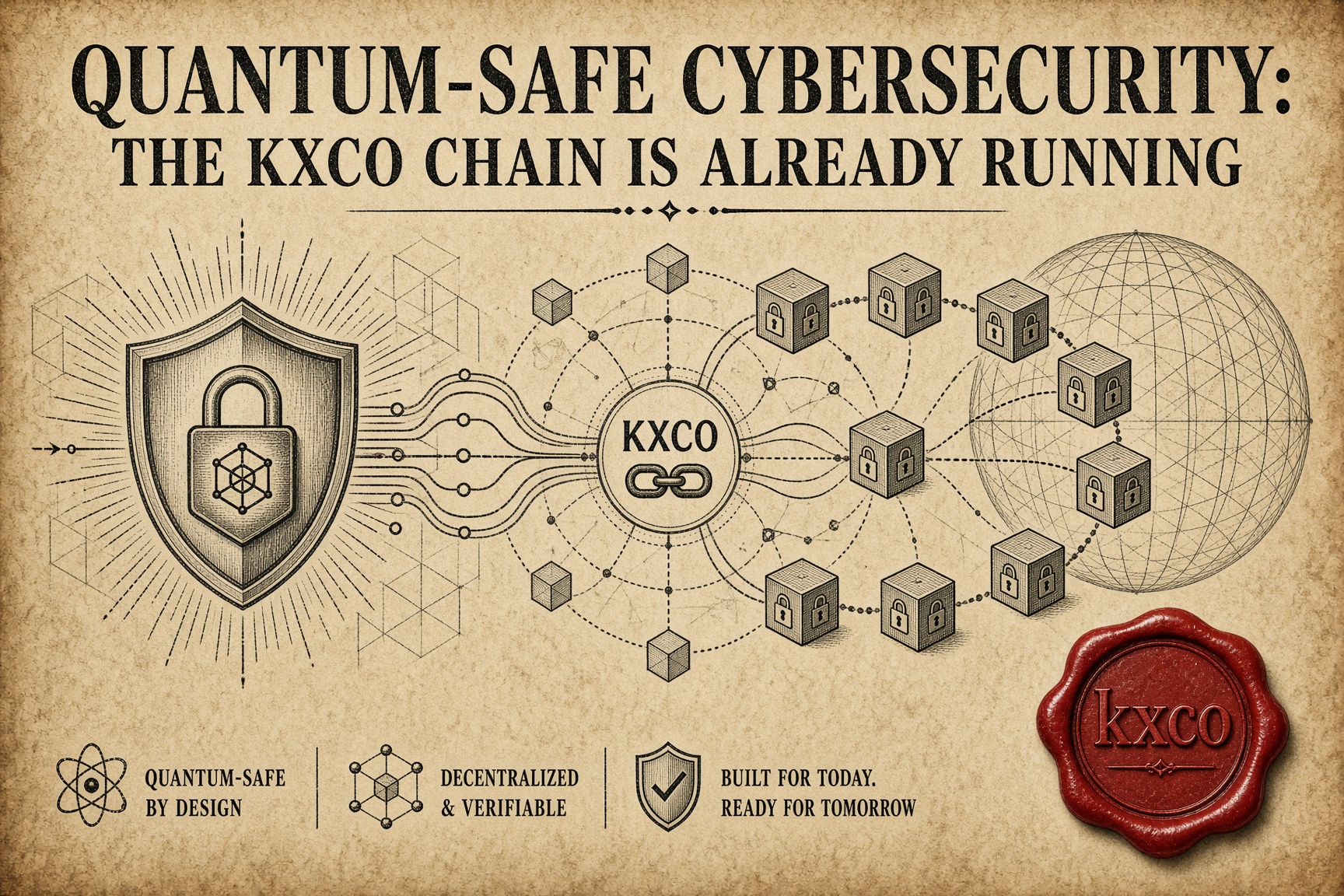
Quantum Cybersecurity: The KXCO Chain Is Already Running
The World Economic Forum warned on 11 September that the quantum-safe race has changed gears. It is right about the direction and late about the work. Every KXCO product already runs on NIST's post-quantum algorithms, and all of them run on the same implementation: 42 package manifests declare one library. The chain verifies ML-DSA-65 on-chain at precompile 0x0b, tested live with three negative controls. NIST's own grader marked the library at 2,130 cases and zero failures.
Every story, signed and delivered.
Subscribe to the kxco channel and get the headline, the AI-written key takeaways, and the chain-anchor link the moment we publish. Audio versions and per-ticker subscriptions arrive in the next iteration.