
Ignore the Noise: AI Is Not Slowing Down
A field report from mid-September 2026 on the frontier, the China stack, and why the hard problem was never intelligence.
Part of theAI Stocks Center
AI is not slowing down. Between 12 August and 16 September 2026 the industry shipped GPT-6 Astra, Claude Fable 5.1, Gemini 3.8 Live, Grok 4.6, Muse Spark, DeepSeek V4-Pro, Kimi K3 and GLM-5.3. What has slowed is accountability. Enterprises still cannot put any of it into a court file, and that gap, not the capability curve, is the real brake on deployment.
Every cycle produces a moment when the people closest to the tape decide the story has ended. In mid-September 2026 that moment arrived dressed as prudence. Commentators pointed at a flat Nasdaq, at a handful of missed prints, at the cost of a megawatt, at the EU watermark rules, at a safety letter, and they called the combination a slowdown. It is not a slowdown. It is what a build-out looks like when the easy multiple expansion is finished and the work of installing intelligence into institutions begins.
The noise has a purpose
Slow-down talk is useful to people who already own the frontier and would like the rest of the world to wait at the gate. It is also useful to people who have never built anything and need a moral vocabulary for a trade they do not understand. Neither group gets to write the physical facts.
The physical facts are these. Training runs are larger. Inference is cheaper per useful token than it was a year ago. Agents can now sit on a desktop and finish work that used to require a junior analyst. The power system, the foundry system and the legal system are all being rebuilt around that change.
What actually shipped in 6 weeks
Ignore the press-release poetry and look at the calendar. In six weeks the industry put more generally useful model surface area into production than it did in some entire prior years. The names change. The direction does not.
The American frontier
GPT-6 Astra is the event the West wanted to treat as a coronation. OpenAI published scores that, if they hold under independent harnesses, close several academic benchmarks that were supposed to last into the next decade. FrontierMath Tier 4 in the high nineties. ARC-AGI-3 near saturation on the adapter harness the lab prefers. ExploitBench at a clean hundred. Computer-use numbers on OSWorld and ScreenSpot-Pro that finally look like a system which can operate a machine rather than describe one. Greg Brockman called it the start of an AGI era. That phrase will be litigated. The product will not wait for the litigation.
Access is the undiscussed half of the story. Astra did not land on every Plus account on day one. It moved first through a restricted channel because the lab's own preparedness rules now treat cyber capability as a gating item. That is not a slowdown. That is what a lab does when the model can do things the previous generation could only talk about. The GPT-5.6 Sol, Terra and Luna stack remains the workhorse underneath, and the workhorse is itself a year ahead of what enterprises were buying in 2025.
Anthropic spent the same fortnight doing what Anthropic does: ship a generally available model good enough to run a firm, and keep the true ceiling behind a named programme. Claude Opus 5 arrived in late July as the price-performance Opus. Claude Fable 5.1 arrived on 1 September with a sharp cut in cache-read pricing and the usual emphasis on long-horizon agent work. Mythos 5.1 sits with Project Glasswing customers. Claude now watermarks its text. Claude now ships workflow skills for financial advisers with BlackRock and Schwab in the room.
Google's public face in September is Gemini 3.8 Live and Live Extended Thinking: speech-to-speech models that hold a conversation, ground against a screen, switch language mid-sentence and keep tools running in the background. The promised Gemini Pro successor is late. The Flash line is not. Four Flash releases since May is not a lab that has paused. It is a lab that has decided the money is in agents cheap enough to leave running. Apple, after years of slipping the date, put a Gemini-powered Siri AI into iOS 27. Salesforce named its Agentforce agents and put a Nemotron-trained CRM reasoner, Koa, on the Dreamforce stage. IBM keeps shipping Granite into the enterprise hole that glamour models refuse to enter. None of this is a pause.
Grok, and the second American stack
Grok 4.6 shipped on 12 August 2026 with a 500,000-token context, a reasoning-effort toggle and a price that undercuts the $10 and $50 club. It is easy for the coastal press to treat xAI as a side bet. That is a category error. A model that lives next to a real-time social graph, a satellite network and a launch business is not trying to win the same bake-off as a San Francisco lab selling API tokens. Grok's job is to be present where the world is talking, and cheap enough that presence is the default. That is a distribution strategy, not a science-fair score.
$NVDA remains the toll booth. Reports through early September put utilisation at the large clouds in the high nineties on the newest iron. A $12.93 billion Hugging Face conversation sat on the tape as a reminder that the company selling the picks also wants the town. $ASML, $TSM, SK Hynix and the power utilities are still the real constraints. Those constraints are not a slowdown of intelligence. They are the industrialisation of it.
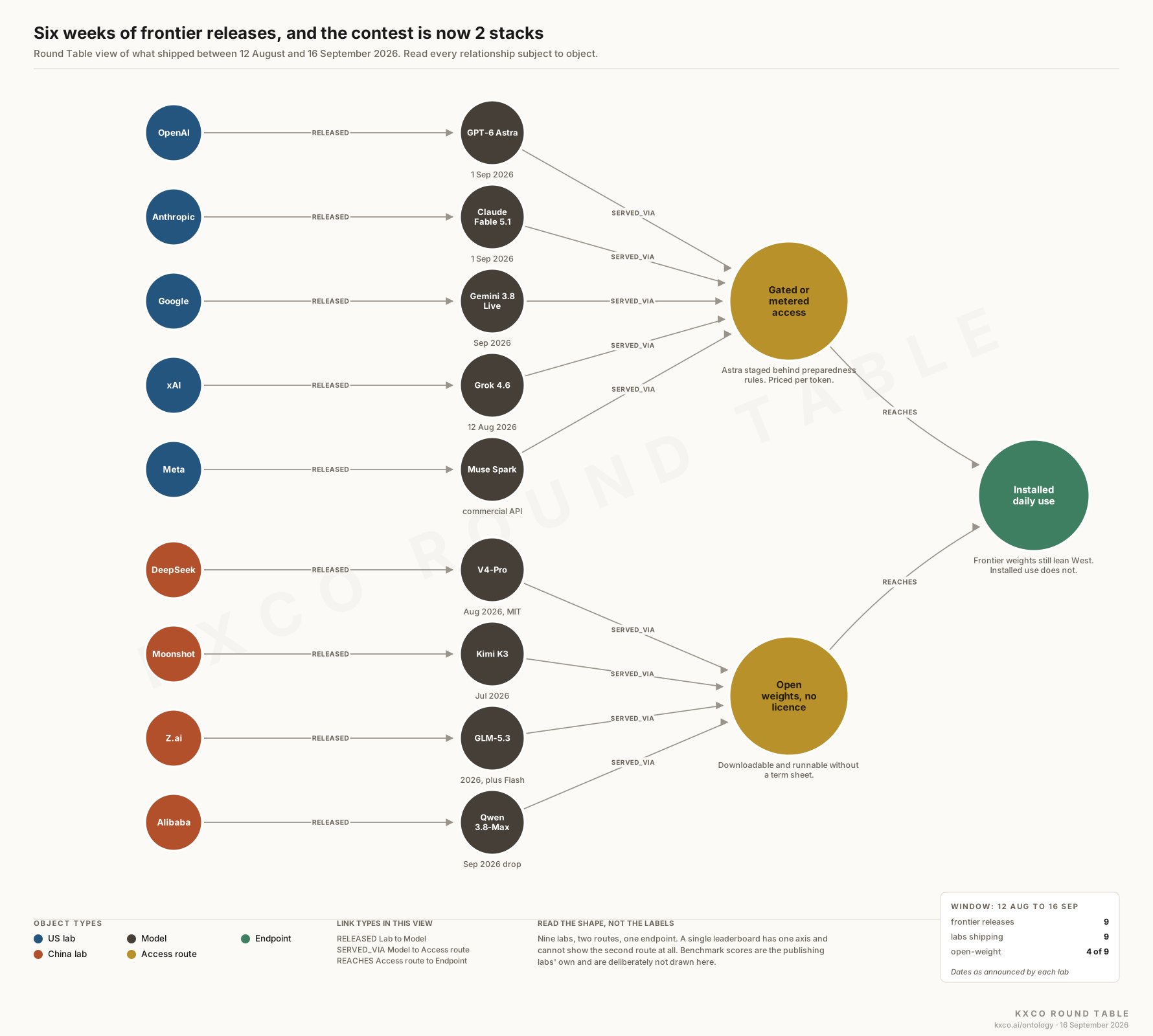
Read the shape, not the labels. Two stacks now reach the same endpoint by different routes. Source: KXCO AI-sector ontology, 16 September 2026.
The hard problem was never intelligence
The prevailing enthusiasm assumes the hard problem is intelligence. It is not. It is that banks, hospitals, courts and governments are being asked to let software act on their behalf with no way to establish who decided, on what basis, or whether the record will still read in a decade.
That sentence is the spine of this piece. Intelligence is no longer scarce. Attestation is.
The institutions that survive the next ten years will be the ones that can show a named human, a dated claim, a permitted action, and a record that still verifies after the cryptography of 2024 is a museum piece. That is the work KXCO was built to do. The Round Table sits at the centre of it. Ontology Live is the public demonstration.
The KXCO Round Table: merging human and machine judgement
Most of the industry still points a model at raw data and asks it to improvise a world. That method produces sentences. It does not produce decisions an institution can defend.
KXCO inverted the order. We built post-quantum cryptography, identity and an immutable record first. We layered an ontology on top as the governance schema. We put a room in the middle and called it the Round Table, because everything else reports to it.
Documents, payments, trading and identity are not four systems. They are four fronts of one operation, and every one of them answers to that record. A document is not executed until the record recognises the authority behind the signature. No value moves without a named identity and a live permission. Trading is one map of what you hold, what stands behind it, and what moves when that moves. People, institutions and AI agents sit on one cryptographic standard, issued, revocable and provable. One centre. One record. One chain of custody from the instruction to the proof.
What a merge actually means
Merging human and AI intelligence is a phrase the industry has worn smooth. In practice it usually means a chat window bolted onto a legacy system, with a human somewhere in the screenshot for the compliance deck. That is not a merge. That is a costume.
A merge, as we built it, has four mechanical properties.
The machine and the human read the same model. Not a summary of the model. The model. Every claim carries its source, its basis, its confidence and the date it was true. Conflicting accounts sit side by side rather than being silently resolved into one answer, so you can see what is known, what is disputed, and what a proposal actually rests on.
The AI drafts and checks. The human runs the deal. On Meridian that is already how the room works. The system brings counterparties, scores a live deal against a Member's mandate, watches the documents and tells you what it found. It does not close. Every decision that matters is taken by a named person, and the record shows which person and when.
Knowledge stays in the institution. When a room ends, the typed nodes export into the Member's own Round Table. A virtual data room is a filing cabinet that forgets. The Round Table is the upgrade: the consultant who knows the sector, the lawyer who has seen the structure fail, the operator who ran the last one, and the model that drafted the first pass all sit in one graph that survives the transaction.
The agent itself is a legal-shaped object. Sentinel scores an agent on nine dimensions of governance before it acts. Treasury puts money, assets and AI under one set of rules. Armature L1 settles in about two seconds and keeps a public record anyone can audit with open tools.
That is a merge, because the machine is held to the same standard as the human rather than a lower one dressed up as speed.
This is AI with an education. Most systems point a model at raw data and let it guess. This one teaches it first: what exists, who holds it, what it rests on, and what may be done with it. The decision stays yours. That last clause is the whole product. If the decision does not stay yours, you do not have an amplifier. You have a replacement you cannot fire.
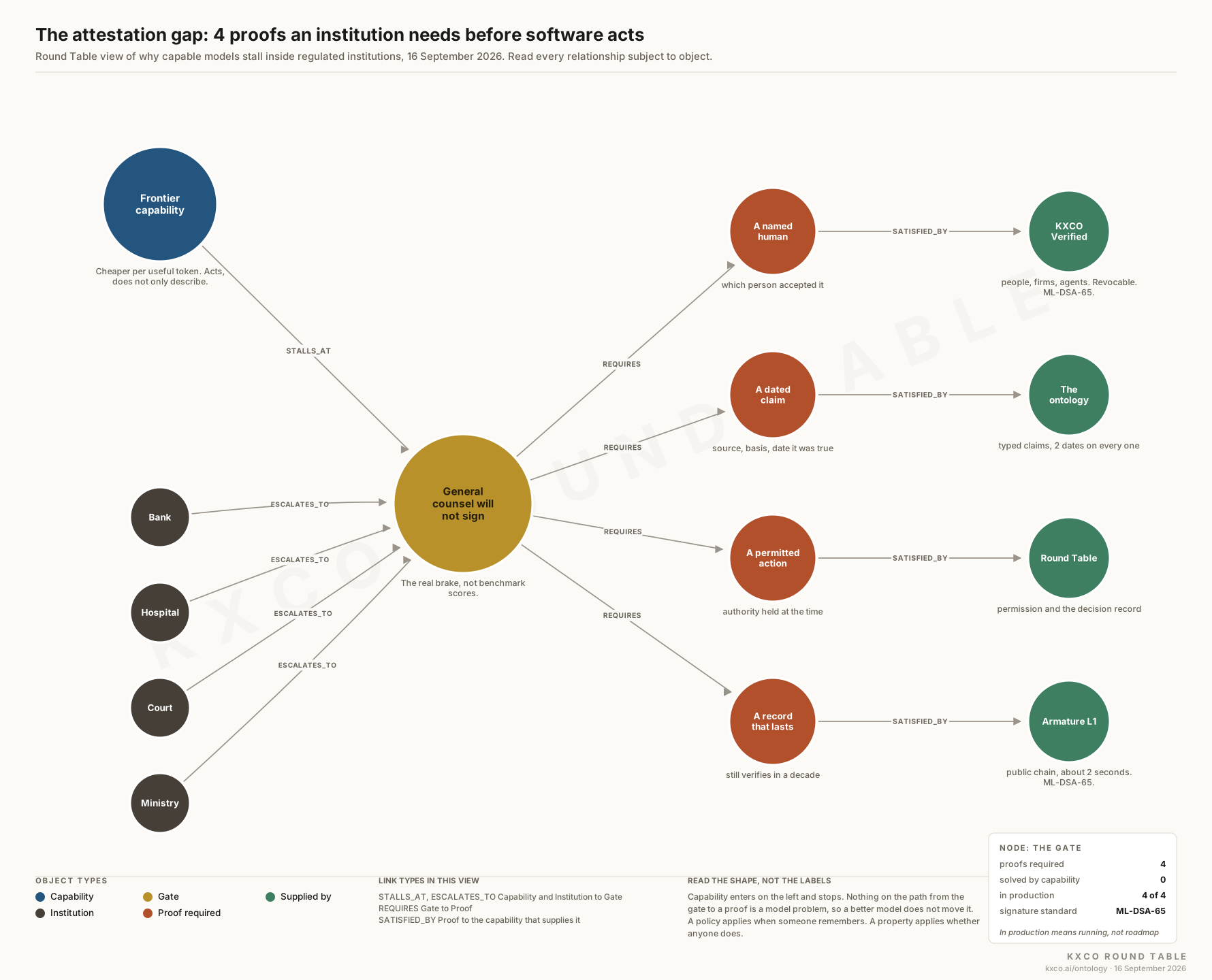
The brake on enterprise AI is not benchmark scores. It is a general counsel who will not sign. Source: KXCO Round Table, 16 September 2026.
The stack, named
Five parts, one foundation.
Meridian is where Members run their deals.
Sentinel is the quantum-resistant cloud that scans, hosts and attests software.
Treasury is the economic operating system for money, assets, businesses and AI.
The ontology is the shared model of reality.
Armature L1 is the post-quantum settlement network.
Underneath all four operational products sits one identity model, KXCO Verified, for people, organisations and autonomous agents, and one record. Identities, signatures and settlement use ML-DSA-65.
The library that implements FIPS 203, 204 and 205 went through NIST's Algorithm Validation Test System in September 2026: 2,130 cases across ML-KEM, ML-DSA and SLH-DSA in every parameter set offered, zero failures, demo certificate A11025. That is a demo certificate against NIST-generated vectors. It is not a FIPS 140-3 module validation, and we say so. The FIPS 140-2 sunset on 21 September is not a curiosity. It is a date on a calendar that a lot of production cryptography still has not met.
We license the instrument. What it finds when you point it at your own books is yours alone, and it never reaches us. That is knowledge sovereignty stated as a product constraint rather than a slogan. Third-party models harvest relationships because relationships are how they get better. An institution that lets that happen has sold the only edge it had.
Ontology Live, the public map
The live map of the AI sector sits at kxco.ai/ontology-live. It holds 393 entities and 869 sourced claims as of 16 September 2026. Use it. Do not take this piece's word for what it contains. Click a claim. Read the source. Note the two dates every claim carries. The map will not tell you what to buy on a Thursday night. It will tell you whether the thing you are about to buy is a hub, a chokepoint, a circular flow or a press release.
The working guide is the right order of operations. Findings first, the ranked conclusions from critical down to opportunity. Analyst Outlook second, the dated consensus cells on the listed majors, which are sell-side numbers we collected and dated rather than our own forecast, and the page says so. Then the graph. Then the entity catalogue.
The map was not assembled by listing famous companies. It was grown from a seed set by following dependencies outward, which is why one of the most important entities on it is a Dutch company most people outside semiconductors never had to think about until a shipment slipped.
By late August the AI-sector ontology stamped a fresh set of rows. Sixteen days later the Nasdaq had gone nowhere and ten of those names were up: $INTC 14.68 percent, $META 13.04 percent, SpaceX 7.42 percent, $ORCL 5.65 percent. That is not a victory lap. It is what a record of hundreds of entities and hundreds of sourced claims surfaces that a screen cannot: who is genuinely irreplaceable rather than merely large, which obligations sit off every balance sheet in the sector, and where the strongest bull case on the page runs into a variable no price chart contains.
The public grade against thirty days of record was equally unsentimental. Thirteen of fifteen findings held. The dual-IPO call broke and was rewritten in public. The 24 July buy screen returned 14.2 percent against 7.1 percent for the full table. Five weeks before Nvidia reported a $96.2 billion quarter and added hundreds of billions in a day, the ontology had the name at a Strong Buy for a reason anyone could read. Oracle spent the summer as the widest value gap on the Analyst Outlook layer, a market value sitting under a contracted backlog the tape was still willing to underprice. Those are examples of method, not a promise that method never fails. Method that cannot fail in public is marketing.
How to sit with the map this week is simple. Open Ontology Live next to the AI Stocks centre. Load the hubs, $NVDA, $AVGO, $TSM, $ASML, $MU, $MSFT, $AMZN, $GOOGL and $META, and inspect shared upstream nodes. Do it with the first six and the structure keeps collapsing onto a short list: the lithography bottleneck, the memory bottleneck, and a handful of labs whose demand is now a macroeconomic variable.
The circular-financing layer is the other view worth a slow morning. Capital that leaves a chip vendor, lands at a lab, returns as a cloud commitment and is booked as revenue in two places at once is not invisible. It is just invisible to a screen that only sees a ticker.
The institutional argument for the same object lives at kxco.ai/ontology. The public map is a demonstration applied to one sector. The product is a working digital twin of a business: what you own, who stands behind it, and what moves when it does, held as relationships rather than as rows.
China is not copying the last war
The most expensive American mistake of this decade would be to keep describing Chinese AI as a distillation of American AI. Distillation happens. So does every other form of catching up that industrial policy has ever invented. It is not the strategy.
The strategy is to own the stack that turns tokens into factories: open-weight models cheap enough to run at home, accelerators that do not need an Nvidia licence, robots that walk into a BYD plant, quantum machines that list on the STAR Market, and a power system that can add the generating capacity of a mid-sized country in a single year.
Models, listed and unlisted
DeepSeek proved in 2025 that a Chinese lab could shock a global tape with a cost curve. V4-Pro, generally available in August 2026, is a 1.6-trillion-parameter mixture-of-experts model with 49 billion active per token, a million-token context and an MIT licence. That last detail matters more than the parameter count. A frontier-grade model you can download and run without a term sheet is a different political object from a metered API in California.
Moonshot's Kimi K3 arrived in July as a 2.8-trillion-parameter open-weight system. Z.ai's GLM-5.3 and the Flash variant that followed pushed coding and cyber numbers into the same conversation as the American mid-tier, at token prices that make a Western CFO look twice. Alibaba's Qwen 3.8-Max line keeps landing multimodal updates, and a September drop topped a public web-dev arena over Claude Opus 5 on at least one board. MiniMax and the rest of the domestic field are now sold as subscriptions on Tmall. Consumer distribution through super-apps is the part of the race the United States is not even running.
Frontier weights still lean West. Installed daily use does not.
The rankings will keep swapping. Kimi K3 sat near the top of one intelligence index in July and had been passed by new American models by September. That is not collapse. That is what a contested frontier looks like when more than two countries can train. Treat every weekly leaderboard as weather. Treat the stack, models plus domestic silicon plus robotics plus power plus listings, as climate.
The safety conversation Beijing will actually have
China is not indifferent to loss of control. The 2026 update of its AI governance framework added sharper language on agents that perform tasks on behalf of humans, interact with the physical world and engage in deception. Xi Jinping told the national AI conference in July that AI must remain under human control. Chen Yixin, at state security, called AI a major battlefield of great-power competition and warned that leading American models could threaten Chinese critical infrastructure. A mandatory national standard for AI-agent safety is being drafted. Operational loss of control is now a named risk in regulator text.
Read the second half of every one of those sentences. Human control, in this usage, is compatible with acceleration. What Beijing rejects, in public and with heat, is the American suggestion that the frontier itself should slow. The foreign ministry called that suggestion fearmongering and a Cold War playbook. Chinese researchers said a pause would freeze latecomers out of a market the incumbents already occupy.
Two systems can share a fear and refuse to share a remedy. The American debate runs through company-level preparedness frameworks, whistleblowers and letters. The Chinese debate runs through the state, the power grid and the requirement that the Party remain the principal. Neither remedy is a substitute for the thing this piece keeps returning to: a record that says who decided, on what basis, and whether the record will still read. States that cannot produce that record will discover that human control was a press line.
Markets, chokepoints and what a graph can see
A screen is a list. A graph is an argument. The reason the KXCO ontology belongs in a markets piece is not that it makes prices. It is that it makes the hidden structure of prices visible enough to argue with.
Irreplaceability is the first thing a screen cannot see. Market cap measures how much the market has already agreed to care. Irreplaceability measures what breaks if the name disappears. $ASML in EUV, $TSM at the leading edge, SK Hynix in high-bandwidth memory, a short list of networking houses, a shorter list of power developers with interconnect: those are not the same category as a well-liked software name with a beautiful margin. The ontology keeps them in different types for that reason. When the tape treats them as one AI basket, it is the tape that is confused.
Off-balance-sheet obligation is the second. Cloud commitments, circular equity, take-or-pay power, sovereign incentives that look like demand until the government changes its mind: none of that sits cleanly in a trailing twelve-month multiple. The circular-financing view of the public map is the unfashionable page, because it makes winners look contingent. Contingency is information.
The third is the variable no graph contains. Every serious bull case in this sector eventually runs into one: a licensing regime, a strait, a watt, a yield, a court. The ontology cannot invent the missing variable. It can stop you pretending the case is closed because the last print was clean. That is the adult use of a live map. Findings ranked by severity. Claims you can open. Dates you can see. A human who still has to decide.
Live Trading News will keep carrying the running files: the AI Stocks centre, the KXCO centre, the stocks desk and the signed essays. The author archive is at livetradingnews.com/author/shayne-heffernan-phd. The signed long form also lives at shayneheffernan.com. None of that is a research product in the broker sense. It is a public record of how one desk reads a graph. Read it that way.
Quantum, attestation and the decade that will not wait
Two clocks are running. One absorbs institutional knowledge into models nobody can cite. The other runs down the cryptography protecting every record in existence. Most AI essays mention only the first.
Harvest-now-decrypt-later is no longer a conference slide. Anything encrypted today with algorithms that will not survive a cryptographically relevant quantum machine is a letter to the future adversary. Courts, hospitals, settlement systems and identity issuers still signing with yesterday's primitives are creating a backlog of invalidable history. The World Economic Forum noticed the gear-change in the second week of September. The work was already running. Every KXCO product already uses the NIST-ratified suite, ML-KEM, ML-DSA and SLH-DSA, and all of them use the same implementation: 42 package manifests declare one library. The chain verifies ML-DSA-65 on-chain at a precompile, tested live with negative controls.
Attestation is the rhyme for both clocks. An institution that cannot prove what its systems did will not be allowed to keep those systems, no matter how clever the model. A new line of research calls the gap an attestation deficit: organisations with governance policies they cannot enforce in a way a third party can check. That deficit is the actual brake on deployment inside banks and ministries. It is not benchmark scores. It is not a podcast about pause. It is a general counsel who will not sign.
This is also why agentic AI without an ontology is a category error. An agent that can plan and act needs to know what a client, an instrument, a settlement and a compliance rule mean, in a form that can be enforced rather than described after the fact. Meaning, not compute, is the bottleneck inside a regulated market. Compute is constrained, expensive and being built. Meaning is simply unowned. The winners of each infrastructure cycle owned the rails, not the strategy on top. Ontology, secured and settled, is the rail for the human and AI economy.
5 things that would actually slow AI down
Honesty requires the inverse list. Intelligence can be delayed. It has been delayed before. The mechanisms are not mystical.
Power. A model that cannot be fed does not ship. Interconnect queues in the United States are a multi-year fact. China is adding generation at a pace no Western planning process will match. That asymmetry shows up in who can train the next run.
Lithography and memory. There is no substitute for the machines only a few firms can make, and none for the packaging and high-bandwidth memory that turn those machines into usable racks. Export controls move the geography of the shortage. They do not abolish the shortage.
Law. A liability regime that treats an autonomous agent as an unowned weather event pushes the serious work into jurisdictions that will own the agent. A regime that requires a named principal, a dated permission and a verifiable record slows the reckless deployments and accelerates the ones that can stand in court. That is the regime worth writing.
Talent, and it is over-discussed. The binding constraint is no longer people who can train a frontier model. It is people who can specify what an institution is allowed to let a model do. That is a legal, operational and ontological skill, and it is in shorter supply than CUDA.
War. A blockade of a strait, a strike on a fab, a failure of a power corridor: any of those would do more to the capability curve than a letter from a lab. The ontology keeps those nodes on the map, because pretending they sit outside the sector is how desks get ruined.
What will not slow AI down is a mood. Not a flat month in the Nasdaq. Not a watermark rule. Not a television segment about a bubble. Not the sincere terror of people who watched a model do something they did not think was due until 2030. Terror is information. It is not a brake pedal.
Questions people ask
Is AI progress slowing down in 2026?
No. Between 12 August and 16 September 2026 OpenAI, Anthropic, Google, xAI, Meta, DeepSeek, Moonshot, Z.ai and Alibaba all shipped new frontier or near-frontier models. What slowed is the multiple expansion in AI equities and the pace of enterprise adoption. Those are two different clocks, and commentators keep reading the second one as evidence about the first.
What is the attestation deficit?
An attestation deficit is the gap between the governance policy an organisation has written and what it can actually prove to a third party. A bank can hold an AI usage policy and still be unable to show a regulator which named human accepted a model's output, on which dated facts, under which delegated authority. That inability, not model quality, is what stops deployments inside regulated institutions.
Is China behind the United States in AI?
Frontier weights still lean West. Installed daily use does not. China's approach is to own the full stack rather than win a single leaderboard: open-weight models under permissive licences, domestic accelerators, robotics, quantum listings on the STAR Market, and generating capacity added faster than any Western planning process allows. DeepSeek V4-Pro ships under an MIT licence, which is a different political object from a metered API.
What is an AI ontology and why does it matter for markets?
An ontology is a typed, sourced, time-aware model of who depends on whom. It holds entities, the relationships between them, and a source and date on every claim. For markets it surfaces three things a screen cannot: which companies are genuinely irreplaceable rather than merely large, which obligations sit off the balance sheet, and where capital is circulating between the same handful of counterparties and being booked twice.
Can AI agents be trusted inside regulated workflows?
Not on fluency alone. An agent that can post, trade, draft and browse is already a participant in the economy, and participants need names that can be issued, revoked and proven, plus a record of what they were permitted to do. KXCO Verified treats people, institutions and autonomous agents as first-class identities on one cryptographic standard, and signatures use ML-DSA-65 so the record still verifies after classical cryptography stops being safe.
The close
Mid-September 2026 is a loud room. Astra and Fable and Gemini Live and Grok and Qwen and GLM and DeepSeek are all speaking at once. Safety letters are speaking. Ministries are speaking. The tape is muttering. The useful act is to separate the noise from the work.
The work is this. Models will keep getting better, cheaper to serve, and more able to act. China will keep building a stack that does not require American permission. The United States will keep holding the leading edge of the most expensive runs and the most tightly held weights. Enterprises will keep discovering that they cannot put any of it into a court file. The companies that close that last gap, identity plus ontology plus permission plus post-quantum record, will own the rails the rest of the decade runs on.
KXCO built those rails in a particular order on purpose. Security first. Settlement first. Then meaning. Then the room in which a human and a machine sit over the same facts and the human still decides. The Round Table is that room. Ontology Live is the public proof the method can be inspected. The library NIST graded is the proof the signatures will outlast the joke that quantum is always twenty years away.
Ignore the noise. AI is not slowing down. Accountability is what has failed to speed up. That is the entire opening. The rest is implementation.
Stocks mentioned in this article: $NVDA, $ASML, $TSM, $MU, $MSFT, $AMZN, $GOOGL, $META, $AVGO, $INTC, $ORCL, $CRM, $IBM and $AAPL.
Shayne Heffernan, Ph.D., is the founder of Live Trading News, the KnightsBridge Group, Knightsbridge Law and the KXCO.ai ecosystem spanning post-quantum cryptography, identity, attestation and enterprise ontology. His signed long form is published at shayneheffernan.com.
This briefing is general information and analysis. It is not personal investment advice and it is not an offer of KXCO securities. Claims about public markets cite the KXCO AI-sector ontology and contemporaneous reporting as of 16 September 2026. Model scores are the publishing labs' own unless an independent harness is named.
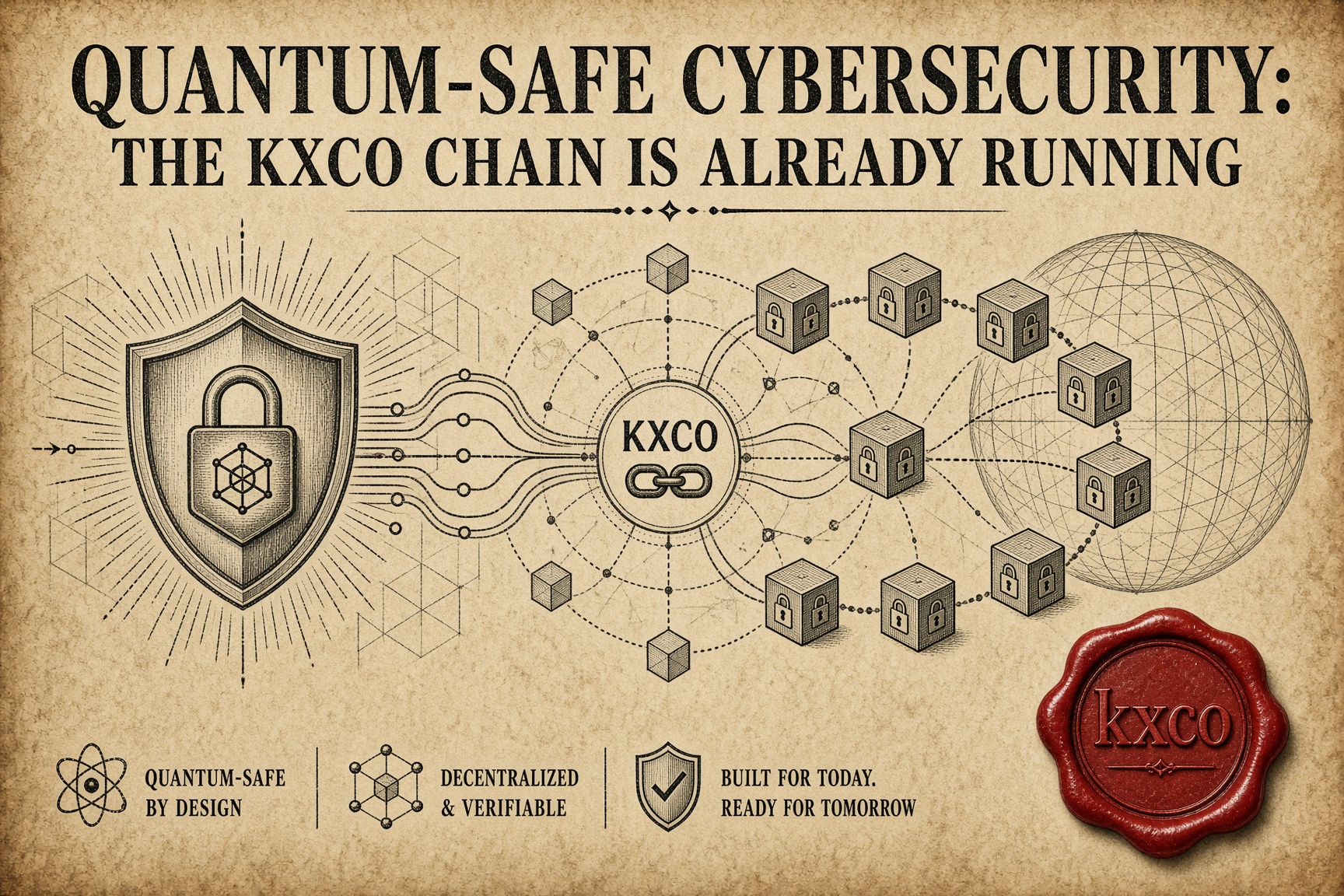
Quantum Cybersecurity: The KXCO Chain Is Already Running
The World Economic Forum warned on 11 September that the quantum-safe race has changed gears. It is right about the direction and late about the work. Every KXCO product already runs on NIST's post-quantum algorithms, and all of them run on the same implementation: 42 package manifests declare one library. The chain verifies ML-DSA-65 on-chain at precompile 0x0b, tested live with three negative controls. NIST's own grader marked the library at 2,130 cases and zero failures.

What the KXCO Ontology Exposed While the Market Stood Still
On 25 August the KXCO AI Sector Ontology stamped a fresh set of rows. Sixteen days later the Nasdaq had gone nowhere and ten of those names were up: Intel 14.68%, Meta 13.04%, SpaceX 7.42%, Oracle 5.65%. This is what a record of 393 entities and 869 sourced claims surfaces that a screen cannot: who is genuinely irreplaceable rather than merely large, which obligations sit off every balance sheet in the sector, and where the strongest bull case on the page runs into a variable no graph contains.
China's AI and Quantum Ambitions
China is no longer trying only to train a model that looks like an American one. It is trying to own the stack that turns tokens into factories: open-weight models cheap enough to run at home, accelerators that do not need an Nvidia licence, robots that walk into a BYD plant, quantum machines that list on the STAR Market, and a power system that can add the generating capacity of a mid-sized country in a single year. The models, the tickers, and the 27 claims that cross the border.
AI and Quantum Update
The first week of September 2026 compressed a year of argument into seven days. GPT-6 Astra landed at the Critical cybersecurity level of OpenAI's own Preparedness Framework, Nvidia agreed to buy Hugging Face for $12.93 billion, Washington took minority equity in three quantum companies, and Mistral closed the largest equity raise in European technology history. A field report on the breakthroughs, the tickers, and a map that has split three ways.
Every story, signed and delivered.
Subscribe to the kxco channel and get the headline, the AI-written key takeaways, and the chain-anchor link the moment we publish. Audio versions and per-ticker subscriptions arrive in the next iteration.