
China's AI and Quantum Ambitions
Models, chips, physical AI, robotics, state capital, and the power grid that makes the race possible
Part of theAI Stocks Center
China is no longer trying only to train a model that looks like an American one. It is trying to own the stack that turns tokens into factories: open-weight models cheap enough to run at home, accelerators that do not need an Nvidia licence, robots that walk into a BYD plant, quantum machines that list on the STAR Market, and a power system that can add the generating capacity of a mid-sized country in a single year.
The 15th Five-Year Plan, which began in 2026, names quantum among seven "future industries" and treats computing power as one of six national infrastructure networks, alongside water and electricity. That is not a metaphor. It is a budget line.
A state project with a factory floor
Two facts frame the rest of this article.
First, Chinese open-weight models now sit on the same coding leaderboards as closed Western flagships. Alibaba's Qwen3.8-Max-0902 posted 1,691 on Code Arena in early September, three points ahead of Claude Opus 5 Max. Moonshot's Kimi K3 shipped 2.8 trillion parameters as downloadable weights.
Second, Chinese firms accounted for the large majority of humanoid robots shipped worldwide in 2025 and the first half of 2026. AgiBot and Unitree have been running one and two in unit counts. Unitree listed on Shanghai's STAR Market in August 2026 as 688836. The software layer and the physical layer are being capitalised on the same exchanges, under the same industrial policy.
The West still leads at the very top of closed frontier training and at the most advanced lithography. China's counter is volume, price, deployment and watts. This feature covers the model and chip race, physical AI and robotics, quantum computing and communications, the web of government money, the power advantage that makes the compute possible, and the publicly traded companies that give an investor a seat. It is analysis, not a recommendation to buy or sell anything.
The model layer: open weights as industrial policy
DeepSeek shocked foreign labs in 2025 by showing that a Hangzhou research group could reach frontier-adjacent reasoning with far fewer imported GPUs than the American playbook assumed. In 2026 the shock became a system.
Qwen from Alibaba Cloud, Kimi from Moonshot, GLM from Zhipu, the MiniMax stack, StepFun, Baidu's Ernie line and Tencent's Hunyuan all ship on a cadence that looks more like consumer internet than national-laboratory science. Doubao, ByteDance's consumer agent, is measured in the hundreds of millions of monthly users. That distribution is an asset no American lab owns inside China.
The listing calendar turned the labs into equities. Zhipu AI rang the Hong Kong bell on 8 January 2026 as 2513.HK, marketed as the world's first large-model stock. MiniMax listed the next day as 00100.HK and doubled on the open. Both have been violently volatile, and Zhipu's capitalisation printed toward enormous Hong Kong dollar numbers mid-year before giving a large fraction back. The structural change is permanent all the same. Chinese model companies now have a public currency and a domestic retail audience that treats AI sovereignty as a theme.
Moonshot has filed confidentially for Hong Kong after K3. DeepSeek remains private, founder-controlled, and is hiring against a usage surge rather than sprinting the IPO clock. ByteDance is expanding Inner Mongolian training capacity and arranging very large loan packages. Alibaba, Tencent and Baidu absorb model costs inside cloud, ads, commerce and payments.
Open weights are the geopolitical product. A ministry in Jakarta, a bank in Riyadh or a factory in Chongqing can download Qwen or Kimi, run it on domestic iron, and never send a prompt to Virginia. Export controls still bite at the dense training end. They do not stop a well-engineered mixture-of-experts checkpoint from landing on Hugging Face and ModelScope the same afternoon. Nvidia's bid for Hugging Face is, among other things, a recognition that this distribution channel now matters as much as the closed API.
The chip layer: substitution under sanctions
Huawei's Ascend line is the unlisted national champion. The Ascend 950PR, launched in March 2026 with in-house HBM branded HiBL, was pitched at about one petaflop FP8 and a price near 116,000 yuan a card. ByteDance's reported order in the multi-billion-dollar range would be the largest single domestic-chip purchase in the country's history if the figure holds.
Cambricon (STAR: 688256), the oldest listed pure-play AI designer, finally turned an annual profit in 2025 after years of losses and then accelerated: cloud inference cards, forced substitution away from Nvidia, and a 2026 shipment target talked up toward half a million accelerators. It sits with Huawei on Beijing's approved AI-hardware procurement list.
Around them a "four dragons" IPO wave listed or cleared Moore Threads, Muxi (MetaX), Biren and Enflame between late 2025 and mid-2026. Debut-day pops of several hundred percent told you what retail wanted. Semi-annual 2026 reports told you something colder. Revenue across the domestic accelerator cohort doubled, but true core profitability concentrated in a short list led by Hygon (CPU plus DCU) and Cambricon. Yields at SMIC on advanced nodes and HBM supply remain the binding constraints.
Horizon Robotics (9660.HK) is the other listed silicon story that matters for physical AI: Journey-series automotive chips, millions of units into Chinese and some foreign nameplates, and a Volkswagen joint-venture footprint. Kunlunxin, still partly inside Baidu, and Pingtouge inside Alibaba are the conglomerate foundry-adjacent bets working toward their own listings.
None of this equals a $TSM N3 training cluster, and none of it arrives without $ASML deciding what a Chinese fab may buy. It does mean that inference, the part of AI that actually touches a robot joint, a camera, a call-centre seat or a consumer app, can be sourced at home in volume. That is the chip war that robotics cares about.
What the graph says about the boundary
The claims in this article are not held as prose at Knightsbridge. They sit in the KXCO AI sector ontology as typed, dated, individually sourced statements, which is what lets a reader audit a layer instead of taking a paragraph on trust. The public view is at kxco.ai/ontology-live.
As of 28 August 2026 that store holds 392 entities and 866 claims. Forty-eight of those entities are Chinese parties, and 158 claims touch at least one of them. Of those 158, 151 carry a public source URL.
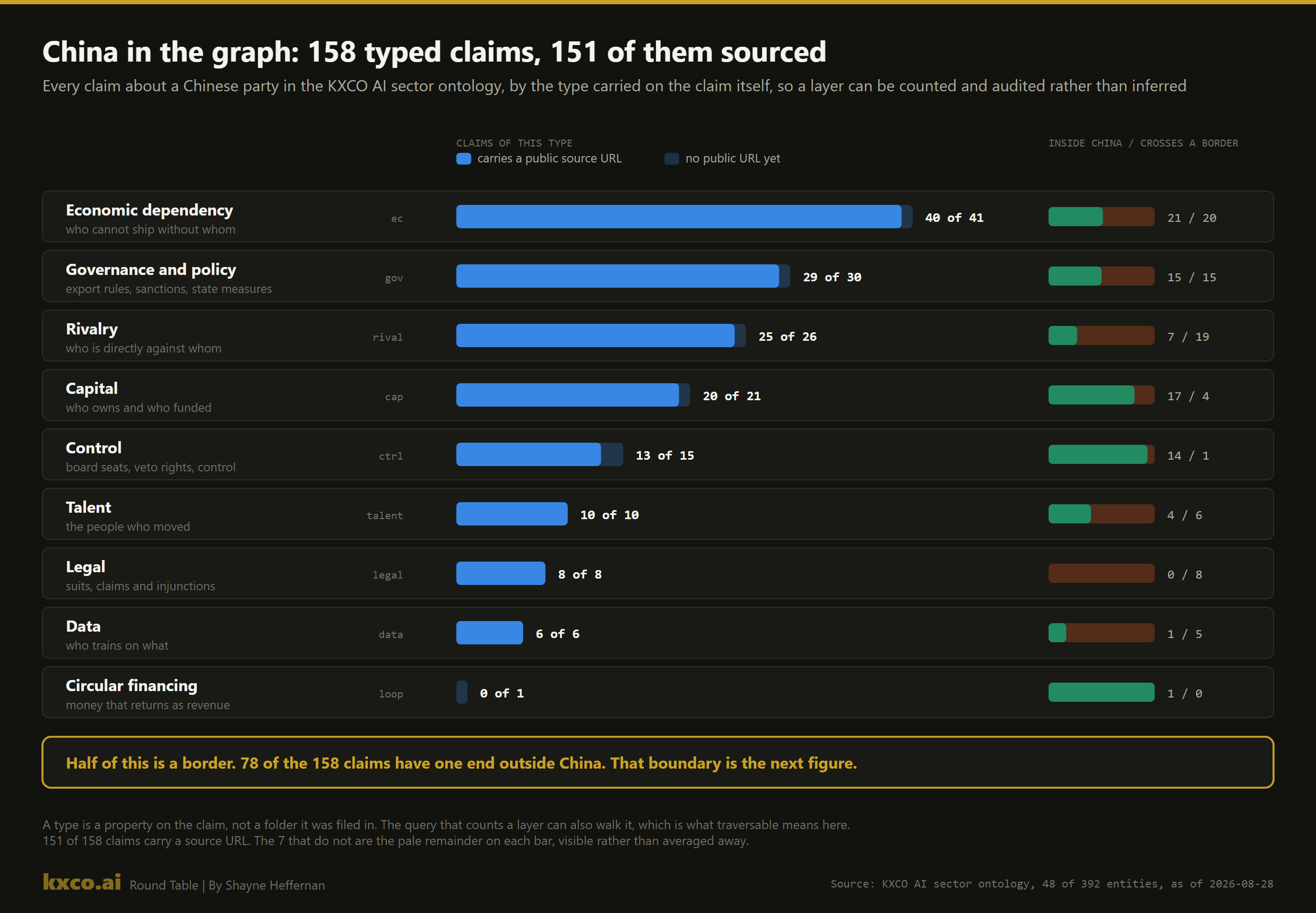
Every claim about a Chinese party in the AI sector ontology, by the type carried on the claim itself. Source: KXCO Round Table, 28 August 2026.
The first thing the breakdown says is that the largest layer is economic dependency, 41 claims, ahead of governance and policy at 30 and rivalry at 26. The second thing it says is that half of the file is not internal at all. Seventy-eight of the 158 claims have one end outside China. A story told as a national programme is, in the record, mostly a story about a border.
So draw the border. The figure below carries every dependency and governance claim in the China subgraph with an organisation at both ends. Twenty-seven claims, 28 parties, 14 of them Chinese and 14 not. Nothing was selected for effect: the subset is defined, and the one claim that carries no public source URL is drawn dashed rather than dropped.
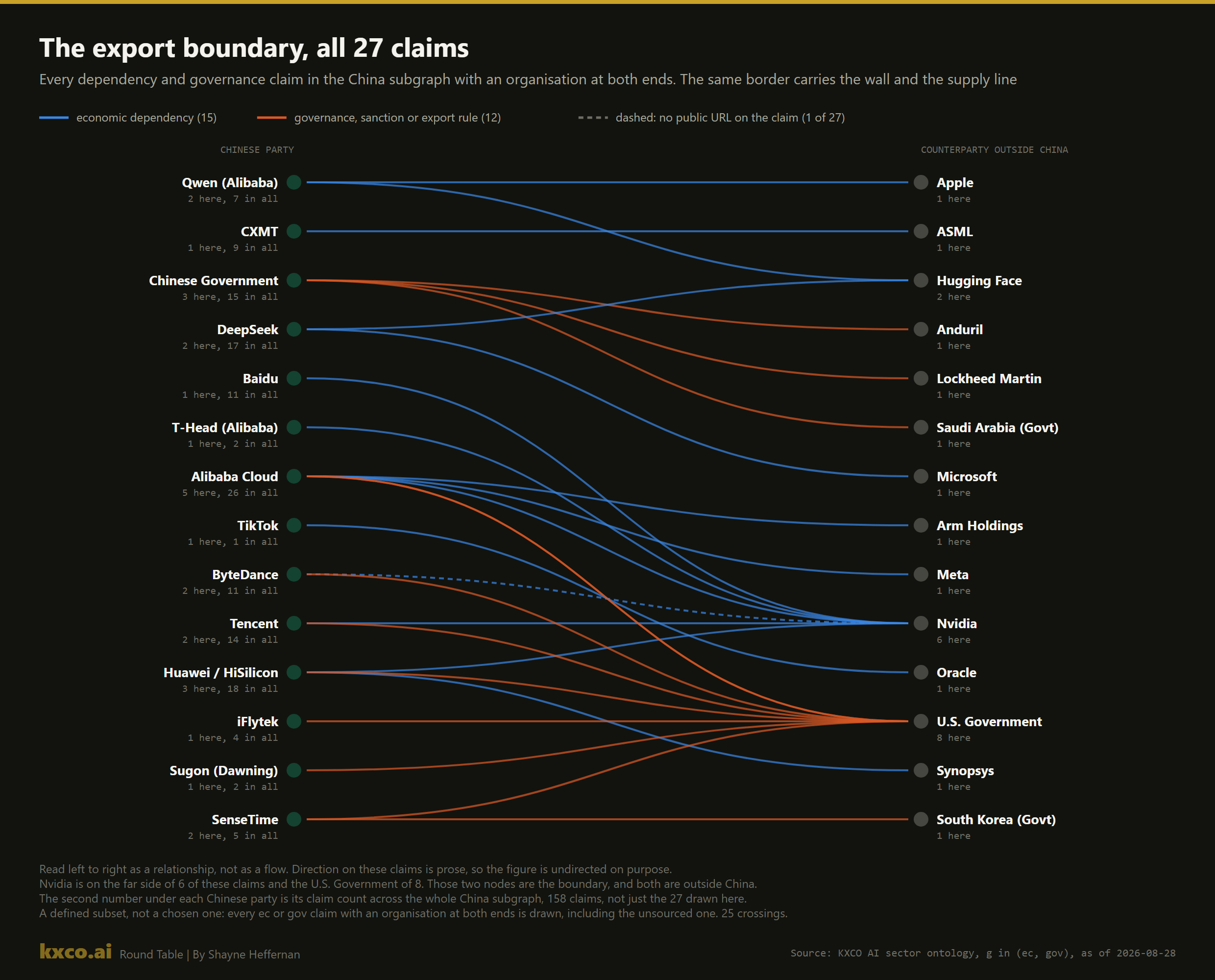
The export boundary, drawn from the ontology. Blue is a dependency, orange is a restriction, and both run through the same two nodes. Source: KXCO Round Table, 28 August 2026.
Two nodes carry the boundary, and both are outside China. $NVDA is on the far side of six of the 27 claims. The U.S. Government is on the far side of eight. Around them the same border does two opposite jobs at once. It restricts: Huawei cut off from $SNPS electronic design tools, export limits filed against $BABA, Tencent and ByteDance, Entity List designations against Huawei, iFlytek and SenseTime. It also supplies: $BABA and Tencent cleared to buy H200 parts, ByteDance a multi-billion-dollar GPU customer, $ASML shipping immersion DUV to CXMT, Qwen powering $AAPL Intelligence inside China, DeepSeek served through $MSFT Copilot, Llama hosted first on Alibaba Cloud by arrangement with $META, TikTok's American user data sitting on $ORCL, Alibaba's own server CPUs built on $ARM cores.
That is the fact the wall-versus-race framing keeps losing. The restriction and the dependency are filed against the same handful of counterparties, in the same period, and often in the same direction. An investor holding the American side of that list is long both the enforcement and the trade.
Physical AI: when the model has hands
Physical AI, or embodied intelligence, is the point at which a vision-language-action model stops answering a prompt and starts moving a gripper.
China has decided this is the application layer that uses its real advantages: the world's largest industrial robot installed base, the densest consumer-electronics supply chain, EV factories that already run lights-out cells, and a state that can designate "10,000 humanoids in 100 scenarios" as a 2026 deployment target rather than a conference talk. In June 2026 Beijing launched a national push to put more than 10,000 humanoid robots into manufacturing, warehousing, inspection, healthcare, retail and emergency response by year-end.
That number will be missed in the interesting sense, because some sites will be photo opportunities. It will be hit in the important sense, because Chinese factories are now the default place a humanoid learns a job.
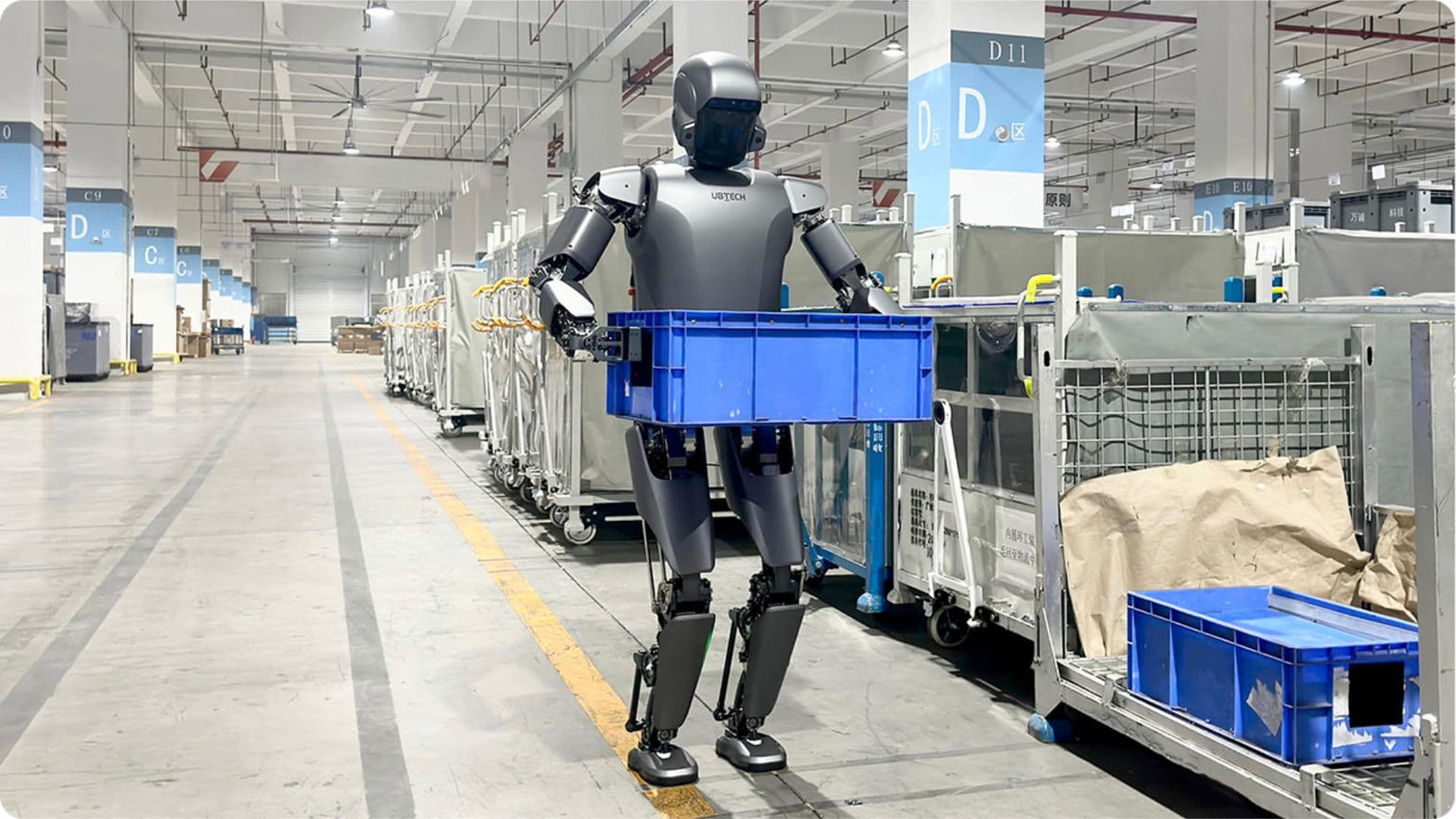
A UBTECH Walker humanoid moving a crate on a Chinese factory floor. Physical AI stops being a demo when the customer already builds cars.
Vision-language-action work inside China still trails the best American generalist stacks, and Chinese teams have been frank that they lack a single foundational robot brain. They compensate with data volume.
Xiaomi has published an open robotics foundation model, XR-1, on a Qwen3-VL backbone plus a diffusion transformer, trained on more than 100,000 hours of UMI data and 7,200-plus hours of real-robot time, and demonstrated laundry folding and suitcase packing. Unitree and DeepSeek took a strategic placement in the Unitree IPO specifically to co-develop embodied models. Nvidia, even under the chip war, has put Unitree bodies into Isaac GR00T reference designs and shipped Jetson Thor modules to UBTECH, Galbot, EngineAI and AgiBot.
The brain can be foreign. The body, the factory and the terabytes of failure data are domestic.
Robotics: shipment share first, software later
Independent tallies put Chinese makers at roughly 87 to 90 percent of global humanoid shipments in 2025. AgiBot led some counts above 5,000 units. Unitree was close behind or ahead depending on who was counting quadrupeds against bipeds. UBTECH, Leju, EngineAI and Fourier filled out the board. Western names including Figure, $TSLA Optimus and Agility were rounding errors on unit volume.
First-half 2026 global humanoid shipments ran above 22,000, up several hundred percent year on year, with AgiBot still near 40 percent share and Unitree near 30.
That is not the same as saying Chinese humanoids do useful work at scale. Unitree's own prospectus said high-end general-purpose robots have not yet achieved large-scale commercialisation. Honesty in a filing is rarer than a backflip in a Spring Festival gala.
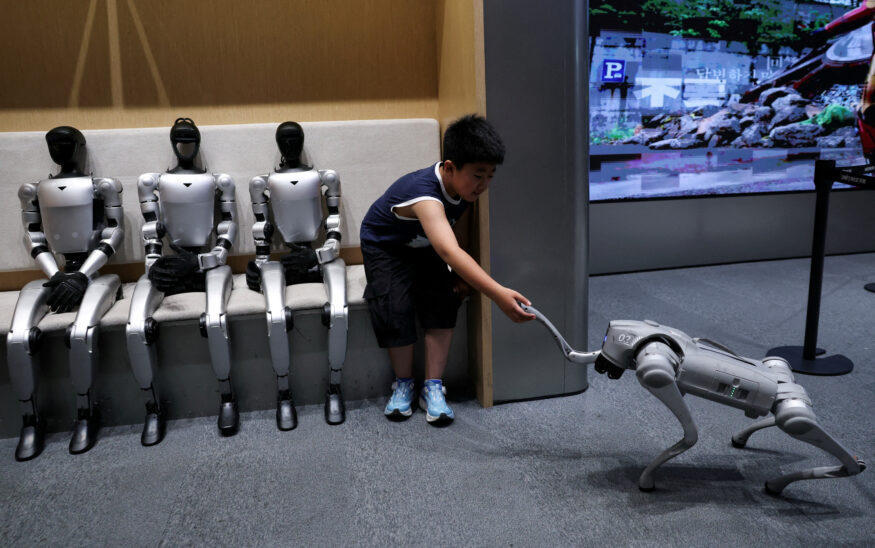
Unitree humanoids and a quadruped on show. Cheap hardware is the data strategy, because every unit sold is a sensor.
Unitree is the financial benchmark. The Hangzhou firm grew up on quadrupeds, more than 30,000 sold and on the order of 60 percent of that global niche, then added G1 and H-series humanoids. 2025 revenue was about 1.7 billion yuan with a 60 percent gross margin and several hundred million yuan of adjusted profit, one of the few humanoid makers that could show black ink.
CSRC registration took 104 days, a STAR Market speed record under the pre-review rules. The IPO priced at 150.80 yuan on 5 and 6 August 2026, raised on the order of 6 billion yuan, and began trading on 19 August as 688836. The open was a carnival: prints several hundred percent above offer, a fleeting capitalisation that briefly looked through Baidu and JD, then a slide of more than half from the peak as first-half numbers reminded buyers that margins compress when you scale metal. DeepSeek and Tencent took strategic allocations.
The Pentagon's Section 1260H list and an FCC Covered List addition have complicated Unitree's American research and commercial path. The home market does not need that path.
UBTECH (9880.HK), listed in Hong Kong in December 2023, is the industrial humanoid. 2025 revenue crossed 2 billion yuan, up 53 percent. Full-size humanoid revenue jumped from 35 million to 821 million yuan. Gross margin widened into the high thirties. The net loss narrowed but did not vanish. Walker S2 went into mass delivery in late 2025, and automotive lines at $NIO, BYD, Geely and Dongfeng have been the proving grounds. Hitachi has put Walker S2 into selected Japanese manufacturing trials. The U1 consumer-priced unit, listed near 119,800 yuan with more than 13,000 pre-orders and deliveries slated from mid-September 2026, is the first real test of whether a household will pay for a humanoid that is not a toy.
AgiBot remains private and, on some shipment charts, number one. It is the volume manufacturer of the wave, with a reported path toward a Hong Kong listing and a side door onto the A-share market through control of Swancor New Material (688585.SH). Galbot, Galaxea, EngineAI, LimX, Fourier, X Square Robot, Spirit AI and a long tail of 30 to 50 embodied-AI names are in Hong Kong or STAR and ChiNext queues. Deep Robotics is on the STAR track for quadrupeds. Dobot (2432.HK) and Geek+ (2590.HK) are already listed on the cobot and warehouse AMR side.
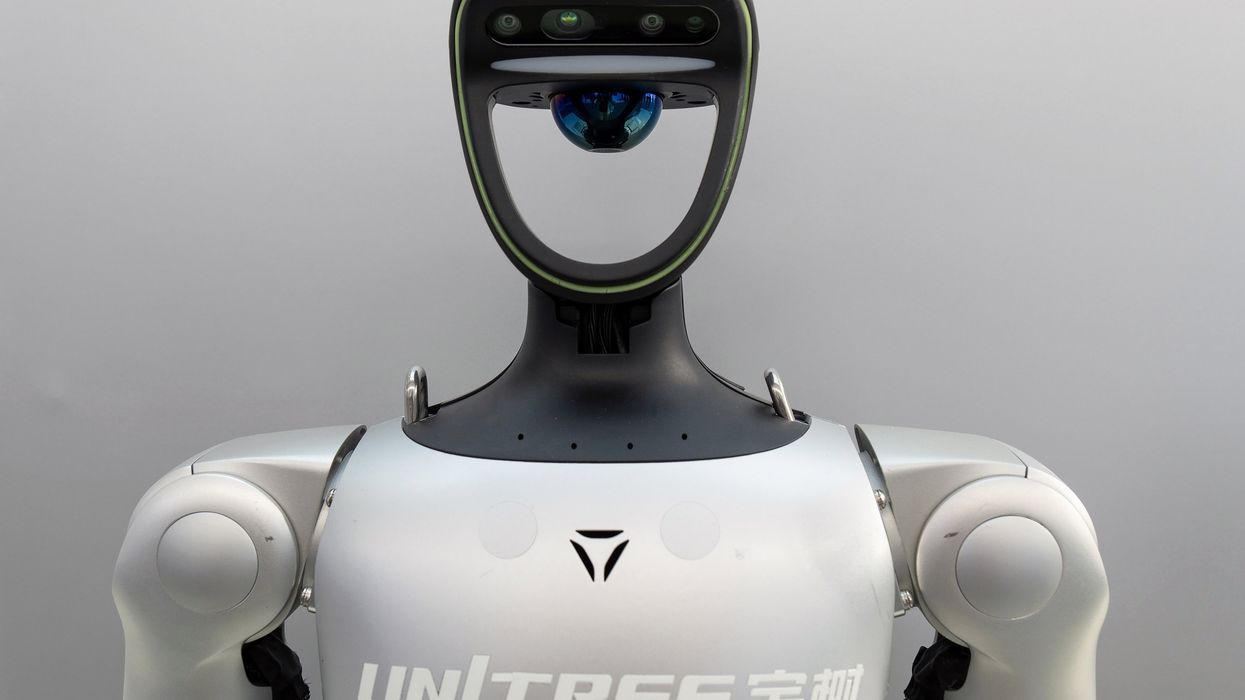
Export controls and entity lists now follow the robots the way they followed the chips.
Behind the humanoids sits the older industrial-robot complex: Estun, Inovance, Siasun, STEP, Efort, JAKA, Midea's KUKA and Hikrobot under Hikvision. China installed about 54 percent of the world's industrial robots in the mid-2020s and more than 80 percent of new humanoid installs. Physical AI is being trained in the only country that already has the cells.
Wheels, warehouses and the rest of the body
Humanoids get the cameras. Most of the money still sits in things that already roll.
China is the largest market for industrial arms, mobile warehouse robots and robotaxis that actually carry passengers in paid service. $PONY and $WRD have listed in the United States. Baidu's Apollo stack remains the domestic incumbent. $XPEV, $NIO and $LI are not robot companies, but their plants are the reason UBTECH has a customer list, and XPeng's Iron programme is an EV maker building a humanoid because it already owns motors, batteries, vision and a dealer network.
Midea's ownership of KUKA put a European industrial-robot brand inside a Chinese appliance giant. Inovance and Estun sell the servos and controllers that make a robot company possible. Hikrobot, under Hikvision, quietly owns a large piece of warehouse vision plus AMR. Geek+ listed in Hong Kong in 2025 as a logistics-robot name. Physical AI is a supply-chain sport, and China already won the parts bin.
That is why Western labs talking about a general robot brain are answering a different exam from Shenzhen. The Chinese exam is this: can you put 10,000 machines into 100 jobs this year, collect the traces, fine-tune a Qwen-backed vision-language-action model, and cut the cost of the next body by 30 percent because the reducer and the battery pack are made in the same province.
Failure is cheap when the factory is next door. Failure is existential when every body is a venture-scale prototype. Volume is a research method.
Quantum: from academy to exchange
China's quantum programme is older than the current AI boom. The Beijing to Shanghai quantum backbone, the Micius satellite, QuantumCTek's 2020 STAR listing and a decade of Hefei "Quantum Avenue" spending built a communications and metrology industry before most Western investors could spell QKD.
The 2026 turn is commercialisation. Quantum technology was named the first of seven future industries in the 15th Five-Year Plan. The National Venture Capital Guidance Fund made its first direct quantum investment, into TuringQ, through a Yangtze Delta sub-fund. Origin Quantum, the superconducting full-stack firm behind the Wukong cloud machines, closed a pre-IPO round near 3 billion yuan led by Norinco at a 21 to 24 billion yuan valuation and is in STAR tutoring. QBoson and TuringQ entered tutoring in 2026. CIQTEK has been working the instrument IPO. SpinQ in Shenzhen sells teaching machines abroad. At WAIC 2026, Zhongqi Wuliang showed a neutral-atom system packaged as a data-centre server rather than a laboratory chandelier.
Sector income was reported around 11.6 billion yuan in 2025 with growth above 30 percent. Company counts rose from 93 in 2023 to 153 in 2024. Cumulative financing through mid-March 2026 was cited near 11.2 billion yuan, with 2.2 billion in the first quarter alone, close to a full prior year in three months.
That is state-shaped capital. China Telecom's quantum vehicle spent hundreds of millions taking control of QuantumCTek (688027.SH), the listed QKD name, and then bought from the companies it incubated. Provincial funds in Sichuan and Beijing and the telecom group added billions of yuan of dedicated dry powder.
The science is real in communications and sensing. Gate-model fault tolerance is the same unsolved engineering problem it is in New York and Oxford. The difference is that Hefei does not need a 2029 product to keep the lights on. The state is the first customer.
Government money: the state as GP
Beijing has become the largest venture capitalist in Chinese hard tech, and it is not shy about it.
The National Venture Capital Guidance Fund, unveiled in December 2025, carries a 100 billion yuan fiscal seed and a 20-year mandate to mobilise up to 1 trillion yuan into semiconductors, quantum, AI, biomedicine and aerospace. Three regional sleeves covering Beijing-Tianjin-Hebei, the Yangtze River Delta and the Greater Bay Area were reported holding a combined 121.8 billion yuan, with each sleeve intended to grow toward 50 billion. They launched with letters of intent covering 49 sub-funds and 27 direct deals.
One compilation put the state's share of 2026 Chinese AI investment at 39 percent, or about 345 billion yuan of public money into the sector. Fifteen new national AI research institutes were capitalised at 89 billion yuan. An $8.2 billion National AI Industry Investment Fund had already been stood up for startups. Local governments from Hangzhou to Shenzhen run parallel vehicles.
The data-centre plan is larger than the model funds. Reporting in mid-2026 described a draft five-year blueprint, associated with the NDRC and the Six Networks programme, to spend around 2 trillion yuan, about $295 billion, building interconnected computing hubs. China Mobile and China Telecom would operate the bulk, with a target that at least 80 percent of the kit come from local suppliers, Huawei first among them. Funding is meant to ride ultra-long special government bonds and strategic-industry vehicles.
That is how China builds high-speed rail. It is now how China builds tokens.
Critics inside and outside the system make the obvious points. State cheques inflate valuations. Private discipline thins. You get a bifurcated market where hard tech is overfed and everything else starves.
Those criticisms can all be true and still miss the design. Patient capital with a 20-year clock will write a seed cheque for a photonic quantum chip that no ten-year American fund will touch. The same capital will buy the first thousand robots a factory does not yet need, so that the thousand and first has a policy gradient. Waste is priced in. So is optionality on technologies that do not care about a 2027 IRR.
Talent and standards are the quieter half of the same machine. NSFC major research plans for 2026 fund interpretable next-generation AI methods and high-precision quantum manipulation as separate national efforts, with lines that explicitly mix deep learning and quantum many-body computation. The Central Cyberspace Affairs Commission's 2026 to 2030 cyber-industry plan puts quantum, high-end chips, agents and open-source participation on one page. Provincial labs, Zhejiang Lab in Hangzhou, the Hefei cluster and Shanghai's optics institutes, exist to turn those plans into graduate students and procurement specs. The guidance fund is the cheque. The five-year plan is the syllabus.
Military-civil fusion is not a slogan in this stack. Beijing is the PLA-contracting hub. Entity-listed university labs sit inside the same districts as commercial quantum startups. Origin's Norinco-led pre-IPO round made the defence-industry link visible on a term sheet. Unitree's American designations made the reverse visible on a trade document. Investors who treat these firms as consumer-internet names will be surprised by both the support and the sanctions.
The real advantage: power
Every serious comparison of American and Chinese AI eventually leaves the model card and lands on the kilowatt-hour. Training and inference are thermodynamics with a software interface. The saying in the industry is crude and correct: the limit of AI is compute, and the limit of compute is electricity.
China runs the world's largest power system, with installed capacity near 4,000 gigawatts, more than twice the United States, and it adds a small country's worth of capacity in a normal year. Solar overtook coal as the largest source by installed capacity in 2026. Renewable generation in 2025 exceeded the entire electricity consumption of the European Union. Forty-three ultra-high-voltage lines, the so-called power expressways, move cheap western electrons toward eastern load, and inter-regional transfer capacity has been put above 380 gigawatts.
Data centres used about 170 billion kilowatt-hours in 2025, 1.6 percent of national demand. Wood Mackenzie's "Rewiring China's Grid for the AI Era" projects that figure near 774 terawatt-hours by 2030, about 6 percent of demand, on the way to a much larger share by 2060. In the United States, incremental data-centre load is a multiple of recent capacity growth. In China it is a sizeable but digestible slice of an already steep demand curve, on the order of 15 percent of annual power-demand growth in some estimates rather than 400 percent of it.
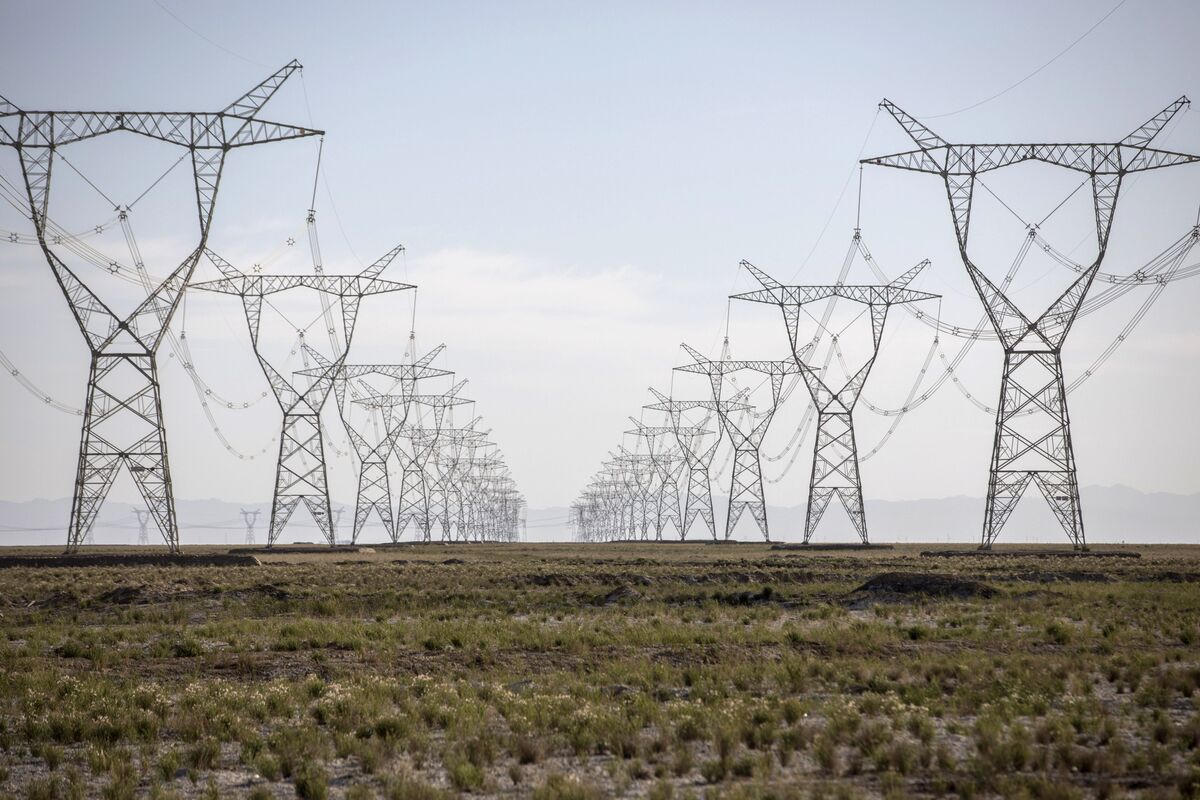
Ultra-high-voltage corridors moving western generation toward eastern load. AI in China is a transmission story as much as a model story.
The ontology holds the size of that gap and, in the same file, the argument against reading it as a lead. On 2025 figures China generated 10,573 terawatt-hours against 4,536 in the United States, a ratio of 2.3 to one. The store also carries a second claim, marked as this author's own derivation rather than a sourced figure, that the United States converts roughly eight times the share of its generation into computation: about 5.66 percent against about 0.70 percent. That derivation deliberately uses the high end of China's contested 4.27 to 8.5 gigawatt data-centre draw, which is the reading least favourable to the argument being made. At the low end it is closer to sixteen times.
Take both claims together and the conclusion changes shape. Chinese generation dominance is not yet a compute lead. It is unused headroom. The binding constraint on American compute is not generation either. It is conversion: transformers, interconnection queues and halls.
Price is the second half of the advantage. A large-scale computing and electricity coordination project in Zhongwei, Ningxia, began sending green power straight to computing halls at 0.36 yuan per kilowatt-hour, about 45 percent of eastern industrial tariffs and a fraction of typical US commercial rates. Xinjiang wind can print near 0.3 yuan. New data centres inside the eight national computing hubs are supposed to source at least 80 percent green power. Direct renewable-to-rack links bypass interconnection queues that have stalled American projects for years.
"Eastern data, western computing", the 2022 slogan, is uneven in practice, and eastern provinces still hold most in-use racks. The direction of capital expenditure is west and north all the same: Guizhou, Inner Mongolia, Ningxia and Gansu, where land is cheap, air is cooler, and surplus wind and solar otherwise curtail. Huawei and Tencent building in Guizhou is not a lifestyle choice. It is a power contract.
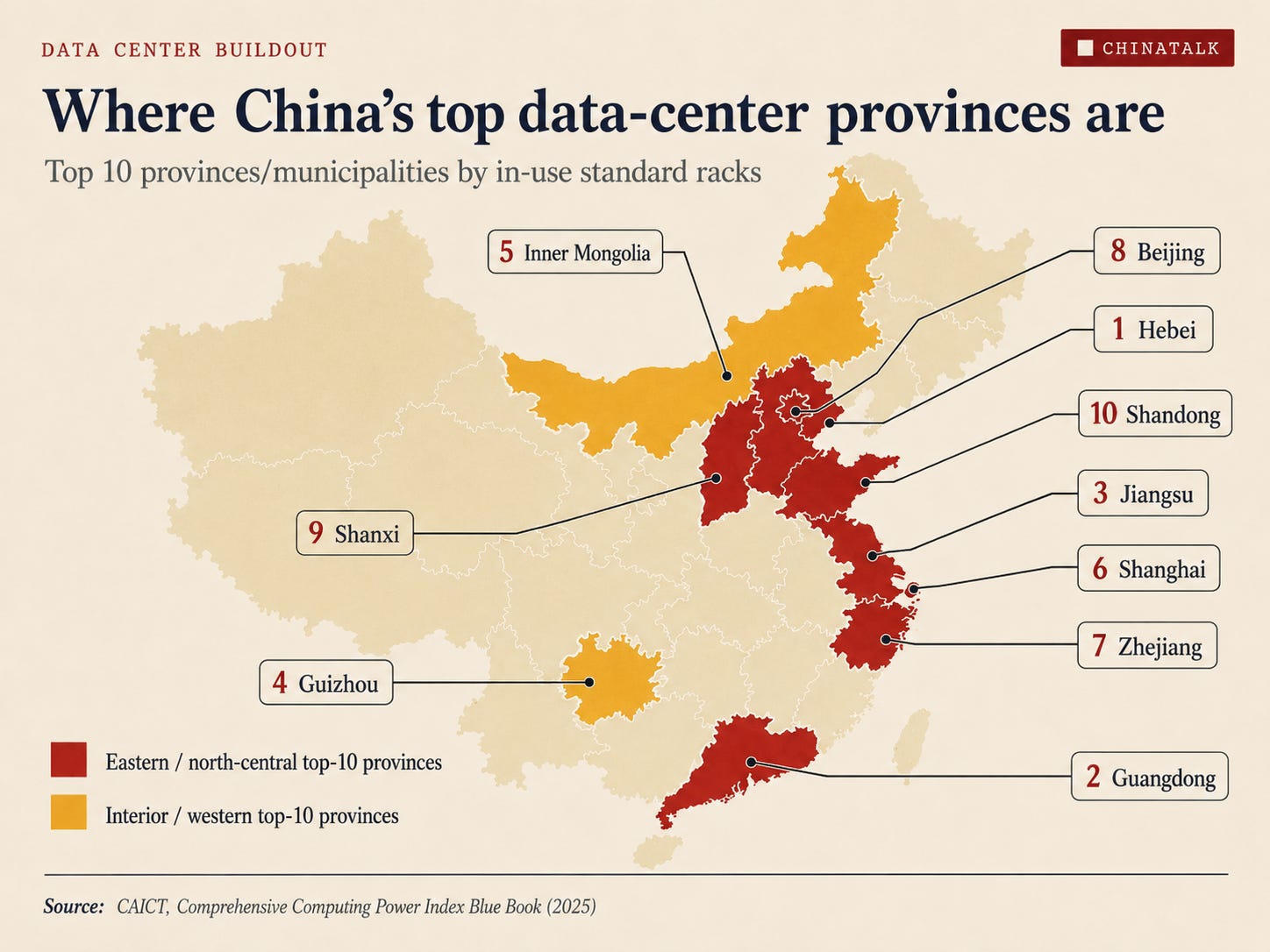
Where the racks actually sit. The west and north are the intended hinterland for training, while the east keeps the latency-sensitive inference. Chart: ChinaTalk, on CAICT Comprehensive Computing Power Index Blue Book (2025) data.
The 15th Five-Year Plan and the 2026 Government Work Report said the quiet part in official language: coordinate green electricity and computing, build hyper-scale intelligent clusters, and treat power supply for big data and AI as a planning object. Four agencies issued a 2030 action plan to raise clean-energy supply for AI infrastructure and to put AI back into the energy system. A professor at North China Electric Power University put the thesis in one sentence: only by combining domestic models with the country's power surplus, especially clean power, does the energy advantage become an AI advantage.
Token prices on Chinese APIs undercut American flagships by several times. Cheaper labour and distilled weights explain part of that. Cheaper electrons explain the rest.
Limits exist. Intermittent renewables still need firming. Coal remains in the mix. Western halls do not erase the need for eastern inference close to users. Water, land use and local political resistance show up even in a planning state. None of that cancels the comparison. A country that can stand up a 500-megawatt solar field and a computing campus as one project is playing a different game from a country that waits in a transformer queue.
Cheap tokens are a power-market result wearing a model-card costume.
Publicly traded companies in the stack
The list below is a map of listed exposure, not a portfolio. Many of the most important actors, Huawei, ByteDance, DeepSeek, Moonshot, AgiBot and Origin Quantum among them, are still private. Tickers and descriptions are current as of early September 2026 reporting and will move. This is not investment advice.
Company | Ticker | Lane |
|---|---|---|
Alibaba Group | NYSE: BABA / 9988.HK | Qwen models, cloud, Pingtouge silicon |
Tencent Holdings | 0700.HK | Hunyuan, WeChat distribution, Unitree stake |
Baidu | NASDAQ: BIDU / 9888.HK | Ernie, Apollo autonomous driving, Kunlunxin chips |
Zhipu AI (Knowledge Atlas) | 2513.HK | First Hong Kong large-model listing, January 2026 |
MiniMax Group | 00100.HK | Consumer plus API models, January 2026 listing |
SenseTime | 0020.HK | Vision, generative AI, smart-city heritage |
iFlytek | 002230.SZ | Speech, education, government AI |
Cambricon | 688256.SH | Cloud AI accelerators, first profit 2025 |
Hygon Information | 688041.SH | CPUs and DCUs, profitable at scale |
Moore Threads | STAR (2025 listing) | Domestic GPGPU dragon |
Muxi / MetaX | 688802.SH | GPGPU on a CUDA-like software path |
Biren Technology | HKEX (2026) | Training and inference GPGPU |
Horizon Robotics | 9660.HK | Journey ADAS chips, Volkswagen footprint |
SMIC | 0981.HK / 688981.SH | Domestic foundry constraint |
NAURA and AMEC peers | STAR tool names | Process tools behind substitution |
Unitree Robotics | 688836.SH | Humanoids and quadrupeds, August 2026 IPO |
UBTECH Robotics | 9880.HK | Walker industrial humanoids |
Dobot | 2432.HK | Collaborative robot arms |
Geek+ | 2590.HK | Warehouse AMRs |
Inovance | 300124.SZ | Servos, PLCs, robot components |
Estun Automation | 002747.SZ | Industrial robots |
Siasun | 300024.SZ | Industrial and service robots |
Midea Group | 000333.SZ | KUKA owner, factory automation |
Hikvision / Hikrobot | 002415.SZ | Vision plus warehouse robots |
XPeng | NYSE: XPEV / 9868.HK | EVs plus Iron humanoid research |
NIO / Li Auto | NYSE: NIO / NASDAQ: LI | EV plants as robot customers |
Pony.ai | NASDAQ: PONY | Robotaxis, listed autonomous stack |
WeRide | NASDAQ: WRD | Autonomous driving |
QuantumCTek | 688027.SH | QKD and quantum communications |
China Telecom | 728.HK / 601728.SH | QuantumCTek control, computing hubs |
China Mobile | 941.HK / 600941.SH | National computing-network operator |
State Grid and listed peers | Domestic utility complex | UHV and computing-power coordination |
XtalPi Holdings | 2228.HK | AI plus physics for drug discovery |
Swancor New Material | 688585.SH | AgiBot-linked A-share vehicle |
Conglomerates still dominate the investable universe. BABA, 0700 and BIDU give you models plus the cash to train them. 688256 and 9660 give you substitution silicon. 688836 and 9880 give you the robot body. 688027 gives you the quantum-communications incumbent. The utilities and telcos give you the quiet fact that someone has to own the hall and the line.
Private names will keep leaking onto this table: Moonshot, AgiBot, Galbot, Origin Quantum, TuringQ, QBoson. When they do, the state will usually already be on the register.
How the pieces lock
It is easy to write about models, robots, quantum and power as four essays. Beijing writes them as one.
A Qwen checkpoint is cheaper to serve if Cambricon or Ascend is on the rack and the rack sits on a Ningxia tariff. A Walker S2 is cheaper to train if the plant already generates the video and the vision-language-action backbone is an open Chinese weight. A Wukong job is easier to justify if China Telecom is both the shareholder and the first cloud customer. A 2 trillion yuan hub plan is financeable if State Grid can move the electrons and the telcos can operate the halls.
The listed table above looks diversified. The industrial logic is concentrated: state demand, western power, eastern applications, domestic silicon where the controls force it, imported silicon where they do not.
That lock is why physical AI is the phrase that should worry competitors more than another chatbot leaderboard. Software can be copied in a night. A reducer supply chain, a UHV corridor and a factory willing to take the first thousand defective units cannot. China is using the AI boom to accelerate a robotics and compute-infrastructure boom it already knew how to run. Quantum rides the same rails: patient capital, a telecom buyer, a listing path, a five-year-plan label.
The United States can still win the next closed model and the next error-corrected logical qubit. It is no longer obvious that it wins the decade in which those things have to live in a warehouse and pay an electricity bill.
What can still go wrong
Export controls can tighten again. SMIC yields can stall a generation. HBM can remain a bottleneck. Humanoids can ship by the tens of thousands and still fail to do a shift without a minder. Open-weight leadership on a coding arena is not the same as winning a closed training run on the next architecture.
STAR Market carnival tapes, Unitree's debut, Cambricon's trillion-yuan whispers and the GPU dragons' first days, create a shareholder base that will not enjoy a normal hardware cycle. Entity lists already follow Unitree and Cambricon. A change in Washington or a change in the Strait rewrites every table in this article.
The deeper risk is the one Beijing accepts: that a planning state can overbuild compute the way it once overbuilt apartments, and that 80 percent local kit becomes a tax on quality. Waste is visible in idle western halls and in robot pilots that exist for a provincial inspection.
The offset is also visible. Tokens are cheap. Robots exist in metal. The grid is growing faster than the queues in Virginia. Quantum has a customer named China Telecom. Physical AI has a customer named BYD. That is an industrial position, not a research paper.
Questions readers are asking
Is China ahead of the United States in AI in 2026? Not at the frontier of closed training, and not in advanced lithography. It leads on open-weight distribution, humanoid robot shipments, installed generating capacity and price per token. Those are different races, and only some of them are scored on a leaderboard.
Which Chinese AI companies are publicly traded? Alibaba, Tencent, Baidu, SenseTime and iFlytek are the established names. Zhipu AI (2513.HK) and MiniMax (00100.HK) listed in Hong Kong in January 2026 as pure-play model companies. Cambricon, Hygon, Moore Threads, Muxi and Biren carry the domestic accelerator trade. Unitree (688836.SH) and UBTECH (9880.HK) are the listed robot bodies.
Can China make its own AI chips yet? For inference, in volume, yes. Huawei's Ascend line and Cambricon's cards are on Beijing's approved procurement list, and the Ascend 950PR was pitched near one petaflop FP8. For leading-edge training clusters, no. SMIC yields on advanced nodes and HBM supply are the binding constraints, and neither is solved by policy alone.
Why does China's power grid matter to AI? Because inference and training are electricity with a software interface. China generated 10,573 terawatt-hours in 2025 against 4,536 in the United States, and it can site a solar field and a computing campus as one project. The catch is conversion: China turns a far smaller share of its generation into computation, so the advantage is currently headroom rather than a lead.
Is Chinese quantum computing ahead? In quantum communications and sensing, it has a commercial industry and a state buyer, with QuantumCTek listed since 2020. In gate-model fault tolerance, it faces the same unsolved engineering problem as IBM, Google and Quantinuum. The difference is that Chinese programmes do not need a near-term product to stay funded.
How do I get exposure without buying a Chinese listing? The boundary figure in this article is the honest answer. Nvidia, ASML, Synopsys, Arm, Apple, Microsoft, Meta and Oracle all appear on the far side of claims about Chinese AI. An investor holding those names is already positioned in this story, on both the enforcement side and the trade side.
The ambition, stated plainly
China's AI and quantum ambition is not to win a single benchmark in San Francisco. It is to make advanced computation a domestic utility: models you can download, chips you can buy without a licence, robots you can put on a line, keys you can send over a quantum link, and electricity cheap enough that none of those layers is rationed.
Government capital writes the first cheque. The power system writes the second. The factory writes the third, in the form of data that only exists if the machine falls over a thousand times on a real floor.
Whether that produces a model the rest of the world prefers is an open question. Whether it produces a stack the rest of the world has to take seriously is no longer one. Qwen is on the leaderboard. Unitree is on the STAR Market. QuantumCTek has been listed for six years. The UHV lines are in the ground. The next five-year plan has already named the industries.
The electrons are the part of the story that does not fit in a keynote, and they may be the part that lasts.
Stocks mentioned in this article: $BABA, $BIDU, $NVDA, $TSM, $ASML, $AAPL, $MSFT, $META, $ORCL, $ARM, $SNPS, $XPEV, $NIO, $LI, $PONY, $WRD and $TSLA.
The entity and claim counts in this article are drawn from the KXCO AI sector ontology and can be inspected at kxco.ai/ontology-live. More of the author's work is at shayneheffernan.com.
Shayne Heffernan, Ph.D., is the founder of Live Trading News, the KnightsBridge Group, Knightsbridge Law and the KXCO.ai ecosystem spanning post-quantum cryptography, identity, attestation and enterprise ontology.
Figures in this feature are drawn from company filings, state planning documents and reporting available as of 9 September 2026. Shipment counts, fund sizes and valuations disagree across sources and should be treated as order-of-magnitude. This article is not investment advice and is not an offer to buy or sell any security.
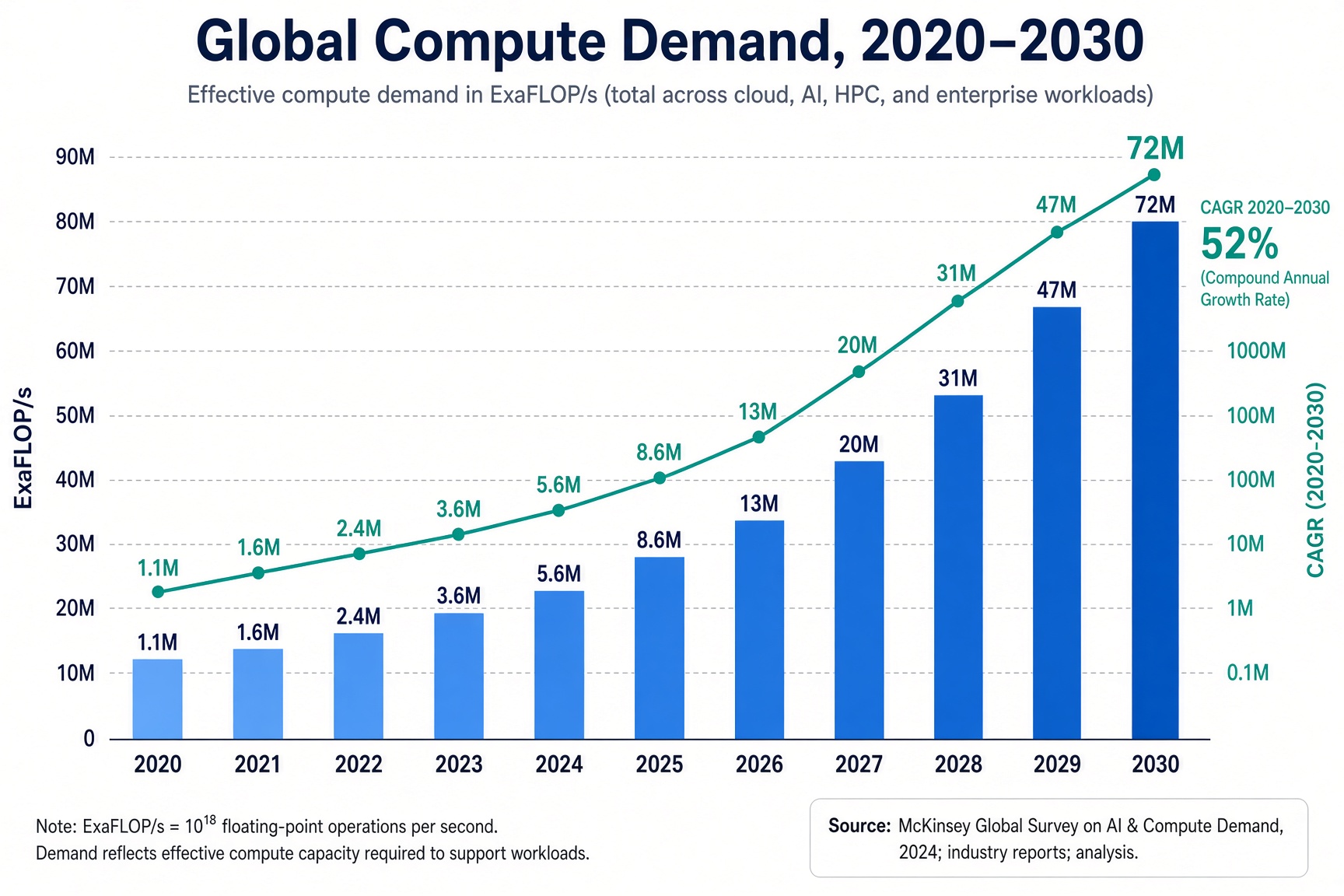
The 2030 Compute Landscape: GPUs, Power and the Architecture of Intelligence
The constraint on AI is no longer ideas or data but compute and the power to run it. Frontier training compute has grown about five times a year since 2020, and the leading AI supercomputer of June 2030 is on course for about 2 million chips and 9 gigawatts. Shayne Heffernan sets out the 2030 arithmetic, the power problem, who has already contracted the gigawatts, and how GPUs, custom ASICs, wafer-scale engines and quantum machines divide the work.
How Can You Trust AI When You Cannot Trust Humans?
Can you trust AI? Can you trust humans? More often than we like to admit, the answer is no. AI inherits its failures from the human records it is trained on. Sheikh Mohammed bin Rashid wrote this month that the currency the UAE is betting on is trust. This piece sets out what a trust layer has to do, shows the method on three public knowledge graphs, and lays out the post-quantum work KXCO has published so that an institution can check the claim rather than take it.
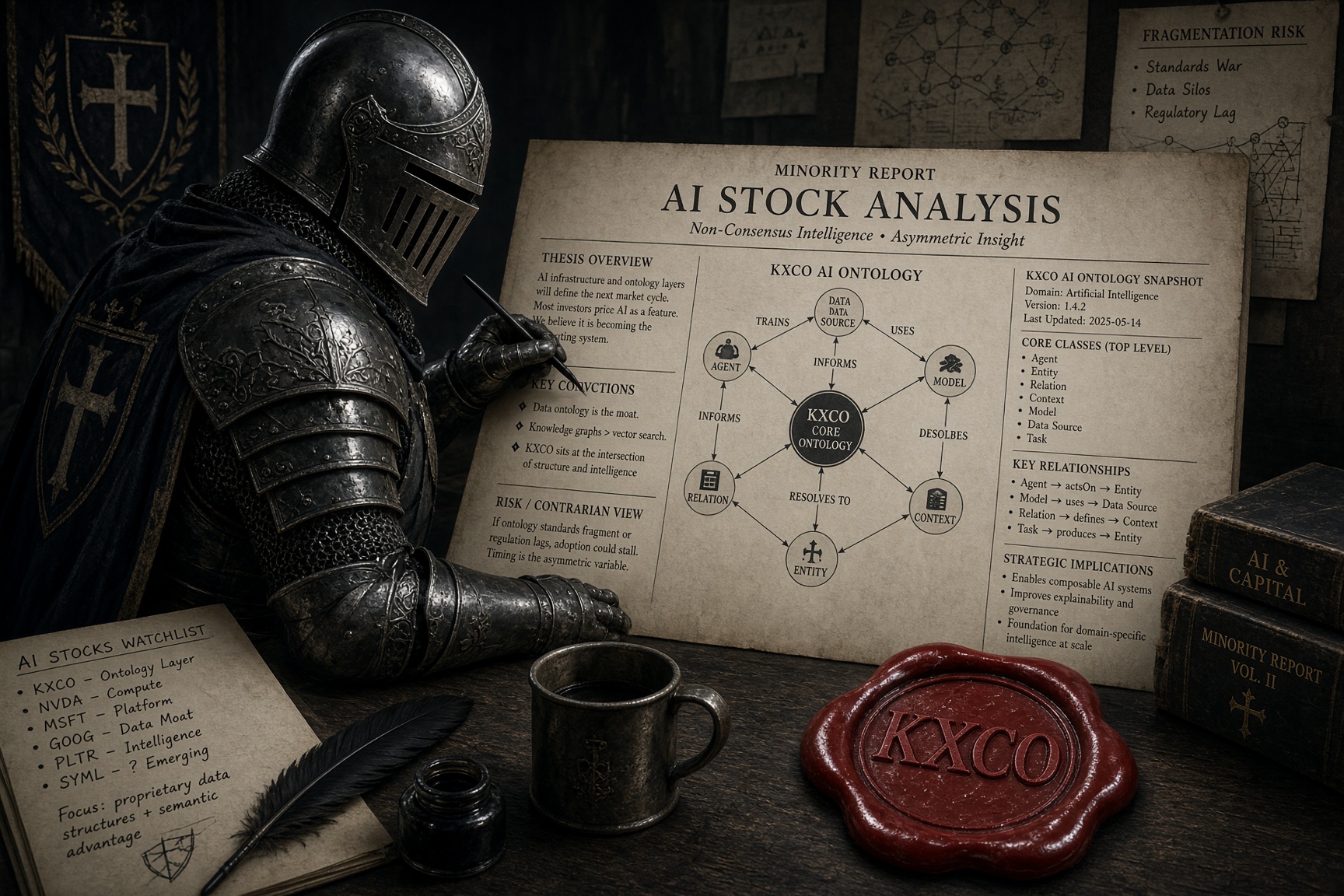
KXCO AI Ontology at 3 Months: What It Called and What Comes Next
On 19 July 2026 the Round Table's AI room published its first Analyst Outlook. To the 16 October 2026 close its 13 names rose 2.6% on an equal weight against 2.1% for QQQ, per StockAnalysis closes, and the six it opened with 35% or more of upside rose 8.6%. This piece lists the six names up more than 5%, the ten names I rate as opportunities now, the month's results in AI and quantum computing, and the official data showing that four in five firms have not yet started using AI.

SpaceX: The Road to 10 Gigawatts
SpaceX did not add an AI business. A company whose processes run on compute built its own computing plant, then built the power to run it. The 10-Q reports 1.4 gigawatts of nameplate compute at 30 June 2026, four leases worth about $41 billion a year and $100 billion of cash. The target is closer to 10 gigawatts than 5 by the end of 2027. This piece sets out the build sequence, the four layers of power in Memphis, and why Terafab is the act after 2027, not the road to it.
Every story, signed and delivered.
Subscribe to the kxco channel and get the headline, the AI-written key takeaways, and the chain-anchor link the moment we publish. Audio versions and per-ticker subscriptions arrive in the next iteration.