
Thoughts on Thinking in an AI World
Answers are cheap now. What stays scarce is memory that keeps its papers, the link between fields nobody owns, and a decision a named person can stand behind. That is the record KXCO builds, and it is where the value sits.
Part of theKXCO Center
Answers are cheap now. A model will write one about anything in seconds, and it reads just as well whether or not it is true. What an AI world makes scarce is everything around the answer: what you believed last month and why you changed your mind, the link between fields nobody reads together, and a decision a named person can stand behind and a stranger can check. That is what KXCO builds, and it is why KXCO is not an AI company.
In July, in Thoughts on Thinking, I drew a line between what drives your thinking and what amplifies it. The driver is the question that will not leave you alone. The amplifier is whatever makes your answer to it sharper: the rain, the cold room, the dark, the walk in the heat. The commonest mistake is building an amplifier with nothing to amplify, a beautiful microphone pointed at silence.
An AI world sells that mistake at scale.
The amplifier that answers back
A model is the most powerful amplifier ever sold, and the first one that talks. A microphone does not finish your sentence. A model does, fluently, and the fluency is the trap. It hands you the conclusion before you have done the work the conclusion was meant to prove, which is why I called it the neat handwriting of the illiterate.
Offloading looks identical to amplification from the outside. Same screen, same speed, same confident paragraph, same feeling of having done the work. The difference shows up later, when somebody asks why, and the reason is not in you. It is in a chat window that has since been closed.
The law has already named the failure. Article 14 of the EU AI Act requires that the people overseeing a high-risk AI system be enabled to "remain aware of the possible tendency of automatically relying or over-relying on the output", which the Regulation calls automation bias (Regulation (EU) 2024/1689, Article 14). A regulation cannot make anyone think. It can only require that the person is still there. The design question for every institution is what puts them there with more of their own mind, and not less.
Where the thinking is kept
The public argument about AI and thinking runs on one axis: will the machine replace the person or assist them. Both camps argue about the model. Neither asks where the thinking is kept, and that is the question that decides it.
A thought that lives in a conversation evaporates when the window closes. A thought that lives on a record, with its source, its date and the confidence you gave it, is still working for you next year, and anyone you hand it to can see how you got there. The model can be identical in both cases. The record is the difference, and the record is the product.
KXCO is Enhanced Intelligence, Not Artificial. Artificial means the machine does the thinking and hands you the answer. Enhanced means the person does the thinking, with more of their own mind in the room than they have ever had at once. The sections below show what that means in practice, each with a knowledge-graph exhibit drawn from the public AI sector record at kxco.ai/ontology-live.
On 2 October 2026 that record held 909 claims about 398 entities, per its published data file.
17 of those claims have stopped holding, per the same file, and all 17 are still in it, each with the date it stopped.
1. Memory that keeps its papers
Human memory keeps the latest version and loses the route. That is fine for a conversation and fatal for a decision, because the question an investment committee, an auditor, a regulator or a court asks is never only what is true now. It is what you knew, and when.
Take one claim from the record, shown in Exhibit 1.
26 August 2026: The Information reports that Nvidia has agreed to buy Hugging Face for $12.9 billion, and CNBC carries it the next day, per CNBC. Nothing is signed.
28 August: the Round Table records it as reported, at medium confidence, holding from 27 August.
2 September: Nvidia signs a definitive agreement at about $11.9 billion plus up to about $1.0 billion of retention equity, per its 8-K.
The record now holds the filing as current, at high confidence. It keeps the report beside it, closed on 2 September, and the new claim names the one it replaced.
The two parts in the 8-K total the $12.9 billion first reported. The report held. What changed is that it is now signed, and a signed fact and a reported one are different things to act on.
A mind that keeps only the latest version will tell you Nvidia is buying Hugging Face and never mention that for a week the price was a report. The record tells you both. It keeps two dates on a claim: when it held in the world, and when the record learned it. A later fact cannot rewrite an earlier one. That is rapid memory formation in the only sense worth having: what you read becomes yours, with the document, the date and the confidence attached.
It is also how learning compounds instead of evaporating. The same record carries Oracle's contracted backlog as a run of quarters, each kept with the period it described, so a trend is read off the record and not off somebody's recollection of it.
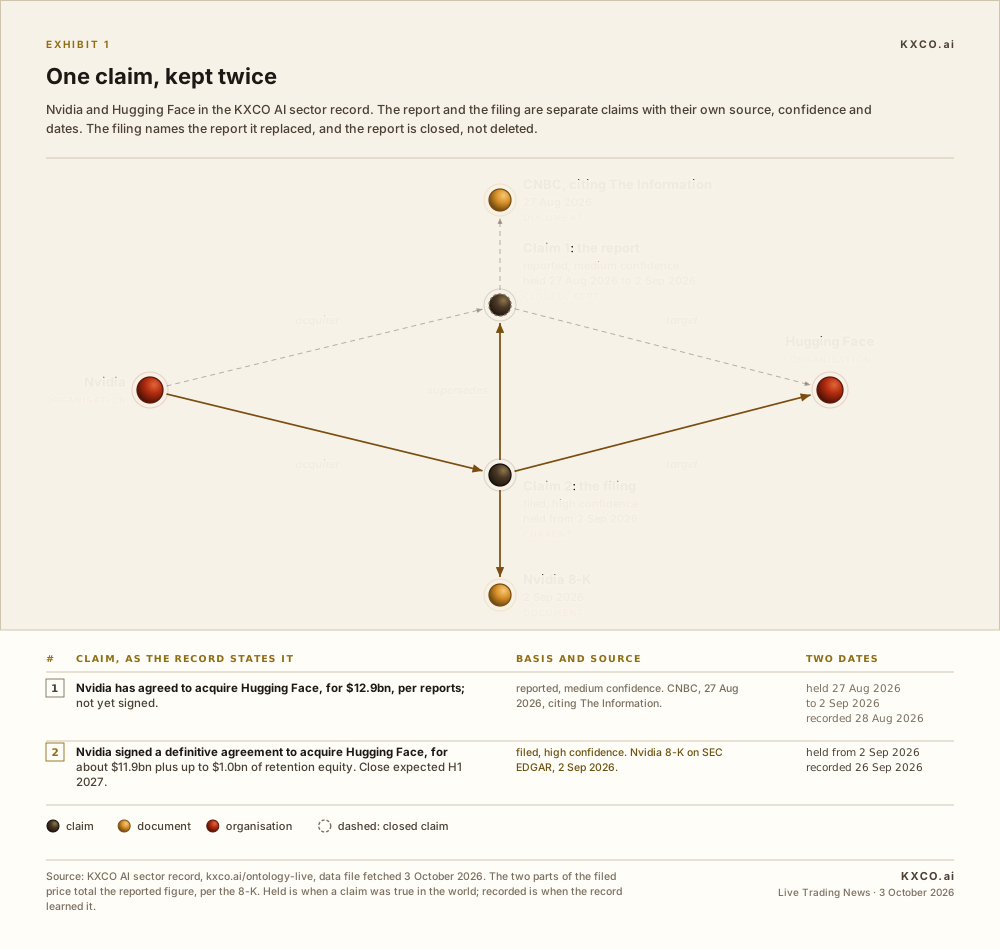
Exhibit 1. The report is closed, not deleted. Source: kxco.ai/ontology-live, data file fetched 3 October 2026.
Why we keep everything twice
Keeping the report beside the filing is not housekeeping. It is the reason the record exists.
We have all watched the ground move under what we read.
Search results get arranged by whoever owns the search. In September 2024 Europe's highest court upheld a €2.4 billion fine on Google for favouring its own shopping service in its search results, per the Court of Justice.
What counts as a fact gets changed after people have acted on it. In September 2025 the Bureau of Labor Statistics said payroll growth for the year to March 2025 had been overstated by 911,000 jobs, per the BLS. That was an honest revision, and markets had already traded on the old count.
Even the definition of a word gets fought over. In July 2022, as the US argued over whether it was in a recession, Wikipedia locked its page on "recession" after a series of revisions to the definition, per NPR.
Some of those changes are honest and some are not. A record that overwrites cannot tell you which, because it keeps only the latest version, and the latest version belongs to whoever pushed last.
That is what most history is. It is less an account of what happened than the product of the forces that worked on it over time: whoever ranked the results, revised the number, rewrote the definition and kept the copy.
What we are building is the opposite: history carved in stone. On the record a claim is never edited in place. It is superseded by a new claim with its own source and its own date, and the old one stays exactly where it was. In Round Table every entry is signed with the institution's ML-DSA-65 key and chained to the entry before it, and decisions are anchored on Armature L1, a public chain. Change an entry after the fact and its signature no longer matches, the chain breaks, and anyone checking can see where. The record can be added to. It cannot be quietly rewritten.
2. The link between fields
The links that pay sit between fields, where no specialist is looking. A credit covenant, a licence clause and a supply constraint are often one object in three vocabularies, and nobody holds all three at once. A graph does.
Here is one corner of the record, around a single chokepoint, shown in Exhibit 2.
The Iran conflict that opened on 28 February 2026 effectively closed the Strait of Hormuz, per Vyrian.
Qatar supplies an estimated one-third of the world's helium, much of it produced alongside LNG at Ras Laffan, per Gowling WLG, and it leaves through Hormuz.
Helium is a non-substitutable input in chipmaking, as carrier gas, purge gas and wafer coolant, per Vyrian, which names Taiwan, home of TSMC, as exposed and says South Korea, home of SK hynix, took nearly 65% of its helium from Qatar in 2025.
Gulf sulfur, which feeds the acid used to refine chip inputs, runs the same strait. The record holds that link at medium confidence, and the exhibit draws it dashed.
TSMC produces Nvidia's wafers, and Nvidia is fabless, using partners for every phase of manufacturing, per Nvidia's 10-K.
SK hynix supplies Nvidia's high-bandwidth memory, per KED Global, and Nvidia supplies the GPUs for Stargate, per Reuters.
A war, a shipping lane, two industrial inputs, a foundry, a memory maker and a data-centre programme. In most institutions that is 5 desks: geopolitics, shipping, chemicals, semiconductors and AI. Each desk holds its own link and none holds the chain.
I designated Hormuz and helium single points of failure on 25 August, and the record marks both as my analytical judgment, not a sourced fact. That is the right marking, and it is the point. The graph puts the vocabularies side by side. The judgment about what they mean stays mine, with my name on it.
This is also where machines struggle without a graph. The National Innovation Centre for Data at Newcastle University ran an AI agent over 510 complex questions. With vector search alone it answered 28.1% of them; with a lightweight graph added it answered 65.3%, per the paper, whose abstract reports that graph tools "can halve the number of hallucinated answers". One benchmark and one model, and a university team measuring the thing this record is built on.
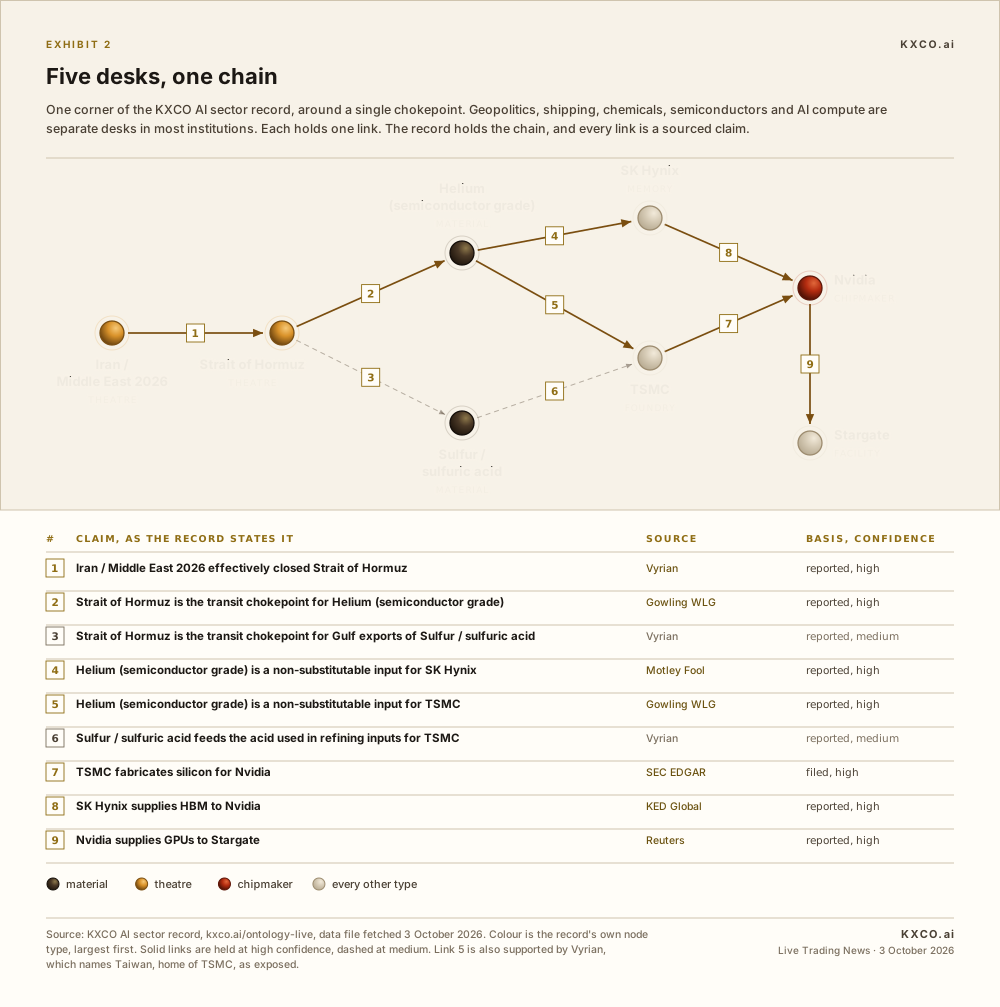
Exhibit 2. Solid links are held at high confidence, dashed at medium. Source: kxco.ai/ontology-live, data file fetched 3 October 2026.
3. A decision someone can stand behind
The third thing is the one a model cannot supply at any price. A model can draft, compare, check and propose. It cannot be the person who answers for the choice. Intelligence can be copied. Standing cannot.
Round Table, the KXCO ontology engine, makes a decision a fact on the record and ties it to the person who made it. Exhibit 3 shows the shape.
Every entry the service accepts is signed with the institution's ML-DSA-65 key, the post-quantum signature standardised by NIST in FIPS 204.
The person deciding is taken from their signed-in session, never typed in.
A decision can carry the decider's own passkey signature, made on their device after it has checked it is them, over a statement that names the action and its outcome. A signature given for Approved cannot be spent on Rejected.
A passkey signs nothing until a witness confirms its fingerprint, read out over a separate channel.
An approval can cite the order behind it, by the hash of the order's own entry, and the service refuses a citation of an order the record does not hold. A verbal order is not an order.
Decisions are anchored on Armature L1, KXCO's post-quantum settlement network, so their sequence can be checked against a public chain.
Who decided, on whose order, acting on what, and when. That is the question every inquiry asks, and the record answers it without anybody having to remember.
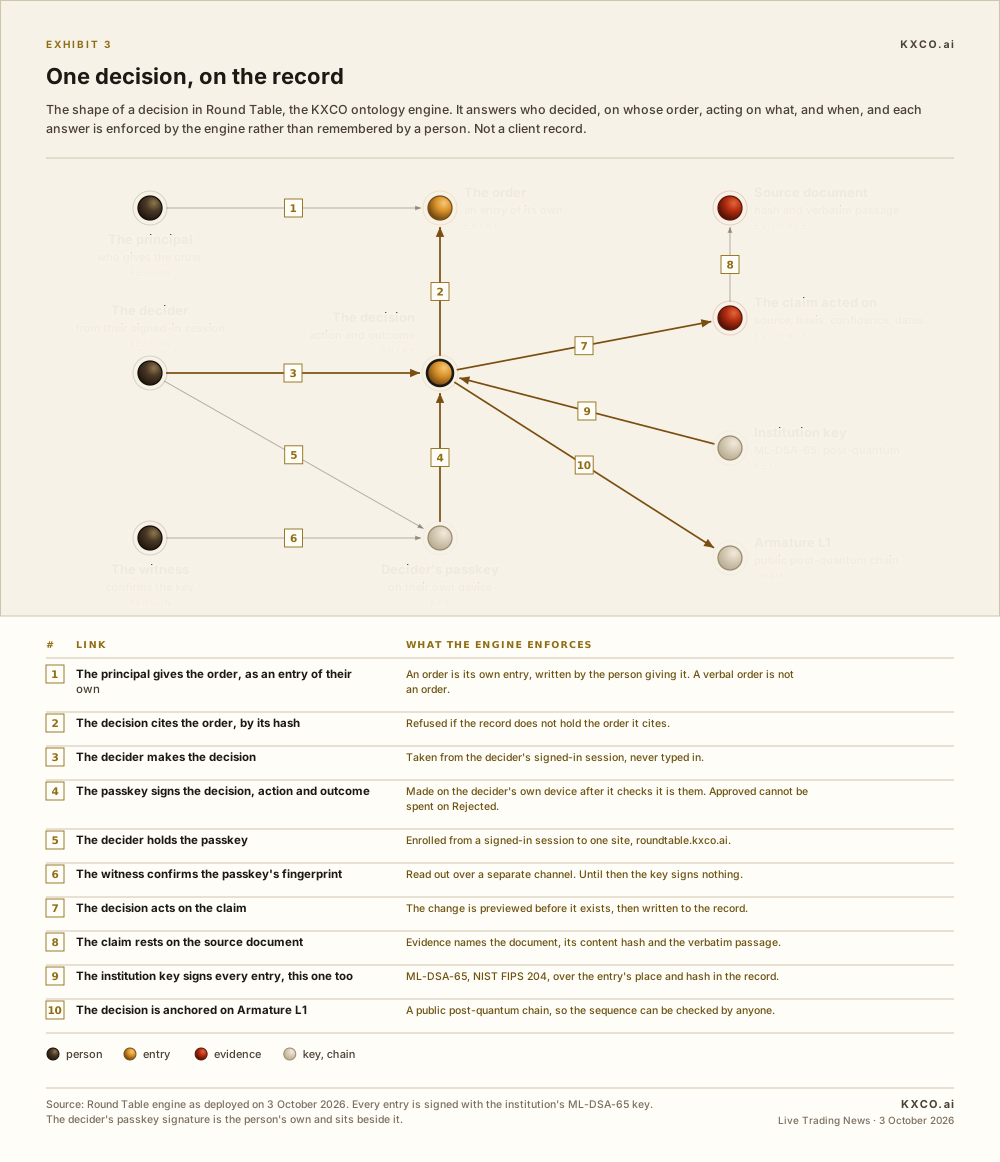
Exhibit 3. The shape of a decision in Round Table, not a client record. Fields as shipped in the engine on 3 October 2026.
What a signature proves
A signature proves who signed, what they signed and when. It does not make the underlying claim true, and nothing should pretend it does. That is still the reader's job. The record's contribution is to make it a job the reader can do: the source is one click away, the confidence was stated before anyone knew how things would turn out, the dates cannot be moved, and the person who acted on it is named.
That is the line between enhanced and artificial. An artificial system asks to be trusted. An enhanced one shows its working and leaves the judgment where it was.
Why the person stays in the loop
The deciding stays with the person because it is the part worth having, and I would want it that way with no regulator in the room. A firm's value to its clients, its regulator, its auditors and its counterparties is the people who can stand behind a decision. A model makes those people faster. Round Table makes their judgment last, and makes it provably theirs.
That is where the value sits. Every competitor can rent the same model on the same terms, so the model cannot be the edge. The record a firm's people think with can be: memory that keeps its papers, links its specialists cannot see alone, and decisions that carry the name of the person who made them and the order they were given. The model is a commodity. The record is the asset, and it stays the client's. What the engine finds in a client's books stays with the client.
Round Table is licensed to institutions and is not offered publicly. The conversation starts at kxco.ai/contact, and the architecture is published at kxco.ai/ontology.
The next entry Exhibit 1 is waiting for is the close of Nvidia's Hugging Face deal, expected in the first half of 2027 subject to regulatory approvals, per the 8-K. When it lands, the record will add it and keep everything that came before.
Stocks mentioned: $NVDA (NASDAQ) and $TSM (NYSE).
Shayne Heffernan, Ph.D., is the founder of Live Trading News, the KnightsBridge Group, Knightsbridge Law and the KXCO.ai ecosystem spanning post-quantum cryptography, identity, attestation and enterprise ontology.
AI Development: The Token Got Cheaper, the Building Did Not
The useful fact on 28 September is a split, not a benchmark. Gartner puts 2026 AI spending at $2.67 trillion, and 56 percent of it is infrastructure against about 1 percent on the models. Inside one week the frontier cut the price of a token in half, Nvidia signed for the shelf the open weights sit on, and three closed labs proposed to run the test. What shipped, what it costs and where the money goes, with the AI sector checked against KXCO Ontology Live.
The Week the Discount Rate Gets a Vote
The Fed hiked on 16 September and left the door open. This week the August PCE deflator on Wednesday, September payrolls on Friday, the RBA on Tuesday and euro-area CPI set the discount rate. Gold, Bitcoin, the dollar, the AI complex and the quantum pure plays share that rate and diverge everywhere else. This is the map of what depends on what, the three regimes the book should already have written down, and the stop that belongs to each node on KXCO Ontology Live.
The Round Table Scorecard: 87 Days of a Live Ontology
On 1 July 2026 KXCO put a Round Table ontology in public with 31 entities, 41 claims and no findings. It now holds 395 entities, 892 claims and 47 findings, with every correction kept rather than overwritten. This scorecard grades the record, how it corrects itself in the open, and the 9 of 13 names on its first outlook table that are higher since 17 July.
Wall Street Week Ahead: Rates, Oil, AI, Quantum, Defense, Metals and Bitcoin
The trading week opens after a Federal Reserve that chose to hike, a White House that chose not to strike Yemen, and an oil market still pricing a war now in its seventh month. The useful work this week is not a list of tickers. It is a map of what depends on what: the funds rate, the Magnificent Seven, a quantum cohort just handed a specification and a deadline, the missile primes selling into a restock, and gold, silver, crude and Bitcoin, all held against the live AI sector ontology.
Every story, signed and delivered.
Subscribe to the kxco channel and get the headline, the AI-written key takeaways, and the chain-anchor link the moment we publish. Audio versions and per-ticker subscriptions arrive in the next iteration.