
AI Is Still a Buy: The Noise Will Not Stop the Build-Out
Jensen Huang's resignation, the alarms around him and the push against data centres are noise. The backlog is signed, the build kept moving this week, and, in my view, if Washington blocks it, the build-out moves abroad.
Part of theStocks Center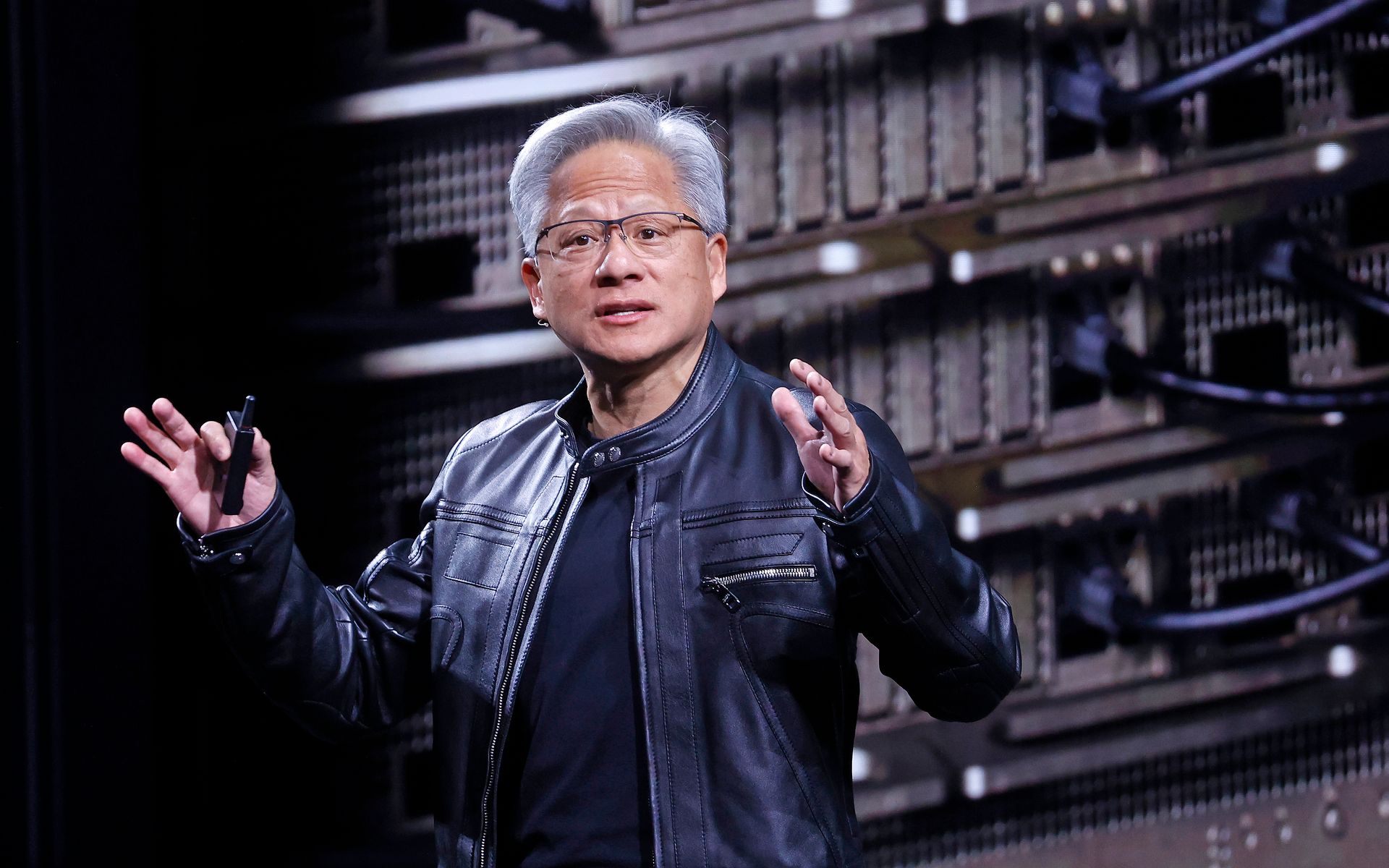
In my view AI is still a buy, and the push against AI, the push against data centres, the alarms over Jensen Huang, the reports of his affairs and his resignation as chief executive of NVIDIA are all noise. I do not expect any of it to hinder or slow the AI build-out. If an American government is ever foolish enough to try to hold back AI and data centres, I do not expect the build-out to stop. I expect it to move.
This note sets out the evidence for that view. Most of it comes from KXCO's AI ontology, the public record at kxco.ai/ontology-live, updated for this note with the news to 15 November and the analyst outlook at the 13 November close. The record reads the AI sector as typed relationships between companies, people, policies, sites and supplies, each one dated and carrying a confidence level, and nearly all sourced, so a reader can check the links drawn below.
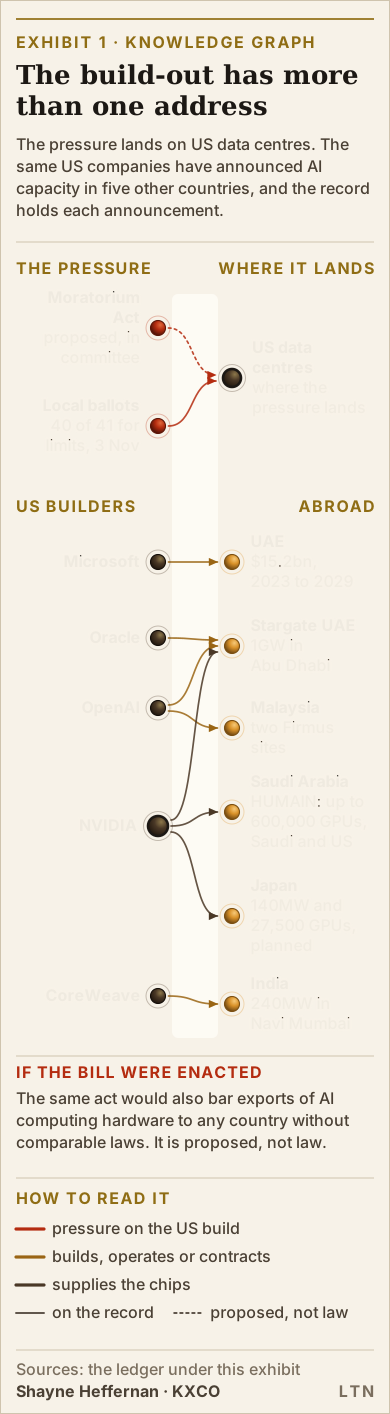
Sources for Exhibit 1:
The pressure: the moratorium bill and its committee referrals, and Ballotpedia on the 3 November ballots.
Abroad: Microsoft on the UAE; G42 and OpenAI on Stargate UAE and NVIDIA's GB300 supply to it; HUMAIN; NVIDIA on Japan; Firmus on Malaysia; CoreWeave on India.
NVIDIA lost its co-founder in a week of alarms
NVIDIA's board announced on 12 November that Jensen Huang had resigned as president, chief executive and director, effective immediately, in a filing with the SEC. Colette Kress, the chief financial officer, is interim chief executive, and Harvey C. Jones becomes the board's first chair. Huang went after reports that he had multiple extramarital relationships, including one with a suspected agent of China and another with an executive who reported to him, NBC News reported. On 5 November, the day of the midterm sell-off, the chairmen of three House committees had asked him for a joint, closed-door briefing on his dealings with a businesswoman they call a publicly reported Chinese intelligence asset, and on NVIDIA's security against foreign espionage.
The chairman of the House China committee said on 12 November that NVIDIA must now change its corporate practices and appoint leadership that makes national security its top priority (House Select Committee). Those are serious questions, and they belong to the board, the investigators and Congress. They are questions about one man. NVIDIA said in announcing the change that it expects its operations, customer commitments and product roadmap to continue without interruption (filing).
The share price told a different story. NVIDIA closed at a record $239.24 on 6 October 2026, when it was worth about $5.78 trillion (Yahoo Finance; The Motley Fool). It closed at $162.85 on Friday 13 November 2026, 31.9% lower. The worst single day of the fall came on 5 November, a 9.3% fall, when, as CNBC reported, top Democrats called for restrictions on data centres after the midterms and shares exposed to the build-out sold off.
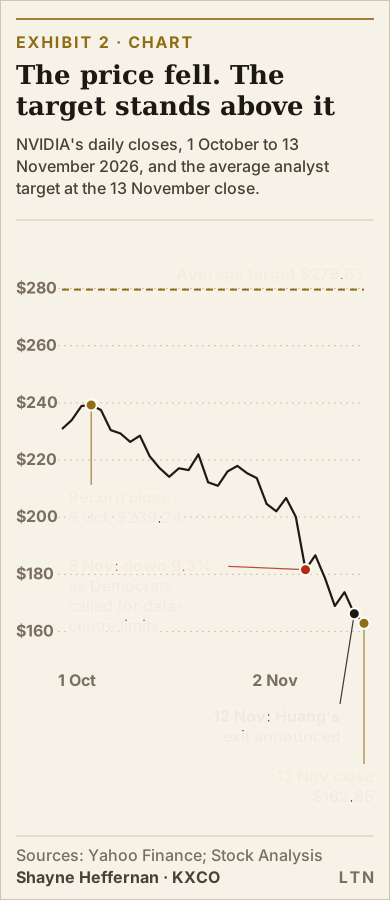
The analysts moved one notch, not out. At the 10 November 2026 close, 62 analysts polled by S&P Global rated NVIDIA a consensus Strong Buy with an average target of $325.25 (Stock Analysis). At the 13 November 2026 close, after the resignation, 61 rated it a Buy with an average target of $279.63, 71.71% above the price (Stock Analysis). NVIDIA was worth $3.93 trillion at the 13 November 2026 close, at 20.59 times trailing and 13.46 times forward earnings (Stock Analysis).
The push against data centres is real, and it works site by site
The federal proposal exists. The Artificial Intelligence Data Center Moratorium Act would stop the construction or upgrading of AI data centres until Congress legislates on federal approval of AI products, worker protections and data-centre conditions (H.R. 9442). H.R. 9442 and its Senate companion, S. 4214, were each referred to committee (bill text), and the President keeps his veto. In my view it will not become law.
The local pressure is a different matter. On 3 November voters favoured limits in 40 of the 41 local data-centre measures decided (Ballotpedia). Data Center Watch counted at least 45 projects worth $68 billion disrupted by local opposition in the second quarter alone (Data Center Watch). Goldman Sachs estimated that Democratic wins at state and local level are likely to bring short-term moratoria that could affect about 45% of planned US data-centre capacity expansion (Reuters, via The Spokesman-Review).
The push widened after the vote. Senator Josh Hawley called on 11 November for a federal data-centre moratorium, which the Washington Examiner reported as the first by a Republican senator. Maine's governor-elect, Hannah Pingree, said she supports a moratorium until protections are in place (WGME). Boise put into effect a moratorium on data-centre projects of 100,000 square feet or more or 20 megawatts (The Spokesman-Review), and Oakland extended its own to October 2027 (KALW). The push against AI itself reached the courts: on 12 November Public Citizen and three other nonprofits sued to freeze the development of the most advanced models at Anthropic, Google, Meta, OpenAI and SpaceXSI (Public Citizen).
The build-out kept moving through the same week. On 9 November the Senate voted 73 to 25 to begin debate on a permitting reform bill that President Trump has endorsed (CNBC). On 12 November Nebius raised its 2026 capital spending to about $27 billion, above its $20 billion to $25 billion range, and set $40 billion to $45 billion for 2027, though a number of colocation sites shifted into the first half of 2027 (Nebius). Riot Platforms' powered land lease to Anthropic at Corsicana, Texas, expected to provide 910 megawatts, took effect on 4 November, the day after the vote (Riot 10-Q).
The administration's answer was plain. National Economic Council Director Kevin Hassett said on 6 November that he expects the build-out to proceed along its projected path (Quartz). In my view he is right, and the reason is in the order books.
The money is already signed
A moratorium vote does not cancel a contract. Four of the largest cloud sellers carried about $2.48 trillion of contracted backlog at their latest reports, at 30 September 2026 and, for Oracle, 31 August 2026: Microsoft's commercial remaining performance obligation rose 73% to $677 billion (Microsoft), Oracle's rose $209 billion in a year to $664 billion (Oracle), Amazon's commitments not yet recognised, mainly AWS, reached about $578 billion (Amazon 10-Q), and Google Cloud's backlog $560.8 billion (Alphabet 10-Q).
The buyers are committed too. Meta held $454.52 billion of non-cancellable contractual commitments at 30 September (Meta 10-Q), and Microsoft had $364.6 billion of leases, mostly for data centres, signed and not yet started at 30 September (Microsoft 10-Q).
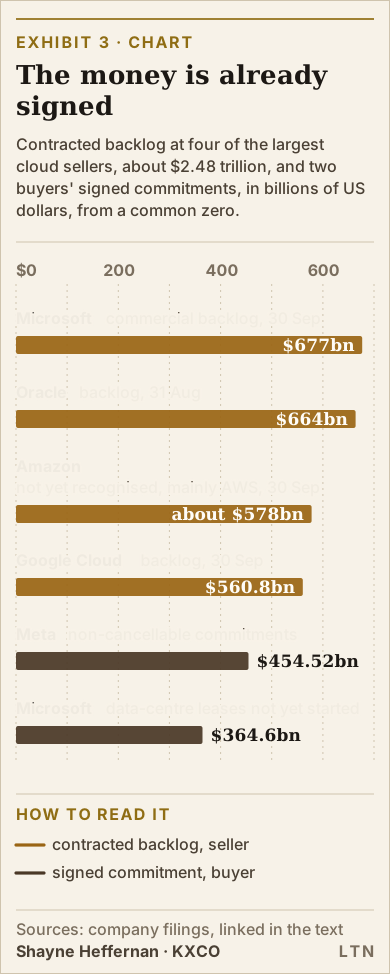
That is demand somebody has signed for. In my view a county pause changes where a hall is built and when, and does not change whether the computing capacity is bought.
If Washington says no, the build-out moves
The same companies have announced plans or commitments to build outside the United States, and KXCO's record holds each one (Exhibit 1). Microsoft said in November 2025 that it will invest $15.2 billion in the United Arab Emirates between 2023 and the end of 2029 (Microsoft). Stargate UAE, a 1-gigawatt cluster in Abu Dhabi, is to be built by G42 and operated by OpenAI and Oracle inside a 5-gigawatt UAE-US campus (G42); in May 2025 OpenAI expected 200 megawatts of it to go live in 2026 (OpenAI).
HUMAIN, the Saudi Public Investment Fund's AI company, announced in November 2025 plans to deploy up to 600,000 NVIDIA GPUs in Saudi Arabia and the United States over three years (HUMAIN). Japan's national AI infrastructure is to run on a 140-megawatt NVIDIA Vera Rubin factory of 27,500 Rubin GPUs, which NVIDIA and Noetra announced in July 2026 (NVIDIA). OpenAI has agreed to contract compute from two Firmus sites in Malaysia (Firmus), and CoreWeave plans 240 megawatts in Navi Mumbai (CoreWeave).
The UK wants more AI computing capacity, on its own conditions. On 11 November the UK's Chancellor, John Healey, told the Treasury Select Committee that the new data-centre covenant aims at 6 gigawatts by 2030 and that he is ready to say no to projects that do not bring community benefits. He said he launched it because he does not want to see the US data-centre debate rerun in the UK (Briefs, citing Bloomberg). The same day AWS opened its Chile region to select customers, with more than $4 billion of planned investment (Amazon), and on 13 November AirTrunk signed a memorandum of understanding with the government of Andhra Pradesh for two proposed campuses totalling 1,800 megawatts (Power Peak Digest).
In my view, capital, chips and engineers move, while power and permits are local. A country that refuses the build-out does not stop it. It hands it to the Gulf, to Japan, to India and to Southeast Asia, and in time to China.
Washington can also try to close the exits. The moratorium bill would bar exports of AI computing hardware to any country without comparable laws (H.R. 9442). Commerce is reported to be preparing a rule extending chip export controls to seven more countries, including Malaysia, Singapore and Thailand (The Information, via Yahoo Finance), and Senate Majority Leader John Thune put a "high probability" on more restrictions on chip exports to China (Semafor). In my view, limits on where American chips can go would not stop AI. They would stop American AI, and they are the provisions to watch.
Why AI is still a buy
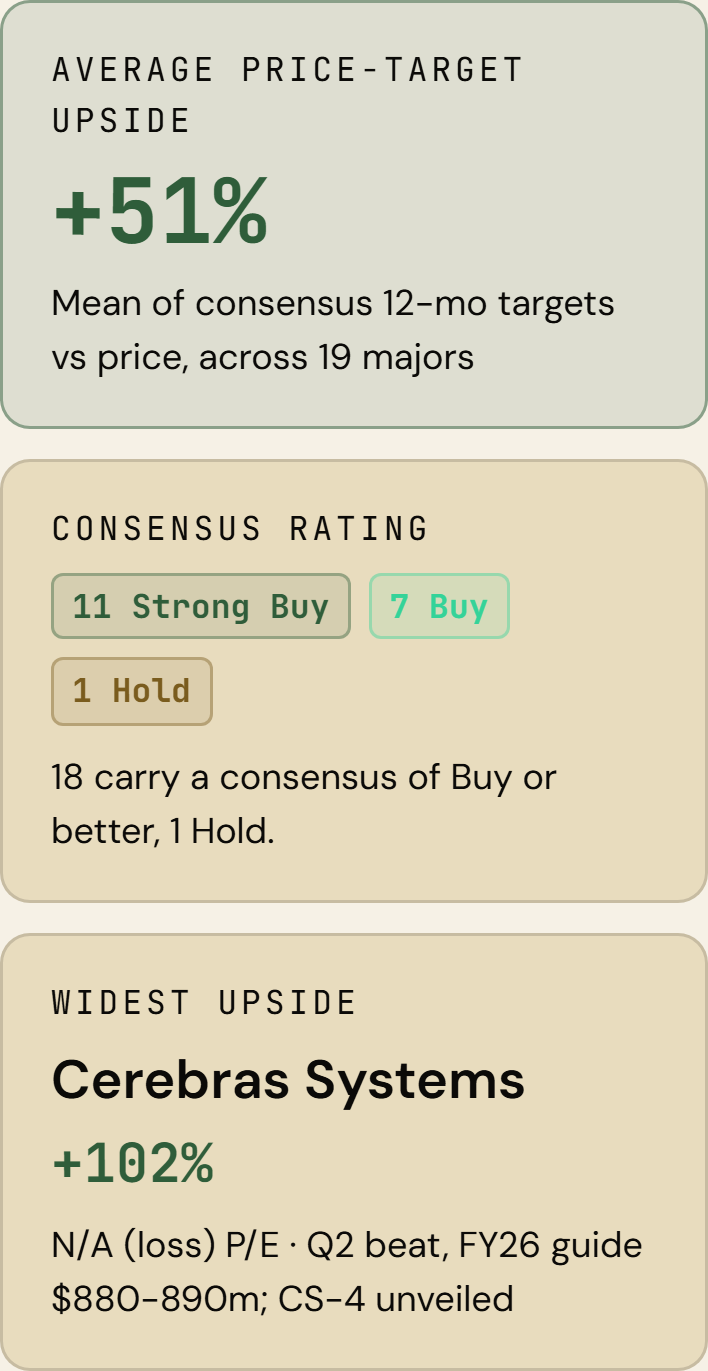
The consensus agrees on direction. At the 13 November 2026 close, the analyst outlook in KXCO's AI record shows an average 12-month upside of 51% across 19 companies, with 11 rated Strong Buy, 7 Buy and 1 Hold (kxco.ai/ontology-live).
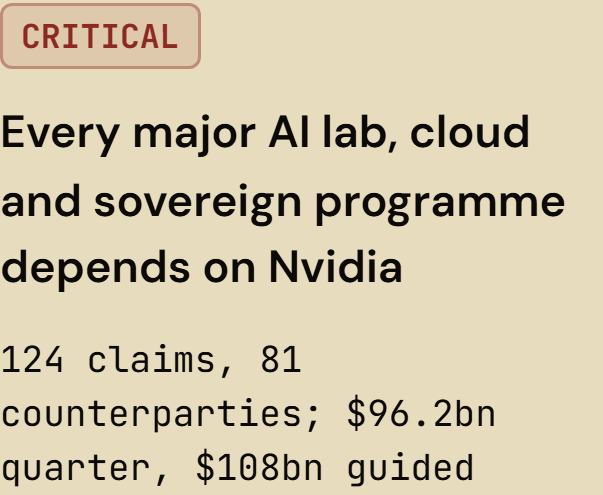
NVIDIA sits at the centre of the record. Every major AI lab, cloud and sovereign programme depends on it, across 124 claims and 81 counterparties, up from 116 and 77 on 8 November (kxco.ai/ontology-live). The record rates that dependency critical, and its finding notes that the concentration it flags as a risk is the same concentration NVIDIA's income statement reports as revenue (the record). At 13.46 times forward earnings (Stock Analysis), I think NVIDIA is still undervalued. The price has fallen, in my view, on the politics and on the uncertainty around Huang's exit, and one executive's departure does not change the supply contracts or the backlog above.
What the ontology shows that a price screen does not
A price screen shows what moved. An ontology shows what is connected, and what changed. KXCO's public AI record holds 493 entities and 1,181 claims (kxco.ai/ontology-live): companies, people, policies, sites and supplies, joined by typed relations such as supplies, invests in, operates and limits. Every claim carries a date and a confidence level, and the record marks what it cannot source: of the 1,214 claims in the full record, which includes 33 superseded ones, 1,160 cite a source, 49 are worked out from other claims, some of which also cite one, and 10 are unsourced (the record).
The resignation shows how it works. When the 8-K arrived, the record did not overwrite its claim that Huang was NVIDIA's founder and chief executive. It closed that claim at 11 November 2026 and added the filed resignation as the claim that supersedes it, so a reader can see what was true, when, and on what evidence (the record). Each claim added in this update was quoted from a page saved when it was read, accepted by a database check against the model's rules, and read by a reviewer who wrote none of it.
The ontology of markets is my own discipline, and the AI room is where I show it working on public data. The engine behind it is not public. The judgement stays with the person who signs.
What to watch
NVIDIA reports its third-quarter results on Tuesday 17 November, its first without Huang (NVIDIA). Data-centre revenue and guidance will show whether any of the noise reached the order book. I expect it did not.
Stocks mentioned: $NVDA (NASDAQ), $MSFT (NASDAQ), $ORCL (NYSE), $AMZN (NASDAQ), $GOOGL (NASDAQ) and $META (NASDAQ).
Shayne Heffernan, Ph.D., is the founder of the KnightsBridge Group (shayneheffernan.com).
Jensen Huang, Nvidia and the Morality Game America Plays With Itself
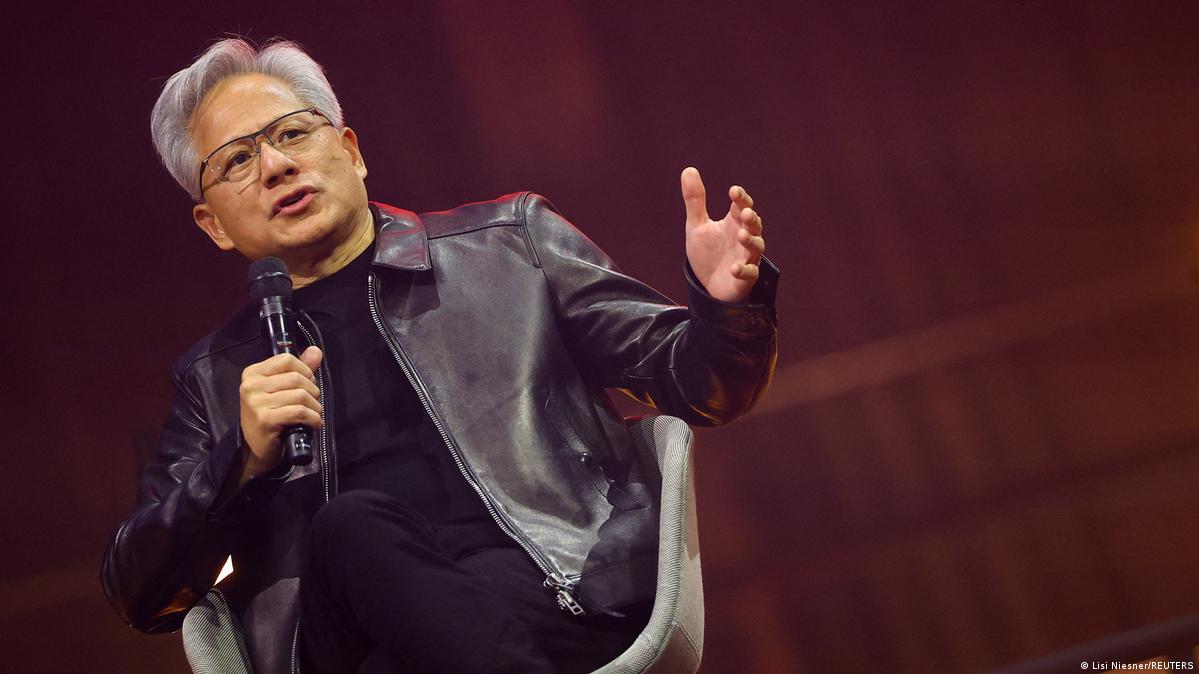
Jensen Huang resigned as Nvidia's chief executive on 12 November 2026 after reports of three relationships. Whether a foreign service reached him, and whether ties to staff broke Nvidia's own conflict rules, are questions for investigators and the board. His marriage is not. A third of Americans say they have cheated on a partner or spouse, and US fans spent an estimated $4.9 billion on OnlyFans in a year. The outrage is selective, and it is never aimed at the audience.

The Nvidia Honeypot: Alice Huang and the China-Linked Network Around Megaspeed
Jensen Huang has admitted an affair with Alice Huang, a former Megaspeed executive whom US intelligence reportedly believes China recruited. Nvidia can still sell a great deal to China legally. The question is whether this relationship got its chips around the export rules. There is no public finding that it did, and Nvidia says its checks found Megaspeed owned outside China. The network around her runs to 7Road, Alibaba's money and a state-controlled bank.

In Defence of Jensen Huang
Jensen Huang told Nvidia's staff on 8 November that he was unfaithful to his wife, and took full responsibility. The claim that the woman is a Chinese intelligence asset comes from press reports, led by the New York Times, citing US intelligence officials. China calls it groundless, and Nvidia's board says it has no reason to believe national security or company secrets were compromised. Huang built the first $5 trillion company. He should stay.

The Week Ahead on Wall Street, 9 November 2026: AI Is Still a Buy
We still think AI is a buy. After the midterms the semiconductor index fell 11.4% while the S&P 500 lost 2.5%, in our view an overreaction that fell on the chip names. October payrolls rose 165,000, oil stays high with the Iran war unresolved, Alibaba and Tencent gained, NVIDIA trades at 15.4 times forward earnings, and both SpaceX and Tesla have special committees studying a combination. KXCO's AI ontology shows the relationships behind the NVIDIA, China and SpaceX calls.
Every story, signed and delivered.
Subscribe to the kxco channel and get the headline, the AI-written key takeaways, and the chain-anchor link the moment we publish. Audio versions and per-ticker subscriptions arrive in the next iteration.