
The Week Ahead on Wall Street, 9 November 2026: AI Is Still a Buy
The midterm sell-off fell on the chip names. Jobs are strong, oil stays high, China's AI names gained, and SpaceX and Tesla are moving towards one company.
Part of theStocks Center
We still think AI is a buy. My other calls for the week follow. The market's reaction to the Democrats' midterm gains was an overreaction, and it fell on the wrong stocks. The employment numbers are good. The AI business will keep growing, and it will give birth to a great many new businesses, which is what America needs. Oil will stay volatile and on the high side, and we expect more action in Iran. NVIDIA is still undervalued, and so is SpaceX. Within 12 to 24 months, I expect Elon Musk to combine SpaceX and Tesla into one company.
This note sets out the week ahead on Wall Street and the evidence behind each of those calls. Much of that evidence comes from KXCO's AI ontology, the public record at kxco.ai/ontology-live, updated for this note to the 6 November close. The Round Table, KXCO's analysis engine, reads markets as a set of typed relationships between companies, people, policies and supplies, each one sourced and dated. The exhibits below are drawn from that record, so a reader can check every link.
What the midterms changed, and what they did not
Democrats won both chambers on 3 November. As of the morning of 8 November, Associated Press calls gave them 254 House seats to the Republicans' 162, with 19 races uncalled, and Fox News's calls gave them 54 Senate seats to 44, with Alaska and Mississippi still open (NPR, via OPB; Fox News results).
The market's first answer was to buy. The S&P 500 rose 1.6 per cent on 4 November. On 5 November it fell 4.4 per cent, its worst day since April 2025, and the Nasdaq Composite fell 5.5 per cent. The selling was concentrated: the PHLX Semiconductor index fell 12.25 per cent that day and NVIDIA 9.26 per cent (AP, via La Nación; Yahoo Finance, semiconductors; Yahoo Finance, Nvidia). Over the three sessions to Friday, the semiconductor index ended 11.4 per cent lower while the S&P 500 lost 2.5 per cent.
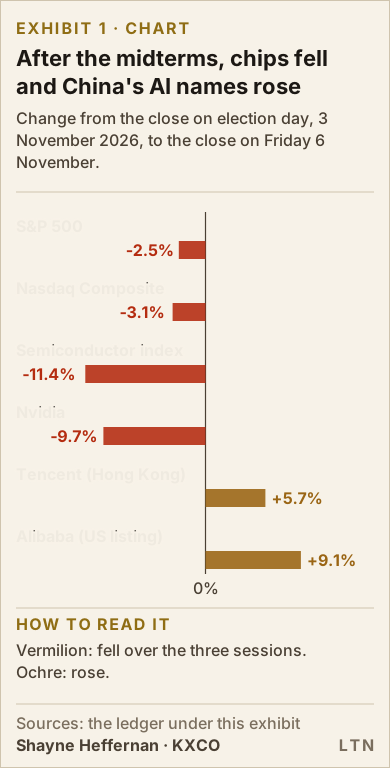
Sources for Exhibit 1: S&P 500 and Nasdaq closes from AP (3 November, 6 November); semiconductor index and Nvidia closes from Yahoo Finance (index, Nvidia); Alibaba and Tencent changes from Yahoo Finance closes (Alibaba, Tencent).
That, in my view, is the overreaction. The broad market held most of its level. The AI hardware names took the loss, on worries, AP reported, about data-centre moratoriums after the Democratic victories, in Congress and in the states (AP, via La Nación).
The proposal behind that view exists. The Artificial Intelligence Data Center Moratorium Act was introduced by Senator Bernie Sanders on 25 March 2026 and by Representative Alexandria Ocasio-Cortez on 24 June. It would stop the construction or upgrading of AI data centres until Congress legislates on federal approval of AI products, worker protections and site conditions. Neither bill has moved past committee. At state level, New York enacted a pause in July, and the governors-elect of Texas and Georgia campaigned for moratoriums (the bill text; Bloomberg, via the News Tribune).
My view is that it will not become law in the next two years. The new Congress sits from January 2027, and the President keeps his veto. Overriding a veto takes two-thirds of each chamber, which is 290 House votes and 67 Senate votes with every seat voting. On the counts above, Democrats hold 254 and 54 (NPR, via OPB; Fox News results). The noise is political. If a lockdown did happen, China would take the lead in AI and America would fall behind, and I believe that is why it will not happen.
Local votes are a different matter, and they deserve a price. On 3 November, voters favoured limits in 40 of the 41 local data-centre measures decided (Ballotpedia), and Goldman Sachs estimated that Democratic wins at state and local level are likely to bring short-term moratoriums that could affect about 45 per cent of planned US data-centre capacity expansion (Reuters, via The Spokesman-Review). That constraint works site by site, and it sets the pace of the build-out. The administration expects the build-out to hold its course: National Economic Council Director Kevin Hassett said on 6 November that he expects it to proceed along its projected path (Quartz).
The same bill carries a second provision, which I think markets have not priced. Section 4 would direct the Commerce Department to bar exports of AI computing hardware to countries without comparable AI laws (H.R. 9442).
Jobs are good; inflation is the risk to watch
The October payroll report beat by a wide margin. Employers added 165,000 jobs. The consensus was 65,000 on the TradingView calendar feed, or 59,000 in the Dow Jones survey. Unemployment fell to 4.1 per cent from 4.2 per cent, and average hourly earnings rose 0.4 per cent on the month to $38.00. August and September were revised up by a combined 84,000 (BLS data; CNBC). Initial jobless claims were 189,000 in the week to 31 October, against 228,000 a year earlier, both seasonally adjusted (Department of Labor).
Strength has a price. The Federal Reserve held its target range at 3.75 to 4 per cent on 28 October, with two members, Governor Lisa Cook and Cleveland Fed President Beth Hammack, dissenting in favour of a rise, and its statement said inflation remains high. After the jobs report, CME's FedWatch tool, which reads the probability from interest-rate futures, put the probability of a quarter-point rise at the 8 to 9 December meeting at 76.8 per cent (Federal Reserve; CNBC). In my view a December rise is the main risk to the buy case this quarter, and this week's inflation prints are the next test of it.
The calendar
The economic calendar on the Live Trading News trading page lists the high-importance US releases. With the official agency calendars, the week runs as follows (LTN trading page; agency calendars):
Monday 9 November: wholesale trade for September; a $58 billion 3-year note auction.
Tuesday 10 November: the October consumer price index (CPI) at 08:30 ET. The forecast is 0.3 per cent on the month against 0.6 per cent prior, and 3.9 per cent on the year against 3.7 per cent. Core is forecast at 0.2 per cent on the month and 2.8 per cent on the year. A $42 billion 10-year note auction follows. The US Energy Information Administration (EIA) publishes its Short-Term Energy Outlook the same day (EIA).
Wednesday 11 November, Veterans Day: the bond market is closed on the recommendation of SIFMA, the securities industry's trade body; the NYSE trades. The Fed's statistical releases and the EIA's weekly petroleum report move to Thursday.
Thursday 12 November: initial jobless claims at 08:30 ET (forecast 195,000); existing home sales at 10:00 ET (forecast 3.85 million against 3.99 million); a $25 billion 30-year bond auction.
Friday 13 November: the producer price index for October.
Fed speakers include Governor Michael Barr on Thursday, on artificial intelligence and inequality, and Vice Chair Philip Jefferson on Friday, on productivity and new technology (Federal Reserve calendar). Beyond the week, NVIDIA reports on Tuesday 17 November (NVIDIA), and Tencent's board meets on 18 November and Alibaba reports on 19 November (Tencent notice; Alibaba notice).
AI is still a buy
NVIDIA closed at $186.64 on 6 November, for a market value of $4.51 trillion. It trades at 23.6 times trailing earnings and 15.4 times forward earnings. In its last reported quarter, revenue was $96.2 billion, up 106 per cent, and data-centre revenue $89.0 billion, up 117 per cent (Stock Analysis; NVIDIA). In my view a company growing at that rate on 15 times forward earnings is undervalued.
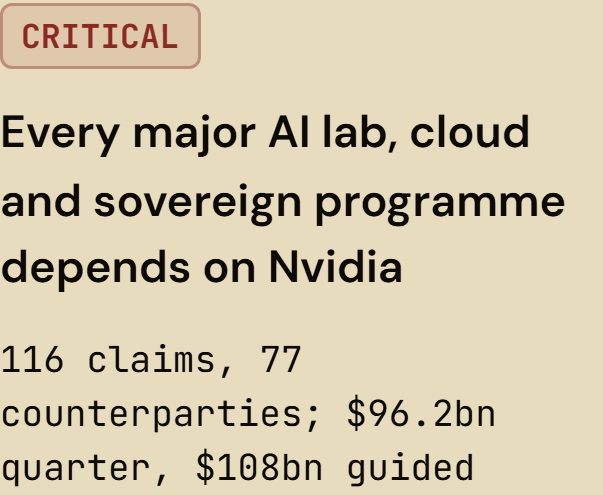
The record shows what the growth rests on. NVIDIA carries 116 claims across 77 counterparties in the AI ontology, and the record's key finding is that every major AI lab, cloud and sovereign programme depends on it (kxco.ai/ontology-live). A fall in the share price changes none of those supply relationships.
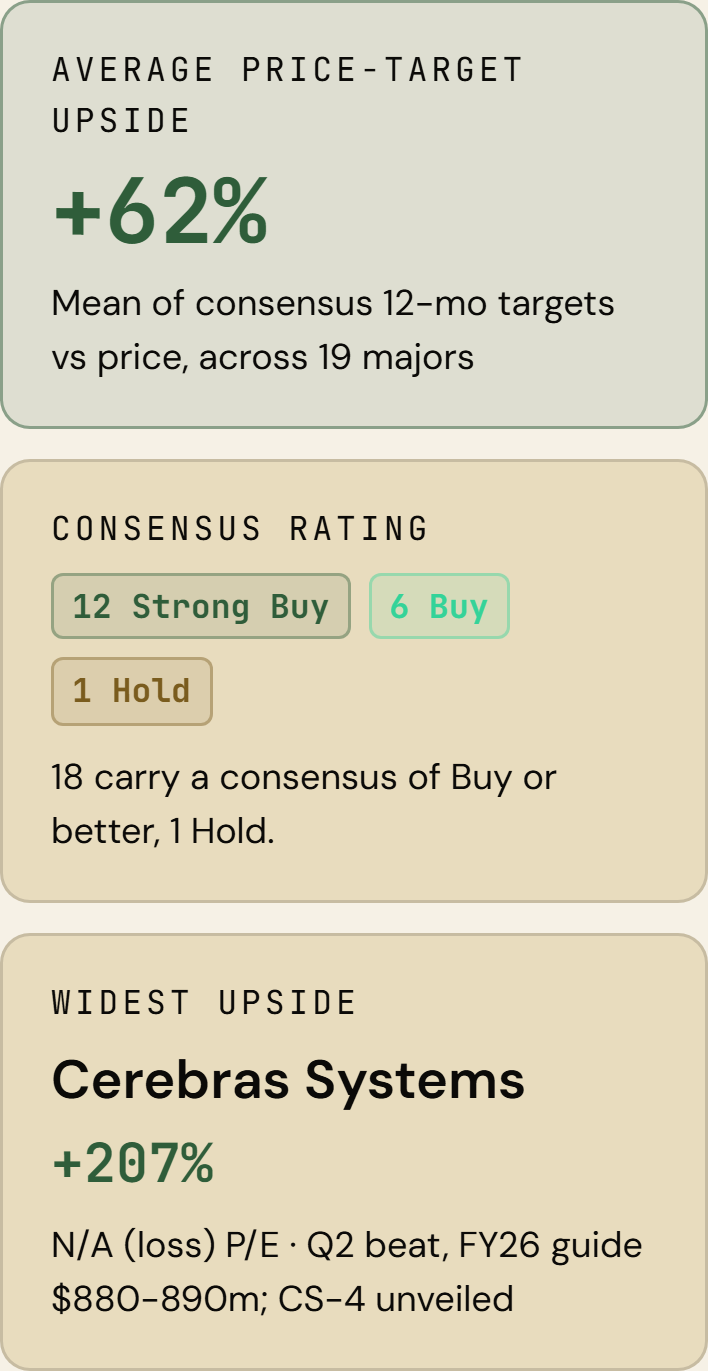
The consensus agrees on direction. At the 6 November close, the analyst outlook in the record shows an average 12-month upside of 62 per cent across its 19 companies, with NVIDIA at 75 per cent (kxco.ai/ontology-live).
The September quarter showed the spending turning into revenue at the suppliers. AMD's data-centre segment reported a record $8.5 billion, up 97 per cent (AMD 8-K). Arm has taken purchase orders from several customers through 2027 for its own data-centre chip, with first deliveries due in the quarter to March 2027, and expects up to $2 billion of revenue from it over this fiscal year and next (Arm).
The growth also creates companies, and the companies it creates are large. Anthropic's amended prospectus commits it to spend at least $44.9 billion with Microsoft and about $121.3 billion with Google regardless of usage (Anthropic S-1/A), and about $41.3 billion with Lambda, payable as capacity is delivered (Anthropic S-1/A). The record also holds Cursor, the coding company SpaceX bought in August for an implied $60 billion (SpaceX filing). Each of those contracts pays for buildings, power, chips and people. America needs exactly this kind of company formation, and the build-out is still early.
China's AI names were the winners from the noise
Money moved east after the vote. Alibaba's US listing rose 9.1 per cent from the 3 November close to Friday, and Tencent 5.7 per cent in Hong Kong (Yahoo Finance, Alibaba; Yahoo Finance, Tencent). On 5 November the Hang Seng rose 3.7 per cent and the Hang Seng Tech index 5.6 per cent, and Bloomberg Intelligence described money moving away from tech hardware and pure AI plays and into China (TheStreet, citing Bloomberg).
The record shows why I think the move has substance. China's AI builders no longer depend on one supply chain, and the claims behind Exhibit 2 were in the record by September, well before the vote (kxco.ai/ontology-live).
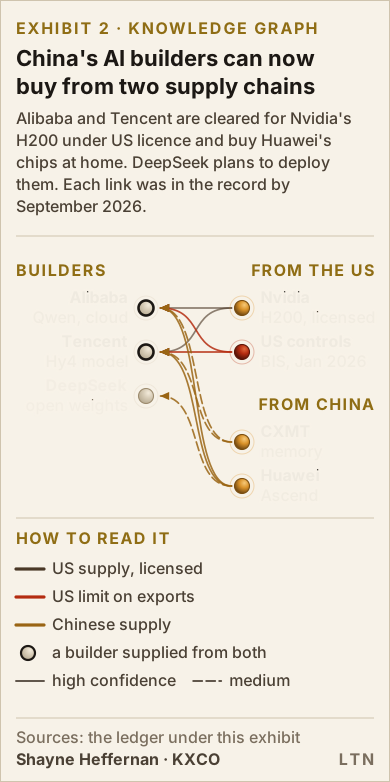
How to read Exhibit 2:
From the US: Alibaba and Tencent are cleared to buy NVIDIA's H200 under the Bureau of Industry and Security rule of 15 January 2026, which moved such chips to case-by-case review with a cap tied to US shipments (Federal Register; kxco.ai/ontology-live). Reuters reported on 5 November that about 600,000 H200 chips were waiting in Hong Kong for Chinese import approval (Reuters, via The FINANCIAL).
From China: Huawei supplies Ascend chips to Alibaba, Tencent orders the Ascend 950PR, DeepSeek plans to deploy at least 160,000 Ascend accelerators for inference, and CXMT, a Chinese memory maker, supplies memory to Alibaba and Tencent (kxco.ai/ontology-live).
Solid lines are claims the record holds at high confidence; dashed lines at medium.
The investment is real. Alibaba's cloud revenue grew 45 per cent in the June quarter and its capital spending 75 per cent. Tencent's capital spending rose 176 per cent in its second quarter, and it released its Hy4 model on 4 November (Alibaba results; Tencent results; Tencent Hy4). In my view a US data-centre freeze would hand these companies the lead. Bloomberg reported investors reading the vote as a risk to the US AI hardware trade (TheStreet, citing Bloomberg).
SpaceX and Tesla are moving towards one company
SpaceX is a listed company. It priced its offering at $135 on 11 June 2026 and closed at $134.27 on 6 November, for a market value of $1.82 trillion. Third-quarter revenue was $14.6 billion, up 161 per cent, with net income of $4.4 billion (SpaceX pricing release; SpaceX results; Stock Analysis). The shares trade below the offer price and 40 per cent below their June high, while the consensus target in the record implies 90 per cent upside (kxco.ai/ontology-live). I think that is undervalued. The demand behind it is contracted: Anthropic's amended prospectus of 2 November says it agreed to spend up to $120.5 billion with SpaceX's AI unit into 2029, about $3.1 billion a month once all capacity is delivered, which Anthropic expects in December (Anthropic S-1/A).
The record already holds the ties a combination would build on. Five of them were in the record by July 2026, months before the special committees (kxco.ai/ontology-live).
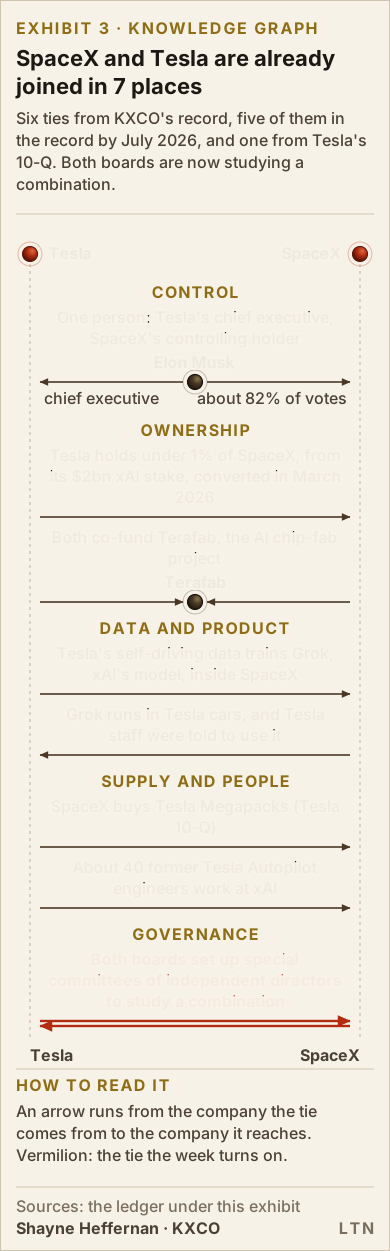
How to read Exhibit 3:
Control: Musk is Tesla's chief executive and holds about 82 per cent of SpaceX's vote (kxco.ai/ontology-live).
Ownership: Tesla's $2 billion stake in xAI became SpaceX shares on 12 March 2026, and both companies co-fund Terafab, a chip-fab project (Tesla proxy statement).
Data and product: Tesla's self-driving data trains Grok, xAI's model, which SpaceX absorbed in February; Grok runs in Tesla cars, and Tesla staff were told to use it (kxco.ai/ontology-live).
Supply and people: SpaceX buys Tesla Megapacks, Tesla's grid batteries, a tie taken from Tesla's 10-Q rather than the record (Tesla 10-Q), and about 40 former Tesla Autopilot engineers work at xAI (kxco.ai/ontology-live).
Governance: on 20 October, Musk said both boards had formed special committees of independent directors to study a combination. He called it a good idea with "a lot of merit" and said that treating it as a certainty "would be overstating it" (SpaceX webcast; SpaceX 10-Q).
No terms exist and no vote is scheduled. Tesla's shareholders backed Musk's pay award in November 2025, and a proposal to invest in xAI drew more votes for than against but failed on Tesla's rule that counts abstentions against (Tesla 8-K). To me, the ties and the two special committees describe two companies already run as one system. I expect the combination within 12 to 24 months.
Oil stays high, and Iran is not finished
ICE Brent futures settled at $98.32 on 6 November and WTI at $90.83. Brent fell 13.3 per cent on the week, and over three months it has settled between $82.49 and $117.64. The EIA's Dated Brent spot price touched $135.51 on 2 October. The EIA's October outlook put Brent at $105 for the fourth quarter and $84 for 2027, and warned that the Middle East conflict would likely bring more volatility than its forecast shows (EIA outlook; EIA Brent spot series).
The war that began on 28 February is not over. Iran offered through Qatari mediators to reopen the Strait of Hormuz within two days if the US met seven demands, and one of its senior officials called the US reply "not convincing". The President confirmed further "minor strikes" on 6 November. On 7 November US Central Command disabled a cargo ship trying to breach the blockade, and Iran's Revolutionary Guard said it had lifted its missile-range limit (Al Jazeera; CBS News). A fall on the hope of a deal, inside a war still being fought, is volatility, and I expect prices to stay high.
The FDA board
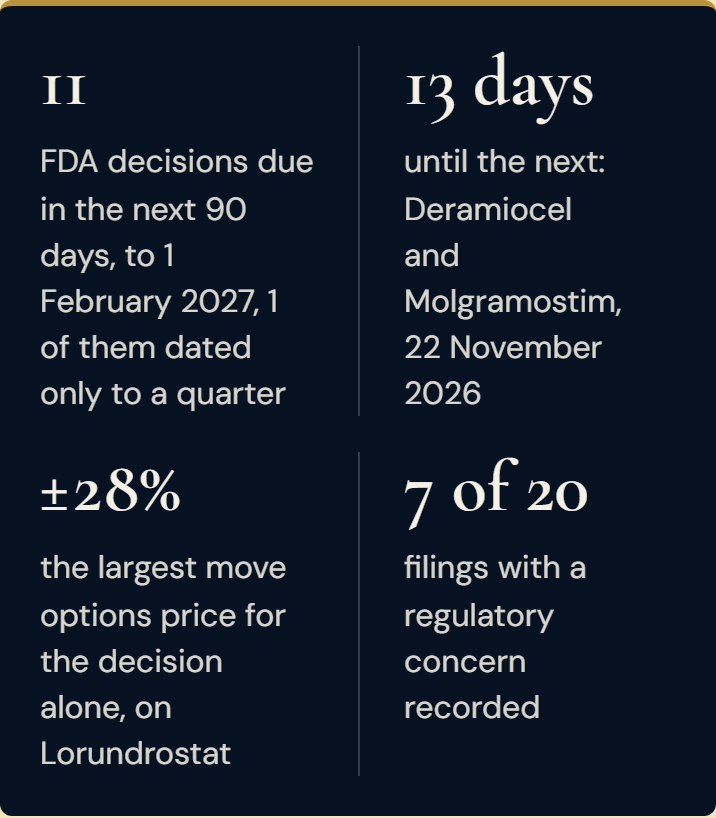
KXCO keeps a second public ontology, the FDA approval board, which records each FDA decision on its list as sourced claims rather than a calendar. No dated decision falls this week. Eleven are due in the next 90 days, one of them dated only to a quarter. The next are Capricor's deramiocel and Savara's molgramostim on 22 November, then BridgeBio's BBP-418 on 27 November and Cogent's bezuclastinib on 30 November. Options price the largest decision-only move, about 28 per cent either way, on Mineralys's lorundrostat, and 7 of 20 filings carry a regulatory concern on the record (kxco.ai/fda).
Why the ontology matters to an investor
A price screen shows what moved. An ontology shows what is connected, and so what is likely to move next. KXCO's public AI record holds 468 entities and 1,127 claims (kxco.ai/ontology-live): companies, people, policies, models and supplies, joined by typed relations such as supplies, invests in, controls and limits. Every claim carries its source, its date, the confidence the record gives it and the period it is valid for. Where two accounts disagree, the record keeps both and names the conflict.
Nothing enters the record on trust. Each new claim is quoted from a page saved when it was read, a database check refuses any claim that breaks the model's rules, and a reader who did not write the update reads every new claim against its saved page. This week's update passed both checks.
Two of the week's stories were in the record months before the vote. China's second supply chain was in the record by September (kxco.ai/ontology-live), and five of the SpaceX and Tesla ties by July (kxco.ai/ontology-live). None of them shows on a price chart. Each is a set of relationships, and relationships are what an ontology records.
The ontology of markets is my own discipline, and the AI room is where I show it working on public data. The engine behind it is not public. A client's own record stays the client's. The judgement stays with the person who signs.
What to watch this week
Tuesday's CPI print is the next fact to test the December rate path, and with it how much of the AI sell-off reverses before NVIDIA reports on 17 November.
Sources
NPR, via OPB: www.opb.org
Fox News results: www.foxnews.com
AP, via La Nación: www.lanacion.com.ar
Yahoo Finance, semiconductors: query1.finance.yahoo.com
Yahoo Finance, Nvidia: query1.finance.yahoo.com
3 November: www.lanacion.com.ar
6 November: www.lanacion.com.ar
Alibaba: query1.finance.yahoo.com
Tencent: query1.finance.yahoo.com
the bill text: www.govinfo.gov
Bloomberg, via the News Tribune: www.newstribune.com
Ballotpedia: news.ballotpedia.org
Reuters, via The Spokesman-Review: www.spokesman.com
Quartz: qz.com
BLS data: api.bls.gov
CNBC: www.cnbc.com
Department of Labor: oui.doleta.gov
Federal Reserve: www.federalreserve.gov
agency calendars: www.census.gov
EIA: www.eia.gov
Federal Reserve calendar: www.federalreserve.gov
NVIDIA: nvidianews.nvidia.com
Tencent notice: www.tencent.com
Alibaba notice: www.sec.gov
Stock Analysis: stockanalysis.com
NVIDIA: nvidianews.nvidia.com
AMD 8-K: www.sec.gov
Arm: newsroom.arm.com
Anthropic S-1/A: www.sec.gov
SpaceX filing: www.sec.gov
TheStreet, citing Bloomberg: pro.thestreet.com
Federal Register: www.federalregister.gov
Reuters, via The FINANCIAL: finchannel.com
Alibaba results: www.sec.gov
Tencent results: www.tencent.com
Tencent Hy4: www.tencent.com
SpaceX pricing release: ir.spacex.com
SpaceX results: ir.spacex.com
Stock Analysis: stockanalysis.com
Tesla proxy statement: www.sec.gov
Tesla 10-Q: www.sec.gov
SpaceX webcast: s21.q4cdn.com
SpaceX 10-Q: www.sec.gov
Tesla 8-K: www.sec.gov
EIA Brent spot series: www.eia.gov
Al Jazeera: www.aljazeera.com
CBS News: www.cbsnews.com
FDA approval board: kxco.ai
Not financial advice: do your own work.
Stocks mentioned: $NVDA (NASDAQ), $BABA (NYSE), $TCEHY (OTC), $SPCX (NASDAQ) and $TSLA (NASDAQ).
Shayne Heffernan, Ph.D., is the founder of the KnightsBridge Group (shayneheffernan.com).
Democrats' AI Spending Curtailment: The Dumbest Idea in Washington
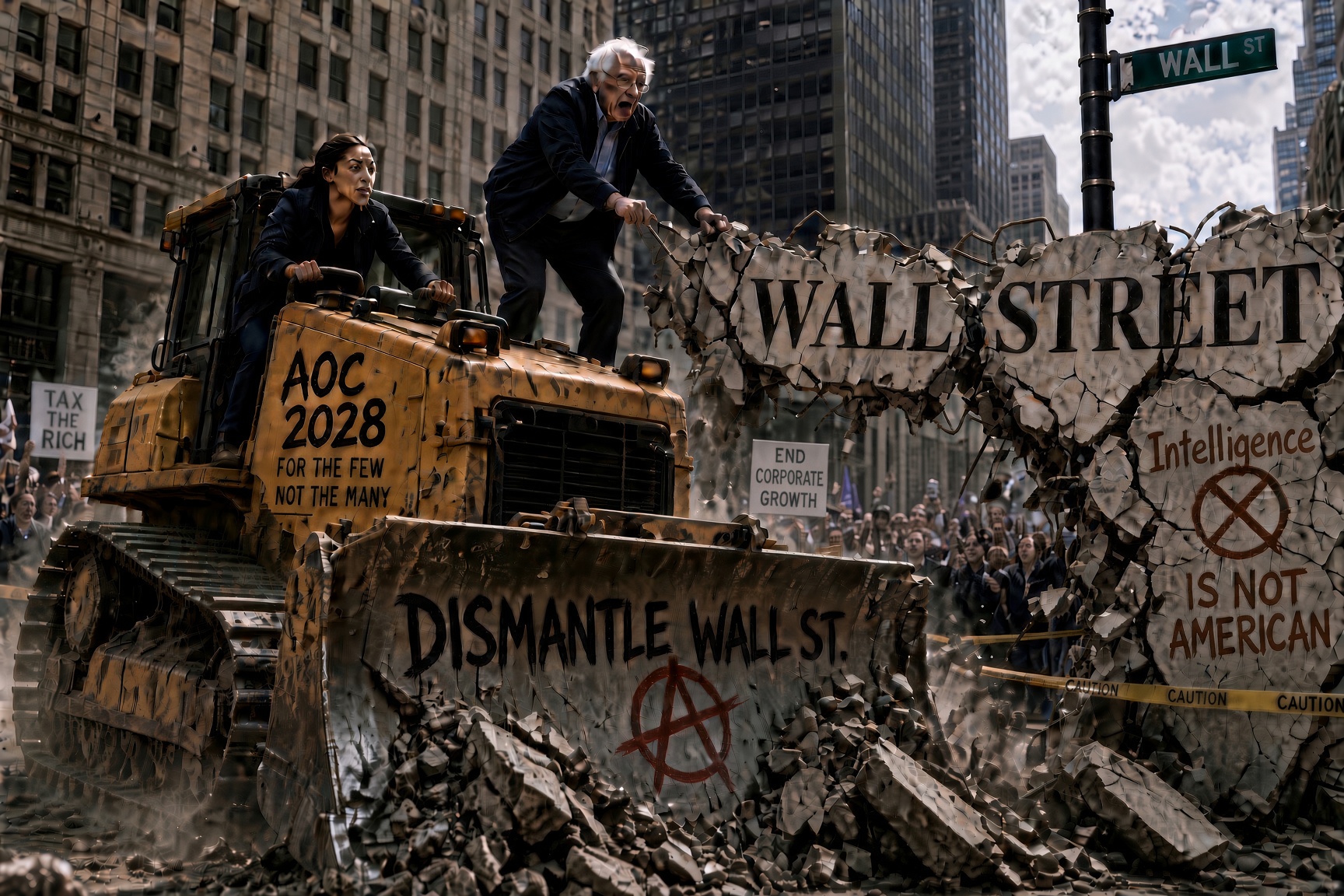
After the midterm sweep, Democrats want to slow America's AI build-out. The Sanders and Ocasio-Cortez bill would freeze building and upgrading of AI data centres nationwide, and a superintelligence ban Rep. Yassamin Ansari wants atop the agenda would pause every model trained with 10^25 operations or more. Governors-elect in Texas and Georgia back pauses, and Goldman Sachs puts 45% of planned capacity in Democrat-run states backing moratoriums. Shayne Heffernan: AI computing follows the power.
AI Stocks, Week of 1 November 2026: Seven Buys and the Ontology Behind Them
Shayne Heffernan rates seven AI stocks buys for the week of 1 November 2026: Nvidia, Broadcom, TSMC, Microsoft, Oracle, Palantir and ASML. The latest results put the contracted backlog of the four largest cloud sellers at about $2.48 trillion, and Amazon, Alphabet, Microsoft and Meta plan about $720 billion to $740 billion of capital spending in 2026. Every call links to KXCO's AI ontology, updated on 1 November with the quarter's results, power and grid data and new defence contracts.
The State of the AI Market in Wartime: Chips, Power and the Defence AI Companies
The AI market is now decided by physical capacity, and this year it went to war. US forces used Palantir's Maven against 13,000 targets in the 38 days of Operation Epic Fury, per the Pentagon's AI chief, while hyperscalers called for about $730 billion of 2026 capital spending, per CNBC. Shayne Heffernan reads demand, chips, power, the Gulf escalation around the 3 November midterms, and the defence AI companies: Palantir, SpaceX and xAI, Anthropic, OpenAI, Alphabet, Anduril and Shield AI.
United States vs China: AI Models, Compute, Quantum and Electricity
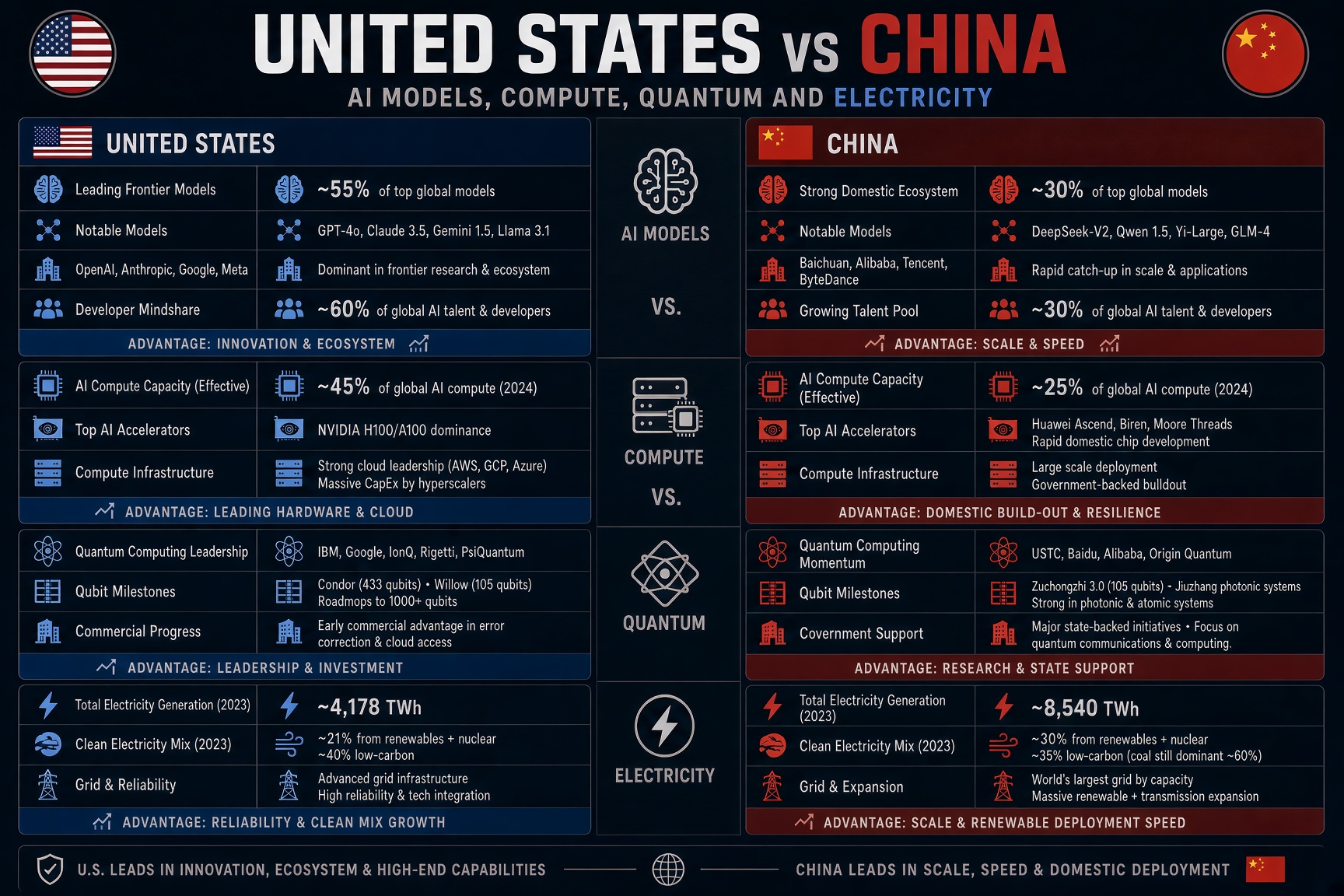
The United States still leads in frontier model capability, total AI compute and quantum error correction, while China has narrowed the gaps in model performance, open-weight adoption and domestic chip volumes, and holds a structural advantage in power for data centres. Shayne Heffernan sets out the developments from July to October 2026 across models, compute, quantum and electricity, and how fast China is catching up.
Every story, signed and delivered.
Subscribe to the kxco channel and get the headline, the AI-written key takeaways, and the chain-anchor link the moment we publish. Audio versions and per-ticker subscriptions arrive in the next iteration.