
Democrats' AI Spending Curtailment: The Dumbest Idea in Washington
Bernie's moratorium, Ansari's call for a superintelligence ban and state-level permit freezes: a coordinated push to strangle America's most important industry.

After the midterm sweep, the Democratic Party has decided that the single most important technology race of the twenty-first century is something America should slow down.
The sweep is real. The Associated Press (AP) called both the Senate and the House for Democrats in the 3 November elections. NBC News projects 54 Democratic senators to 44 Republicans, with Alaska and Mississippi still uncalled. CNN projects more than 250 Democratic House seats, the party's largest majority since 2008. CNBC called it a historic midterm landslide: Democrats flipped seven Senate seats and at least 24 House districts, and by the afternoon of 4 November Republicans had yet to flip a single Democratic-held seat.
By 5 November, top Democrats had a first demand. Bernie Sanders posted on X: "National data center moratorium now." Rep. Yassamin Ansari wrote on 4 November that the top of the Democratic agenda on day 1 "needs to be a pause on advanced AI development, regulation of this out of control industry, and a ban on artificial superintelligence." Rep. Greg Casar, chair of the Congressional Progressive Caucus, shared her post and said "Yes!"
What the 2 federal bills would do
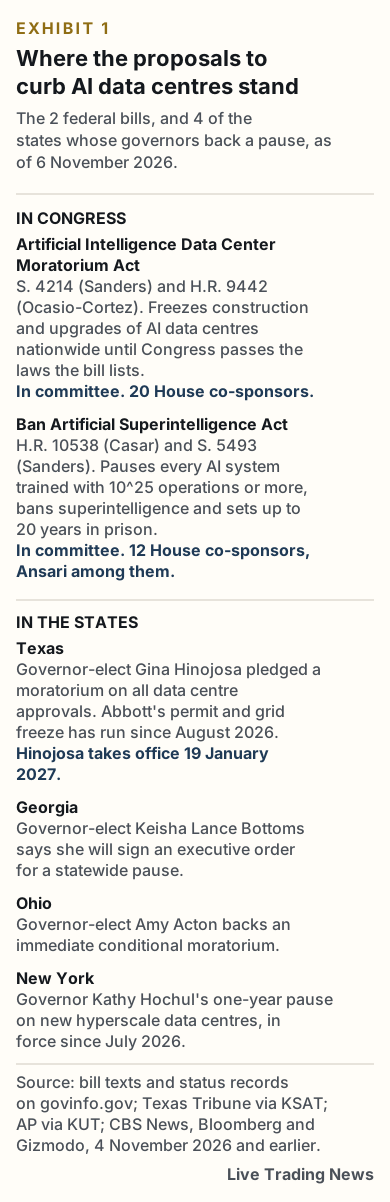
Two bills already carry that agenda in Congress. The first is the Artificial Intelligence Data Center Moratorium Act, which Sanders introduced in the Senate as S. 4214 on 25 March 2026. Alexandria Ocasio-Cortez introduced the House version, H.R. 9442, on 24 June, and it now has 20 Democratic co-sponsors. The bill would bar the construction or upgrading of any AI data centre in the United States, new or existing, whoever owns it. A site is caught if it has more than 20 megawatts of capacity and is built for dense server racks or liquid cooling, or if it is used to develop or run AI models at scale.
The freeze lasts until Congress passes laws that meet a list of conditions. Those laws must require federal approval of AI products before release, share the gains from AI with workers and stop data centres from raising power bills or harming the environment. They must also give each community a veto over each site, bar any government subsidy for the sites and guarantee union jobs. The bill would also order a ban on exports of AI computing hardware to countries without comparable laws.
The second is the Ban Artificial Superintelligence Act of 2026, which has also been reported as the ASI Prohibition Act, ASI being artificial superintelligence. Casar introduced it in the House as H.R. 10538 on 24 September with Ansari among its nine original co-sponsors, and it now has 12, all Democrats. Sanders introduced the Senate version, S. 5493, the day before. Neither version has had a hearing, a markup or a vote.
The bill would put every AI system trained with 10^25 or more operations under a mandatory pause, with no training, modification or fine-tuning allowed. The pause ends only when a new Department of Artificial Intelligence is fully staffed and has issued its safety rules. It would ban artificial superintelligence permanently. Policymaking staff at AI companies, and unaffiliated "rogue actors", who recklessly break the pause or the ban face a fine and up to 20 years in prison. Under the general federal fine law, that fine can reach $250,000 for an individual, or twice the gain or loss. Companies in breach lose their federal charter and face forfeiture of their intellectual property and assets.
The states are where the freeze bites first
Texas is the largest single prize. SemiAnalysis says Texas accounts for nearly 30% of the US data centre capacity due online in 2028, and Wells Fargo puts the state at 27% of planned US data centre gigawatts. On 3 November Democrat Gina Hinojosa defeated Governor Greg Abbott; the AP called the race at 10:17 p.m. with Hinojosa on about 57% of the reported vote. During the campaign she pledged a moratorium "on all data center approvals until laws can be passed by the Legislature to protect Texans". Analysts at Jefferies wrote before the vote that her win would result in an immediate statewide pause.
Texas is already paused. Abbott, a Republican, froze environmental permitting and grid connections for data centres from August while the state audits them, and Hinojosa campaigned on going further. She takes office on 19 January 2027. Wells Fargo estimates that every 10% cut in planned Texas capacity cuts Big Tech's AI infrastructure spending by 1.6%.
Georgia is next. Keisha Lance Bottoms defeated Republican Rick Jackson and campaigned on a temporary statewide pause on new data centre construction. The day after the vote she told CBS she would immediately "sign an executive order for that pause" and review the tax incentives behind Georgia's data centre growth. Democrats also won a 3-2 majority on the Public Service Commission, which sets the terms Georgia Power offers data centres. On election night, Effingham County tabled the site plan for OpenAI's 3.2 gigawatt (GW) Project Camellia until 17 November.
Ohio elected Democrat Amy Acton over Vivek Ramaswamy, and she has called for an immediate conditional moratorium. Morgan Stanley's analysts say her win creates a significant risk of data centre delays in Ohio, including a 10 GW project involving Nvidia, the largest in the state. New York has had a one-year statewide pause on new hyperscale data centres since July, under Governor Kathy Hochul.
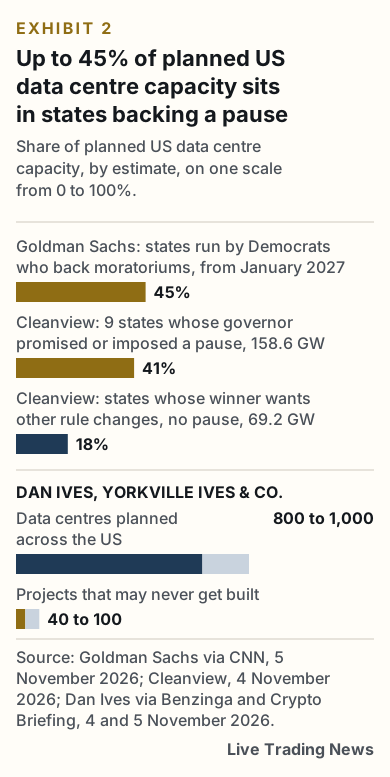
Add up the map and the exposure is large. Goldman Sachs estimates that from January, states controlled by Democrats who back expanding or extending construction moratoriums will account for 45% of America's planned data centre capacity. Goldman expects the halts to be short-lived. Its strategist Rich Privorotsky suggested some companies could bring spending forward into 2027 to start projects before new rules take effect. Cleanview, counting separately, finds nine states whose governor has promised or imposed a pause, holding 158.6 GW of planned capacity, 41% of the US pipeline.
Dan Ives of Yorkville Ives & Co. estimates that 10% of planned data centres "will not happen now", out of the 800 to 1,000 he counts across the country. Crypto Briefing reports his range as 5% to 10%, or about 40 to 100 projects that may never get built.
This is industrial surrender with extra steps, dressed as industrial policy.
A compute threshold bans a number, not a capability
The compute-threshold idea is the worst of it. Training runs do not ship with a little sticker telling you how smart the finished model will be. You are banning a number, not a capability.
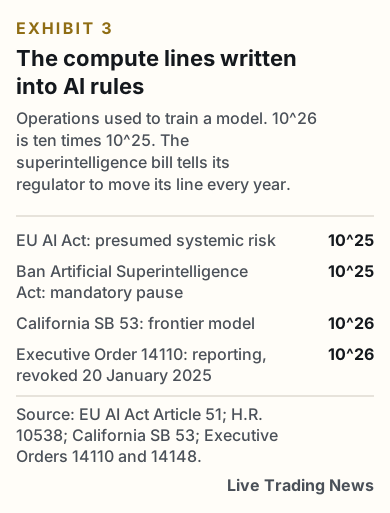
The number is a choice, and different lawmakers choose differently. The superintelligence bill draws its line at 10^25 operations, the same line the EU AI Act uses to presume systemic risk. California's SB 53 defines a frontier model at 10^26, the line President Biden's Executive Order 14110 used for reporting until President Trump revoked it on 20 January 2025. The bill itself admits the problem: it tells the new Secretary of Artificial Intelligence to adjust the threshold each year as training becomes more efficient. A line that has to move every year to catch the same risk does not measure the risk.
The predictable result is that labs split workloads across more, smaller clusters, scatter them across jurisdictions, and offshore the heavy lifting to wherever the rules are laxer.
The frontier already trains that way. Microsoft links its Fairwater AI data centres in Wisconsin and Atlanta so that sites in different states train one model together, and says land and power availability make it more attractive, and at this point necessary, to spread the work across locations. Google trained Gemini Ultra across multiple data centres. A 2025 governance paper warns that an actor could evade thresholds based on training compute by dividing a run into smaller workloads executed in parallel on different cloud providers. Epoch AI finds that a 10 GW training run could be spread across 23 sites linked by fibre, although it expects developers to build multi-gigawatt single sites first. Prime Intellect has already trained a model across five countries and three continents.
That does not make oversight better. It makes it impossible. You have not slowed the technology. You have scattered it into the dark. Epoch AI itself notes that very small data centres offer little advantage, "except perhaps for concealing them".
Where the work goes: China
And where does it scatter to? China. Nvidia itself has said America's advantage over China in the AI race is thin. Nvidia chief executive Jensen Huang told the Financial Times on 5 November 2025 that "China is going to win the AI race", and CNBC reported that he tied that to China's lower energy costs and looser regulations. Nvidia's statement the same day put China "nanoseconds behind America in AI".
That thin edge rests almost entirely on Nvidia's hardware lead. On power, Huang says America is already behind: "China is well ahead of us on energy. We are way ahead on chips." At the Center for Strategic and International Studies (CSIS) in December 2025 he said that "China has twice the amount of energy we have as a nation". He also said America is "generations ahead on chips". In the quarter to 26 July 2026, Nvidia's data centre revenue was $89.0 billion, up 117% on a year earlier, and its guidance assumes no data centre compute revenue from China. In May 2026 Huang said Nvidia has "largely conceded" China's AI chip market to Huawei, and Huawei plans to make up for lagging manufacturing process nodes with scale.
Every data centre that gets blocked or delayed in Texas or Georgia is a data centre that does not have to be built in China.
Beijing does not have a Bernie Sanders. Beijing does not have an ASI Prohibition Act. Beijing has a five-year plan and a state that treats AI compute as a national security asset, which it is. China's 15th Five-Year Plan, published in March 2026, orders a national integrated computing power network, faster build-out of the national hub computing clusters and green power sited alongside compute. The draft outline of 5 March paired development with security, and the published plan calls for full implementation of the "AI+" action. Reuters reported in November 2025 that Beijing had told state-funded data centres to use only domestic AI chips. Beijing's East Data, West Computing programme places ten data centre clusters within eight national hub nodes, with non-real-time computing in renewable-rich western provinces.
The power gap
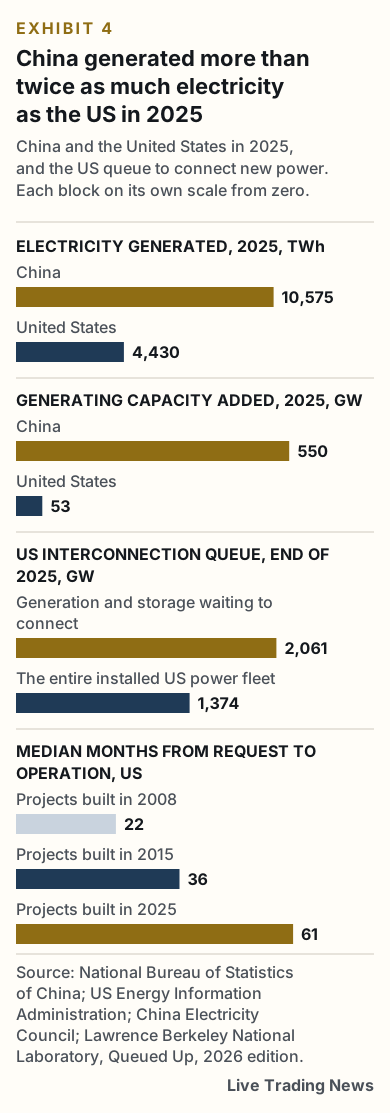
The power gap is the part nobody in Washington wants to say out loud. China already has ample electricity available for compute. It generated 10,575 terawatt-hours (TWh) in 2025, against 4,430 TWh in the United States, more than twice as much. It added 550 GW of generating capacity in 2025, 440 GW of it wind and solar, while the United States added 53 GW, its most in a single year since 2002. China energy analyst David Fishman told Fortune that China's reserve margin has never dipped below 80% to 100% nationwide, which he says means at least twice the capacity it needs, against a typical 15% on US regional grids.
Beijing also prices that power for compute. The Financial Times reported that local governments in Gansu, Guizhou and Inner Mongolia have cut power costs for some of the largest data centres by up to 50% where they run domestic AI chips. Asked about those discounts, Huang said American energy already costs more and "we're probably, call it, four to eight times the cost".
The United States has a disadvantage: grid constraints, permitting delays and interconnection queues stretching years. Lawrence Berkeley National Laboratory counts about 2,061 GW of generation and storage waiting in interconnection queues at the end of 2025, more than the entire US power fleet of 1,374 GW. The median project built in 2025 took 61 months, about five years, from request to operation, against 22 months in 2008.
PJM Interconnection runs the grid for more than 67 million people in 13 states and Washington, DC. Its auction results of 17 December 2025 cleared the 2027/2028 delivery year 6,623 megawatts (MW) short of its reliability requirement. Its results of 14 July 2026 cleared 2028/2029 at its price cap and 6,831 MW short, and PJM says these were the first auctions in its history in which the whole region fell short. Data centres used 4.4% of US electricity in 2023 and are expected to use 6.7% to 12% by 2028.
Curtailing US industry on top of that is no rounding error. It is the dumbest idea in history. You are taking the country that is already behind on power and telling it to build less of the thing power feeds.
The companies will move, not stop
The AI companies will not stop developing. That is the part the Democrats refuse to understand. These are not hobbyists waiting for permission. They are the most capital-rich, talent-hungry organisations on Earth, and they will simply move the work outside America.
Meta's president, Dina Powell McCormick, said on 4 November that starting new data centre build-outs in the United States today "will be very challenging" and that "every hyperscaler is now thinking about" whether to build outside the country. Gordon Johnson of GLJ Research expects Texas projects that have neither power nor permits to "probably go to Louisiana, Oklahoma or nowhere". HSBC's analysts set out a scenario in which data centres simply move from Texas to other states.
Compute follows the power and the policy. If Washington makes power expensive and permits impossible, the racks go where power is cheap and permits are fast. That is not a threat. That is arithmetic.
What America needs is power
Here is what America actually needs: power. Massive, abundant, cheap electricity to feed the compute capacity that services AI. This is no niche technology story. This is the industry of the future, and it is more important than any arms race in history. The country that controls AI compute controls the next century of economic and military advantage.
The Soviet Union lost the Cold War not because its tanks were worse but because its economy could not sustain the race. America is now being asked to handicap itself voluntarily in the one race that matters, by the same party that spent the last decade lecturing about American decline.
The moratorium is coherent and the threshold ban is not
The moratorium on data centres is at least coherent as a position: if you believe AI is a net harm, freezing the build-out follows. But the compute-threshold ban is not coherent. It is performative. It signals virtue to a base while handing Beijing the one gift it cannot manufacture on its own: American self-sabotage.
The veto stops the bills, not the damage
Trump can veto the federal bills, which is why the near-term damage is state-level permitting freezes rather than national law. A vetoed bill becomes law only if two-thirds of both chambers vote to pass it again, and Trump said in October that with a Democratic Congress "I veto everything". The new Congress does not sit until noon on 3 January 2027, and bills not enacted by then lapse and must be reintroduced. Senate Democratic leader Chuck Schumer warned on 5 November that if Trump spends the next year vetoing Democratic bills, Republicans face worse losses in 2028.
Not every Democrat wants the freeze. Before the election, House Democratic leader Hakeem Jeffries and other leaders were sceptical of a data centre ban, and Rep. Kathy Castor, the top Democrat on the House energy subcommittee, opposes a moratorium. Two Senate Democrats, Sheldon Whitehouse and Martin Heinrich, co-sponsor S. 5653, a bipartisan bill to speed permitting for energy infrastructure, and the Senate was preparing a procedural vote to advance it on Monday 9 November.
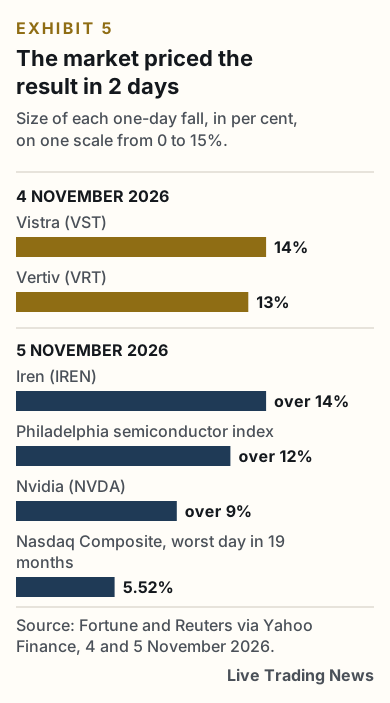
But the signal is already sent. Capital is already pricing in the risk. On 4 November, as the result became clear, Vistra fell 14% and Vertiv 13% on fears of data centre moratoriums, while some of the largest technology companies, which pay for the build-out, rose. Reuters reported that Core Scientific fell 11.6% and Iren 12.5% as the sweep became apparent. On 5 November the Nasdaq Composite fell 5.52%, its deepest one-day drop in 19 months, and Reuters put the fall down to fears of tougher AI regulation. Nvidia fell more than 9%, Iren more than 14% and the Philadelphia semiconductor index more than 12%. Projects are already being delayed, and the companies building them are already asking where else to go.
Regulate the outcomes
If Democrats want to regulate AI, regulate the outcomes: fraud, manipulation, autonomous weapons, privacy abuse. Those are real problems with real victims and real statutes. Banning a training run because it crossed a count of floating-point operations (FLOP) is like banning a car because it has too much horsepower. It does not make the roads safer. It just moves the fast cars to other countries.
Stocks mentioned: $NVDA (NASDAQ), $VST (NYSE), $VRT (NYSE), $CORZ (NASDAQ), $IREN (NASDAQ) and $META (NASDAQ).
Shayne Heffernan, Ph.D., Editor-in-Chief of Live Trading News, is the founder of the KnightsBridge Group (shayneheffernan.com).
This article reflects the opinion of the author and Live Trading News, with each sourced figure linked. It is provided for informational purposes and does not constitute investment advice.
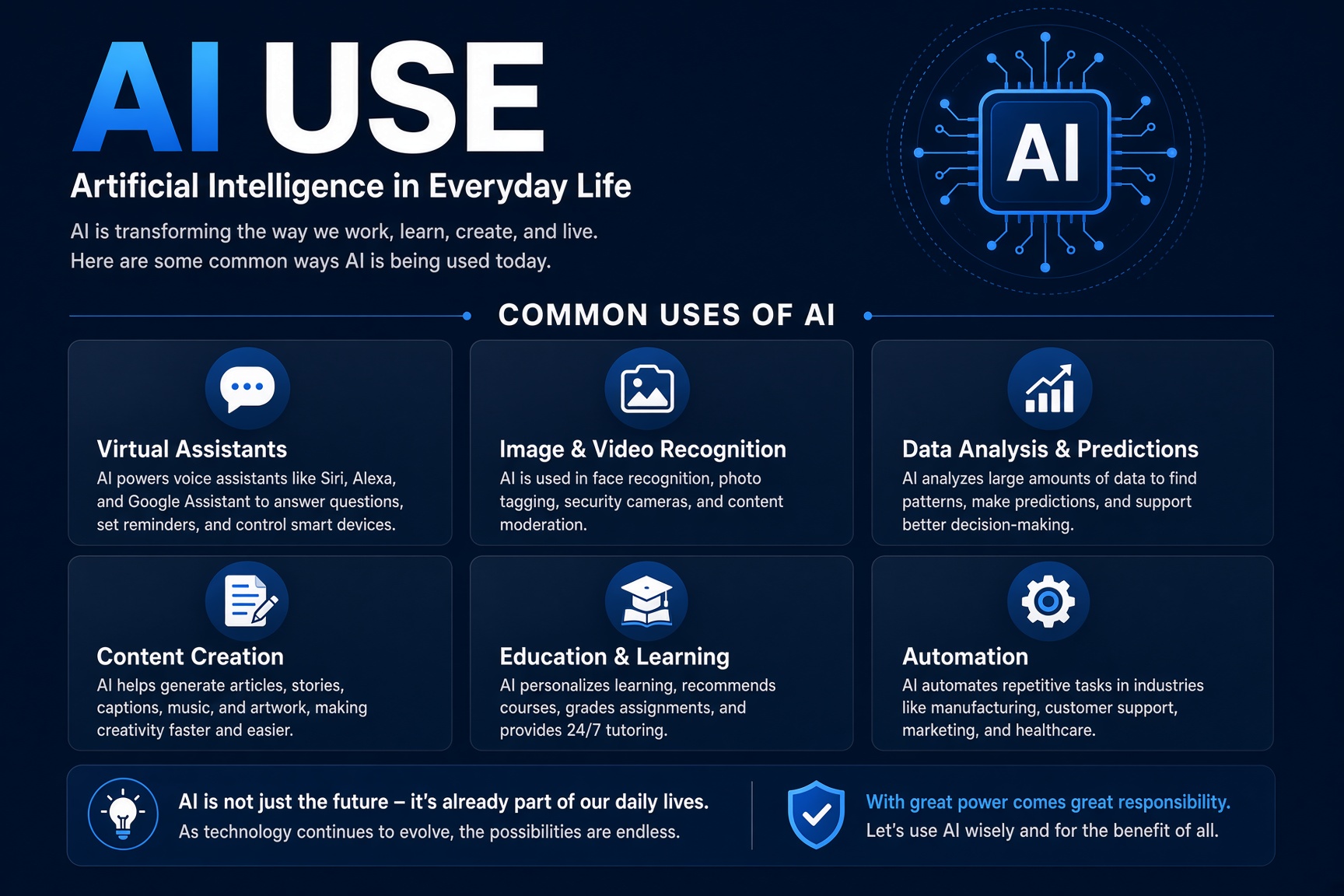
AI Stocks, Week of 1 November 2026: Seven Buys and the Ontology Behind Them
Shayne Heffernan rates seven AI stocks buys for the week of 1 November 2026: Nvidia, Broadcom, TSMC, Microsoft, Oracle, Palantir and ASML. The latest results put the contracted backlog of the four largest cloud sellers at about $2.48 trillion, and Amazon, Alphabet, Microsoft and Meta plan about $720 billion to $740 billion of capital spending in 2026. Every call links to KXCO's AI ontology, updated on 1 November with the quarter's results, power and grid data and new defence contracts.
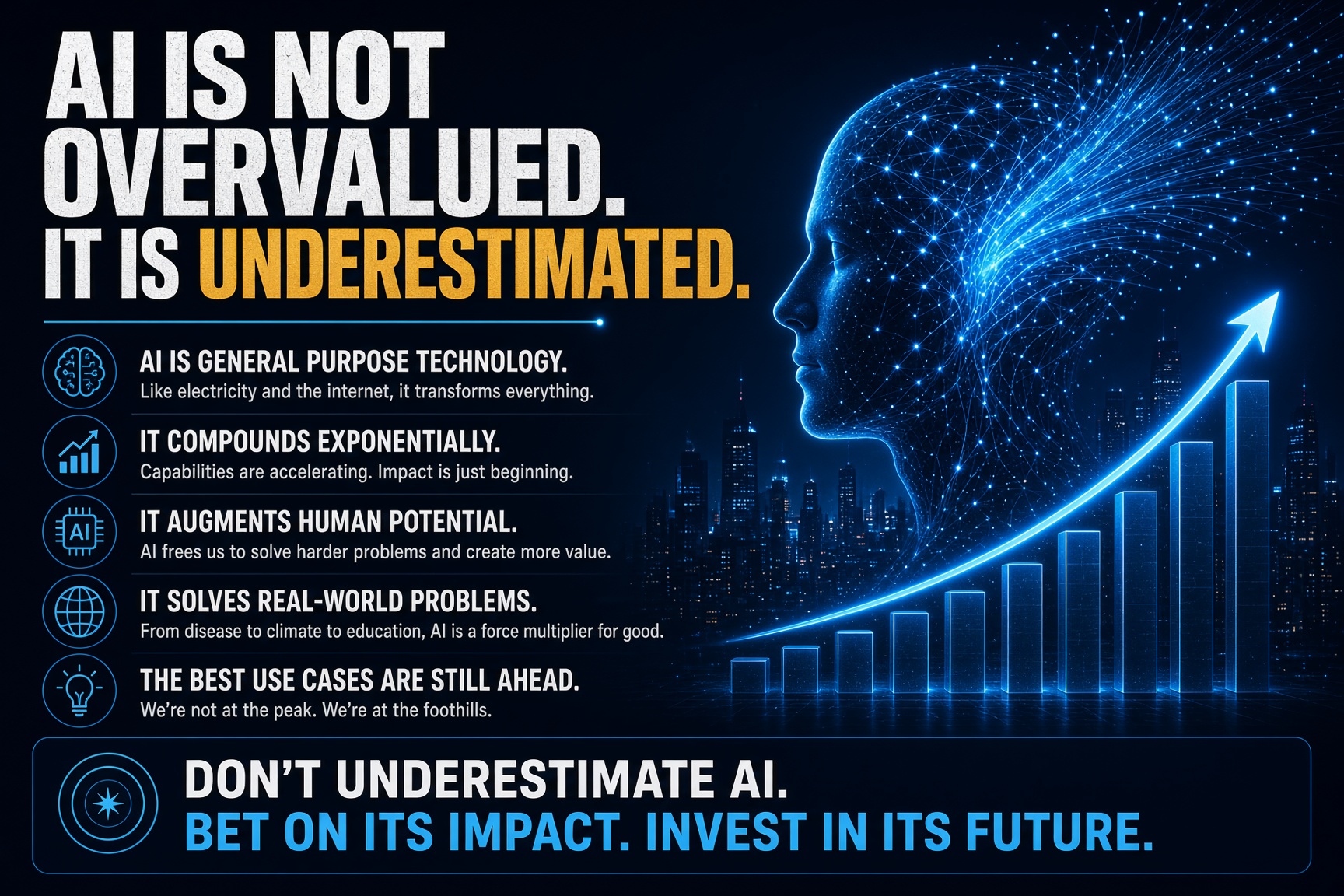
AI Is Not Overvalued. It Is Underestimated.
Markets debate whether artificial intelligence (AI) is overvalued. Shayne Heffernan argues the more material risk is underestimation. Alphabet's capital expenditure reached $51.4 billion in the third quarter, Google Cloud revenue rose 103% to $30.7 billion and the Cloud backlog stands at $561 billion, per its 28 October results and earnings call. Jurisdictions that block data centres do not remove the demand: they import the capability later, at a higher price.

The State of the AI Market in Wartime: Chips, Power and the Defence AI Companies
The AI market is now decided by physical capacity, and this year it went to war. US forces used Palantir's Maven against 13,000 targets in the 38 days of Operation Epic Fury, per the Pentagon's AI chief, while hyperscalers called for about $730 billion of 2026 capital spending, per CNBC. Shayne Heffernan reads demand, chips, power, the Gulf escalation around the 3 November midterms, and the defence AI companies: Palantir, SpaceX and xAI, Anthropic, OpenAI, Alphabet, Anduril and Shield AI.
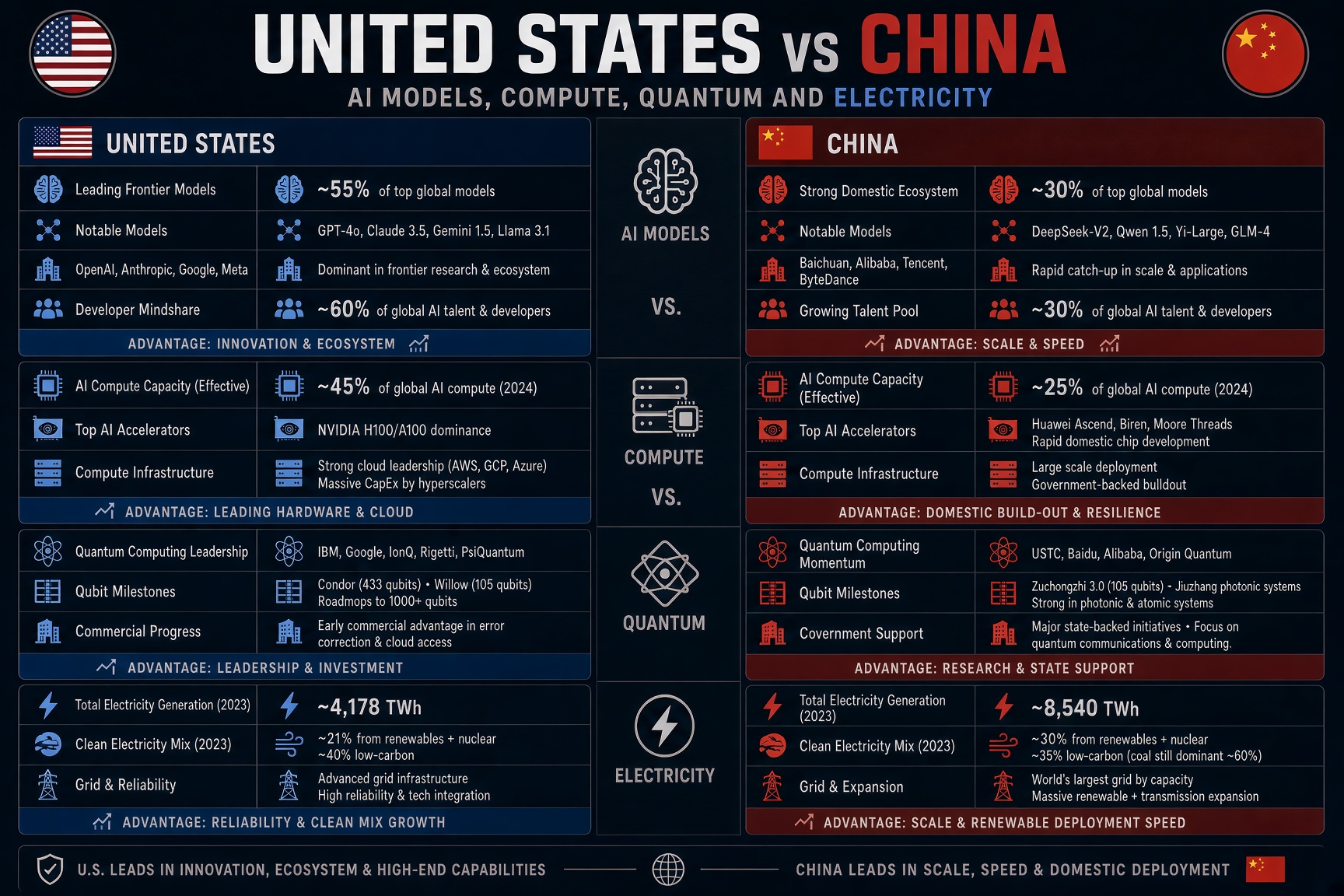
United States vs China: AI Models, Compute, Quantum and Electricity
The United States still leads in frontier model capability, total AI compute and quantum error correction, while China has narrowed the gaps in model performance, open-weight adoption and domestic chip volumes, and holds a structural advantage in power for data centres. Shayne Heffernan sets out the developments from July to October 2026 across models, compute, quantum and electricity, and how fast China is catching up.
Every story, signed and delivered.
Subscribe to the kxco channel and get the headline, the AI-written key takeaways, and the chain-anchor link the moment we publish. Audio versions and per-ticker subscriptions arrive in the next iteration.