
Jensen Huang, Nvidia and the Morality Game America Plays With Itself
Huang resigned after reports of three relationships. They raised two real questions for investigators and the board. His marriage was his family's business, and a country with America's own numbers on infidelity has no standing to sermonise about it.
Part of theAI Stocks Center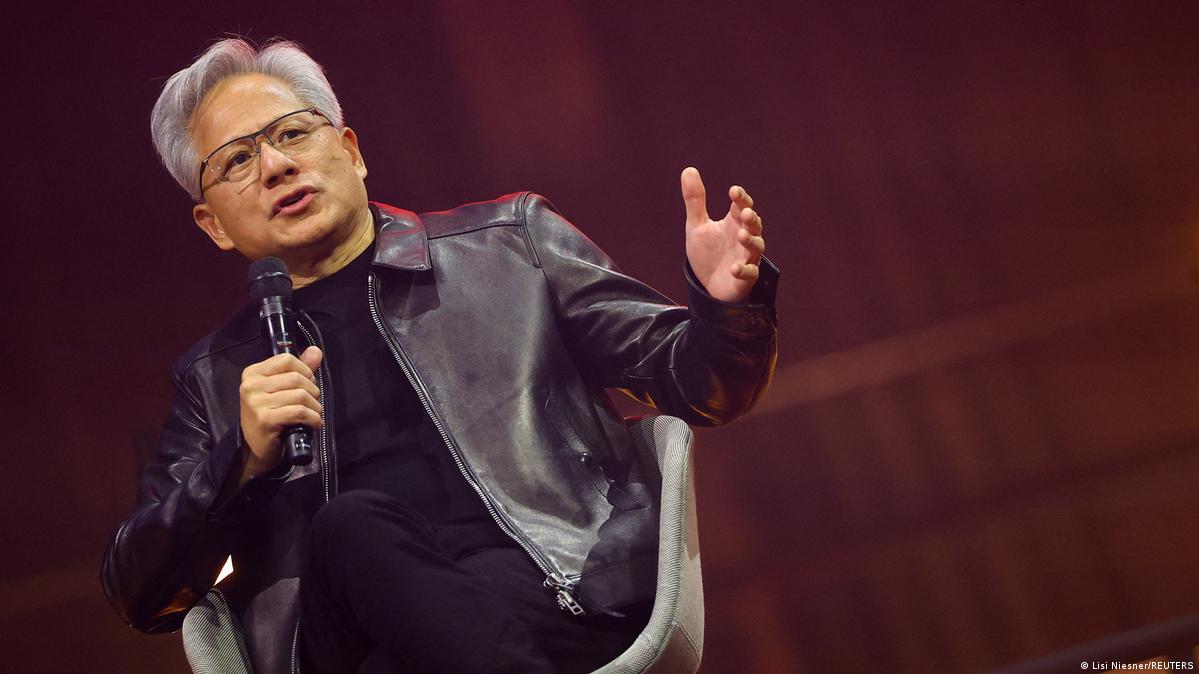
Jensen Huang resigned on 12 November 2026 as president, chief executive and director of Nvidia, effective immediately, the company said in a filing. Colette Kress, the chief financial officer, is interim chief executive, and Harvey Jones becomes the board's first chair. He went after reports of three relationships. The first was with Alice Huang, a former senior executive of Megaspeed, a Singapore company that bought Nvidia chips. US intelligence officials have concluded she was working for the Chinese government, according to the New York Times. The second was with an executive who reported to him, and the third with a second Nvidia employee, as NBC News and Yahoo Finance report.
China calls the spy allegation "pure groundless speculation and slander", ABC News reports. Nvidia's shares fell as much as 14% at the open on 12 November 2026, to their lowest level since June 2025, and closed 4.3% lower, Yahoo Finance and NBC News report.
Two questions raised by those reports belong to investigators and to the board: whether a foreign service reached him, and whether his ties to staff broke the company's rules. The third question, his marriage, belongs to his family. America has spent the week treating that one as its own.

Sources for Exhibit 1:
The ties: Huang's memo to staff, the New York Times account relayed by the San Francisco Standard, NBC News on the executive and Yahoo Finance on Reuters' report of a second employee.
The security question: CNBC on the intelligence assessment, China's denial, the board's statement, the House chairmen's letter, Yahoo Finance on the testimony and the Boston Globe on the FBI.
The conduct question: Nvidia's code of conduct and NBC News on the board's meeting.
The audience: the Institute for Family Studies in 2018 and 2025, the Survey Center on American Life, and Similarweb's visitor estimate as reported by OnlyGuider.
What Huang built
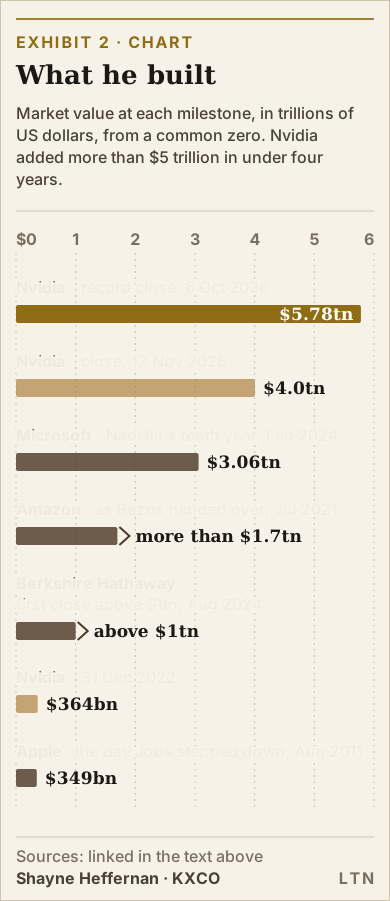
Jensen Huang did not inherit a company. He did not buy one. He, Chris Malachowsky and Curtis Priem met at a Denny's in Silicon Valley, Nvidia's blog recalls, to plan a chip that would bring realistic 3D graphics to personal computers. They founded Nvidia on 5 April 1993 with $40,000 in the bank, according to Nvidia, NBC News and Fortune. Over 33 years he turned that start-up into the first company worth $5 trillion. It closed above the mark on 29 October 2025, Fox Business reported, and was worth about $5.78 trillion at its record close on 6 October 2026, the Motley Fool notes.
No chief executive has created more shareholder value in a shorter span. Nvidia was worth $364 billion on 31 December 2022, by Companies Market Cap's year-end figures, and added more than $5 trillion in under four years. Apple was worth $349 billion the day Steve Jobs stepped down, AP reported. Amazon was worth more than $1.7 trillion when Jeff Bezos handed over the chief executive's job, AFP reported. Berkshire Hathaway, Warren Buffett's company, first closed above $1 trillion on 28 August 2024, CNN reported. Microsoft grew from just over $300 billion to $3.06 trillion in Satya Nadella's first decade, CNBC reported. Huang's achievement is singular, and it is measured in trillions.
He did it by seeing what almost nobody else saw: that silicon built to render video-game frames could train neural networks. While the industry chased mobile chips and then crypto mining rigs, Huang bet the company on computing for artificial intelligence before most of the world took the phrase "large language model" seriously. CUDA, the platform Nvidia launched in 2006 to open the graphics chip's parallel processing to science and research, as its own history records, became the working layer of the AI age.
OpenAI's GPT-5.2, Meta's Llama 3, Mistral NeMo and DeepSeek-V3 were all trained on Nvidia hardware, according to Nvidia, Meta, Nvidia and Mistral and DeepSeek's technical report. Google trained Gemini 1.0 on its own Tensor Processing Units, and Anthropic runs Claude on three chip platforms: Google's TPUs, Amazon's Trainium and Nvidia's GPUs. That custom silicon is the real competitive question, and I return to it below. Nvidia still controls an estimated 90% of the market for advanced AI chips, Al Jazeera reports.
The numbers are almost absurd. In fiscal 2026, the year to January, Nvidia's revenue was $215.9 billion, up 65%, and its operating income was $130.4 billion, according to its annual report. That operating profit is larger than the whole annual revenue of Valero Energy, 40th on the 2026 Fortune 500, or FedEx, 50th, by the 2026 list. In the quarter to July 2026, revenue was $96.2 billion, $89.0 billion of it from the data centre, at a gross margin of 75.0%, its quarterly report shows. Its operations produced $74.4 billion of cash in the first half of this fiscal year against $4.4 billion of capital spending: about $70 billion of free cash flow in six months. By the conventional measures of industrial achievement, revenue, margin and cash, I know of no peer in modern corporate history that has matched it.
And yet, in late 2026, much of the American business press and political commentary spent more ink passing moral judgement on Jensen Huang's marriage than on the questions that decide Nvidia's future. Those are its export-control posture, its supply chain, the threat from custom silicon at Google, Amazon and Microsoft, and its place in the contest with China. That inversion, the trivial crowding out the consequential, is not an accident. It is a pattern, and it deserves to be named.
What a board is for
A board of directors has a fiduciary duty. That duty runs to shareholders and concerns the health of the enterprise: strategy, capital allocation, risk, succession, compliance and the integrity of the accounts. A board that spends its time adjudicating a chief executive's marriage has abandoned its job.
Nvidia's board faced two questions that were its job, and neither is about a marriage.
The first is security. On 8 November the board opened an independent investigation into reporting that Huang had been the target of a foreign intelligence effort, saying it had no reason to believe national security or Nvidia's secrets were compromised, in its statement. It has hired a former acting US attorney to run it, NBC News reports. US intelligence reportedly assessed that China's Ministry of State Security recruited Alice Huang to gather information on him, CNBC reports. Bloomberg reported that Nvidia's general counsel called the Commerce Department to ask about the investigation into Megaspeed. Nvidia says he did not know of the affair at the time, The Edge Singapore relays.
President Trump says the FBI is looking into the relationship, the Boston Globe reports, and Huang has agreed to testify to Congress before Thanksgiving, the House Foreign Affairs chairman told reporters. These are questions of law and evidence, and they can be answered. There is no established evidence that Huang knowingly assisted Beijing or that company secrets were compromised, as Al Jazeera's correspondent put it. If evidence exists, it should be presented, tested and, if proven, prosecuted. That is how a serious society handles a serious allegation.
The second is conduct. The New York Times, citing five people who worked at Nvidia, reported that Huang had a relationship with an executive who reported to him, NBC News reports, and Reuters reported a relationship with a second employee. Nvidia's own code of conduct opens with a letter from Huang. It tells staff to avoid any conflict between personal gain and their obligations to the company and to step away from any decision where one arises, and it lists personal relationships among the things that may create one.
Boards have treated this as their business for years. Intel's Brian Krzanich resigned in 2018 after an investigation confirmed a consensual relationship with an employee broke a policy that applies to all managers. McDonald's parted with Steve Easterbrook in 2019 after its board found that a consensual relationship with an employee broke company policy. Nvidia's board met on the night of 11 November, NBC News reports, and Huang resigned the next day.
Here is the distinction that matters. A chief executive's conduct becomes a board matter when it creates legal liability for the company, misuses its assets, breaches its own rules on the people who report to him, or impairs his judgement in ways that harm the enterprise. The reported ties to staff, if confirmed, meet that test, and a foreign service near the chief executive is the gravest test a board can face. His marriage meets none of it. It is, in the oldest and most accurate sense of the phrase, nobody's business but his, his wife's and, if he is a believer, his God's. Everything said beyond those two questions is the morality game.
The numbers America does not want to see
The American media's moral outrage over a billionaire's marriage is hypocritical, and America's own data show it. Consider the General Social Survey, which NORC at the University of Chicago calls America's longest-running social science project, and the money in the adult platform economy.
Infidelity. Among ever-married Americans, 20% of men and 13% of women say they have had sex with someone other than their spouse while married, the Institute for Family Studies reported in 2018, from General Social Survey data. One in five husbands. One in eight wives. Among ever-married adults aged 25 to 54, the prime working years, the picture has changed. An August 2025 analysis by the same institute found 11% of men and 14% of women in the 2021 and 2022 surveys, a difference that is not statistically significant. The men at the top cheat more often than the men below them. Nearly one in five prime-age men in high-prestige jobs, chief executives, physicians and surgeons among them, report extramarital sex: 18%, against 7% of men in upper-middle prestige jobs and 13% in low-prestige jobs, the same analysis found.
The gender gap everyone knows about has closed. In the 1990s and 2000s, about one in five ever-married men of prime age reported extramarital sex. The share fell to 17% in the 2010s and has kept falling, and cheating is now roughly equal between prime-age men and women, the same analysis shows. In the institute's 2018 analysis, ever-married women aged 18 to 29 were already slightly more likely than men to have cheated, 11% against 10%. Americans born between 1940 and 1959, the first generations to come of age in the sexual revolution, report the highest rates of extramarital sex, the institute found. The generation that lectured the world about family values is the generation that broke them most.
The "I was cheated on" rate runs well above the "I cheated" rate. A YouGov survey cited by the Survey Center on American Life found that 50% of men and 58% of women say a spouse or partner has cheated on them. The Center's own 2023 survey put it at 34% of men and 46% of women, and it says both measures may undercount. The same YouGov survey found that a third of Americans report having cheated on a partner or spouse. On the lower count, a third of American men and nearly half of American women say they have been betrayed. On the higher one, it is half the country.
OnlyFans. The subscription platform had 5.06 million creator accounts at the end of November 2025, up 9.3% in a year, OnlyGuider reports from the accounts filed at Companies House in September 2026. About 2.5 million were active, the Financial Times reported, as relayed by UNN. OnlyFans publishes no counts by gender or country, so every national figure is an estimate. OnlyGuider's index of the most-clicked profiles on its own site puts women at 84.1% of creators, which across 5.06 million accounts would be about 4.3 million, and at 81.9% of US creators with a listed gender.
OnlyGuider estimates 700,153 active creators in the US, about 28% of the active base. At OnlyGuider's 81.9% share of women, that is about 573,000 American women, with about 1.06 million registered US accounts belonging to women. The claim that 1.4 million American women, 2% of women aged 18 to 45, are on the platform began with a Washington Examiner estimate whose author called it "very, very" rough, OnlyGuider notes. Even the conservative estimates describe hundreds of thousands of American women selling subscriptions on a platform that became known for adult content.
The demand side is plainer still. Similarweb estimated that 80.1% of visitors to onlyfans.com in September 2026 were men, and that the largest age group was 25 to 34. In a 2022 CivicScience survey, 4% of US adults said they subscribed. Fan accounts reached 437 million by November 2025, 132 million of them active. The US supplied 42.78% of visits and $965 million of revenue, 62.2% of the company's total, and OnlyGuider estimates that American fans spent about $4.9 billion on the platform in the year, from the filings. The median paid subscription is $10 a month. This is a mainstream business, and America is its largest market.
Now hold the two side by side. A third of Americans say they have cheated on a partner or spouse. On the lower count, a third of American men and nearly half of American women say a partner cheated on them. American fans paid about $4.9 billion in a year to one subscription platform, by OnlyGuider's estimate. A country with those numbers does not get to position itself as the arbiter of sexual morality. The outrage is not moral. It is selective. It is aimed downward and outward: at celebrities, at foreigners, at political opponents, at anyone whose private life can be weaponised for clicks or for leverage. It is never aimed at the audience. The audience is always presumed innocent. The audience is the customer, and the customer is never the story.
Who benefits from the moral story
The moral story about Jensen Huang's marriage did not come from nowhere. It surfaced in a period of intense political and economic anxiety about AI infrastructure. After the November midterms, top Democrats called for restrictions on data centres and the AI build-out, CNBC reported. Communities resist data centres over power, water and land. Environmental groups oppose them on carbon. Unions weigh the jobs they create against the jobs they displace. National-security hawks worry about computing power concentrated in too few hands. Privacy advocates worry about surveillance. And a large cohort of technology journalists and commentators, many of whom built careers on the case that social media and algorithmic amplification were net harms, have extended that scepticism to the machines that generate what those algorithms distribute.
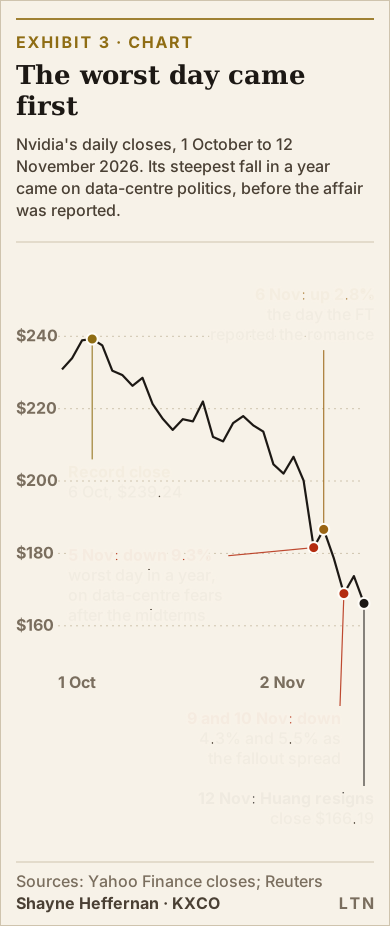
The market has already shown that data-centre politics can move this stock on its own. Nvidia's worst day of the past year was 5 November, a fall of 9.3%, as shares exposed to AI sold off on fears of Democratic action against data centres, by Yahoo Finance's daily closes and CNBC's report. The Financial Times reported the romantic relationship the next day, the San Francisco Standard noted, and Nvidia rose 2.8% that day. It then fell 4.3% on 9 November 2026 and 5.5% on 10 November, by the same daily closes, as concerns mounted over the fallout from the affair with a businesswoman alleged to be a Chinese spy, Reuters reported.
None of these concerns is frivolous on its own. Data-centre siting, grid capacity, water stress and the labour transition are real policy problems that deserve real debate. The sermon about his marriage works differently. It does not argue about power consumption. It does not model grid load. It does not examine the architecture of export controls. It personalises. It reduces a question about industrial policy, semiconductor supply chains and American technological leadership to a question about one man's bedroom. That is not journalism. That is narrative management.
The incentives are simple. Outrage drives engagement, and engagement drives advertising revenue. A story about GPU export controls needs a reader who understands dual-use technology, the Entity List and transshipment through third countries. A sermon about a billionaire's marriage needs no such reader. It needs only a pulse. The market selects for the second, and it has done so for a decade. The result is a press corps that too often cannot tell a governance scandal from a tabloid item, because its business model rewards the tabloid item whatever its truth or relevance.
There is a simpler explanation that should not be discounted: many of the people writing these stories dislike AI. Their objection is to its trajectory: the concentration of power, the displacement of creative work, the environmental cost, and the sense that something essential about human expression is being automated. That dislike is a legitimate position to hold. It is a position, not a fact, and it should be argued as one. When it is smuggled into coverage as moral condemnation of the executives building the technology, it stops being argument and becomes innuendo. The reader is not being persuaded. The reader is being pointed.
What shareholders care about
Ask any institutional investor, BlackRock, Vanguard, State Street, the sovereign wealth funds or the pension funds, what they evaluate when they hold Nvidia. They evaluate revenue growth, the trajectory of the gross margin, data-centre demand, the competitive position against custom chips, exposure to export licences, customer concentration, management execution and capital return. They do not evaluate the chief executive's marital status. The proxy statements, annual reports and investor-day presentations contain no section on a chief executive's personal life, because no serious capital allocator has ever asked for one.
The market's indifference to private conduct is rational. Absent legal exposure, it does not move the income statement. The share price did move. Nvidia closed at $166.19 on 12 November 2026, 11.0% below its close of 6 November and 30.5% below its record close of 6 October, by Yahoo Finance's daily closes, and its market value fell from $4.498 trillion to $4.005 trillion over the week, Yahoo Finance reports.
That fall prices the loss of a founder who had 60 direct reports and no succession plan, as a Yahoo Finance analysis notes, and a security question still open. The income statement has not moved. What moves it is whether TSMC can produce Blackwell wafers at volume, whether memory supply from SK Hynix, Samsung and Micron holds, the suppliers Nvidia names, whether the CUDA software moat survives open alternatives, whether the export-control regime tightens or loosens, and whether enterprise and sovereign AI spending keeps scaling. Those are the variables. Everything else is noise with a byline.
Character is not irrelevant to leadership. A chief executive who lies to the board, steals from the company, abuses subordinates or builds a culture of fear has failed in ways that become enterprise failures, and those failures are properly the board's business. The inference from "this executive has a complicated private life" to "this executive is unfit" is a non sequitur, and American media culture has spent decades normalising it. The normalisation is the scandal.
The selective outrage problem
Consider the asymmetry. American media spent years covering the private lives of politicians, athletes and entertainers with a voracity that had no evident limiting principle. The justification offered was always some version of "the public has a right to know". The public's right to know has never extended to the private lives of the audience. It has always extended to the private lives of the people the audience consumes. That is a consumption principle. The audience is entitled to the spectacle because the audience pays for it.
Apply that principle to Jensen Huang. He is not a politician. He holds no public office. He is not an entertainer. He is an engineer whose product is infrastructure. The public's interest in his marriage is a consumer interest, manufactured by a press that has learned manufactured interest is profitable. The "right to know" collapses the moment you ask what the public is supposed to do with the knowledge. Vote differently? Nvidia is on no ballot. Boycott? Most of what Nvidia sells goes to companies and governments: $89.0 billion of its $96.2 billion of revenue in the July quarter came from the data centre, its quarterly report shows. Knowing about his marriage serves no civic function. It serves the narrative.
And the narrative serves interests that have nothing to do with Huang. It serves the campaign against data centres, which benefits from any story that makes AI infrastructure look morally tainted. It serves the anti-AI commentary class, which benefits from any story that moves attention from the technology's capabilities to its makers' flaws. It serves the engagement economy, which benefits from any story that triggers. None of these beneficiaries is Jensen Huang's wife. None of them is his God. All of them are in the business of selling attention, and a morality story is the cheapest product they make.
What accountability would look like
If the American press wants to hold Nvidia to account, here is what accountability looks like. It looks like rigorous reporting on whether the company's export-control compliance is adequate: evidence of screening failures, of shipments to restricted end users, of internal warnings ignored, rather than allegation. Some of that work is under way. The Justice Department's investigations reach Megaspeed and Super Micro, and one examines Nvidia itself for possible antitrust violations, Semafor reported. It looks like analysis of Nvidia's dependence on TSMC and the geopolitical risk that concentration creates. It looks at the competition from Google's TPUs, Amazon's Trainium, Microsoft's Maia and China's own chip programmes, and asks whether Nvidia's moat is structural or temporary. It looks at the energy and water footprint of the data-centre build-out and whether the grid can absorb it. It looks at the displacement of labour and whether the productivity gains are shared or captured.
These are the questions. They are hard. They require expertise. They do not sell as well as a bedroom scandal, and that is why they are asked less often. The morality game is easier because it needs no expertise, no sourcing and no verification beyond a rumour's circulation. It is also more corrosive, because it trains the public to judge institutions by the private conduct of their leaders rather than by the performance of the institutions.
A country that judges its companies by the gossip about their executives rather than by their output will eventually find it cannot tell a scandal from a success. It will punish the success for resembling the scandal. It will reward the scandal for the attention it generates. And it will wake up one day to find that the companies it destroyed for their leaders' private lives were the companies that mattered.
Jensen Huang built something that works. The question for America is not who he slept with. It is whether a foreign service reached him, whether his company's own code was kept, and whether America still knows how to value what works. The first test comes on Tuesday 17 November, when Nvidia reports its third quarter without him, the company says: read the data-centre revenue, the gross margin and what Colette Kress says about China. Huang is due to testify to Congress before Thanksgiving, the House Foreign Affairs chairman said.
Stocks mentioned: $NVDA (NASDAQ).
Shayne Heffernan, Ph.D., is the founder of the KnightsBridge Group (shayneheffernan.com).

The Nvidia Honeypot: Alice Huang and the China-Linked Network Around Megaspeed
Jensen Huang has admitted an affair with Alice Huang, a former Megaspeed executive whom US intelligence reportedly believes China recruited. Nvidia can still sell a great deal to China legally. The question is whether this relationship got its chips around the export rules. There is no public finding that it did, and Nvidia says its checks found Megaspeed owned outside China. The network around her runs to 7Road, Alibaba's money and a state-controlled bank.

In Defence of Jensen Huang
Jensen Huang told Nvidia's staff on 8 November that he was unfaithful to his wife, and took full responsibility. The claim that the woman is a Chinese intelligence asset comes from press reports, led by the New York Times, citing US intelligence officials. China calls it groundless, and Nvidia's board says it has no reason to believe national security or company secrets were compromised. Huang built the first $5 trillion company. He should stay.

The Week Ahead on Wall Street, 9 November 2026: AI Is Still a Buy
We still think AI is a buy. After the midterms the semiconductor index fell 11.4% while the S&P 500 lost 2.5%, in our view an overreaction that fell on the chip names. October payrolls rose 165,000, oil stays high with the Iran war unresolved, Alibaba and Tencent gained, NVIDIA trades at 15.4 times forward earnings, and both SpaceX and Tesla have special committees studying a combination. KXCO's AI ontology shows the relationships behind the NVIDIA, China and SpaceX calls.

Democrats' AI Spending Curtailment: The Dumbest Idea in Washington
After the midterm sweep, Democrats want to slow America's AI build-out. The Sanders and Ocasio-Cortez bill would freeze building and upgrading of AI data centres nationwide, and a superintelligence ban Rep. Yassamin Ansari wants atop the agenda would pause every model trained with 10^25 operations or more. Governors-elect in Texas and Georgia back pauses, and Goldman Sachs puts 45% of planned capacity in Democrat-run states backing moratoriums. Shayne Heffernan: AI computing follows the power.
Every story, signed and delivered.
Subscribe to the kxco channel and get the headline, the AI-written key takeaways, and the chain-anchor link the moment we publish. Audio versions and per-ticker subscriptions arrive in the next iteration.