
The Nvidia Honeypot: Alice Huang and the China-Linked Network Around Megaspeed
Jensen Huang has admitted an affair with a former Megaspeed executive whom US intelligence reportedly believes China recruited. There is no public finding of an export breach. The network around her runs to China in its origins, its money and most of its people.
Part of theAI Stocks Center
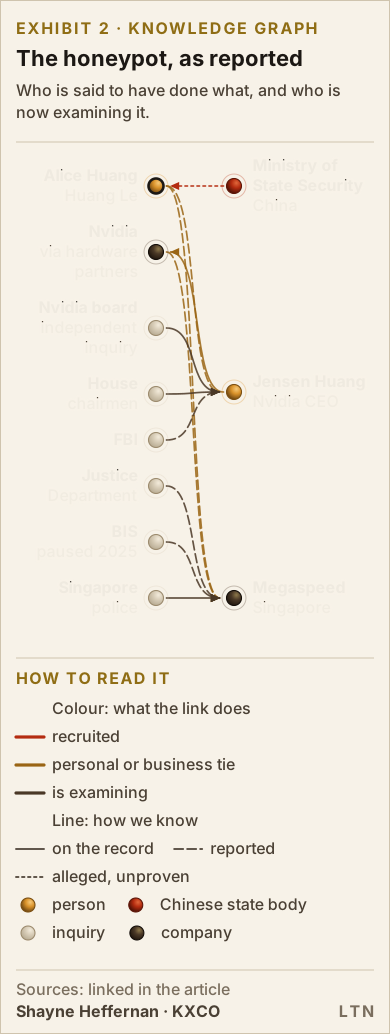
Jensen Huang told Nvidia's staff on 8 November that he had been unfaithful to his wife, in a memo Nvidia published. He admitted to Nvidia's board that the relationship was with Alice Huang, also known as Huang Le, who US intelligence officials have concluded was working for the Chinese government, the San Francisco Standard reports from the New York Times. She used to be an executive of Megaspeed, a Singapore company that rents out Nvidia computing power from data centres in Southeast Asia. US intelligence reportedly assessed that China's Ministry of State Security recruited her to gather information on Nvidia's chief executive, CNBC reports.
In my view, this is a honeypot: an intelligence operation that uses a personal relationship to get close to a target. That is my reading of the reporting, and it is not proven. China's foreign ministry calls the allegations "pure groundless speculation and slander", ABC News reports. Reuters could not independently verify the allegation or find Alice Huang to seek comment, it reports. Nvidia's board has opened an independent investigation and says it has "no reason to believe that either national security or NVIDIA secrets were compromised", in its statement of 8 November.
Nvidia's chips are not all banned from China, and much of its China business is legal. The question for investors is whether this relationship got Nvidia's products around the export rules, and what it could cost. There has been no public finding that Megaspeed broke the rules, Reuters reports. The network around Alice Huang runs to China in its origins, its money and most of its people, and Bloomberg has documented gaps in the checks Nvidia ran on it.
What Nvidia may sell to China
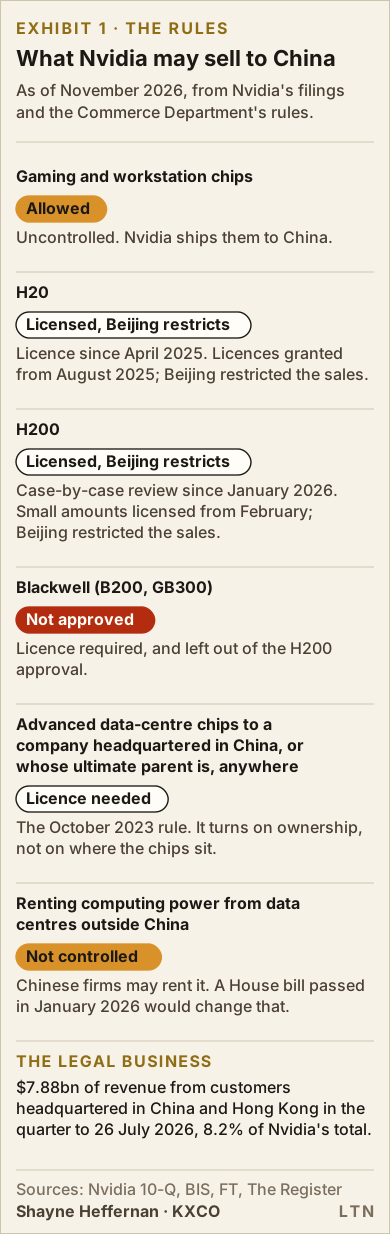
Since October 2023, US rules have required a licence to export Nvidia's most advanced data-centre chips to China, and to any party "headquartered in, or with an ultimate parent headquartered in" China, wherever it operates, as Nvidia disclosed at the time. In January 2026 the Commerce Department's Bureau of Industry and Security (BIS) moved licence applications for the H200 and less advanced chips from a presumption of denial to case-by-case review. The approval of H200 sales did not cover Blackwell, Nvidia's current generation, The Register reported.
The business that remains is large. Nvidia booked $7.88 billion of revenue from customers headquartered in China and Hong Kong in the quarter to 26 July 2026, 8.2% of its total, according to its quarterly report. The same filing says it could ship "uncontrolled products to China, such as gaming and workstation GPUs" but was "effectively foreclosed" from China's data-centre market, and that shipments of its Hopper data-centre chips to China were less than 1% of data-centre revenue. Nvidia counts revenue by where the direct customer has its headquarters, and says "the end customer and shipping location may be different".
Renting is a separate matter. Chinese companies can legally rent computing capacity in data centres outside China but cannot own the restricted chips that power them, the Financial Times reports. That is Megaspeed's business. In January 2026 the House passed the Remote Access Security Act, which would extend export controls to remote access to chips, Baker McKenzie notes.
The honeypot, as reported
The New York Times reported on 29 October that US intelligence officials had concluded Alice Huang worked as a Chinese spy and had grown close to Jensen Huang, and that Trump was briefed but apparently took no action, the Standard reports. Secretary of State Marco Rubio told Trump aboard Air Force One in May, on the way to Beijing, that the United States had intelligence showing Huang was in a relationship with a woman believed to be a Chinese spy, the Times reported on 10 November. It was at least the second time in seven months that Trump had been told. The FBI first raised concerns with lawmakers nearly a year ago, two people familiar with the matter told CNN, and is separately examining whether Huang was targeted, according to Reuters. Trump says Huang told him he had "absolutely no idea" and that he believes him.
Huang told Bloomberg News in October that his dealings with Alice Huang were "related to Megaspeed, and it was all completely normal and not unusual", the Standard reports. She has visited the United States ten times since 2017, the latest in March 2025, when she was photographed at Nvidia's headquarters in Santa Clara, CNN reports.
Nvidia's independent directors have hired former acting US Attorney Joon Kim and the law firm Wachtell, Lipton, Rosen & Katz to lead the investigation, Reuters reports. Three House committee chairmen have asked Huang to brief them behind closed doors on 18 November, and to reply by 11 November, in a letter released on 5 November.
Nationality is not evidence. The case rests on intelligence that has not been made public, and it should be judged on what the inquiries find.
The network around Alice Huang
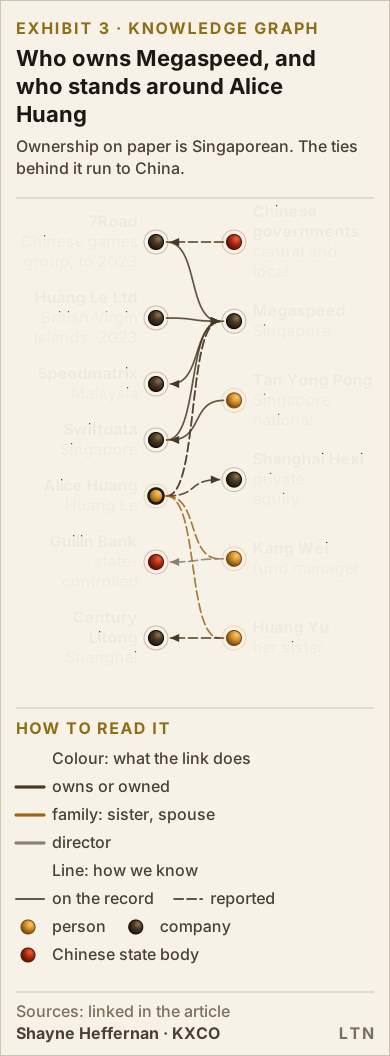
Megaspeed began as the Singapore arm of 7Road, a Chinese gaming and cloud computing company whose owners include China's central government and several local governments, Mothership reports, citing the New York Times. It was renamed Megaspeed International on 7 March 2023, Business Insider reports. When Alice Huang took over, its shares passed from 7Road's Hong Kong unit to Huang Le Limited, a British Virgin Islands company. Alice Huang became its controlling shareholder that month, according to the research group C4ADS.
In November 2023 Huang Le Limited sold Megaspeed to a Singapore shell company owned by Tan Yong Pong, a Singapore national, and four days later Megaspeed was designated an official Nvidia Cloud Partner, Bloomberg reported. The status gives preferred access to Nvidia's chips. C4ADS could not determine who ultimately controls Swiftdata, the new owner, but assessed that Alice Huang may have continued to exercise influence over Megaspeed, citing appearances in which she was identified as its chair, Reuters reports.
Her ties in China run through Shanghai Hexi Investment, a private equity firm founded by the fund manager Kang Wei. She was a major shareholder and senior executive there, and the two were married, Caixin reports. Kang sits on the board of state-controlled Guilin Bank, according to corporate records cited by the Financial Times, and Shanghai police detained him around the Lunar New Year on suspected stock manipulation, Caixin reports.
Until August 2025 Shanghai Hexi was 48% owned by a holding company Alice Huang founded, Bloomberg reported. Hexi backed the Yangtze River Delta Project, a Shanghai data centre that counts Tencent as a tenant. Shanghai Shuoyao, another company under her holding company, advertised for engineers to work on "H100, H200 and other GPU models" about half a kilometre from that data centre. Its WeChat photos of its Indonesia staff show Megaspeed's employees, according to a person with knowledge of the matter.
Her sister, Huang Yu, ultimately controlled a founding shareholder of Shanghai Century Litong that exited the company in 2024, The Information reported, via Reuters. Litong, a China-based company founded in June 2023, secured preferred cloud partner status with Nvidia by October that year, Reuters reports. Litong told The Information that "our company has no business dealings with Ms. Huang" and that its resources are obtained in compliance with the law, Yahoo Finance reports.
The money and the chips
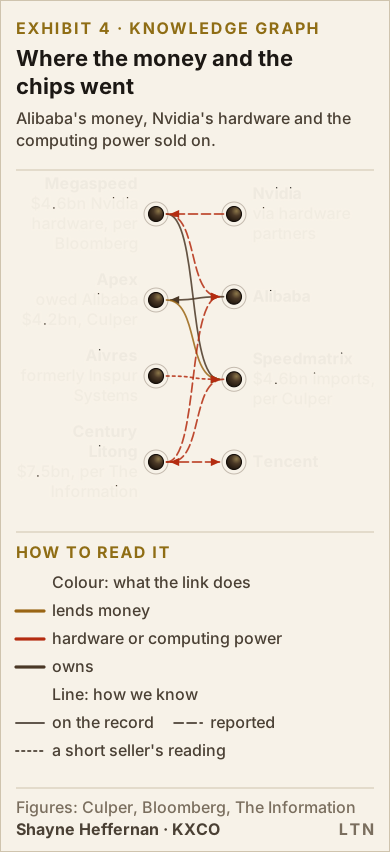
Alibaba was the founding anchor customer of Megaspeed's Southeast Asian cloud and remains its largest client, two people told the Financial Times. In June 2024 Apex Enterprise Solutions, Alibaba's Singapore subsidiary, lent money to Speedmatrix, Megaspeed's Malaysian subsidiary, which pledged its entire business as collateral.
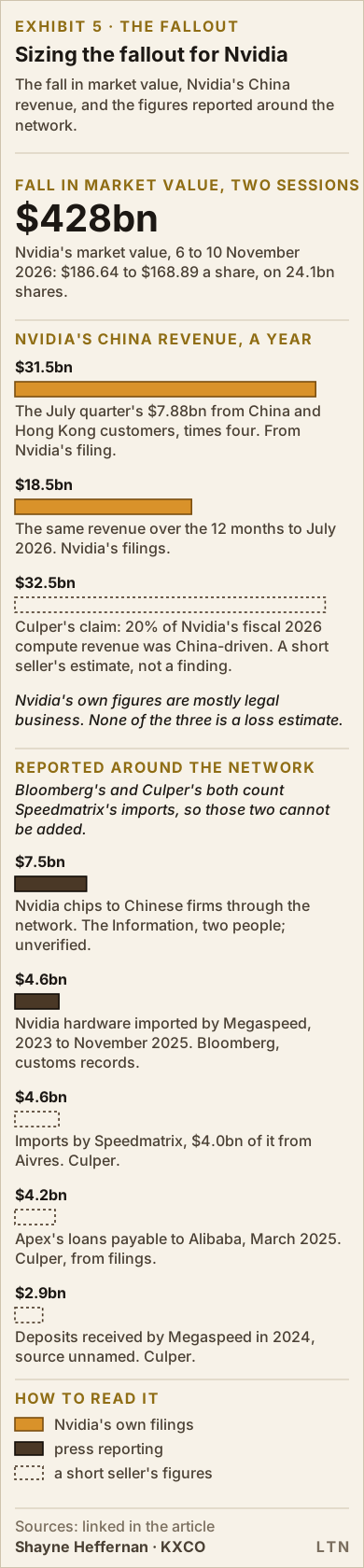
Culper Research, which published a short report on Nvidia on 13 May 2026, read Apex's filings: at 31 March 2025, "Apex reported over $4.1 billion in prepayments against $4.2 billion in loans payable to Alibaba", according to Culper's summary. Megaspeed's assets rose from $33 million at the end of 2023 to $3 billion a year later, its filings show, with revenue of $294 million and an after-tax loss of $20 million in 2024, Reuters reports. Culper traced the growth to $2.9 billion of "refundable deposits received" from an unnamed source.
Bloomberg's analysis of Malaysian and Indonesian customs records found that Megaspeed imported Nvidia hardware worth at least $4.6 billion, containing at least 136,000 GPUs, from its founding in 2023 to November 2025, Bloomberg reported. More than half were from the Blackwell line, which Trump has said he will not approve for export to China. In November 2025 Megaspeed imported at least 17,544 GB300s worth some $787 million, Bloomberg reports. Culper counted $4.6 billion of imports by Speedmatrix from December 2024 to January 2026, $4.0 billion of it from Aivres Systems, formerly Inspur Systems (Culper's summary).
The largest figure comes from The Information, citing two people who know her: the relationship helped move at least $7.5 billion of Nvidia chips to Chinese firms, about 240,000 H100, H200 and some A100 chips, through a network centred on Century Litong, Reuters reports. Hardware bought by Speedmatrix later reached Century Litong, and some of the chips served Alibaba, Tencent and smaller Chinese AI labs, the report said. Reuters could not independently verify it.
For scale, Epoch AI estimates with 90% confidence that between 290,000 and 1.6 million H100-equivalents of computing power were smuggled to China through the end of 2025, across every route. It models Megaspeed as having between none and 50,000 chips diverted, according to Epoch AI.
Nvidia's checks and the gaps in them
Nvidia says its checks found what the rules ask about. Its inquiry found Megaspeed "fully owned and operated outside of China, with no China shareholders", and it called Megaspeed's business "a cloud service permitted under the export control rules", Bloomberg reported in December 2025. Nvidia visited 12 facilities owned by eight companies in three countries, sent inventory checks to BIS and said in mid-November 2025 that everything was where it should be. Nvidia said it had asked the government whether it needed to cut Megaspeed off and was told no, Bloomberg reports.
In December 2025 Malaysia's trade ministry said there was "no clear evidence" of export control violations in its jurisdiction, and Bloomberg's own review found no evidence that any of Megaspeed's Nvidia chips had been diverted to China, Bloomberg reported. Megaspeed says inspections by BIS, Malaysia's trade ministry and Nvidia found no evidence of any violations, on its website.
Singapore questioned Alice Huang in 2025 in a probe into false import declarations and barred her from leaving. The investigations against her were closed for lack of evidence, a person familiar with the matter told the New York Times, The Next Web notes. Answering a Wall Street Journal report that authorities were investigating her alleged links to Chinese intelligence, Singapore's home affairs ministry said "there were no such investigations conducted in respect of Alice Huang", and that investigations into Megaspeed continue, Reuters reports.
The gaps are in the counting. Nvidia's tabulations, as relayed to the US government, undercounted the chips it had sold to Megaspeed through hardware partners by 50,000 units, worth billions of dollars, by Bloomberg's analysis of trade records published on 10 November 2026. Nvidia says further Megaspeed warehouses contained the missing hardware, but it has not said how many chips it found there. Two of the eight data-centre operators it named say they do not have Megaspeed's hardware. Nvidia says it banned all sales and shipments to Megaspeed in June 2025, The Next Web reports from the Wall Street Journal. Megaspeed remains an official Nvidia Cloud Partner.
Then there is the call. In late summer 2025, Nvidia's general counsel, Tim Teter, called Jeffrey Kessler, the Commerce under secretary who oversees chip export controls, to ask whether BIS was involved in Singapore's detention of Alice Huang, Bloomberg reports. By detention, Bloomberg means her questioning and the bar on leaving. BIS was not involved, the people said, and it is unclear whether Teter made any specific requests of Kessler. Nvidia says Teter was unaware of the affair at the time.
In the weeks that followed, BIS staff were told to route all requests of Nvidia through Kessler, a step people familiar with the matter called highly unusual, Bloomberg reports. When Teter later wrote to BIS staff, Kessler told them to continue handling the case by the book. The Justice Department asked BIS to pause in late 2025, and its criminal investigation means the case has not been dropped. The New York Times report gives no evidence that Kessler ordered investigators to halt their work or that Nvidia successfully influenced the outcome, Investing.com reports. BIS says it "conducts all enforcement strictly by the book".
In my view, on the surface there is no public evidence that the relationship got Nvidia's chips around its compliance process. There is no public finding of a breach, and The Information's account of chips moving into China rests on two people, and Reuters could not independently check it. The rules turn on ownership, and on paper, by Nvidia's account, Megaspeed passed: a Singapore owner and no Chinese shareholders. The regulations do not define "ultimate parent", Bloomberg noted. The inquiries will look at who controlled Megaspeed in practice, whether all 50,000 chips are in those warehouses, and why Nvidia's lawyer called the regulator.
Sizing the fallout
The market has already marked part of it. Nvidia closed at $168.89 on 10 November 2026, against $186.64 on 6 November 2026, the last close before Huang's memo, according to Yahoo Finance data. On the 24.1 billion shares Nvidia reported outstanding in August, that is a fall of about $428 billion in market value over the two sessions to 10 November 2026, on closing prices.
Revenue tied to China is the larger exposure. Nvidia's revenue from customers headquartered in China and Hong Kong was $18.5 billion over the 12 months to July 2026, by its annual report and quarterly report, and runs at about $31.5 billion a year at the July quarter's $7.88 billion, up from about $4.6 billion in the quarter before. Much of it is legal business, and not all of it is exposed: gaming and workstation chips are uncontrolled. Culper argues that "over 20% of Nvidia's FY 2026 compute revenues remained driven by China", through diversion and Southeast Asian intermediaries. On Nvidia's fiscal 2026 compute revenue of $162.4 billion, 20% is $32.5 billion. That is the short seller's claim, not a finding. None of these figures is an estimate of what Nvidia will lose.
Washington's response will decide whether any of it is at risk. Senators Jim Banks, a Republican, and Elizabeth Warren, a Democrat, have urged Commerce to suspend or reconsider Nvidia's China export licences. Their bill would temporarily bar Nvidia from selling Chinese customers any chip more advanced than the H200, and House Democratic leader Hakeem Jeffries wants it in the annual defence bill, The Next Web reports. Export penalties can reach twice the value of the transaction, under 50 U.S.C. 4819, and there is no public finding of a violation.
Some of the figures reported around the network overlap and cannot be added together: Bloomberg's and Culper's both count imports by Speedmatrix, Bloomberg's data note shows.
What to watch
Nvidia reports third-quarter results on 17 November, a day before the House briefing, CNBC reports. Its China revenue line will show whether the legal business is holding. Huang's answer to the three chairmen was due on 11 November, under their letter.
Stocks mentioned: $NVDA (NASDAQ), $BABA (NYSE) and $TCEHY (OTC).
Shayne Heffernan, Ph.D., is the founder of the KnightsBridge Group (shayneheffernan.com).

In Defence of Jensen Huang
Jensen Huang told Nvidia's staff on 8 November that he was unfaithful to his wife, and took full responsibility. The claim that the woman is a Chinese intelligence asset comes from press reports, led by the New York Times, citing US intelligence officials. China calls it groundless, and Nvidia's board says it has no reason to believe national security or company secrets were compromised. Huang built the first $5 trillion company. He should stay.

The Week Ahead on Wall Street, 9 November 2026: AI Is Still a Buy
We still think AI is a buy. After the midterms the semiconductor index fell 11.4% while the S&P 500 lost 2.5%, in our view an overreaction that fell on the chip names. October payrolls rose 165,000, oil stays high with the Iran war unresolved, Alibaba and Tencent gained, NVIDIA trades at 15.4 times forward earnings, and both SpaceX and Tesla have special committees studying a combination. KXCO's AI ontology shows the relationships behind the NVIDIA, China and SpaceX calls.

Democrats' AI Spending Curtailment: The Dumbest Idea in Washington
After the midterm sweep, Democrats want to slow America's AI build-out. The Sanders and Ocasio-Cortez bill would freeze building and upgrading of AI data centres nationwide, and a superintelligence ban Rep. Yassamin Ansari wants atop the agenda would pause every model trained with 10^25 operations or more. Governors-elect in Texas and Georgia back pauses, and Goldman Sachs puts 45% of planned capacity in Democrat-run states backing moratoriums. Shayne Heffernan: AI computing follows the power.

AI Stocks, Week of 1 November 2026: Seven Buys and the Ontology Behind Them
Shayne Heffernan rates seven AI stocks buys for the week of 1 November 2026: Nvidia, Broadcom, TSMC, Microsoft, Oracle, Palantir and ASML. The latest results put the contracted backlog of the four largest cloud sellers at about $2.48 trillion, and Amazon, Alphabet, Microsoft and Meta plan about $720 billion to $740 billion of capital spending in 2026. Every call links to KXCO's AI ontology, updated on 1 November with the quarter's results, power and grid data and new defence contracts.
Every story, signed and delivered.
Subscribe to the kxco channel and get the headline, the AI-written key takeaways, and the chain-anchor link the moment we publish. Audio versions and per-ticker subscriptions arrive in the next iteration.