
Thoughts on Thinking
This article is the expansion of a Telegram conversation with my friend Alex
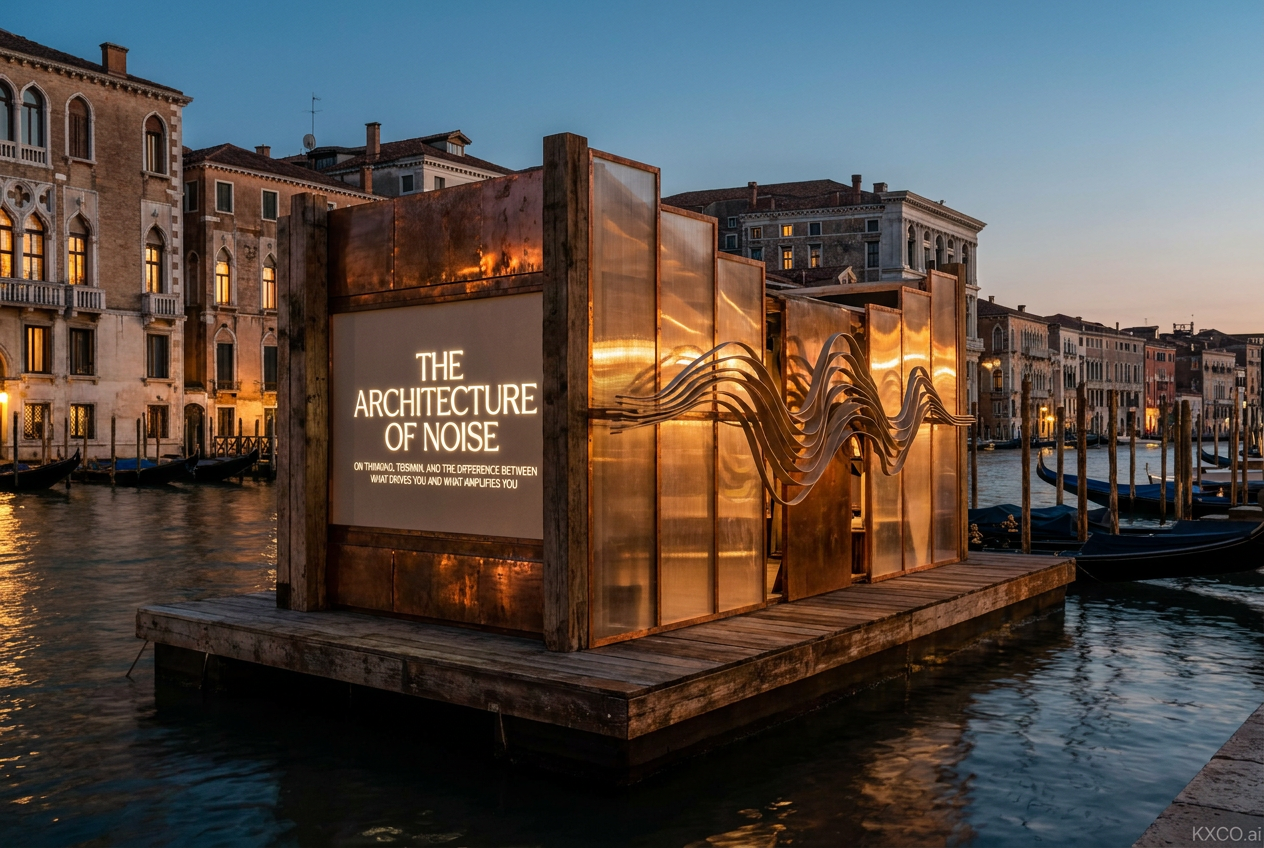
The Architecture of Noise
On Thinking, Terrain, and the Difference Between What Drives You and What Amplifies You
I don’t meditate. I don’t journal. I don’t sit cross-legged and wait for clarity to arrive like a bus, I hunt it down and capture it.
What I do is far less aesthetic and far more deliberate. I put rain sounds on so loud in a cold, dark room that it drowns out every other input and then, if I’ve got the volume right, the rain itself disappears. What’s left is the only thing that was always there: my own mind, operating without interference for the first time in hours, maybe days. Most people add things to their thinking process. Apps, frameworks, morning routines, journals, cold plunges. I remove things. I am an excavator, not a builder.
This isn’t a model for you to copy. That would miss the entire point. What I’m describing is what works for my specific cognitive architecture after years of running experiments on myself. You may find it profound. You may find it unhinged. Different environments, different frequencies, different nervous systems will produce wildly different reactions. The insight isn’t in the specifics, the rain sound, cold room, dark. The insight is in the underlying principle: refining the knowledge of what drives your thinking and what amplifies that is the key. Not what works for someone else. What works for you. And the only way to find that is to test ruthlessly and observe honestly.
The Cognitive Atlas
I’ve mapped my own thinking geography with enough precision to know that different physical locations produce qualitatively different types of thought. This isn’t metaphor. It’s repeatable, observable, and I’ve been doing it long enough to trust it. St. Moritz gives me a particular kind of thinking more humanistic, more expansive, more connected to civilization and culture and what people actually need. The Swiss mountains seem to widen the aperture. I come out of those sessions thinking about people, about society, about what endures.
Bhutan is the opposite. Raw. Battle-planning territory. I go there to map operational terrain — how do we get from where we are to where we’re going? How do we bridge the gap? What are the obstacles and what’s the order in which they need to be dismantled? Bhutan thinking is not gentle. It’s not philosophical in the way people use that word to mean soft. It’s philosophical in the way Sun Tzu was philosophical.
Paris is something else entirely. Walking the streets of Paris — that’s where thinking about people becomes thinking with people. Love, relationships, family, friendships, art. It’s no accident that artists and scientists and writers have been finding each other in Paris for centuries. The city functions as a cognitive catalyst for human connection. I don’t go there to plan. I go there to connect.
The ocean is not a thinking place. I want to be very clear about this because it contradicts what most people assume. The ocean is a non-thinking place. It’s a disconnect. It’s good for resetting, for swimming, for the simple things — food, sleep, the physical world. But personal reflection as a primary activity? That’s a luxury for people who have stopped building. If you’re still in the arena, the ocean is a weekend, not a strategy.
Walking — which I actually dislike — is for battle plans. The rhythm, the forward motion, the discomfort of doing it in heat: all of it sharpens concentration in a way that sitting still doesn’t. There’s something about the physical act of moving toward a horizon while your mind is doing the same thing cognitively. The discomfort gives it an edge. I’ve come to believe that a little discomfort is essential for real thinking. Perfection — the warm breeze, the sunset, the ideal temperature — doesn’t sharpen you. It relaxes you. And there’s a time for that. But it’s not the time when you’re trying to see clearly.
How I Learned to Think
Thinking is the hardest skill of all to acquire. Harder than any technical discipline. Harder than learning to read a balance sheet or write code or build a business. Because thinking isn’t additive — you don’t layer it on top of what you know. Thinking is subtractive. You strip away everything that isn’t essential until only the essential remains.
A 2021 study published in Nature by Adams, Converse, and colleagues confirmed this at a cognitive level. They demonstrated that “people systematically default to searching for additive transformations, and consequently overlook subtractive transformations.” The researchers found that additive ideas come to mind quickly and easily, but subtractive ideas require more cognitive effort — and that most people never make that effort. They keep adding. New tools, new frameworks, new habits. I learned early that the opposite was true for me: every addition to my process made the thinking worse. What improved it was removal. Strip away the noise. Strip away the inputs. Strip away everything that occupies cognitive bandwidth without earning it. What remains is thinking that is sharper because it has less interference, not more support.
Edward de Bono’s “I Am Right, You Are Wrong” is where I started, and I’d recommend it to anyone. Not because it teaches you how to win arguments — it does the opposite. It teaches you that the best argument may not be the right answer. Once you genuinely internalize that, something shifts permanently. Everything you hear, read, and see stops being instruction and starts being noise. Not in a dismissive sense. In a precise, operational sense. External input no longer influences your thinking. It merely raises questions. And a question, unlike an answer, doesn’t occupy space in your mind. It points you toward the space you need to explore yourself.
Cardinal Sarah’s writings on silence take this further. His argument, which I won’t paraphrase because you should read him directly, is that in silence you find yourself, and when you find yourself you will find God. I don’t offer that as theology. I offer it as an empirical observation about cognitive function. The silence isn’t empty. It’s full — full of everything that was always there but that you couldn’t hear because you were too busy listening to other people.
These two frameworks — de Bono’s radical skepticism about the superiority of any single argument, and Sarah’s insistence on silence as the precondition for self-knowledge — aren’t separate systems for me. They’re the same machine. You strip away the tyranny of other people’s answers, then you strip away the noise of your own accumulated inputs, and what remains is something that can actually think rather than merely react.
Noise
I want to be precise about what I mean by noise because I think most people misunderstand the concept. Noise isn’t just loud sounds or busy environments. Noise is anything that occupies your cognitive bandwidth without earning it.
Social media comparison is noise. Not because other people’s achievements aren’t real, but because the act of measuring yourself against them uses the exact cognitive resources you need for your own thinking. You’re spending the capital you need to build your own house on appraising someone else’s.
Money — or rather, the constant awareness of money — is noise. I only carry cash. I don’t look at the bank. I don’t count the assets. I wake up every morning needing to earn. What I made today is what I can spend tomorrow. This isn’t financial advice. This is a psychological defense mechanism. I’ve seen what the awareness of accumulated resources does to people. It softens them. It replaces the question “what do I need to build?” with the question “what do I need to protect?” And those are radically different cognitive states. One creates. The other consolidates. I have no interest in consolidation.
The desire to win, to achieve, to build — that has to come from deep within you. If you find it by looking at other people, whether in person or on a screen, you haven’t found desire. You’ve found envy. And envy is not a fuel. It’s a solvent. It dissolves your ability to think clearly because you’re no longer oriented toward your own north — you’re oriented toward someone else’s.
The Objective
When you remove enough noise, what you’re left with is the question of objective. What are you actually building, and why? Money is a byproduct of your objective. If it becomes the objective itself, you are lost. That’s the mentality the world tries to teach you from childhood — that the purpose of work is income, that the purpose of income is consumption, that the purpose of consumption is happiness. Reject the entire chain. It’s a closed loop that goes nowhere.
A good objective is something that creates lasting value for humanity, or something that has a lasting impact on those around you. That covers a wide spectrum. On one end, you have someone making humanity interplanetary. On the other, you have someone who gave up every material possession to serve the poor and build a single church. Opposite in dollar terms. Identical in structural integrity. Both are solid objectives because both are oriented outward — toward something larger than the self — rather than inward, toward comfort or status or accumulation.
When you connect to an objective like that, it doesn’t need to be managed. It guides all of your decision-making without you even thinking about it. You don’t need motivation. You don’t need discipline. You need clarity. And clarity is what’s left when the noise is gone.
The Frequency of Places
There’s something I’ve been investigating that I can’t fully prove but that I believe is real: places have frequencies. Not in a mystical sense — or at least, not only in a mystical sense. Environments produce measurable effects on cognitive state: temperature, sound, visual complexity, air quality, population density, altitude. These are physical variables with physical effects on the brain. I’ve actually looked for data on this and found surprisingly little systematic research on how specific physical environments affect specific types of thinking. Da Vinci had a thing for mountains and emotions in his paintings. Artists have been drawn to specific geographies for centuries. I don’t think that’s aesthetic preference. I think it’s cognitive resonance — certain minds operate at peak capacity in certain physical conditions.
The rain sound works for me because it occupies the auditory channel uniformly, preventing other sounds from fragmenting my attention. The cold works because mild physical discomfort activates alertness systems in the brain. The dark works because it eliminates visual processing demands. None of this is magical. It’s just applied cognitive science, arrived at empirically rather than theoretically.
But here’s the part that might be harder to replicate: you have to actually care about the thinking itself. Not care about the results of thinking — the deal, the strategy, the breakthrough. Care about the process. Care about the quality of the thinking independent of what it produces. Because the quality of the thinking is what determines the quality of everything downstream. Most people rush past the thinking to get to the doing. They don’t realize that the doing is only ever as good as the thinking that preceded it.
What Drives vs. What Amplifies
This is the distinction that took me the longest to understand, and it’s the one I think matters most. Some things drive your thinking. They are the fuel. The deep internal question, the unresolved tension, the genuine problem that won’t leave you alone. These are the things that make you sit down in a cold dark room at 2am because the thinking demands to happen.
Other things amplify your thinking. They don’t create the thought — they make it sharper, clearer, more precise. The rain sound. The cold. The walking. The specific geography. De Bono’s framework. Sarah’s silence. These are amplifiers, not drivers.
The mistake most people make is confusing the two. They optimize their environment — the perfect desk, the perfect coffee, the perfect notebook, the perfect morning routine — without ever identifying what is actually driving their thinking in the first place. They build an amplifier with nothing to amplify. A beautiful microphone pointed at silence.
Refining the knowledge of what drives your thinking and what amplifies that is the key. Not one or the other. Both. You need to know what question is burning inside you — that’s the driver. And you need to know which conditions make your answer to that question the sharpest it can possibly be — those are the amplifiers.
The driver can’t be manufactured. It has to be genuine, internal, and oriented toward something that matters. The amplifier can be engineered, tested, and optimized. My rain-sound-in-the-dark setup took years to dial in. The volume has to be exactly right. The temperature has to be uncomfortable but not distracting. The room has to be completely dark. Your setup will be different. Your geography will be different. Your driver will be different. But the principle is universal: know the difference between what makes you think and what makes you think better. Refine both. Never stop refining. The quality of your life’s work depends on nothing else.
The Rosary
I do the rosary every day without fail. I want to be precise about what this is and what it is not, because there is a widespread assumption that repetitive prayer is a form of meditation. It is not. Meditation, in the sense most people use the term, is an exercise in emptying the mind — detaching from thought, observing without judgment, letting go. The rosary is the opposite. It is an exercise in filling the mind deliberately and completely. You are not emptying yourself. You are presenting yourself. Every bead, every decade, every Hail Mary is a structured act of directed attention toward something specific: your failures, your grief, your sorrow, your regrets, your attempts to be better, and the God before whom all of it is laid bare.
I am not recommending the rosary to you. I am recommending that you discover what functions as the rosary functions for me, and build it into your life with the same irrevocability. The form is mine. The function is universal: a daily, structured practice of complete and honest self-examination before something larger than yourself. What that looks like for you is your business.
The rosary is my time of self-reflection. Not the casual kind — not the ocean-with-a-cocktail kind I described earlier. This is something else entirely: the baring of your all before God. The things you have done wrong. The attempt to be a better person. Your grief, your sorrow, your regrets. The rosary is where all of it goes, every day, without exception. It is not pleasant. It is not relaxing. It is the most uncomfortable five decades of the day, and I do not skip a single one.
The mechanism is conditioning. By living with your failures daily — by naming them, sitting with them, and refusing to look away from them — you condition yourself to resist your weaknesses. And sometimes your strengths. That second part is important and almost never discussed. Strengths can become weaknesses when they operate without check. Confidence becomes arrogance. Decisiveness becomes recklessness. Persistence becomes blindness. The daily examination that the rosary demands does not discriminate between the two. It examines everything. That is the point.
This is not self-esteem. It is not affirmation. It is not the endless curation of a personal brand. It is the daily, voluntary confrontation with the truth about who you actually are. The rosary is the structure that makes that confrontation happen. It is a repetitive physical practice — the beads, the prayers, the rhythm — that occupies the conscious mind just enough to allow the deeper self to surface. In that sense, it functions exactly like the rain sound: it occupies the channel uniformly, then disappears, leaving you alone with what is actually there.
A landmark study published in the British Medical Journal by Bernardi and colleagues found that reciting the rosary “slowed respiration to almost exactly 6/min, and enhanced heart rate variability and baroreflex sensitivity.” Both the rosary and yoga mantras “caused striking, powerful, and synchronous increases in existing cardiovascular rhythms when recited six times a minute.” The rhythm of the prayers, it turns out, synchronizes with the body’s own natural cardiovascular rhythms — specifically the rate at which the cardiovascular system operates most efficiently. The repetitive cadence of the rosary is not an accident of liturgy. It is a biological tuning mechanism. Your breathing slows. Your heart rate stabilizes. Your autonomic nervous system shifts toward parasympathetic dominance — the rest-and-digest state that is the physiological precondition for any kind of genuine self-reflection. I did not know any of this when I started. I only knew that the rosary worked. The science explains why.
A 2021 qualitative study published in the Journal of Religion and Health, drawing on participants across multiple countries, found that those who pray the rosary regularly experience increased subjective well-being, lower religious struggle, and higher empathy scores. Participants reported that the rosary provided “spiritual peace, calm, and confidence” and was a primary mechanism for “coping with problems.” A separate study published in PMC examined the effects of prayer on attention resource availability and attention bias, finding that “prayer involves and is related to a wide range of cognitive processes, including perception, language and inner speech, affect, self-concept, memory, decision-making.” Prayer, in other words, is not a passive state. It is a cognitively demanding practice that engages multiple brain systems simultaneously — which is precisely why it produces the kind of deep self-examination that passive relaxation cannot.
And the research on moral habituation supports the mechanism I described. Aristotle’s framework of virtue development through repeated practice — what he called habituation — has been validated by modern moral psychology. A 2025 paper in PMC on “Character Virtues: Toward a Functionalist Perspective” found that contemporary psychology often reduces virtue to stable traits or observable behaviors, “overlooking the motivational core.” That motivational core is exactly what the rosary targets: not the behavior, but the internal state that produces the behavior. Daily, structured self-examination is not a religious indulgence. It is a cognitive conditioning practice. You are training the same neural pathways that govern moral decision-making, and you are doing it with the same deliberate repetition that an athlete uses to train a physical skill. The difference is that the skill you are training is the most important one: the ability to see yourself clearly and to act on what you see.
I want to be explicit about this because I think it matters: this is not a guide. This is what I do. The rosary works for me because it connects me to a tradition, a practice, and a relationship with God that is real and specific to my own life. What works for you might look completely different. It might be meditation. It might be journaling. It might be long-distance running. The form does not matter. The function matters. The function is: a daily, irrevocable practice of honest self-examination before something larger than yourself. If you do not have that, build it. If you have it, protect it. Do not skip it. The quality of everything downstream depends on it.
And I want to repeat something I said at the beginning, because I think it needs to be said again: none of this is a guide. I am not telling you to do the rosary, to listen to rain sounds, to think in cold dark rooms, to walk in the heat for battle plans. I am telling you that these are the things that work for my specific cognitive architecture after years of testing. Your job is to discover what works for yours, expand on it, and build it into your life with the same discipline. The principle is universal. The practice is personal. Never confuse the two.
Research: The Science Behind the Frequency of Places
What follows is a survey of the existing research on how physical environments — terrain, temperature, sound, light, movement, and urban design — affect cognitive performance and creative thinking. I have looked for this data myself and found it scattered, incomplete, and surprisingly sparse given how fundamental the question is. But what exists is compelling, and it aligns with the framework I’ve described above: different environments produce measurably different cognitive states, and the effects are large enough to matter for anyone serious about the quality of their thinking.
Subtractive Thinking and Information Overload
A 2021 study published in Nature by Adams, Converse, Hales, and Klotz demonstrated that “people systematically default to searching for additive transformations, and consequently overlook subtractive transformations.” Across multiple experiments, participants overwhelmingly chose to add elements when asked to improve a design, a recipe, or a situation — even when subtraction would have been more effective. The researchers found that “additive ideas come to mind quickly and easily, but subtractive ideas require more cognitive effort.” This finding directly supports the framework I’ve described: my approach to thinking is subtractive not by preference but because subtraction produces results that addition cannot. Information overload research confirms this from the other direction. A comprehensive review in ScienceDirect found that information overload “directly reduces decision quality,” “prolongs decision-making time,” and causes “chronic stress.” The Decision Lab at McGill University summarizes the mechanism: “information overload decreases our cognitive capability and can lead us to make suboptimal decisions.” The practical implication is clear: removing inputs — reducing noise — is not a philosophical position. It is a cognitive optimization strategy with robust empirical support.
“People Systematically Overlook Subtractive Changes” (Nature, 2021): https://www.nature.com/articles/s41586-021-03380-y
“Causes, Consequences, and Strategies to Deal with Information Overload” (ScienceDirect): https://www.sciencedirect.com/science/article/pii/S2667096824000508
The Default Mode Network and Reduced Sensory Input
Neuroscience has identified a brain network called the Default Mode Network (DMN) that becomes active when external demands on attention are reduced. A 2025 review published in PMC described the DMN as “crucial for processes like self-reflection, emotional processing, and moral reasoning.” The DMN activates “during periods of rest or in states of reduced attention.” This is significant for my practice because it provides a neurobiological explanation for why the cold-dark-rain-sound configuration works: by systematically reducing visual input (darkness), introducing uniform auditory masking (brown noise), and maintaining mild physical discomfort (cold), I am creating the precise conditions under which the DMN activates and the brain shifts into its self-reflective mode. A 2020 study in PMC found that “scanner background noise suppresses default-mode network” connectivity, which at first seems contradictory — but the critical variable is uniformity. Random noise suppresses the DMN. Uniform noise, once it drops below the threshold of conscious awareness, creates the sensory void that allows the DMN to engage. My experience of the rain sound “disappearing” is not subjective. It is the moment when uniform auditory input stops competing for attentional resources and the DMN takes over.
“The Journey of the Default Mode Network” (PMC, 2025): https://pmc.ncbi.nlm.nih.gov/articles/PMC12025022
“Scanner Background Noise Suppresses Default-Mode Network” (PMC, 2020): https://pmc.ncbi.nlm.nih.gov/articles/PMC6870799
Natural Environments and Creative Thinking
A 2022 study published in the National Institutes of Health library, titled “The Influence of Natural Environments on Creativity,” found that exposure to natural environments “beneficially enhances creativity, new ideas, and flexible thinking, while improving our attention to analyze further and develop ideas.” The study examined multiple mechanisms: natural settings reduce cognitive fatigue by lowering the demand on directed attention, which is the finite resource you burn through during focused work. Nature, in other words, restores the very capacity that cities and screens deplete. The American Psychological Association has summarized related findings, noting that “experiments have found that being exposed to natural environments improves working memory, cognitive flexibility, and attentional control.” A 2025 study in ScienceDirect found that viewing natural scenes enhanced stress recovery and altered default mode network connectivity, providing direct neural evidence that natural environments shift the brain into a more reflective, less reactive state. This is consistent with what I experience in the Swiss mountains: the environment isn’t just pleasant, it is actively enhancing a specific type of expansive, humanistic thinking that I cannot access as reliably in urban settings.
“The Influence of Natural Environments on Creativity” (PMC/NIH, 2022): https://pmc.ncbi.nlm.nih.gov/articles/PMC9363772
Nurtured by Nature, American Psychological Association: https://www.apa.org/monitor/2020/04/nurtured-nature
“Default Mode Network Connectivity Contributes the Augment Effect” (ScienceDirect, 2025): https://www.sciencedirect.com/science/article/pii/S2352289525000530
Altitude and Cognitive Function
Research compiled by the National Center for Biotechnology Information on “The Effect of Altitude on Cognitive Performance and Mood States” presents a more complex picture. The studies reviewed “show that altitude produces adverse alterations in human mood states, behavior, and cognitive functioning.” Cognitive impairment can begin as low as 3,000 meters and becomes more severe above 5,000 meters. However — and this is the critical nuance — a separate line of research has found that moderate altitude exposure may have a paradoxical effect on certain types of creative and non-linear thinking. A 2012 study noted that altitude “may play a role in fostering creativity,” potentially because mild hypoxia disrupts routine cognitive patterns and forces the brain into more exploratory processing modes. This aligns with my experience in Bhutan: the altitude isn’t making me smarter in a conventional sense, but it appears to strip away something — perhaps cognitive comfort, perhaps routine — that leaves a rawer, more operational mode of thinking. The research on long-term altitude exposure published in MDPI’s Brain Sciences journal found a non-linear relationship: “cognitive function decreased first, then increased, and finally decreased” with increasing altitude exposure, suggesting there is an optimal zone where altitude enhances rather than degrades cognitive performance.
“The Effect of Altitude on Cognitive Performance and Mood States” (NCBI): https://www.ncbi.nlm.nih.gov/books/NBK232882
“Effects of Long-Term Exposure to High Altitude Hypoxia on Cognitive Function” (Brain Sciences, 2022): https://www.mdpi.com/2076-3425/12/6/808
Temperature and Cognitive Sharpness
A working paper from the MIT Center for Energy and Environmental Policy Research titled “Temperature and Cognitive Performance” quantified the effect with unusual precision: “a 1°C increase in ambient air temperature leads to a performance reduction of 0.13%.” The effect, the authors found, is “mostly driven by individuals living in relatively cold areas,” suggesting that people adapt to their baseline temperature and that deviations in either direction impair performance. A study on cold stress from PMC found that “cold exposure affected attention by slowing response times and increasing the lapses, and decision-making by reducing risky behaviour.” The reduction in risky behavior is significant for my purposes: a cold room doesn’t just make you alert, it makes you cautious, deliberate, and precise. That is a different cognitive mode than the expansive creativity of a natural environment — and it is exactly what I want when I’m doing the kind of deep, precise thinking that requires accuracy rather than fluency.
“Temperature and Cognitive Performance” (MIT CEEPR): https://ceepr.mit.edu/workingpaper/temperature-and-cognitive-performance
“Cold Stress Impacts Cognitive Performance in Healthy Volunteers” (PMC): https://pmc.ncbi.nlm.nih.gov/articles/PMC3375336
Rain Sound, Brown Noise, and Auditory Masking
The rain sound technique I use has a name in the research literature: auditory masking with brown noise. Brown noise — named after Robert Brown, not the color — concentrates its acoustic energy in low frequencies, producing a sound profile similar to heavy rain, waterfalls, or ocean surf. The Cleveland Clinic notes that “brown noise has louder low frequencies and softer high frequencies for balanced sounds like waterfalls, which may help with focus.” A 2021 study published in PMC on “Spectral Content (Colour) of Noise Exposure Affects Work Efficiency” found that white noise “exerted a positive effect on cognitive performance for the attention deficit hyperactivity disorder (ADHD) group,” and that the specific spectral content of the noise — the balance between low and high frequencies — determined its effectiveness. The mechanism is straightforward: brown noise occupies the auditory channel uniformly enough to mask distracting sounds without itself becoming a source of distraction. The Superpower research platform describes the mechanism more precisely: “Brown noise supports sleep via masking disruptive background sounds,” and the same masking mechanism that supports sleep supports sustained cognitive focus. My experience of the sound “disappearing” once the volume is calibrated correctly is consistent with the masking literature: the sound occupies the attentional channel just enough to block other inputs, then drops below the threshold of conscious awareness, leaving only silence.
Cleveland Clinic, “What Is Brown Noise? The Benefits”: https://health.clevelandclinic.org/brown-noise
“Spectral Content (Colour) of Noise Exposure Affects Work Efficiency” (PMC, 2021): https://pmc.ncbi.nlm.nih.gov/articles/PMC7986458
Superpower, “Why Brown Noise Helps You Focus”: https://www.superpower.ai/blog/why-brown-noise-helps-you-focus
Walking and Creative Ideation
The most robust finding in the entire field is also the simplest: walking makes you more creative. A 2014 Stanford study led by Marily Oppezzo and Daniel Schwartz, published in the Journal of Experimental Psychology, demonstrated that “walking boosts creative ideation in real time and shortly after.” Four experiments showed that “walking increased 81% of participants’ creative output.” The study found that the effect persisted even when participants sat down after walking, suggesting that the movement itself triggers a cognitive state that outlasts the physical activity. The researchers concluded that “walking opens up the free flow of ideas, and it is a simple and robust solution to the goals of increasing creativity.” This is precisely what I experience when walking for battle plans: the forward motion appears to unlock a forward-motion cognitive mode. The brain doesn’t distinguish between physical progress toward a horizon and cognitive progress toward a solution. Walking makes both happen simultaneously.
Stanford News, “Stanford Study Finds Walking Improves Creativity” (2014): https://news.stanford.edu/stories/2014/04/walking-vs-sitting-042414
Oppezzo & Schwartz, “Give Your Ideas Some Legs” (J. Experimental Psychology): https://www.apa.org/pubs/journals/releases/xlm-a0036577.pdf
Darkness and Creative Performance
A series of studies published under the title “Freedom from Constraints: Darkness and Dim Illumination Promote Creativity” found that “both priming darkness and actual dim illumination improved creative performance.” Six studies confirmed the effect: “Darkness enhances creativity by promoting a global, explorative processing style.” The mechanism, as described by Fast Company summarizing the research, is that “darkness triggers a chain of interrelated processes, including a cognitive processing style, which is beneficial to creativity.” The researchers found that dim lighting creates a “perceptual freedom” — a sense that constraints have been loosened — which in turn promotes more exploratory, less self-censored thinking. This is consistent with my practice of thinking in a completely dark room. The darkness isn’t just removing visual distractions. It is actively shifting my cognitive processing style toward the exploratory mode that produces the deepest and most original thinking.
“Freedom from Constraints: Darkness and Dim Illumination Promote Creativity” (Journal of Environmental Psychology): https://www.sciencedirect.com/science/article/abs/pii/S0272494413000261
Urban Design and Cognitive Architecture
A 2024 study published in ScienceDirect on “Impacts of Imageability of Architecture on Brain Health” found that “environments with high imageability are correlated with better cognitive and psychological health, high emotional engagement.” Imageability is a measure of how easily a physical environment can be mentally recalled and imagined — essentially, how cognitively stimulating it is. Cities with distinctive, legible architecture produce measurable cognitive benefits compared to generic or chaotic urban environments. The LandDesign research summary on “Urban Design is Affecting Our Brains” confirmed that “many aspects of the urban environment exert a strong effect on our emotions and influence our attraction to particular areas of the city.” The Baker Institute at Rice University has gone further, proposing the concept of “brain-healthy cities” — urban environments specifically designed to support cognitive function and reduce the risk of neurodegenerative disease. This research provides a scientific basis for what artists and writers have always known intuitively: Paris makes you think differently than Frankfurt. Not because of the culture alone, but because the physical structure of the city — its imageability, its visual complexity, its walkability — produces a different cognitive state. My experience of Paris as a place for relational and artistic thinking is not romanticism. It is an empirical response to the cognitive properties of the built environment.
“Impacts of Imageability of Architecture on Brain Health” (ScienceDirect, 2024): https://www.sciencedirect.com/science/article/pii/S0169204624002858
LandDesign, “Urban Design is Affecting Our Brains”: https://landdesign.com/urban-design-is-affecting-our-brains
Baker Institute, “Brain-Healthy Cities”: https://www.bakerinstitute.org/research/brain-healthy-cities
The Rosary, Prayer, and Cognitive Function
The rosary section above is not merely personal testimony. It is supported by a growing body of research on the cognitive and physiological effects of repetitive prayer. The most significant study is by Bernardi et al., published in the British Medical Journal, which found that reciting the rosary “slowed respiration to almost exactly 6/min, and enhanced heart rate variability and baroreflex sensitivity.” The rosary and yoga mantras “caused striking, powerful, and synchronous increases in existing cardiovascular rhythms.” The practical implication is that the rosary synchronizes the body’s autonomic nervous system with its most efficient operating rhythm, creating the physiological precondition for deep cognitive work.
“Effect of Rosary Prayer and Yoga Mantras on Autonomic Cardiovascular Rhythms” (BMJ/PMC): https://pmc.ncbi.nlm.nih.gov/articles/PMC61046
A 2019 study published in PMC, “The Effects of Prayer on Attention Resource Availability and Attention Bias,” used two experiments to measure the effects of prayer, contemplation, or a control activity on attention. The researchers found that “prayer involves and is related to a wide range of cognitive processes, including perception, language and inner speech, affect, self-concept, memory, decision-making.” Prayer is cognitively active, not passive — it engages the same systems used for complex decision-making and self-regulation.
“The Effects of Prayer on Attention Resource Availability and Attention Bias” (PMC, 2019): https://pmc.ncbi.nlm.nih.gov/articles/PMC6369522
A 2021 qualitative study published in the Journal of Religion and Health, “Experiences and Perceived Effects of Rosary Praying,” found that regular rosary practitioners reported “spiritual peace, calm, and confidence,” that it was a primary mechanism for “coping with problems,” and that it produced “increased subjective well-being, lower religious struggle, and higher empathy scores.” The study drew on participants from multiple countries and cultural contexts, suggesting that the effects are robust and not limited to a single demographic.
“Experiences and Perceived Effects of Rosary Praying” (J. Religion and Health, 2021): https://pmc.ncbi.nlm.nih.gov/articles/PMC8542536
A 2025 review published in PMC on “Religion, Spirituality, Well-Being and Praying the Rosary” confirmed and extended these findings, establishing a direct link between regular rosary practice and measurable improvements in psychological well-being. A separate 2024 paper in IJSRA on “The Neurobiological Link Between Prayer, Breath Control and Cognitive Function” found that “prayer activates brain regions involved in emotional regulation, such as the prefrontal cortex and the anterior cingulate cortex,” and that “controlled breathing can significantly affect the autonomic nervous system, particularly by engaging the parasympathetic response.” The neuroscience is unambiguous: the rosary is not a relaxation technique. It is a structured cognitive practice that simultaneously engages attention, emotional regulation, self-referential processing, and autonomic nervous system regulation.
“Religion, Spirituality, Well-Being and Praying the Rosary” (PMC, 2025): https://pmc.ncbi.nlm.nih.gov/articles/PMC11950082
“The Neurobiological Link Between Prayer, Breath Control and Cognitive Function” (IJSRA, 2024): https://ijsra.net/sites/default/files/fulltext_pdf/IJSRA-2024-2136.pdf
Moral Habituation and Character Development
The concept of daily self-examination as a path to character development has deep roots in moral philosophy and is increasingly supported by empirical research. Aristotle’s framework of virtue ethics holds that “moral virtues must be developed through practice and habituation” — you become just by doing just acts, courageous by doing courageous acts. The Oxford Character Project published a comprehensive review titled “How Is Virtue Cultivated?” which argues that character is not a fixed trait but a set of “virtues of thought” and “virtues of character” that develop through deliberate, repeated practice. A 2025 paper in PMC, “Character Virtues: Toward a Functionalist Perspective,” found that “contemporary psychology often reduces virtue to stable traits or observable behaviors, overlooking the motivational core.” That motivational core is precisely what daily self-examination targets. The Jubilee Centre for Character and Virtues published research by Wouter Sanderse on “Habituation as a Lifelong Process,” confirming that “character traits [are] developed through the habituation of passionate elements.” What I described in the rosary section — the daily, voluntary confrontation with your own weaknesses and strengths — is habituation in the Aristotelian sense. You are not thinking your way into being a better person. You are practicing your way into it, one day at a time, one decade at a time, one failure at a time.
“How Is Virtue Cultivated?” (Oxford Character Project): https://oxfordcharacter.org/uploads/files/how-is-virtue-cultivated.pdf
“Character Virtues: Toward a Functionalist Perspective” (PMC, 2025): https://pmc.ncbi.nlm.nih.gov/articles/PMC12108779
“Habituation as a Lifelong Process?” (Jubilee Centre): https://www.jubileecentre.ac.uk/wp-content/uploads/2023/07/Sanderse_W.pdf

Thoughts on Thinking: Take an Art Break
The best way I know to keep complex work in perspective is to stop at intervals and look at something that took the same order of sustained attention under real constraints. The studies now show what that does: a museum visit restored attention where an urban walk did not, judging the beauty of an object raised abstract thinking almost 14 per cent, and artistic film raised originality even in people who felt worse for it. Five works, Leonardo to Holbein, and the non-default decision in each.

KXCO's New Names, Explained
Sentinel became Portcullis, Treasury became Sovereign and Meridian became Guildhall when KXCO brought its products into one family of seven, the House, on 9 October 2026. This guide explains what each name means and where it comes from, maps every former name to the product or module it became, shows how the seven connect, and lists what did not change: the addresses redirect, the packages and the chain keep their names.
Tokenized Assets for Wall Street
Regulators now ask whether the ledger is the register, who holds each unit, and whether a transfer is checked before it clears. KXCO answers all three in software: a register that settles on a chain whose validators attest every block with ML-DSA-87, holders admitted by the licensed institution under its own KYC with the Travel Rule in the wallet, and the offering's rule applied before a unit moves. The close is a market to sell into.

The China Chip Shock
On 10 October CXMT said it will ship DDR5 server modules on a 4F2 cell by year-end. Micron, SK Hynix, Samsung and Sandisk sold off for two sessions and Elon Musk said China scales faster than the rest of the world combined. This piece sets out China's memory makers, foundries, AI chip designers and toolmakers, with two knowledge graphs drawn from the KXCO AI Sector Ontology, and says what the sell-off prices and what it does not.
Every story, signed and delivered.
Subscribe to the kxco channel and get the headline, the AI-written key takeaways, and the chain-anchor link the moment we publish. Audio versions and per-ticker subscriptions arrive in the next iteration.