
History Does Not Repeat, But It Rhymes
Why This Is Still the Greatest Time in Human History to Be Alive
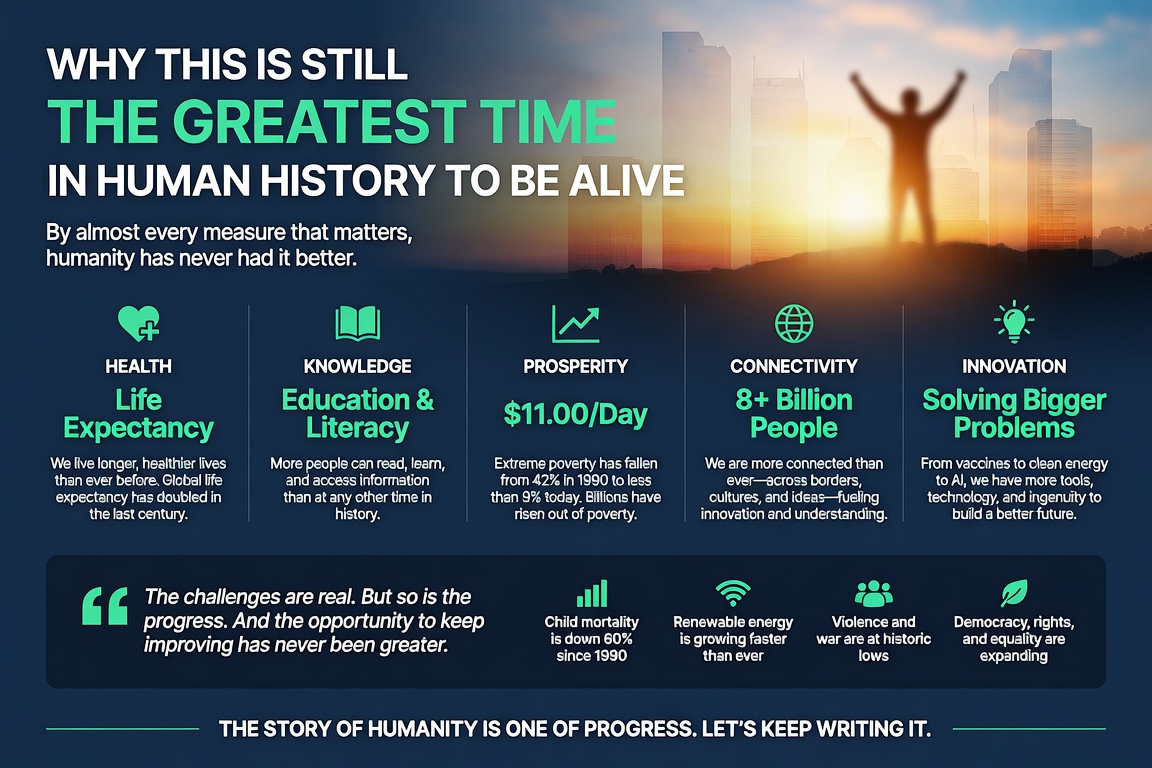
History Does Not Repeat, But It Rhymes
Why This Is Still the Greatest Time in Human History to Be Alive
Shayne Heffernan | Live Trading News | July 2026
Mark Twain is credited with one of the most durable observations about human civilization, even if he never quite said it in those exact words: history does not repeat itself, but it rhymes. The sentiment captures something profound about the way societies move through time. We do not relive the same events, wear the same uniforms, or fight the same battles on the same ground. But the underlying patterns, the oscillation between complacency and crisis, between abundance and scarcity, between the forgetting of pain and the rediscovery of sacrifice, these patterns recur with a rhythm that is almost musical in its predictability. The melody changes. The chord progression is older than any of us.
Consider where we sit in the summer of 2026. The last veterans of the Second World War are departing this earth at a rate that defies comprehension. Of the 16.4 million Americans who served in that conflict, the Department of Veterans Affairs projects that only about 31,000 remain alive as of this year. By the early 2040s, that number will reach zero. World War Two, the defining cataclysm of the twentieth century, the event that reshaped every border, every economy, every moral framework in the modern world, is transitioning from living memory into something read about in textbooks, watched in documentaries, and referenced by politicians who never heard a single first-hand account of what it was like to land on a beach under fire or survive the Burma Railway. When the last veteran dies, something irreplaceable dies with them: the ability to look a survivor in the eye and ask, what was it actually like?
And yet history tells us this is not an ending but a turning. New conflicts are already taking shape. New alliances, new rivalries, new technologies of war and peace are emerging. The rhyme is unmistakable if you listen for it. The world of the 1930s, a decade of denial, economic fragility, rising authoritarianism, and technological disruption, has echoes in the world of the 2020s. The specific actors have changed. The structural conditions have not.
The Fading of the Second World War
The statistics are sobering and they deserve to be studied with the gravity they command. In 2015, approximately 930,000 World War Two veterans were still living in the United States. By 2018, that number had fallen below 500,000. Today, we are looking at a decline of roughly ninety-five percent in just a single decade. The arc from 16.4 million to 31,000 is not merely demographic. It is civilizational. These were the men and women who liberated concentration camps, who stormed Omaha Beach, who flew bomber missions over Germany, who endured the Bataan Death March, who built the arsenal of democracy in factories from Detroit to Los Angeles. Their individual stories are irreplaceable primary sources, human repositories of experience that no archive, no museum, no film can fully replicate.
WWII Veterans: A Generation Passing | |
Total who served (US) | 16.4 million (1941–1945) |
Alive in 2015 | ~930,000 |
Alive in 2018 | ~496,000 |
Alive in 2026 (VA projection) | ~31,000 |
Decline this decade | ~95% |
Projected zero (living veterans) | Early 2040s |
Table 1: The rapid disappearance of the Greatest Generation from American life
What does a society lose when its last direct witnesses to a world war are gone? It loses a particular kind of moral authority, the kind that can only come from someone who chose to risk everything for a cause larger than themselves. It loses the corrective to romanticism, because a veteran can tell you in unsparing detail that war is not glorious, it is terrifying and ugly and arbitrary. It loses the chain of transmission between generations, the dinner-table stories, the quiet moments of reflection that shaped the values of the baby boomers, who in turn shaped the values of Generation X, and so on down the line. When that chain breaks, the lessons must be learned all over again, the hard way, through experience rather than inheritance.
This is not a uniquely American phenomenon. The same pattern is playing out across Europe, across Russia, across Japan, across every nation that participated in the conflict. The Second World War is becoming what the Napoleonic Wars became to the Victorians: a subject of study, of reverence, of artistic imagination, but not of personal recollection. And just as the forgetting of Napoleonic devastation did not prevent the First World War, the forgetting of 1939 to 1945 will not prevent the conflicts of our own century. It never does. That is the rhyme.
COVID Was the Spanish Flu
If you want to understand how history rhymes, consider the pandemics. In the spring of 1918, a novel strain of H1N1 influenza emerged, most likely at a military camp in Kansas, and proceeded to kill between fifty and one hundred million people worldwide over the next three years. More than a century later, in the winter of 2019, a novel coronavirus emerged in Wuhan, China, and within two years had claimed more than six million confirmed lives (with excess mortality estimates suggesting a far higher toll) and reshaped the global economy, politics, and daily life in ways that will take decades to fully process. Different viruses. Different centuries. Different technologies of response. But the human reactions were almost identical, and that is where the rhyme lives.
The Pandemic Rhyme: 1918 vs. 2020 | |
Causative agent | H1N1 influenza virus (1918) / SARS-CoV-2 coronavirus (2019) |
Origin | United States (1918) / China (2019) |
Estimated global deaths | 50–100 million (1918) / 6.9 million confirmed, est. 18–28 million excess (2020) |
Denial and delay | Wartime censorship suppressed reports (1918) / Political polarization delayed response (2020) |
Mask debates | Mask ordinances met with Anti-Mask League protests (1918) / Politicized mask mandates (2020) |
Blaming the “other” | Named “Spanish Flu” to deflect from US origin (1918) / Anti-Asian hate crimes surged (2020) |
Economic impact | Post-war inflation + labor disruption (1918) / Global supply chain collapse + lockdowns (2020) |
Lasting institutional change | Creation of national health ministries worldwide (1918) / mRNA vaccine revolution + remote work (2020) |
Table 2: Structural parallels between the two great pandemics of the modern era
In 1918, public health officials denied the severity of the outbreak for months, partly because of wartime censorship and partly because of a human reluctance to face unpleasant truths. In 2020, politicians on multiple continents downplayed the threat, disputed the science, and delayed interventions that epidemiologists were screaming for. In 1918, cities that implemented early social distancing and mask mandates saw significantly lower death rates than those that did not, a lesson that had to be relearned from scratch one hundred and two years later. In both pandemics, marginalized communities bore a disproportionate share of the suffering. In both, economic disruption was massive and uneven. In both, the crisis eventually passed, and in both, society quickly moved on, eager to forget the trauma, destined to be unprepared for the next one.
The Spanish Flu did not repeat in 2020. But it rhymed with a precision that should humble anyone who believes that modernity has made us immune to the patterns of the past. We had better medicine, better communication, better logistics. And yet the fundamental human responses, denial, scapegoating, resistance to collective sacrifice, the rush to declare victory prematurely, were essentially unchanged. The technology was different. The species was not.
The Fourth Turning
In 1997, historians William Strauss and Neil Howe published a book that has only grown more influential with time: The Fourth Turning: An American Prophecy. Their argument was deceptively simple and profoundly unsettling. They proposed that American (and, by extension, Western) history moves in cycles of approximately eighty to one hundred years, divided into four phases or turnings, each lasting about twenty to twenty-five years. These turnings are, in order: a High (post-crisis boom and institutional confidence), an Awakening (cultural upheaval and spiritual searching), an Unraveling (institutional decay and individualism run amok), and a Crisis (a period of maximum danger and transformation, in which the old order is dismantled and a new one is forged). The theory drew on hundreds of years of Anglo-American history and identified a consistent pattern that, if correct, places us squarely in the middle of a Fourth Turning right now.
Turning | Phase | Approximate Period | Defining Mood | Historical Example |
|---|---|---|---|---|
First | High | 1946–1964 | Institutional strength, civic unity, postwar boom | Post-WWII American Century |
Second | Awakening | 1964–1984 | Cultural revolution, spiritual searching, authority questioned | Vietnam, civil rights, counterculture |
Third | Unraveling | 1984–2005 | Individualism, institutional distrust, culture wars | End of Cold War, dot-com, 9/11 |
Fourth | Crisis | 2005–2026+ | Catastrophic events reshape institutions and national identity | Financial crisis, pandemic, geopolitical realignment |
Table 3: The Strauss–Howe generational cycle and where we are now
According to Strauss and Howe, a Fourth Turning is not merely a rough patch. It is a period in which the accumulated failures and contradictions of the previous Unraveling reach a breaking point. The institutions that have been eroding for decades can no longer function. The social contract comes apart. And a new social order, built on the sacrifices and hard choices of the crisis itself, begins to emerge. Previous Fourth Turnings in American history include the American Revolution (1775–1794), the Civil War (1860–1865), and the Great Depression plus the Second World War (1929–1946). Each of these periods was characterized by widespread fear, economic dislocation, military conflict, and ultimately, a fundamental reordering of American life. Each was also, paradoxically, the crucible from which a stronger and more cohesive nation emerged.
We are, by Strauss and Howe’s framework, in the late stages of the current Fourth Turning. The crisis period began around 2005 to 2008, with the global financial crisis serving as its opening convulsion. It was followed by the political convulsions of the 2010s, the pandemic of 2020, and now the geopolitical realignments of the 2020s, including the return of great-power competition, the reshoring of supply chains, the weaponization of technology, and the erosion of the post-Cold War international order. If the pattern holds, the resolution of this turning, the moment when the crisis gives way to a new High, is likely to come sometime in the late 2020s or early 2030s. What form that resolution takes, peaceful or violent, constructive or destructive, depends entirely on the choices made by the generations living through it.
Weak Men, Hard Times, Strong Men
There is a quotation that has circulated widely in recent years, often attributed to G. Michael Hopf from his 2012 novel Those Who Remain, though its antecedents reach much further back into the stoic and cyclical traditions of Western thought. It goes like this: “Hard times create strong men. Strong men create good times. Good times create weak men. And weak men create hard times.” The line has become a kind of shorthand for a cyclical view of history that resonates deeply with the Strauss–Howe framework, even if it lacks their scholarly rigor. Where Strauss and Howe see generational archetypes, the Hopf quote sees a simpler, more brutal pendulum: the comfort that follows struggle inevitably breeds the complacency that invites the next struggle.
There is something to this, even if it is reductive. Consider the trajectory of the post-World War Two era. The generation that fought the war, that endured the Depression, that knew genuine scarcity and existential threat, built institutions of extraordinary durability and generosity: the United Nations, the Marshall Plan, the European Union, the Bretton Woods system, the Interstate Highway System, the Great Society programs. They created the longest period of sustained economic growth and relative peace in Western history. Their children and grandchildren grew up in a world of unprecedented comfort, and from that comfort came a gradual erosion of the civic virtues, the shared sacrifice, the sense of common purpose, that had made the comfort possible. By the 1990s and 2000s, political discourse had become a spectator sport, institutions were treated with reflexive contempt, and the very idea of collective sacrifice for a common good had come to seem almost quaint.
And then the hard times returned. The 2008 financial crisis, the pandemic, the wars in Ukraine and the Middle East, the return of inflation, the fragility of supply chains, the polarization of democracies around the world, these are the hard times that weak men, or more precisely, the complacency bred by good times, helped to create. The question the Hopf quote begs, and the question that the Fourth Turning framework attempts to answer, is what happens next. Do the hard times create strong men? Is a new generation of leaders, builders, and thinkers already being forged in the crucible of the 2020s? The evidence suggests yes.
Heroes Are Emerging Now
It is easy, in a period of crisis, to see only the decay. The headlines are dominated by conflict, by institutional failure, by the excesses of polarization and grievance. But if you look more carefully, if you listen past the noise, you can see something else happening. Heroes are emerging. Not the kind who wear capes, but the kind who show up, who build, who create, who refuse to accept that decline is inevitable. They are the entrepreneurs who are building companies that will define the next century. They are the scientists and engineers who are making breakthroughs in artificial intelligence, in quantum computing, in biotechnology, in clean energy that will transform the material conditions of human life. They are the military personnel and first responders who run toward danger while the rest of us run away. They are the teachers, the nurses, the parents, the neighbors who hold the social fabric together in ways that never make the news but without which nothing else would function.
We are living through a period of extraordinary technological creativity. The development of large language models and generative AI since 2022 has been one of the most rapid and consequential technological transitions in human history, comparable in its potential impact to the invention of the printing press, the steam engine, or electricity. Quantum computing, still in its early stages, promises to revolutionize cryptography, materials science, drug discovery, and financial modeling within the next decade. The private space industry, led by companies like SpaceX, has reduced the cost of reaching orbit by more than ninety percent and is opening the possibility of a human presence on Mars within the lifetimes of people already born. Fusion energy, long dismissed as perpetually thirty years away, is attracting billions of dollars in private investment and showing genuine technical progress. These are not small things. These are the building blocks of a future that would be unrecognizable to anyone born even fifty years ago.
And the heroes are not only technological. Around the world, there are people fighting corruption, defending democratic norms, providing humanitarian aid in conflict zones, developing new models of education and healthcare for the billions who have been left behind by the current system. They do not make the front pages as often as the demagogues and the destroyers. But they are there, and their numbers are growing. The Fourth Turning does not only produce destruction. It produces the leaders and the institutions that will define the next High. It is happening now, in real time, all around us.
The Invention Timeline: Miracles We Take for Granted
One of the most powerful exercises in perspective is to consider how many of the things we consider essential to a tolerable existence did not exist until startlingly recently. The vast majority of human history, stretching back roughly three hundred thousand years, was characterized by a level of material deprivation that is almost impossible for a modern person to imagine. No electricity. No running water. No anesthesia for surgery. No antibiotics for infection. No refrigeration for food. No wheeled transport faster than a horse. No ability to communicate with anyone beyond shouting distance. For three hundred millennia, this was the human condition. And then, in the span of roughly two hundred years, everything changed. The change was not gradual. It was explosive, compounding, self-reinforcing. And most of us treat it as background noise.
Year | Invention | Impact on Daily Life |
|---|---|---|
1769 | Steam engine (Watt) | Mechanized industry, railroads, end of muscle-powered production |
1804 | First steam locomotive | Overland transport faster than a horse for the first time in history |
1831 | Electromagnetic induction (Faraday) | The theoretical foundation for all electrical generation |
1837 | Telegraph (Morse) | Instant communication across distances for the first time |
1856 | Bessemer steel process | Cheap steel: skyscrapers, bridges, railroads, modern infrastructure |
1876 | Telephone (Bell) | Voice communication across distance; the death of isolation |
1879 | Incandescent light bulb (Edison) | The end of the daylight-only civilization; productive hours after sunset |
1886 | Automobile (Benz) | Personal mobility; the reshaping of cities and geography |
1895 | X-rays (Röntgen) | Seeing inside the human body without cutting it open |
1897 | Aspirin (Bayer) | The first mass-produced pharmaceutical painkiller |
1901 | First wireless transmission (Marconi) | Communication without wires; the foundation of radio |
1903 | Powered flight (Wright brothers) | Humans leave the ground under controlled power for the first time |
1908 | Model T Ford | The automobile becomes affordable for the middle class |
1913 | Household refrigerator (Domelre) | Food preservation; the end of daily shopping and salt-cured diets |
1920 | Commercial radio broadcasting | Real-time information and entertainment enter the home |
1928 | Penicillin (Fleming) | Bacterial infections become treatable; millions of lives saved |
1936 | First practical helicopter (Focke-Wulf) | Vertical flight; rescue, military, and medical transport revolution |
1947 | Transistor (Bell Labs) | The foundation of all modern electronics and computing |
1953 | Polio vaccine (Salk) | A disease that paralyzed millions is virtually eliminated |
1957 | Satellite (Sputnik) | Humanity enters orbit; GPS, weather forecasting, global communications follow |
1960 | Laser (Maiman) | Optical communications, surgery, manufacturing, barcode scanning |
1969 | ARPANET (precursor to Internet) | The beginning of networked computing |
1969 | Moon landing (Apollo 11) | Humans walk on another world for the first time |
1971 | Microprocessor (Intel 4004) | Computing power on a chip; the foundation of the personal computer |
1973 | MRI scanning | Non-invasive imaging of soft tissue; revolutionizes diagnosis |
1983 | Internet protocol (TCP/IP) | The global network that will connect all humanity |
1991 | World Wide Web (Berners-Lee) | Information access for everyone with a connection |
2007 | Smartphone (iPhone) | A supercomputer, camera, GPS, and library in every pocket |
2022 | Large language models (ChatGPT) | AI that can converse, reason, and create at near-human levels |
Table 4: A timeline of inventions that transformed the human condition, mostly within the last 200 years
Think about something as simple as a hot shower. For the overwhelming majority of human existence, bathing meant cold water, if water was available at all, and it was a rare luxury rather than a daily routine. Indoor plumbing, the combination of pressurized water delivery and wastewater removal, did not become common in Western cities until the late nineteenth and early twentieth centuries. As of 2020, the World Health Organization estimates that 2.2 billion people still lack access to safely managed drinking water, and 4.2 billion lack safely managed sanitation. The hot shower that most of us take for granted every morning is, in the broad sweep of human history, a miracle of engineering and infrastructure that is barely a century old for most of the developed world, and still unavailable to billions.
Cars and airplanes are similarly miraculous when viewed against the full arc of human existence. For three hundred thousand years, the fastest a human being could travel was the speed of a galloping horse, roughly thirty miles per hour. In 1903, the Wright brothers achieved powered flight at a speed that was, at first, slower than a horse. Within sixty-six years of that first fragile hop at Kitty Hawk, human beings were walking on the Moon. Within another fifty-seven years, reusable rockets were landing vertically on drone ships in the ocean and launching satellites at a fraction of the cost of the Space Shuttle. The speed of progress is not merely linear. It is exponential, and it is accelerating. The inventions of the next twenty years will likely dwarf the inventions of the previous two hundred in their cumulative impact on human welfare.
The Greatest Time in History
This is the greatest time in human history to be alive. That is not a statement of naive optimism. It is a statement of demographic and economic fact. Global extreme poverty has fallen from roughly ninety percent of the world population in 1820 to less than ten percent today. Global life expectancy at birth has risen from around thirty years in 1800 to roughly seventy-three years today, with many developed nations exceeding eighty years. Child mortality has plummeted. Literacy has soared. More people live in democratic societies today than at any point in human history. More people have access to information, education, healthcare, and economic opportunity than at any point in human history. These are not small achievements. They are the aggregate result of two hundred years of innovation, trade, institutional building, and human ingenuity, and they should not be discounted because the news cycle is dominated by crises.
The Progress Facts: Then vs. Now | |
Global extreme poverty (1820) | ~90% of world population |
Global extreme poverty (2024) | < 10% of world population |
Global life expectancy (1800) | ~30 years |
Global life expectancy (2024) | ~73 years (developed nations: 80+) |
Global child mortality (1800) | ~43% died before age 5 |
Global child mortality (2024) | ~3.7% die before age 5 |
Global literacy (1820) | ~12% of adults |
Global literacy (2024) | ~87% of adults |
Global GDP per capita (1820, inflation-adjusted) | ~$1,100 |
Global GDP per capita (2024, inflation-adjusted) | ~$20,000+ |
Table 5: Measurable human progress over the last two centuries
This is not to say that everything is fine. It manifestly is not. Inequality, both within and between nations, remains a profound challenge. Climate change poses an existential threat to the gains of the last two centuries. Political polarization, institutional decay, and the return of great-power conflict are real and dangerous. The rhymes of history are not lullabies; they are warnings. But the correct response to these challenges is not despair. It is the recognition that humanity has faced and overcome crises of comparable or greater severity before, and has emerged each time stronger, more prosperous, and more capable than before. The Black Death killed a third of Europe and was followed by the Renaissance. The Thirty Years War killed a similar proportion of Central Europe and was followed by the Enlightenment and the Westphalian peace. The Second World War killed seventy to eighty-five million people and was followed by the longest period of sustained economic growth in human history.
The pattern is not guaranteed to repeat. There is no law of history that says humanity will always muddle through. But the weight of evidence suggests that the arc of human civilization, despite its catastrophes and regressions, bends toward greater capability, greater abundance, and greater opportunity. The question is not whether the future will be better than the past in aggregate, it almost certainly will be, but whether we will have the wisdom and the courage to navigate the transition without unnecessary suffering. That is where individual choices matter. That is where leadership matters. That is where the heroes emerging right now matter.
Shayne Heffernan on Humanity
“I have an unshakable belief in the fundamental trajectory of humanity. Not because we are perfect, not because we always get it right, but because every generation builds on the last, and the building never stops. We are in a messy period right now, a transition between orders, and transitions are always painful. But if you zoom out, if you look at the data, look at the invention timelines, look at what human beings have accomplished in just the last two hundred years out of three hundred thousand, you cannot help but be optimistic. The future is not just inevitable. It is inevitably good. Not perfectly good, not without cost, but good in the way that a sunrise is good: reliable, renewing, and infinitely worth waking up for.”
— Shayne Heffernan, Live Trading News
Heffernan’s view is not only built on blind faith. It is a reading of the data. The invention timeline tells a story of compounding human capability that shows no signs of plateauing. The demographic data tells a story of declining violence, improving health, and expanding opportunity that is unprecedented in the three hundred thousand year history of our species. The challenge is not that the trajectory is wrong. The challenge is that human beings, wired for threat detection and loss aversion, are psychologically predisposed to notice what is going wrong far more vividly than what is going right. We are walking through the most extraordinary period of progress in the history of life on Earth, and most of us are staring at our phones complaining about the decline of civilization. The irony would be comic if it were not so dangerous, because despair is a self-fulfilling prophecy, and the people who believe the future is bleak are the ones most likely to make it so.
Why This Moment Matters
We are living at an inflection point that comes along roughly once every eighty to one hundred years. The old order, the post-World War Two, post-Cold War liberal international order, is crumbling. The new order has not yet taken shape. What happens in the next five to ten years will determine the shape of the next several decades. This is not a time for complacency. It is not a time for despair. It is a time for clarity, for courage, and for the kind of pragmatic optimism that Heffernan describes: the recognition that the future is being built right now, in laboratories and boardrooms and legislative chambers and battlefields and living rooms around the world, and that the outcome is not predetermined.
The rhymes of history are instructive, not deterministic. The Fourth Turning is a framework, not a prophecy. The Hopf cycle is a pattern, not a prison. We are not doomed to repeat the worst mistakes of the past, any more than we are guaranteed to repeat its greatest triumphs. What we are guaranteed is the opportunity to choose. The heroes are emerging. The inventions are compounding. The arc is long, but it bends toward progress, provided that enough people in each generation are willing to do the hard, unglamorous, essential work of bending it. That work is happening now. It has always been happening. And if you needed a single reason to be optimistic about the future, consider this: you are alive at the precise moment in human history when the largest number of people, by far, have the tools, the knowledge, and the freedom to participate in that work. That is not a small thing. That is, by any reasonable historical standard, a miracle.
The Rhyme Index: History's Echo Chamber
If we step back and survey the last three centuries through the lens of historical rhyming, certain patterns become impossible to ignore. The table below maps the structural parallels between crisis periods, showing how different eras produce remarkably similar human behaviors, institutional failures, and eventual resolutions. The details are always unique. The architecture is always familiar.
Dimension | 1780s–1790s | 1860s | 1930s–1940s | 2020s |
|---|---|---|---|---|
Trigger event | Imperial overreach + fiscal crisis | Sectional conflict + institutional failure | Economic collapse + rising authoritarianism | Pandemic + institutional distrust + great-power rivalry |
Pandemic parallel | Smallpox still endemic | Civil War camp diseases | Spanish Flu (1918, immediate aftermath) | COVID-19 (2020) |
Generational role | Founders forge a republic | Abolitionists and soldiers end slavery | Greatest Generation defeats fascism | Millennials and Gen Z navigate the crisis |
Technology shift | Printing press + early industry | Railroads + telegraph + ironclads | Radio + aviation + penicillin + nuclear | AI + quantum + biotech + commercial space |
Institutional outcome | Constitution and federal republic | 13th, 14th, 15th Amendments | UN, Bretton Woods, NATO, EU | Still forming (2026) |
Key lesson | Self-governance requires vigilance | Human rights are not self-enforcing | Appeasement of authoritarians fails | Technological progress without wisdom is dangerous |
Table 6: Cross-era comparison of crisis periods and their structural parallels
What the Rhyme Index makes clear is that the current moment, for all its novelty and complexity, fits comfortably within a pattern that has repeated four times in Anglo-American history alone. Each crisis period features a convergence of threats: economic, pandemic, geopolitical, and technological. Each produces a generational cohort that is defined by its response to the crisis. Each results in a new institutional framework that attempts to address the failures of the previous order. And each is followed by a period of growth, expansion, and eventual complacency that sets the stage for the next crisis. The cycle is not inevitable, but it is deeply rooted in human psychology, in the tendency of prosperous societies to take their prosperity for granted, and in the tendency of crisis to strip away complacency and reveal character.
The Compounding Miracle of Progress
Perhaps the most important insight that the invention timeline provides is that progress compounds. It is not linear. It is not additive. It is multiplicative. The invention of electricity made the invention of the telephone possible. The telephone made the telegraph obsolete. The computer made the internet possible. The internet made the smartphone possible. The smartphone made AI possible. Each breakthrough does not merely add to the stock of human capability; it multiplies it, creating new platforms for further breakthroughs that the original inventors could not have imagined. This compounding effect is why the last two hundred years have produced more material progress than the previous three hundred thousand, and it is why the next twenty years are likely to produce more progress than the last two hundred.
Consider the trajectory of artificial intelligence. In 2012, a neural network called AlexNet won an image recognition competition by a margin that shocked the machine learning community. Fourteen years later, large language models can write code, diagnose diseases, draft legal briefs, compose music, and reason about complex problems at a level that would have seemed magical to a computer scientist in 2012. The compounding is staggering, and it shows no signs of slowing. If anything, it is accelerating, as each generation of AI systems is used to design the next generation, a feedback loop that was theoretically predicted but is now empirically observable. The same compounding dynamic is at work in biotechnology, in materials science, in energy storage, and in space exploration. We are not living in an era of incremental improvement. We are living in an era of exponential acceleration.
And this is why, despite the crises and the conflicts and the rhymes of history that remind us of our capacity for destruction, the fundamental case for optimism is so strong. The same human ingenuity that produced the crises of the 2020s, the internet that spread misinformation, the financial systems that collapsed, the technologies that enabled new forms of warfare, is producing the solutions: the AI that can detect disease earlier than any human doctor, the quantum computers that will simulate new materials for clean energy, the reusable rockets that will make humanity a multi-planetary species, the mRNA platforms that can develop vaccines in weeks instead of years. The same fire that burns also cooks. The same water that drowns also sustains. The same species that produced the Holocaust also produced the Marshall Plan. We contain multitudes, and the multitudes are, on balance, tilted toward creation rather than destruction.
The Inevitable Good
In the end, we win.
History does not repeat. It rhymes. The specific notes are always different: new viruses, new weapons, new technologies, new leaders, new ideologies. But the chord progression, the underlying pattern of crisis and renewal, of forgetting and remembering, of complacency and consequence, is as old as civilization itself. We are in a Fourth Turning now. The old order is crumbling. The new order is being built, not by politicians or pundits, but by the scientists, engineers, entrepreneurs, soldiers, teachers, and ordinary people who show up every day and do the work of progress without waiting for permission or recognition.
The last veterans of World War Two are leaving us, and with them, the last living link to a crisis that defined the modern world. Their departure does not mean we are doomed to repeat their suffering. It means we must earn the peace they built for us, as every generation must earn what it inherits. COVID-19 rhymed with the Spanish Flu, and the next pandemic will rhyme with COVID-19, and in each case, the human response will be a mixture of the same noble and foolish impulses that have always characterized our species. The Fourth Turning will resolve, as the previous three did, in a new institutional framework and a new period of growth. The weak men of the good times will be replaced, are being replaced right now, by the strong men and women that hard times demand.
And through it all, the compounding miracle of human progress continues. The hot shower. The airplane. The smartphone. The AI model that can reason about the universe. These are not small things. They are the visible evidence of an invisible process that has been accelerating for two hundred years and shows no sign of stopping. We are alive at the greatest moment in the three hundred thousand year history of our species. The future is not just inevitable. As Shayne Heffernan says, it is inevitably good. The only question is whether we will have the courage to build it.
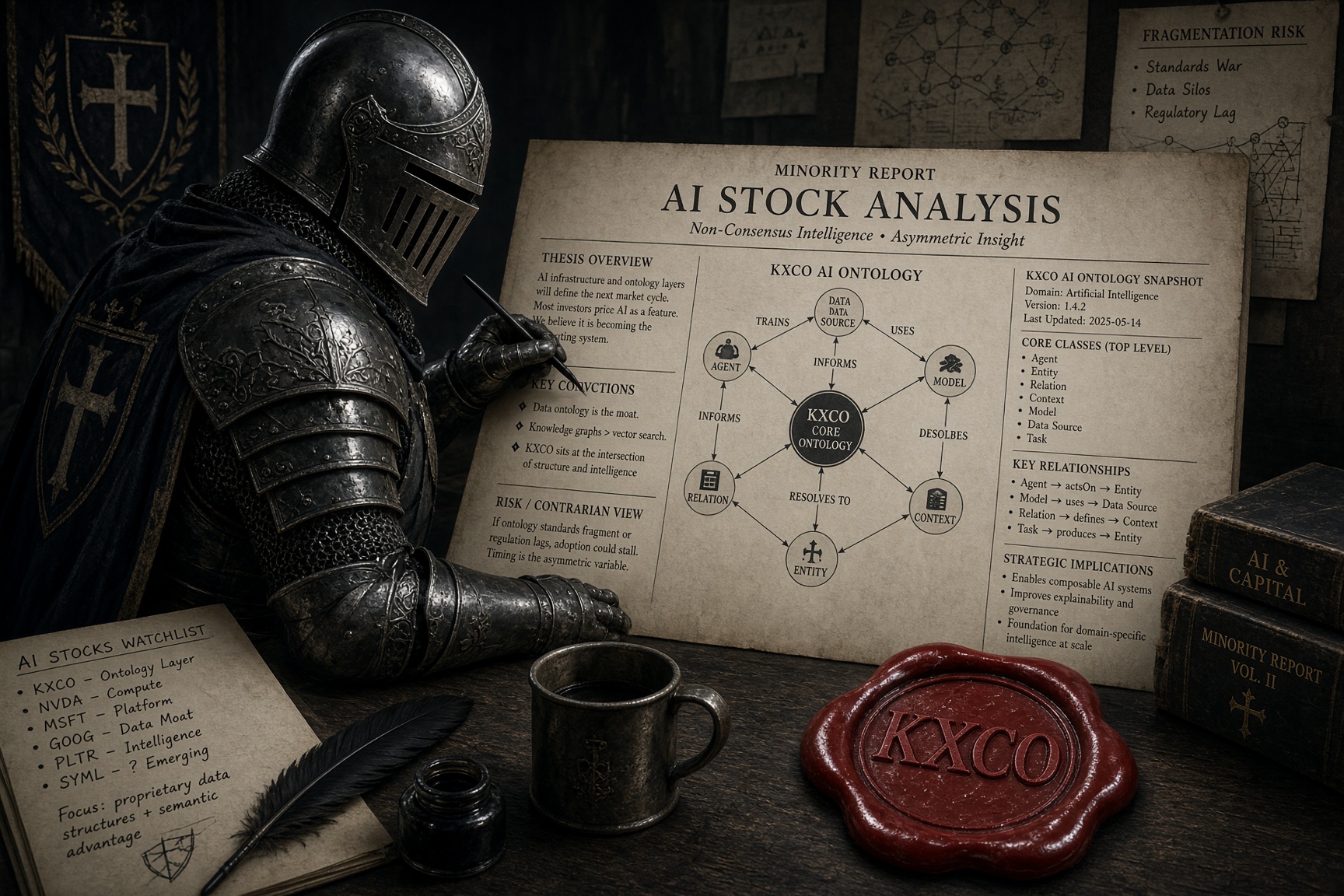
KXCO AI Ontology at 3 Months: What It Called and What Comes Next
On 19 July 2026 the Round Table's AI room published its first Analyst Outlook. To the 16 October 2026 close its 13 names rose 2.6% on an equal weight against 2.1% for QQQ, per StockAnalysis closes, and the six it opened with 35% or more of upside rose 8.6%. This piece lists the six names up more than 5%, the ten names I rate as opportunities now, the month's results in AI and quantum computing, and the official data showing that four in five firms have not yet started using AI.
Thoughts on Thinking: Physics, Biology and Thought
Thinking is not a faculty that sits on top of the body. It is the electrochemical activity of neurons, organised into rhythms whose frequencies are set by the time constants of channels, synapses and loops. Diet, light, noise, natural settings and 40 Hz drive can shift the balance, and an MIT study of essay writing found the weakest EEG connectivity in the group using a language model. The tools and the biology work on one resource: the capacity of a named person to form and defend a judgment.
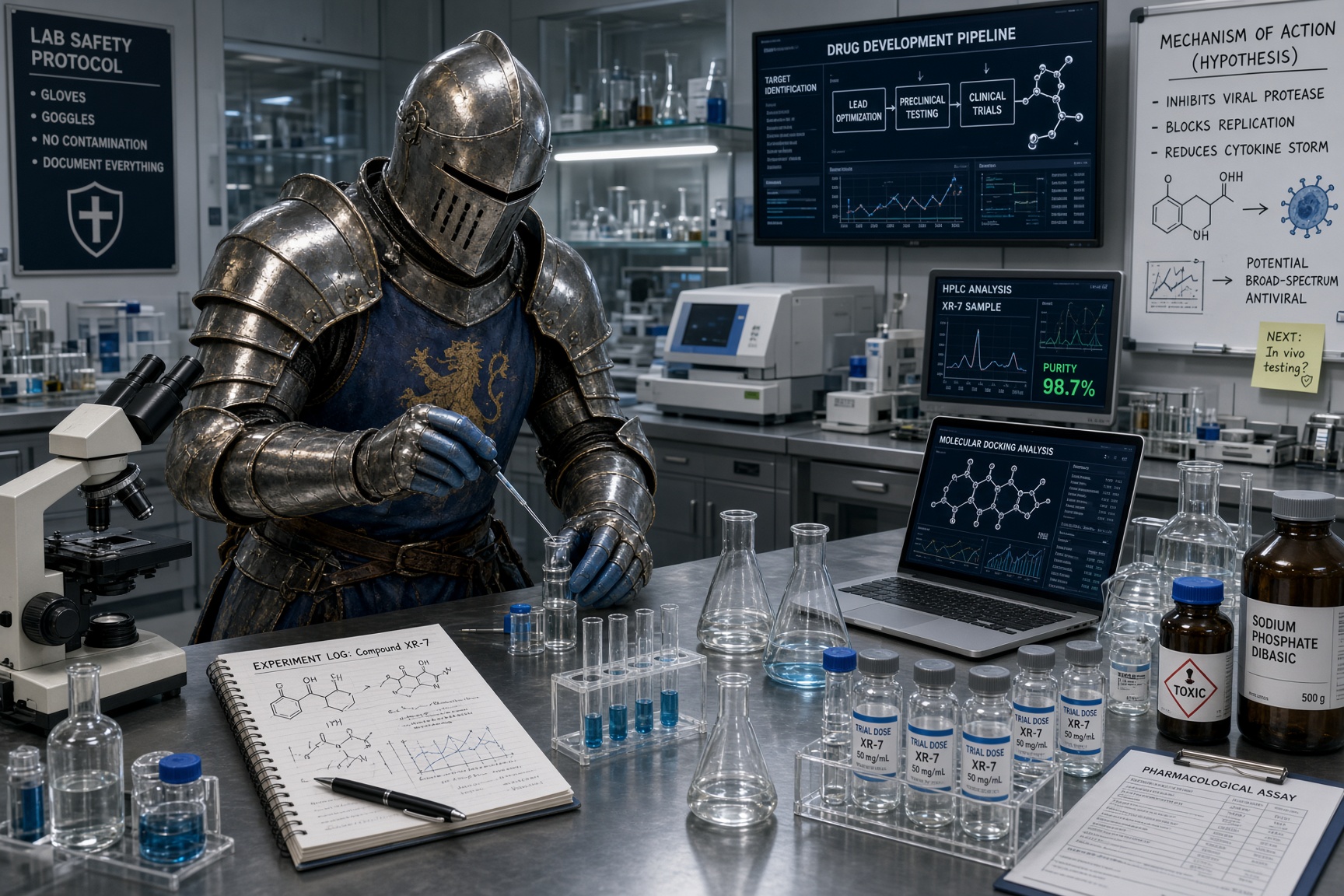
What the Round Table Is Predicting in Biotech Markets
Seventeen FDA decisions fall due between 30 October 2026 and 29 June 2027, and KXCO's Round Table has called every one. Its model portfolio holds the thirteen Nasdaq companies behind them, led by BridgeBio, Cogent Biosciences and Praxis, and was signed with ML-DSA-87 and anchored on chain before the FDA acts. The first test is Inovio's INO-3107 on 30 October.
SpaceX: The Road to 10 Gigawatts
SpaceX did not add an AI business. A company whose processes run on compute built its own computing plant, then built the power to run it. The 10-Q reports 1.4 gigawatts of nameplate compute at 30 June 2026, four leases worth about $41 billion a year and $100 billion of cash. The target is closer to 10 gigawatts than 5 by the end of 2027. This piece sets out the build sequence, the four layers of power in Memphis, and why Terafab is the act after 2027, not the road to it.
Every story, signed and delivered.
Subscribe to the kxco channel and get the headline, the AI-written key takeaways, and the chain-anchor link the moment we publish. Audio versions and per-ticker subscriptions arrive in the next iteration.