
Week Ahead on Wall Street: CPI, Banks and Oil
12 to 16 October 2026: September CPI, the bank and chip earnings, Saudi pipeline risk, and why the dips in the AI leaders are still worth buying.

The week of 12 to 16 October 2026 opens with equity markets that have absorbed a September rate hike from the Federal Reserve. The 10-year Treasury yield is at its highest in more than two decades, and the energy complex still carries a risk premium from repeated attacks on Saudi oil infrastructure. The Fed raised its target range by a quarter point to 3.75% to 4.00% on 16 September, per the Federal Reserve. The 10-year par yield reached 5.31% on 5 October 2026, its highest since May 2002, and closed at 5.24% on 9 October 2026, per the US Treasury. Brent settled at $104.72 on 9 October 2026, having come within 3 cents of $110 on 11 September, per CNBC.
Despite those pressures, the structural drivers of the AI build-out remain intact. There is no AI bubble. Capacity is used as it is added, demand is contracted in multi-year commitments that run into the trillions of dollars at the largest sellers of compute, and supply is still rationed at critical layers of the stack: advanced packaging, high-bandwidth memory, power delivery and lithography.
The KXCO AI Sector Ontology, refreshed on 7 October 2026, documents these facts with sourced claims, and the full case is in There Is No AI Bubble. The strategy for the week is to buy the dips. A correction driven by a hot CPI print, a soft bank result or a fresh oil spike is an opportunity in the leaders of the AI infrastructure theme, in selective quantum names with commercial traction, and in biotech assets that benefit from governed biological AI tools. Confirm every release and level on the Live Trading News trading page before sizing a position. The calendar is live and updates through the week, and last week's weekly market outlook set out the hiking Fed and the stalling job market behind it.
Economic calendar, 12 to 16 October 2026
Monday 12 October
Columbus Day. SIFMA recommends a full close for US bond markets, while the NYSE and Nasdaq trade normally, per SIFMA. No major US data are scheduled. Cleveland Fed President Beth Hammack speaks at 12:10 ET, per the Federal Reserve calendar, and the IMF and World Bank Annual Meetings run from 12 to 18 October in Bangkok, per the IMF. Volume is usually lighter, which can amplify moves if geopolitical headlines arrive, and weekend developments on the Saudi pipeline or Red Sea shipping will set the tone.
Tuesday 13 October
The NFIB Small Business Optimism Index for September is out at 06:00 ET, after 98.7 in August, and the Monthly Treasury Statement follows at 14:00 ET, per Kiplinger. Existing home sales for September arrive at 10:00 ET, after 3.98 million in August, per NAR. Governor Christopher Waller discusses AI in New Delhi, Richmond Fed President Thomas Barkin speaks at 13:00 ET and Boston Fed President Susan Collins at 16:00 ET. Waller said on 8 October that more rate hikes are likely needed, per Newsquawk.
Bank earnings open before the bell. JPMorgan Chase ($JPM, NYSE), Goldman Sachs ($GS, NYSE), Wells Fargo ($WFC, NYSE) and Citigroup ($C, NYSE) report, alongside Johnson & Johnson ($JNJ, NYSE) and UnitedHealth ($UNH, NYSE), per the companies' own announcements. These results give the first broad look at net interest income, trading revenue and credit quality at this level of rates, and existing home sales will show how far mortgage rates are holding housing back.
Wednesday 14 October
The inflation pivot. September CPI is released at 08:30 ET, per the BLS. Consensus looks for headline CPI of 3.6% year on year from 3.4%, and 0.6% on the month, per investingLive. Core is seen at 2.5% from 2.4%, and 0.2% on the month, per investingLive. The Beige Book follows at 14:00 ET. Vice Chair for Supervision Michelle Bowman speaks in Bangkok, outside US market hours.
This is one of the last major inflation prints before the next FOMC decision on 28 October. A significant upside surprise would reinforce higher-for-longer pricing and pressure long-duration equities, and a softer print would ease real-yield pressure. Bank of America ($BAC, NYSE), Morgan Stanley ($MS, NYSE) and BlackRock ($BLK, NYSE) report before the open, and so does ASML, per its financial calendar. ASML's order commentary matters most for the AI capital-equipment chain.
Thursday 15 October
Weekly jobless claims are due at 08:30 ET, after 197,000 the previous week, per the weekly claims report. September retail sales arrive at the same time, with consensus near 0.3% on the month after 1.2% in August, per the Census Bureau and investingLive. September PPI is due at 08:30 ET, with consensus near 0.5% for the headline and 0.3% for core, per the BLS and investingLive. The Empire State and Philadelphia Fed surveys and business inventories complete the morning.
TSMC ($TSM, NYSE) reports before the US open, per TSMC Investor Relations. Retail sales will be scrutinised for consumer fatigue, and PPI gives the pipeline view of future consumer prices. Friday's options expiration can amplify Thursday's moves.
Friday 16 October
September import and export prices are out at 08:30 ET, per the BLS. Industrial production and capacity utilisation follow at 09:15 ET, after utilisation of 76.3% in August, per the Federal Reserve. It is also the monthly options expiration, which adds positioning noise. With the major inflation and activity data already out, Friday is mostly about confirmation and residual flows. The Macro Center carries the running coverage of the data.
The complete live calendar, earnings schedule and market boards are on the Live Trading News trading page. Consensus figures are survey medians and can shift, so confirm them on the agency calendars before the release.
Saudi attacks, energy infrastructure and market transmission
Attacks on Saudi energy infrastructure have been a recurring source of risk premium through 2026, against a war on Iran that has largely closed the Strait of Hormuz since late February. Saudi Arabia's East-West pipeline, which runs from the Abqaiq area to Yanbu on the Red Sea, is its main route around Hormuz, with capacity of 7 million barrels a day, per CNBC.
On 10 September drones launched from Iraq hit pumping stations on the line, and the energy ministry shut it the next day as a precaution, per CNBC. Aramco deferred or cancelled some cargoes to European refiners, per Argus, and pumping resumed at a low rate on 22 September, per Pipeline Technology Journal, citing Reuters. On 6 October the energy minister said flows were back to 5.8 million barrels a day, per Al Jazeera.
Brent rose more than 3% to about $108 after the shutdown, per CNN, came within 3 cents of $110 on 11 September 2026, and settled at $104.72 on 9 October 2026, per CNBC. The Houthis declared a maritime embargo on Saudi Arabia in July and have claimed further strikes, including one near Riyadh on 3 October that the Saudi-led coalition called misleading, per Al Jazeera. Diesel and the other refined products have been sensitive throughout.
Higher oil prices feed directly into headline inflation, can support the dollar on terms-of-trade grounds, and act as a tax on consumers in importing nations. A sustained outage that removes a material share of global supply for an extended period would matter more than a temporary spike. A credible repair timeline or diplomatic de-escalation can produce sharp reversals in crude and in risk assets.
History gives the template. The September 2019 attack on Abqaiq shut in about 5.7 million barrels a day, and Brent jumped 14.6% at the settle on 16 September 2019, the largest one-day rise in more than a decade, per the EIA. The whole jump was gone within about two weeks as Aramco restored output faster than feared. Temporary oil spikes that reverse within weeks have produced only short-lived equity drawdowns outside the energy sector, provided the growth and earnings backdrop holds. The question for equities is whether the inflation impulse is large enough, and lasts long enough, to change the Federal Reserve's reaction function.
Treat energy headlines as a volatility overlay. Sharp risk-off moves driven by oil spikes have been followed by recovery once the immediate supply threat recedes, and energy equities and selective oil-services names can serve as a partial hedge. The Energy and Commodities Center carries the running coverage.
There is no AI bubble: the record and the buy-the-dips framework
A bubble is capacity built for demand that never arrives: unused infrastructure, then a glut when the investment stops. The evidence from contracted revenue, utilisation and physical constraints points the other way.
The KXCO AI Sector Ontology holds 413 entities and 937 current sourced claims as of 7 October 2026. It records adoption rising across six independent measures, about $2.35 trillion of contracted backlog at the four largest cloud sellers according to their own filings and releases, and rationing rather than surplus at the key layers. Microsoft's ($MSFT, NASDAQ) commercial remaining performance obligation alone is $678 billion, up 84%, per its results filing. Oracle ($ORCL, NYSE), Alphabet ($GOOGL, NASDAQ) and Amazon ($AMZN, NASDAQ) carry the rest, and Exhibit 1 draws who owes whom.
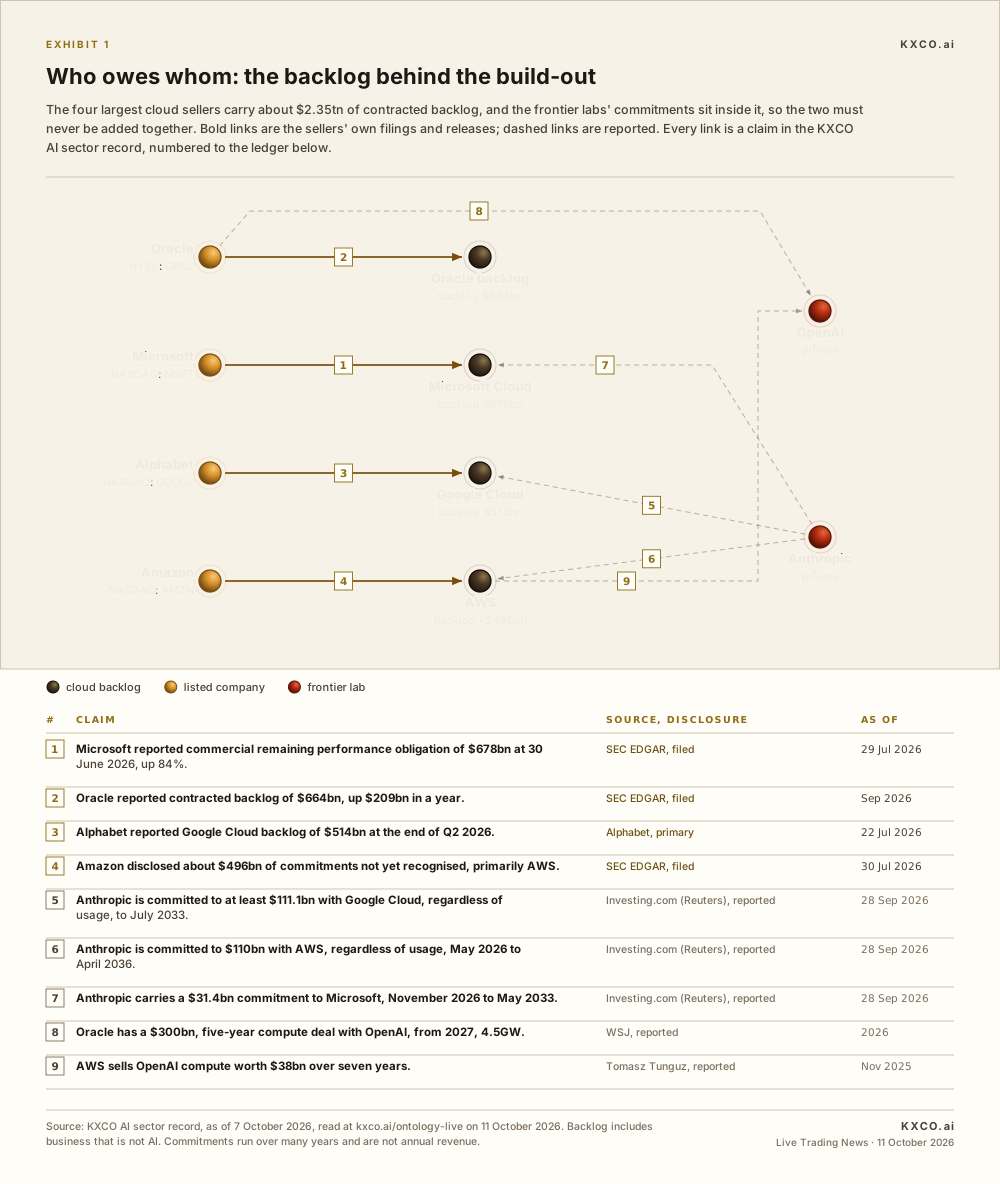
Exhibit 1. The backlog behind the build-out, read from the KXCO AI Sector Ontology. Each numbered link is a sourced claim, listed under the graph.
The record keeps the contrary account on the page. Its own findings include capex compounding faster than the revenue behind it, about $725 billion in 2026, and roughly $1 trillion of deals that recycle capital inside one cohort of labs, clouds and chipmakers, per the record. Those are funding questions. They describe a build-out that is capital intensive and owed under contract, not capacity that sits idle. Valuation does not look like a bubble either. Nvidia ($NVDA, NASDAQ) traded at about 25 times forward earnings at the 9 October 2026 close, per Yahoo Finance. Goldman Sachs put the median forward multiple of the technology leaders in 2000 at 52 times, with Cisco near 102, per Benzinga.
Physical constraints, namely power, transformers, advanced packaging and high-bandwidth memory, still limit how fast capacity can be added. That scarcity supports pricing power and high utilisation. Corrections driven by higher yields, geopolitical headlines or temporary growth scares are therefore opportunities rather than the start of a structural unwind.
Buy the dips in the leaders of the AI infrastructure stack, in the companies with contracted backlog, and in the pure-play or hybrid quantum names demonstrating commercial traction. Size positions with valuation and concentration risk in mind, but the base case remains that the multi-year build-out has further to run. The ontology's chokepoint findings, ASML's lithography monopoly, specialty materials, and foundry and packaging bottlenecks, support selective exposure. The AI Stocks Center tracks the leaders.
AI and quantum computing in detail
The convergence of classical AI and quantum computing accelerated through 2026. Hybrid systems that use generative models to design quantum circuits, AI agents that tune sensitive quantum hardware, and quantum-centric supercomputing have moved from research into funded programmes and commercial roadmaps. On 8 October the Department of Energy's Quantum Genesis initiative, part of its Genesis Mission, published eight priority scientific applications across chemistry, materials, subatomic physics and applied mathematics, per the Department of Energy. They give fault-tolerant systems concrete benchmarks.
The same day NVIDIA committed $1 billion over five years to science and quantum computing in the United States, per NVIDIA. Its NVQLink interconnect, which ties quantum processors to GPU supercomputers, has been adopted by more than a dozen supercomputing centres in Asia and Europe alongside the US national laboratories, per NVIDIA.
IonQ ($IONQ, NYSE) is the most visible pure-play. On 7 October DARPA named it one of four teams entering Stage C, the final stage of the Quantum Benchmarking Initiative, per DARPA. Second-quarter revenue was $80.1 million, up 287% year on year, per its results filing. On 8 September it set full-year revenue guidance of $450 million to $460 million, including SkyWater from 31 July, per its 8-K. The Superion 256 is available to order now, with deliveries in 2027, per IonQ.
IonQ will install a Superion 256 at NVIDIA's Accelerated Quantum Research Center in 2027, linked to a GB200 NVL72 through NVQLink, per IonQ. With Oak Ridge National Laboratory, NVIDIA and the University of Tennessee it showed a generative model that writes quantum optimisation circuits in about 28 seconds at every problem size tested, where the prior method rose from 34 seconds at 4 qubits to more than 11 minutes at 12, per IonQ. The SkyWater acquisition, completed on 31 July, added a US foundry, per its completion filing. The company remains unprofitable and the stock is volatile.
IBM ($IBM, NYSE) entered the same final stage of the DARPA programme on 7 October. Anderon, its new quantum wafer foundry in Albany, New York, finalised a $1 billion CHIPS Act award on 16 September, per Anderon. IBM's roadmap runs through a C++ interface to Qiskit for high-performance computing and real-time error-correction decoding demonstrated on its Loon processor, toward fault tolerance by 2029, per IBM. Google, Microsoft and the other large platforms keep substantial quantum research beside their classical AI work. Smaller pure-plays such as Rigetti ($RGTI, NASDAQ) and D-Wave ($QBTS, NYSE) remain higher-beta vehicles.
Fault-tolerant quantum computing remains a multi-year effort, and current systems are noisy. Commercial activity is concentrated where noisy intermediate-scale devices or hybrid workflows already add value: some optimisation problems, modest-scale materials simulation and research workloads. Generative methods that propose better circuits reduce the number of expensive quantum evaluations required, and similar hybrid approaches are being tested for error mitigation and real-time calibration. These developments can generate revenue before full fault tolerance arrives. They do depend on continued gains in qubit quality, gate fidelity and the software stack.
Investors should separate near-term commercial traction in hybrid and research applications from the longer-term prospect of broadly useful fault-tolerant machines. Both can support equity value, on different timelines. Selective positions in IonQ and similar names can be sized as higher-risk satellites, and the same discipline applies: sharp drawdowns on risk-off days or delayed milestones have created entry points while the technical roadmap held. The Quantum Computing Center carries the running coverage.
FDA, AI ontology and biotech applications
Regulators have formalised their guidance on AI in drug development and manufacturing. On 14 January 2026 the FDA and the European Medicines Agency published ten common principles of good AI practice in drug development, covering the whole medicines lifecycle, per the EMA. They call for a human-centric, risk-based approach, data governance, multidisciplinary expertise, transparency and appropriate human oversight.
The FDA has also enforced the point. On 2 April 2026 it issued a warning letter to Purolea Cosmetics Lab, whose quality unit had not reviewed specifications, procedures and records drafted by AI agents, per the FDA. AI can speed up development and manufacturing, but it does not remove the obligation to validate, review and control the process. Provenance, the ability to reconstruct which model version, training data and human decisions produced an output, is becoming more important.
Ontology, the structured representation of entities, relationships, evidence and provenance, is essential infrastructure for reliable AI in life sciences, and general-purpose enterprise ontology layers do not fully capture biological function. MindWalk Holdings ($HYFT, NASDAQ) launched ReefIQ on 10 June 2026 as a HYFT-powered biological context layer, per its SEC filing. The company says its knowledge graph holds 660 million patterns and 25 billion relationships, per the same filing. ReefIQ is designed to enrich a pharmaceutical company's discovery data at ingestion and to stay model-agnostic, which is relevant to FDA expectations on data integrity and on reconstructing model outputs.
Its chief executive said on 14 September 2026 that the discovery business works with 19 of the top 20 pharmaceutical companies, per its results release.
Scale is starting to surface patterns no single analyst would find. Stanford Medicine's Virtual Biotech, published in Science on 17 September 2026, used about 37,000 AI agents to analyse historical trials. Drugs aimed at cell-type-specific, switch-like genes were 40% more likely to pass from Phase I to Phase II and 48% more likely to reach the market, per Stanford Medicine. These are associations in historical data, not proof of cause, but they show what structured biological knowledge plus scale can do. AI-enabled medical devices also continue to receive 510(k) clearances.
The KXCO Biotech Ontology tracks pending FDA filings and decision dates. A recent Live Trading News analysis of the filings due to April 2027, 5 biotech stocks for the FDA calendar to April 2027, ranked the names by approval profile and by upside. Seven of those decisions fall due before the end of 2026, and Exhibit 3 draws them, from the listed sponsor to the drug to the regulator.
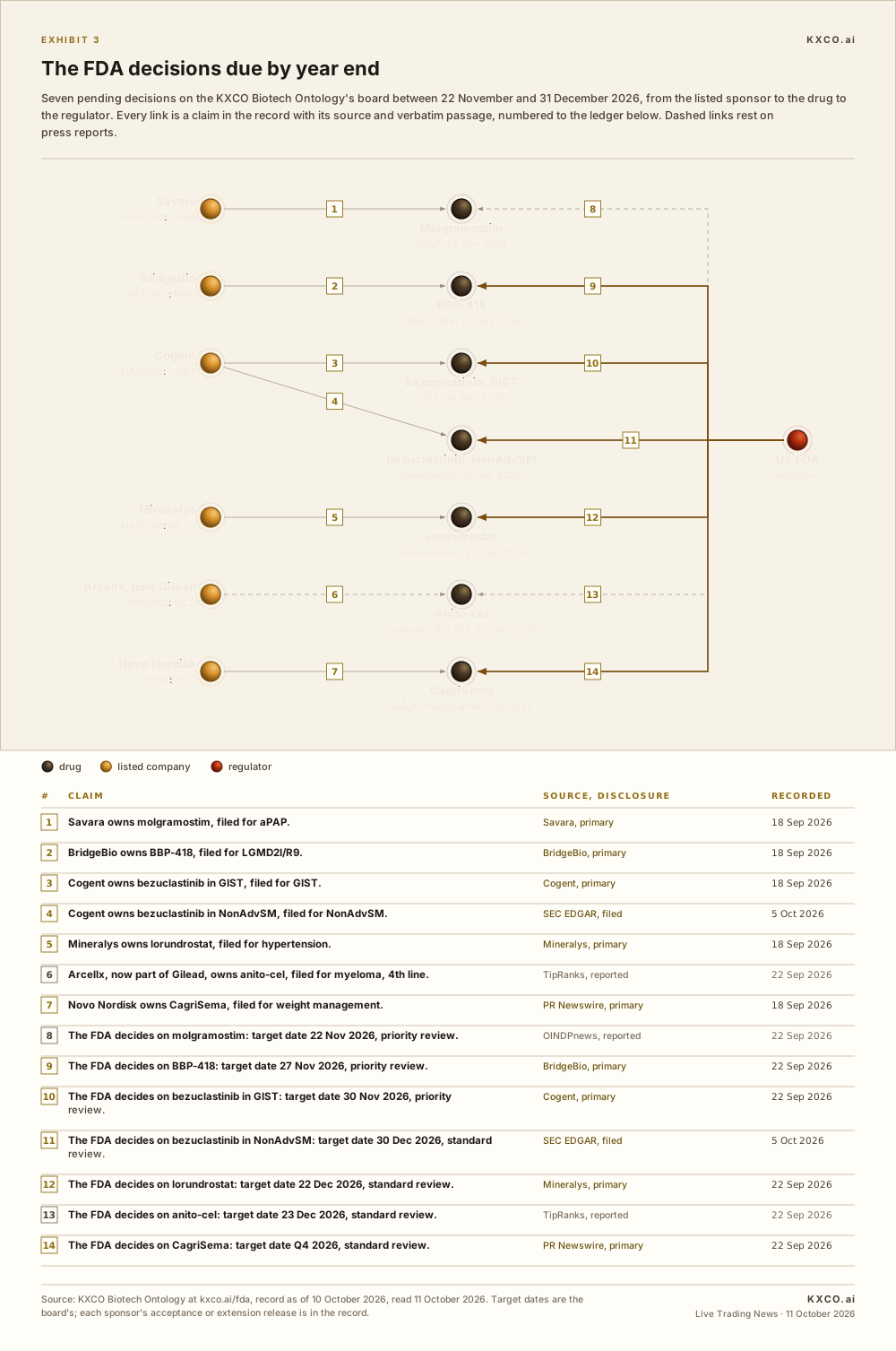
Exhibit 3. The FDA decisions due by year end, read from the KXCO Biotech Ontology. Each numbered link is a sourced claim, listed under the graph.
BridgeBio's BBP-418 ($BBIO, NASDAQ) faces its decision on 27 November under priority review, and Cogent's bezuclastinib ($COGT, NASDAQ) has two clocks inside five weeks, 30 November for GIST and 30 December for non-advanced systemic mastocytosis. Savara's molgramostim ($SVRA, NASDAQ) is due 22 November, Mineralys's lorundrostat ($MLYS, NASDAQ) 22 December, anito-cel, now owned by Gilead ($GILD, NASDAQ), 23 December, and Novo Nordisk's CagriSema ($NVO, NYSE) in the fourth quarter, all per the KXCO Biotech Ontology.
The intersection of FDA process, AI tooling and ontology infrastructure creates listed and private companies with asymmetric upside, if they can show a higher probability of technical success or lower development time and cost while meeting regulatory expectations. Larger pharmaceutical companies that integrate governed AI into discovery and manufacturing stand to gain faster pipelines. The regulatory environment is becoming more defined, not more hostile. The constraint is execution on data quality, validation and human oversight.
Companies with substantial upside
Several categories offer asymmetric upside over the next 12 to 36 months if roadmaps stay on track.
In pure-play quantum, IonQ has combined revenue acceleration, a clear product roadmap in the Superion line, DARPA progression and partnerships that include NVIDIA. The stock is high-beta. Rigetti, D-Wave and smaller quantum names offer more torque, with correspondingly higher execution and dilution risk, so a diversified satellite allocation is the practical approach.
In the AI infrastructure layer, the leaders continue to show contracted demand that exceeds near-term supply. Nvidia ($NVDA, NASDAQ), the hyperscalers and the key suppliers in advanced packaging, high-bandwidth memory and power infrastructure retain pricing power. Valuation multiples have compressed from peak levels in some cases, which gives better entry points on dips. ASML ($ASML, NASDAQ) remains the lithography chokepoint, and its results on Wednesday will be watched closely. Broadcom ($AVGO, NASDAQ) and the other custom-silicon and networking providers also sit in the flow of AI capital expenditure.
In biotech and AI-enabled drug discovery, upside is more binary and catalyst-driven. Companies with late-stage assets approaching their decision dates, or platforms that can show better hit rates or shorter timelines through governed biological AI, can re-rate sharply on positive data or regulatory outcomes. MindWalk's biological ontology approach is differentiated because it addresses the representation problem rather than competing only on model performance. The KXCO Biotech Ontology gives one structured way to rank the near-term FDA calendar, and individual diligence on trial design, safety signals and the competition remains essential.
Across these areas the operating principle is the same: buy the dips when the roadmap and the contracted demand remain intact. Temporary sell-offs driven by higher yields, oil spikes or broader risk-off episodes have repeatedly created better entry points in 2026. Size positions for the higher volatility of pure-plays and the binary nature of some biotech catalysts. The absence of an AI bubble does not mean every AI stock is cheap or that every quantum name will succeed. It means the structural demand for compute, for better discovery tools and for complementary quantum capability is real and still growing.
FX, gold and Bitcoin
The dollar has been supported by higher yields and relative growth differentials, with two-way volatility around the data. EUR/USD closed at 1.1201 on 9 October 2026, sitting on support near 1.12 after a 52-week low of 1.1160 on 5 October, with resistance toward 1.13, per CNBC. A hotter CPI would typically support the dollar and a softer print would pressure it. The yen remains sensitive to yield differentials. Commodity currencies can gain from higher oil if the premium persists, but face the drag of a stronger dollar. CPI, retail sales and industrial production are the domestic drivers this week.
Spot gold closed at about $4,193 on 9 October 2026, up from $4,133 a day earlier, per CNBC. As of the 9 October 2026 close, that puts it in the $4,180 to $4,200 resistance area cited by desks, with support at $4,100 to $4,130 where it traded earlier in the week. It is about 25% below the record of $5,585 set on 29 January 2026, per CNBC, but still high on a multi-year view.
Gold has found support on dips when real yields ease or geopolitical headlines intensify. A sustained move higher in oil and renewed risk aversion can support it as a hedge, while a sharp rise in real yields on a hot CPI would pressure it. The longer-term case rests on fiscal deficits, central-bank diversification and eventual easing, and in the near term it remains tactical around the data and the Middle East headlines.
Bitcoin closed at about $82,546 on 9 October 2026, per Yahoo Finance, in the low-to-mid $80,000s after pulling back from higher levels as yields rose. It held support near $80,000 again this week, with a low of $80,330 on 8 October 2026, per Yahoo Finance. Bitcoin behaves as a high-beta risk asset in the short term while keeping its longer-term institutional-adoption and scarcity case, and the $80,000 to $82,000 area has acted as near-term support.
As with equities, sharp dips driven by temporary macro or geopolitical shocks have been buying opportunities for multi-year horizons when the adoption trend holds. Higher oil and yields tend to support the dollar and pressure gold and Bitcoin at first, and de-escalation or a softer inflation print can reverse those moves quickly. The equity approach has its counterpart here: selective accumulation of gold on yield-driven weakness and of Bitcoin on risk-off spikes, sized to risk tolerance. The Gold Forecast Center and the Blockchain Center carry the running coverage.
Bank earnings, inflation and the semiconductor chain
Bank earnings open on Tuesday and give a direct read on net interest income, deposit costs, loan growth, trading revenue and credit provisions. The order is in the calendar above, from JPMorgan Chase on Tuesday to Morgan Stanley and BlackRock on Wednesday. Strong trading results or better-than-feared credit quality can support financials and broader risk sentiment, while rising delinquencies or margin pressure would weigh on the group.
These results arrive against high yields that have lifted net interest margins for many banks, but also against a slowing housing market and a consumer being watched for fatigue. Constructive commentary on consumer resilience and manageable commercial real-estate exposure would help. Because financials have lagged the AI-driven sectors, a solid season could produce relative outperformance and support the broader index on dips.
The September CPI is the most important single data point of the week. Consensus looks for headline inflation to rise to 3.6% from 3.4%, per investingLive, on base effects and the energy impulse: gasoline was up 27.4% on the year in August, per the BLS. Core is expected to stay better behaved. Composition matters: shelter, services excluding energy, and goods prices will be parsed for persistence or further disinflation. A print that matches or undershoots consensus eases real-yield pressure and supports duration-sensitive equities. A significant upside surprise reinforces higher-for-longer and can produce a sharp, temporary risk-off move.
The Beige Book adds qualitative colour. Payrolls rose by just 29,000 in September, against a 12-month average of 45,000, per the BLS, so the balance of risks is more two-sided than earlier in the year. That is why dips driven by a single hot print can be bought if the broader earnings and adoption picture holds.
ASML's results on Wednesday are a direct read on the capital-equipment cycle under advanced AI chips, and AI Is Being Powered by Tech That Looks Almost Alien explains the machine itself. Demand for extreme-ultraviolet lithography remains strong because the most advanced nodes required for leading accelerators cannot be produced without it. Order intake, lead times and capacity-expansion commentary will be watched across the semiconductor complex. TSMC reports on Thursday and gives the foundry view. Together the two prints calibrate whether the AI capital-expenditure cycle continues at the pace implied by hyperscaler commentary and contracted backlog. Exhibit 2 draws the chain they sit in.
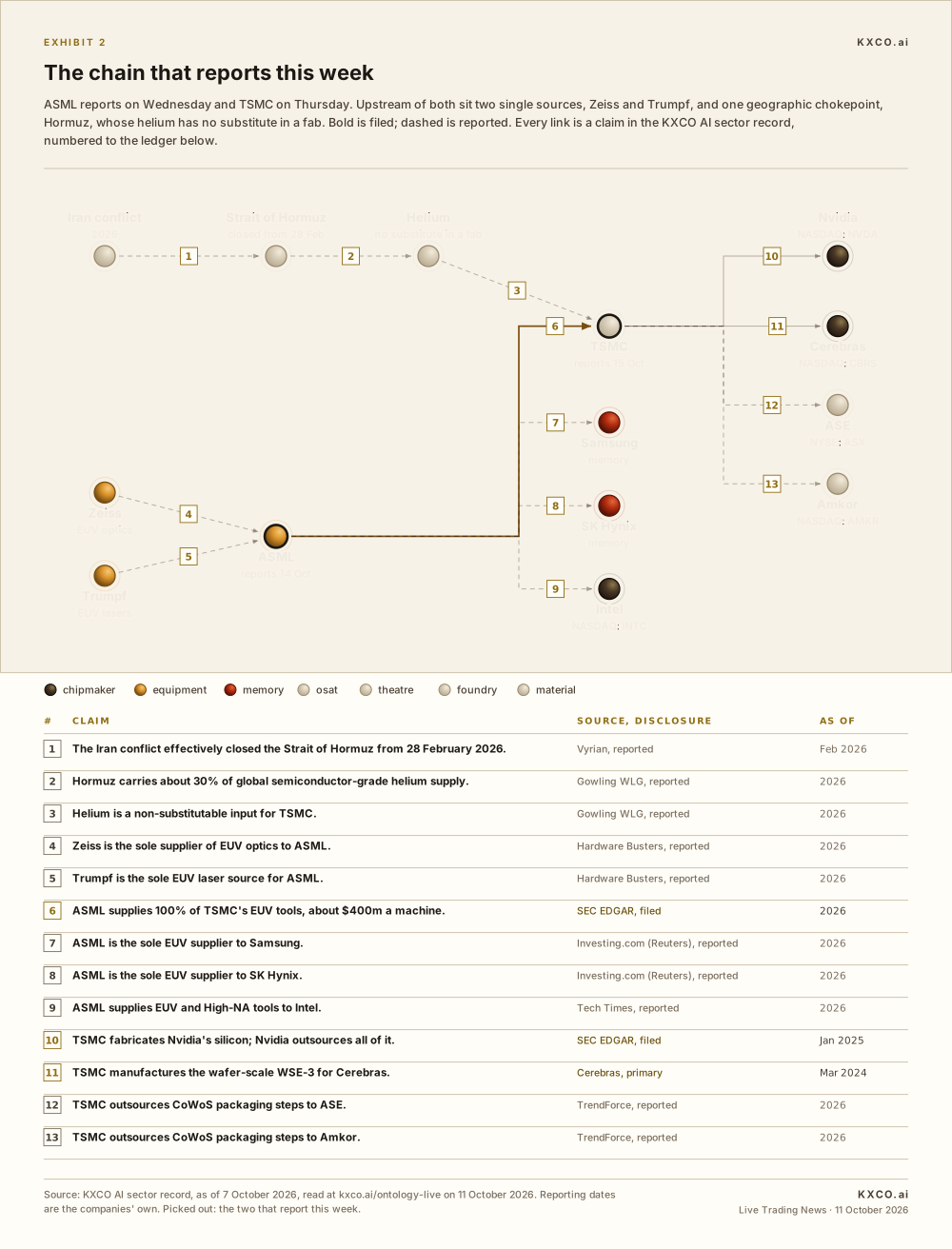
Exhibit 2. The chain that reports this week, read from the KXCO AI Sector Ontology. Each numbered link is a sourced claim, listed under the graph.
The chokepoint nature of advanced lithography and certain packaging steps means capacity additions remain constrained, which supports pricing and utilisation even if end-demand growth slows for a time. The same graph shows why the energy section above matters to chip investors: the Strait of Hormuz, effectively closed since 28 February 2026, carries about 30% of semiconductor-grade helium, and helium has no substitute in a fab, per the record.
Risk management, scenarios and monitoring tools
The combination of geopolitical energy risk, an important inflation print and the opening of earnings season makes a week in which volatility can spike on any single headline. The response is not to abandon positions in the structural growth themes, but to size them so that a drawdown of five to ten per cent in the leaders does not force selling. Cash or short-duration fixed income can be held as dry powder. Energy equities or selective commodity exposure can hedge part of an oil-driven inflation spike, and gold can play a similar role on a smaller scale. Within the AI and quantum complex, a core allocation to the cash-flow-generating platforms plus smaller satellite positions in higher-beta pure-plays holds up better than a concentrated bet on any single name.
Three scenarios frame the week. In the base case, CPI prints close to consensus, bank earnings are mixed to modestly positive, and no new major attack on Saudi infrastructure occurs. Equities chop but find support on dips, the dollar is range-bound, and gold and Bitcoin trade with the risk tone.
In the hawkish scenario, CPI surprises to the upside, yields rise further and energy headlines stay tense. Risk assets sell off, the dollar strengthens, and gold is pressured by real yields even as it draws some safe-haven demand. This is the scenario in which disciplined buying of the structural AI and selective quantum names is most attractive, provided the time horizon extends beyond the immediate reaction.
In the dovish or de-escalation scenario, CPI is soft, yields ease, and diplomatic or repair news reduces the oil premium. Risk assets rally, the dollar weakens, and gold and Bitcoin can both participate. The probability-weighted outcome still favours treating weakness as an opportunity.
The public KXCO AI Sector Ontology is updated periodically and keeps its historical claims. Checking it after major earnings, or after news on partnerships, capacity or regulation, gives a structured view of whether the underlying relationships have changed. The KXCO Biotech Ontology and the FDA calendar analysis identify the names with binary events quickly, and the trading page aggregates the economic calendar, earnings and live market data. Used together, the calendar for timing, the ontology for structural dependencies and the filings for company detail reduce the chance of being surprised by a second-order effect, such as a supplier bottleneck or a regulatory delay that was already visible in the record.
What would change the call
A thesis is only as good as the facts that would break it, so name them before arguing for it. For the buy-the-dips call this week, there are three:
Backlog stops converting. If the cloud sellers' contracted backlog stops turning into recognised revenue, or the frontier labs renegotiate their non-cancellable commitments down, the demand evidence weakens. Watch the commentary at the next round of cloud results.
Inflation forces more hikes. A hot September CPI that tilts the 28 October FOMC toward another hike would reprice duration and the AI leaders together. One print does not do that; a run of them would.
Supply is lost, not delayed. A strike that takes the East-West pipeline out for months rather than days, or a disruption at ASML or TSMC, would turn a volatility overlay into a supply shock.
None of the three has happened. The contrary account, that capex is outrunning revenue and that capital circulates inside one cohort, stays on the page in the record behind Exhibit 1, and the decision stays with the reader.
Conclusion
The week of 12 to 16 October 2026 is defined by the September CPI on Wednesday, the opening of bank and semiconductor earnings, and the continuing overlay of Middle East energy risk. Bond markets are closed on Monday, so liquidity will be thinner at the start. The base case remains that a dip driven by a hotter inflation print, a weak bank result or a fresh oil spike is a buying opportunity in the leaders of the AI build-out, in selective quantum names with demonstrated traction, and in biotech assets that benefit from governed AI tools.
There is no AI bubble. The capacity is being used, the demand is contracted, and supply remains constrained at critical layers. The KXCO AI Sector Ontology and the KXCO Biotech Ontology continue to document that with sourced claims. The next fact to watch is ASML's order intake on Wednesday morning, which will say whether the lithography queue behind the backlog is still lengthening.
Stocks mentioned: $JPM (NYSE), $GS (NYSE), $WFC (NYSE), $C (NYSE), $JNJ (NYSE), $UNH (NYSE), $BAC (NYSE), $MS (NYSE), $BLK (NYSE), $ASML (NASDAQ), $TSM (NYSE), $NVDA (NASDAQ), $MSFT (NASDAQ), $ORCL (NYSE), $GOOGL (NASDAQ), $AMZN (NASDAQ), $AVGO (NASDAQ), $IONQ (NYSE), $IBM (NYSE), $RGTI (NASDAQ), $QBTS (NYSE), $HYFT (NASDAQ), $BBIO (NASDAQ), $COGT (NASDAQ), $SVRA (NASDAQ), $MLYS (NASDAQ), $GILD (NASDAQ) and $NVO (NYSE).
Sources: the Federal Reserve, the US Treasury, the Bureau of Labor Statistics, the Census Bureau, company investor-relations releases and SEC filings, the KXCO AI Sector Ontology and the KXCO Biotech Ontology, and the press reports linked in the text. Figures are as at the 9 October 2026 close unless stated.
Shayne Heffernan, Ph.D., is the founder of Live Trading News, the KnightsBridge Group, Knightsbridge Law and the KXCO.ai ecosystem spanning post-quantum cryptography, identity, attestation and enterprise ontology.
This commentary is for informational purposes and does not constitute investment advice. Markets involve risk of loss. Always conduct your own research and consult appropriate professionals.

China's Coordinated Push in AI, Quantum Computing and Blockchain
On 9 October 2026 Beijing called for a nationally integrated computing-power network and a national blockchain network. DeepSeek is scaling on Huawei Ascend chips, China's intelligent computing reached 2,185 EFLOPS by June, per the industry ministry, and quantum communications remain a strength. This analysis explains the strategy and sets out the Hong Kong and US listed companies with exposure, from Tencent and Alibaba to China Mobile, HashKey and Nvidia.

AI Is Being Powered by Tech That Looks Almost Alien
Every frontier AI model runs on chips printed by one Dutch machine. ASML's extreme-ultraviolet scanner fires a laser at up to 50,000 droplets of molten tin a second, per ASML, and bounces the light off mirrors whose deviations are tens of picometres. Veritasium called it the closest thing we have to alien technology. This piece takes the film as the brief and checks it: the machine, High-NA, and the wafer-scale chips and liquid-cooled racks downstream of it.
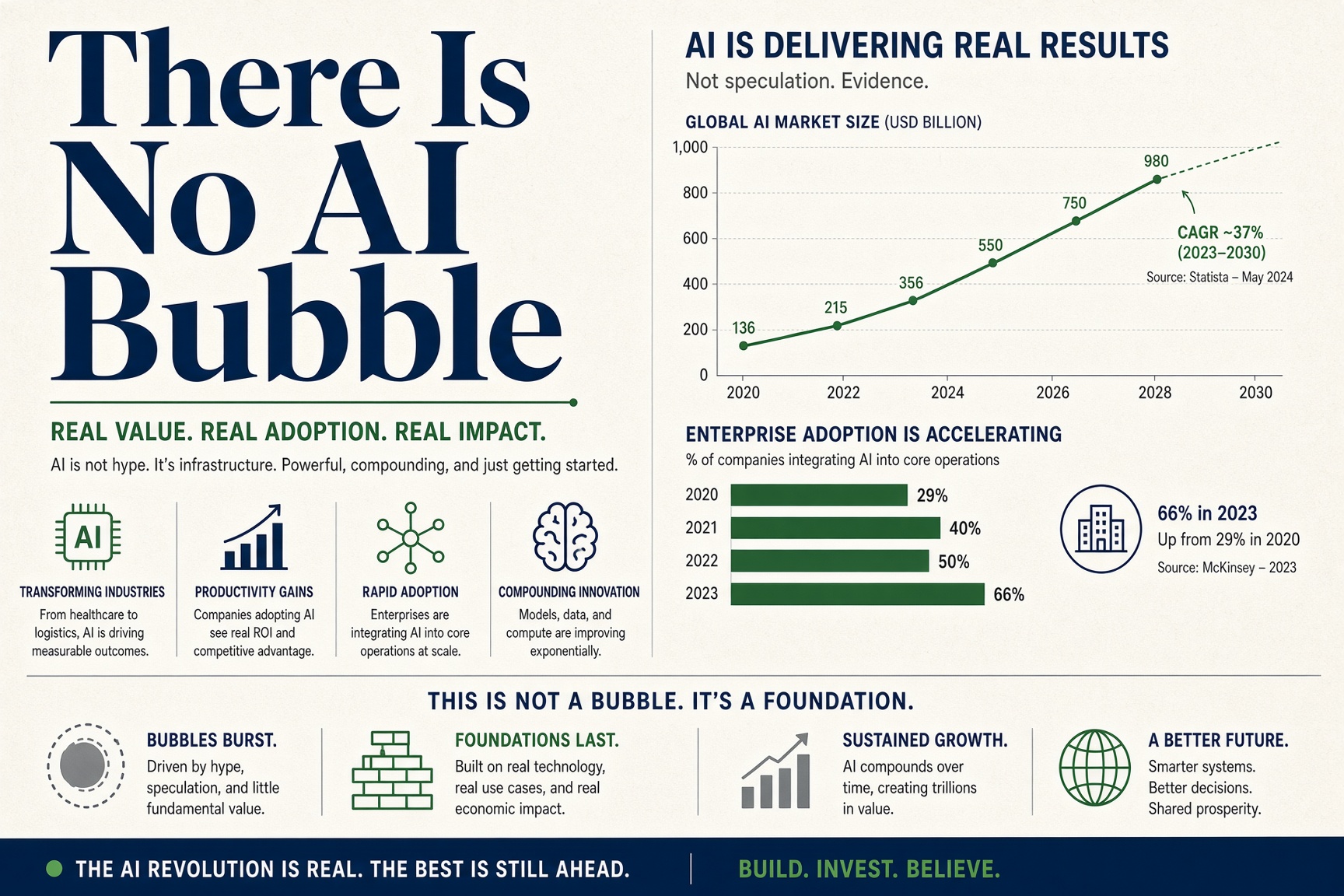
There Is No AI Bubble
There is no AI bubble. A bubble is capacity nobody uses, demand nobody signs for and a glut when the building stops. KXCO's AI sector ontology, refreshed on 7 October 2026, finds the reverse: adoption rising on six independent measures, about $2.35tn of contracted backlog at the four largest sellers of compute per their own reports, and supply rationed at every layer. It keeps the bear case in the same record, 20 circular capital claims, and answers it.
Weekly Market Outlook: Fed Minutes, Anthropic and OpenAI IPOs, Gold, Bitcoin, FX
The Fed raised rates in September and payrolls rose 29,000, per the Labor Department. This week the FOMC minutes, three Treasury auctions and a 10-year near 5.3 percent test that gap. Anthropic's IPO clock runs toward a 14 October investor day while OpenAI's chief executive says not 2026. Gold sits 26 percent below its record, bitcoin near $85,500, the dollar up three weeks running. Two knowledge graphs from KXCO's records map the IPO backers and the FDA board.
Every story, signed and delivered.
Subscribe to the kxco channel and get the headline, the AI-written key takeaways, and the chain-anchor link the moment we publish. Audio versions and per-ticker subscriptions arrive in the next iteration.