
AI Makes Storage and DRAM Strategic Assets
Elon Musk answered a post about the memory bottleneck with three words and the market repriced the whole complex the next session. Shayne Heffernan on why DRAM, HBM and NAND stopped behaving like a commodity cycle, what an autonomous agent actually does to memory, and where quantum computing fits.
Part of theAI Stocks Center
On 14 August a post on X put the problem in one line: memory, not compute, is the rate limiter of the Agentic Era. The line came from Peter H. Diamandis. Elon Musk answered it with three words that have been ricocheting through trading desks and semiconductor conference calls ever since.
"Few realize this."
Those three words did not arrive from nowhere. They followed months of consistent signals from the same source, and on the following Monday the market repriced the entire memory complex around them. Sandisk closed up 8.9%, Western Digital up 5.4%, Micron up 4.1%, SK Hynix up 3.0% and Seagate up 2.2%.
What Musk Actually Said, and When
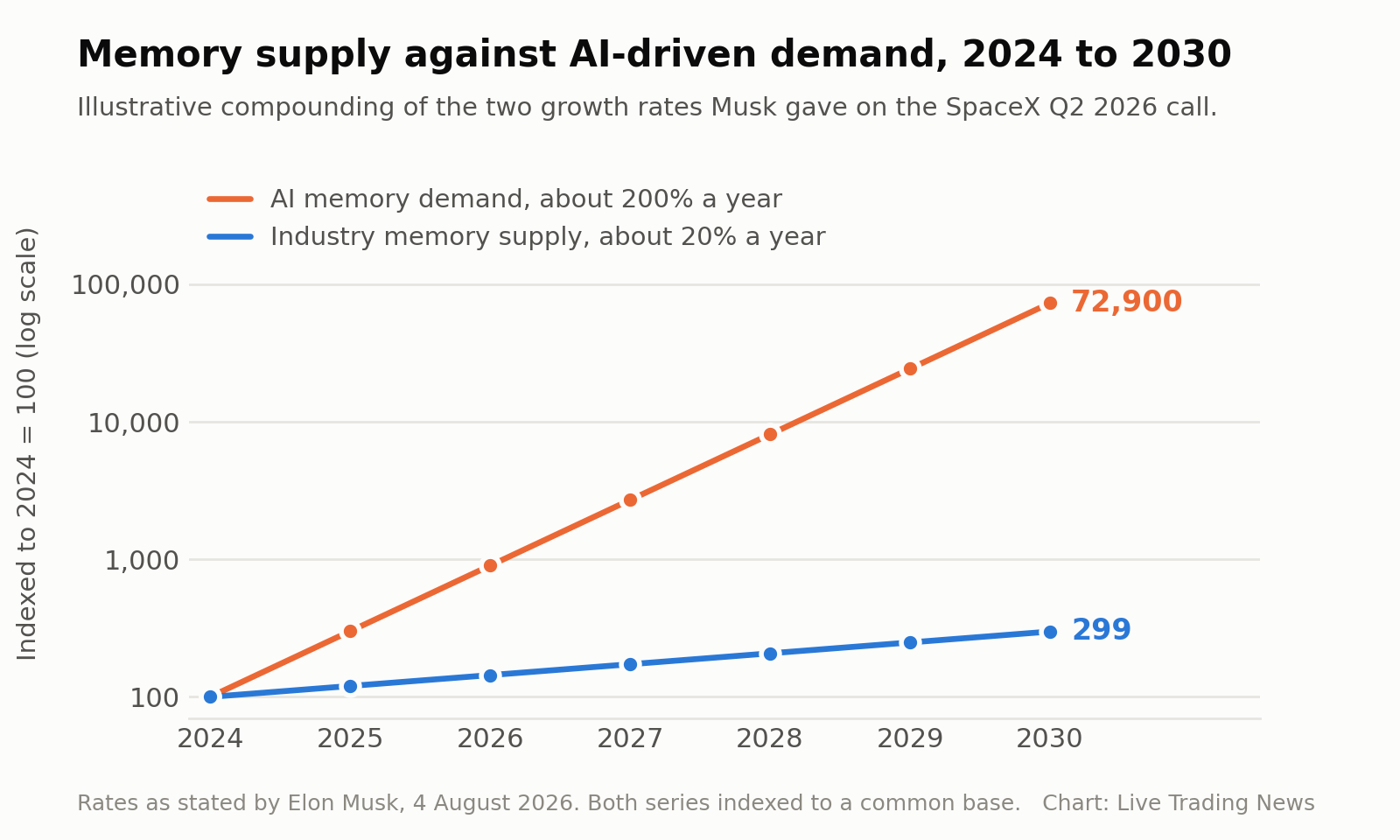
On SpaceX's second-quarter 2026 earnings call on 4 August, Musk was asked about the pace of the compute build-out. His answer was five words: "Limiting factor currently is memory." He then put numbers on the imbalance. Memory output is rising at roughly 20% a year. Demand is climbing at 200% a year, and in his words maybe higher. Economics 101 suggests that prices rise under those conditions. They do not fall.
Twelve days earlier, on Tesla's own second-quarter call on 23 July, he had been more specific, and more revealing:
"I'd actually also like to thank Micron for giving us memory allocation. They've got to make some very tough decisions on memory allocation. We really appreciate Micron making room for Tesla in the years to come and giving us actually a very significant allocation on reasonable terms given the pretty insane pricing of memory these days."
He described the current environment as the biggest price jump in anything he had ever seen. He thanked Micron twice on the same call. That is worth sitting with. When one of the largest and best connected buyers of advanced silicon on earth publicly thanks a supplier for making room for him, the supplier is not the one with the weak hand.
The comment lands at a moment when memory and storage stocks have already delivered historic returns for the cycle, then suffered a sharp July pullback that left many shares 15% to 30% below their June peaks. Profit taking, concerns about more efficient Chinese models, short-seller skepticism, and the difficulties of one AI-focused hedge fund all contributed. Investors are asking whether that correction marked the start of a longer unwind or the latest chance to accumulate ahead of the next leg higher. Musk's public confirmation of the bottleneck tilts the argument toward the latter.
This piece examines the structural reasons behind the shortage, the specific demands agentic AI places on DRAM, high-bandwidth memory and NAND, the implications for the leading listed names, and the longer-term intersection with quantum computing systems that will themselves keep leaning on classical memory and control infrastructure.
From Commodity Cycle to Strategic Constraint
For most of the past two decades, DRAM and NAND flash lived firmly in the commodity bucket. Capacity expansions by Samsung Electronics, SK Hynix, Micron Technology and the storage specialists routinely produced oversupply, sharp price collapses, and multi-year troughs. Gross margins swung from the mid-teens to the high sixties and back inside a single cycle. Valuation multiples stayed depressed relative to other semiconductor groups. That history is exactly why many experienced portfolio managers still treat the memory complex with skepticism, even after the rallies of 2025 and the first half of 2026.
The agentic wave is rewriting that script. In the first generation of generative models, a user typed a prompt and the system produced a response. The heavy lifting sat with the GPU's parallel arithmetic units. Memory mattered, since high-bandwidth stacks sit physically beside the accelerators and feed them, but system design still treated it as a supporting actor rather than the binding constraint.
Agentic systems change the workload profile at its root. An autonomous agent plans multi-step tasks, calls external tools and APIs, reads intermediate results, tests outputs against criteria, revises its approach, and loops until the objective is met or resources run out. Every one of those steps needs persistent state that has to be stored, retrieved and updated at speed. Micron's own technical material lists the memory demands of a single agent instance plainly: state and KV context staging so the model knows where it sits inside its reasoning loop, tool outputs and queues buffering results from API calls and code execution, container and sandbox memory isolating runtime environments for safety, vector and index data for retrieval-augmented generation and semantic search, and the ordinary operating-system overhead of keeping thousands of those environments alive at once across a cluster.
If an agent runs for hours or days rather than seconds, the key-value cache is read and written continuously. Context windows stretch far past the lengths common in early chatbots. Token counts multiply. Goldman Sachs researchers put monthly token consumption on a path to roughly 120 quadrillion by 2030, about 24 times the level observed in early 2026. That is not incremental growth stacked on existing generative workloads. It is a structural re-rating of the resource that stores, moves and stages those tokens between processors.
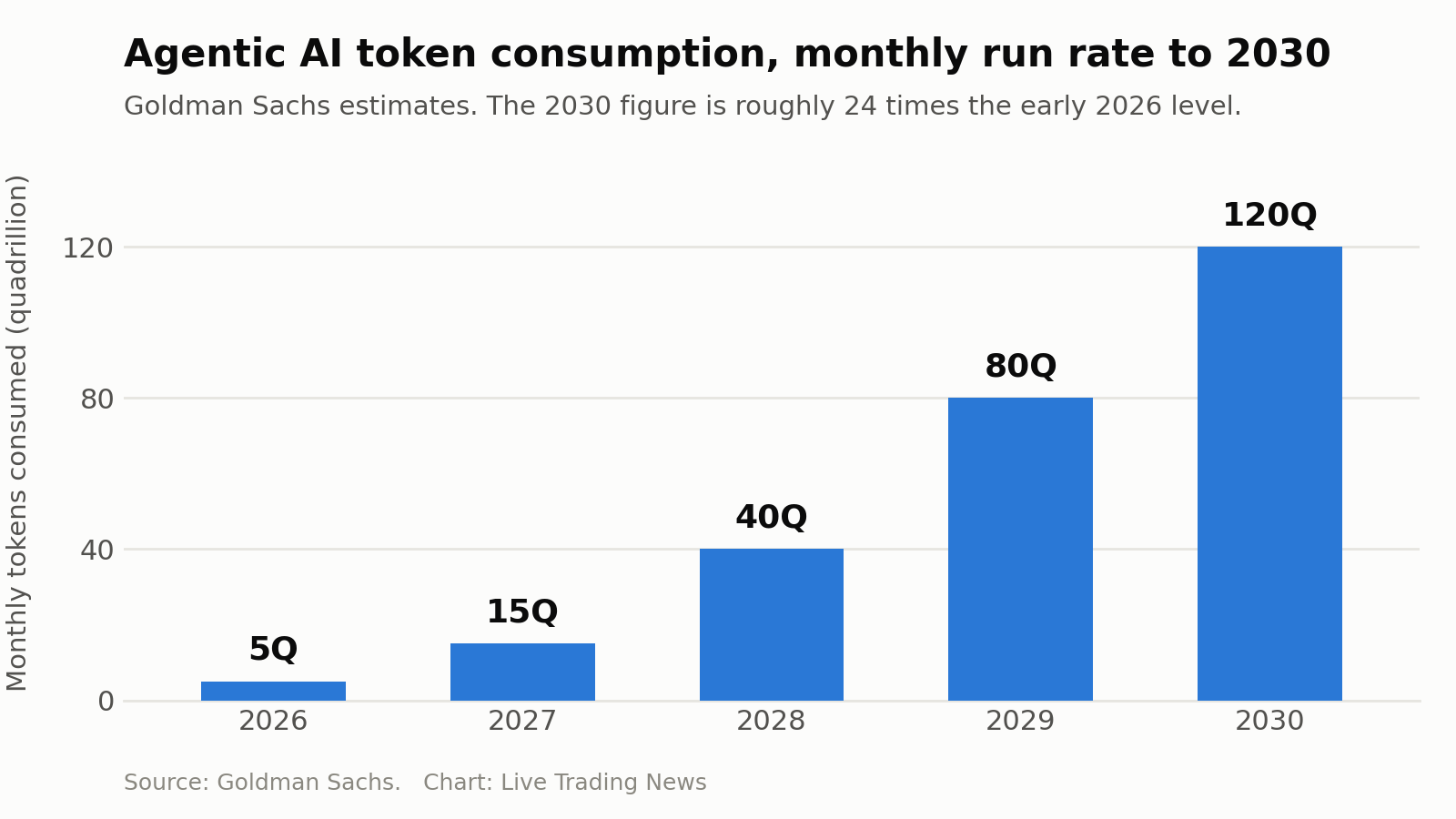
The actual trajectory will depend on adoption rates, model efficiency, and the mix of consumer against enterprise agent workloads. The direction is not seriously in dispute.
The Supply Reality Musk Highlighted
The 20% against 200% framing is deliberately stark, and it aligns with what supply-chain specialists have tracked for some time. Capacity additions for advanced DRAM, and especially for high-bandwidth memory, are capital intensive, process intensive and slow. Clean-room space and wafer starts dedicated to HBM cannot be flipped back to commodity DDR overnight without real yield and cost penalties. New fabs take years from groundbreaking to qualified high-volume production.
Micron's own schedule shows how long that runway is. The company poured first concrete at its New York megafab in July 2026, having broken ground in January, and has not named a production date for the site. The nearer-term American capacity is in Idaho, where first fab wafer output is expected in mid-2027 and a second fab follows in late 2028. Micron has committed more than $250 billion of US investment through 2035. All of that is real, and none of it helps a buyer who needs parts in 2027. The United States still lacks high-volume domestic memory fabrication at commercial scale, a vulnerability Musk has described elsewhere as catastrophic.
On the demand side the pressure comes from hyperscalers whose capital budgets keep rising even after the mid-year volatility. Alphabet, Amazon, Meta Platforms and Microsoft have all lifted 2026 and forward spending guidance in recent quarters. Tesla and SpaceX are themselves significant and growing buyers. Even the largest and best connected buyers are working hard to lock in multi-year supply rather than trusting the spot market.
Pricing power has shifted decisively toward the producers. Contract prices for both DRAM and NAND have moved sharply higher through 2025 and into 2026, and gross margins at the leading memory companies have expanded into ranges once thought unreachable for what was long treated as a pure commodity cycle. The open question is no longer whether the upturn is real. It is how long the tight balance holds, and whether the next wave of capacity arrives in time to prevent further price spikes.
The Names That Matter
Three companies sit at the centre of the debate: Micron Technology, SK Hynix and Sandisk. Two more, Western Digital and Seagate, complete the storage picture.
Ticker | Company | Focus | Close 17 Aug | Day | 52-week range |
|---|---|---|---|---|---|
MU | Micron Technology | DRAM, HBM, NAND | $1,011.75 | +4.13% | $113.46 to $1,255.00 |
SNDK | Sandisk | NAND flash, enterprise SSD | $1,786.85 | +8.88% | $43.20 to $2,354.39 |
SKHY | SK Hynix (ADR) | HBM leadership, DRAM | $171.38 | +3.04% | $124.80 to $194.80 |
WDC | Western Digital | HDD and flash storage | $536.01 | +5.35% | $73.14 to $799.87 |
STX | Seagate Technology | High-capacity HDD | $994.79 | +2.19% | $152.50 to $1,145.00 |
Prices are official closes for 17 August 2026. Always verify live quotes and do your own research. Past performance is not indicative of future results.
$MU remains the clearest pure-play vehicle available to most American investors. Its high-bandwidth memory capacity is effectively sold out well into future periods under binding multi-year customer contracts, and it is expanding domestic manufacturing at a moment when governments on both sides of the Pacific are increasingly sensitive to supply-chain concentration.
$SKHY holds the leading position in HBM and has repeatedly been first to qualify successive generations with $NVDA, the dominant buyer of AI accelerators. Two details matter for anyone buying the ticker rather than the story. Its HBM share was about 58% in the first quarter of 2026, down from 69% a year earlier, with Micron having moved past Samsung into second place, so the lead is real but it is being competed for. And SKHY itself is new: SK Hynix listed its ADRs on Nasdaq on 10 July 2026 at $149, raising roughly $26.5 billion, with each ADR representing one tenth of a Korean common share. The US line has a short trading history and its own liquidity behaviour.
$SNDK, focused on NAND flash and solid-state drives, captures the complementary need for high-capacity persistent storage that both training clusters and long-running agent fleets consume in volume. It has also been the most violent re-rating in the group, which cuts both ways.
$WDC and $STX cover the rest of the hierarchy. Hard-disk drives still dominate bulk archival and much nearline work inside large data centres. The AI data flood has not killed spinning magnetic media. It has made both flash and high-capacity HDDs more valuable as complementary layers.
Where Quantum Computing Intersects the Memory Bottleneck
Quantum computing does not replace or solve the classical memory problem. In most practical respects it intensifies the need for high-performance classical storage, DRAM and specialised control memory, while adding its own research challenges around quantum memory.
Near-term quantum systems remain noisy intermediate-scale devices. Almost all useful work today happens inside hybrid classical-quantum loops. The classical side of those loops still performs data preparation, error mitigation, result decoding, orchestration of many circuit executions, and the storage of intermediate classical results. Those tasks need the same fast DRAM, high-bandwidth stacks and large persistent storage pools that agentic workloads already stress. Quantum control electronics face their own memory bottlenecks: limited on-chip block RAM and the non-deterministic latency of external DRAM constrain both circuit depth and experimental throughput. Research groups are actively redesigning control-system memory hierarchies to keep pace with higher physical qubit counts and more complex pulse sequences.
True quantum random-access memory remains an open and difficult research problem. Without efficient quantum memory structures, many data-intensive algorithms, including whole families of quantum machine-learning approaches, cannot realise their theoretical speed-ups, because the cost of loading classical data into the processor becomes the dominant term. Hybrid architectures that keep the bulk of data classical and send only carefully chosen subproblems to the quantum processor are the practical engineering path for the rest of this decade.
Major research houses continue to forecast that enterprise AI workloads at production scale will not run primarily on quantum hardware through at least 2028. Fault-tolerant machines with enough logical qubits to deliver economically meaningful advantage on real AI tasks sit further out again. In the interim, the companies supplying classical memory, storage, networking and the control electronics around quantum processors benefit from both build-outs at once.
Investors following pure-play quantum names should keep the classical memory constraint firmly in view. Progress in quantum hardware tends to increase, not reduce, demand for the classical infrastructure that feeds data into those machines, steers their control systems and stores their results. The same HBM, DRAM and NAND suppliers serving Nvidia-dominated clusters will serve the hybrid systems that eventually host quantum accelerators beside classical processors.
Risks That Could Interrupt the Thesis
No industrial cycle lasts forever, and several identifiable risks could moderate this one.
Software and algorithmic efficiency gains could reduce hardware demand relative to current forecasts. More capable models needing fewer tokens per completed task, better sparsity and quantisation, architectural work that shrinks key-value cache pressure, or improved retrieval methods would all ease the constraint at the margin. Chinese model developers have already demonstrated aggressive efficiency improvements in publicly released systems, and further progress there is a genuine downside risk to pure capacity demand.
New manufacturing capacity will eventually arrive. If multiple large-scale fabs ramp together in the 2028 to 2030 window while demand growth decelerates from its current extreme rates, the classic oversupply pattern that defined prior cycles could reassert itself.
Valuation risk is real after moves of this size in a short period. A sustained risk-off episode in broader equity markets, or a genuine multi-quarter slowdown in hyperscaler capital expenditure, would pressure these high-beta names regardless of the longer-term story.
Geopolitical and export-control developments remain wild cards. Further restrictions on the transfer of advanced memory technology, or deeper concentration of HBM manufacturing inside a small number of jurisdictions, could alter both physical availability and the pricing power of the remaining unconstrained producers.
Investment Posture After the Mid-Year Pullback
The July correction and the partial August recovery have left the group cheaper than it stood at the June highs, yet still expensive against the historical valuation norms of prior memory cycles. That tension is the whole argument. If memory has genuinely shifted from a cyclical commodity to a strategic enabler of the agentic era, historical multiples become less useful as a sole guide, and the better comparison is the scarcity value of a resource whose demand is compounding far faster than the industry can expand physical supply.
Musk's statements remove one layer of uncertainty. The largest and most aggressive builders of AI infrastructure see memory as the binding constraint and expect prices to stay elevated rather than mean-revert quickly. That view is consistent with the multi-year sold-out status of leading HBM lines and with the capital budgets hyperscalers keep announcing.
For investors who missed the first leg of the re-rating, the current environment offers a clearer fundamental narrative than existed twelve or eighteen months ago. The agentic workload is no longer a research-paper construct. Large banks have published quantified token forecasts that attempt to size it, and the public remarks of the industry's most visible operator confirm the bottleneck in plain language. Quantum computing, still early, adds a longer-duration secondary tailwind for the same classical stack that will be required to control, feed and interpret quantum processors for many years.
Position sizing and time horizon matter more than ever here. These equities will stay volatile. The underlying physical shortage, though, is measured in years of fab construction, process qualification and customer certification, not in the quarterly inventory swings that characterised earlier commodity cycles. That duration is what separates the present tightness from the many shorter-lived upturns before it.
Closing Observation
Three words from Elon Musk will not by themselves move multi-hundred-billion-dollar equity markets. They do crystallise a diagnosis that engineers and procurement teams inside the largest AI laboratories and cloud providers have been living with for a while. Memory bandwidth, memory capacity and persistent storage have become first-order constraints on the next phase of artificial intelligence. Storage is no longer an afterthought buried in the bill of materials. It is critical infrastructure.
The companies that design and make the chips and drives relieving those constraints sit at the intersection of two of the most powerful technology trends of the decade: the continued scaling of agentic AI, and the gradual, capital-intensive maturation of quantum computing platforms that will keep depending on classical memory for control, data movement and hybrid execution. For investors willing to look past the commodity narrative that has long attached to this sector, the next several years of tightness may prove more durable, and more strategically important, than the skeptics assume.
Related Reading
CXMT: Inside ChangXin Memory Technologies, China's DRAM Champion
The End of the GPU Arms Race: Why Context Is the New King in AI
Compute and Electricity: The Defining Challenge of Our Times
The Quantum Frontier: A Global Analysis of Listed Quantum Computing Stocks
The Titans, Tokens and Terabytes Reshaping the Global Economy
Shayne Heffernan, Ph.D., is an economist and founder of Live Trading News. He writes regularly on markets, artificial intelligence infrastructure, semiconductors and emerging technology platforms. This article is provided for informational and educational purposes only and does not constitute investment advice, a recommendation, or an offer to buy or sell any securities. Readers should conduct their own independent due diligence and consult qualified financial, legal and tax advisors before making any investment decisions. Past performance is not a guarantee of future results. Market conditions can change rapidly.

Weekly Market Outlook: Fed Minutes, Anthropic and OpenAI IPOs, Gold, Bitcoin, FX
The Fed raised rates in September and payrolls rose 29,000, per the Labor Department. This week the FOMC minutes, three Treasury auctions and a 10-year near 5.3 percent test that gap. Anthropic's IPO clock runs toward a 14 October investor day while OpenAI's chief executive says not 2026. Gold sits 26 percent below its record, bitcoin near $85,500, the dollar up three weeks running. Two knowledge graphs from KXCO's records map the IPO backers and the FDA board.
Thoughts on Thinking in an AI World
A model will write an answer about anything in seconds. What an AI world makes scarce is everything around the answer: what you believed last month and why you changed it, the link between fields nobody reads together, and a decision a named person can stand behind. Three knowledge-graph exhibits from the KXCO record show each one, from a reported Nvidia deal that became a signed 8-K to a war five links from a data centre.

AI Development: The Token Got Cheaper, the Building Did Not
The useful fact on 28 September is a split, not a benchmark. Gartner puts 2026 AI spending at $2.67 trillion, and 56 percent of it is infrastructure against about 1 percent on the models. Inside one week the frontier cut the price of a token in half, Nvidia signed for the shelf the open weights sit on, and three closed labs proposed to run the test. What shipped, what it costs and where the money goes, with the AI sector checked against KXCO Ontology Live.

The Week the Discount Rate Gets a Vote
The Fed hiked on 16 September and left the door open. This week the August PCE deflator on Wednesday, September payrolls on Friday, the RBA on Tuesday and euro-area CPI set the discount rate. Gold, Bitcoin, the dollar, the AI complex and the quantum pure plays share that rate and diverge everywhere else. This is the map of what depends on what, the three regimes the book should already have written down, and the stop that belongs to each node on KXCO Ontology Live.
Every story, signed and delivered.
Subscribe to the kxco channel and get the headline, the AI-written key takeaways, and the chain-anchor link the moment we publish. Audio versions and per-ticker subscriptions arrive in the next iteration.