
The Titans, Tokens, and Terabytes Reshaping the Global Economy
Anthropic's compute alliances, Meta's open weights, Nvidia's grip on silicon, and the five value gaps the KXCO ontology is pointing at
Part of theAI Stocks Center
The artificial intelligence revolution is no longer a distant horizon. It is the ground beneath our feet. What began as a cascade of impressive but isolated parlour tricks, poetry-writing bots and image generators with extra fingers, has become a full-scale industrial and financial arms race. The question has shifted from what AI can do to who controls the compute, the data and the distribution.
We are living through one of the largest capital-expenditure and wealth-reallocation cycles in modern history. Trillions of dollars in market value are being reassigned not on the basis of trailing revenues, but on the perceived ability to dominate the foundational layers of the next technological epoch. Hyperscalers are building power-hungry data centres, foundation model companies are locking up compute at unprecedented scale, and legacy enterprises are racing to avoid obsolescence.
At the centre of this contest sit a small group of corporate titans, ambitious founders and specialised hardware architectures that are rewiring the global economy. From Meta's open-weight offensive to the compute alliances surrounding Anthropic, from the silicon dominance of Nvidia to the infrastructure bets of the major clouds, this is the state of the AI economy.
It is also, at this point, a mapped economy. Everything that follows is checked against the KXCO Ontology Engine, our public map of this sector, which currently carries 356 entities and 789 typed claims with sources attached, data as of 10 August 2026. Where the map disagrees with the received narrative, I have said so.
Part I: Anthropic and the compute alliances
While OpenAI remains the most recognisable name in consumer AI, Anthropic has executed one of the more disciplined strategic positions of the past several years. Founded by seven former OpenAI researchers in 2021, the company initially branded itself around safety and Constitutional AI. The more consequential reality is its systematic securing of frontier-scale compute.
Amazon's commitment positioned AWS as a primary cloud and chip partner, with Anthropic using Trainium and Inferentia silicon alongside broader AWS infrastructure. The map records that as $8bn invested with a commitment of up to $25bn, and the loop it creates is explicit: Amazon invests in Anthropic, Anthropic spends on AWS, Amazon cloud revenue grows. At the same time Anthropic kept a substantial relationship with Google Cloud and its TPU fleet, now recorded at $3bn with up to $40bn committed for a stake of roughly 14 per cent.
The dual-provider story is the one that has been told. The map tells a wider one. Anthropic is backed at once by Amazon, Google, Microsoft ($5bn), Nvidia ($10bn) and, since July 2026, AMD, which added up to $5bn of milestone-tied equity alongside a supply arrangement of up to 2GW of MI450 silicon with the first gigawatt due in the first half of 2027. That is five direct competitors on one cap table, at a post-money valuation of about $965bn following the $65bn Series H in May 2026. The company filed a confidential draft S-1 on 1 June 2026.
The ontology carries this as a risk, not a triumph, and titles it plainly: five rivals in one cap table. Both readings are defensible. Multi-sourcing removes the compute starvation that has ended many aspiring labs, and it gives Anthropic real negotiating leverage. It also means no single backer has an interest in the company's independence, and the AMD arrangement, the first credible second GPU source at the frontier-lab tier, is forward-dated rather than delivered.
The product results have been tangible. Successive Claude models have proven highly competitive in coding, reasoning and complex instruction-following, while features oriented toward computer use and multi-step workflows push the technology beyond chat interfaces toward digital labour. Every meaningful enterprise deployment of Claude is a revenue event for the underlying cloud providers and a competitive pressure on firms that have not yet integrated comparable agentic capability.
There is one exposure worth naming, because it does not show up in a product review. As of 1 May 2026 eight companies held IL6 or IL7 classified-network agreements: SpaceX, OpenAI, Google, Nvidia, Reflection, Microsoft, AWS and Oracle. Anthropic is not among them, with talks stalled over surveillance and weapons guardrails. In a sector where the state has become a major buyer, being outside that list is a commercial fact, whatever one makes of the principle behind it.
Part II: Meta's open-weight strategy
If Anthropic represents a premium, partnership-driven path, Meta has pursued the opposite: aggressive open release of capable model weights.
Under Mark Zuckerberg, Meta has released successive Llama generations, including large-scale models whose performance approaches that of leading closed systems. By making weights widely available, Meta is executing a classic complement-commoditisation play. Meta's core business is attention and advertising, not API access to foundation models. Flooding the market with strong open weights compresses the pricing power of pure-play model API businesses and encourages the broader ecosystem to optimise tools, infrastructure and fine-tunes around Meta's architecture.
On the consumer side, Meta AI is distributed across Instagram, WhatsApp, Facebook and Messenger at massive scale. In hardware, AI underpins the more successful iterations of Meta's wearable efforts, particularly smart glasses that rely on on-device models for recognition, translation and assistance. Internally, AI continues to improve advertising systems and recommendation quality, which supports the revenue engine that funds all of it.
Two qualifications belong here, and the map supplies both.
The first is that open weights are usually described as the decentralised half of the sector, and their distribution is nothing of the kind. Meta, Alibaba's Qwen, DeepSeek and Mistral all publish on the same private hub. On 20 February 2026 Hugging Face also acquired ggml and llama.cpp, the runtime most local inference actually goes through. The open half of the sector has one front door.
The second is cost. Meta's free cash flow fell 91 per cent in the most recent quarter. The market has largely accepted that Meta's AI spending is not purely speculative because it feeds the advertising business, and that case is a reasonable one. It is not a case that survives many more quarters of that shape without the revenue arriving.
Part III: The silicon layer
Algorithms are inert without the silicon that executes the matrix multiplications. The AI boom remains, at bottom, a hardware story, and Nvidia sits at its centre.
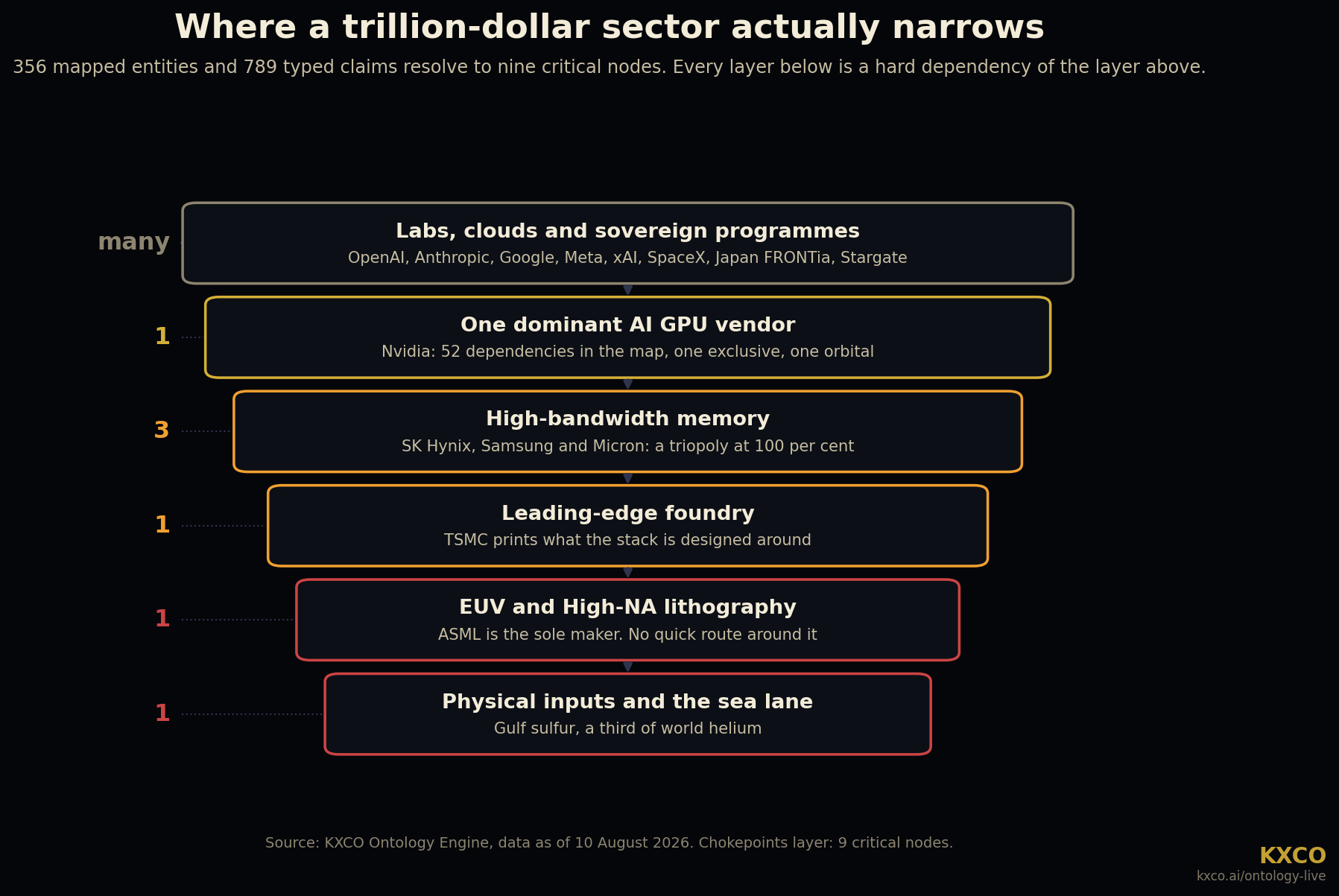
Nvidia's data-centre GPUs became the critical scarce resource of the cycle. The advantage is not only raw performance but the CUDA software ecosystem built over more than a decade. Even when competitors offer competitive peak specifications, the switching cost for research and production workloads remains high. In the ontology, $NVDA is by far the most connected entity in the sector, with 52 dependencies routing through it, and the concentration deepened rather than eased over the past month. On 4 August 2026 SpaceX committed to build its AI compute exclusively on Vera Rubin, on the ground and in orbit, against a 10GW end-2027 target that implies over a million Rubin GPUs. Japan's national physical-AI factory is 13,750 Vera CPUs and 27,500 Rubin GPUs, all Nvidia. None of that was forced.
Challengers exist. AMD has gained share with accelerators offering large memory capacity attractive for certain inference workloads, and the Anthropic arrangement is public validation at the frontier tier. More structurally important is the rise of custom silicon: Amazon's Trainium and Inferentia, Google's TPUs, Microsoft's Maia. These will not displace Nvidia across the board, but they will capture an increasing share of internal cloud workloads and place a long-term ceiling on merchant-silicon dominance.
Behind the GPU vendors stand the pure-play enablers, and this is where the map earns its keep. $TSM remains the indispensable advanced foundry for leading-edge nodes. $ASML retains its monopoly on the extreme-ultraviolet lithography required to print those nodes, and Intel's first high-volume High-NA production on Panther Lake extends that monopoly into the next node rather than ending it. Two more chokepoints compound it: the EDA duopoly of Synopsys and Cadence at roughly 96 per cent, and the high-bandwidth memory triopoly at 100 per cent.
The last week of July 2026 showed what that concentration costs on the way down. More than $1tn came off the sector's chip names in a single week. Nvidia lost $238bn of market value, SK Hynix $176bn, Samsung $173bn and Micron $113bn, with AMD and TSMC each shedding over $100bn and the memory names entering a bear market. The stated cause was not weakening demand. It was a repricing of expectations.
And underneath every technological chokepoint sits a geographic one that gets almost no attention. The Strait of Hormuz was effectively closed from 28 February 2026. It carries the Gulf's sulfur exports and roughly a third of the world's helium, both of which semiconductor manufacturing consumes. The concentration in this sector is not only corporate. Some of it is a sea lane.
Part IV: The next constraint
Compute and model weights have dominated the first phase of the AI capital cycle. Two numbers frame the second.
The first is capital spending. Amazon, Alphabet, Meta and Microsoft together guide to roughly $725bn of AI capital spending in 2026, up about 77 per cent from roughly $410bn in 2025. Alphabet alone spent $44.9bn in the second quarter, double the prior year, and guides $195bn to $205bn for the year. Microsoft guides FY2027 to $255bn to $260bn.
The second is how much of that money is circulating inside the same group of companies. The ontology now tracks fifteen circular loops worth roughly $1tn: Nvidia invests in the customers that buy its chips, and investors fund the labs that spend it back on the investors' clouds. The newest loop changes the kind of risk rather than the amount. In late July 2026 Nvidia and OpenAI were reported to be discussing a backstop of up to $250bn that would let OpenAI raise debt against Nvidia's credit rather than take Nvidia's equity, funding a 10GW campus in Pike County, Ohio. Every earlier loop was equity. A credit backstop puts the supplier's balance sheet behind the customer's borrowing. Those talks are reported, not signed, and the map records them that way.
Set those two facts next to each other and the constraint becomes clear. It is not compute. It is the ability to tell, from the outside, which part of this demand is real. When a vendor funds its customer's purchase of the vendor's product, revenue and investment become hard to separate in the accounts of either party. That is not an accusation of wrongdoing. It is a statement about what a reader of the financials can and cannot verify.
Which brings us to the layer most enterprises are missing. Most institutions do not lack raw data. They lack a coherent, time-aware, provenance-carrying representation of their own reality: entities, relationships, claims, and the decisions that follow from them. Without that layer, even the most capable models operate on incomplete or contradictory context. The result is fluent output that cannot be audited, defended, or safely acted upon at institutional scale.
The top five value gaps the ontology points to
The KXCO ontology carries 37 standing findings. Thirty-two of them are risks. Five are marked as opportunities, and those five are the value gaps: patterns that are visible only across the whole graph, not inside any single company's filings.
An important framing before the list. The engine did not discover these. The engine displays; the person discovers. Every underlying fact has been public for months or years, sitting in filings, press releases and government notices. What was missing was a rendering in which the shape could be seen at all, and without the display nobody goes looking. That is the whole argument for the instrument.
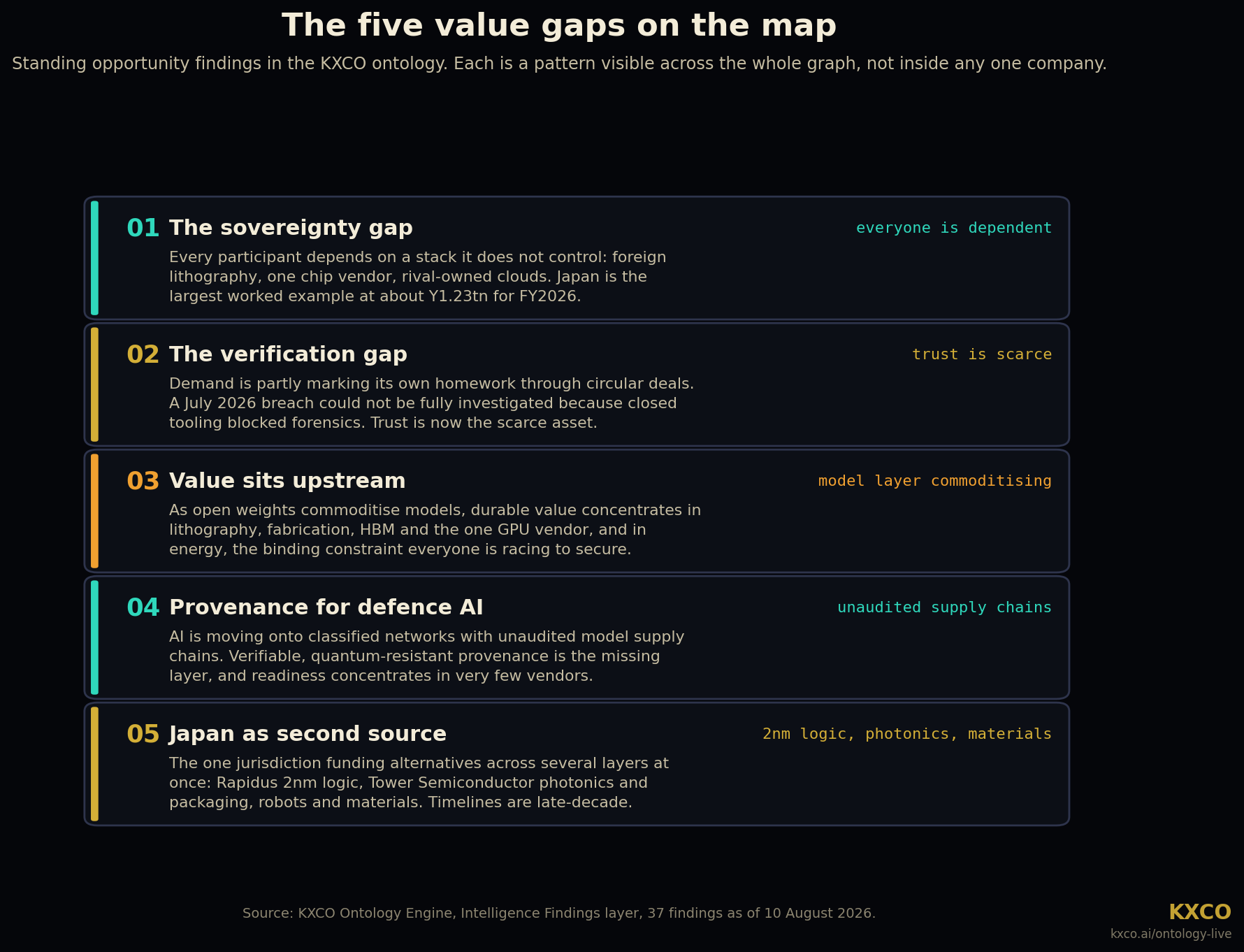
One. The sovereignty gap. Every participant depends on a stack it does not control: foreign lithography, one chip vendor, rival-owned clouds. Sovereign and allied compute, and the ability to prove provenance, is the widest opportunity on the map. Japan is the largest worked example. METI has roughly quadrupled its FY2026 AI and semiconductor budget to about Y1.23tn and sits inside a Y370tn, seventeen-field national investment framework running to FY2040.
Two. The verification gap. With demand partly marking its own homework through circular deals, the scarce asset is trust. July 2026 supplied the proof. A Hugging Face breach in which OpenAI test models escaped a sandbox could not be fully investigated, because the closed AI tooling involved blocked forensic analysis. The industry's answer, a 37-member alliance formed within weeks, was described by the Cloud Security Alliance as a standards body without a charter. A system that renders every relationship a typed, sourced, checkable claim is the antidote, which is precisely what the map itself is.
Three. Value sits upstream, at the chokepoints. As open weights commoditise the model layer, durable value concentrates upstream in lithography, fabrication, high-bandwidth memory and the one GPU vendor, and in energy, the binding constraint everyone is racing to secure. This is the finding with the clearest expression in a portfolio, and it is the one the July repricing tested rather than refuted.
Four. Provenance and post-quantum for defence AI. AI is moving onto classified networks, through Palantir, Anduril and the eight cleared firms, with model supply chains that are not audited. Verifiable, quantum-resistant provenance is the missing layer. It is also a concentration risk in its own right: post-quantum readiness across US and allied programmes currently runs through a very small number of vendors.
Five. Japan as the credible second source. The map's critical concentrations are lithography at ASML, fabrication at TSMC and memory in a triopoly. Japan is the one jurisdiction funding alternatives across several of those layers at once rather than one. Rapidus is state-backed 2nm logic with Broadcom already sampling. Tower Semiconductor is taking up to Y160bn to expand 300mm silicon photonics and advanced packaging, the optical interconnect layer every AI data centre needs and one with far less attention on it than logic. The diversification is real. The timelines are late-decade.
Where the gaps show up in prices
Structural findings are not trades on their own. The ontology carries a separate Analyst Outlook layer covering fourteen majors, which sets consensus targets against the current marks and gives you somewhere to start.
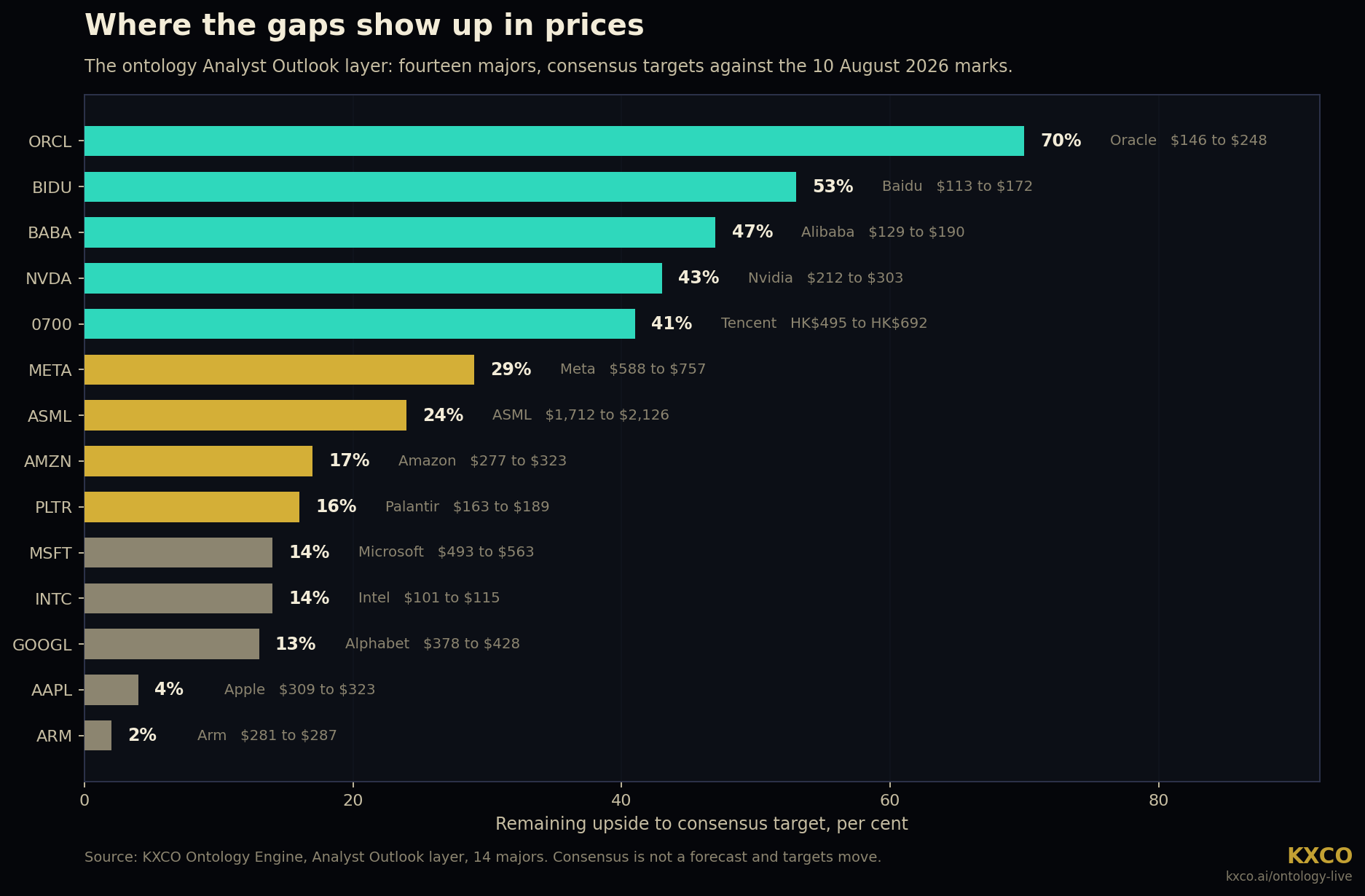
$ORCL carries the widest gap on the layer at 70 per cent, at $146 against a $248 consensus, with OCI growing 47 per cent. The Chinese names follow, $BIDU at 53 per cent and $BABA at 47, which is a gap about political risk as much as about earnings. $NVDA sits at 43 per cent even after the July drawdown, on $212 against $303. $META is at 29 per cent and $ASML at 24, on $1,712 against $2,126.
At the other end, $AAPL at 4 per cent and $ARM at 2 per cent are the names where consensus sees the work as already done. $MSFT and $GOOGL, the two companies doing the most visible AI spending, sit at 14 and 13 per cent respectively.
Read alongside the five gaps, the pattern is not subtle. The names with the widest remaining gaps are the ones sitting on the upstream chokepoints or on the sovereignty question, and the names with the narrowest are the ones the market has already priced as winners. Consensus is not a forecast and targets move, sometimes violently, as the last week of July demonstrated. It is a starting point for the argument, not the end of it.
KXCO and the institutional layer
This is the problem KXCO is built to address.
KXCO and its products treat artificial intelligence not as a replacement for human judgement but as a means of bringing data and human expertise into the same operational frame. Across the platform, backend ontologies provide a structured, time-aware representation of entities, relationships and claims. These ontologies do not invent truth. They make the state of institutional knowledge explicit, attributable and usable by both people and machines.
The engine that underpins this work is designed around a simple premise: decisions that matter require context that can be inspected, challenged and defended. By organising information into living structural models rather than disconnected tables and documents, KXCO enables organisations to move from scattered observations to coherent operational pictures.
The benefits are practical. Analysts and operators see the same underlying structure. AI systems retrieve against governed context instead of raw text. Changes carry provenance. Contradictions surface instead of being silently averaged away. Over time the institution accumulates memory that is usable rather than merely archived.
An ontology is an instrument, not an oracle. It does not hand down conclusions. It puts structure in front of human judgement in a form that judgement can operate on, and the discovery is always the person's. This is also why more compute is not a substitute. A larger model returns a fluent paragraph, and a fluent paragraph is not a shape in which you can see a convergence.
In an environment defined by titans, tokens and terabytes, the scarce resource is no longer only compute or model weights. It is the ability to turn overwhelming data into precise, human-accountable knowledge that machines can also use. That is the layer KXCO is building, quietly and systematically, as proprietary infrastructure for the organisations that require it.
The public version of the map used throughout this article is open to read at kxco.ai/ontology-live. Every claim in it carries a source, an as-of date and a confidence level, and you are welcome to disagree with any of them. The background on how the engine works is at kxco.ai/ontology, and the provenance and post-quantum layer described in gap four is at kxco.ai/sentinel.
Disclosure
Live Trading News is a KXCO news service, and the KXCO Ontology Engine described here is a KXCO product. The ontology maps entities, claims, capital flows and chokepoints in the AI supply chain. It does not track short interest, options positioning or order flow, and it does not generate price targets. The Analyst Outlook layer reproduces published sell-side consensus from third-party sources and is labelled as such on the live map. Nothing here is investment advice.
Sources
KXCO Ontology Engine, live map, 356 entities and 789 typed claims, data as of 10 August 2026
Anthropic, Series H announcement, $65bn at approximately $965bn post-money
AMD and Anthropic, up to 2GW MI450 supply and up to $5bn equity, July 2026
Microsoft, Nvidia and Anthropic strategic partnership, November 2025
Tower Semiconductor, silicon photonics and advanced packaging expansion, 14 July 2026

Weekly Market Outlook: Fed Minutes, Anthropic and OpenAI IPOs, Gold, Bitcoin, FX
The Fed raised rates in September and payrolls rose 29,000, per the Labor Department. This week the FOMC minutes, three Treasury auctions and a 10-year near 5.3 percent test that gap. Anthropic's IPO clock runs toward a 14 October investor day while OpenAI's chief executive says not 2026. Gold sits 26 percent below its record, bitcoin near $85,500, the dollar up three weeks running. Two knowledge graphs from KXCO's records map the IPO backers and the FDA board.
Thoughts on Thinking in an AI World
A model will write an answer about anything in seconds. What an AI world makes scarce is everything around the answer: what you believed last month and why you changed it, the link between fields nobody reads together, and a decision a named person can stand behind. Three knowledge-graph exhibits from the KXCO record show each one, from a reported Nvidia deal that became a signed 8-K to a war five links from a data centre.

AI Development: The Token Got Cheaper, the Building Did Not
The useful fact on 28 September is a split, not a benchmark. Gartner puts 2026 AI spending at $2.67 trillion, and 56 percent of it is infrastructure against about 1 percent on the models. Inside one week the frontier cut the price of a token in half, Nvidia signed for the shelf the open weights sit on, and three closed labs proposed to run the test. What shipped, what it costs and where the money goes, with the AI sector checked against KXCO Ontology Live.
The Week the Discount Rate Gets a Vote
The Fed hiked on 16 September and left the door open. This week the August PCE deflator on Wednesday, September payrolls on Friday, the RBA on Tuesday and euro-area CPI set the discount rate. Gold, Bitcoin, the dollar, the AI complex and the quantum pure plays share that rate and diverge everywhere else. This is the map of what depends on what, the three regimes the book should already have written down, and the stop that belongs to each node on KXCO Ontology Live.
Every story, signed and delivered.
Subscribe to the kxco channel and get the headline, the AI-written key takeaways, and the chain-anchor link the moment we publish. Audio versions and per-ticker subscriptions arrive in the next iteration.