
Elon Musk and Orbital Compute
The Sovereignty of the Void: Why SpaceX Is Building the Next Layer of Global AI Infrastructure
Part of theAI Stocks Center
If you stood this week inside one of the massive data-center campuses of Northern Virginia, the deserts of Arizona, or the expanding campuses in Texas and Georgia, you would feel the strain. The air is thick with the heat of tens of thousands of GPUs. Utility companies continue to issue warnings about peak loads. Local communities push back on water use and land consumption. The physical limits of terrestrial artificial-intelligence infrastructure are no longer a forecast: they are the operating reality of August 2026.
According to the Lawrence Berkeley National Laboratory's 2025 Data Center Energy Usage Report (updated mid-2026), U.S. data centers accounted for approximately 4.5–4.7% of total U.S. electricity consumption in the most recent full-year data, with a reference-case trajectory that could reach roughly 11.8% by 2030 under continued AI-driven growth. Other scenarios place the range between 9.5% and 15.3%. Data centers have already absorbed roughly half of new U.S. electricity demand growth in recent periods. The grid is not collapsing, but the friction is real: permitting delays, interconnection queues, community opposition, and the sheer capital cost of new generation and transmission are slowing the terrestrial AI build-out.
Look up, however, and a different architecture is taking shape. Elon Musk is no longer treating orbital compute as a distant science-fiction concept or a Kardashev-scale aspiration for the 2030s. On August 14, 2026, responding to discussion of land-based power and permitting constraints, Musk stated on X: "Orbital compute will be the only way to scale AI probably sometime in 2029 due to power availability & permitting problems on land." That single sentence crystallized years of comments into the most concrete near-term timeline he has publicly offered.
This article examines the state of orbital compute as of mid-August 2026: what Musk and SpaceX have actually committed to, the engineering reality of the Starmind/AI1 architecture, the role of Starship and Starlink V3, the competitive landscape, the physics that make space attractive, the geopolitical and economic ramifications, and the investment implications. The original vision of a fully operational, multi-trillion-dollar orbital cloud dominating global AI by summer 2026 has not arrived. What has arrived is a rapidly maturing industrial plan backed by regulatory filings, detailed vehicle designs, a named Nvidia partnership, manufacturing commitments, and explicit executive timelines.
1. Elon Musk's Statements on Orbital Compute: From Concept to Timeline
Musk has discussed the advantages of space-based compute for several years. The core arguments have remained consistent: abundant solar power (roughly five times the output of an equivalent panel on Earth because of the absence of atmosphere and, in suitable orbits, limited night periods), free radiative cooling into the 3-kelvin background of deep space, no land-use or zoning constraints, and ultimately the ability to scale far beyond the physical and political limits of terrestrial grids.
In late 2025 and early 2026 the commentary intensified. Musk noted that Starship could eventually deliver hundreds of gigawatts of solar-powered AI satellites per year once operational at scale. He linked the effort to the joint SpaceX–Tesla Terafab project, whose stated goal is production of logic, memory, and packaging at the scale of a terawatt of compute per year, with the majority intended for space. In March 2026, during the formal Terafab announcement period, he emphasized that U.S. terrestrial electricity capacity is finite and that the bulk of future high-end AI compute would necessarily move off-planet.
The June 2026 period surrounding SpaceX's IPO and related investor materials brought the most detailed public technical discussion to date. Musk and SpaceX leadership released specifications and conceptual illustrations for the first-generation orbital data-center satellite (then referred to as AI1, later associated with the Starmind constellation name). He argued that much of the required technology (solar arrays, radiators, laser terminals) already existed in advanced form on Starlink V3 satellites, and that the problem was therefore more one of scale and manufacturing than of fundamental invention.
The August 4, 2026 partnership announcement with Nvidia for the Starmind AI1 compute payload, followed ten days later by the explicit 2029 "only way to scale" comment, marks the transition from vision to near-term industrial schedule. Long-term, Musk has repeatedly stated that the overwhelming majority of AI compute, "99.99…%" in one formulation, will eventually reside in space because the scaling ceiling on Earth is simply too low.
Earlier statements provide useful context. In 2025 Musk noted that Starship should be capable of delivering on the order of 300 GW per year of solar-powered AI satellites, potentially higher, and compared that figure with average U.S. electricity consumption. He has also linked the effort to the broader Terafab initiative, arguing that chip production itself is the binding constraint once launch costs fall. In multiple interviews and posts he has emphasized that space becomes cheaper and easier to scale over time while terrestrial power becomes harder and more expensive. The consistency of the message across years, combined with the sudden appearance of concrete satellite designs and a major silicon partnership in 2026, is what has shifted market and media attention from speculative to operational planning.
It is worth noting that Musk's timelines have historically been aggressive. Starship, full self-driving, and earlier Starlink capacity targets all slipped relative to initial public statements. Investors and analysts therefore treat the 2027 prototype and 2029 scaling comments as directional rather than contractual. Even so, the existence of detailed vehicle specifications, a named manufacturing facility, and a live Nvidia collaboration places the program in a different category from pure aspiration.
2. Starmind and the AI1 Satellite: What SpaceX Has Actually Designed
SpaceX filed with the Federal Communications Commission in early 2026 for authority to deploy a constellation of up to one million satellites intended to serve as orbital data centers for AI workloads. The constellation has been associated with the name Starmind. The first-generation vehicle is the AI1 satellite.
Publicly released design parameters (as of mid-2026 briefings and the dedicated Starmind materials) describe a spacecraft roughly 20–30 meters in height with a deployed wingspan on the order of 70–75 meters, larger than a Boeing 747 in span. The satellite is dominated by large solar arrays and deployable liquid radiators. Sustained compute capability has been described in the 120–175 kW range depending on the specific briefing, with peak figures higher. Early concepts compared the payload to roughly one modern high-end terrestrial AI rack (for example, references to Nvidia GB300-class power draw appeared in earlier discussions). Later Nvidia partnership materials reference Vera CPUs and Rubin GPUs in NVL-class configurations.
Cooling is achieved by pumped liquid loops that carry heat to large thin-film or panel radiators that reject infrared energy into space. Power is continuous solar in appropriate sun-synchronous or near-polar orbits. Inter-satellite communication relies on the same class of high-bandwidth laser terminals already flying and being upgraded on Starlink. Data return to Earth can use either radio frequency or optical links via the existing Starlink mesh. The compute section is designed to be modular so that silicon can evolve: Nvidia hardware for the first generations, with a longer-term path to radiation-tolerant or custom devices from Terafab or other sources.
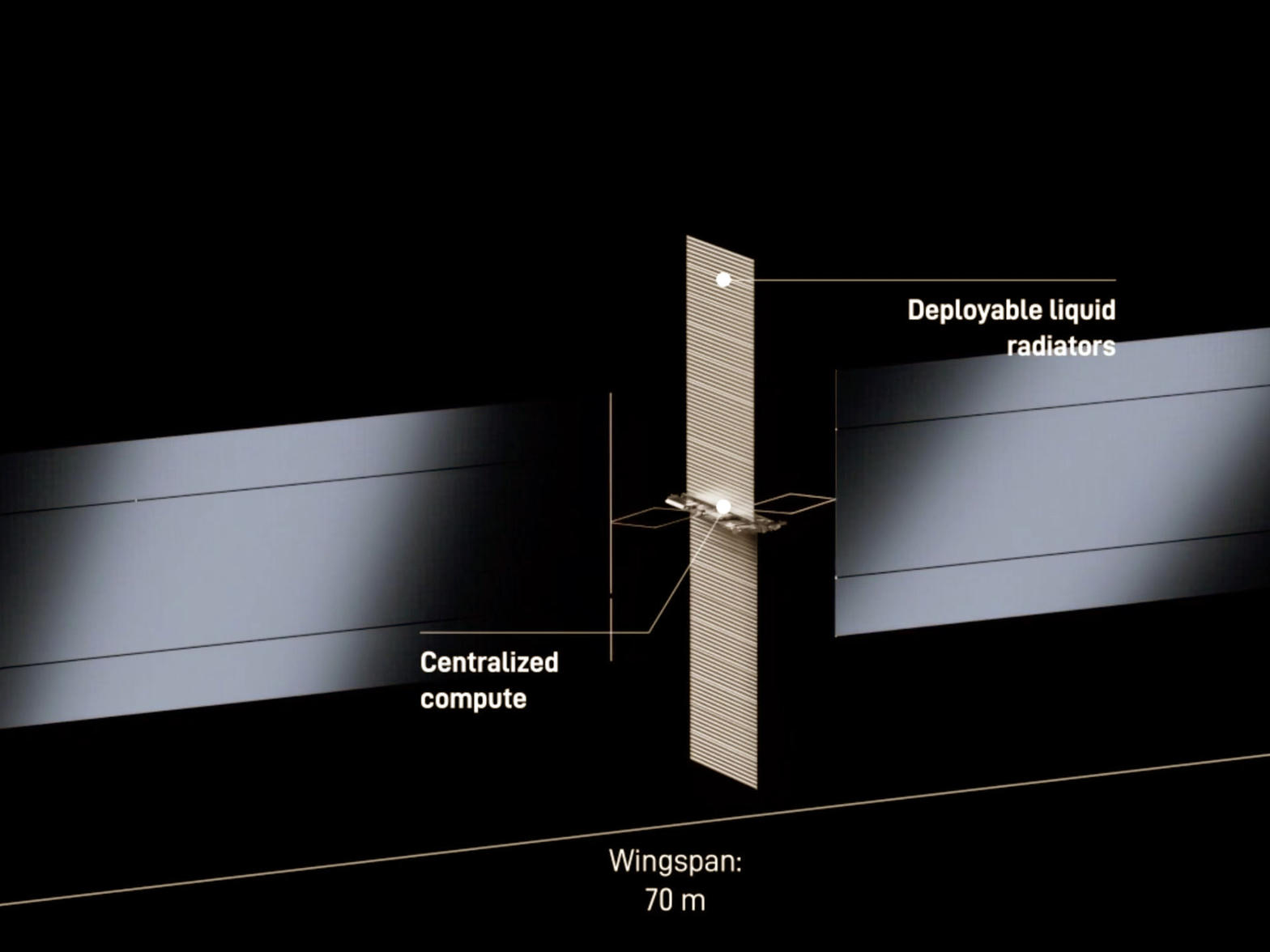
Conceptual diagram of the SpaceX AI1 / Starmind orbital data-center satellite showing centralized compute, deployable liquid radiators, and large solar arrays (wingspan ~70 m). Source: SpaceX public materials / Notebookcheck reporting.
SpaceX has indicated that early "canary" compute payloads may fly on Starlink vehicles before dedicated AI1 spacecraft. Prototype AI1 flights are targeted for 2027, with volume manufacturing planned later that year at the Gigasat facility under construction in Bastrop, Texas. The company has been explicit that Starship is the intended launch vehicle because of the size and mass of the solar-array and radiator systems.
It is important to be precise about status. As of August 15, 2026, no AI1 satellite has flown. No commercial orbital compute-as-a-service offering is live at scale. No frontier-class model comparable to Grok or its peers has been trained in orbit by xAI or SpaceX. The system is in advanced design, regulatory, partnership, and early manufacturing preparation. That is a meaningful advance from pure concept, but it is not yet operational infrastructure.
The modular compute approach is strategically significant. By designing the satellite bus, power system, and thermal system around a swappable payload, SpaceX can begin with Nvidia's current-generation (and next-generation) silicon while leaving open a path to Terafab or other radiation-optimized devices later. Early public comments indicated that the same compute architecture, stripped of solar arrays and radiators, would also be used in terrestrial SpaceX data centers, creating a common software and hardware stack across ground and orbit. That commonality reduces software and operations overhead and allows lessons from one environment to transfer more readily to the other.
Power figures in the 120–175 kW sustained range per satellite imply that a constellation of even a few thousand units would already represent a material increment to global AI capacity. Scaling to the full one-million-satellite FCC request would be transformative, but even a 1–5% realization of that vision would constitute one of the largest infrastructure deployments in the history of computing. The economic and strategic implications therefore begin well before the constellation reaches its theoretical maximum.
3. Starship and Starlink V3: The Enablers
None of the orbital-compute architecture works at interesting scale without cheap, high-cadence heavy lift and a dense, high-bandwidth laser mesh already in orbit. Both are progressing, though neither has reached the cadence or capability required for million-satellite deployment.
Starlink V3 satellites represent a substantial capacity increase over previous generations. SpaceX has stated that a single V3 can support on the order of 1 Tbps downlink and hundreds of Gbps uplink, with thousands of beams. In July 2026, Starship Flight 13 successfully deployed the first set of Starlink V3 satellites on a suborbital trajectory. The upper stage communicated with the satellites via radio and laser links and recovered telemetry before the vehicles re-entered as planned. Subsequent Starship flights are expected to continue V3 testing and, eventually, operational orbital insertion. Falcon 9 continues high-tempo Starlink launches in parallel.
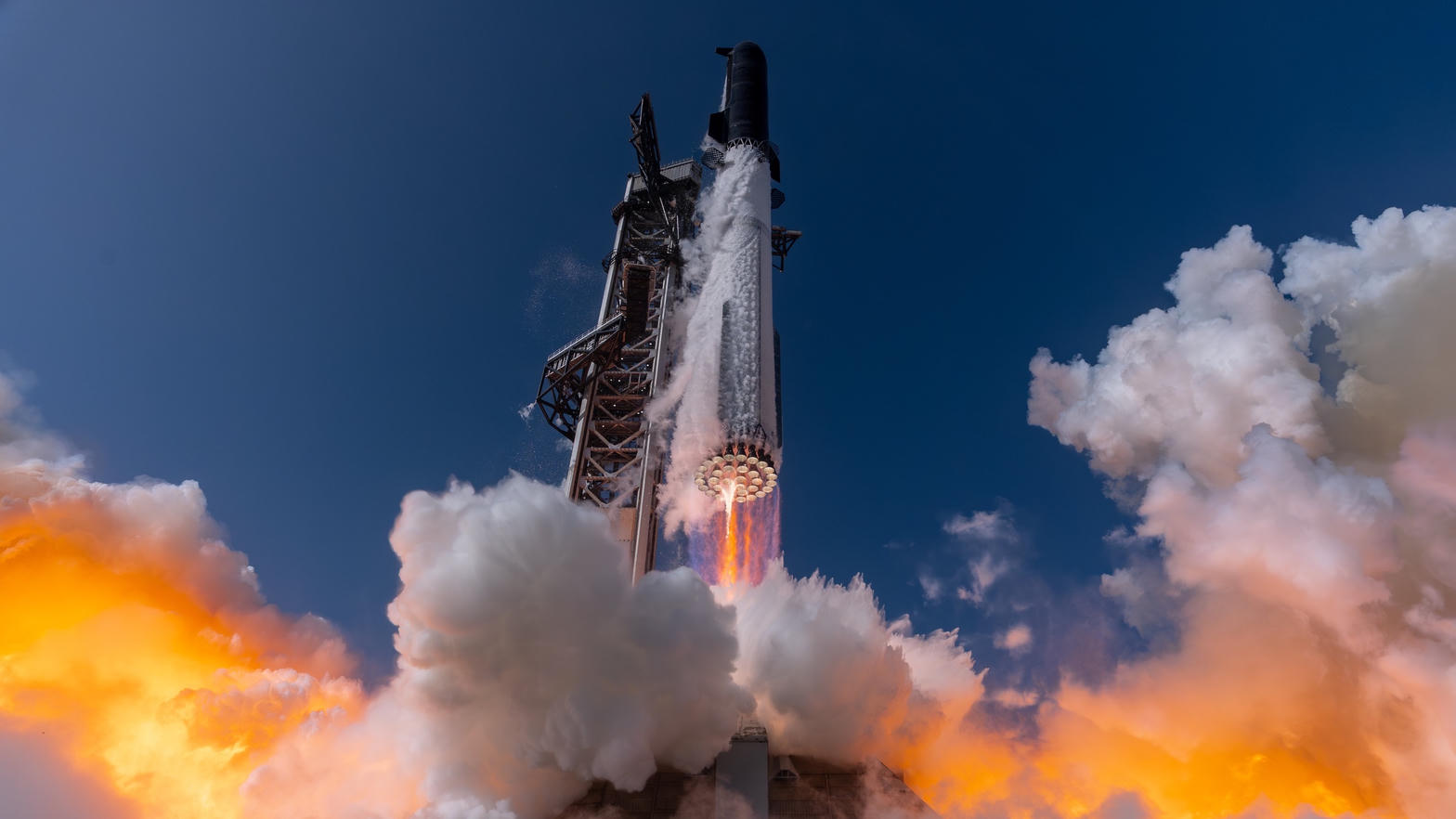
SpaceX Starship during a test flight. Starship is the planned heavy-lift vehicle for large AI1-class orbital data-center satellites.
The laser inter-satellite link network is already operational across much of the Starlink constellation and is being upgraded with each generation. These optical terminals are the backbone that would allow orbital compute nodes to function as a coherent distributed system rather than isolated islands. Latency for certain long-haul paths can be lower than terrestrial fiber because light travels faster in vacuum than in glass and because the geometric path can be more direct than cable routes that follow continental and undersea geography. Claims of 40% improvements on specific city pairs have appeared in industry discussion; actual performance depends on constellation geometry, routing, and the mix of space and ground segments.
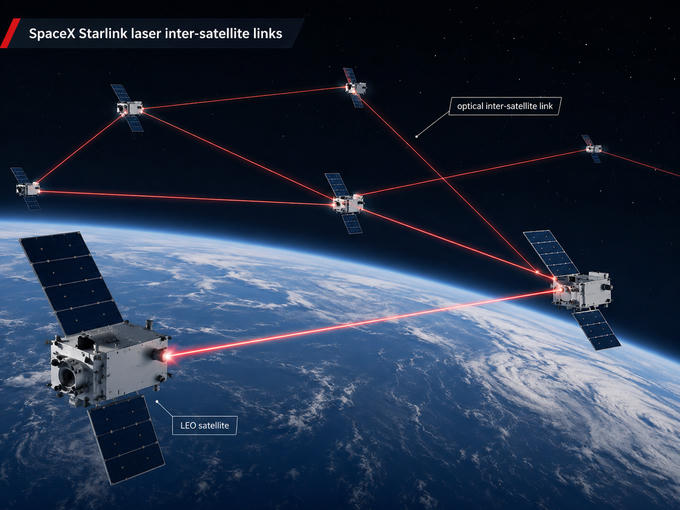
Conceptual illustration of Starlink-style laser inter-satellite links forming a mesh network in low Earth orbit.
4. The Physics Case: Power, Cooling, and Latency
Three physical realities underpin the orbital-compute thesis.
Power. Outside the atmosphere, solar irradiance is higher and more predictable. In a properly chosen sun-synchronous orbit, a satellite can remain in near-continuous sunlight for extended periods. Musk has repeatedly cited an approximate five-fold advantage in power generation per unit of solar array area compared with terrestrial installations. Once launch costs fall sufficiently, the marginal cost of adding power in space becomes more favorable than fighting for new terrestrial generation, transmission, and permits.
Cooling. Terrestrial data centers expend enormous energy and water on heat rejection. In space there is no convective cooling, but the vacuum allows pure radiative cooling. Heat pipes, pumped two-phase loops, and large deployable radiator panels can reject infrared energy into the 3 K cosmic microwave background. The engineering challenge is mass, deployment reliability, and micrometeoroid protection, not the fundamental thermodynamics. SpaceX's AI1 designs center on liquid radiators sized for the compute payload.
Latency and topology. For many AI inference and training workloads, absolute lowest latency to a specific end user is less critical than aggregate throughput and the ability to keep data in a secure, high-bandwidth fabric. For certain financial, defense, and global sensing applications, however, the combination of vacuum speed-of-light propagation and a dense mesh can offer structural advantages over fiber routes that must traverse oceans and continents. High-frequency trading firms and quantitative funds have long explored any physical edge; orbital nodes would simply be the next iteration of that arms race if the economics close.
A secondary but important advantage is security isolation. An orbital compute fabric that processes data in space and returns only results or highly compressed intermediates reduces the surface area exposed to terrestrial cyber threats, physical taps on undersea cables, and certain classes of nation-state interference. For defense and critical-infrastructure customers this isolation has independent value even if the pure performance economics are only marginally better than ground alternatives. The same isolation, however, complicates lawful access, audit, and regulatory oversight, a tension that will define much of the policy debate over the next decade.
Finally, the volume of space itself removes the physical packing density constraints that force terrestrial data centers into ever-taller buildings or ever-larger land footprints. Once the satellite bus and thermal system are proven, adding capacity is primarily a question of launch rate and manufacturing rate rather than real-estate acquisition and local permitting. That difference in scaling geometry is the deepest reason Musk and others describe space as the eventual home of the majority of AI compute.
5. The Broader Ecosystem: Who Else Is Building
SpaceX is the most visible and best-capitalized player, but it is not alone.
Starcloud has already launched satellites carrying Nvidia H100-class GPUs and has publicly claimed the first training of a language model in orbit. That demonstration, while small in absolute compute terms, is a genuine technical milestone and validates radiation and thermal management approaches for commercial silicon.
Blue Origin has filed its own orbital data-center constellation plans (Project Sunrise) targeting tens of thousands of satellites in sun-synchronous orbits.
Google announced Project Suncatcher as a research effort to place TPUs on satellites flying in tight formation, with prototype launches discussed for 2027.
Chinese programs, including the Three-Body Computing Constellation associated with ADA Space and Zhejiang Lab, have launched initial batches of satellites and reported successful in-orbit networking, model deployment, and scientific payload verification. Other Chinese entities have outlined multi-thousand-satellite space-computing networks. European and independent analyses have noted that China is moving from concept toward early implementation while some Western actors remain in study phases.
Startups such as Orbital Compute have filed FCC applications for up to 100,000 satellites aiming at multi-gigawatt aggregate capacity, with pathfinder missions planned for 2027. Specialized component suppliers for phased-array antennas, radiation-tolerant electronics, advanced thermal materials, and optical terminals form a growing supply chain. Nvidia's decision to co-design the Starmind payload signals that the leading AI silicon company views space as a serious long-term market.
The supply-chain dimension is easy to overlook but critical. Every AI1-class satellite requires not only the compute payload but large-area solar arrays optimized for the space environment, high-reliability pumped-loop thermal systems, deployable mechanisms that must function after launch vibration and years of thermal cycling, optical terminals capable of maintaining lock at relative velocities of several kilometers per second, and radiation-tolerant avionics and power electronics. Companies that already supply these subsystems to Starlink or to traditional GEO/MEO operators are natural beneficiaries of any scale-up. New entrants focused specifically on space-grade AI thermal solutions or high-density radiation-mitigated packaging are also appearing. The capital markets have begun to differentiate pure-play launch and constellation operators from the component and materials suppliers that will be needed regardless of which constellation operator ultimately wins the largest share.
On the demand side, early customers are likely to be a mix of government (defense and intelligence), hyperscale cloud providers seeking capacity outside constrained terrestrial markets, and specialized quantitative or sensing firms for whom the latency or security characteristics are decisive. Broad commercial adoption for general AI training and inference will require the cost per FLOP or per token to approach or undercut terrestrial alternatives on a fully loaded basis, including launch amortization, insurance, and operations. That cost crossover is the central economic question of the next five years.
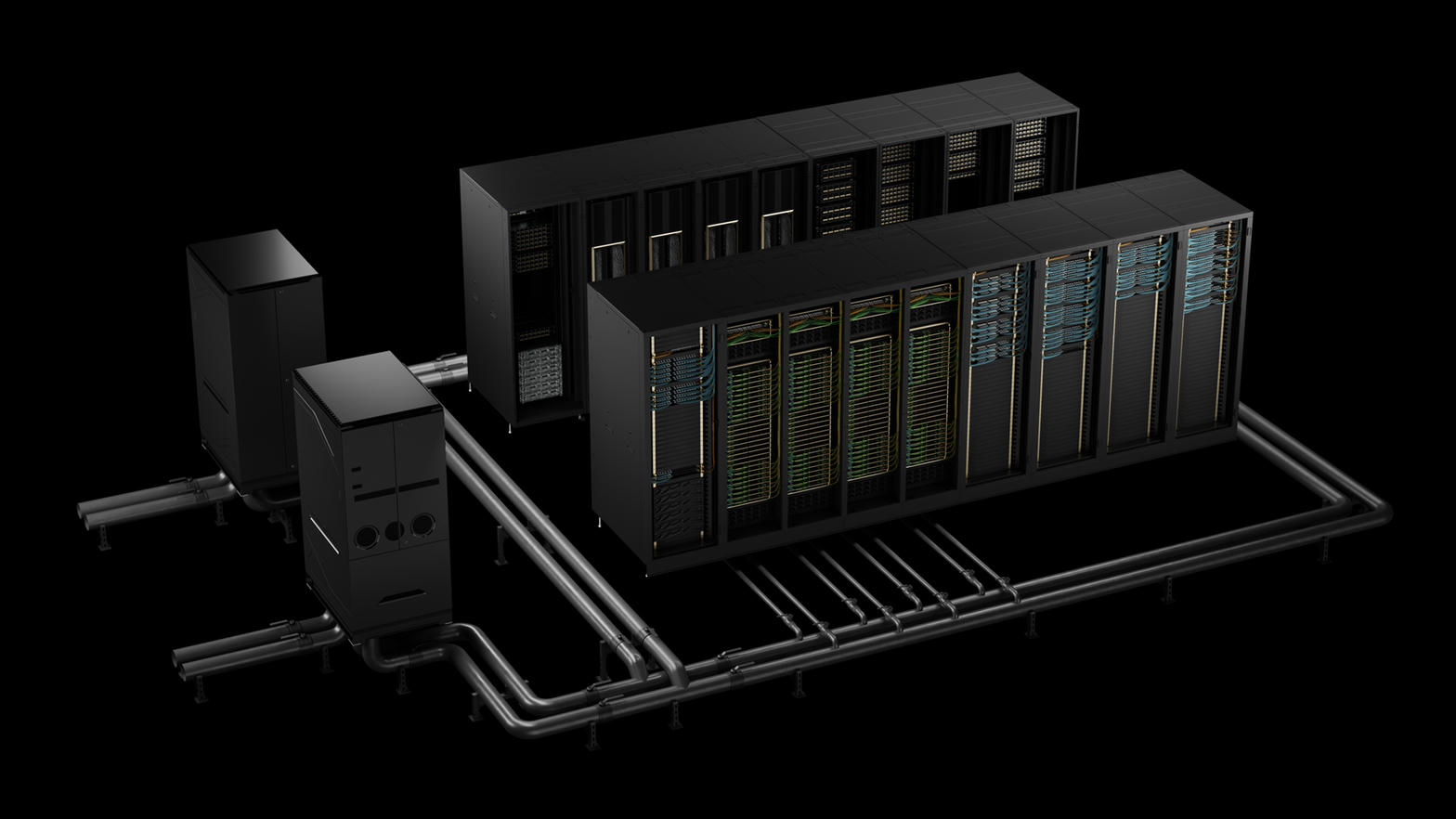
High-density AI compute infrastructure of the type Nvidia is adapting for both terrestrial and orbital environments.
6. Geopolitical and Economic Ramifications
If orbital compute reaches even a modest fraction of the scale envisioned in the FCC filings, several structural shifts follow.
Jurisdiction and regulation. Compute that never touches a terrestrial cable or national power grid raises novel questions for financial regulators, export-control regimes, data-protection authorities, and the International Telecommunication Union. A trading algorithm running on a node over the Pacific, linked only by laser to other orbital nodes and ultimately to a ground gateway in a chosen jurisdiction, is not easily supervised by any single terrestrial regulator. Emergency sessions and working groups are already discussing "stateless" or multi-jurisdictional processing; enforceable rules remain elusive.
Defense and intelligence. SpaceX's Starshield program already provides a national-security pathway. On-orbit sensor fusion and AI inference reduce the need to downlink raw data that can be jammed or intercepted. Real-time tracking and decision support for hypersonic or other high-speed threats becomes more feasible when the compute is co-located with the sensors. The same architecture that serves commercial AI can, with different payloads and access controls, serve military customers.
Capital allocation. Terrestrial cloud growth is increasingly constrained by power and permits. Capital is therefore exploring every alternative: behind-the-meter generation, small modular reactors, long-duration storage, and now orbital capacity. SpaceX's post-IPO valuation and the premium attached to any credible space-compute narrative reflect this search for unconstrained scale. The "picks and shovels" (radiation-tolerant or space-qualified silicon, advanced thermal systems, optical terminals, and the launch vehicles themselves) are attracting investment even while full constellation economics remain unproven.
Industrial policy and competition. The United States currently holds a commanding position in both launch cadence and advanced AI silicon. China's parallel programs demonstrate that orbital compute is viewed as strategically important in Beijing as well. Europe has been warned by think tanks that it risks falling behind in the orbital-compute race. The result is an emerging space-based layer of the AI competition that sits above the familiar terrestrial semiconductor and cloud rivalries.
7. Investment Thesis and Risk Factors
From a capital-markets perspective in August 2026, orbital compute is best understood as a high-optionality, high-uncertainty infrastructure bet layered on top of SpaceX's existing launch and Starlink businesses.
Bullish factors include: (1) the undeniable terrestrial power and permitting constraints documented by LBNL and utility filings; (2) SpaceX's unique combination of launch capability, constellation operations experience, and now a formal Nvidia partnership; (3) the modular design that allows silicon to improve over time; (4) the potential for dual-use (commercial + defense) revenue; and (5) Musk's demonstrated willingness to direct enormous resources toward long-horizon infrastructure.
Bearish or cautionary factors are equally clear. Radiation effects on advanced commercial silicon remain a serious engineering problem; heavy shielding adds mass and cost. Thermal systems must prove multi-year reliability in the presence of micrometeoroids and thermal cycling. Orbital debris and space-traffic management become acute at the constellation scales contemplated. Launch costs must continue to fall and cadence must rise dramatically. Manufacturing of the large solar arrays, radiators, and satellite buses must scale far beyond current rates. Independent cost models from analysts and research firms have produced estimates ranging from challenging to prohibitive for true terawatt-class capacity. SpaceX's own IPO risk factors acknowledged that orbital data centers involve technologies that may not achieve commercial viability.
The smart-money approach visible in 2025–2026 has therefore focused less on pure "SpaceX will own all AI" narratives and more on the enabling technologies: optical communications, advanced thermal materials, space-qualified or radiation-mitigated processors, and the launch systems themselves. Nvidia's space-related commentary and partnership are watched closely as a leading indicator of silicon-road-map seriousness.
8. What Stage Are We Actually At?
A realistic generational framework for mid-2026 looks something like this:
Generation 0–1 (historical): Proof-of-concept computers on the International Space Station (HPE Spaceborne series and similar). Demonstration that commercial processors can run in orbit with appropriate software mitigation.
Generation 2 (2023–2025/26): Early AI accelerators and small language-model experiments on dedicated or hosted small satellites (Starcloud and Chinese demonstrations). Validation of GPU operation, basic thermal control, and downlink of results.
Generation 3 (current – 2027/28 target): Purpose-built orbital data-center satellites in the 100+ kW class (AI1 / Starmind and peer designs). First prototypes, early manufacturing, initial commercial or government workloads. This is the phase SpaceX, Nvidia, and several startups are now entering.
Generation 4 (late 2020s – 2030s): Scaled constellations, higher power levels, possible nuclear-augmented nodes, and the point at which orbital capacity becomes a material fraction of global AI compute. Musk's 2029 "only way to scale" comment places the crossover into this regime within the current decade if terrestrial constraints continue to tighten.
We are therefore at the transition from Generation 2 demonstrations into Generation 3 industrial design and early production. The experimental phase is ending; the manufacturing and operations phase is beginning. That is a significant milestone, but it is not yet the multi-trillion-dollar operational dominance imagined in some earlier speculative writing.
9. Remaining Technical and Operational Challenges
Several hard problems remain before orbital compute can be considered routine infrastructure.
Radiation. High-energy particles cause single-event upsets and cumulative degradation. Pure commercial silicon requires either heavy shielding (mass penalty), extensive error-correction and redundancy (performance and power penalty), or process and design changes that reduce peak performance relative to terrestrial parts. The industry is pursuing all three approaches.
Thermal management at scale. Radiators must deploy reliably, survive years of thermal cycling and debris impacts, and reject tens to hundreds of kilowatts per satellite without excessive mass. Two-phase pumped loops and advanced materials are the current focus.
Manufacturing cadence. A million-satellite constellation, even if only a fraction is ultimately flown, requires satellite production rates far above anything previously achieved. Gigasat and similar facilities are the attempted answer; execution risk is high.
Space traffic and debris. Adding large numbers of high-value, high-power satellites to already crowded LEO shells increases conjunction risk. Active debris removal, improved tracking, and responsible end-of-life disposal become mandatory, not optional.
Ground segment and operations. Command, control, software updates, and secure multi-tenant access for commercial customers require new operational models. The same laser mesh that enables the compute fabric must also support high-reliability telemetry and control.
10. Conclusion: The Void as Infrastructure
For most of the history of computing, the vacuum of space was treated as an obstacle to be crossed on the way to other planets or as a convenient location for communications and remote-sensing satellites. Elon Musk and the architects of orbital compute have reframed it as a resource: abundant power, unlimited radiative cooling, and geometric freedom from terrestrial geography and politics.
As of August 15, 2026, that reframing has moved from rhetoric to engineering schedules, regulatory filings, named silicon partnerships, and manufacturing commitments. The first AI1-class satellites are intended to fly in 2027. Starlink V3 and Starship are progressing, albeit with the usual setbacks and iterative testing that characterize SpaceX development. Competitors in the United States, China, and elsewhere are running parallel experiments and filings. The terrestrial grid continues to feel the weight of AI demand.
The data center of the future will not exclusively fly at 17,000 miles per hour. Many latency-sensitive, highly interactive, or regulatory-constrained workloads will remain on the ground for decades. But the architecture that can continue scaling when land, water, power, and permits become binding constraints is being designed to operate in the sovereign void of low Earth orbit. Musk's August 14 statement that orbital compute may be the only viable path by 2029 is the clearest signal yet that the timeline is measured in years, not decades.
The age of serious orbital compute is not a completed revolution. It is an industrial program that has now entered the prototype and early-production phase. The hardware is being designed in Hawthorne, Sunnyvale, Austin, and Bastrop. The lasers are already flashing between Starlink satellites. The policy and capital-markets conversations have begun in earnest. What remains is execution: the hardest part of any multi-hundred-billion-dollar infrastructure vision.
The void is no longer empty. It is the next competitive frontier for artificial intelligence.
For investors, policymakers, and technologists watching this space, the practical questions over the next 18–24 months are concrete. Will the first AI1 prototypes fly on schedule in 2027 and return useful telemetry on thermal performance, radiation effects, and laser-mesh integration? Will Gigasat achieve meaningful production rates? Will Nvidia and SpaceX demonstrate that the same software stack can schedule workloads across ground and orbital nodes without excessive operational friction? Will early defense or commercial customers sign multi-year capacity agreements that validate the revenue model? And will terrestrial power and permitting constraints continue to tighten at the rate that makes Musk's 2029 crossover comment look conservative rather than aggressive?
The answers will determine whether orbital compute becomes a multi-hundred-billion-dollar infrastructure layer within the decade or remains a specialized, high-cost niche for the most latency- or security-sensitive workloads. What is no longer in doubt is that the engineering, capital, and industrial effort is real. SpaceX has moved the concept from white papers and conference talks into vehicle design, silicon partnerships, factory construction, and public timelines. Competitors are responding. The physics favors the approach for certain classes of workload. The only remaining variables are execution speed, cost curves, and the continued severity of the terrestrial bottlenecks that created the opportunity in the first place.
In the server farms of Northern Virginia the humming continues. In the clean rooms of Hawthorne and Bastrop the next generation of infrastructure is being assembled. Above them both, the laser links of Starlink already form a mesh that circles the planet every ninety minutes. The age of orbital compute has moved from speculation to schedule. The sovereign void is open for business, or soon will be.
Shayne Heffernan is a veteran analyst, economist, and deep-tech strategist focusing on the intersection of emerging technologies, macro-economic trends, and global capital markets. He is the founder of Live Trading News (livetradingnews.com) and writes regularly on AI infrastructure, space technology, and the capital markets that fund them.
Primary sources and further reading (selected): Lawrence Berkeley National Laboratory, United States Data Center Energy Usage Report: 2025 Update; SpaceX / Starmind public materials and FCC filings 2026; SpaceX–Nvidia partnership announcements August 2026; Elon Musk posts on X (particularly August 14, 2026 and preceding technical discussions); contemporaneous reporting from SpaceNews, Data Center Dynamics, TechCrunch, Ars Technica, and IEEE Spectrum on orbital data-center developments 2025–2026.

Careful of the Prompts You Give Yourself
A prompt is not only what you type into a model. It is any sentence that gets inside you and starts issuing orders. Most of what we call goals were written by comparison, media, competition and now the model, and they arrive dressed as ambition. Shayne Heffernan maps how an imported sentence becomes a week, why a want should carry its source the way a Round Table claim does, and how to strip, lock and guard the objective that is actually yours.
KXCO is Enhanced Intelligence, Not Artificial
I never wanted artificial intelligence. I wanted enhanced intelligence, and they are not the same product. Artificial means the machine does the thinking and hands you the answer. Enhanced means I do the thinking, with more of my own mind in the room than I have ever had at one time. Forty years of reading, recallable in the second I need it. Patterns across law, credit, physics and markets that no specialist sees, because the useful ones sit between the fields rather than inside them.

The AI Safety Argument Is Being Held in the Wrong Room
The people who will be blamed for what AI does are not in the room where its safety is argued. A jailbreak escapes a policy. The failure that costs money is an action that escapes an owner, a payment sent or a record altered. Tokens are not authority. Intelligence got cheap and judgment did not, and there is no organ of standing you can copy into a model. Shayne Heffernan on the objection worth taking seriously, and the questions to take into a vendor meeting.

NIST Graded Our Post-Quantum Cryptography. Zero Failures.
NIST's Algorithm Validation Test System generated test vectors nobody had seen, we answered them over the ACVP protocol, and NIST graded the result: 2,130 cases across ML-KEM, ML-DSA and SLH-DSA in every parameter set offered, zero failures, demo certificate A11025. This is what that proves, where we deliberately drew the claim narrower than NIST's own matrix, and why the FIPS 140-2 sunset on 21 September makes the distinction between being graded and grading yourself worth understanding.
Every story, signed and delivered.
Subscribe to the kxco channel and get the headline, the AI-written key takeaways, and the chain-anchor link the moment we publish. Audio versions and per-ticker subscriptions arrive in the next iteration.