
KXCO's FDA Ontology Is Two for Two on FDA Decisions
The board ranked Inovio's INO-3107 first and the FDA approved it. It gave Summit's ivonescimab no call, and the FDA refused it. On my scorecard: two decisions, two right.
Part of theStocks Center
The FDA has decided two filings on KXCO's FDA board since the board began ranking them. On my scorecard, the board got both right.
It ranked Inovio's INO-3107 first of the FDA decisions on the board due in the next 90 days, at every update from 21 October, and the FDA approved it on 30 October. It did not back Summit Therapeutics' ivonescimab, and Summit announced the FDA's refusal on 15 November. Two decisions, two right.
We built the FDA ontology. It runs on our engine and it is powered by the Forge. The ontology, the engine and the Forge are KXCO's own, and they are proprietary. The board itself is public, at kxco.ai/fda.
In my experience most of what is published about FDA decisions is never scored. A preview names a date, lists the bulls and the bears, and moves on, and nobody goes back to count. We go back to every one: each result goes on the board, in public, as the FDA decides.
Decision one: INO-3107, ranked first and approved
INO-3107 is Inovio's DNA medicine for recurrent respiratory papillomatosis. The board ranked it first of the FDA decisions on the board due in the next 90 days, and it held that ranking at every update from 21 October 2026 until the decision.
It was not an easy call. The FDA had already approved a rival treatment for adults with the disease, PAPZIMEOS, in August 2025, and Inovio's own filings said it expected accelerated approval only if INO-3107 showed a clinically meaningful benefit over that rival. A screen that reads headlines sees an approved rival and a high bar. The board ranked the filing first anyway, on its potential return.
The board also wrote down, before the decision, what would change its view: "An FDA statement on whether INO-3107 qualifies for accelerated approval, or an extension of the target date, would change our view." A call that cannot say what would prove it wrong is not a call. This one could.
The FDA granted INO-3107 accelerated approval on 30 October 2026, its target date, with no extension. Its letter is headed "ACCELERATED BLA APPROVAL".
The market had not priced it. Inovio's shares closed at $0.60 on Friday 30 October. In after-hours trading that evening they hit $2.71, a rise of as much as 351.7% from the close. On Monday 2 November they closed at $1.89, up 215.0% on the 30 October close.
The board measures every decision day the same way, from the close before the decision day to the first close after it, and it takes out the move in XBI, the equal-weight biotech index fund, so that a sector day is not read as the decision. For INO-3107, from the close of 29 October to the close of 2 November, Inovio moved +145.5% while XBI moved -3.6%: net of the sector, +149.1%.
That is what a first-place ranking is for. It put the decision of consequence at the top of the screen, nine days before the FDA acted, on a stock the market had left at 60 cents.
Decision two: ivonescimab, not backed and refused
Ivonescimab is a bispecific antibody that Summit Therapeutics develops with Akeso. Summit filed it with the FDA, in combination with platinum-based chemotherapy, for patients with advanced non-small cell lung cancer who had already received EGFR-targeted therapy.
The board did not back it. In KXCO's record as it stood on 15 November, ivonescimab carried no signed call and no potential return, so it never reached the ranked screen. Anyone following the board was not in it.
The record also held the ground the FDA would refuse it on. Its one recorded concern on the filing was a statement the FDA made to Summit before the application, which Summit first disclosed on 30 May 2025. The record quotes it word for word from Summit's quarterly report: "The FDA noted that a statistically significant OS benefit is necessary to support marketing authorization in this setting, and the PFS results from this study may not be sufficient to support marketing authorization." OS is overall survival, how long patients live. PFS is progression-free survival, how long before the cancer grows.
Summit's trial, HARMONi, had two primary endpoints, PFS and OS. It met PFS. At the primary analysis, in Summit's own words, OS "showed a positive trend without achieving a statistically significant result". The FDA had told Summit, more than a year before its decision, which of those two endpoints it needed to see.
That entry was committed to KXCO's record at 01:35 UTC on 15 November 2026. In New York it was 8:35 on Saturday evening.
On Sunday 15 November, Summit announced that the FDA had issued a complete response letter, the FDA's refusal to approve an application in its present form. Summit's own filing gives the FDA's ground: "the FDA determined that substantial evidence of effectiveness is not established in the absence of a statistically significant overall survival (OS) improvement." It is the same point the FDA had made to Summit before the filing, the point the record held.
The market priced the refusal on Monday. From Friday's close to Monday's close Summit's shares fell 16.5% while XBI fell 3.1%: net of the sector, -13.4%.
Summit says it is not giving up on the drug. With five positive Phase III studies between Summit and Akeso, it says its determination to advance ivonescimab is unchanged. That is a question for the next filing. The board records it, and it will rank that filing on its own record when it comes.
A reader who followed the board was not holding Summit through Monday. A decision the board did not call that then failed counts as right.
Two kinds of right
The two results were different, and a fund needs both.
The first was being in. The board put INO-3107 at the top of its screen, and the decision paid: net of the sector, Inovio moved +149.1% on the decision. A board that only ever warns is no use to a fund. It has to find the decisions worth owning, and rank them first.
The second was staying out. The board gave ivonescimab no call and no potential return, and KXCO's record carried the FDA's own warning against the filing. When the refusal came, Summit fell 16.5% in a session, 13.4% net of the sector. No call of the board's put a reader into Summit.
One right made money. The other kept it. In my view, over a book of FDA decisions the second kind matters as much as the first: the board has measured refusal days as deep as -35.1% net of the sector.
A board that is only judged on the drugs it backs can hide its misses by backing nothing. A board judged on everything it ranks and everything it leaves out cannot hide.
The board has said, in writing on its own page, that each result will be published as the FDA decides. The next two are due on 22 November.
What the record held
A calendar of FDA dates tells you when a decision is due. It does not tell you what the FDA has already said about the application, what the sponsor has disclosed, or which of those statements bears on the outcome. In my view most of the FDA coverage in the market is a calendar.
KXCO's FDA ontology is a record. It holds 548 entities of 8 kinds: drugs, companies, regulators, manufacturing sites, trials, conditions, regulatory events and people. Each drug is joined to its sponsor, its condition, its trials, its regulatory events and its market, and each of those links is a claim with a source.
As at 16 November 2026 it holds 548 entities, 567 claims, 40 drugs and 704 sources. Every claim in it carries the web address it came from and the sentence it was read from: 567 of 567, without exception.
The FDA's warning to Summit was in KXCO's record before Summit announced the refusal. It was not a forecast. It was a statement read from the sponsor's own filing and filed against the drug as a regulatory event.
In my view this is the difference that matters to a fund. A calendar tells you the date. An ontology tells you what stands between the drug and the approval, in the words of the FDA and the company, with the source one click away. A portfolio manager does not need another opinion on a drug. They need the record of what the regulator has already said about it, joined to the price.
What a refusal is, and what it is not
The board has learned something else from the FDA's own letters, and it matters for every refusal still to come.
Until 2025 the only public account of a complete response letter came from the company that received it. The FDA now publishes the letters.
Of the four refusals on the board whose letter the FDA has published, three were followed by approval. In the fourth, the letter states that the registrational trial failed its primary endpoint.
In my view that is the distinction that matters. A refusal over manufacturing, a facility inspection or missing data is a delay the sponsor can work through. A refusal because the trial did not show what the FDA required is a different kind of event. Ivonescimab's refusal was the second kind: the FDA named the endpoint it required, and the trial did not meet it with statistical significance.
The market does not always draw that line on the day. The board measures refusal days the same way it measures approvals, net of XBI. It has now measured five: -9.7%, -35.1%, -5.7%, +3.4% and, for Summit, -13.4%. A fall of 35% and a rise of 3% are both refusals. The record tells you which kind you are looking at before the price does.
What the board shows a fund
The board is built to be read by someone who has to take a position, not by someone who wants a story.
The first screen ranks the decisions on the board due in the next 90 days by potential return, with the number and its parts on the page, and names each filing it leaves out and why.
Decisions ahead lists each filing in date order with its recorded concerns, the move the options market prices for the decision, and the company's net cash as a share of the price.
The FDA letters view sets the FDA's letter and the sponsor's disclosure side by side, so the reader can see where a company's account of a refusal differs from the regulator's.
The event study measures every decision day on the board, approval or refusal, net of XBI.
The short side shows short interest, borrow and fails for the 21 companies it measures. Short interest at Capricor is 32.3% of all shares, the highest of them.
Every one of those numbers carries its source and the time it was read. A reader can check any line on the board from the board itself.
How the board ranks a decision
The board does not stop at the record. It turns the record into a ranking a portfolio manager can act on.
Each ranked decision is ordered by its potential return: the approval rate of filings like it, times the upside to the major banks' median price target, plus the rest of the probability times the fall a refusal would bring. A filing with no signed call carries no potential return and is not ranked. That is how ivonescimab stayed off the screen.
The fall on a refusal is not a guess. The board takes it from the refusal days it has measured, or from the company's net cash per share, and says which beside each filing.
The engine and the Forge
The board you can see is the output. The engine that produces it, and the Forge that powers it, are not on the page.
KXCO does not publish the Round Table software, its private graphs or the detail of its method. That is deliberate. The method is the edge, and an edge that is published is no longer an edge.
What I will say is this. The ontology is built and kept by KXCO's engine, and the Forge is what drives it. Neither can be rented from anyone else, and neither is for sale as a download. The board shows what they produce, on public data, in public, with every claim sourced and every result published.
What the board says next
My scorecard grows fast from here. 26 FDA filings on the board await a decision, with one more excluded from the ranking, and five fall due in the next two weeks.
22 November: Capricor's deramiocel and Savara's molgramostim.
27 November: BridgeBio's BBP-418.
28 November: PolyPid's D-PLEX100.
30 November: Cogent's bezuclastinib.
The board has already taken a position on each of them.
Deramiocel is excluded from the ranking. An FDA advisory committee voted 9 to 3 that the evidence did not show substantial effectiveness in the filed indication, and Capricor then narrowed the indication. The options market prices the largest move on the board for this decision: ±63.5% for the decision alone.
Molgramostim ranks with a potential return of +46%. Its group's approval rate is 60.6%, the two major banks that cover Savara both rate the shares a buy, and their median target is +135% above the price. Options price ±43.9% to the December expiry.
BBP-418 ranks at +22%. Its group's approval rate is 74.3%, and 12 of the 13 major banks that cover BridgeBio rate the shares a buy.
D-PLEX100 carries no signed call, so the board does not back it.
Bezuclastinib ranks at +79%, second on the screen. Its group's approval rate is 74.3%, and all three major banks that cover Cogent rate the shares a buy, with a median target +119% above the price.
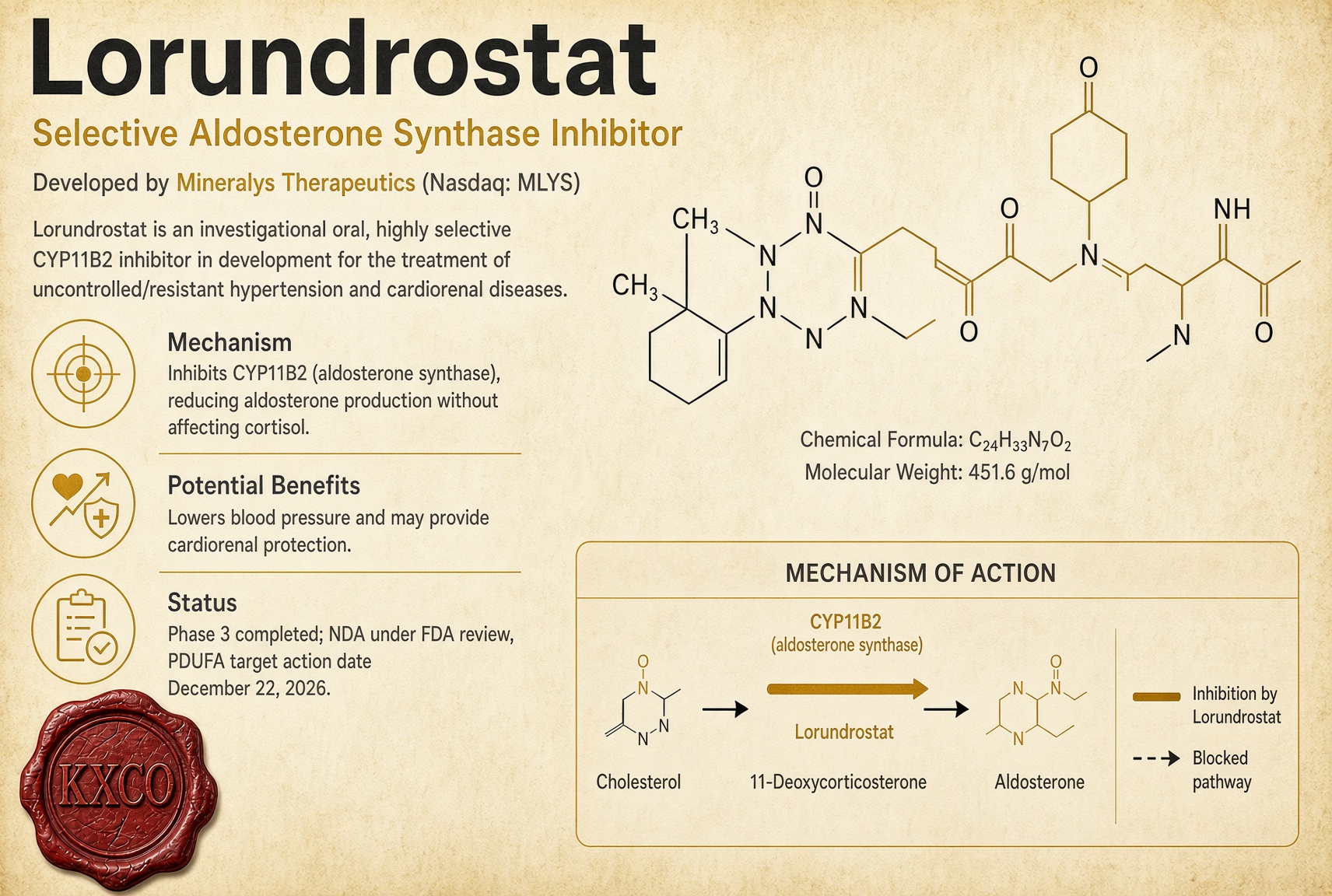
Further out, the board's first screen ranks Mineralys's lorundrostat first of the decisions on the board due in the next 90 days. Its decision is due on 22 December. Four major banks cover Mineralys, three of them at buy, with a median target +206% above the price, and the board puts its potential return at +102%.
Each result goes on the board as the FDA decides, and I score each one: called and right, called and wrong, or not called and failed.
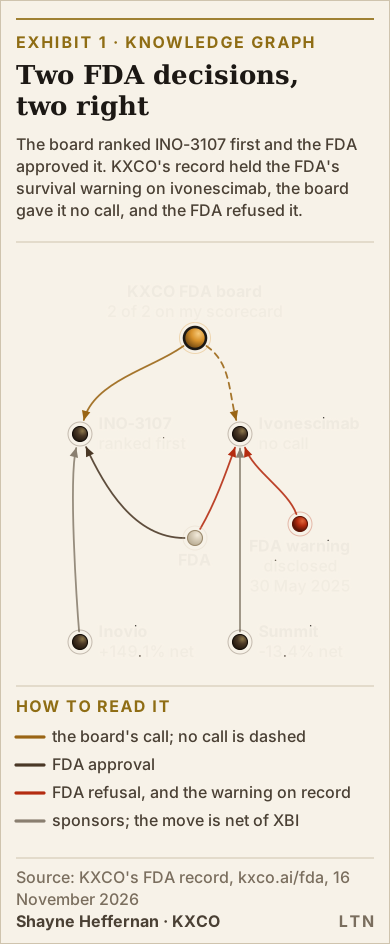
How to read Exhibit 1: on the left, the board's solid line runs to INO-3107, which the FDA approved and on which Inovio moved +149.1% net of XBI. On the right, the board's dashed line marks no call on ivonescimab, which carried the FDA's warning, disclosed on 30 May 2025, and which the FDA refused; Summit moved -13.4% net. Each link is a sourced claim.
For funds
The public board is a sample. It covers 27 pending FDA filings, chosen to show what the research can do. A KXCO room built for a fund covers any number of stocks, with live quotes, alerts, export and a data feed.
The same engine and the same Forge build it. The record stays the fund's own.
If you run money in biotech, or you allocate to people who do, talk to us. Request a briefing at kxco.ai.
What to watch
Capricor's deramiocel and Savara's molgramostim, both due on 22 November, are the next two results on my scorecard.
Not financial advice: do your own work.
Stocks mentioned: $INO (NASDAQ), $SMMT (NASDAQ), $CAPR (NASDAQ), $SVRA (NASDAQ), $BBIO (NASDAQ), $PYPD (NASDAQ), $COGT (NASDAQ) and $MLYS (NASDAQ).
Shayne Heffernan, Ph.D., is the founder of the KnightsBridge Group (shayneheffernan.com).
The Week Ahead on Wall Street, 16 November 2026: Look for the Bounce
NVIDIA reports on Tuesday 17 November 2026, its first results since Jensen Huang resigned, and I expect the stock and the AI market to bounce. NVIDIA closed at $162.85 on 13 November 2026, 31.93% below its record, while the semiconductor index rose 8.05% on the week. The calendar leans to currencies, with the yen near 160 after briefly crossing it, and the US publishes retail sales, housing starts, jobless claims and the Fed's minutes. Follow them on the Live Trading News trading page.
KXCO's FDA Ontology Ranked INO-3107 First. Its Two Published Books Beat XBI.
KXCO's FDA ontology ranked INO-3107 first before the FDA approved it on 30 October 2026; Inovio (INO) then hit $2.71 after hours from a $0.60 close. KXCO's two published research books on the ontology stood at 109.31 and 110.28 at the close of 13 November, from 100 at the close of 14 October, against 102.58 for XBI. Nine more decisions on the board fall due before 31 December, starting with molgramostim (SVRA) and deramiocel (CAPR) on 22 November.
KXCO's FDA Ontology Ranks Lorundrostat First After Its 10 November Update
KXCO's FDA ontology at kxco.ai/fda was updated in full on 10 November 2026. Its first screen now ranks Mineralys's lorundrostat (MLYS) first of the FDA decisions due within 90 days: decision 22 December, potential return +86%, per the page. Mineralys's shares fell 24.5% between reads on 20 October and 10 November. The update read six quarterly reports to 30 September by hand, and on KXCO's calculation Mineralys is funded to 12 October 2029, even if it repays its $100.0m loan by 30 June 2028.
KXCO's FDA Ontology Ranked INO-3107 First. Inovio Hit Over 300% After Hours.
KXCO's FDA ontology ranked INO-3107, from Inovio (INO), first of the FDA decisions due in the next 90 days, from 21 October 2026 to the decision. The FDA granted accelerated approval on 30 October; the news reached the market after the close. From its $0.60 close that day, Inovio traded as high as $2.71 after hours, up 351.7%, and closed 2 November at $1.89, up 215.0%. Both published research books closed ahead of XBI. On our radar: BBP-418 (BBIO), Bezuclastinib (COGT) and Relutrigine (PRAX).
Every story, signed and delivered.
Subscribe to the kxco channel and get the headline, the AI-written key takeaways, and the chain-anchor link the moment we publish. Audio versions and per-ticker subscriptions arrive in the next iteration.