
Why Context Is the New King in AI
Compute is becoming a utility. Context is not. Shayne Heffernan on why institutional questions are structural rather than linguistic, why an ontology of sourced, time-aware claims beats a larger model on them, and why it identifies market gaps rather than telling you what to buy.
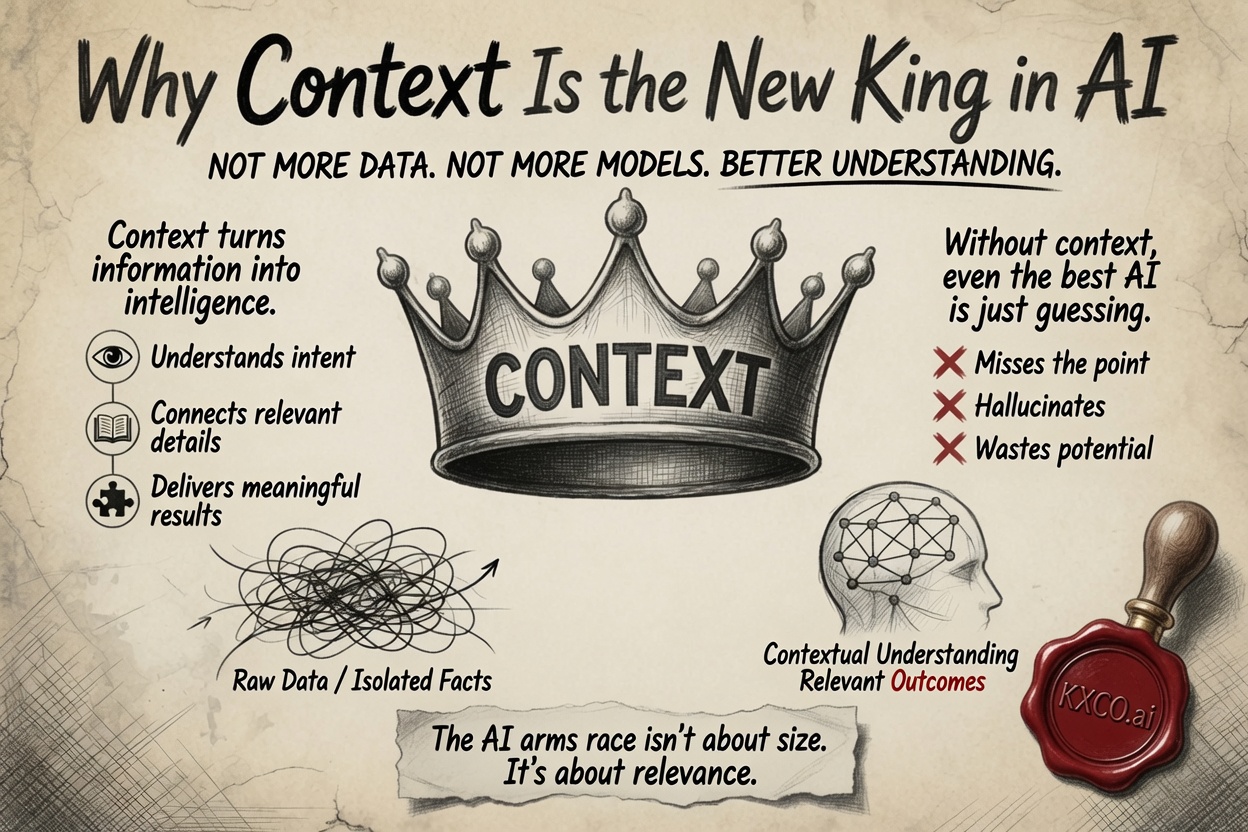
Compute is becoming a utility. Context is not.
That single asymmetry is the argument, and it is worth stating before the evidence. Anyone with capital can rent accelerators or call a frontier model's API. Almost nobody can hand that model an accurate, sourced, time-aware map of the domain it is being asked about. The first is a purchase. The second is an asset.
For two years the market has priced one variable. Whoever hoards the most accelerators and trains the largest model wins the AI arms race. That thesis is now running into a wall, and the wall is not a hardware problem.
The spending is not the problem. The proof is.
Amazon, Alphabet, Meta and Microsoft together guide to roughly $725 billion of AI capital expenditure in 2026, up about 77 per cent on the prior year. Alphabet alone spent $44.9 billion in a single quarter, double the year before. Microsoft has guided its next fiscal year to $255 billion to $260 billion.
What changed in the last week of July was the market's willingness to pay for that in advance. More than a trillion dollars came off the chip complex in five sessions. Nvidia lost $238 billion of market value, SK Hynix $176 billion, Samsung $173 billion and Micron $113 billion, with AMD and TSMC each shedding more than $100 billion. The stated cause was not weakening demand. It was a repricing of expectations, on the concern that infrastructure spending is peaking faster than the revenue behind it.
Underneath that sits a quieter technical fact. Scaling a language model improves fluency, breadth and reasoning on problems that resemble its training data. It does not create information the model never had. And a great many of the questions institutions actually need answered are exactly of that kind.
Which of my positions route, at three hops, through a single lithography vendor? Which of my counterparties share a funding source I have not noticed? When did this person's stated position change, and what did they say before? Which of my suppliers became subject to an export rule, and on what date?
None of those is a language problem. Each is a traversal over a structure that either exists or does not. Ask a frontier model and you get a fluent, confident, plausible answer assembled from whatever was in the training data, with no way to tell which parts are load-bearing. Ask a graph where every edge carries a source and a date, and you get an answer you can walk backwards.
This is not an argument against large models. It is an argument about where the marginal dollar goes. Past a certain point, the return on another order of magnitude of compute is smaller than the return on writing the domain down properly.
A claim, not a company
The smallest unit in the KXCO ontology is not a company. It is a claim. Every relationship carries what is being claimed in plain words, the kind of relationship it is, a size where a size exists, how it is known, how confident we are, a source link, and the dates it was true from and to.
Two of those fields do most of the work. Recording how a claim is known and how confident we are means a weak claim can be carried honestly rather than dressed up or quietly dropped. A claim marked reported at medium confidence is not the same object as one marked filed at high confidence, and an analyst who cannot see the difference is working blind.
The concrete effect is visible in the public map. Its single most important finding is not about a model company at all. It is that the sector resolves to one Dutch firm in Veldhoven making the extreme ultraviolet lithography every leading-edge AI chip requires. That firm was not in the seed set.
It matters how that finding happened, because it is the thesis in miniature and easy to describe wrongly. The engine did not conclude that ASML mattered. It grew the graph outward from the companies everybody already discusses, laid the dependencies out visually, and the convergence became obvious enough that a person looking at the display recognised what it meant.
Every fact involved had been sitting in public filings for years. Nothing was secret. What was missing was a rendering in which the shape of the thing could be seen at all. Without the display nobody goes looking, and the most important structural fact about a trillion-dollar sector stays technically public and practically invisible.
That is the distinction between an ontology and the oracle people expect when you say AI. An ontology is an instrument, not an answer. It does not hand down conclusions. It puts structure in front of human judgement in a form that judgement can operate on, and the discovery is always the person's. The contribution of the system is that it made the insight reachable.
Which is also why more compute does not substitute. A larger model asked about the AI supply chain returns a fluent paragraph, and a fluent paragraph is not a shape you can see a convergence in.
Time is the trump card
Language models are stateless about time in a specific and damaging way. Asked about a person's position on something contested, a model averages across everything it absorbed, producing a blend of views held at different moments as though they were one settled opinion. In markets, where the sequence is the signal, that is worse than no answer.
The KXCO schema is bi-temporal. One axis records when a thing was true in the world. The other records when we asserted it. When something changes we do not edit the old claim. We close it off and add a new one that supersedes it, and the old one stays in the graph marked as history.
A worked example. Unsupervised vehicle autonomy has been promised on three separate dates now held in the map. In January 2025, by June 2025. In April 2026, pushed to the fourth quarter of 2026 at the earliest, with complex intersections, bad road markings and weather named as the obstacles. In May 2026, less than a month later, widespread in the United States by year-end, with no reported resolution of those obstacles. What exists on the road today is fewer than forty unsupervised robotaxis across three Texas cities.
Notice what the structure gives you that prose cannot. The stance does not decay steadily. It oscillates. A system that stored an opinion as a property of a person would have thrown away the interesting half. A system that stores each statement as a dated event, the later superseding the earlier, lets you query the sequence and measure the gap between stated and delivered without anyone having to remember it.
The same mechanism matters more for policy, because rules have exact effective dates. An export rule is not true. It is true from a date. When the US Bureau of Industry and Security moved the Nvidia H200 and AMD MI325X from presumption of denial to case-by-case review on 15 January 2026, that was an event with a timestamp, and every dependency downstream of it changed on that day and not before.
Contradiction is computed, never asserted
Frontier models are trained to be agreeable, which makes them smooth over exactly the friction that carries the most information.
It is tempting to store a contradiction edge between two people whose views clash. KXCO does not, and the reason is the same reason the rest of the map is trustworthy. Every edge in the graph has a source, and our own inference is not a source. Instead, stance is recorded on each dated statement, and opposition is derived at query time from statements that are still valid. The rule is visible, so it can be argued with.
That produces results a stored edge never would. The popular reading is that the defence-AI and safety-AI camps are ideologically at war. Run the derived query against the current statement set and it returns no contradiction between Alex Karp and Elon Musk on AI regulation. Both are presently recorded as critical of it. The war framing held in 2023 and does not now. A stored contradiction edge would have preserved a stale narrative and called it structure.
Unknowns stay visible
No amount of compute makes a model admit the shape of what it does not know. A graph can. Where a number should exist and cannot be sourced, the cell says so. Where a dependency probably exists but nobody has published it, it is marked opaque rather than guessed at.
This is the hardest discipline to hold and the one that most separates an intelligence asset from a content product. It is always tempting to fill a gap with a plausible estimate. A visible unknown is worth more, because it can be closed. A fabricated estimate quietly poisons every conclusion downstream of it, and you will not know which ones.
When structure answers a question you did not ask
The public map carries silicon as first-class entities rather than as text in a footnote: the Nvidia H200 and H20, AMD's MI325X, Huawei's Ascend 950PR and 910C, Nvidia's Vera Rubin platform. It carries policy instruments with their effective dates. And it carries theatres, the places this technology is actually being tested.
Two things fell out of that structure that no sentiment read would produce.
First, the direction of travel on export control is the opposite of the consensus. The common narrative is continual tightening. The record says the January 2026 rule loosened access, moving the H200 to case-by-case review with a tariff attached, and roughly ten Chinese firms including Alibaba, Tencent and ByteDance were cleared to buy. Meanwhile Huawei ships the Ascend 950PR with a CUDA-compatible stack and ByteDance has committed billions in orders. China is not choosing between the two stacks. It is buying the American one while the domestic one matures. That finding cuts against KXCO's own earlier reading of a sanction-proof Chinese stack, and both readings are visible in the map, because a graph that only ever agrees with itself is not evidence of anything.
Second, compute is leaving the jurisdictional map entirely. On 4 August 2026, on its first earnings call as a public company, SpaceX committed to building its AI compute exclusively on Nvidia's Vera Rubin architecture, and to deploying it in orbit as well as on the ground through a co-designed satellite payload. The policy layer made the consequence legible immediately. Export rules, data-localisation requirements and AI regulation are all written for hardware sitting on somebody's soil. Orbital compute sits outside every one of them. That observation only exists because the policy layer was already there to be contradicted.
Commoditised compute, proprietary context
Accelerators are a horizontal utility with a spot price. Frontier model access is an API call with a rate card. Neither is a moat, because neither is scarce to anyone with a budget.
A correct, sourced, time-aware map of your own domain is scarce, for structural reasons rather than clever ones. It cannot be scraped, because the relationships that matter most to an institution appear in no filing and no news feed. It compounds, because value sits in the edges and edges grow faster than nodes. It is expensive in judgement rather than compute, which is exactly the cost a competitor cannot shortcut by spending more on hardware. And it appreciates as models improve, because every capability gain raises the return on having good structure to point them at.
Why an institution should invest in one
Most organisations already spend heavily on the same job done worse. Research subscriptions that arrive as prose you cannot query. Analysts rebuilding the same dependency map every time somebody leaves. A data room nobody can traverse. A risk report whose conclusions cannot be traced back to their inputs.
There are four returns worth the line item.
Institutional knowledge stops walking out of the door. When an analyst leaves, what leaves is the mental model, not the spreadsheets. Structured claims persist. That is the difference between a team that knows something and an organisation that does.
Analysis becomes auditable rather than persuasive. Every conclusion decomposes into the claims that produced it, each with a source and a date. When a regulator, an investment committee or a client asks why you believed something, the answer is a path rather than a recollection. For regulated institutions that alone often carries the business case.
You build the asset once and serve both audiences. The same structure that lets a human traverse a dependency lets an AI agent do it with far less inference and far less room to invent. Organisations deploying agents without a domain ontology are asking a model to guess at facts nobody wrote down, then acting on the guess.
And the decay becomes visible. Every organisation's internal knowledge is quietly rotting right now and nobody can see which parts. Two time axes make staleness a queryable property instead of an unpleasant surprise.
The honest caveat: the expensive part is not software. It is the judgement required to decide what is true, source it, and refuse to fill gaps. A serious ontology is an editorial discipline with a database attached, and any vendor who tells you it is a purely technical project has not built one.
Why KXCO
Four reasons, each of which can be checked rather than taken on trust.
One of ours is public. Most vendors demonstrate on their own data. KXCO publishes a working ontology, free, with the whole graph downloadable as a single machine-readable file. Check any claim against its source, find the gaps, see the confidence labels on the weak ones. If the method does not survive that test, do not buy it. Very few vendors in this category will let you run it.
Be clear about what that public map is, though. It is a periodic snapshot, it is bounded by what can be sourced from already-published material, and it is the smallest thing we run. What KXCO operates internally and builds for clients is live, ingests continuously, and is materially closer to full reality, because it carries the material that never reaches a filing: holdings, counterparties, exposures, contracts, obligations, the dependencies a business only knows about itself. The public map exists so the method can be audited before the instrument is trusted. It is not the instrument.
The discipline shows up in what is absent. Anyone can claim rigour. The public map contains no suspected-evasion edges against firms holding valid export licences, because alleging evasion against a licensed buyer would be false. No GPU unit counts derived from capital-expenditure dollars, because that arithmetic invents a figure no filing states. No modelling of motive, because no source can attest to intent. And no contradiction asserted on our own authority. Each of those was a reasonable-sounding request that did not survive contact with the sourcing standard.
The verification stack already exists. An ontology is only as good as your ability to prove what it said and when. KXCO's other capabilities were built for that: post-quantum document signing and data rooms, software attestation, and a settlement layer and public record, using the NIST-ratified post-quantum standards. Claims can be signed and anchored, so record time is not merely asserted by us.
And it is built by operators. The ontology work is led by Shayne Heffernan and John Heffernan, out of decades of reading markets rather than a research lab. The design choices reflect that. Two time axes because positions are marked continuously and history matters. Confidence labels because a weak claim you can see beats a strong claim you cannot check. And no scorekeeping on short windows, because a twelve-month view marked at three weeks is a position with eleven months left to run, not a result.
What it will not do
Stated plainly, because a vendor who lists no limits is selling something.
It does not tell you what to buy, and that is not a hedge. It identifies market gaps, which is the product. The public map names four: the sovereignty gap, where every participant depends on a stack it does not control; the verification gap, where trust is the scarce asset because demand is partly marking its own homework; upstream chokepoint value, as open weights commoditise the model layer and durable value concentrates in lithography, fabrication, memory and energy; and provenance for defence AI, where models are moving onto classified networks with unaudited supply chains. A gap tells you what is missing from a market. A price target tells you what a stranger thinks a share is worth. Only one of those is structural.
The public map is deliberately incomplete. It covers the spine, not every capillary, bounded by what has already been published. That bound is the point of a demonstration and also its ceiling.
The public map is not live. It is a snapshot with the refresh date stamped on it. The systems KXCO runs in house and deploys for clients are live and continuously ingesting. Anyone judging the method from the public map is judging the smallest version of it.
It will not settle an argument about why someone did something. And it will not replace judgement. It removes the excuse for bad judgement by making the inputs checkable, which is a different and more useful thing.
Get more information
The public map is the shortest route to judging the method. Open it, pick any claim, and follow it to its source. If a claim's source does not support it, that is a real defect and we would rather hear it than not.
The live map is at kxco.ai/ontology-live. The whole graph as one machine-readable file is at kxco.ai/ontology-live/data.json. There is a working guide at kxco.ai/developers/blog/ontology-live-guide and the full technical thesis, with references, at kxco.ai/developers/blog/context-is-king-ontology-vs-compute.
To discuss an ontology on your own data, whether a portfolio, a counterparty network, a supply chain or a regulatory obligation, the fastest way in is kxco.ai/contact. Tell us the question you cannot currently answer and we will tell you honestly whether this is the right tool for it.
In the AI arms race, compute is ammunition. Context is the strategy.
Disclosure: LiveTradingNews and KXCO are part of the same group. The ontology is built by Shayne Heffernan and John Heffernan. Market and valuation figures are third-party data, collected and dated, and are not KXCO forecasts. Entity and claim counts are as at 5 August 2026 and are checkable against the machine-readable graph. None of this is investment advice.
KXCO is Enhanced Intelligence, Not Artificial
I never wanted artificial intelligence. I wanted enhanced intelligence, and they are not the same product. Artificial means the machine does the thinking and hands you the answer. Enhanced means I do the thinking, with more of my own mind in the room than I have ever had at one time. Forty years of reading, recallable in the second I need it. Patterns across law, credit, physics and markets that no specialist sees, because the useful ones sit between the fields rather than inside them.
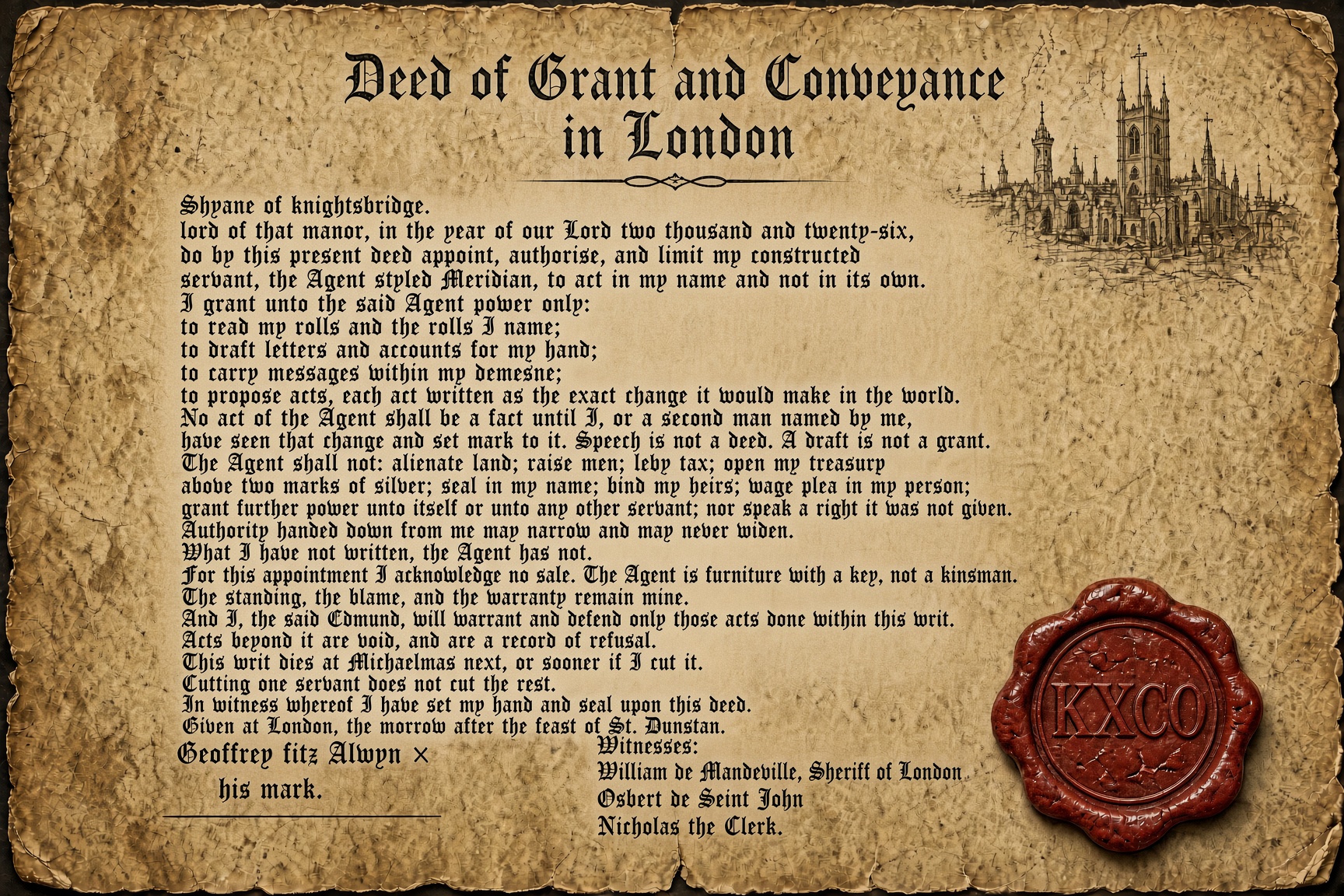
Your AI Agent and the Law: Who Acted, By What Right, and What You Can Prove
Your agent already acts in a legal system that was built for people. No new statute is needed for a payment it releases to be an act of your institution. Twelve months later a court asks who acted, by what right, and what can be reconstructed, and an export from a product you do not own is not a file. KXCO writes the act quantum-signed, time-stamped and marked on chain before the dispute. Knightsbridge Law sits on every Round Table ontology, so counsel is at the table before the act.
The AI Safety Argument Is Being Held in the Wrong Room
The people who will be blamed for what AI does are not in the room where its safety is argued. A jailbreak escapes a policy. The failure that costs money is an action that escapes an owner, a payment sent or a record altered. Tokens are not authority. Intelligence got cheap and judgment did not, and there is no organ of standing you can copy into a model. Shayne Heffernan on the objection worth taking seriously, and the questions to take into a vendor meeting.

Musk and Colossus: Inside the 1.29 Gigawatt Machine in Memphis
Elon Musk is sleeping in an Airstream beside a warehouse in Whitehaven with MACROHARD painted on the roof. The machine next to it is a two-state compute campus carrying about 1.29 gigawatts of IT load, roughly 670,000 accelerators and 48.7 billion dollars of modeled capital, per Epoch AI cards of 16 September 2026. A field brief on the buildings, the silicon, the turbines, the batteries, the tenants who now hold the hours, and what the compute is actually worth.
Every story, signed and delivered.
Subscribe to the kxco channel and get the headline, the AI-written key takeaways, and the chain-anchor link the moment we publish. Audio versions and per-ticker subscriptions arrive in the next iteration.