
KXCO Quantum Security 13 Packages, Published for Anyone to Inspect
Instead of asking to be trusted, KXCO published 13 post-quantum security packages open-source on npm and GitHub. Shayne Heffernan on third-party-verifiable cryptography, an Elon-Musk-style trade-secret strategy, and the convergence of chain, quantum and AI.
Part of theQuantum Computing Center
Most technology companies ask you to trust them. KXCO has just done the opposite. This week it published thirteen of its post-quantum security packages as open-source software on npm, the world's largest software registry, with the source code mirrored on GitHub and independently indexed by the supply-chain security service Socket.dev. Anyone — a bank's security team, a regulator, or a competitor — can now read, run and scrutinise exactly how KXCO defends data and identity against the coming generation of quantum computers.
That openness is the point. In a market crowded with "quantum-safe" marketing, the rarest thing is a claim a third party can verify rather than simply believe. Published, inspectable, independently scanned code is precisely that: external validation that cannot be faked by a datasheet.
The full technical announcement, with links to every package, is on the KXCO developer blog: We put our cryptography in the open.
Why post-quantum, and why now
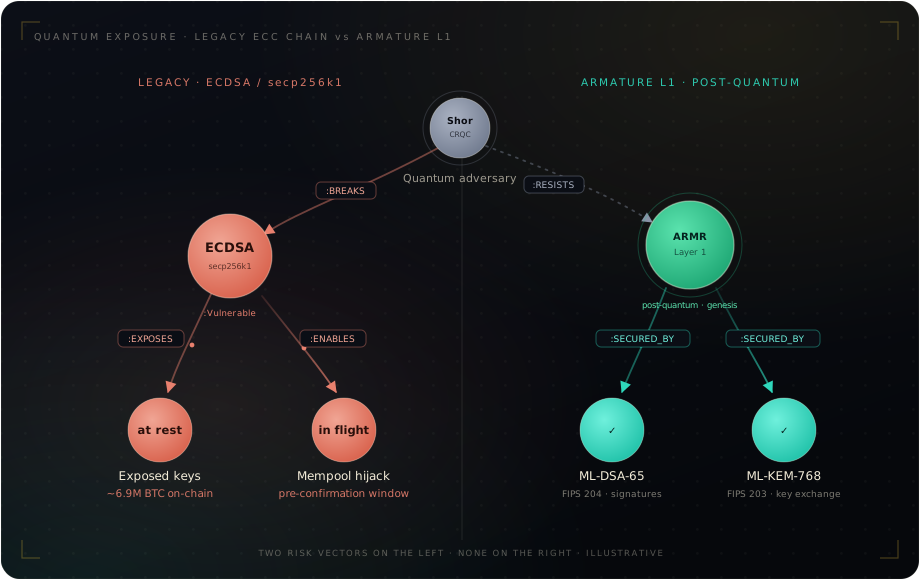
Almost all of today's digital security rests on mathematical problems that are hard for ordinary computers but fall to a sufficiently powerful quantum machine. The encryption behind banking, messaging and identity was designed when quantum computers were theoretical. That era is closing: governments are already issuing migration guidance, and "harvest now, decrypt later" means data captured today can be unlocked the moment such a machine exists.
In August 2024 the U.S. National Institute of Standards and Technology finalised the first post-quantum standards. KXCO's packages implement those standards directly — ML-DSA-65 for digital signatures, ML-KEM-768 for key exchange — at NIST's Category-3 security level. Publishing them lets institutions begin the transition on a foundation they can audit, rather than a proprietary black box they must take on faith.
A toolkit, not a token gesture
Rather than one library, KXCO released an interconnected suite of thirteen packages that together cover the real needs of a regulated institution:
Data protection — file and envelope encryption that stays secure in a post-quantum world.
Digital signatures — signing documents, messages and outgoing webhooks so recipients can prove they were not altered.
Audit and compliance — a tamper-evident log where every entry is cryptographically signed and hash-chained, so any tampering breaks the chain.
Secure communication — encrypted channels for moving data safely between systems.
Key custody — signing through a hardware security module boundary, as regulated environments require.
AI-agent identity — tools that give autonomous AI systems their own verified, post-quantum identities, sponsored by an accountable institution.
Developer tooling — a command-line tool, an institution SDK, a standalone verifier, and a single package that bundles the whole stack.
Several packages can also anchor records on a blockchain, adding a layer of transparency and immutability that is difficult to achieve any other way. Features like these — HSM support, hash-chained audit trails, on-chain attestation — are not demonstration toys; they are the controls compliance teams look for.
Validation that comes from the outside
The significance is less about any single tool than about where the code now lives. Three independent surfaces carry KXCO's cryptography, and none of them is controlled by the company's marketing department. On npm, the packages are live and versioned, with a history that shows sustained development rather than a one-off release. On GitHub, the source can be read line by line and audited by any security team before a single byte is trusted. And on Socket.dev, an independent service scans the suite for supply-chain risk entirely outside KXCO's control.
A company can assert anything in a brochure. It cannot fake a public, inspectable, independently scanned codebase that implements named international standards. That KXCO is willing to expose its cryptographic foundation to that level of scrutiny — and that the suite is coherent and production-shaped rather than a proof of concept — says a great deal about the maturity of the engineering behind it. Confidence that survives inspection is the only kind worth having.
Only the foundation is public — and that is deliberate
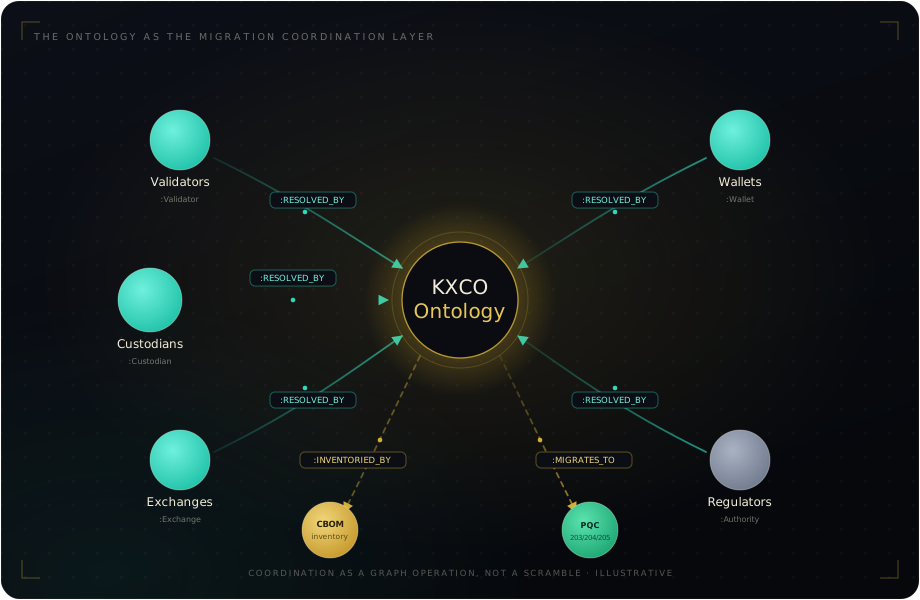
What KXCO has released is the foundation: the primitives, the identity layer, the verifiers and the tooling. It is real, and it is enough to build on. But it is not everything the company has built. The more advanced components — the coordination logic, the ontology engine, and the systems that weave these pieces into a single verifiable record of reality — are kept private, as trade secrets, by deliberate policy.
That choice echoes a stance Elon Musk has stated bluntly. Explaining why SpaceX does not patent its hardest-won engineering, he said:
"We have essentially no patents in SpaceX. Our primary long-term competition is in China. If we published patents, it would be farcical, because the Chinese would just use them as a recipe book." — Elon Musk
Musk has elsewhere put it more sharply still, calling patents "for the weak." The logic is simple and, for frontier technology, hard to argue with: a patent application is a public teaching document. To win the monopoly, you must disclose the method — handing a recipe to any competitor or adversary. KXCO's answer is a two-tier posture: open-source the foundation so it can be inspected and trusted, and keep the advanced work as protected trade secrets so the hardest engineering is never given away in a filing. What the public can see is genuine and verifiable. What it cannot see is further ahead.
The engine inside the products
These packages are not a side project. They are the cryptographic engine running inside KXCO's product family — the same primitives, exposed as libraries. The identity SDK and hardware-module signing underpin KXCO Nexus, the company's identity, signing and verification layer. The attestation and tamper-evident audit tools feed KXCO Sentinel, its quantum-resistant cloud. The chain and attestation clients anchor records on Armature L1, KXCO's post-quantum settlement network. The agent-identity package is what lets KnightsPurse give people and autonomous AI agents their own secure wallets. The verifiable state of the open foundation is, in effect, direct evidence for the quality of the private whole.
Chain, quantum and AI are converging
Step back and a larger pattern comes into view. Three forces are arriving together. Artificial intelligence is producing autonomous agents that act, not merely advise. Quantum computing is threatening the cryptography beneath everything those agents touch. And blockchain is maturing into the neutral record where their actions can be settled and proven. Treated separately they are three problems; treated together they are one — and these packages sit precisely on the seam between them.
An autonomous agent can be issued a post-quantum identity sponsored by a verified institution, sign each action with a quantum-resistant signature, anchor that action on a public chain, and have any party verify it independently — quantum-safe from identity to settlement to proof. Very few organisations are building at that intersection at all. Fewer still have published working code to show they can. By putting the foundation in the open while keeping the frontier private, KXCO is signalling something specific to the institutions that will depend on this infrastructure: the visible state of the art is a floor, not a ceiling.
The technical detail, and links to all thirteen packages, is here: We put our cryptography in the open.
KXCO is a software company; regulated services are operated by licensed institutions. Cryptographic posture reflects NIST FIPS 203/204/205 alignment at Category-3 parameters; KXCO does not claim CNSA 2.0. The Musk quotation is reproduced from public reporting for commentary. Nothing here is investment advice.
The 2030 Compute Landscape: GPUs, Power and the Architecture of Intelligence
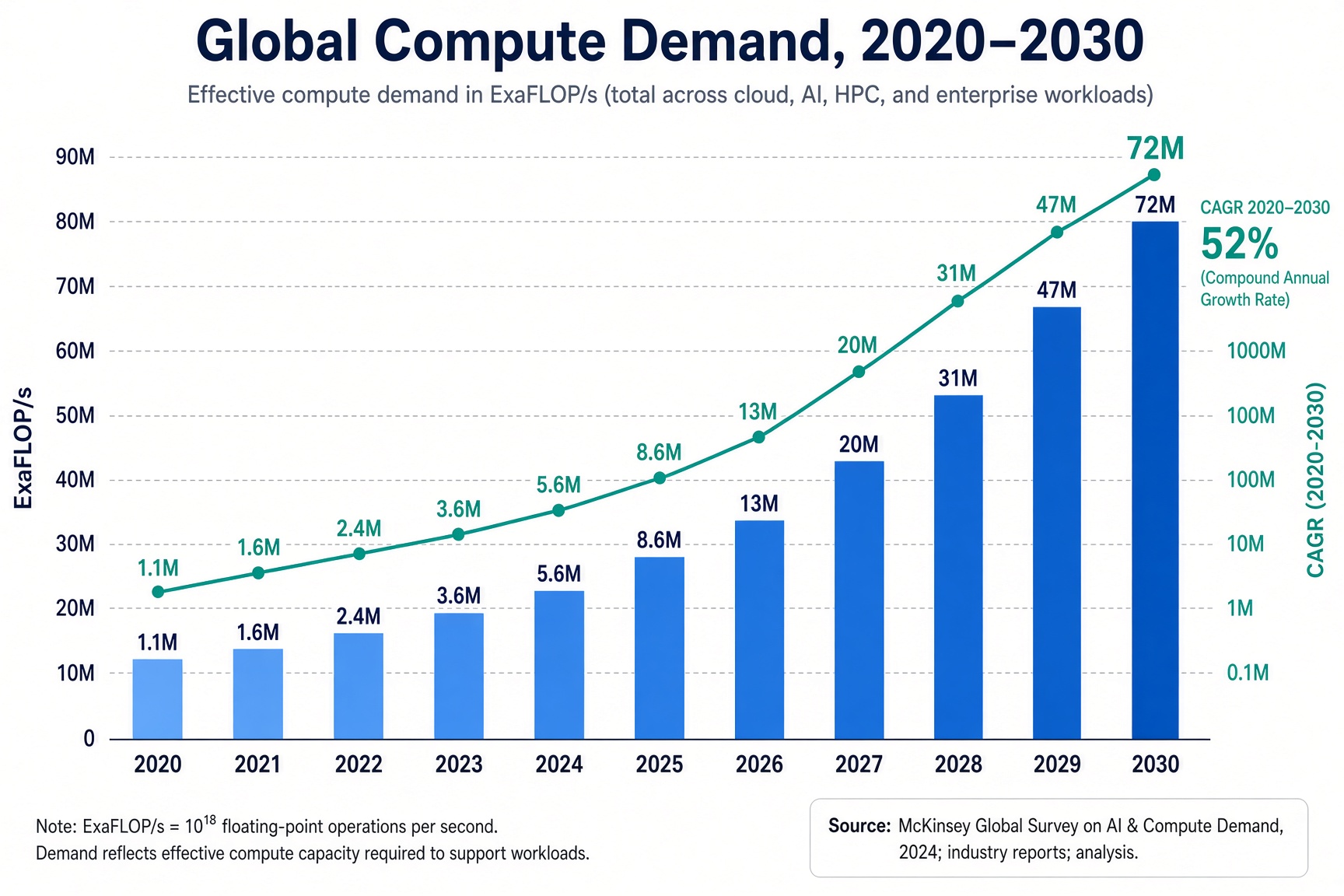
The constraint on AI is no longer ideas or data but compute and the power to run it. Frontier training compute has grown about five times a year since 2020, and the leading AI supercomputer of June 2030 is on course for about 2 million chips and 9 gigawatts. Shayne Heffernan sets out the 2030 arithmetic, the power problem, who has already contracted the gigawatts, and how GPUs, custom ASICs, wafer-scale engines and quantum machines divide the work.
Harvest Now, Decrypt Later: Why KXCO Took Its Ontologies Private
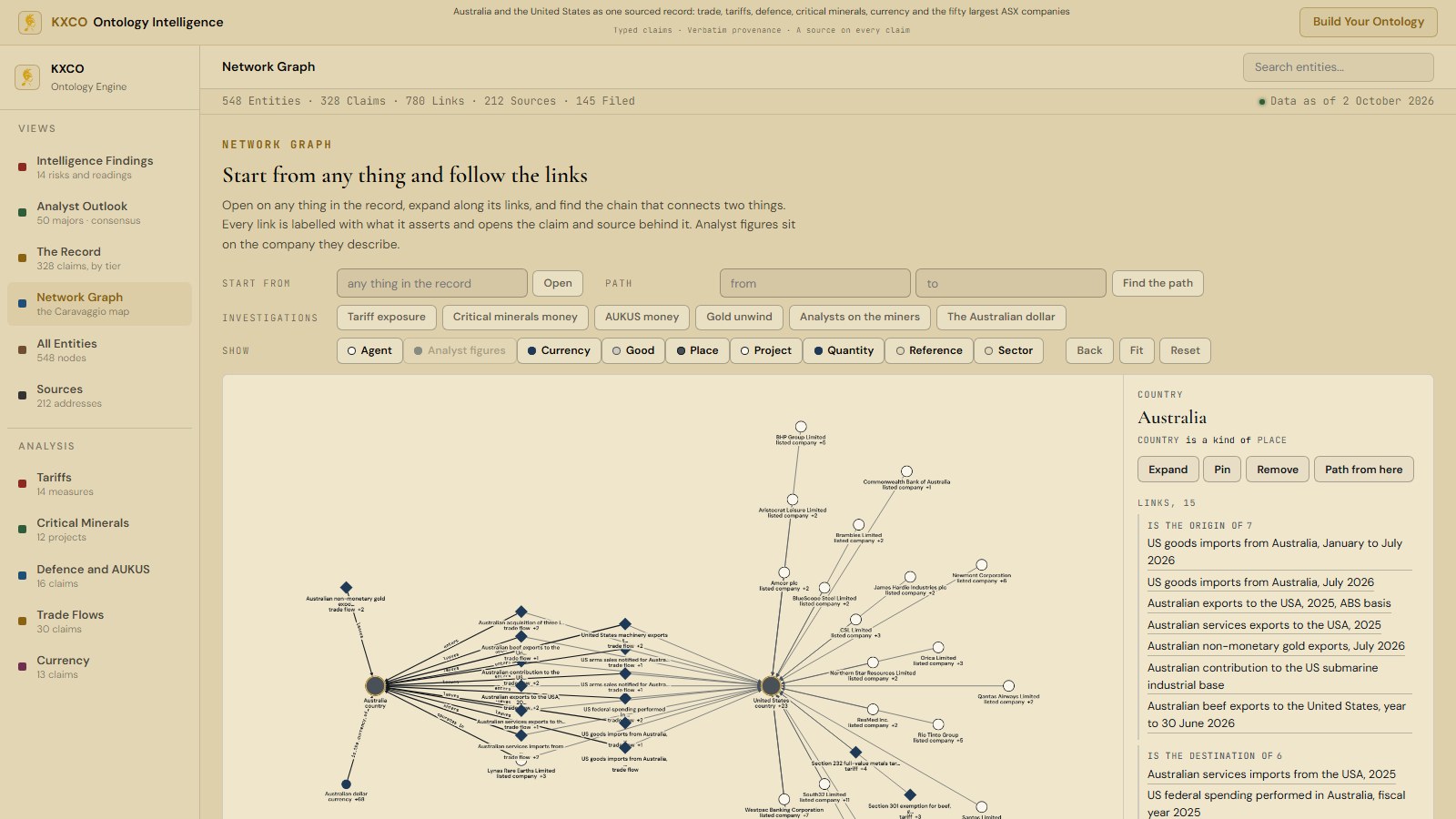
For more than 90 days KXCO ran its ontologies in public: the AI sector resolved from six names to one lithography supplier, and Australia's trade with the United States as one sourced record. They proved the method. They are now private, still running, for KXCO and its clients only. Europol's report on harvest now, decrypt later explains why: data collected today will be read when a quantum computer arrives, and a graph of your relationships is the most valuable thing to harvest.
KXCO AI Ontology at 3 Months: What It Called and What Comes Next
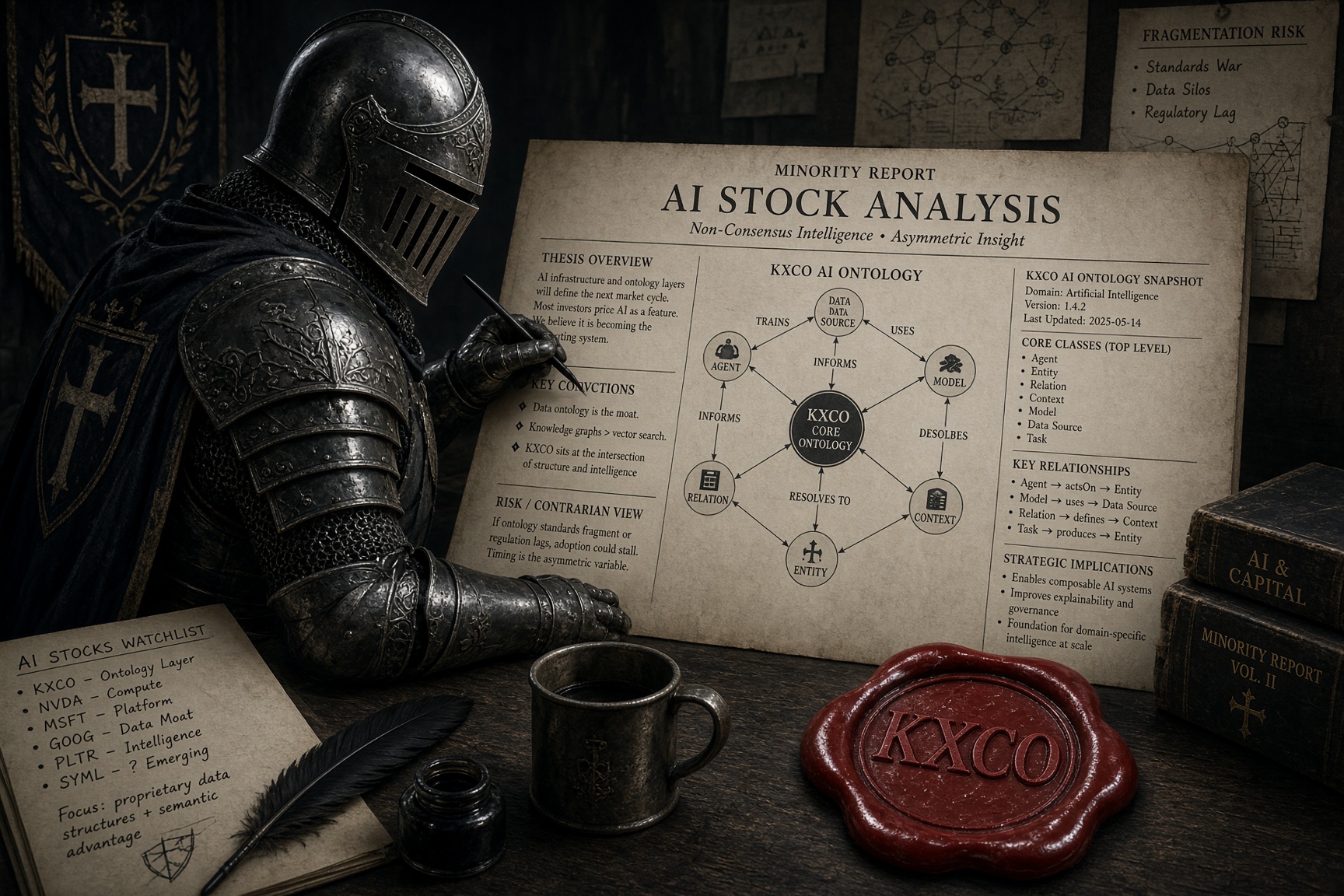
On 19 July 2026 the Round Table's AI room published its first Analyst Outlook. To the 16 October 2026 close its 13 names rose 2.6% on an equal weight against 2.1% for QQQ, per StockAnalysis closes, and the six it opened with 35% or more of upside rose 8.6%. This piece lists the six names up more than 5%, the ten names I rate as opportunities now, the month's results in AI and quantum computing, and the official data showing that four in five firms have not yet started using AI.

What the Round Table Is Predicting in Biotech Markets
Seventeen FDA decisions fall due between 30 October 2026 and 29 June 2027, and KXCO's Round Table has called every one. Its model portfolio holds the thirteen Nasdaq companies behind them, led by BridgeBio, Cogent Biosciences and Praxis, and was signed with ML-DSA-87 and anchored on chain before the FDA acts. The first test is Inovio's INO-3107 on 30 October.
Every story, signed and delivered.
Subscribe to the kxco channel and get the headline, the AI-written key takeaways, and the chain-anchor link the moment we publish. Audio versions and per-ticker subscriptions arrive in the next iteration.