
Ontology: Agentic AI and Infrastructure
Gartner expects 40% of agentic-AI projects abandoned by 2027 and Oracle says only 7% of enterprise data is AI-ready. Shayne Heffernan on why the bottleneck is meaning, not compute — and the secured, settled semantic layer that agentic finance actually demands.
Part of theThinking Center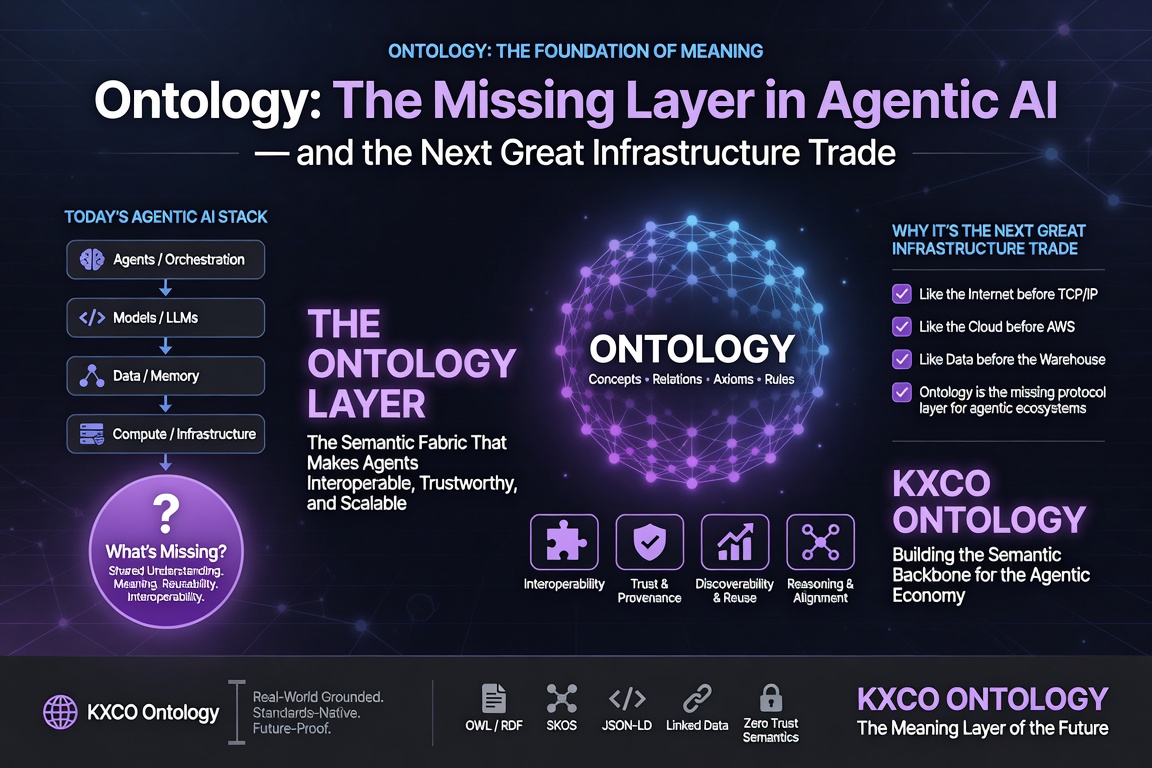
For three years, the entire conversation about artificial intelligence has been about scale — more parameters, more GPUs, more context. I have watched a lot of infrastructure cycles in forty years of markets, and I can tell you that conversation is about to hit a wall that no amount of compute can climb. The thing standing in the way is not a hardware problem. It is a meaning problem. And the companies that solve it, not the ones with the biggest models, will own the next decade of financial infrastructure.
Two numbers frame the whole issue. Gartner expects that 40% of agentic-AI projects will be abandoned by 2027 — not because the models were not good enough, but because the enterprises deploying them lacked the semantic foundation for AI agents to reason over. Oracle has reported that only 7% of enterprises consider their data ready for AI. Read that second figure again. It does not say the models are 7% ready. It says the data — the ground the agents must stand on — is not ready in ninety-three cases out of a hundred. The industry has spent three years optimising the wrong end of the pipeline.
The missing piece has a name that until recently lived in philosophy departments and academic computer science: ontology. In 2026 it has become an enterprise imperative, and I want to explain why it matters, why it is the real bottleneck for the AI trade, and why the way almost everyone is building it has a hole in the middle of it. I have written a much longer, more technical treatment of this on our own site — the full essay is at kxco.ai — but here is the argument for a markets audience.
The bottleneck is meaning, not compute
Start with the failure mode, because it is the whole argument. A human operator has a superpower an AI agent does not: judgment under ambiguity, backed by the ability to fall back on discretion. When a field is labelled ambiguously and could mean gross or net, a person asks. When two systems disagree on what "settled" means, a person reconciles by picking up the phone. When a counterparty's name is spelled three ways across three databases, a person just knows they are the same entity. That improvisation is the invisible substrate the entire financial system quietly runs on. It is slow and expensive, and it works precisely because a human can supply the missing meaning on the fly.
An agent has none of that. It cannot get a feel for a counterparty. It cannot phone a bank. It has to make a decision from the data in front of it, at a volume and cadence that makes human review after the fact impossible. So the data in front of it must be self-describing — structured enough for a machine to parse without a human interpreter — and self-proving — verifiable enough that the machine can check it without asking anyone. Absent that, an agentic economy is just the old fragmented mess running faster, and failing faster, with no one in the loop to catch it.
Everyone is racing to build AI agents. Nobody is building the semantic rails those agents need to operate in regulated markets. That is the gap, and that is the opportunity.
An ontology is a formal, machine-readable model of what things are and how they relate. In finance, it names the entities that actually exist — a client, an instrument, a settlement, a counterparty, an obligation, a compliance rule — and it specifies the relationships and constraints that connect them. The distinction that matters is between a schema and an ontology. A database schema describes how data is stored. An ontology describes what data means, independent of where it lives, so that two systems built by two different teams in two different decades will nonetheless agree on whether a given record is a client and what follows from that. A schema lets you retrieve a row. An ontology lets a machine reason.
At my firm, KXCO, we compress the whole idea into a single principle: a value is a typed claim, not a bare number. The figure "1,250,000" is meaningless. What an ontology insists on is that every value arrives wearing its meaning — this is a monthly commitment, from this source, as of this date, at this confidence, on this basis. A bare number is something you have to trust. A typed claim is something you can check. That difference — from asserted to provable — is the entire game.
The market is exploding — and missing security
The realisation that meaning is the bottleneck has produced a boom. The enterprise knowledge-graph market was valued at roughly $2.9 billion in 2025, is projected near $3.5 billion in 2026, and is forecast to reach $13.4 billion by 2033 — a compound annual growth rate above 21%. In the language of the analysts, knowledge graphs have moved "from experiments to decision infrastructure," and executive scrutiny of them is at an all-time high. When something moves from the lab to the boardroom, the questions change. It stops being "does it work?" and becomes "can I bet the institution on it?"
Here is the hole in the middle of that boom, and it is the part of this I feel most strongly about. Every knowledge-graph vendor is talking about semantics — richer models, better inference, tighter integration with the language models. Almost none of them are talking about security, and specifically none of them are talking about post-quantum security. That is a strange blind spot, because the moment a knowledge graph becomes decision infrastructure, its integrity becomes the whole ballgame.
Think about what it means for markets. If your ontology encodes financial regulations, counterparty relationships and compliance rules, and an adversary — or a careless administrator — can alter one relationship without anyone noticing, then every decision downstream of that relationship is silently corrupted. The graph does not fail loudly. It fails quietly, and you find out in the audit, or the loss, or the enforcement action. A crashed system pages someone at three in the morning. A corrupted meaning does not page anyone. The agents keep running, confidently, on a model that is subtly wrong, and the wrongness compounds trade by trade.
A knowledge graph that can be tampered with is a liability, not an asset.
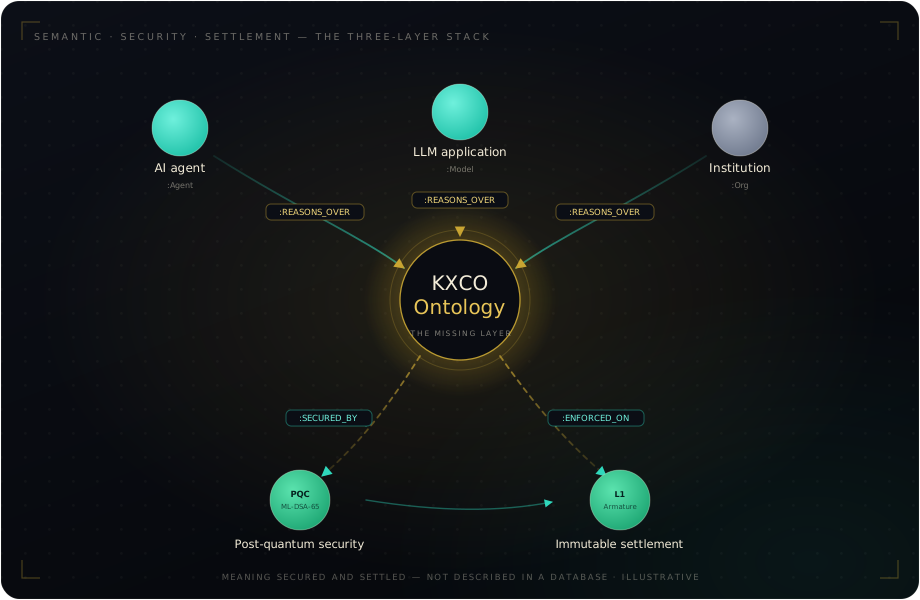
There are really two threats here. The first is tampering you can see coming — an insider, a compromised credential, a bad migration — and the defence is not access control alone but tamper-evidence: anchoring the consequential state of the ontology on an immutable, independently readable record, so any alteration is detectable by anyone. The second threat is slower and worse: the cryptography itself expiring. The signatures that today prove "this claim was made by this authority at this time" rest on RSA and elliptic-curve mathematics that a sufficiently large quantum computer breaks. And because of "harvest now, decrypt later," the exposure is already live — a signed claim captured today becomes forgeable within the lifetime of the obligation it underwrites.
An ontology is a long-lived thing; it is supposed to outlast the systems that query it. That is exactly the profile of asset the quantum transition targets. KXCO is, as far as I am aware, the only company merging ontology-driven knowledge representation with ML-DSA-65 post-quantum signatures (NIST FIPS 204) on an immutable ledger. We did not add security as a feature to a knowledge-graph product. We built the secure, immutable record first — our Armature L1 network, post-quantum from its genesis block — and we are layering the ontology onto a foundation that was quantum-resistant before the ontology existed. That is the right order, and it is very hard to retrofit in the wrong one.
Ontology as the governance schema for AI agents
The most important reframing of the last year came from the people building the semantic layer for a living: the ontology is not just a data model — it is the governance schema that determines how every AI agent in the enterprise interprets and acts on data. Snowflake made semantic-layer governance a headline at its 2026 summit, framing it as what powers trusted agentic AI. Atlan has named the emerging "Context Layer" — semantic meaning, ontology, governance, lineage and decision memory fused into one governed surface. The industry is converging, from several directions at once, on the same conclusion: the layer that gives an agent meaning is also the layer that must govern it.
This maps cleanly onto how I have thought about markets for four decades. In institutional finance, the rules layer is the market. What a "client" is determines who you can transact with. What "settlement" means determines when risk actually transfers. What "compliance" requires determines what is permitted at all. These are not annotations on top of the business; they are the business, encoded. An ontology for finance is the machine-readable form of the rulebook every participant already operates by, made precise enough that an agent can be held to it.
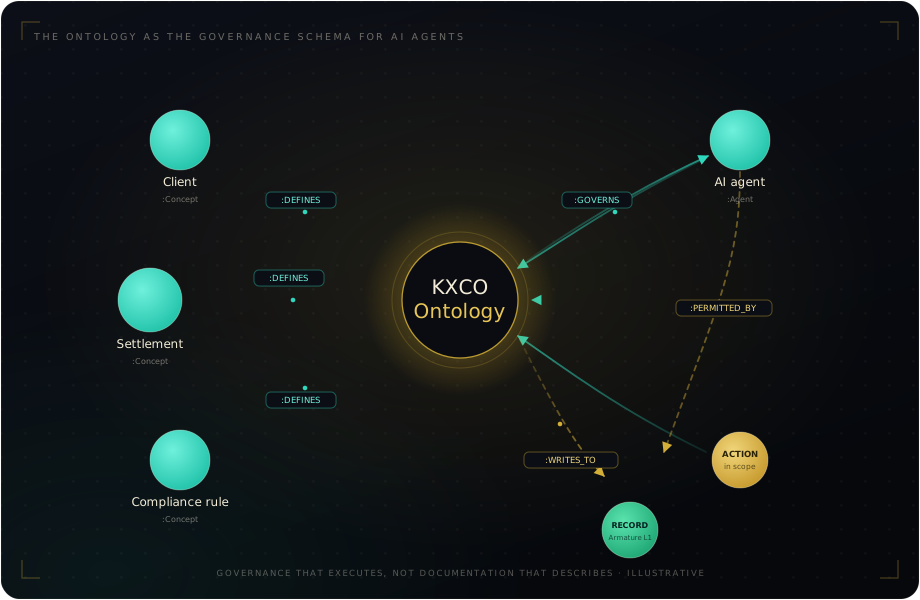
The difference between what KXCO does and a knowledge graph sitting in a database is the difference between describing policy and enforcing it. In most stacks, the ontology is documentation: it says what a client is, and then a separate pile of application code — written by different people, at a different time, with its own bugs — is supposed to honour that definition. The gap between the model and the code is where compliance failures live. KXCO closes that gap by making the ontology the thing the action is checked against at the moment it happens. An agent proposes an action; the action is evaluated against the ontology's definitions and the scope its owner delegated; only if it holds does it settle and get written to the record.
Ontology without enforcement is just documentation. KXCO turns ontology into executable governance on an immutable ledger.
There is a consequence here that any compliance officer will appreciate immediately. Because the ontology governs the action and the action is recorded, the answer to a regulator's question — "who authorised this, and what rules governed it?" — is not reconstructed after the fact from logs of uncertain integrity. It is evidence, produced at the moment of action, cryptographically bound to the actor and the rule, and readable by anyone. Regulators do not want explanations. They want evidence. An ontology that enforces and records provides both.
Why LLMs alone will never be enough
It is tempting, in 2026, to believe the language model is the whole answer — that a large enough model with a long enough context will simply absorb the rules and behave. It will not, and the research community that studies knowledge representation has been unusually clear about why. The frontier is not large language models alone; it is neurosymbolic AI: language models providing flexibility and fluency, and formal ontologies providing logical rigour and explainability. The model proposes; the ontology constrains, checks and explains.
The reason this matters for anyone deploying capital is simple. A language model is a statistical machine: it produces the most plausible continuation, and plausibility is not truth. On the open web that is tolerable, because a wrong answer is an inconvenience. In a market, a plausible-but-wrong answer that an agent acts on is a loss, a breach, or an enforcement action. You do not fix over-confidence with more parameters. You fix it with an external source of truth the model is required to defer to — a formal ontology it cannot argue its way around.
AI without ontology is hallucination. AI with ontology but without security is a hack waiting to happen. The infrastructure has to deliver both.
KXCO is not theorising about neurosymbolic AI. We are building the infrastructure it runs on. The language model is yours — bring whichever you trust. What we supply is the symbolic half done properly: an ontology that is not a research artefact but a governed, secured, settled layer, so that the "symbolic" in neurosymbolic is something you can bet an institution on.
Healthcare already proved this works
If the argument so far sounds theoretical, there is a large, boring, real-world proof that formal ontology works at scale — and it is not in finance. It is in medicine. Healthcare spent roughly fifteen years building ontology-driven interoperability, and it worked. The Ontology of Adverse Events was recently published in Nature Scientific Data with 10,829 terms, a roughly 250% expansion since 2014. A 2025 paper in Frontiers in Digital Health is titled, plainly, "Ontologies as the Semantic Bridge Between AI and Healthcare." The healthcare interoperability market alone was around $4.5 billion in 2025 and is projected toward $14.4 billion.
The mechanism that made this work is worth naming, because finance needs the same one. Formal ontology plus shared standards — FHIR and HL7 in the clinical world — produced interoperability at scale, not because everyone adopted the same software, but because everyone adopted the same meaning. A lab result generated by one vendor's system means the same thing to another vendor's system, because both are grounded in a common ontology of what a lab result is. That is the prize: not standardised software, but standardised semantics, which lets heterogeneous systems cooperate without merging.
Finance is now where healthcare was fifteen years ago — heterogeneous systems, incompatible meanings, integration by brute force and human reconciliation — except finance does not have fifteen years. Tokenization of real-world assets and the arrival of autonomous agents are happening now, on a timescale of quarters, not decades. KXCO's bet is that you can compress that timeline by applying the same formal-ontology principles healthcare proved, but on infrastructure healthcare never had: a blockchain-native, quantum-resistant foundation. Same rigour, better substrate, compressed timeline.
Interoperability is the real prize — and decentralized identity is the answer
There is a specific prediction circulating among semantic-web practitioners that I think is exactly right: the industry is about to rediscover a truth that community has known for decades — decentralized identification is essential to interoperability. You cannot make heterogeneous systems agree on what an entity is if every system mints its own private identifier for it and guards it as an asset. Interoperability at scale requires identifiers that are shared, resolvable and not owned by any single party.
Regulation is now forcing the issue. In the United States, interoperability mandates such as TEFCA and the ONC rules are compelling systems to exchange meaning, not just files. In Europe, the Data Act and the AI Act demand semantic traceability — the ability to say what data an automated decision used and where it came from. A private schema in a private database cannot satisfy those requirements. A shared ontology with resolvable, decentralized identifiers can.
This is the part where KXCO did not have to pivot, because we anticipated it. We have been building decentralized identity on a post-quantum blockchain from day one. An entity on KXCO has an identity that is a cryptographic key it controls, not a row in our database that you have to trust us about. Identity, signing, compliance and settlement all record their consequential state to Armature L1, so that "who approved this, under what identity, and what rules governed it?" is answerable by reference to a shared, independently verifiable record. The decentralized-identity layer the semantic-web community is predicting the enterprise will rediscover is the layer we started with.
A forty-year thesis
I have spent forty years in global capital markets, most of it across Asia-Pacific, and I founded Knightsbridge Group in 1987. I have watched every infrastructure cycle of the modern market — the move from open outcry to Reuters terminals, from paper settlement to electronic clearing, from electronic trading to blockchain, and now to autonomous agents. If that history taught me one thing, it is that the winners of each cycle were not the ones with the cleverest strategy on top. They were the ones who owned the infrastructure underneath — the rails everyone else had to use. Strategy is transient. Rails compound.
Most ontology and knowledge-graph companies are led by computer scientists, and they build accordingly — brilliant on representation, thin on markets. My angle is the opposite. Ontology, to me, is not primarily a computer-science problem; it is a market problem, because an ontology is ultimately about how markets define and exchange value. What is a client? What is settlement? What is an instrument? What is compliant? These are the oldest questions in finance, and every institution answers them today in incompatible, human-mediated ways. Turning those answers into formal, machine-readable, post-quantum-secured semantic infrastructure is not an academic exercise. It is translating four decades of institutional knowledge into the rails the next cycle will run on.
The winners of each infrastructure cycle owned the rails, not the strategy on top. Ontology, secured and settled, is the rail for the human–AI economy.
This is also why KXCO built in the order it did. We did not start with AI and bolt on infrastructure. We built the infrastructure first — post-quantum cryptography, decentralized identity, an immutable record, compliance rails — and we are layering ontology on top as the semantic governance layer that makes agentic AI trustworthy in regulated finance. A computer scientist optimising for a demo would have shipped the graph first. Someone who has watched forty years of infrastructure cycles knows that the graph is the easy part and the trust underneath it is the hard part — and that you cannot retrofit trust, you can only build on it.
What this means for markets
I will not tell you which ticker to buy; that is not what this piece is for. But I will tell you what to watch, because the shift is real and it is investable at the infrastructure level. The AI trade so far has been a compute trade — chips, data centres, power. The next leg is a meaning trade, and it will reward the companies that own the semantic and trust layers rather than the ones renting GPUs. Watch the knowledge-graph and semantic-layer market keep compounding above 20% a year. Watch the regulators in the US and EU turn semantic traceability from a nice-to-have into a legal requirement. Watch the quantum-security question move from footnote to due-diligence checklist as the standards bodies finish their work and the first institutions get asked, in an examination, how their records survive the transition.
What is happening now — the convergence of ontology, agentic AI and the quantum transition — is, to my eye, the most significant infrastructure shift since electronic trading arrived. Electronic trading changed how fast the market moved. This changes who moves in it: machines, acting autonomously, at machine volume, needing meaning they can prove and security that outlasts the adversary. KXCO exists to engineer the rails for that. Not to describe the future of financial semantics — to build the secure, immutable, regulation-ready infrastructure it runs on.
If you want the full technical argument — the three-layer architecture, the worked examples, the honest limits of what this does and does not do — I have written it in detail at kxco.ai, and you can see a public proof-of-concept, a six-company sector ontology built entirely from public data, at kxco.ai/ontology-live. Watch us build a rigorous ontology from public data. Then imagine it on your closed data, where the meaning matters even more.
Dr. Shayne Heffernan is the founder of KXCO and has spent forty years in global capital markets. KXCO is a software company operating in the UK and USA; it holds no financial licences and does not custody assets. Market figures cited above are as reported by the named sources and reflect their projections. The graphics are illustrative of the model, not live data. This article is for information only and is not investment advice.
Harvest Now, Decrypt Later: Why KXCO Took Its Ontologies Private
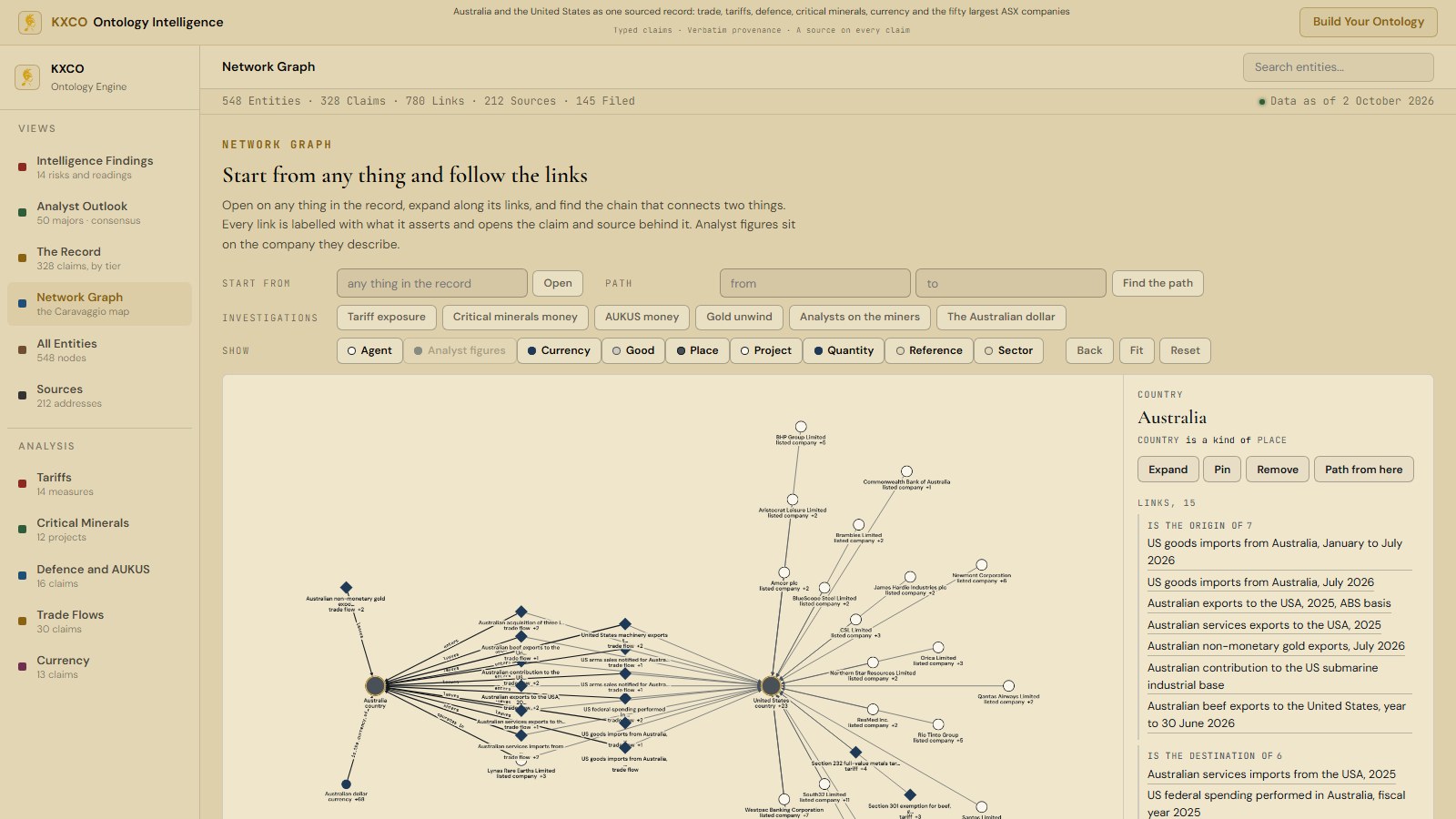
For more than 90 days KXCO ran its ontologies in public: the AI sector resolved from six names to one lithography supplier, and Australia's trade with the United States as one sourced record. They proved the method. They are now private, still running, for KXCO and its clients only. Europol's report on harvest now, decrypt later explains why: data collected today will be read when a quantum computer arrives, and a graph of your relationships is the most valuable thing to harvest.
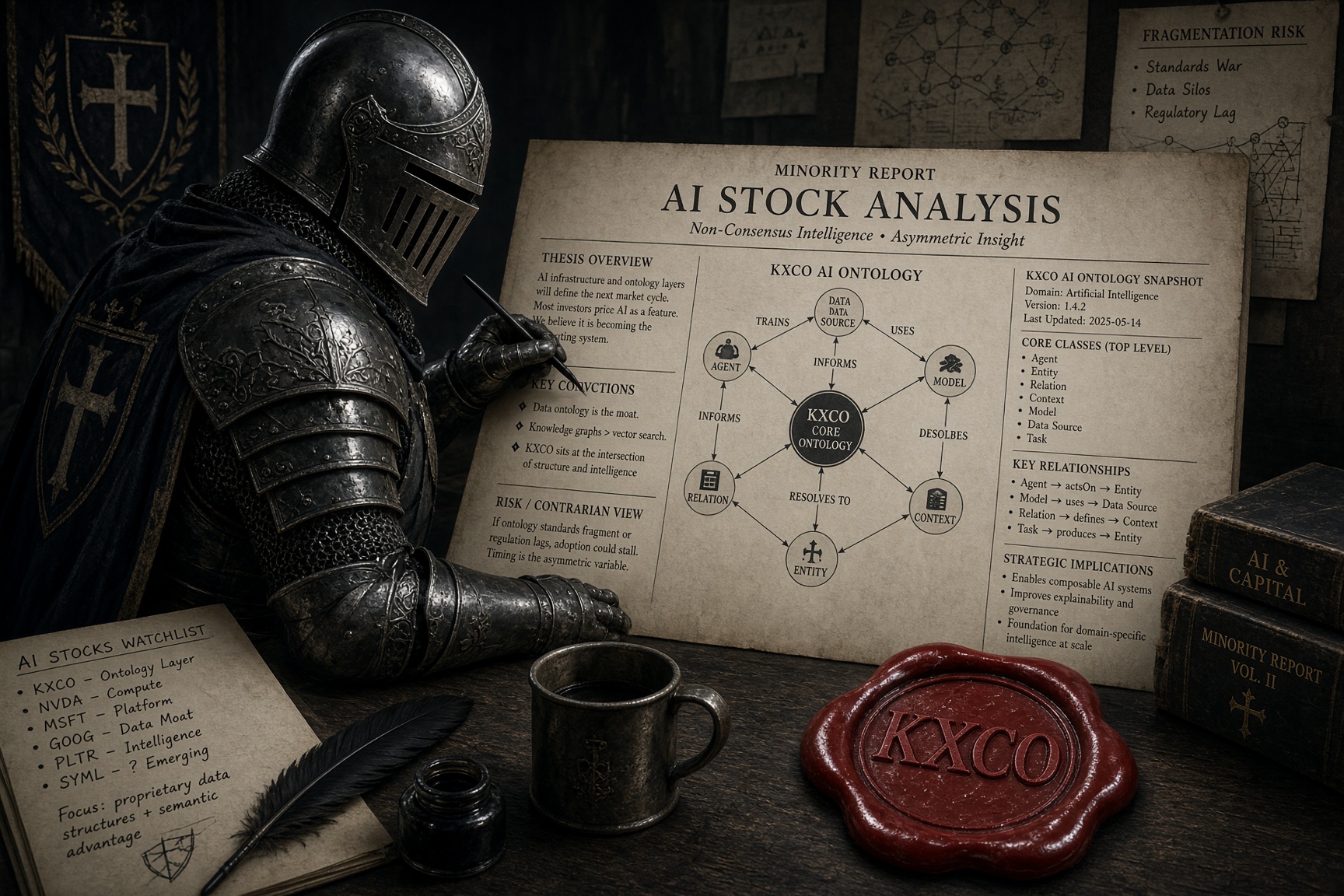
KXCO AI Ontology at 3 Months: What It Called and What Comes Next
On 19 July 2026 the Round Table's AI room published its first Analyst Outlook. To the 16 October 2026 close its 13 names rose 2.6% on an equal weight against 2.1% for QQQ, per StockAnalysis closes, and the six it opened with 35% or more of upside rose 8.6%. This piece lists the six names up more than 5%, the ten names I rate as opportunities now, the month's results in AI and quantum computing, and the official data showing that four in five firms have not yet started using AI.

What the Round Table Is Predicting in Biotech Markets
Seventeen FDA decisions fall due between 30 October 2026 and 29 June 2027, and KXCO's Round Table has called every one. Its model portfolio holds the thirteen Nasdaq companies behind them, led by BridgeBio, Cogent Biosciences and Praxis, and was signed with ML-DSA-87 and anchored on chain before the FDA acts. The first test is Inovio's INO-3107 on 30 October.

SpaceX: The Road to 10 Gigawatts
SpaceX did not add an AI business. A company whose processes run on compute built its own computing plant, then built the power to run it. The 10-Q reports 1.4 gigawatts of nameplate compute at 30 June 2026, four leases worth about $41 billion a year and $100 billion of cash. The target is closer to 10 gigawatts than 5 by the end of 2027. This piece sets out the build sequence, the four layers of power in Memphis, and why Terafab is the act after 2027, not the road to it.
Every story, signed and delivered.
Subscribe to the kxco channel and get the headline, the AI-written key takeaways, and the chain-anchor link the moment we publish. Audio versions and per-ticker subscriptions arrive in the next iteration.