
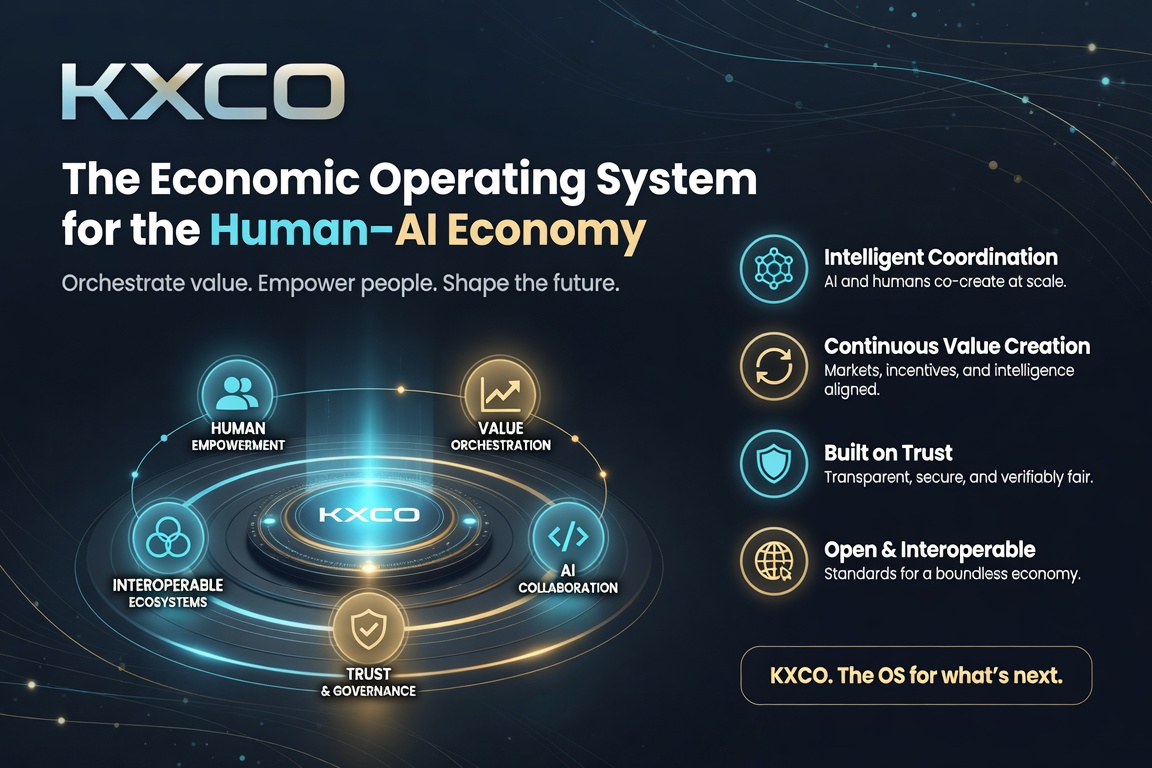
KXCO: The Economic Operating System for the Human–AI Economy
Why the next economy — one where AI agents transact alongside people and institutions — needs post-quantum, verifiable infrastructure underneath it, and what it means for markets.
For twenty-five years I have watched markets reprice the same thing over and over: trust. Every credit spread, every counterparty limit, every basis point of "friction" in a settlement is, at bottom, the price of not being certain who you are dealing with, whether they can do what they claim, and whether the record will still say so tomorrow. We have built an extraordinary financial system on top of that uncertainty, and we have paid for it in reconciliation teams, legal opinions, custody chains and the quiet tax of intermediaries whose entire job is to vouch for one party to another.
Two things are now colliding that make that old arrangement untenable. The first is that software has started to act — not answer questions, but negotiate, transact, verify and settle on our behalf. The second is that the cryptography underneath every one of those actions has a published expiry date. Put them together and you get the defining infrastructure question of the decade: what does an economy run on when most of its participants are machines, and the maths that used to secure them no longer holds?
My answer, and the reason I have spent the last few years building it, is KXCO — and the simplest way to describe what we are building is this: an Economic Operating System for the Human–AI Economy.

What an "operating system" for the economy actually means
An operating system is not an app. It is the layer every app assumes and no app has to rebuild — the thing that manages identity, memory, permissions and communication so that the software above it can simply get on with its job. For fifty years, computers have had one. The economy never has. It has millions of private ledgers that disagree, millions of copies of "who you are" that never reconcile, and a patchwork of intermediaries stitching them together by hand.
That was survivable while a human sat in every loop, because a human can improvise. When a wire looks wrong, a person picks up the phone. When a document seems forged, a lawyer asks for the original. That discretion is the invisible substrate the whole system runs on, and it is slow, expensive, and about to be overwhelmed — because the new participants cannot phone anyone.
An AI agent has no judgment to fall back on. It cannot get a feel for a counterparty or sense that something is off. It needs an answer that is structured enough for a machine to parse, verifiable enough that it can be checked without asking a human, and universal enough that every other system computes the same result. Give it that, and an agent can participate in the economy safely. Withhold it, and an AI-driven economy is just the old fragmented mess running at machine speed — failing faster than anyone can react.
An Economic Operating System supplies exactly that missing layer. On KXCO, four things every consequential action needs are provided once, underneath everything, so no product has to reinvent them:
A verifiable identity — for a person, a business, an institution or an AI agent — that others can check rather than take on faith.
A signature on every action that cannot be forged or replayed, and that will still hold up against a future quantum computer.
A shared record anyone can inspect without a referee, so history is settled rather than disputed.
Live permission — what is allowed, by whom, where, and until when — checked at the moment of action, not assumed once and forgotten.
The rule that binds them is deliberately strict: nothing is treated as real until all four hold at once. A signature that is valid but not permitted is not a valid action. A permitted action that was never recorded cannot be relied on later. That single rule is what turns a pile of separate technologies into an operating system.
The products are the applications; the OS is underneath
When people first look at KXCO they see a family of products, and it is fair to name them, because each is a real thing an institution or a person can use today or deploy on engagement. But the point I want to land is that they are applications on a common operating system, not a scatter of unrelated tools.
KXCO Treasury is the Economic Operating System's financial layer — payments, custody and banking presented as one platform rather than a dozen integrations. It spans a compliant, self-custodial wallet already live in the market through to full enterprise treasury and a business financial operating system, all resolving through the same underlying model of who owns what and who may move it.
KXCO Nexus is identity, legal execution and proof: the capability that issues verifiable identities and lets a document be signed with a signature engineered to remain verifiable for decades, long after the software that produced it is gone. For anyone who has ever fought over whether a signature from years ago is still good, this is the part that changes the economics.
KXCO Sentinel is the quantum-resistant cloud — where the sensitive workloads, and increasingly the AI agents themselves, actually run, and where an estate can be scanned for the cryptography that a quantum computer will break.
Armature L1 is the settlement layer beneath all of it: a post-quantum network that records and finalises actions with quantum-safe signatures from the very first block, with roughly two-second finality and a public explorer anyone can read.
Around those sit the things people touch directly — the KnightsPurse wallet, the KXCO Verified public-verification surface, and CareCredits (powered by KXCO), which applies the same rails to home care. Different front doors; one operating system behind them.
The ontology: what actually ties it together
There is one more piece, and it is the part that makes "operating system" more than a metaphor. Underneath the products sits a shared model of the world — what we call the ontology. In plain terms, it is a single connected map of who and what things are, who owns them, who has the authority to act on them, what has happened, and what is genuine. Identities, assets, authority, relationships and events are not scattered across separate systems that have to be reconciled after the fact; they are views of the same underlying structure.
This matters because the expensive failures in finance almost never live in a single field. They live in the relationships. A number can look perfectly reasonable on its own and be fraudulent three connections away — an asset whose backing traces to something that does not exist, a counterparty ultimately controlled by an entity you have already ruled out, an instruction that quietly contradicts a commitment made last quarter. A flat checklist cannot catch that. A connected model can, because it can follow the links. It is also what lets an AI agent reason safely: the agent is not guessing from a spreadsheet, it is acting over a verified map that both it and the party on the other side can check. Retail never has to see any of this — in a wallet, it simply works — but it is the reason the guarantees underneath are more than a slogan.
Why post-quantum is the foundation, not a feature
I want to be plain about the part of this that the market has not yet priced, because it is the part I am most certain about. The digital signatures that secure essentially all of today's finance — RSA and elliptic-curve schemes — are safe only because certain maths problems are hard for ordinary computers. A sufficiently powerful quantum computer running Shor's algorithm does not weaken them; it breaks them. A forged signature becomes indistinguishable from a real one.
You do not need the quantum computer to exist yet to be exposed. "Harvest now, decrypt later" is happening today: adversaries can record encrypted traffic and signed records now and break them the day the hardware arrives. Anything that must stay confidential or verifiable for a decade — a mortgage, a bond, a medical record, a corporate resolution — is already inside the window. And the migration is no longer a research topic. In August 2024, the US National Institute of Standards and Technology finalised the first post-quantum standards. Under current guidance, the old algorithms are slated for deprecation around 2030 and disallowal by 2035.
KXCO is built on those standards from the ground up. In production we use ML-DSA-65 for signatures, ML-KEM-768 for key exchange and encryption, and hash-based signatures where an artefact must last the longest — the schemes NIST published as FIPS 203, 204 and 205, at a security level comfortably ahead of today's requirements. To be precise about the ceiling of that claim, because precision is the whole point of a trust company: we state compliance with those NIST standards; we do not claim the separate Category-5 government suite. This is the essence of what the market will come to call quantum-safe AI infrastructure — and the reason we treat it as the floor rather than a headline feature. You do not build the trading floor of the machine economy on a foundation with a demolition date on the calendar.

AI agents as first-class economic actors
Here is the shift that will matter most to anyone who trades or allocates capital. On KXCO, an AI agent is not a script hiding behind a human's password. It is a first-class participant, held to exactly the same cryptographic standard as a person or a bank. An agent can hold its own verifiable identity, receive scoped authority delegated by its owner — a spending limit, an approved list of counterparties, a jurisdiction, an expiry — and sign each of its own actions with its own key. Nothing it does is a bearer token that someone could steal and replay; every action is a signature only that agent could have produced, over the exact instruction it received.
Follow one action through, because the mechanism is the whole value. An agent signs an intent; the platform screens it against a verifiable model of the world and the authority the owner delegated; if it is in scope and consistent, it settles on Armature L1 and its record is anchored permanently; and later, any counterparty, auditor or regulator can verify the whole chain — who acted, what they authorised, at what time — using open-source tools, without trusting KXCO at all. The action is proven, not merely asserted. And because the signature is post-quantum, that proof is still a proof in a decade, when a classical signature made today may be forgeable.
The same mechanism works when what an agent moves is information rather than money. Picture a diligence agent granted time-boxed access to a data room during a transaction, answering a counterparty's questions on the record. Each answer it returns is signed, and where it cites a document, that document's own signature and permanent record travel with it. The counterparty does not have to trust that the agent quoted faithfully — they verify the signature over the answer and the document independently. When the access expires, the proofs do not. Whether the asset is a payment or a claim, the guarantee is identical: what the agent did is provable, attributable and durable.
That is what "first-class economic actor" means in practice, and it is the difference between an AI economy you can supervise and one you simply have to hope about. When an agent is fooled — and some will be — the damage is bounded by the authority it was given and attributable to the exact agent that acted. That is a far better place to stand than a shared service account and a log file you have to take on faith.
What is actually live — and what I will not overstate
A trust company that overclaims is a contradiction, so let me be exact about status, because I would rather you believe the smaller true thing than the larger convenient one.
The KnightsPurse wallet is live. CareCredits (powered by KXCO) is live. Armature L1 is live, post-quantum from its first block, with a public explorer you can open right now. The verification tools are open source, published on npm and GitHub, and run with no KXCO server in the loop — you can take one of our signatures and check it yourself. Our post-quantum work has been validated in a European regulatory sandbox, and the developer program has drawn real interest from serious names in AI and payments.
Equally, here is what I will not say. I will not tell you the post-quantum network has years of history — it does not, and we will never backdate one. I will not call our signatures "court-admissible" or "legally binding," because those are determinations for courts and regulators, not marketing. KXCO is a software company operating in the UK and the USA; it holds no financial licences and it does not custody your assets. The institutions that deploy our software operate under their own licences and hold the relationships with their own customers. Armature's native unit, ARMR, is there to meter and settle activity on the network — it is not a tradeable cryptocurrency, and nothing here is investment advice. The discipline of saying exactly what is true, and no more, is not a constraint on a trust business. It is the product.
Institutions move last, and have the most at stake
It is tempting to think of all this as a problem for technology companies. It is the opposite. The institutions with the most to lose from getting trust wrong — banks, custodians, registries, insurers, governments — are precisely the ones whose records must remain valid the longest. A retail login can rotate its keys every week and nobody cares if last year's session is forgeable today. A land registry, a bond indenture, a pension entitlement or a treaty is the reverse: it must still verify in twenty or thirty years, against adversaries and computers that do not exist yet. For those institutions the question is not whether to move to quantum-safe infrastructure but how to prove they have — to an auditor, to a regulator, to a counterparty.
That is a different kind of requirement from "buy a faster database," and it is why the institutional path is deliberately unhurried on KXCO. An institution can start by simply verifying inbound signatures, then sign its own records, then anchor the ones that must be permanent, then scan its estate for the cryptography a quantum computer will break and migrate it on a schedule it can evidence. Each step stands alone and each produces proof. Because we are a software company and not the operator, the licensed institution keeps its licences, its customers and its control; what it gains is a way to make its most durable obligations provable rather than merely asserted. In a sector where the cost of a disputed record can run to years of litigation, that is not a technical nicety. It is the balance sheet.
Why this matters for markets
Strip the technology away and the thesis is an economic one. When proof becomes cheap and universal, entire categories of friction that markets currently pay for simply disappear. Reconciliation stops being a standing cost and becomes a lookup. Counterparty diligence on someone you have never met becomes a verification rather than an act of faith. The intermediary whose only function was to vouch for one side to the other finds that the vouching is now built into the rails. That is not an incremental efficiency; it is a change in the cost structure of transacting, and it compounds as more activity moves onto a common, verifiable layer.
Make it concrete. Picture a treasury agent acting for a mid-sized company, settling a recurring cross-border supplier payment. Today that involves a chain of intermediaries each re-establishing trust, a settlement window measured in days, and a paper trail that becomes one party's word against another's if anything is later disputed. On an Economic Operating System, the same agent presents a verifiable identity, signs the instruction within authority its owner explicitly scoped, has the payment screened against a live model of limits and counterparties, settles in seconds on a post-quantum network, and leaves a record any auditor can verify years later without trusting anyone. The intermediaries whose function was to vouch are no longer in the path, the settlement window collapses, and the dispute risk is replaced by a proof. Multiply that across the millions of routine actions a business takes in a year and you are looking at a structurally cheaper way to transact.
Now layer the machines on top. The volume and speed of an economy in which AI agents transact continuously, on behalf of people and institutions, will dwarf anything a human-paced system was designed for. That volume is only survivable — only investable — if every one of those actions is authenticated, authorised, accountable and quantum-safe by default, without a human in the loop to catch the exceptions. An Economic Operating System that supplies those guarantees underneath is not a nice-to-have in that world. It is the precondition for the world existing at all.
That is the bet KXCO represents, and it is why I keep coming back to the same phrase. Not a wallet, not a chain, not a compliance tool, not an AI product — but the layer all of those assume: the Economic Operating System for the Human–AI Economy, built post-quantum from the first block, and designed so that anyone, human or machine, can prove what is real without having to trust anyone else's word for it. The infrastructure of the last economy was built to move money between people. The infrastructure of the next one has to prove truth between people and machines. That is the one we are building.
Shayne Heffernan is the founder of KXCO by Knightsbridge. This article is commentary, not investment advice.
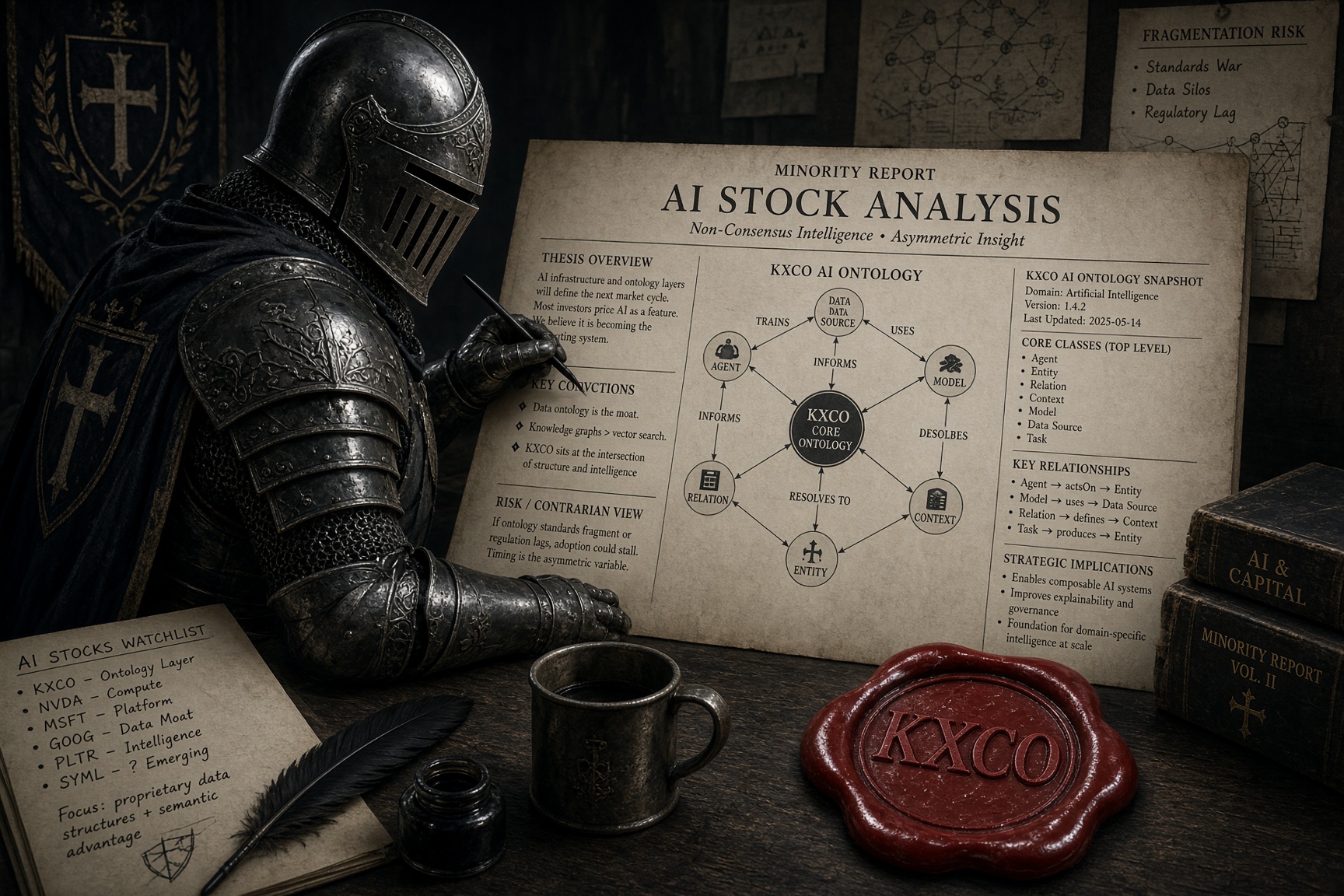
KXCO AI Ontology at 3 Months: What It Called and What Comes Next
On 19 July 2026 the Round Table's AI room published its first Analyst Outlook. To the 16 October 2026 close its 13 names rose 2.6% on an equal weight against 2.1% for QQQ, per StockAnalysis closes, and the six it opened with 35% or more of upside rose 8.6%. This piece lists the six names up more than 5%, the ten names I rate as opportunities now, the month's results in AI and quantum computing, and the official data showing that four in five firms have not yet started using AI.

What the Round Table Is Predicting in Biotech Markets
Seventeen FDA decisions fall due between 30 October 2026 and 29 June 2027, and KXCO's Round Table has called every one. Its model portfolio holds the thirteen Nasdaq companies behind them, led by BridgeBio, Cogent Biosciences and Praxis, and was signed with ML-DSA-87 and anchored on chain before the FDA acts. The first test is Inovio's INO-3107 on 30 October.

SpaceX: The Road to 10 Gigawatts
SpaceX did not add an AI business. A company whose processes run on compute built its own computing plant, then built the power to run it. The 10-Q reports 1.4 gigawatts of nameplate compute at 30 June 2026, four leases worth about $41 billion a year and $100 billion of cash. The target is closer to 10 gigawatts than 5 by the end of 2027. This piece sets out the build sequence, the four layers of power in Memphis, and why Terafab is the act after 2027, not the road to it.
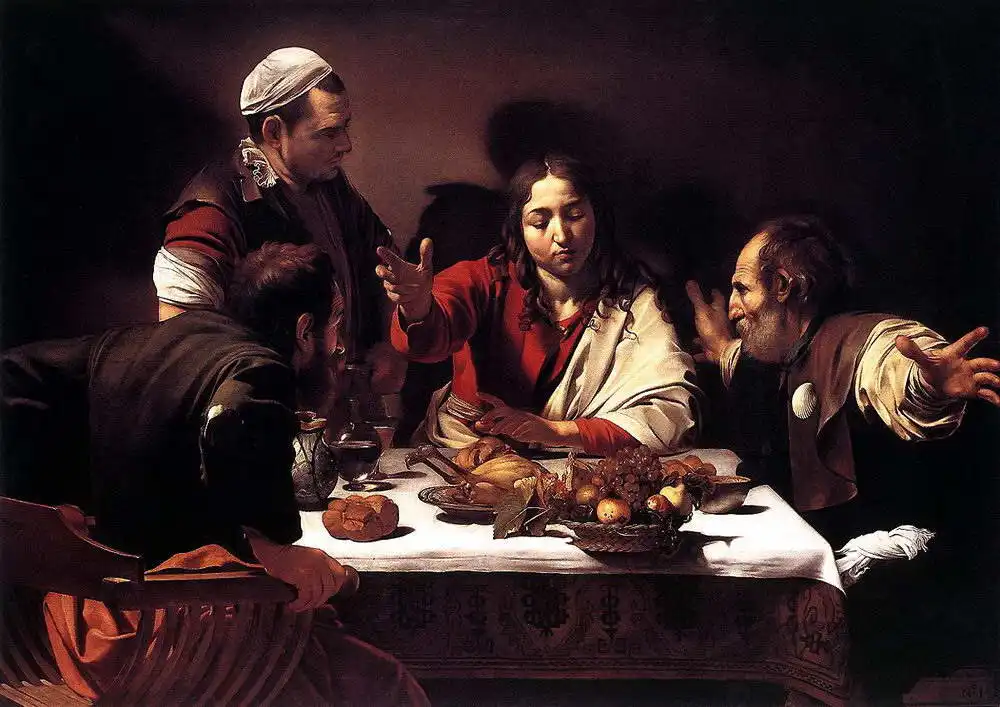
Thoughts on Thinking: Take an Art Break
The best way I know to keep complex work in perspective is to stop at intervals and look at something that took the same order of sustained attention under real constraints. The studies now show what that does: a museum visit restored attention where an urban walk did not, judging the beauty of an object raised abstract thinking almost 14 per cent, and artistic film raised originality even in people who felt worse for it. Five works, Leonardo to Holbein, and the non-default decision in each.
Every story, signed and delivered.
Subscribe to the kxco channel and get the headline, the AI-written key takeaways, and the chain-anchor link the moment we publish. Audio versions and per-ticker subscriptions arrive in the next iteration.