
The Quantum Deadline and Why KXCO Was Built for It
Washington just set a date on the post-quantum transition. Inside the harvest-now-decrypt-later threat, the NIST standards it mandates, and the quantum-resistant products KXCO already ships.
Part of theQuantum Computing Center
On June 22, 2026, the White House issued Executive Order 14409, Securing the Nation Against Advanced Cryptographic Attacks. It is the most consequential cryptography document an American president has signed, and most people outside the security industry will never read past the headline. That is a mistake. The order does something governments rarely do this early: it puts a date on a threat that has, until now, lived almost entirely in the future tense.
The threat is quantum computing. The defense is post-quantum cryptography. And the order makes one thing unambiguous — the transition is no longer a research topic, a conference panel, or a line item in a five-year roadmap. It is federal policy with deadlines attached.
I want to walk through what the order actually says, in plain English, because the detail matters. Then I want to explain why this is not only a government problem — why it reaches into banking, contracting, healthcare, and any business that stores data it expects to still be sensitive in 2031. And finally I want to be direct about something I have spent the last several years building toward: KXCO did not wait for this order. The products were designed for exactly the world the order now mandates.
What the order actually says
Strip away the preamble and Executive Order 14409 is a sequence of instructions with clocks on them. The stated policy is to "safeguard national security and maintain technological leadership by responsibly and effectively executing the transition of Federal information systems to NIST-approved Federal Information Processing Standards for Post-Quantum Cryptography."
Read that twice. The government is not asking agencies to evaluate post-quantum cryptography. It is ordering them to transition to it, against published NIST standards, on a schedule. Here is the schedule.
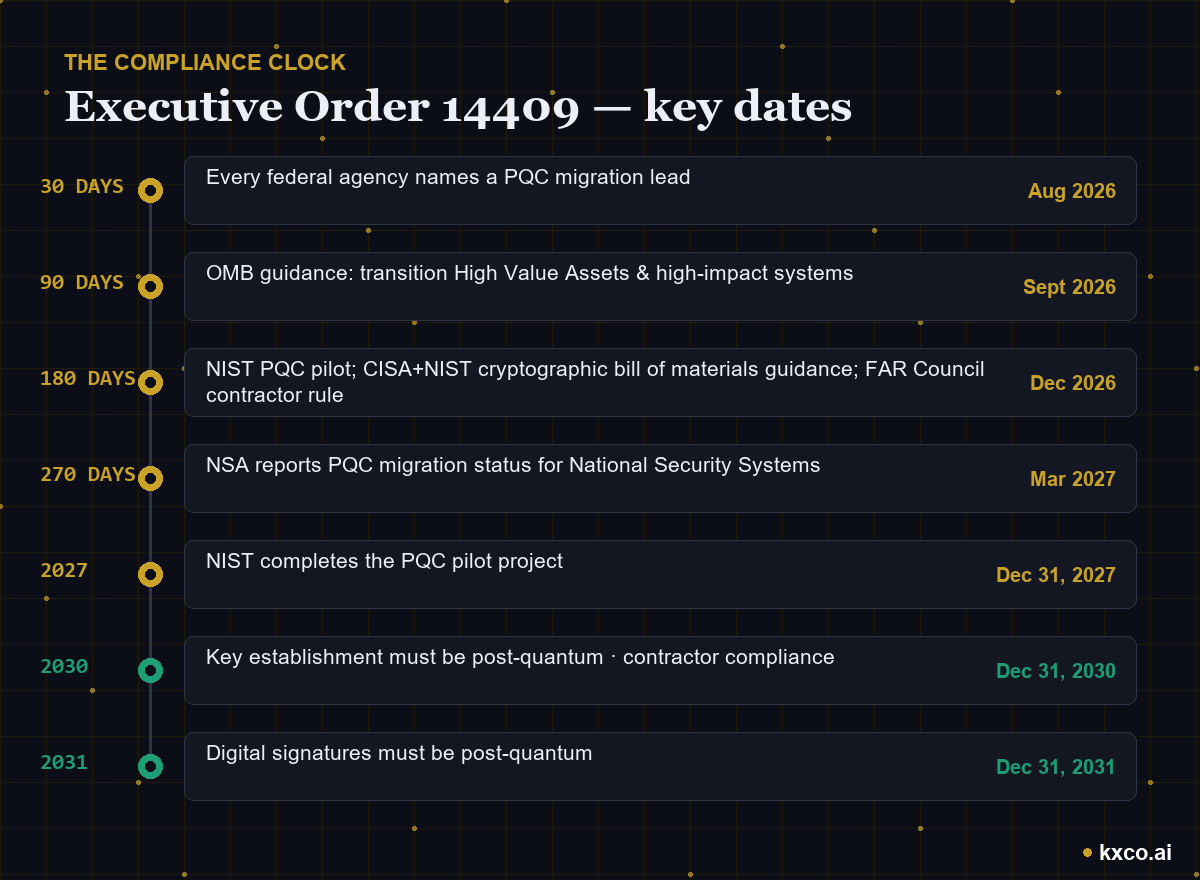
Within 30 days, every federal agency must identify a post-quantum migration lead. This sounds bureaucratic, and it is — but naming an accountable individual is how large organizations turn intention into action. A migration without an owner is a migration that never happens.
Within 90 days, the Office of Management and Budget must issue guidance requiring agencies to transition their High Value Assets and high-impact systems to post-quantum cryptography — for key establishment by December 31, 2030, and for digital signatures by December 31, 2031. "High Value Assets" and "high-impact systems" are defined terms; they are the systems whose compromise would cause severe or catastrophic harm. The order starts where the damage would be worst.
Within 180 days, four things happen at once. NIST begins a post-quantum pilot project, to be completed by December 31, 2027. CISA and NIST release public guidance on a cryptographic bill of materials — an inventory of the cryptography a system actually uses. NIST revises its Cryptographic Module Validation Program. And the Federal Acquisition Regulatory Council publishes a proposed rule requiring contractors to be post-quantum compliant by December 31, 2030.
Within 270 days, the National Security Agency submits a status report on the post-quantum migration of National Security Systems, and the FAR Council publishes a proposed vulnerability-disclosure-program rule.
Coordination is split across the senior cyber leadership of the United States: the OMB Director and the National Cyber Director lead strategy, NIST and NSA provide the technical guidance, CISA assists critical-infrastructure owners, and the State Department engages foreign governments on adoption. This is a whole-of-government effort, not a single agency's pet project.
Two dates do the heavy lifting. Key establishment must be post-quantum by the end of 2030. Digital signatures by the end of 2031. Everything else in the order — the leads, the guidance, the pilots, the procurement rules — exists to make those two deadlines real.
Why "harvest now, decrypt later" changes the math
The most important sentence in the order is not about a deadline. It is the acknowledgment that adversaries may engage in "harvest now, decrypt later" tactics — collecting encrypted data today and storing it until quantum capabilities mature enough to break it.
This is the idea that makes quantum risk urgent rather than theoretical, and it is worth sitting with for a moment, because it inverts the usual intuition about security.
Normally, if your encryption is strong today, you are safe today, and you can upgrade tomorrow without having lost anything. Harvest-now-decrypt-later breaks that comfort. An adversary does not need a quantum computer now to harm you with one later. They only need to copy your encrypted traffic now — your financial records, your legal communications, your health data, your trade secrets, your state secrets — and wait. When a cryptographically relevant quantum machine arrives, every encrypted thing they hoarded becomes readable retroactively.
That means the relevant question is not "when will quantum computers break today's encryption?" The relevant question is "how long does this data need to stay secret?" If you are protecting something that must remain confidential for ten years, and a capable quantum computer plausibly arrives within ten years, then data you encrypt with classical algorithms today is already at risk. The breach has, in a sense, already happened. You just will not find out until the decryption does.
This is precisely why a government would put 2030 and 2031 dates on a 2026 order. The deadlines are not when the danger begins. The danger has begun. The deadlines are when the exposure must end.
The standard is settled: NIST FIPS 203, 204, and 205
For years, the honest objection to acting on quantum risk was that there was nothing concrete to migrate to. That objection is dead. In August 2024, NIST finalized the first federal post-quantum standards:
FIPS 203 — ML-KEM (Module-Lattice-Based Key-Encapsulation Mechanism), the standard for key establishment, derived from CRYSTALS-Kyber.
FIPS 204 — ML-DSA (Module-Lattice-Based Digital Signature Algorithm), the primary signature standard, derived from CRYSTALS-Dilithium.
FIPS 205 — SLH-DSA (Stateless Hash-Based Digital Signature Algorithm), a conservative, hash-based signature standard derived from SPHINCS+.
Executive Order 14409 is built directly on these. When it says "NIST-approved Federal Information Processing Standards for Post-Quantum Cryptography," these are the standards it means. The key-establishment deadline maps to ML-KEM. The digital-signature deadline maps to ML-DSA and SLH-DSA. There is no ambiguity about what "compliant" looks like anymore. The math has been chosen, published, and standardized. What remains is engineering and execution — which is exactly the hard part, and exactly where most organizations are unprepared.
What actually changes when you swap the cryptography
It is tempting to imagine post-quantum migration as a find-and-replace: locate the old algorithm, drop in the new one, done. The reality is more demanding, and understanding why is the difference between a migration that finishes on time and one that stalls.
The new lattice-based algorithms behave differently from the elliptic-curve and RSA cryptography they replace. Keys and signatures are larger. Handshakes carry more data. Some protocols that assumed a certain message size need to be re-examined. None of this is a dealbreaker — the standards were chosen precisely because they are practical — but it means you cannot treat the swap as invisible. It touches performance budgets, network assumptions, hardware modules, and old systems that were never designed to flex. This is exactly why the order gives agencies years rather than months, and why it starts with an inventory and a pilot rather than a flag day.
The deeper lesson is crypto-agility: the ability to change cryptographic algorithms without rebuilding the system around them. Most existing software fails this test badly — the algorithm is welded into the application, so changing it means surgery. The organizations that will sail through this transition, and the next one, are the ones whose systems treat cryptography as a replaceable component rather than a permanent fixture. Building for agility now is the thing that makes 2030 and 2031 achievable instead of terrifying. It is also a design principle KXCO took seriously from the start — standardizing on one FIPS-aligned foundation across every product is itself an agility decision, because it means a single, well-understood component to reason about and evolve rather than a dozen scattered ones.
There is one more reason early starts win, and it is purely about time. A migration of this depth, across real systems that have to stay running, is measured in years for any organization of size. Counting backward from a 2030 key-establishment deadline, the inventory, the triage, the pilots, the vendor negotiations, and the staged rollout do not leave much slack if you begin in 2028. The order's deadlines look distant. The work behind them is not.
This is not only Washington's problem
It would be easy to file this order under "government IT" and move on. That would be a serious misreading. Three mechanisms in the order push the requirement straight into the private sector.
First, procurement. The FAR Council rule requires contractors to be post-quantum compliant by December 31, 2030. The U.S. federal government is the largest buyer of goods and services on earth. When it changes what it will buy, entire supply chains change with it. Any company that sells to a federal agency — directly or as a subcontractor — is now on the same clock. And in practice, large enterprises tend to standardize their security posture across all customers rather than maintain a separate "government-grade" stack, so the requirement bleeds outward.
Second, critical infrastructure. The order tasks CISA with assisting critical-infrastructure owners and operators. Banking, energy, water, telecommunications, healthcare — these are mostly private, and they hold exactly the long-lived sensitive data that harvest-now-decrypt-later targets. Formal mandates for these sectors tend to follow federal guidance closely, and insurers and regulators rarely wait for the mandate to start asking questions.
Third, the standard becomes the expectation. Once the U.S. government formally adopts ML-KEM and ML-DSA on a deadline, "are you post-quantum ready?" becomes a standard question in vendor security reviews, in M&A due diligence, in cyber-insurance underwriting, and in board risk reviews. The order does not need to legally bind your business for it to reset the market's definition of competent.
If your organization stores data that must remain confidential into the 2030s, signs documents or code whose validity must be trusted for years, or sells anything to anyone who answers to a regulator, this order is about you. The only real variable is whether you start now or scramble later.
AI and quantum need specialized products — not retrofits
Here is the part the market consistently underestimates. You cannot bolt post-quantum security onto a system as an afterthought, and you especially cannot do it for the two technologies defining this decade — artificial intelligence and quantum computing — using general-purpose tools designed for neither.
AI systems are now the connective tissue of modern business: they ingest data, make decisions, sign actions, call other systems, and increasingly act on a user's behalf. Every one of those handoffs is a trust boundary. When an AI agent signs a transaction, authorizes a payment, or attests to a result, the signature underneath it has to be one that will still mean something in 2031. If it is a classical signature, it is a future forgery waiting to happen. AI raises the volume and the autonomy of cryptographic operations by orders of magnitude — which means it raises the cost of using the wrong cryptography by the same orders of magnitude.
Quantum is the other half of the same coin. The technology that threatens classical cryptography is the same technology that demands its replacement. Defending against it is not a feature you toggle on. It requires the right algorithms (the NIST standards), implemented correctly, at every layer where trust is established — identity, transport, signing, storage, settlement — and it requires those layers to interoperate.
General-purpose security tooling was not built for this. It was built for a world where the cryptographic primitives were stable for decades and the main job was configuring them. The post-quantum transition is different in kind: it is a primitive-level replacement across the entire stack, on a deadline, while the systems stay running. That demands specialized products — designed from the foundation around the new standards, not patched to tolerate them.
KXCO has those products. Not as a roadmap. As live, running software.
The KXCO post-quantum stack
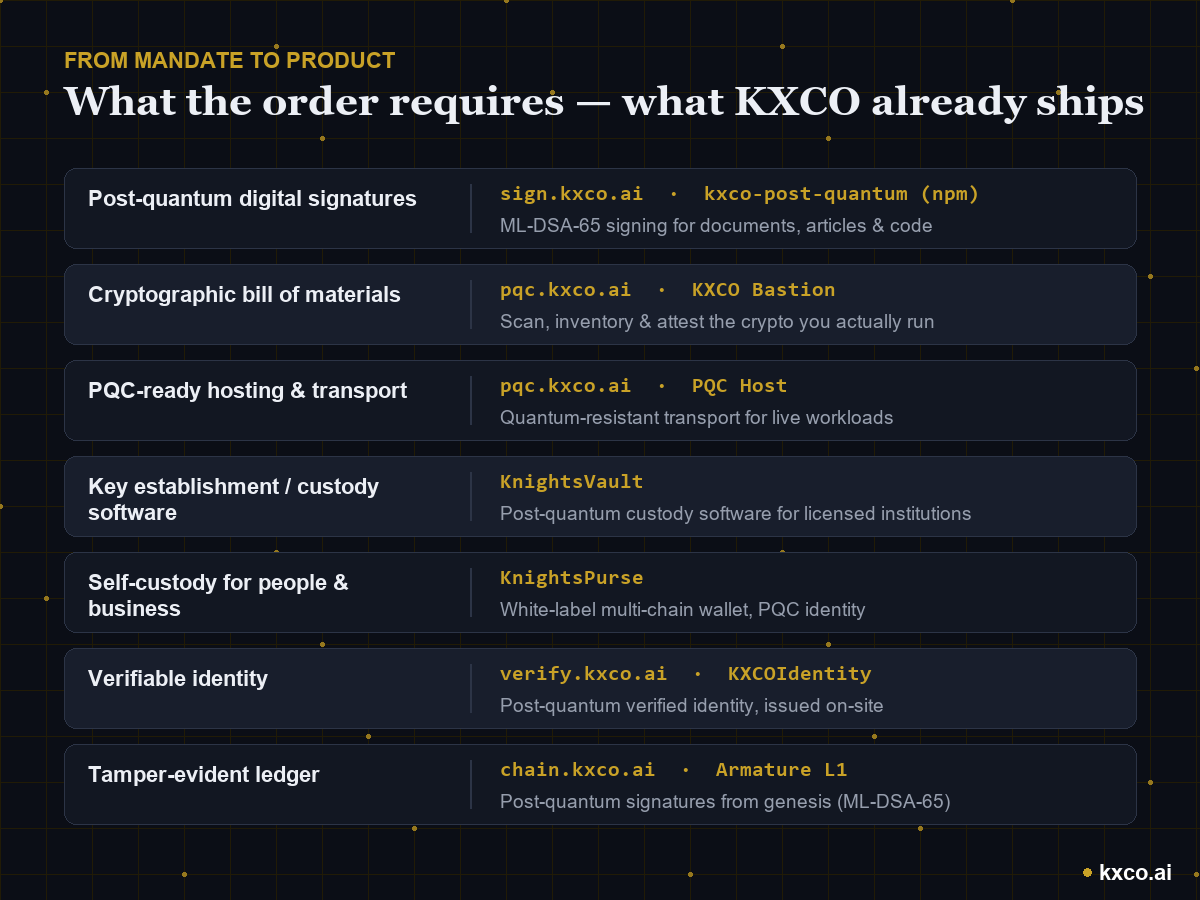
Let me go through the stack the way the order goes through its requirements — by capability — and show what we actually run today. A theme runs through all of it: KXCO is a software company. We build the post-quantum infrastructure; the licensed institutions, businesses, and individuals who use it operate it. We do not hold anyone's assets and we do not stand between a customer and their regulator. We make the tools that make those customers quantum-safe.
The foundation: kxco-post-quantum
Everything starts with the primitive layer. kxco-post-quantum is a published npm package implementing the NIST signature scheme KXCO standardizes on — ML-DSA-65, the NIST Level 3 parameter set of FIPS 204. It is the same library that signs the article you are reading. Standardizing on a single, well-chosen, FIPS-aligned parameter set across every product is a deliberate decision: it means the post-quantum guarantee is consistent whether you are signing a document, anchoring a ledger entry, or verifying an identity. One foundation, audited once, reused everywhere. That is how you avoid the trap of "post-quantum in the marketing, classical in the code."
A note on honesty, because it matters in this field: ML-DSA-65 and ML-KEM-768 are NIST Level 3 parameter sets. That means KXCO's claim is alignment with NIST FIPS 203, 204, and 205 — the exact standards Executive Order 14409 names. We are deliberately precise about which standards and which security levels, because in cryptography vague claims are worse than no claims.
sign.kxco.ai — post-quantum digital signatures, today
The order's hardest signature deadline is December 31, 2031: digital signatures on high-value federal systems must be post-quantum. sign.kxco.ai is a quantum-secure electronic signature platform that already signs with ML-DSA-65. Documents signed on it carry a signature designed to remain verifiable and unforgeable in a world with quantum computers — the world the order is preparing for.
For any organization that signs contracts, board resolutions, audit attestations, or compliance records whose validity must hold for years, this is the most directly actionable product in the stack. A signature is a promise about the future: this document was approved, by this party, at this time, and you can trust that later. A classical signature makes that promise on borrowed time. A post-quantum signature keeps it. sign.kxco.ai also offers data-room sharing and template workflows, so the post-quantum guarantee rides along with the way real businesses already handle documents, rather than asking them to change their process to get it.
pqc.kxco.ai — the cloud platform: PQC Host and KXCO Bastion
This is where the order and the product line up almost line for line. Executive Order 14409 directs CISA and NIST to publish guidance on a cryptographic bill of materials — an inventory of the cryptography a system actually uses. You cannot migrate what you cannot see, and most organizations genuinely do not know which algorithms are running across their estate. That inventory problem is the unglamorous, decisive first step of every real migration.
KXCO Bastion, part of the pqc.kxco.ai cloud platform, is built for exactly this: it scans, inventories, and attests the cryptography in use, so an organization can produce an honest cryptographic bill of materials and see where it is exposed. When CISA's guidance lands, the organizations that already have this inventory will be executing while the rest are still discovering. PQC Host, the other half of the platform, provides quantum-resistant transport and hosting for live workloads — the "deploy it post-quantum from the start" path, rather than the "retrofit it under deadline pressure" path. Together they are the migration toolkit the order's 180-day cryptographic-bill-of-materials guidance will send everyone looking for.
KnightsVault — post-quantum custody software
The order's other hard deadline, December 31, 2030, is for key establishment. Wherever cryptographic keys are generated, exchanged, and protected, that is where ML-KEM belongs and where the migration is most delicate. KnightsVault is KXCO's custody software for licensed institutions — the post-quantum machinery for institutions that safeguard assets and the keys that control them.
I want to be precise here, because it is a recurring point of confusion: KXCO does not do custody. KnightsVault is software for custodians. We never hold assets and we hold no licenses. A regulated institution runs KnightsVault; the institution carries the licensing and the customer relationship; we provide the quantum-resistant key infrastructure underneath. That separation is the point. It lets a licensed operator become post-quantum without rebuilding their cryptography from scratch, and it keeps KXCO squarely a software company rather than a regulated intermediary.
KnightsPurse — self-custody for people and businesses
Not everything that needs post-quantum protection sits inside a federal agency or a licensed institution. People and businesses hold value, identity, and credentials directly, and they deserve the same standard. KnightsPurse is KXCO's white-label, self-custodial, multi-chain wallet and platform — for individuals, businesses, and AI agents. Self-custodial means the user holds their own keys; KXCO never takes possession. It is the consumer-and-business-facing edge of the same post-quantum foundation, so the protection the order demands for the government's most sensitive systems is available to the ordinary user who simply wants their assets and identity to survive the quantum era.
verify.kxco.ai — post-quantum verifiable identity
Signatures and keys only matter if you can trust who is behind them. KXCOIdentity, surfaced publicly at verify.kxco.ai, is KXCO's verifiable-identity layer — post-quantum verified identity, issued on-site through a real KYC process and surfaced as per-person verification pages. In a world where AI agents act on behalf of people and machines transact with machines, a durable, quantum-resistant answer to "is this really who they claim to be?" is foundational infrastructure, not a nice-to-have. Identity is the first trust boundary; if it falls to a future quantum attack, everything built on top of it falls with it.
chain.kxco.ai — Armature, post-quantum from genesis
KXCO operates Armature, a Layer 1 blockchain at chain.kxco.ai built with post-quantum signatures (ML-DSA-65) from genesis — the ledger was post-quantum from its first block by architecture, rather than a classical chain hoping to retrofit later. For records that must be tamper-evident and independently verifiable over long horizons — and "long horizons" is precisely the harvest-now-decrypt-later danger zone — a ledger whose integrity does not depend on soon-to-be-breakable signatures is a meaningful primitive. It is the anchoring layer the rest of the stack can write to when permanence and verifiability matter.
This is also where I will be careful, because the field is full of overstatement. The post-quantum guarantee on Armature is real at the signature layer and designed in from the start. KXCO describes Armature precisely and does not inflate the claim into things it is not. That discipline — claiming exactly what is true and no more — is, frankly, part of what post-quantum credibility is. Anyone can put "quantum-resistant" on a landing page. Being able to say precisely which algorithm, at which NIST level, at which layer, is the difference between a marketing claim and a security claim.
Mapping the mandate to the stack
Put the two halves together and the fit is uncomfortably neat — uncomfortable, that is, for anyone who assumed this would take years to even begin.
The order needs post-quantum digital signatures by 2031. KXCO ships them now, in
sign.kxco.aiand the underlyingkxco-post-quantumlibrary.The order needs a cryptographic bill of materials. KXCO Bastion at
pqc.kxco.aiproduces exactly that — scan, inventory, attest.The order needs post-quantum key establishment by 2030. KnightsVault provides the custody-grade key infrastructure for the institutions that need it most.
The order needs PQC-ready systems, not retrofits under pressure. PQC Host runs quantum-resistant workloads from day one.
The order's whole premise rests on trustworthy identity and verifiable records.
verify.kxco.aiand Armature atchain.kxco.aisupply both.
None of this is a coincidence and none of it was reverse-engineered from the order this week. KXCO read the same trajectory the U.S. government just formalized — the NIST standards finalized in 2024, the harvest-now-decrypt-later threat model, the inevitability of a deadline — and built products against it ahead of the mandate. Executive Order 14409 did not create the KXCO strategy. It validated it.
What this means for markets and finance
Readers of this publication think in terms of markets, so let me translate the order into that language.
Post-quantum readiness is becoming a balance-sheet risk and, eventually, a disclosed one. Financial institutions hold the longest-lived, most sensitive data in the economy — and they sit squarely inside the critical-infrastructure perimeter the order tells CISA to assist. The data a bank encrypts today about a client, a position, or a transaction may need to stay confidential for a decade or more. Under the harvest-now-decrypt-later model, that data is already exposed if it travels and rests under classical encryption. The institutions that recognize this early will treat post-quantum migration as enterprise risk management, not an IT line item — and the ones that do not will eventually have it treated for them, by regulators, auditors, and cyber-insurers who have read the same order.
Watch the procurement channel especially. The FAR Council rule turns post-quantum compliance into a condition of selling to the federal government by 2030. That is not a niche requirement — it reshapes the addressable market for every security vendor, cloud provider, and software supplier with public-sector exposure. Companies that can credibly answer "yes, and here is exactly how" will win contracts that companies offering vague assurances will lose. Over time, "quantum-ready" migrates from a differentiator to a baseline, the way "encrypted" did a generation ago. Early movers capture the premium while it still exists.
And there is a broader market signal in the order itself. When a government commits its own most sensitive systems to a specific cryptographic standard on a fixed timeline, it is making a statement about where the puck is going. Capital, talent, and procurement tend to follow that statement. The post-quantum transition is, among other things, a multi-year build cycle across software, hardware, and services — and Executive Order 14409 just told the entire market the build cycle has officially begun.
What to actually do now
I am wary of articles that diagnose a problem and leave you with nothing but anxiety. So here is a concrete sequence, drawn straight from the order's own logic, that any organization can start this quarter.
1. Inventory your cryptography. You cannot migrate what you cannot see. Before you buy anything or change anything, find out which algorithms are actually running across your systems, your vendors, and your data flows. This is the cryptographic bill of materials the order will soon require federally — and it is the right first move whether or not you ever sell to the government. KXCO Bastion exists to make this tractable.
2. Triage by data lifetime. For each system, ask the harvest-now-decrypt-later question: how long must this data stay secret, and would a quantum computer plausibly arrive within that window? Anything protecting long-lived secrets — legal, financial, health, strategic, identity — goes to the front of the line. This mirrors the order's own choice to start with High Value Assets and high-impact systems.
3. Start with signatures and identity. Signatures and identity are where post-quantum migration delivers value immediately and where the tooling is most mature. A document signed post-quantum today is protected for its entire future life. sign.kxco.ai and verify.kxco.ai let you start here without a multi-year program.
4. Make key establishment the institutional priority. If you safeguard assets or operate critical systems, key establishment is your 2030 deadline equivalent. This is the deepest part of the migration and the one most worth starting early. For institutions, KnightsVault is the post-quantum key infrastructure designed for it.
5. Name an owner. The order's very first instruction — name a migration lead within 30 days — is the one every organization should copy regardless of whether the mandate binds them. A migration without an accountable owner is a slide deck.
6. Demand precision from your vendors. When a supplier says "quantum-resistant," ask which algorithm, at which NIST level, at which layer. If they cannot answer, they have not done the work. This is the single best filter available, and it costs nothing.
The deadline was always coming. Now it has a date.
For years, the people building post-quantum infrastructure made an argument that was easy to nod along to and easy to defer: the quantum threat is real, the migration is enormous, and the longer you wait the worse your harvest-now-decrypt-later exposure gets. The argument was correct. It was also, for most organizations, ignorable — because there was no deadline, no standard everyone agreed on, and no authority forcing the issue.
Executive Order 14409 removes all three excuses at once. The deadline is set: 2030 for key establishment, 2031 for signatures. The standard is named: NIST FIPS 203, 204, and 205. And the authority is the President of the United States, with OMB, NIST, NSA, CISA, and the FAR Council behind the order and the world's largest procurement budget enforcing it down the supply chain.
I have spent the last several years building KXCO on the conviction that this moment was not a question of if but when. That the NIST standards would land. That a deadline would follow. That AI and quantum would make specialized post-quantum products a requirement rather than a luxury. And that the organizations who started before the mandate would be executing while everyone else was still discovering what they had.
That conviction is now federal policy. The clock that was always ticking finally has a face on the wall. The advantage belongs to whoever was already building for the world the order describes — and KXCO has been. Signatures at sign.kxco.ai. Inventory and hosting at pqc.kxco.ai. Custody software in KnightsVault. Self-custody in KnightsPurse. Identity at verify.kxco.ai. A post-quantum ledger at chain.kxco.ai. One FIPS-aligned foundation underneath all of it.
The nation has been told to secure itself against advanced cryptographic attacks. The tools to do it already exist. The only question left is the one the order forces every organization to finally answer: are you going to start now, or explain later why you didn't?
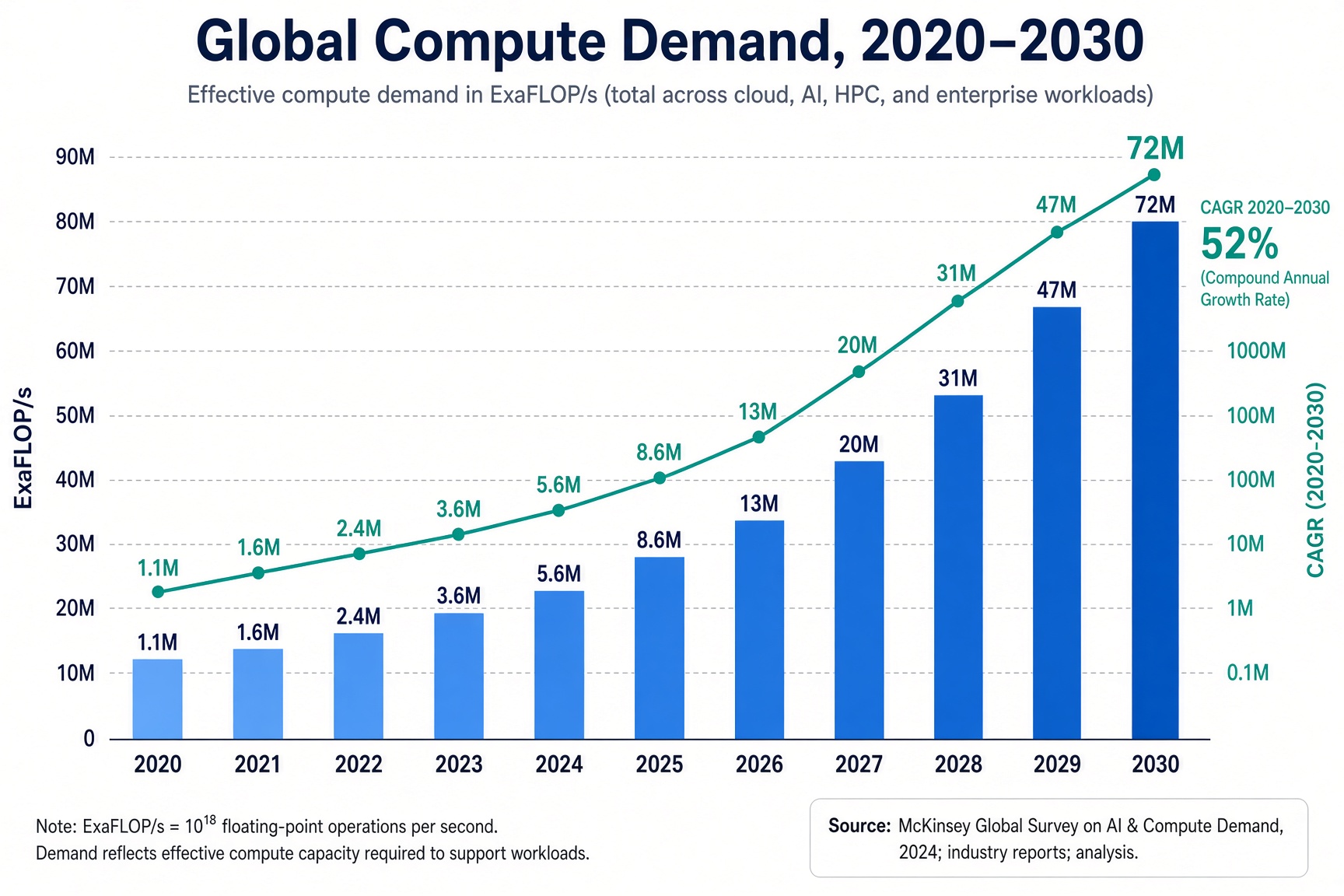
The 2030 Compute Landscape: GPUs, Power and the Architecture of Intelligence
The constraint on AI is no longer ideas or data but compute and the power to run it. Frontier training compute has grown about five times a year since 2020, and the leading AI supercomputer of June 2030 is on course for about 2 million chips and 9 gigawatts. Shayne Heffernan sets out the 2030 arithmetic, the power problem, who has already contracted the gigawatts, and how GPUs, custom ASICs, wafer-scale engines and quantum machines divide the work.
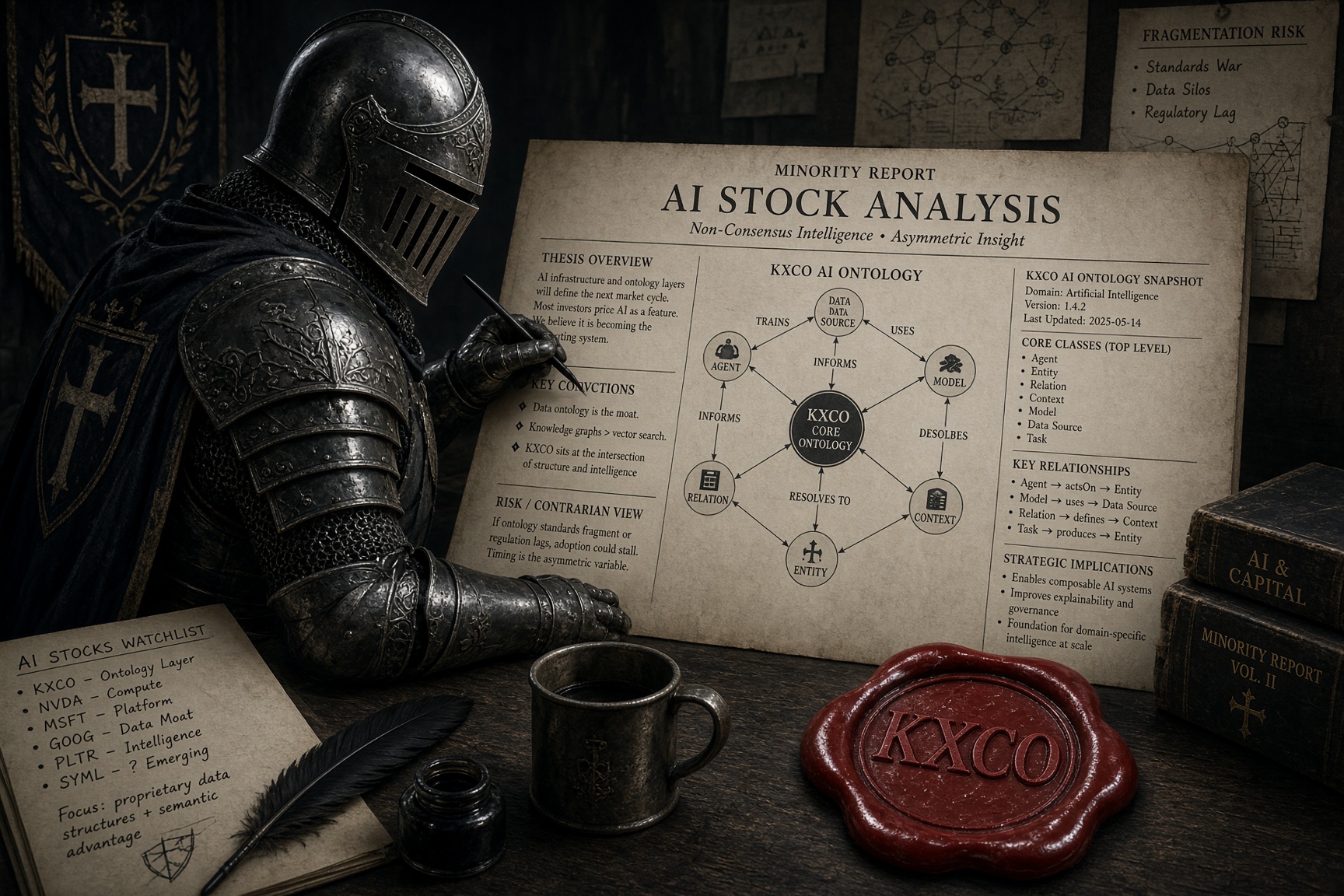
KXCO AI Ontology at 3 Months: What It Called and What Comes Next
On 19 July 2026 the Round Table's AI room published its first Analyst Outlook. To the 16 October 2026 close its 13 names rose 2.6% on an equal weight against 2.1% for QQQ, per StockAnalysis closes, and the six it opened with 35% or more of upside rose 8.6%. This piece lists the six names up more than 5%, the ten names I rate as opportunities now, the month's results in AI and quantum computing, and the official data showing that four in five firms have not yet started using AI.

What the Round Table Is Predicting in Biotech Markets
Seventeen FDA decisions fall due between 30 October 2026 and 29 June 2027, and KXCO's Round Table has called every one. Its model portfolio holds the thirteen Nasdaq companies behind them, led by BridgeBio, Cogent Biosciences and Praxis, and was signed with ML-DSA-87 and anchored on chain before the FDA acts. The first test is Inovio's INO-3107 on 30 October.

SpaceX: The Road to 10 Gigawatts
SpaceX did not add an AI business. A company whose processes run on compute built its own computing plant, then built the power to run it. The 10-Q reports 1.4 gigawatts of nameplate compute at 30 June 2026, four leases worth about $41 billion a year and $100 billion of cash. The target is closer to 10 gigawatts than 5 by the end of 2027. This piece sets out the build sequence, the four layers of power in Memphis, and why Terafab is the act after 2027, not the road to it.
Every story, signed and delivered.
Subscribe to the kxco channel and get the headline, the AI-written key takeaways, and the chain-anchor link the moment we publish. Audio versions and per-ticker subscriptions arrive in the next iteration.