
USA vs China: The Quantum Computing Race
$IBM $IONQ $RGTI $QBTS
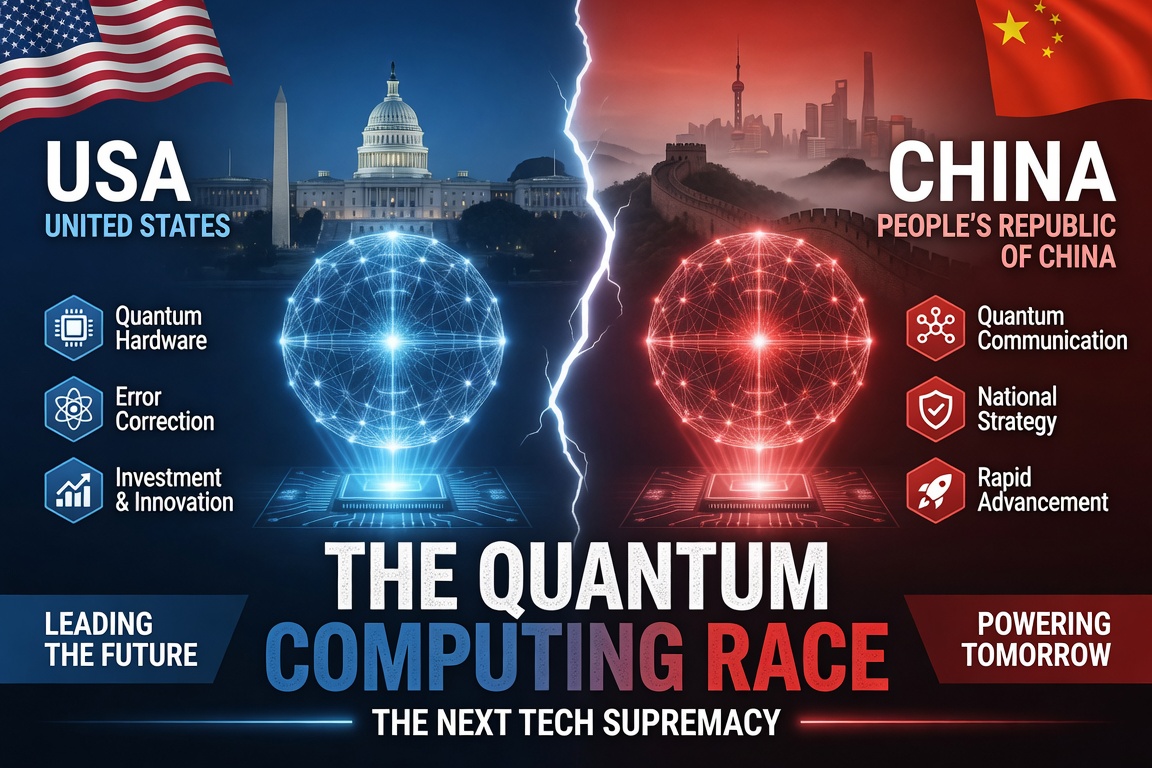
The United States still holds the overall lead in quantum computing, but China has narrowed the gap considerably over the past two years. This is no longer just a race for the highest qubit count. It’s now about who can build reliable systems, secure their supply chains, and turn quantum hardware into something practically useful — especially when combined with AI.
Both countries are investing heavily, but they’re using very different playbooks. The U.S. leans on private companies and open innovation. China uses strong central coordination and a heavy focus on self-reliance.
Government Strategies
The two governments have taken noticeably different approaches.
Table 1 — Government Strategy Comparison
Aspect | United States | China | Winner (Mid-2026) |
|---|---|---|---|
Overall Approach | Public-private partnership model | Centralized national strategy | China (speed) |
Main Funding Vehicle | CHIPS and Science Act + National Quantum Initiative | 15th Five-Year Plan + National Venture Guidance Fund | China |
Recent Major Funding | $2.01 billion (May 2026) for quantum projects | Multiple regional quantum funds (over RMB 120 billion) | China |
Focus on Self-Reliance | Moderate | Extremely High | China |
Role of National Labs | Very Strong (Sandia, Oak Ridge, etc.) | Strong but more integrated with industry | USA |
Speed of Decision Making | Slower (requires legislation & private buy-in) | Very Fast | China |
Post-Quantum Cryptography | Active government push | Active but less transparent | USA |
Publicly Traded Companies
One of the clearest differences is in how investors can access these efforts.
Table 2 — Major Publicly Traded Quantum Companies
Country | Company | Ticker | Main Focus | Stage (2026) | Notes |
|---|---|---|---|---|---|
USA | IBM | IBM | Superconducting | Advanced | Most mature big-tech roadmap |
USA | IonQ | IONQ | Trapped Ion | Commercial | Leading pure-play trapped-ion company |
USA | Rigetti | RGTI | Superconducting | Early Commercial | Smaller but active |
USA | D-Wave | QBTS | Quantum Annealing | Commercial Revenue | Niche but generating revenue |
China | QuantumCTek | Listed | Quantum Comms + Components | Growing | One of the few pure-play listed Chinese firms |
China | Origin Quantum | Private | Superconducting | Commercial (Cloud) | Major player, not publicly traded |
China | China Telecom Quantum | State-linked | Cloud + Hardware | Scaling | Operates Tianyan quantum cloud |
Hardware Platforms
This is currently the most competitive area.
Table 3 — Hardware Platform Comparison (Mid-2026)
Platform | USA Strengths | China Strengths | Current Leader | Key Recent Development |
|---|---|---|---|---|
Superconducting | IBM roadmap, error correction research | Zuchongzhi 3.2 (107 qubits), Wukong-180 (180 qubits) | Competitive | Origin Wukong-180 launched May 2026 |
Trapped Ion | Quantinuum Helios (98 qubits, high fidelity) | Limited progress | Clear USA | Validated with Sandia (June 2026) |
Photonic | PsiQuantum (private, large scale) | Jiuzhang 4.0 (Nature paper, May 2026) | China (scale) | Claimed 10⁵⁴ speedup |
Neutral Atom | QuEra, Pasqal | Hanyuan-2 (dual-core design) | Competitive | First dual-core system claimed |
Silicon Spin | Intel research | Mass production of Silicon-28 (June 2026) | China (materials) | Major self-reliance breakthrough |
Table 4 — Notable Quantum Systems (2025–2026)
System | Country | Type | Qubits | Status | Notes |
|---|---|---|---|---|---|
Zuchongzhi 3.2 | China | Superconducting | 107 | Cloud accessible | Strong performance claims |
Origin Wukong-180 | China | Superconducting | 180 | Launched May 2026 | Fourth-generation system |
Jiuzhang 4.0 | China | Photonic | ~3,050 photons | Research breakthrough | Published in Nature |
Hanyuan-2 | China | Neutral Atom | ~200 | Dual-core design | Lower power consumption |
Quantinuum Helios | USA/UK | Trapped Ion | 98 | Validated June 2026 | High gate fidelity |
IBM (Roadmap) | USA | Superconducting | Scaling | Kookaburra in development | Focus on logical qubits |
Semiconductor & Supply Chain
Table 5 — Semiconductor and Supply Chain Position
Factor | United States | China | Trend |
|---|---|---|---|
Advanced Chip Design | Strong | Improving | China catching up |
Cryogenic Systems | Strong | Rapid progress | China improving fast |
Control Electronics | Strong | Domestic push | Competitive |
High-Purity Materials (e.g. Silicon-28) | Dependent on imports | Mass production achieved (June 2026) | China advantage |
Overall Self-Reliance | Moderate vulnerability | Aggressive push | China leading effort |
Corporate Strategies
Table 6 — Big Tech Corporate Outlook on Quantum
Company | Country | Quantum Approach | Transparency | Integration with AI/HPC | Outlook |
|---|---|---|---|---|---|
IBM | USA | Full-stack (hardware + software) | High | Strong | Most committed big-tech player |
USA | Error correction focus | High | Growing | Research-heavy | |
Microsoft | USA | Topological qubits + Azure Quantum | Medium | Strong cloud play | High-risk, high-reward bet |
Nvidia | USA | Classical infrastructure for hybrid systems | High | Very strong | Positioning as enabler |
Huawei | China | Quantum comms + computing components | Low | Integrated with national goals | Closely tied to state strategy |
Alibaba | China | Cloud quantum access | Low | Moderate | Less visible recently |
Baidu | China | Quantum machine learning | Low | AI-focused | Research-oriented |
AI and Quantum Integration
Table 7 — AI Adoption and Quantum Connection
Factor | United States | China | Current Edge |
|---|---|---|---|
Current AI Leadership | Strong (OpenAI, Google, Anthropic) | Very strong in deployment & scale | USA (innovation), China (scale) |
Quantum + AI Integration | Growing focus on hybrid systems | Strategic priority | Competitive |
Use Case Focus | Drug discovery, optimization, simulation | Logistics, cryptography, materials | Different strengths |
Data Availability | Strong | Extremely strong | China |
Government AI-Quantum Push | Moderate | Very Strong | China |
Overall Leadership Assessment
Table 8 — Category-by-Category Leadership (June 2026)
Category | Current Leader | Margin | Trend | Notes |
|---|---|---|---|---|
Overall Quantum Capability | USA | Narrow | China closing | Gap shrinking |
Hardware Scaling | Competitive | - | China gaining | Multiple Chinese systems advancing |
Error Correction | USA | Clear | USA maintaining | Strong U.S. research lead |
Quantum Networking | China | Significant | China extending | Major Chinese advantage |
Software & Algorithms | USA | Clear | USA maintaining | Stronger U.S. ecosystem |
Supply Chain Self-Reliance | China | Growing | China improving fast | Silicon-28 breakthrough key |
Commercial Cloud Access | Competitive | - | Both scaling | Multiple platforms available |
Private Sector Innovation | USA | Clear | USA leading | More dynamic ecosystem |
Government Coordination | China | Clear | China effective | Centralized model works well |
AI-Quantum Integration | Competitive | - | Both investing | Different approaches |
Key Metrics to Watch
Table 9 — Important Metrics Going Forward
Metric | USA Position | China Position | Why It Matters |
|---|---|---|---|
Logical Qubits Demonstrated | Leading | Catching up | Critical for useful computing |
Domestic Supply Chain Completeness | Partial | Rapidly improving | Reduces external risk |
Number of Cloud-accessible Systems | Multiple | Multiple | Shows commercialization progress |
Integration with AI/HPC | Strong | Strong and growing | Real-world usefulness |
Post-Quantum Cryptography Readiness | Advanced | Progressing | National security issue |
Outlook
The race is still ongoing and far from decided. The United States currently leads in most technical categories, especially error correction and software. However, China’s speed in hardware development, manufacturing scale-up, and supply chain localization has already changed the competitive landscape.
Over the next 2–3 years, the key battlegrounds will be:
Achieving the first clear demonstrations of practical quantum advantage
Building secure and complete domestic supply chains
Successfully combining quantum systems with AI and classical supercomputers
Right now, the U.S. has the technical edge. China has the momentum in execution and self-reliance. The country that manages to combine both will likely pull ahead decisively by the end of the decade.
Citations and Sources
Special Competitive Studies Project (SCSP). Quantifying the Competition: Assessing Leadership in Quantum Technologies. June 15, 2026.
IQM Quantum Computers. State of Quantum 2026 report. June 18, 2026.
Nature. “Gaussian boson sampling with 1,024 squeezed states in 8,176 modes” (Jiuzhang 4.0). May 13, 2026.
South China Morning Post. “China reaches mass production of key isotope in quantum computing.” June 15, 2026.
CSIS. Understanding China’s Quest for Quantum Advancement. Updated 2026.
China Daily and Global Times reporting on Zuchongzhi, Origin Wukong, and Hanyuan systems (2025–2026).
Quantum Insider articles on U.S. funding and Quantinuum-Sandia collaboration (2026).
Technical updates from Origin Quantum, USTC, and China Telecom Quantum Group (2025–2026).
Weekly Market Outlook: Fed Minutes, Anthropic and OpenAI IPOs, Gold, Bitcoin, FX
The Fed raised rates in September and payrolls rose 29,000, per the Labor Department. This week the FOMC minutes, three Treasury auctions and a 10-year near 5.3 percent test that gap. Anthropic's IPO clock runs toward a 14 October investor day while OpenAI's chief executive says not 2026. Gold sits 26 percent below its record, bitcoin near $85,500, the dollar up three weeks running. Two knowledge graphs from KXCO's records map the IPO backers and the FDA board.

AI Development: The Token Got Cheaper, the Building Did Not
The useful fact on 28 September is a split, not a benchmark. Gartner puts 2026 AI spending at $2.67 trillion, and 56 percent of it is infrastructure against about 1 percent on the models. Inside one week the frontier cut the price of a token in half, Nvidia signed for the shelf the open weights sit on, and three closed labs proposed to run the test. What shipped, what it costs and where the money goes, with the AI sector checked against KXCO Ontology Live.
The Week the Discount Rate Gets a Vote
The Fed hiked on 16 September and left the door open. This week the August PCE deflator on Wednesday, September payrolls on Friday, the RBA on Tuesday and euro-area CPI set the discount rate. Gold, Bitcoin, the dollar, the AI complex and the quantum pure plays share that rate and diverge everywhere else. This is the map of what depends on what, the three regimes the book should already have written down, and the stop that belongs to each node on KXCO Ontology Live.

Wall Street Week Ahead: Rates, Oil, AI, Quantum, Defense, Metals and Bitcoin
The trading week opens after a Federal Reserve that chose to hike, a White House that chose not to strike Yemen, and an oil market still pricing a war now in its seventh month. The useful work this week is not a list of tickers. It is a map of what depends on what: the funds rate, the Magnificent Seven, a quantum cohort just handed a specification and a deadline, the missile primes selling into a restock, and gold, silver, crude and Bitcoin, all held against the live AI sector ontology.
Every story, signed and delivered.
Subscribe to the kxco channel and get the headline, the AI-written key takeaways, and the chain-anchor link the moment we publish. Audio versions and per-ticker subscriptions arrive in the next iteration.