
The New Economies: Space, AI, and Quantum
$AMD $AMAT $AMZN $ARM $ASML $ASTS $AVGO $BA $GOOG $IBM $IONQ $LMT $MSFT $NVDA $QBTS $RGTI $RKLB $TSM $VRT $KXCO Era of Expansion
Part of theStocks Center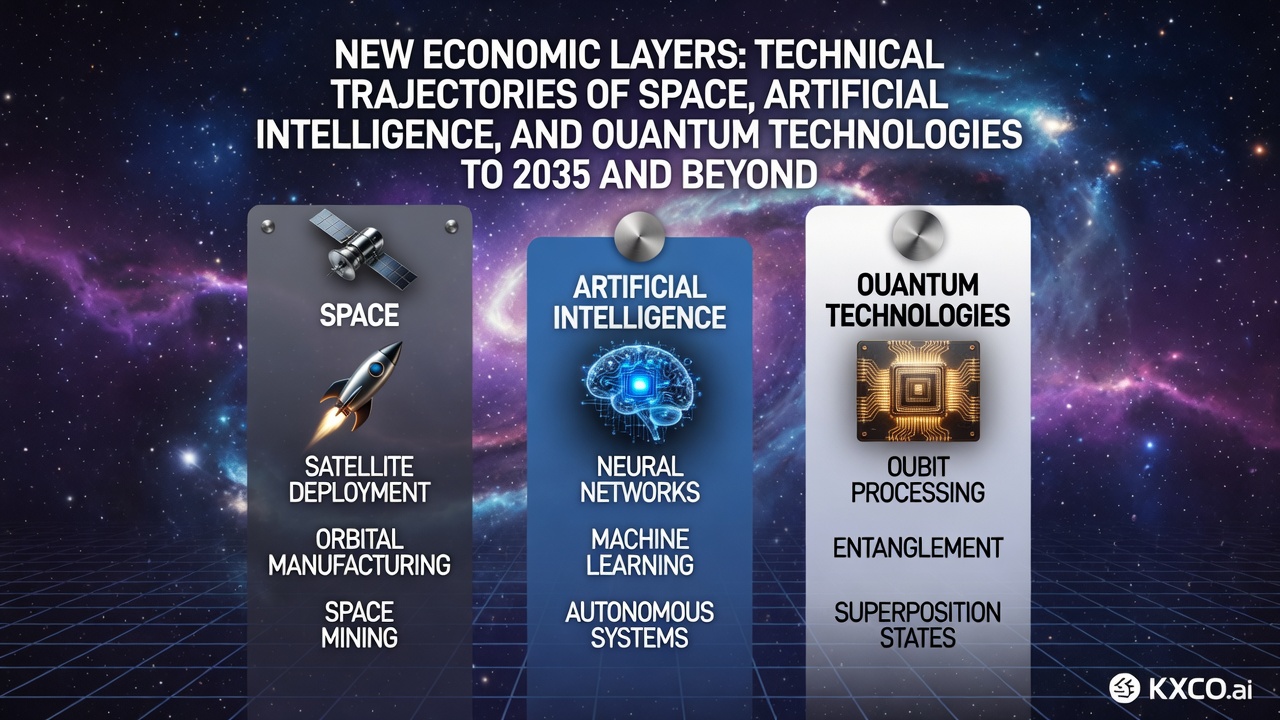
New Economic Layers
Technical Trajectories of Space, Artificial Intelligence, and Quantum Technologies to 2035 and Beyond
By Shayne Heffernan, Ph.D. | Live Trading News | June 2026
Three new economic layers are taking shape at the same time. Each one follows its own physical rules and creates value in ways that existing industrial and digital systems do not. Space is moving from a domain of occasional launches and satellite services into something closer to sustained industrial activity. Artificial intelligence is shifting from individual models and tools into infrastructure that produces intelligence at scale. Quantum technologies are leaving the laboratory and entering operational use in simulation, sensing, and security, even while their full computational potential is still years away.
These layers are being added to the economy rather than replacing what already exists. Their development through the early 2030s will depend on concrete technical progress, the availability of energy and specialized materials, and the creation of supporting systems that can verify actions and maintain integrity across increasingly autonomous operations. What follows is an examination of where each layer stands technically and where it appears headed.
The most consistent signal in frontier artificial intelligence remains scaling. The relationships first mapped out by Kaplan and colleagues in 2020, and later refined in the Chinchilla scaling laws, have continued to hold as models have grown into the hundreds of billions and low trillions of parameters. Performance on many tasks improves in a reasonably predictable way when compute, data, and parameters increase together. What has become clearer over the past two years is that scaling is no longer confined to the training phase. Allocating more compute during inference — through extended reasoning chains, tree search, or self-consistency methods — can produce noticeably stronger results on difficult problems without any additional training.
Architectural choices continue to matter. Mixture-of-Experts designs, in which only a subset of parameters activates for any given token, have improved both training efficiency and inference speed. At Anthropic, the emphasis has been on building models that organizations can actually trust in production environments. Dario Amodei, the company’s CEO, has written that AI systems are already responsible for writing substantial portions of the code used to create the next generation of models. This feedback loop is shortening development cycles in ways that are difficult to forecast precisely but appear to be accelerating. Amodei has also been direct that the window for maintaining leadership in frontier compute is measured in years rather than decades, and that continued scaling must be paired with serious attention to reliability and safety.
Agentic systems — models that can plan, maintain state across multiple steps, use external tools, and act in external environments — represent the clearest near-term expansion of capability. Current versions still struggle with long-horizon planning and accumulate errors when tasks require dozens of sequential decisions. Progress here depends on better memory mechanisms, stronger internal world models, and training methods that reward successful multi-step outcomes. By the early 2030s it is reasonable to expect agentic systems that can handle sustained workflows in defined software domains and selected physical settings, though they will almost certainly remain narrower and more brittle than human operators in open-ended situations.
The physical infrastructure required to support this activity is substantial and growing. Training runs for frontier models now use clusters measured in the tens or hundreds of thousands of advanced accelerators. Inference at population scale creates different pressures. Techniques such as lower-precision arithmetic, speculative decoding, and continuous batching have improved tokens-per-second throughput, yet aggregate demand continues to rise. Energy is the most visible constraint. Large clusters already draw tens of megawatts, and projections suggest that AI-related electricity use could reach several percent of total generation in major economies within the next five to seven years if efficiency gains and new generation capacity do not keep pace.
Quantum Technologies: Hardware, Error Correction, and Near-Term Value
Quantum hardware is being pursued through several physical implementations, each with clear strengths and limitations. Superconducting circuits currently lead in qubit count and gate speed but require cryogenic cooling and face coherence challenges. Trapped-ion systems deliver higher gate fidelity and longer coherence times, though scaling the number of qubits has proven slower. Photonic platforms offer potential advantages for networking and room-temperature operation, yet creating deterministic two-qubit gates remains difficult. Neutral-atom arrays have shown rapid growth in qubit number and flexible connectivity.
Most current devices still operate in the noisy intermediate-scale regime. Gate error rates remain too high for deep, useful circuits without error correction. Variational algorithms such as the Variational Quantum Eigensolver and Quantum Approximate Optimization Algorithm have been run on hardware, but in many cases classical methods or carefully designed heuristics remain competitive for the problem sizes that matter today.
The path to fault-tolerant quantum computing runs through quantum error correction. The surface code is the leading candidate, and recent experiments have demonstrated that logical error rates can be suppressed below physical error rates once the code distance is increased and physical error rates fall below roughly one percent. The resource overhead is still large. Useful algorithms will likely require thousands of physical qubits per logical qubit, plus additional resources for magic state distillation. Small demonstrations of logical qubits with error suppression have appeared, but scaling this to hundreds of logical qubits with useful circuit depth remains a multi-year engineering effort.
Near-term economic value is already visible in two areas that do not require fully fault-tolerant computers. SandboxAQ has developed Large Quantitative Models that combine classical machine learning with quantum-inspired simulation for molecular systems. These tools target parts of computational drug discovery where classical approximations lose accuracy or become prohibitively slow. The company has formed partnerships with pharmaceutical organizations and is advancing practical pipelines that aim to reduce the time and cost of identifying viable candidates.
Quantum sensing provides another operational pathway. SandboxAQ’s AQNav system uses quantum magnetometers to enable magnetic anomaly navigation using Earth’s crustal magnetic field. The approach is passive and resistant to jamming or spoofing. Flight testing has accumulated hundreds of hours across multiple aircraft platforms, and the technology is under evaluation by U.S. defense programs and through NATO channels. For autonomous systems and operations in GPS-denied environments, this capability addresses a concrete problem today.
Space as a Sustained Operational and Production Domain
Launch economics have improved sufficiently that sustained commercial activity in orbit is now viable. Reusable vehicles have changed the cost curve, and satellite constellations already generate recurring revenue from communications and observation services. The next capabilities involve actual production and computation in space rather than simply observation from space.
In-space manufacturing can exploit microgravity and vacuum conditions to produce materials with properties that are difficult or impossible to achieve on Earth. Early demonstrations have occurred on the International Space Station and on commercial vehicles. Scaling this activity requires reliable cargo transport, in-space assembly or printing systems, and either return logistics or on-orbit utilization pathways.
Space-based compute introduces its own engineering problems. Radiation effects, thermal management in vacuum, and power generation all constrain conventional designs. Radiation-tolerant processors, advanced packaging, and optical interconnects are active areas of development. The Terafab project, announced in 2026 by entities including SpaceX and xAI, explicitly targets chips hardened for space environments alongside terrestrial AI workloads. This reflects a recognition that future orbital systems — whether autonomous satellites or orbital compute platforms — will require substantial onboard intelligence.
Resilient positioning and navigation that does not depend on vulnerable satellite signals remains a supporting requirement. Quantum magnetometry combined with AI-based processing offers one path forward. Integration of these capabilities with inertial systems is already being tested in flight programs.
Materials, Energy, and the Requirements of Verification
Each new layer creates distinct demands on foundational inputs. Advanced semiconductors require continued progress at the atomic scale in deposition, etching, and new interconnect materials. Space systems need high-specific-strength composites and electronics that tolerate radiation and extreme temperatures. Quantum hardware depends on low-loss materials, precise control electronics, and cryogenic infrastructure where applicable.
Energy availability cuts across all three layers. AI clusters are already large electricity consumers, and projections show continued growth. Responses include new generation capacity, efficiency improvements at chip and system level, and more intelligent workload placement. Space systems require reliable power over long durations, whether from solar arrays or other sources.
A less visible but increasingly important requirement is the ability to verify actions and data across these layers. Autonomous AI agents acting across distributed systems, satellite constellations with decade-scale operational lives, and computations that may combine classical and quantum components all need mechanisms for establishing provenance, integrity, and authorization. Cryptographic methods must remain secure as quantum capabilities advance. Attestation frameworks that can confirm computational integrity on remote hardware add another layer of assurance. These capabilities are not optional features. They are prerequisites for operating the new layers at meaningful scale with acceptable risk.
Strategic Context and Key Uncertainties
Leadership across these layers carries implications that extend beyond immediate commercial returns. The pace of progress in artificial intelligence is tied to access to advanced compute and energy. Capabilities in space influence communications resilience and operational reach. Advances in quantum sensing and simulation affect both defense applications and scientific discovery rates. Supply chain concentration in critical equipment and materials has already prompted industrial policy responses in multiple jurisdictions, and those efforts will continue through the decade.
Between now and 2035, the most important variables are likely to be energy availability at the required scale, progress on quantum error correction, reliability of long-horizon agentic AI, and regulatory frameworks governing space activity. Technical milestones in any single layer can accelerate or constrain progress in others because the layers share underlying requirements for power, materials, and verification.
Uncertainties remain substantial. Energy infrastructure may not expand quickly enough in some regions. Error correction overhead in quantum systems could prove higher than current projections. Agentic AI systems may encounter persistent limitations in open-ended environments. Regulatory delays or coordination failures could slow space industrialization. Any of these factors could materially alter the trajectories described here.
Public Market Exposure
Public markets provide exposure to multiple parts of the infrastructure and capability stack required by these new economic layers. The table below summarizes the principal publicly traded companies referenced in this analysis.
Company | Ticker | Primary Layer | Key Relevance |
NVIDIA | NVDA | Artificial Intelligence | Dominant AI accelerator provider and CUDA ecosystem |
Microsoft | MSFT | Artificial Intelligence | Cloud infrastructure and enterprise AI deployment |
Amazon | AMZN | Artificial Intelligence | AWS scale and quantum access through Braket |
Alphabet | GOOG | AI / Quantum | DeepMind and Quantum AI lab |
IBM | IBM | AI / Quantum | Enterprise AI and long-standing quantum efforts |
IonQ | IONQ | Trapped-ion quantum computing hardware | |
Rigetti | RGTI | Superconducting quantum processors | |
D-Wave | QBTS | Quantum annealing systems | |
Rocket Lab | RKLB | Space | Small-to-medium launch and space systems |
AST SpaceMobile | ASTS | Space | Direct-to-cell satellite broadband |
Lockheed Martin | LMT | Space | Space systems and defense contracts |
Boeing | BA | Space | Space systems and satellite programs |
ASML | ASML | AI / Quantum | EUV lithography for advanced nodes |
Applied Materials | AMAT | Artificial Intelligence | Wafer fabrication equipment |
Vertiv | VRT | Artificial Intelligence | Data center power and cooling |
TSMC | TSM | Artificial Intelligence | Leading-edge semiconductor manufacturing |
Broadcom | AVGO | Artificial Intelligence | Networking and custom AI accelerators |
AMD | AMD | Artificial Intelligence | AI accelerators and CPUs |
Arm Holdings | ARM | Artificial Intelligence | Architecture licensing for efficient AI chips |
SpaceX | SPCX | Space | Launch, Starlink, and space systems (public 2026) |
SMIC | 0981.HK | Artificial Intelligence | China’s leading advanced semiconductor manufacturer |
US–China Strategic Positioning
Competition between the United States and China is shaping investment, technology access, and industrial policy across all three layers.
Domain | United States Position | China Position | Outlook to 2035 |
Artificial Intelligence | Leadership in frontier models and enterprise deployment. Strong private-sector innovation. | Rapid catch-up in model development and massive domestic investment. Strong state coordination. | US retains lead in frontier capabilities; China narrows gap in applied AI. |
Space | Dominant commercial launch capacity and satellite economics. Strong private execution. | Rapid growth in launch cadence and state-backed satellite programs. | US maintains commercial lead; China closes gap in orbital infrastructure. |
Strong academic and private research base. Leadership in several hardware modalities. | Significant state funding and rapid scaling of research output. Focus on sensing. | US holds edge in error correction; China strong in sensing applications. | |
Semiconductors | Control of leading-edge design and lithography. Domestic manufacturing push via CHIPS Act. | Heavy investment in domestic foundry capacity (SMIC). Focus on self-sufficiency. | US and allies maintain lead in most advanced nodes; China achieves greater self-sufficiency at 7nm+. |
The Transactional and Hosting Layer
As these new economic layers expand, the volume of autonomous decisions, cross-system interactions, and long-duration data flows will increase substantially. AI agents will initiate and settle economic transactions. Space assets will generate and transmit data that must retain verifiable provenance over many years. Hybrid computational workflows will combine classical and quantum components whose outputs must be trusted by downstream systems. Without coherent mechanisms to sign, attest, verify identity, and record state changes, operational risk rises sharply.
What is required is a transactional layer capable of operating across all three domains. This layer must support persistent identity, post-quantum secure signatures, attestation of computational integrity, and verifiable recording of actions. It must perform at the speed and volume demanded by agentic systems while also supporting the long operational lifetimes and intermittent connectivity characteristic of space assets.
KXCO has built its infrastructure around precisely these functions. Its signing services, attestation capabilities, identity framework, and verifiable infrastructure components are designed to serve as the transactional substrate on which autonomous agents, orbital systems, and hybrid computational environments can operate with cryptographic assurance. The company’s hosting services function in practice as an emerging trust and verification cloud — a quantum-resistant, verifiable infrastructure layer that sits beneath the new economic domains.
As one observer of these developments has noted, “The real bottleneck in scaling these new economies will not be raw compute or launch capacity alone, but the ability to establish verifiable trust and quantum-resistant security across increasingly autonomous systems.”
Another way of putting it is this: in an environment where AI agents execute economic actions, space systems maintain long-lived records, and computations may span classical and quantum resources, this form of infrastructure becomes foundational. It enables the new layers to interact securely and at scale. Without robust transactional and hosting capabilities of this kind, the expansion of these domains will be constrained by the difficulty of maintaining verifiable trust across increasingly distributed and autonomous operations.
References
Kaplan, J. et al. (2020). Scaling Laws for Neural Language Models. https://arxiv.org/abs/2001.08361
Hoffmann, J. et al. (2022). Training Compute-Optimal Large Language Models. https://arxiv.org/abs/2203.15556
Amodei, D. (2026). The Adolescence of Technology. https://darioamodei.com/essay/the-adolescence-of-technology
McKinsey & Company (2025). The Cost of Compute: A $7 Trillion Race to Scale Data Centers. https://www.mckinsey.com
McKinsey & World Economic Forum (2024, updated 2025–2026). Space: The $1.8 Trillion Opportunity. https://www.weforum.org
SandboxAQ technical publications on Large Quantitative Models and AQNav. https://www.sandboxaq.com
NIST Post-Quantum Cryptography Standardization (FIPS 203, 204, 205) and migration guidance. https://csrc.nist.gov
Reuters, Bloomberg, and company statements on Terafab project (March–June 2026).
Technical literature on quantum error correction thresholds and surface code performance (2023–2026).
U.S. Department of Defense and NATO documentation on quantum sensing programs (2025–2026).

Weekly Market Outlook: Fed Minutes, Anthropic and OpenAI IPOs, Gold, Bitcoin, FX
The Fed raised rates in September and payrolls rose 29,000, per the Labor Department. This week the FOMC minutes, three Treasury auctions and a 10-year near 5.3 percent test that gap. Anthropic's IPO clock runs toward a 14 October investor day while OpenAI's chief executive says not 2026. Gold sits 26 percent below its record, bitcoin near $85,500, the dollar up three weeks running. Two knowledge graphs from KXCO's records map the IPO backers and the FDA board.

Thoughts on Thinking in an AI World
A model will write an answer about anything in seconds. What an AI world makes scarce is everything around the answer: what you believed last month and why you changed it, the link between fields nobody reads together, and a decision a named person can stand behind. Three knowledge-graph exhibits from the KXCO record show each one, from a reported Nvidia deal that became a signed 8-K to a war five links from a data centre.
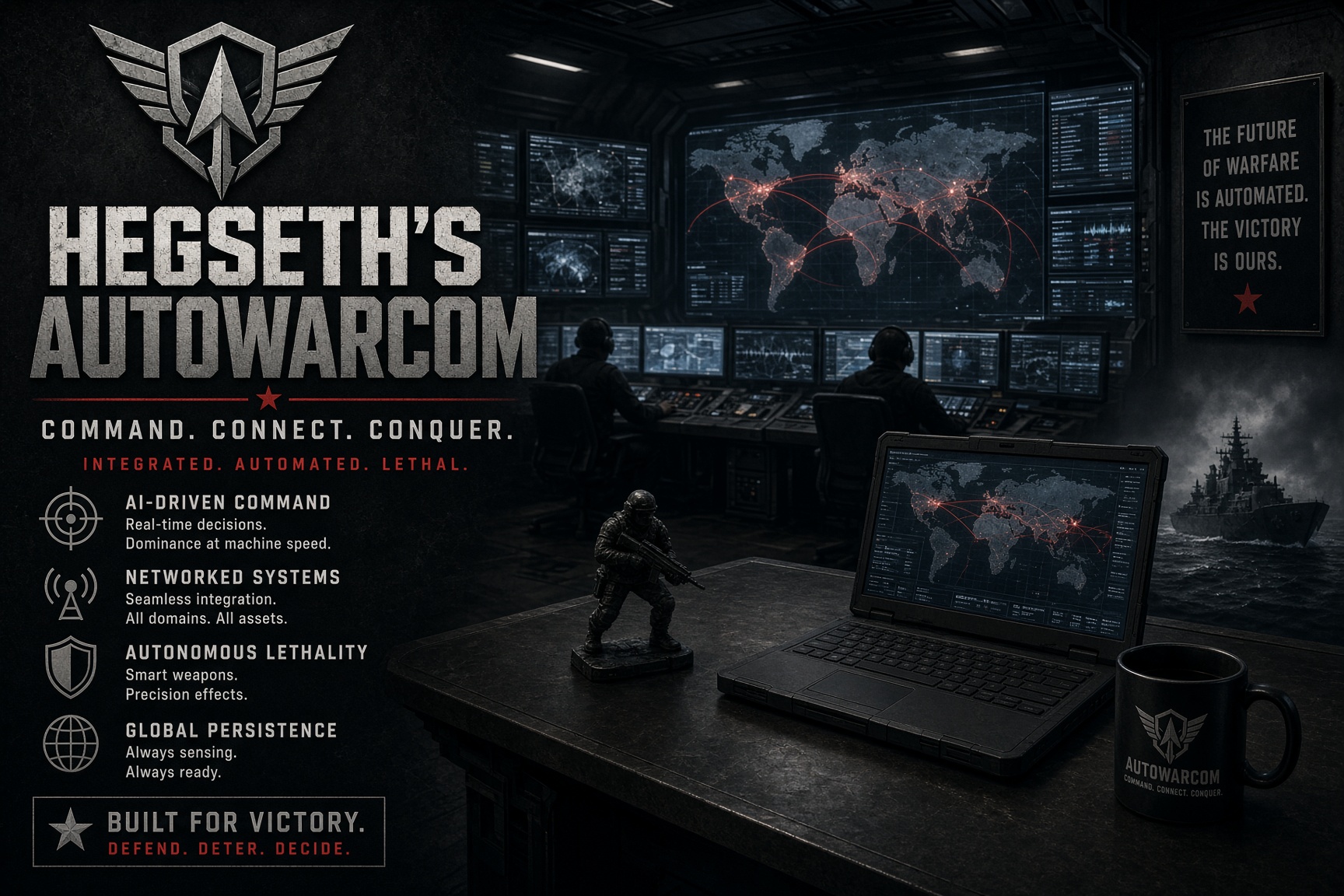
Hegseth's AutoWarCom: Who Builds It, What the Money Buys, and the Record It Needs
Pete Hegseth's Autonomous Warfare Command is a four-star proposal that needs Congress by 1 October 2027. Until then Project Agincourt holds the work, and the money moves through Drone Dominance, the Army's counter-drone contracts and DIU. The software layer, Palantir's Maven, Anduril's Lattice and Shield AI's Hivemind, is the one the KXCO AI Sector ontology had mapped before the speech. After Minab, its hardest problem is the record, not the model.

AI Development: The Token Got Cheaper, the Building Did Not
The useful fact on 28 September is a split, not a benchmark. Gartner puts 2026 AI spending at $2.67 trillion, and 56 percent of it is infrastructure against about 1 percent on the models. Inside one week the frontier cut the price of a token in half, Nvidia signed for the shelf the open weights sit on, and three closed labs proposed to run the test. What shipped, what it costs and where the money goes, with the AI sector checked against KXCO Ontology Live.
Every story, signed and delivered.
Subscribe to the kxco channel and get the headline, the AI-written key takeaways, and the chain-anchor link the moment we publish. Audio versions and per-ticker subscriptions arrive in the next iteration.