
The New AI-Quantum Arms Race
$NVDA, $MSFT, $GOOGL, $IBM, $IONQ, $RGTI, $QBTS, $AMD, $AVGO, $TSM, $HON
Part of theQuantum Computing Center
The AI-Quantum Convergence: What the Leading Voices Are Really Saying About the Technology That Will Reshape Markets, Discovery, and Global Competition
By Shayne Heffernan, PhD June 12, 2026 | ~10 min read
The conversation about quantum computing has shifted decisively. The relevant question is no longer whether these systems will matter, but how quickly and how powerfully they will combine with today’s AI infrastructure to expand what is possible.
Leaders across the major technology companies and specialized quantum organizations are now describing a hybrid future in which quantum capabilities act as a powerful co-processor and accelerator alongside classical AI and high-performance computing. They are also converging on the areas where this combination will create the most significant new capabilities and markets.
Jensen Huang (NVIDIA): Quantum as the Next Accelerator in the Stack
NVIDIA’s CEO has been one of the most direct voices on integration. Jensen Huang now describes quantum computing as reaching an inflection point and envisions future high-performance systems as quantum-GPU hybrids.
His view is pragmatic: quantum excels at certain simulations and optimizations that remain extremely difficult for classical systems. The surrounding AI and GPU infrastructure provides the scale, programmability, and orchestration. NVIDIA is focused on building the connective layers — programming models, simulation tools, and interconnects — that allow quantum processors to work effectively with existing AI systems.
Arvind Krishna (IBM): Quantum and AI as Complementary Systems
IBM CEO Arvind Krishna has been explicit that quantum and AI converge and complement each other. Quantum can surface insights or solve sub-problems that current AI models handle inefficiently. AI can then learn from and build upon those results, creating a productive feedback loop.
He has encouraged enterprises to begin aligning their AI and quantum strategies now, rather than treating them as sequential or separate initiatives.
Satya Nadella (Microsoft): Quantum as Future Cloud Infrastructure
Microsoft’s CEO has positioned quantum computing as the next major accelerator layer for cloud platforms, developed alongside AI scaling. The company’s work on more stable qubit architectures reflects a bet that quantum capabilities will eventually become accessible within the same enterprise environments already running large-scale AI.
Google Leadership: Scientific Discovery at New Scales
Sundar Pichai, Demis Hassabis at DeepMind, and Hartmut Neven at Google Quantum AI have emphasized the two-way relationship between AI and quantum. AI is already accelerating scientific discovery at unprecedented speed. Quantum systems open simulations and optimizations in materials, chemistry, and energy that remain intractable for classical methods alone. AI helps design and control quantum hardware, while quantum expands what AI can ultimately achieve.
Jack Hidary (SandboxAQ): Large Quantitative Models and Real-World Applications
One of the clearest enterprise voices is Jack Hidary, CEO of SandboxAQ. He has focused on the emergence of Large Quantitative Models (LQMs) — AI systems grounded in the laws of physics and chemistry and enhanced by quantum methods.
Hidary’s emphasis is on practical impact: using the combination of AI and quantum to advance drug discovery, materials design, energy systems, and complex optimization. SandboxAQ’s work demonstrates that applications in the physical world are already moving from theory into real enterprise use cases.
Quantum Hardware Leaders: Hybrid Workflows as the Path Forward
Leaders at companies such as IonQ, Quantinuum, and Rigetti have consistently highlighted hybrid classical-quantum-AI workflows as the route to early commercial value. Quantinuum, for example, has introduced frameworks that combine generative AI with quantum and supercomputing specifically for problems that classical systems cannot solve effectively. The shared message is integration, not isolation.
The Emerging Consensus
Across these voices, several patterns are clear:
Hybrid systems are the near-term reality.
The highest-leverage applications sit in scientific discovery, materials and energy, complex optimization, and new forms of intelligence.
AI and quantum are already improving each other in feedback loops — better AI helps quantum systems, and quantum capabilities expand what AI can model and optimize.
The exact pace remains uncertain, but each advancement tends to accelerate the ones that follow.
Where the Earliest and Most Asymmetric Advantages Are Emerging
This convergence is creating new markets and capabilities rather than simply improving existing ones.
In finance and markets, one of the most compelling opportunities lies in global access to markets with live settlement. The ability to combine quantum-accelerated optimization and simulation with AI-driven decision systems could dramatically reduce latency, counterparty risk, and capital requirements in cross-border trading and settlement. This is not incremental improvement — it is a structural shift in how markets can operate at global scale.
In scientific discovery and longevity, companies like SandboxAQ are already showing that quantum-enhanced AI can accelerate molecular simulation and materials design in ways that directly feed into drug development and advanced therapeutics.
On the sovereign and strategic front, the quantum-AI race is emerging as a new form of strategic competition, with implications for economic leadership, technological sovereignty, and national security.
The convergence also touches energy and compute infrastructure itself, both in the problems being solved and in the massive new demands these hybrid systems will place on power and data center architecture.
Key Public Companies Positioned for the Convergence
Investors and strategists tracking this shift are closely watching established leaders such as $NVDA, $MSFT, $GOOGL, $IBM, $IONQ, $RGTI, $QBTS, $AMD, $AVGO, $TSM, and $HON, alongside emerging players building specialized infrastructure for the quantum-AI era including $KXCO.
Company | Ticker | Primary Focus | Relevance to AI-Quantum Convergence |
|---|---|---|---|
NVIDIA | AI Infrastructure & GPUs | Hybrid quantum-GPU systems, CUDA-Q, simulation tools | |
Microsoft | Cloud + AI | Azure Quantum, Majorana topological qubits | |
Alphabet (Google) | Quantum AI + Scientific AI | Google Quantum AI lab, Willow chip, DeepMind | |
IBM | Enterprise Quantum + AI | Hybrid cloud + quantum convergence strategy | |
IonQ | Quantum Hardware (Trapped Ion) | Enterprise quantum applications & hybrid workflows | |
Rigetti Computing | Quantum Hardware (Superconducting) | Hybrid quantum-classical systems | |
D-Wave | Quantum Annealing | Hybrid optimization solutions | |
AMD | AI & High-Performance Chips | AI acceleration + quantum simulation support | |
Broadcom | AI Semiconductors & Networking | Critical infrastructure for large AI/quantum clusters | |
TSMC | Advanced Semiconductor Manufacturing | Foundry for next-gen AI and quantum chips | |
Honeywell | Industrial + Quantum (Quantinuum) | Stake in Quantinuum quantum systems | |
KXCO | Post-Quantum AI Infrastructure | Verifiable systems & quantum-resistant layers |
The Opportunity Landscape
Hardware is becoming a boom industry as multiple approaches compete to deliver scalable, useful quantum systems. At the same time, the software layer is becoming ubiquitous — the connective tissue that allows quantum capabilities to work inside existing AI and enterprise workflows.
In this environment, design and functionality will be decisive. The organizations that deliver solutions serving real needs in the simplest, most powerful, and most appealing form will capture the advantage. Technical performance matters, but the ability to integrate cleanly into existing systems and deliver clear economic or scientific value will determine winners.
The quantum-AI convergence is not arriving as a single breakthrough. It is arriving as a compounding set of capabilities that expand what is possible across finance, science, energy, and strategic competition. The organizations and leaders who focus on building the most effective bridges between these new capabilities and real-world needs will shape the next era of computational advantage.
Quantum Cybersecurity: The KXCO Chain Is Already Running
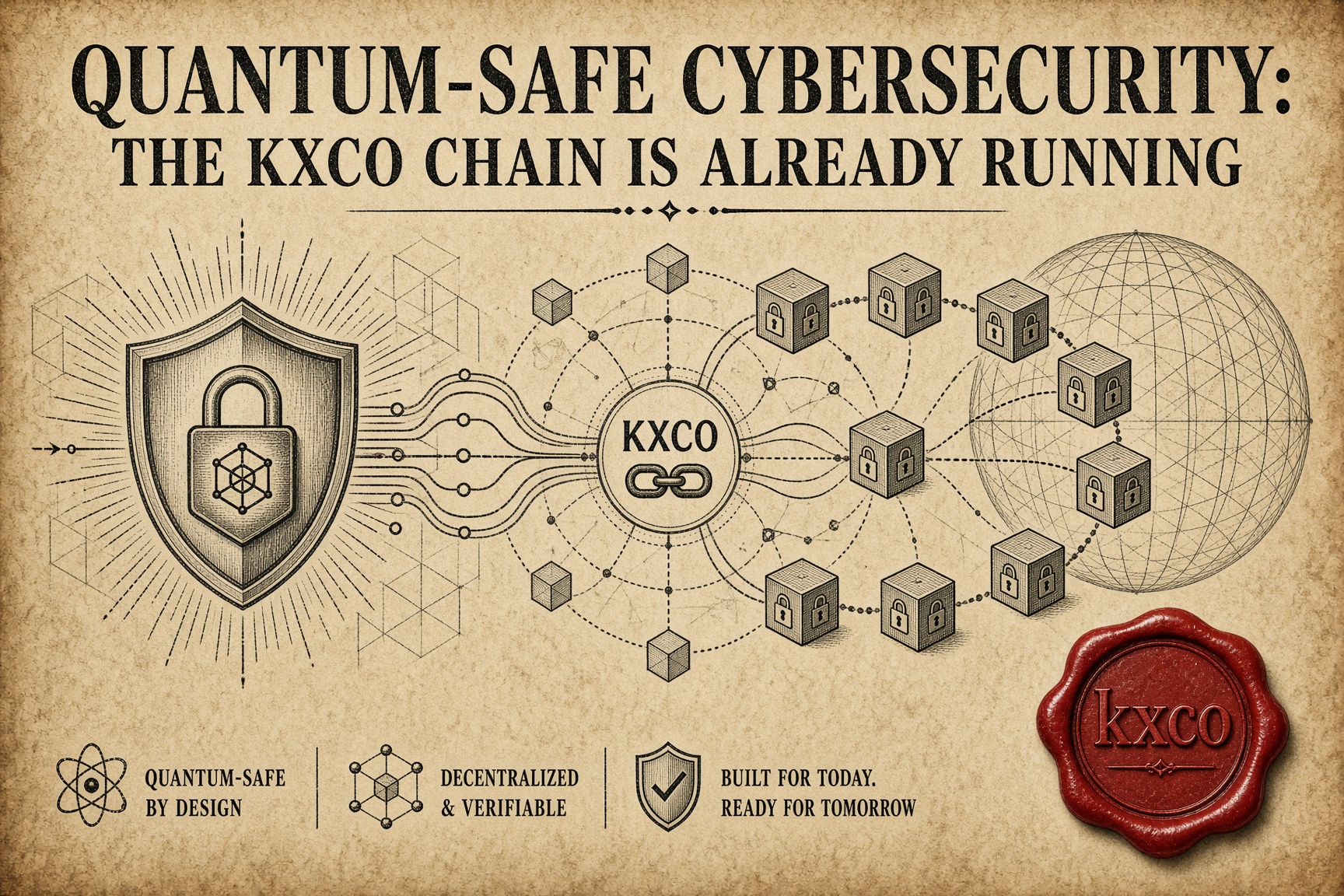
The World Economic Forum warned on 11 September that the quantum-safe race has changed gears. It is right about the direction and late about the work. Every KXCO product already runs on NIST's post-quantum algorithms, and all of them run on the same implementation: 42 package manifests declare one library. The chain verifies ML-DSA-65 on-chain at precompile 0x0b, tested live with three negative controls. NIST's own grader marked the library at 2,130 cases and zero failures.

What the KXCO Ontology Exposed While the Market Stood Still
On 25 August the KXCO AI Sector Ontology stamped a fresh set of rows. Sixteen days later the Nasdaq had gone nowhere and ten of those names were up: Intel 14.68%, Meta 13.04%, SpaceX 7.42%, Oracle 5.65%. This is what a record of 393 entities and 869 sourced claims surfaces that a screen cannot: who is genuinely irreplaceable rather than merely large, which obligations sit off every balance sheet in the sector, and where the strongest bull case on the page runs into a variable no graph contains.
China's AI and Quantum Ambitions
China is no longer trying only to train a model that looks like an American one. It is trying to own the stack that turns tokens into factories: open-weight models cheap enough to run at home, accelerators that do not need an Nvidia licence, robots that walk into a BYD plant, quantum machines that list on the STAR Market, and a power system that can add the generating capacity of a mid-sized country in a single year. The models, the tickers, and the 27 claims that cross the border.
AI and Quantum Update
The first week of September 2026 compressed a year of argument into seven days. GPT-6 Astra landed at the Critical cybersecurity level of OpenAI's own Preparedness Framework, Nvidia agreed to buy Hugging Face for $12.93 billion, Washington took minority equity in three quantum companies, and Mistral closed the largest equity raise in European technology history. A field report on the breakthroughs, the tickers, and a map that has split three ways.
Every story, signed and delivered.
Subscribe to the kxco channel and get the headline, the AI-written key takeaways, and the chain-anchor link the moment we publish. Audio versions and per-ticker subscriptions arrive in the next iteration.