
Armature L1 and the Ontology as Enterprise Infrastructure
Post-Quantum Cryptography, Verifiable Settlement, and a Shared Model of Reality for the Human–AI Economy
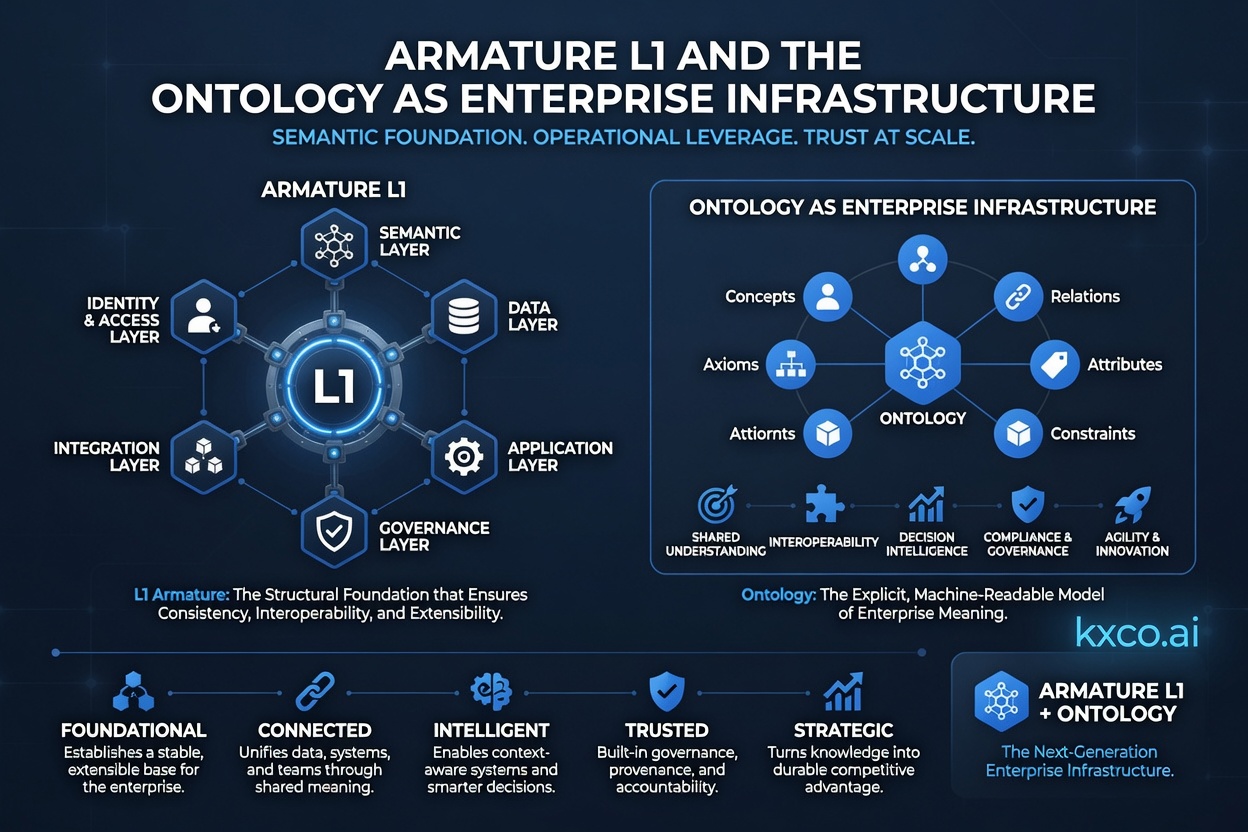
The KXCO Product Stack: Real Products, One Foundation
KXCO does not sell a platform with a marketplace of third-party integrations. KXCO builds real financial infrastructure products — wallets, treasury systems, identity layers, verification engines, legal signing tools, and regulatory compliance systems — and every one of them runs on the same foundation: Armature L1 for settlement and provenance, the ontology for shared data, and post-quantum cryptography for security. The ontology is not the product. It is the shared model of reality that makes every product work. This section outlines each product and explains how blockchain is integral to its function, not incidental to its marketing.
KXCO Treasury
KXCO Treasury is the money layer of the KXCO platform: self-custody wallets, settlement on Armature L1, and quantum-safe key handling. It is designed for the human–AI economy — holding, moving, and settling money for people, businesses, institutions, and the AI agents that increasingly act on their behalf. Every treasury operation writes to Armature L1. Every wallet is post-quantum protected. Every settlement is an immutable, independently verifiable transaction on a public ledger. This is not a custodial service where you trust KXCO to hold your assets. This is a self-custody system where you hold your own keys, your own assets, and your own proof of every transaction — with KXCO providing the infrastructure to make that practical at enterprise scale.
The blockchain integration is not a backend detail. It is the product. Without Armature L1, Treasury would be another payment processor with a database. With Armature L1, Treasury is a settlement system where every payment is a cryptographic fact, every balance is independently auditable, and every dispute is resolvable by reference to an immutable public record. For institutions managing billions across multiple jurisdictions, counterparties, and regulatory regimes, this is the difference between a system you operate and a system you can prove.
The quantum-safe key handling within Treasury deserves emphasis because it addresses a problem that most treasury teams do not yet know they have. Every wallet, every settlement instruction, every authorisation in a conventional treasury system relies on cryptographic keys that will be breakable by quantum computers. The keys protecting a treasury system today are the same class of keys that NIST has already flagged for replacement. Treasury does not wait for the migration timeline. It handles ML-DSA-65 and ML-KEM-768 natively, from day one. Every key generation, every signature, every key exchange operation is post-quantum by default. There is no legacy mode, no fallback to RSA, no configuration flag to enable quantum-safe operations. It is quantum-safe because the entire stack was designed after NIST standardisation, not adapted to it.
KXCO Treasury: https://kxco.ai/treasury
KXCO Nexus
KXCO Nexus is the identity, signing, and verification layer. It issues verifiable identities and credentials for people, organisations, and AI agents using the same API. It executes legal signings — contracts, authorisations, governance actions — with post-quantum signatures that are anchored to Armature L1. The critical insight is that identity on KXCO is not a username in a database. It is a verifiable credential linked to a post-quantum key pair, recorded on a blockchain, and queryable through the ontology. You can prove who you are, what you are authorised to do, and that the proof has not been tampered with — without relying on any intermediary.
This matters for AI agents in particular. As enterprises deploy AI systems that execute trades, manage portfolios, and interact with counterparties, the question of agent identity becomes critical. An AI agent on KXCO does not operate with a bearer token or an API key that anyone who intercepts it can use. It operates with per-request signed authentication governed by its own keys. The ontology records what the agent is authorised to do. Armature L1 records what it actually did. If there is a dispute, the entire chain of authority and action is verifiable from first principles. This is infrastructure for a world where AI agents are economic actors, not just software tools.
The legal execution capability within Nexus deserves particular attention. Most digital signing solutions today rely on PDF-based electronic signatures that provide limited legal certainty and no cryptographic proof of the signers intent or authority. Nexus approaches legal signing differently: every signature is an ML-DSA-65 post-quantum cryptographic operation linked to a verifiable identity credential, timestamped on Armature L1, and recorded in the ontology with full context of the signers authority, the documents being signed, and the jurisdictional framework that governs the execution. A court, a regulator, or a counterparty can verify not just that a signature exists, but that the signer was authorised to execute, that the document has not been altered, and that the signature was created at the claimed time. This transforms digital signing from a convenience into evidence-grade legal infrastructure.
KXCO Nexus: https://kxco.ai/nexus
KXCO Sentinel
KXCO Sentinel is the quantum-safe cloud: a hosting and verification platform that scans code and dependencies for quantum-vulnerable cryptography, hosts software with a quantum-proof pre-deploy scan, and issues an independently verifiable ML-DSA-65 attestation on every release. The scanning engine, Bastion, identifies where your code still relies on RSA, ECDSA, and other algorithms that quantum computers will break. If your deployment contains quantum-vulnerable dependencies, the platform can block the deploy. The
moment a build completes, Sentinel signs a deployment manifest — commit SHA, timestamp, scan result, and live URL — with an ML-DSA-65 post-quantum signature and commits it to Armature L1.
The blockchain integration here is what transforms Sentinel from a security tool into a trust engine. A security scan is an internal assertion: “we checked our code and it is safe.” A Sentinel attestation anchored to Armature L1 is an external, verifiable fact: “this specific code, at this specific commit, was scanned with these specific results, and this claim is cryptographically signed and timestamped on a public blockchain.” The difference is the difference between telling a regulator you are compliant and proving it. For enterprises operating in regulated industries — financial services, healthcare, defence, critical infrastructure — this distinction is the difference between a passing audit and an existential liability.
Bastion, the scanning engine at the core of Sentinel, can be run across code, dependencies, containers, and transport layers to identify every instance where an organisation still relies on quantum-vulnerable cryptography. This is not theoretical. The blog post on KXCOs developer site documents how to run Bastion across an entire codebase to find RSA, ECDSA, and other vulnerable algorithms before they become exploitable. For organisations with large, legacy codebases, this is the difference between a systematic migration and a reactive crisis. Sentinel does not just identify the vulnerability. It provides the migration path, blocks deployments that contain vulnerable dependencies, and issues post-quantum attestations for every clean deployment. The entire lifecycle — discovery, migration, verification, and proof — is managed within a single platform anchored to Armature L1.
KXCO Sentinel: https://kxco.ai/sentinel
KXCO Verify
KXCO Verify is the browser-based and server-side verification engine that allows anyone to verify any KXCO signature without running KXCO software, without creating an account, and without trusting KXCO. The verifier runs entirely client-side: you feed it a signature and it uses the KXCO public key to confirm that the signature is valid, that the signing key is authorized, and that the signed content has not been altered. This is the “independent” in independently verifiable. It is what makes the entire system work as trust infrastructure rather than as a trusted third party.
Verify is available as an open-source library (kxco-verify on npm) with support for JavaScript, Python, Rust, and Go. It can be integrated into any application, any workflow, any audit process. A regulator can use it to verify a signing event. A counterparty can use it to verify a payment authorization. A court can use it to verify a legal execution. In every case, the verification relies on mathematics, not on trust in KXCO. The blockchain provides the immutable record. Verify provides the tool to check it. The ontology provides the context to understand it.
KXCO Verify: https://verify.kxco.ai
KXCO Corporate
KXCO Corporate is the regulatory technology layer: encoding what is permitted, by whom, and where as a first-class part of the infrastructure. Rather than treating compliance as a periodic reporting exercise, Corporate embeds regulatory requirements into the operating fabric of the organisation. Permissions, restrictions, reporting obligations, and jurisdictional rules are expressed as machine-readable claims in the ontology and enforced through the product stack. When Treasury processes a cross-border payment, Corporate checks the regulatory regime. When Nexus issues an identity, Corporate checks the jurisdictional requirements. When an AI agent requests authorisation, Corporate verifies that the action is permitted under the applicable rules.
The blockchain layer is what makes this enforceable and auditable, not just aspirational. Every regulatory check, every permission grant, every restriction enforced is recorded on Armature L1. The regulator does not have to take the organisation’s word that compliance was checked. The regulator can verify it on-chain. The ontology provides the mapping between regulatory requirements and operational actions. Armature L1 provides the proof that the mapping was followed. Corporate provides the interface that makes it operational.
Consider the practical application in financial services. A fund operating across the United States, the European Union, and the Middle East must comply with different regulatory regimes in each jurisdiction — different reporting obligations, different investor protection rules, different anti-money laundering requirements, different data residency restrictions. In a conventional system, compliance with each regime is managed by separate teams using separate systems, with periodic reconciliation to ensure consistency. On KXCO, every jurisdictional requirement is encoded as a claim in the ontology. When a transaction crosses a jurisdictional boundary, Corporate checks it against the applicable rules automatically. The result is recorded on Armature L1. The compliance team does not reconcile because there is nothing to reconcile: the compliance check is part of the transaction itself, not a separate process that runs after the fact. For a fund with operations in twelve jurisdictions, this is not an incremental improvement. It is a fundamentally different operating model for regulatory compliance.
KXCO Corporate: https://kxco.ai/corporate
The Product Stack at a Glance
Product | Function | Blockchain Role | Key Capability |
Treasury | Payments, custody, banking | Every settlement recorded on Armature L1; self-custody | Hold, move, and settle money for people, businesses, |
Product | Function | Blockchain Role | Key Capability |
wallets with quantum-safe keys | institutions, and AI agents | ||
Nexus | Identity, legal execution, proof | Identity credentials and legal signings anchored to Armature L1 with ML-DSA-65 | Verifiable identity and legal signing for humans and AI agents |
Sentinel | Quantum-safe cloud, DevSecOps | Deployment attestations signed and committed to Armature L1 | Scan for quantum-vulnerable crypto, sign releases with ML-DSA-65 |
Verify | Signature verification | Verifies on-chain signatures without KXCO account or software | Client-side verification using open-source libraries in JS/Python/Rust/Go |
Corporate | Regulatory technology | Regulatory checks and permissions recorded on Armature L1 | Encode what is permitted, by whom, and where as infrastructure |
Shared domain model | Claims anchored to Armature L1; entities and relationships queryable | Structured, navigable, provable model of any domain |
Table 3: KXCO Product Stack — Real Products, One Foundation
How We Turned Blockchain and AI Into a Powerful Ontology
The AI Sector Ontology is the proof of what the KXCO stack can do when all of these layers — Armature L1, the ontology engine, the product stack, and post-quantum cryptography — operate together. The ontology maps 81 entities across the AI supply chain, from ASML’s EUV lithography machines in the Netherlands to the hyperscale data centres in Memphis, from the venture capital firms in Silicon Valley to the HBM factories in South Korea. It tracks $973 billion in capital flows. It identifies 5 critical chokepoints, 7 geopolitical risk zones, and 14 structural revelations about how the AI sector actually operates.
Each entity in the ontology is a structured record, not a Wikipedia page. ASML is not described as “the leading lithography company.” It is described with precision: 100% of EUV lithography worldwide, approximately $400 million per machine, 3 cross-references to dependent entities (TSMC, Zeiss, Trumpf), 8 claims about its role in the supply chain, and a confidence rating on each claim. TSMC is not described as “a major chip fabricator.” It is described as fabricating 100% of the AI cohort’s leading-edge silicon, with 9 claims, 9 cross-references, and $12 billion in tracked flows. This granularity is what makes the ontology useful for decision-making rather than merely informative.
The AI assistant built into the ontology page demonstrates the next step: natural-language querying of a structured, verifiable model. A user can ask, “What are the 3 chokepoints the entire AI sector depends on?” and receive a precise, sourced answer: ASML’s monopoly on EUV lithography, TSMC’s geographic concentration in Taiwan, and the HBM triopoly of SK Hynix, Samsung, and Micron. Each answer links to the underlying claims, which link to the on-chain records, which can be independently verified. This is AI reasoning over a structured, blockchain-anchored model of reality — not an LLM hallucinating answers from a training set, but an AI system operating over a shared, verifiable, post-quantum-secured data layer.
The capital loop revelation is perhaps the most striking finding in the ontology. Investors fund AI labs. Those labs commit that capital straight back to the investors clouds and chips — roughly $1 trillion of announced deals circulating inside one cohort. SoftBank commits $500 billion over four years. Amazon commits $38 billion over seven years to AWS. Microsoft commits approximately $135 billion. These same investors then fund the next round of labs, which commit capital back to the same clouds and chips. The ontology makes this loop visible in a way that conventional financial analysis cannot, because it maps relationships rather than just transactions. It shows not just that money moved from A to B, but that A and B are part of the same dependency structure, the same capital circuit, the same systemic risk profile. For investors, this is the difference between seeing individual positions and seeing the structure that connects them. For regulators, it is the difference between examining individual firms and examining systemic concentration risk. For the enterprises being mapped, it is the difference between operating in a blind spot and operating with full visibility into their own supply chain dependencies.
Ontology Dimension | Current Scope | What It Enables |
Entities | 81 nodes (equipment, foundries, chip designers, memory, networking, AI labs, cloud, data centres, capital, geopolitics, quantum, power, tech companies, key people) | Comprehensive mapping of any domain’s supply chain, capital flows, and systemic risks |
Claims | 112 sourced, dated, confidence-rated claims | Every assertion is traceable to a source and verifiable against on-chain records |
Capital Flows | $973B tracked across 22 investors and 31 cloud/compute entities | Visibility into where money flows, who funds whom, and where the capital loop creates concentration risk |
Chokepoints | 5 critical nodes identified (ASML, TSMC, HBM triopoly, Nvidia GPU dominance, US-China decoupling) | Structural risk analysis showing single points of failure for entire sectors |
Ontology Dimension | Current Scope | What It Enables |
Geopolitical Overlay | 7 regions (US, China, EU, Taiwan, South Korea, Japan, Middle East) with dependency counts | Country-by-country exposure analysis for investors, regulators, and risk managers |
AI Assistant | Natural-language query interface over the ontology | Ask questions, get sourced answers, verify claims without leaving the interface |
Table 4: KXCO AI Sector Ontology — Structure and Capabilities
Why Building on KXCO Is an Advantage
There are three structural advantages to building on KXCO rather than assembling a comparable stack from individual vendors. The first is integration by design. When you build on KXCO, your treasury system, your identity layer, your compliance engine, and your AI trust infrastructure share the same ontology, the same settlement layer, and the same cryptographic foundation. There is no integration gap. There is no data transformation layer between systems. There is no reconciliation process because there is only one ledger. This is not a convenience. It is an architectural advantage that compounds over time: every new product, every new use case, every new regulatory requirement plugs into the same infrastructure without requiring a new integration project.
The second advantage is post-quantum security from the ground up. Most enterprises will spend the next decade migrating their cryptography from RSA and ECC to post-quantum standards. Research from Post Quantum and MDPI predicts enterprise migration timelines of 5 to 15+ years, with significant complexity in identifying and replacing vulnerable algorithms across entire software stacks. KXCO customers do not have this problem. Every signing event, every key exchange, every identity issuance, every settlement on the KXCO stack already uses NIST-standardised post-quantum cryptography. The migration is not a future project. It is already done. BlackRock’s recent warnings about quantum risk to long-duration financial instruments apply to every institution still running RSA and ECC. KXCO customers are already protected.
The third advantage is independent verifiability. This is the one that most platforms cannot replicate because it requires the blockchain layer as a foundation, not an add-on. When you build on KXCO, every critical action produces a verifiable artifact: a signed transaction on Armature L1, a post-quantum attestation from Sentinel, a verifiable credential from Nexus. Your counterparties, your regulators, and your auditors can verify these artifacts without your involvement, without your permission, and without a KXCO account. This transforms your relationship with every external stakeholder. You are no longer asking them to trust you. You are giving them the tools to verify you. In regulated industries, this is not a marketing advantage. It is a competitive moat.
Advantage | Building on KXCO | Assembling from Vendors |
Advantage | Building on KXCO | Assembling from Vendors |
Integration | Single ontology, single ledger, single cryptographic foundation — zero integration gap | Multiple systems with different data models, separate databases, manual reconciliation |
Post-Quantum Security | ML-DSA-65 and ML-KEM-768 native across all products from day one | Multi-year migration project; 5–15 year timeline per industry research |
Verifiability | Every action produces an independently verifiable artifact on Armature L1 | Verification requires access to internal systems and trust in the operator |
AI Agent Infrastructure | Per-request signed authentication, governed wallets, on-chain audit trail | Bearer tokens, API keys, no standard agent identity or audit framework |
Regulatory Compliance | Compliance as a query, not a project; on-chain proof for every obligation | Periodic reporting, document production, manual audit processes |
Development Speed | Open-source SDKs (JS, Python, Rust, Go); EVM-compatible tooling; live network | Proprietary APIs, vendor lock-in, custom integration for each product |
Cost | Shared infrastructure; one foundation for identity, treasury, compliance, and AI trust | Separate licensing, separate integration, separate maintenance for each function |
Table 5: Structural Advantages of Building on KXCO vs. Assembling from Vendors
The Developer Experience
KXCO provides a full suite of open-source tools for developers who want to build on post-quantum trust infrastructure. The core library, kxco-post-quantum, provides ML-DSA-65 and ML-KEM-768 primitives for signatures, key encapsulation, and key derivation. It is available on npm under @kxco and on GitHub under JackKXCO. The verification library, kxco-verify, enables browser-side and server-side verification of any KXCO signature with no KXCO server required. Webhook adapters for Express, Fastify, Hono, and Cloudflare Workers allow developers to add signed webhooks to any application with minimal code. The entire stack runs on a live, EVM-compatible network with standard tooling — if you have worked with Ethereum, you can work with Armature L1.
The developer experience is designed around a principle that matters for adoption: no lock-in. Everything you produce on the KXCO stack can be verified independently, with or without KXCO. Your identities are yours. Your signatures are yours. Your on-chain records
are yours. KXCO provides the infrastructure to create them, the blockchain to anchor them, and the ontology to give them context. But the proof belongs to you, and it is mathematically verifiable by anyone. This is not a platform play dressed in decentralisation language. It is actual infrastructure that works the way infrastructure should work: it gets out of your way and lets you build.
The open-source packages are published under @kxco on npm and JackKXCO on GitHub. The core kxco-post-quantum library provides ML-DSA-65 and ML-KEM-768 primitives for signatures, key encapsulation, and key derivation. The kxco-verify library offers browser-side and server-side verification of any KXCO signature with no server dependency. Webhook adapters cover Express, Fastify, Hono, and Cloudflare Workers, allowing developers to add post-quantum signed webhooks to existing applications with minimal code changes. The SDKs are available for JavaScript, Python, Rust, and Go. A developer who wants to experiment can be up and running against the live Armature L1 network within minutes, using the same EVM tooling they already know. The barrier to entry is not technical complexity. It is the decision to take post-quantum trust infrastructure seriously.
KXCO Developers: https://kxco.ai/developers
KXCO npm Packages (@kxco): https://www.npmjs.com/~kxco
KXCO GitHub (JackKXCO): https://github.com/JackKXCO
The Road Ahead: Your Ontology, Your Domain
The AI Sector Ontology is a demonstration, not a limitation. KXCO builds ontologies for any domain: funds, family offices, brokers, exchanges, retail platforms, e-commerce, healthcare, supply chains. The same infrastructure that maps the AI supply chain can map a fund’s portfolio, a hospital’s supply chain, or a regulator’s jurisdiction. Your entities, your relationships, your claims — structured, navigable, and provable. Every claim sourced, dated, and confidence-rated. Every critical claim anchored to Armature L1. Every product in the stack operating from the same shared model.
The human–AI economy is not a future state. It is the current state. AI agents are already executing trades, managing portfolios, writing code, and making decisions that affect human welfare. The question is not whether AI will be embedded in enterprise operations, but whether the infrastructure supporting that embedding will be verifiable, accountable, and secure against the quantum threat. KXCO’s answer is Armature L1: one foundation, post-quantum by design, independently verifiable by anyone, and open for any domain. The ontology makes it intelligent. The blockchain makes it true. The products make it usable. The choice is whether to build on a foundation designed for the world as it is, or to keep patching a foundation designed for the world as it was.
For organisations evaluating infrastructure for the next decade, the calculation is
straightforward. Quantum computers will eventually break RSA and ECC. The timeline is uncertain but the direction is not. AI agents will become more autonomous, more numerous, and more consequential. The regulatory environment will demand more proof, more auditability, and more real-time compliance. KXCO addresses all three dynamics with a single, integrated foundation. The alternative is to address each one separately, with separate vendors, separate integration projects, and separate migration timelines — and to hope that the pieces fit together before the threats materialise. Armature L1 is live, proven, and processing blocks today. The ontology is mapping $973 billion in capital flows in real time. The products are deployed and operational. The infrastructure is not a roadmap. It is a working system, and it is ready for any organisation that wants to build on a foundation designed for the world that is coming, not the world that is passing.
Build Your Ontology: https://kxco.ai/ontology
Request a Briefing: https://kxco.ai/contact
Key Takeaways
Armature L1 is the foundation, not a feature. Every KXCO product — Treasury, Nexus, Sentinel, Verify, Corporate — runs on Armature L1. Settlement, identity, legal signing, deployment attestation, and regulatory compliance all write to the same post-quantum blockchain with instant finality and independent verifiability. This is not a blockchain bolted onto conventional software. This is software built around a blockchain from the ground up.
Blockchain is the prerequisite for trust, not an add-on. Without immutability, independent verifiability, and temporal proof, there is no way to build enterprise infrastructure that regulators, counterparties, and courts can verify without trusting the operator. Armature L1 provides all three. Every product is stronger because of it.
The ontology turns data into a shared model of reality. 81 entities, 112 claims, $973 billion in tracked capital flows in the AI sector alone. The same infrastructure can map any domain. Every claim is sourced, dated, confidence-rated, and anchored to Armature L1. Compliance becomes a query. Risk that was invisible becomes visible.
Post-quantum security is already built in. ML-DSA-65 for signing, ML-KEM-768 for key exchange, NIST FIPS 203/204/205 compliance. While other enterprises face 5–15 year migration timelines, KXCO customers are already protected. The quantum threat is not future. The defense is already deployed.
Building on KXCO means zero integration gap, zero migration risk, and independent verifiability by design. One ontology, one ledger, one cryptographic foundation. Open-source SDKs, EVM-compatible tooling, no vendor lock-in. Everything you produce is verifiable by anyone, with or without KXCO.
The 2030 Compute Landscape: GPUs, Power and the Architecture of Intelligence
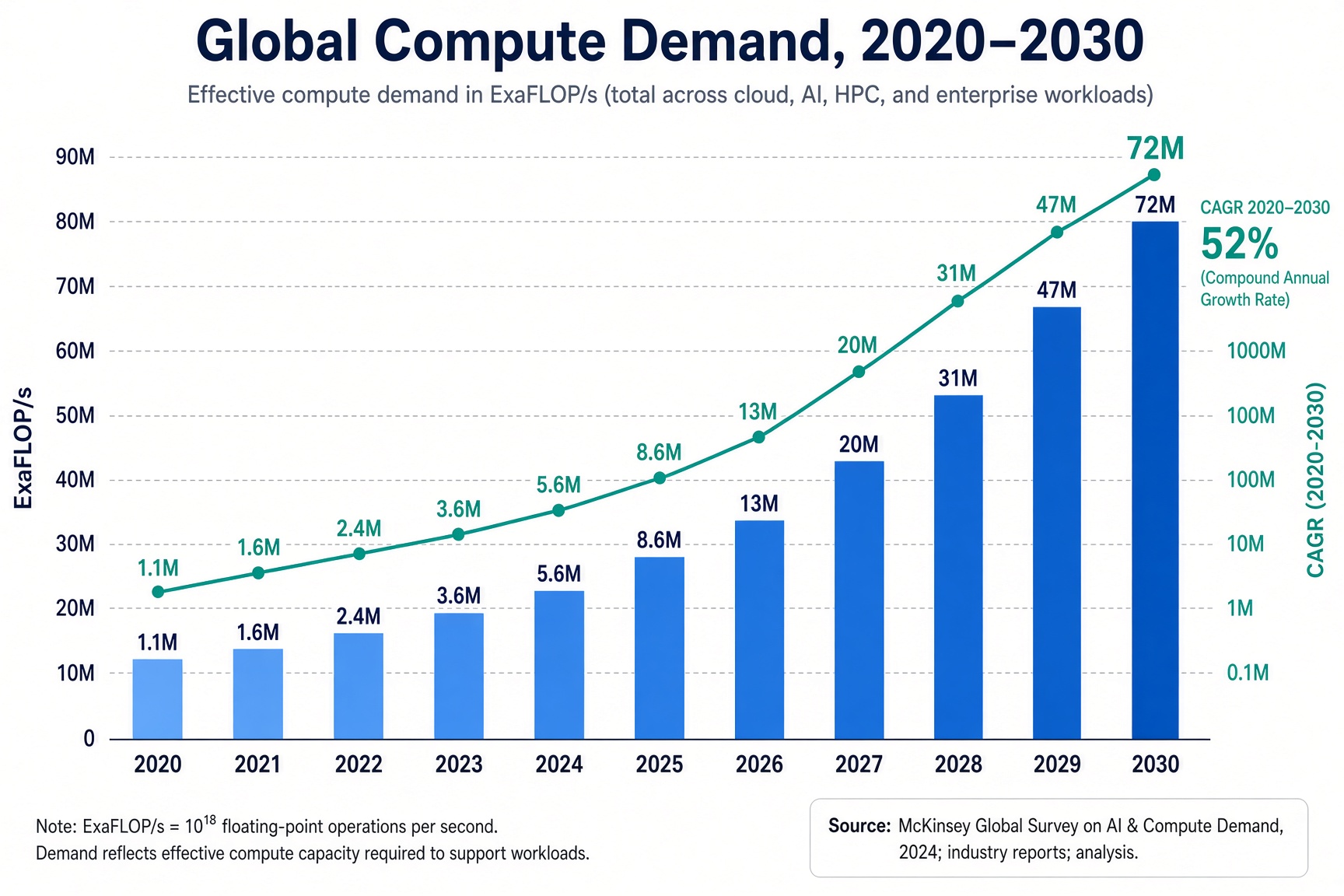
The constraint on AI is no longer ideas or data but compute and the power to run it. Frontier training compute has grown about five times a year since 2020, and the leading AI supercomputer of June 2030 is on course for about 2 million chips and 9 gigawatts. Shayne Heffernan sets out the 2030 arithmetic, the power problem, who has already contracted the gigawatts, and how GPUs, custom ASICs, wafer-scale engines and quantum machines divide the work.
Harvest Now, Decrypt Later: Why KXCO Took Its Ontologies Private
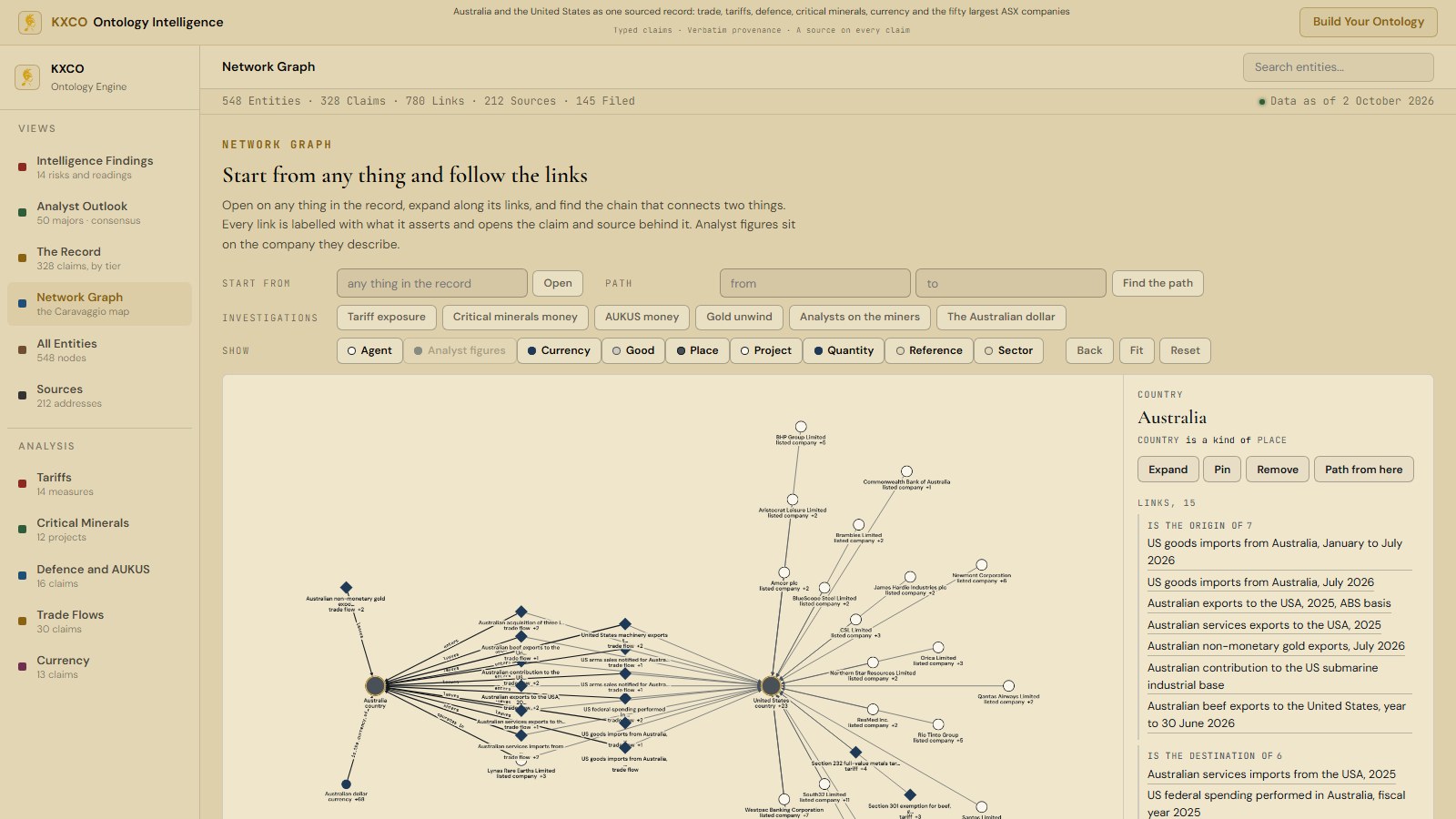
For more than 90 days KXCO ran its ontologies in public: the AI sector resolved from six names to one lithography supplier, and Australia's trade with the United States as one sourced record. They proved the method. They are now private, still running, for KXCO and its clients only. Europol's report on harvest now, decrypt later explains why: data collected today will be read when a quantum computer arrives, and a graph of your relationships is the most valuable thing to harvest.
How Can You Trust AI When You Cannot Trust Humans?
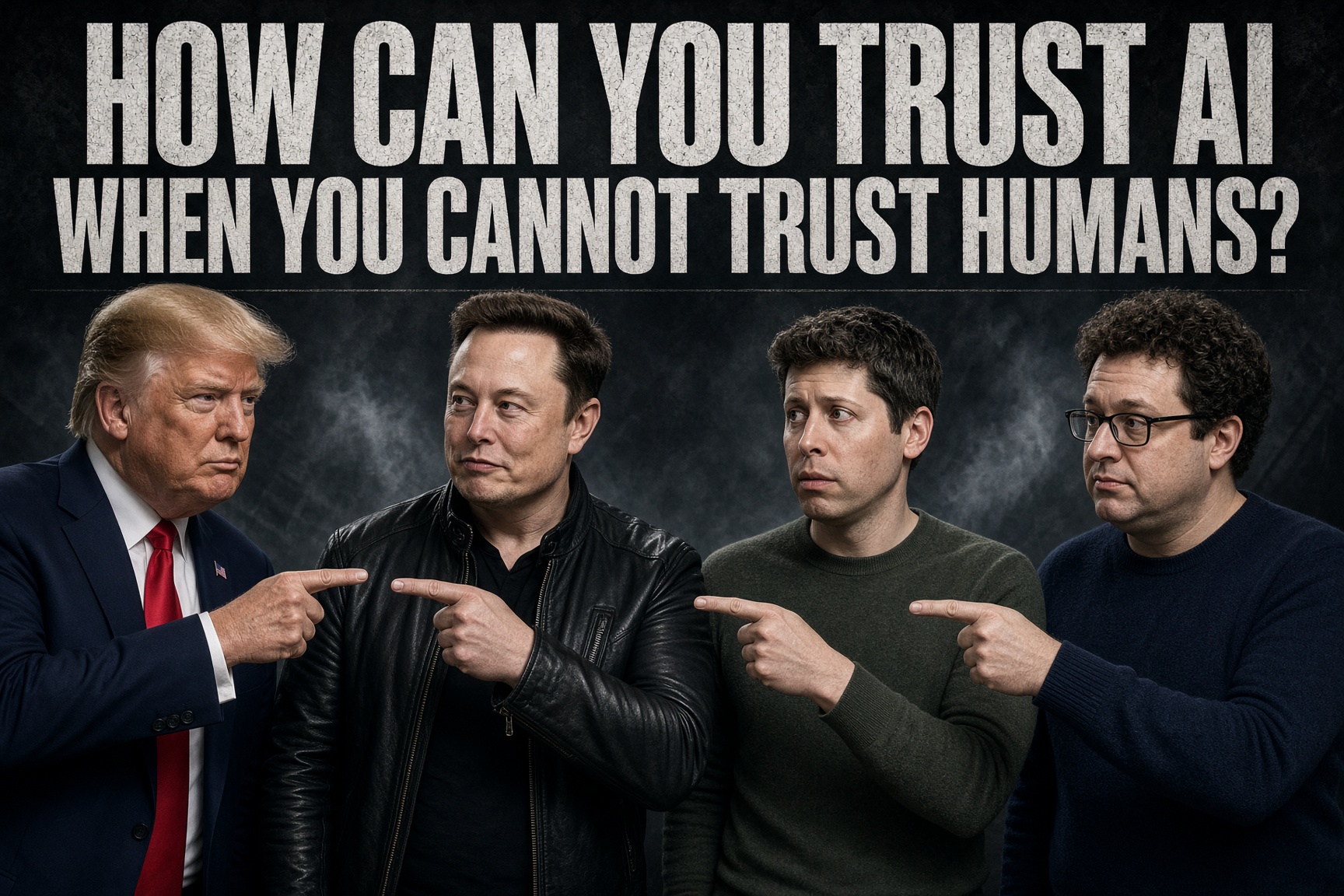
Can you trust AI? Can you trust humans? More often than we like to admit, the answer is no. AI inherits its failures from the human records it is trained on. Sheikh Mohammed bin Rashid wrote this month that the currency the UAE is betting on is trust. This piece sets out what a trust layer has to do, shows the method on three public knowledge graphs, and lays out the post-quantum work KXCO has published so that an institution can check the claim rather than take it.
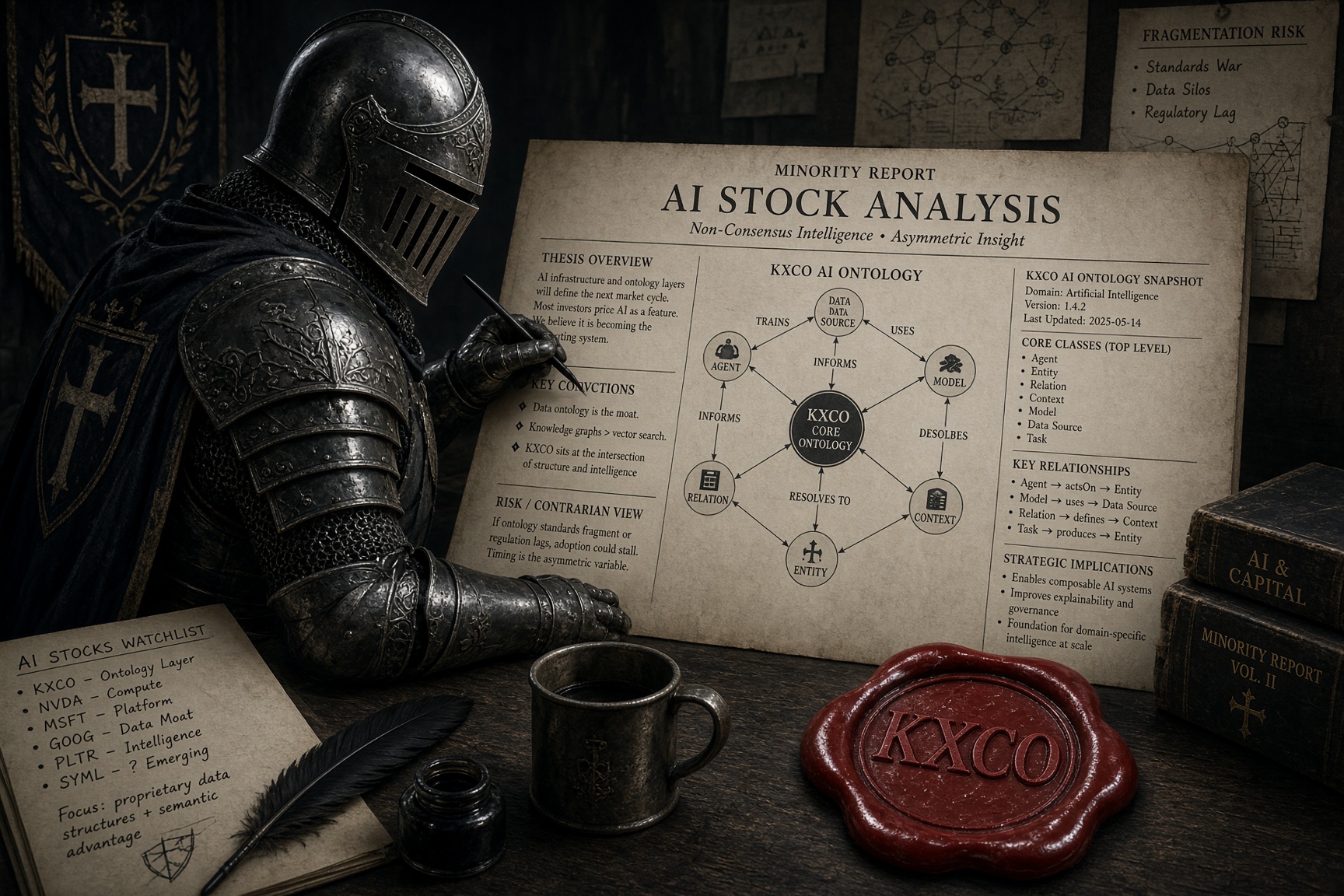
KXCO AI Ontology at 3 Months: What It Called and What Comes Next
On 19 July 2026 the Round Table's AI room published its first Analyst Outlook. To the 16 October 2026 close its 13 names rose 2.6% on an equal weight against 2.1% for QQQ, per StockAnalysis closes, and the six it opened with 35% or more of upside rose 8.6%. This piece lists the six names up more than 5%, the ten names I rate as opportunities now, the month's results in AI and quantum computing, and the official data showing that four in five firms have not yet started using AI.
Every story, signed and delivered.
Subscribe to the kxco channel and get the headline, the AI-written key takeaways, and the chain-anchor link the moment we publish. Audio versions and per-ticker subscriptions arrive in the next iteration.