
The AI–Quantum Convergence Is One Problem, Not Two — and It Needs One Environment
The BIS just warned that frontier-AI cyber risk favours attackers. Why AI and quantum are a single trust problem — and why one integrated, post-quantum, fact-based environment beats six vendors.
Part of theAI Stocks Center
Two revolutions are arriving at the same time, and most organisations are treating them as two separate problems. Artificial intelligence is moving into the core of the business — pricing risk, reading scans, writing code, and increasingly acting on its own through autonomous agents. Quantum computing, meanwhile, is advancing toward the point where it can break the cryptography that quietly secures almost every digital transaction on earth. Handled apart, each is an expensive, open-ended programme. Handled together, they turn out to be a single question: can you still prove what is true, and will the proof survive?
That question is no longer confined to technologists. In July 2026 the Bank for International Settlements — the central bank for central banks — published a bulletin titled *A Mythos moment? Frontier AI and cyber risk*, asking whether frontier AI models that can find and exploit software vulnerabilities represent a genuine turning point for financial stability.
"Frontier artificial intelligence (AI) models increase the speed, scale and complexity of cyber attacks, and they also strengthen cyber defence. But the costs are asymmetric and may favour attackers." — Aldasoro, Auer, Frost & Pérez-Cruz (2026), BIS Bulletin No 129
The BIS authors go further, noting that recent models can "autonomously carry out sophisticated multi-step, multi-vulnerability cyber attacks," and singling out the financial system as "an obvious place of concern" where a step change in attacker capability "could bear directly on financial stability." The uncomfortable implication is that the same intelligence now defending institutions is also arming those attacking them — and, for now, the economics favour the attacker.
Why patching your way out does not work
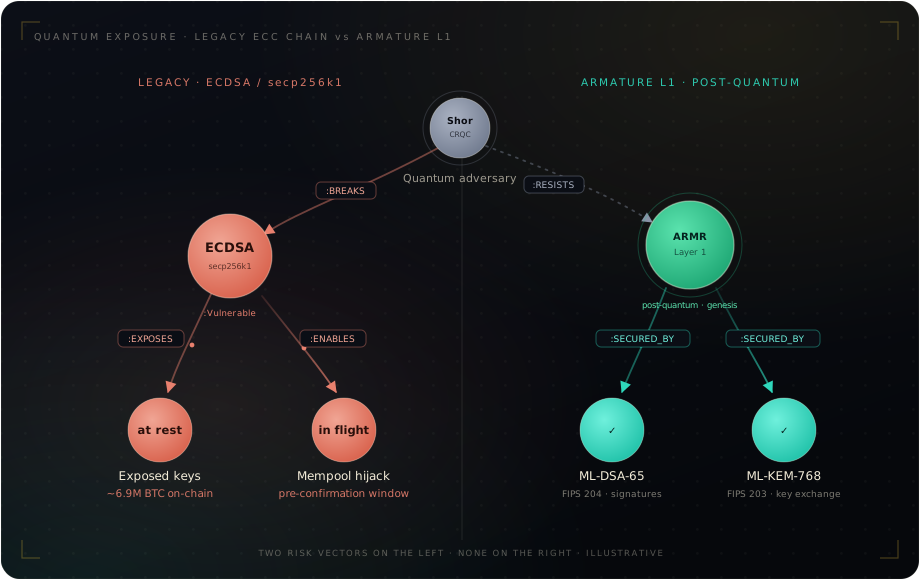
The instinct, faced with a cryptographic threat, is to upgrade. In August 2024 the United States' National Institute of Standards and Technology finalised the first post-quantum cryptography standards — new algorithms designed to withstand a quantum computer. The standards exist. The trouble is that migrating to them is not a patch; it touches every layer of a system, from the encryption between servers to the way identities are issued.
Bolting post-quantum protection onto a live system tends to introduce compatibility work, performance costs and — most dangerously — gaps. A platform that upgrades its headline signatures but leaves the connections between its servers, or the encryption of its stored data, on old cryptography has simply moved the unlocked window. And there is a clock running: under "harvest now, decrypt later," an adversary can copy encrypted data today and break it the day a capable quantum computer exists, retroactively exposing everything an organisation believed was private. You cannot retrofit your way to safety after the fact, because by then the data is already gone.
The only clean answer is to build systems that were post-quantum from the beginning — and to protect every surface, not just the obvious one.
One environment instead of six vendors
This is the case that KXCO, the technology company behind the Armature network, makes in a new white paper and a companion article for builders. Its argument is not that it sells a better quantum-resistant blockchain, a better identity product, or a better AI tool. It is that these things cannot be bought separately and bolted together without recreating exactly the seams attackers exploit — the "long, complex chains of proprietary and open source software" the BIS names as the financial system's weak point. The answer, KXCO argues, is a single environment where trust, record, judgment and meaning are the same system.
Four capabilities do the work, and the point is that they are inseparable:
A post-quantum record. The Armature network was built quantum-resistant from its very first block, across every cryptographic surface — not upgraded later. It settles transactions with instant finality and keeps a public, verifiable record.
Verifiable AI agents. Every autonomous agent is given a cryptographic identity and signs each action, so what it did is provable and cannot later be forged or denied — an answer to the "black box" problem that makes regulators nervous about AI making consequential decisions.
A fact-based ontology. This is the least familiar idea and the most important, so it is worth explaining.
A shared model of reality that ties the other three together, so that a fact is only treated as true when all of them agree.
Making truth fact-based, not just fast
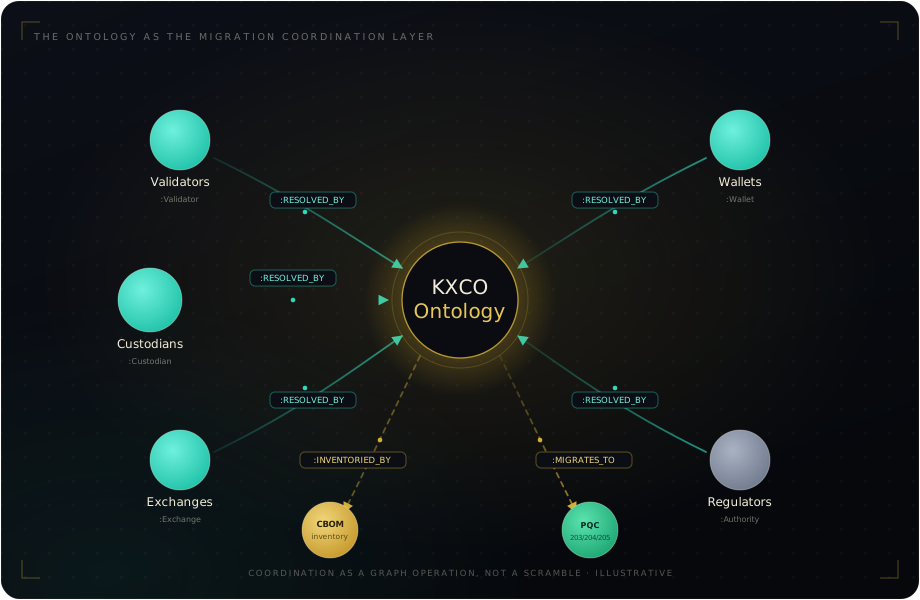
An ontology is a structured map of who and what exists in a domain and how they relate — the entities, the relationships, the rules. Most such maps are simply databases of assertions someone typed in. They can be edited, back-dated or quietly corrupted, and any AI that reasons over them inherits every error and every lie. A knowledge graph that can be tampered with is not an asset; it is a liability waiting to mislead.
KXCO's distinction is that it makes the map fact-based by construction. Every claim carries three things with it: its source, its date, and a measured confidence. Each is cryptographically signed and anchored to the Armature record, so it cannot be silently altered or invented, and anyone can check it independently. The effect is to turn the model from opinion into evidence — and, critically, to give AI something trustworthy to reason over. An AI grounded in a verified ontology cites evidence; an AI left to its own devices hallucinates. For a bank or a regulator, that is the difference between a system that can be audited continuously and one that must be taken on faith.
Why the whole is genuinely different from the parts
Put together, the effect is more than the sum of the pieces, because each answers a question the others cannot. Post-quantum cryptography answers can this be trusted, and will it hold? The record answers what happened, and when? AI answers what does it mean, and what next? The ontology answers what is actually true, and on whose evidence? Individually, each is a familiar product with familiar competitors. Together, they make a guarantee none of them can make alone: nothing is treated as real until all four agree — over the same fact, at the same time.
Consider an AI agent authorised to pay a supplier. Its identity is quantum-resistant; it signs the payment and settles it on the record instantly; a screening layer checks the action against its limits; and the supplier, the amount and the authority to pay are all sourced, verifiable claims in the ontology. If any one of those disagrees, the payment never becomes truth. No standalone blockchain, encryption library or chatbot can offer that, because each sees only one quarter of the picture.
Why it becomes hard to leave
Infrastructure earns a permanent place not by trapping customers, but by becoming the thing their proof depends on. That is the quiet argument underneath the white paper. Once an institution's identities are post-quantum, its record lives on the shared chain, its AI agents are individually accountable, its software is attested, and its facts are anchored in a verifiable model, the cost of walking away is not swapping one vendor for another. It is giving up the one record everyone else can already check. As more institutions anchor their claims in the same model of reality, that shared, verifiable picture grows more valuable to each of them — the same network effect that made the internet indispensable, applied to trust rather than information.
The BIS bulletin ends on the need for defenders to move quickly and to coordinate internationally. The convergence of AI and quantum is not a distant scenario to be scheduled for later; it is happening now, and it rewards the organisations that treated it as one problem before it arrived. The full technical case — with the specific products, the cryptographic detail and the architecture — is laid out in KXCO's companion article: Why KXCO Is the Indispensable Environment for the AI–Quantum Era.
KXCO is a software company; regulated services are operated by licensed institutions. Nothing here is investment advice. BIS Bulletin material © Bank for International Settlements 2026, quoted under the BIS terms permitting brief excerpts with attribution.
Harvest Now, Decrypt Later: Why KXCO Took Its Ontologies Private
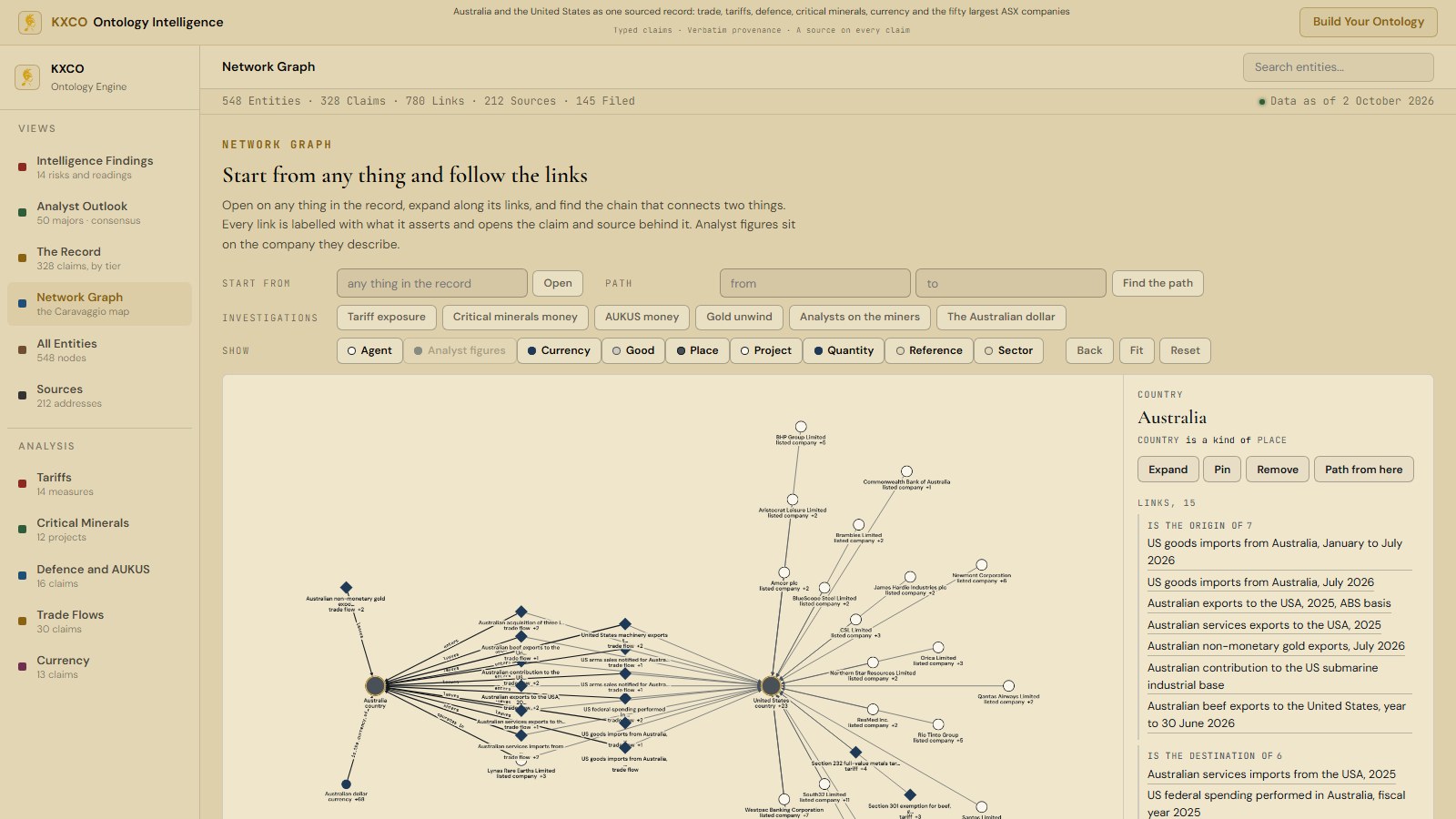
For more than 90 days KXCO ran its ontologies in public: the AI sector resolved from six names to one lithography supplier, and Australia's trade with the United States as one sourced record. They proved the method. They are now private, still running, for KXCO and its clients only. Europol's report on harvest now, decrypt later explains why: data collected today will be read when a quantum computer arrives, and a graph of your relationships is the most valuable thing to harvest.
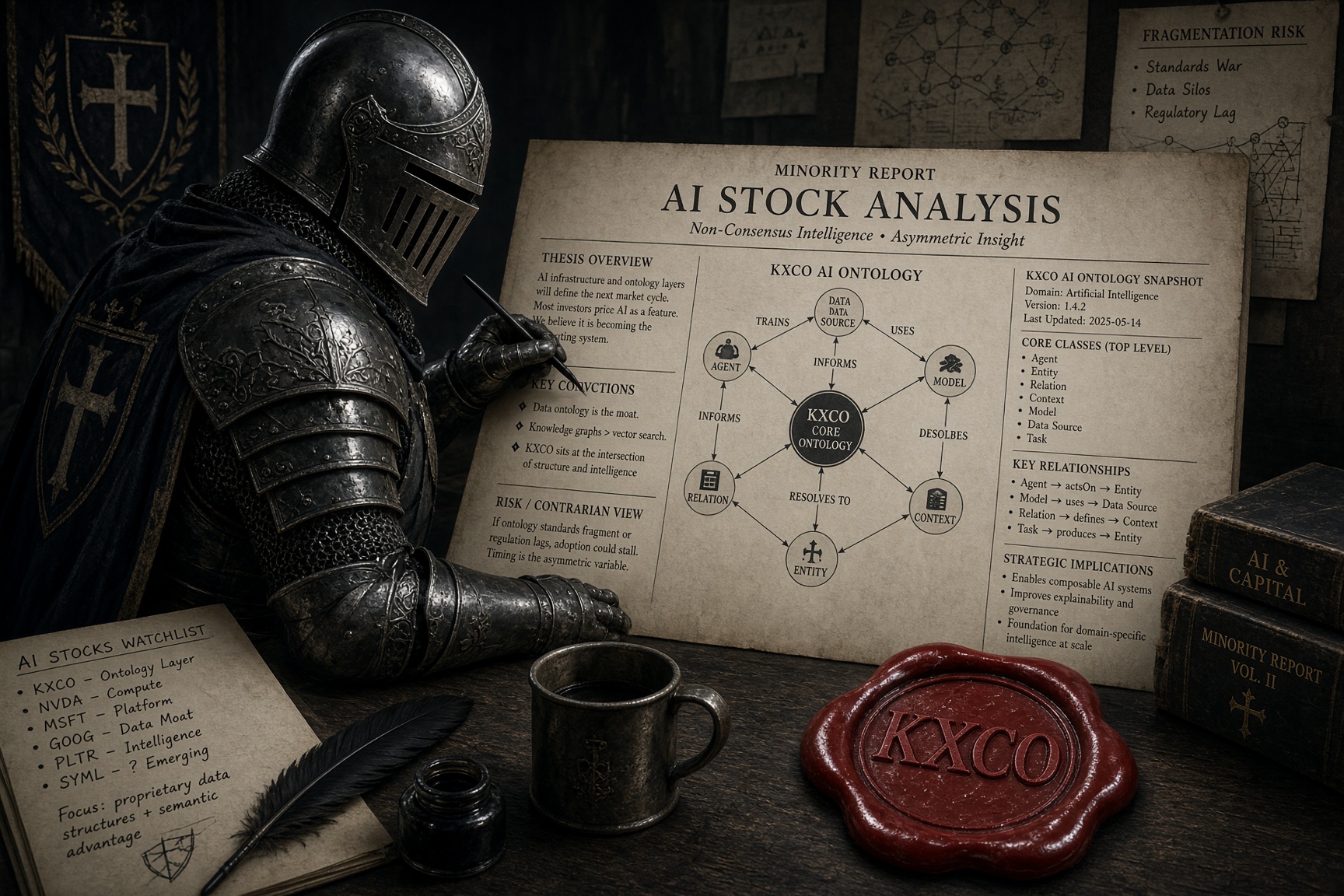
KXCO AI Ontology at 3 Months: What It Called and What Comes Next
On 19 July 2026 the Round Table's AI room published its first Analyst Outlook. To the 16 October 2026 close its 13 names rose 2.6% on an equal weight against 2.1% for QQQ, per StockAnalysis closes, and the six it opened with 35% or more of upside rose 8.6%. This piece lists the six names up more than 5%, the ten names I rate as opportunities now, the month's results in AI and quantum computing, and the official data showing that four in five firms have not yet started using AI.

What the Round Table Is Predicting in Biotech Markets
Seventeen FDA decisions fall due between 30 October 2026 and 29 June 2027, and KXCO's Round Table has called every one. Its model portfolio holds the thirteen Nasdaq companies behind them, led by BridgeBio, Cogent Biosciences and Praxis, and was signed with ML-DSA-87 and anchored on chain before the FDA acts. The first test is Inovio's INO-3107 on 30 October.

SpaceX: The Road to 10 Gigawatts
SpaceX did not add an AI business. A company whose processes run on compute built its own computing plant, then built the power to run it. The 10-Q reports 1.4 gigawatts of nameplate compute at 30 June 2026, four leases worth about $41 billion a year and $100 billion of cash. The target is closer to 10 gigawatts than 5 by the end of 2027. This piece sets out the build sequence, the four layers of power in Memphis, and why Terafab is the act after 2027, not the road to it.
Every story, signed and delivered.
Subscribe to the kxco channel and get the headline, the AI-written key takeaways, and the chain-anchor link the moment we publish. Audio versions and per-ticker subscriptions arrive in the next iteration.