
Worthship: Do Not Conform to the Age
Bishop Barron on Romans 12, the letters Paul wrote in chains, and the practised strength that keeps a Catholic mind from despair.
Part of theRamblings
On the Twenty-second Sunday in Ordinary Time, 30 August 2026, Bishop Robert Barron stood in an ordinary pulpit and did the least ordinary thing a public man can still do. He refused the age. The sermon runs fourteen minutes and twelve seconds. The title is "A Living Sacrifice." The text is Romans 12:1-2. You can watch it on his channel, and the standing invitation to everything else he has said for twenty years is the same channel. Word on Fire keeps the written landing page at wordonfire.org.
Barron begins where English still remembers what worship is. The older word is worthship. To worship is to ascribe worth. It is not a mood and it is not a playlist. It is the act of saying, with the whole of a life, what is highest.
What worthship actually means
The lectionary text that morning was blunt. "I appeal to you therefore, brothers and sisters, by the mercies of God, to present your bodies as a living sacrifice, holy and acceptable to God, which is your spiritual worship. Do not be conformed to this world, but be transformed by the renewing of your minds, so that you may discern what is the will of God, what is good and acceptable and perfect."
Worth noting before we go further: where the English says "this world," the Greek says toi aioni toutoi, this age. Barron preaches it as age and so will I, because world sounds like the planet and age sounds like what it is, a period with a management style.
Listen to Barron on what conformity actually is. I am quoting him, not decorating him.
"See, what's it mean to be conformed to the age? That means I'm worshipping things that every sinner around me worships. That means sex and pleasure and money and power and country and family and everything else that gets worshipped. When I turn my energies and my powers and everything in me to these false gods, I get off-kilter. I become sort of cattywampus. I'm lost."
Cattywampus is not a theological term. It is a Midwestern way of saying the furniture of the soul has been shoved against the wrong wall. The age always has a catalogue of things that must be treated as ultimate. In Paul's Rome it was the emperor, the household gods, the career, the appetite, the tribe. In our Rome it is the same list with better lighting. The feed will tell you what is worth your fear this morning. The market will tell you what is worth your life. The party will tell you what is worth your neighbour. None of those voices is shy. All of them are crowded. Paul's instruction is not to become a hermit. It is to refuse to let the crowd set the price of a soul.
Four readings, one instruction
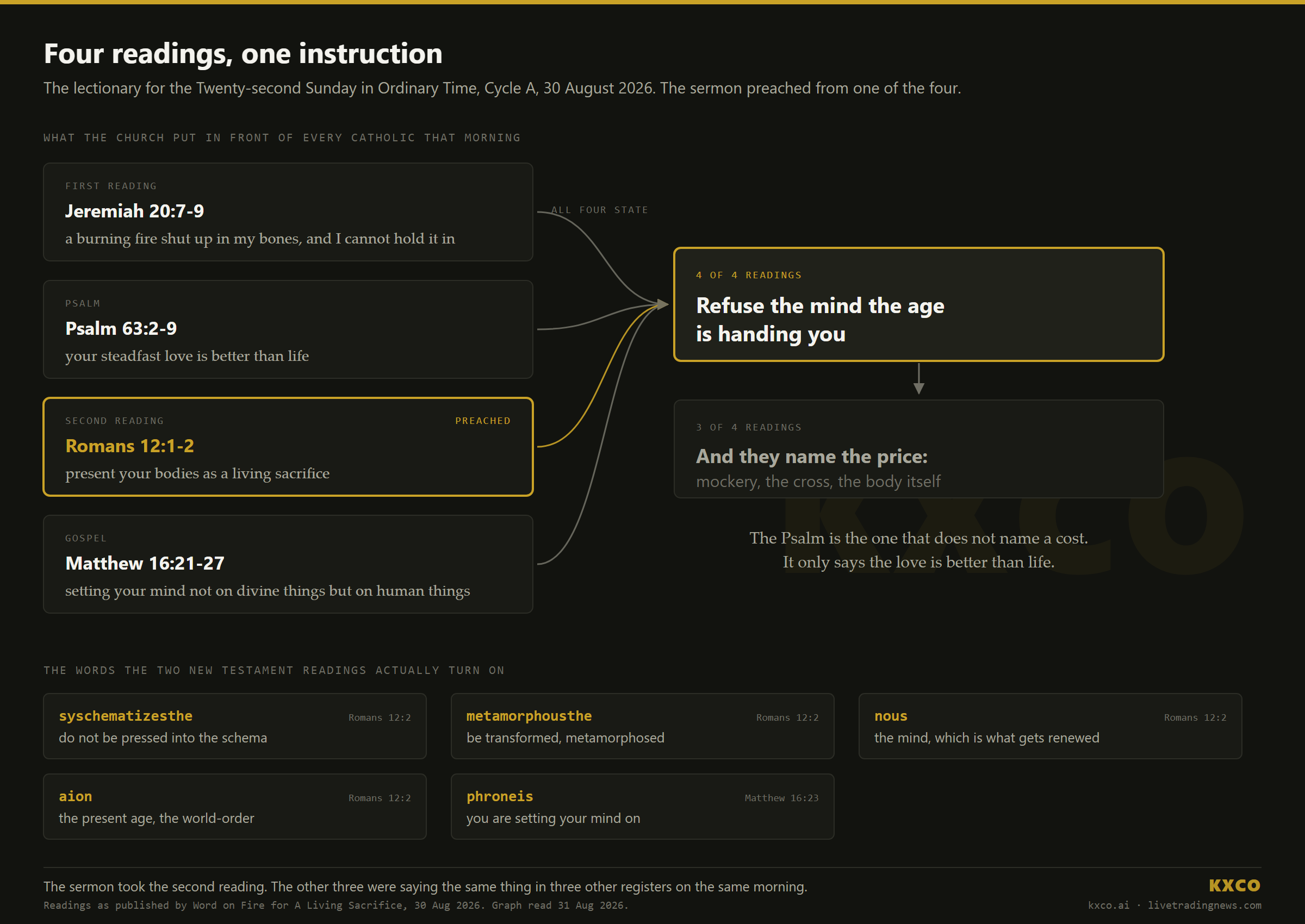
Figure 1. The four readings appointed for the Twenty-second Sunday in Ordinary Time, Cycle A, 30 August 2026, mapped as a small graph. All four state the same instruction. Three of the four also name what it costs.
Here is something I did not expect when I sat down to write about a single sermon, and it is the reason this essay has a graph in it.
Barron preached the second reading. He had three others in front of him, and the Church had put all four in front of every Catholic in the world that same morning. I loaded the day's lectionary into a small graph and asked a dull question: do these four texts say the same thing, or four different things?
They say the same thing, in four registers.
Jeremiah is mocked all day long and cannot stop speaking, because the word is a burning fire shut up in his bones. The Psalm says the steadfast love is better than life. Romans says do not be pressed into the shape of this age. And the Gospel, Matthew 16, has Jesus turn on Peter with the sharpest version of it: "you are setting your mind not on divine things but on human things." The Greek there is phroneis, you are setting your mind on. It is Romans 12 stated as a rebuke rather than an appeal, and it was read on the same morning, from the same lectern, twenty minutes apart.
Three of the four also name the price. Jeremiah is a laughingstock. Matthew says take up the cross and lose your life to find it. Romans says the thing offered is the body itself. Only the Psalm declines to name a cost, and it only says that the love is better than life, which is a cost stated as a preference.
That convergence is not a discovery. Any liturgist could tell you the readings are chosen to agree. The point is what it does to the sermon. Barron was not making an argument on one text. He was reporting the weather of an entire morning.
What Paul was doing when he wrote that sentence
Romans is not a prison letter. That matters, because we like our saints already safely miserable. Paul wrote Romans from Corinth, most likely in the winter of AD 56 to 58, near the end of his third missionary journey, while he was gathering the collection for the poor in Jerusalem and planning a westward push he hoped would take him through Rome to Spain. He was free. He was also a marked man. He had already been beaten with rods, stoned and left for dead at Lystra, imprisoned at Philippi, hunted in Damascus, shouted down in Ephesus, and nearly torn apart by a mob in Jerusalem on a previous visit. He sat in a working port city and wrote the most architected letter in the New Testament to people he had not yet met, because he wanted the capital of the world to hear the gospel before the capital of the world decided what to do with him.
Chapter 12 is the hinge. Eleven chapters of mercy, covering justification, Abraham, Adam, the Spirit and the mystery of Israel, and then the therefore. Because of the mercies of God, present your bodies. The body is not an afterthought. In a city that treated bodies as instruments of appetite and display, Paul said the body itself is the altar. Worthship is not an interior hobby. It is a public arrangement of time, money, speech, sex, work and attention.
Then: do not be conformed to this age. The Greek is syschematizesthe, do not be pressed into the schema of the aion, the present world-order. The counter-verb is metamorphousthe. Be metamorphosed. The agent of the change is the renewal of the nous, the mind. Discernment is the fruit, not the technique. You do not first figure out God's will and then become holy. You become a living sacrifice and the mind clears enough to tell good from glossy.
That is the letter written in relative freedom. The letters written in chains are how you test whether the teaching survives contact with despair.
The conditions under which he refused to break
Between the writing of Romans and the end of Acts, Paul walked into the machine that Rome reserved for inconvenient men. Arrested in Jerusalem around AD 57. Held two years at Caesarea under Felix and then Festus, a legal limbo designed to exhaust a prisoner who would not pay. He appealed to Caesar because a provincial governor would have handed him to the crowd. The voyage to Rome included a fourteen-day storm and a shipwreck on Malta. Acts 28 says he spent two further years in Rome under house arrest, chained to a soldier, paying his own keep, receiving visitors, teaching "with all boldness and without hindrance."
The traditional dating puts the Prison Epistles, Ephesians, Philippians, Colossians and Philemon, in that window of AD 60 to 62. Some careful scholars argue for an earlier Ephesian imprisonment for part of that group. Either way the physical facts do not soften. He was not at a writing desk in a quiet rectory. He was a man whose travel plans had been cancelled by iron.
The despair was written free. The joy was written in chains.
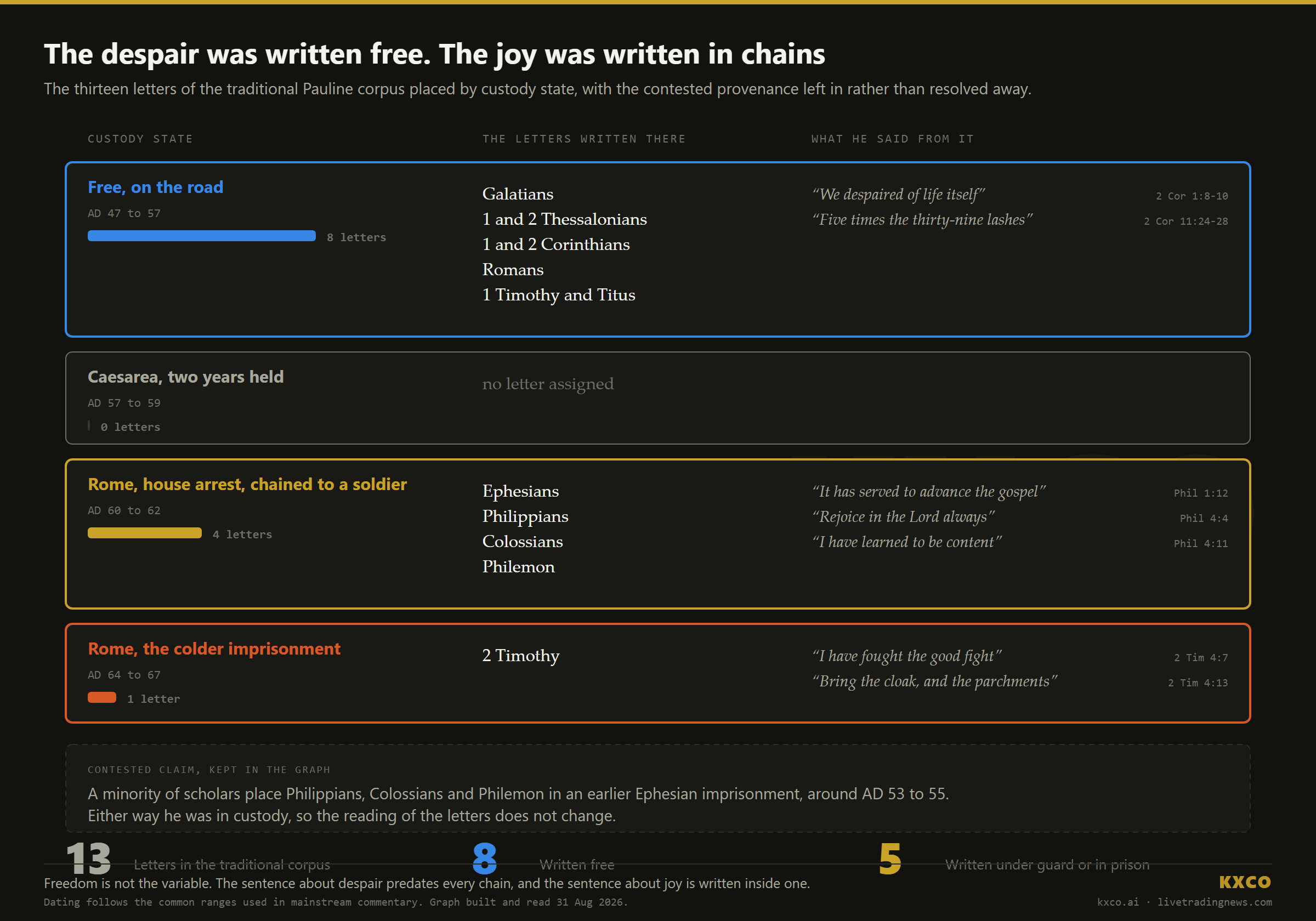
Figure 2. The thirteen letters of the traditional Pauline corpus placed by custody state, with the contested Ephesian provenance kept in the graph rather than resolved away.
I put the corpus into the graph as well, because I wanted to know whether the pattern I thought I saw would survive being counted.
Thirteen letters in the traditional corpus. Eight written free. Five written under guard or in prison, four of those in the Roman house arrest and one in whatever colder room came after. Caesarea, the two years that look most like punishment from the outside, produced nothing that has come down to us at all.
Then the thing worth the whole exercise. Philippians is the scandal of the corpus. It is the most joyful letter Paul wrote and he wrote it with a soldier attached to his wrist. "I want you to know, brothers, that what has happened to me has really served to advance the gospel." The whole praetorian guard has heard. Some preach Christ from envy, and he will take the sermon anyway. "To live is Christ, and to die is gain." "Rejoice in the Lord always; again I will say, rejoice." "I have learned in whatever situation I am to be content." "I can do all things through him who strengthens me," which read in context is not a gym slogan. It is a man saying that hunger and plenty are both survivable if the worthship is intact. He thanks the church at Philippi for a gift sent through Epaphroditus, who nearly died bringing it. He names two women who are quarrelling and asks them, from a cell, to agree in the Lord.
Now put the other sentence beside it. "We were so utterly burdened beyond our strength that we despaired of life itself. Indeed, we felt that we had received the sentence of death." That is 2 Corinthians, written from Macedonia after the bruising years in Asia, and Paul was a free man when he wrote it. Free, travelling, in charge of his own diary, and he says he despaired of life itself.
So freedom is not the variable. The despair sentence predates every chain in his life. The joy sentences are written inside one. Whatever was holding that mind together, it was not his circumstances, and it was not a personality that had never met the dark. He finishes the despair passage by saying why it happened: "that was to make us rely not on ourselves but on God who raises the dead." The resistance was not cheerfulness. It was a transfer of weight, off the self and onto the God who raises the dead. That is the entire psychology of the man, stated without ornament.
Later still, if the traditional reading of 2 Timothy holds, the house arrest tightened into a colder imprisonment under Nero, with death no longer hypothetical. "I am already being poured out as a drink offering." "The time of my departure has come." "I have fought the good fight." Demas has gone to Thessalonica because he loved this present age, the same aion Romans 12 told the church not to be pressed into. Only Luke is with him. He asks for a cloak and the parchments. He is cold and he still wants books. That last detail is not charming. It is the practice. The mind stays in the text while the empire decides the date.
Add the catalogue he gave the same Corinthian church when they were impressed by smoother apostles: five times the thirty-nine lashes, three times beaten with rods, once stoned, three times shipwrecked, a night and a day adrift, rivers, robbers, wilderness, sea, false brothers, sleeplessness, hunger, thirst, cold, and the daily anxiety for all the churches. He does not recite this as a brand. He recites it because the super-apostles were selling a gospel that did not include a cross. The age always prefers a gospel that does not include a cross. Paul's mental strength is not the absence of those facts. It is the refusal to let those facts become the highest thing in the room.
What the age is asking of us now
Barron's list, sex and pleasure and money and power and country and family, is not a puritan inventory. Family is a good. Country can be a duty. Money is a tool. Pleasure is not a crime. The problem is worthship: treating a good as an ultimate. The age does not usually demand that you deny God in a formal sentence. It demands that you give the goods the attention, fear and sacrifice that belong to God, and then it calls the result sanity. A market that prices attention will call you unsophisticated if you withhold it. A politics that prices rage will call you complicit if you refuse the script. A culture that prices the self will call you repressed if you offer the body as something other than a project. Conformity is rarely announced as conformity. It arrives as the tone of the room.
I work in markets. The temptation of this desk is to treat the tape as the real world and everything else as a hobby. Prices are real. Payrolls are real. Wars are real. None of them is ultimate. The moment a trader, a founder, a minister or a parent lets the age name the highest good, the mind starts to lean. Anxiety becomes piety. Outrage becomes virtue. Success becomes proof. Failure becomes a verdict on the soul. Paul would have recognised the lean. He called it schema. Barron called it cattywampus. Both are describing a person whose interior furniture has been arranged by someone who does not love them.
Non-conformity, in this register, is not eccentricity and it is not nostalgia. It is not the personality of being against things. The transformed mind can still love a city, build a firm, raise children and read a balance sheet. It simply will not burn the offering on those altars. The test is always the same. What, if lost tomorrow, would make you decide that life has become unsayable? If the answer is a ticker, an office, a following, a party, or even a family treated as an idol rather than a gift, you have already conformed. Paul lost freedom, reputation, health and finally his life, and the letters get clearer, not smaller. That is the data.
The strength is not a temperament. It is a practice.
People talk about Paul's resilience as if it were a personality type. The intense convert. The high-agency operator. The man who could sleep on a shipwreck. Personality does not write Philippians from a chain. Practice does. Faith does. The two are not rivals. Faith without practice is a mood. Practice without faith is a gym for the ego. Paul had both, and he named the source: "It is no longer I who live, but Christ who lives in me." The renewed mind is not self-help with candles. It is a life offered, daily, until the offering becomes the default posture rather than a weekend effort.
What did the practice look like in the conditions he actually had? He prayed without ceasing, which in his case meant he talked to God from a rented room with a soldier attached to his wrist. He sang in the Philippian jail at midnight before the earthquake, which means the practice preceded the miracle. He kept companions and named them, Timothy and Luke and Tychicus and Onesimus and Epaphroditus, because isolation is how despair wins. He kept working: tents when he could, letters when he could not. He kept the collection for the poor moving even while his own legal bill was unpaid. He read, and at the end he wanted the parchments. He examined himself and admitted the despair in Asia instead of branding it as strategy. He blessed churches that were disappointing him. He refused to let a quarrel between Euodia and Syntyche become smaller than the gospel. None of that is cinematic. All of it is repeatable.
This is the level of mental strength the age will require of anyone who does not intend to be eaten by it. Not the strength to dominate a comment thread. The strength to remain a living sacrifice when the schema is loud, when the body is tired, when the news is a war, when the portfolio is red, when the friends have a better offer, when the night is long and the cloak has not arrived. Paul did not wait to feel brave. He practised worthship until bravery was no longer the point. The point was a mind that could still tell the difference between a good and a god.
Faith, here, is not the denial of facts. It is the decision about which facts get to be final. The sentence of death in Asia was a fact. The chain in Rome was a fact. Nero was a fact. The resurrection, for Paul, was a more final fact. That ordering is what kept the despair from becoming a theology. You cannot talk yourself into that ordering on the morning you need it. You build it on the mornings you do not. Scripture, prayer, the company of the unfashionable, the refusal of the small altar, the offering of the body when the body would rather scroll. These are not accessories to strength. They are how strength is made in a creature who is not an angel.
A living sacrifice in a loud century
Barron closes the short passage where Paul closes it. Right worship, a rightly ordered life, a mind that is being renewed, and then the capacity to discern what is good, pleasing and perfect. Discernment is downstream of worthship. That is why a culture with infinite information still cannot tell what a human being is for. It has not decided what is worthy. It has only decided what is trending. The feed is a liturgy. It ascribes worth by repetition. If you do not bring another liturgy to the day, that one will do the ascribing for you.
I am not a bishop and this desk is not a pulpit. I am an economist who has watched intelligent people hand their interiors to an age that does not know their names. The counsel is older than my profession. Do not be pressed into the schema. Offer the body. Renew the mind. Practise until the chain, if it comes, does not get to name you. Paul wrote the most joyful letter of his life with a soldier in the room. That is available. It is not cheap. It takes the kind of faith that keeps asking for the parchments when the cloak has not come, and the kind of practice that sings at midnight before anyone has promised an earthquake.
There is a last honesty owed to anyone who has actually been near despair. Paul's strength did not feel, on the worst nights in Asia, like strength. It felt like the end of his own resources. That is why he says the sentence of death was given so that he would not rely on himself. The practice is what you do after you have admitted that. You get up. You pray the same psalms. You write the same kind of letter to people who cannot help you. You refuse the small bitterness that wants to become a worldview. Faith is not the denial that the night was dark. Faith is the decision that the dark is not God. Repeat that decision long enough and the mind becomes a place a human being can live in, even when the age is shouting and the body is not free.
Watch the sermon. Barron is a clear teacher and he does not waste the text. "A Living Sacrifice," Bishop Barron's Sunday sermon. Stay on the channel: Bishop Robert Barron on YouTube. Then read Romans 12 slowly, and Philippians 1 and 4, and 2 Corinthians 1:8-10, and the last chapter of 2 Timothy. Read them as letters from a man who knew the weather of despair and refused to let it become the climate. That refusal is the work. The age will not do it for you.
Questions readers have asked
What does worthship mean? Worthship is the older English form of worship. It means to ascribe worth, to declare with a whole life what is highest. Bishop Barron uses the older word because the modern one has drifted toward mood and music.
What does Romans 12:2 mean by "do not conform"? The Greek verb is syschematizesthe, do not be pressed into the schema, the shape, of this present age. The counter-verb is metamorphousthe, be transformed, and the thing transformed is the nous, the mind.
Was Paul in prison when he wrote Romans? No. Romans was written from Corinth around AD 56 to 58 while he was free. Five of the thirteen letters in the traditional corpus were written under guard, including Philippians, which is the most joyful of them.
Which sermon is this? "A Living Sacrifice," preached by Bishop Robert Barron for the Twenty-second Sunday in Ordinary Time, Cycle A, 30 August 2026. It runs fourteen minutes and twelve seconds.
Shayne Heffernan, Ph.D., is the founder of Live Trading News, the KnightsBridge Group, Knightsbridge Law and the KXCO.ai ecosystem spanning post-quantum cryptography, identity, attestation and enterprise ontology. Further essays at shayneheffernan.com and his Live Trading News archive.
Sources and method. Scripture quoted in standard English translations. The Romans 12:1-2 text is the lectionary reading as published by Word on Fire for this sermon. Historical dates for Paul's letters follow the common ranges used in mainstream commentary: Romans from Corinth c. AD 56-58, the Prison Epistles commonly placed in the Roman house arrest of AD 60-62, and 2 Timothy traditionally in a later Neronian imprisonment. Some scholars argue an Ephesian origin for part of the prison corpus. The conditions of custody are not thereby made gentle, and the alternative is carried in the graph behind Figure 2 rather than resolved away. Both figures were built in Neo4j and read on 31 August 2026.
Thoughts on Thinking: Take an Art Break
The best way I know to keep complex work in perspective is to stop at intervals and look at something that took the same order of sustained attention under real constraints. The studies now show what that does: a museum visit restored attention where an urban walk did not, judging the beauty of an object raised abstract thinking almost 14 per cent, and artistic film raised originality even in people who felt worse for it. Five works, Leonardo to Holbein, and the non-default decision in each.
The Evil Legacy of the French Revolution
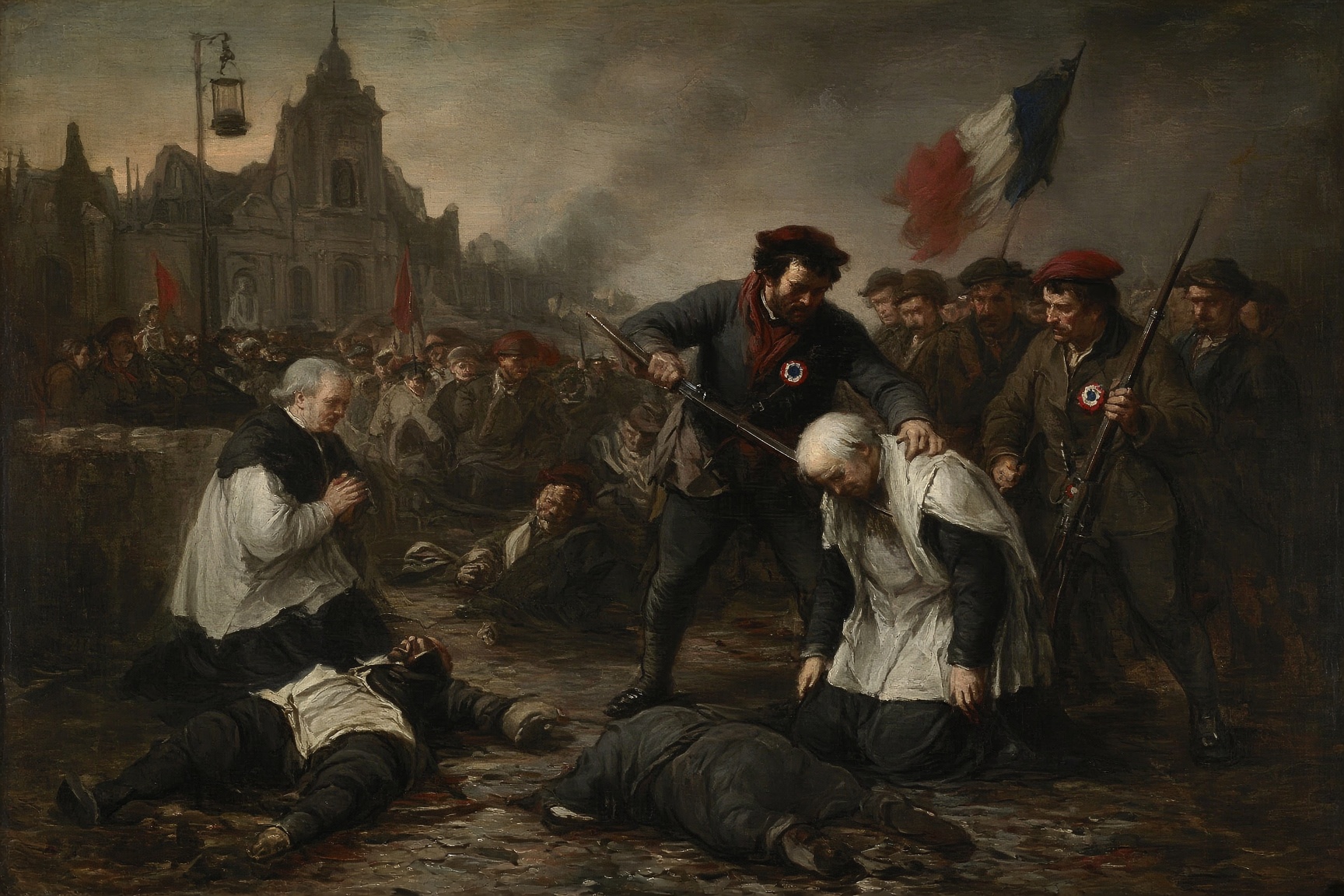
The French Revolution is still sold as the birthday of the modern world. The ledger does not match the posters. It seized the Church's land and floated its paper money on the seizure, hunted the priests who would not swear, defined the nobility as a moral enemy, and put in their place a political class accountable chiefly to itself. Four knowledge-graph exhibits trace who put the king and queen on the scaffold, and how the template left France.
Careful of the Prompts You Give Yourself
A prompt is not only what you type into a model. It is any sentence that gets inside you and starts issuing orders. Most of what we call goals were written by comparison, media, competition and now the model, and they arrive dressed as ambition. Shayne Heffernan maps how an imported sentence becomes a week, why a want should carry its source the way a Round Table claim does, and how to strip, lock and guard the objective that is actually yours.
KXCO is Enhanced Intelligence, Not Artificial
I never wanted artificial intelligence. I wanted enhanced intelligence, and they are not the same product. Artificial means the machine does the thinking and hands you the answer. Enhanced means I do the thinking, with more of my own mind in the room than I have ever had at one time. Forty years of reading, recallable in the second I need it. Patterns across law, credit, physics and markets that no specialist sees, because the useful ones sit between the fields rather than inside them.
Every story, signed and delivered.
Subscribe to the kxco channel and get the headline, the AI-written key takeaways, and the chain-anchor link the moment we publish. Audio versions and per-ticker subscriptions arrive in the next iteration.