
The Evil Legacy of the French Revolution
The attack on the Catholics, the demonisation of the nobility, and the rise of a political class with nothing left above it.
Part of theThinking Center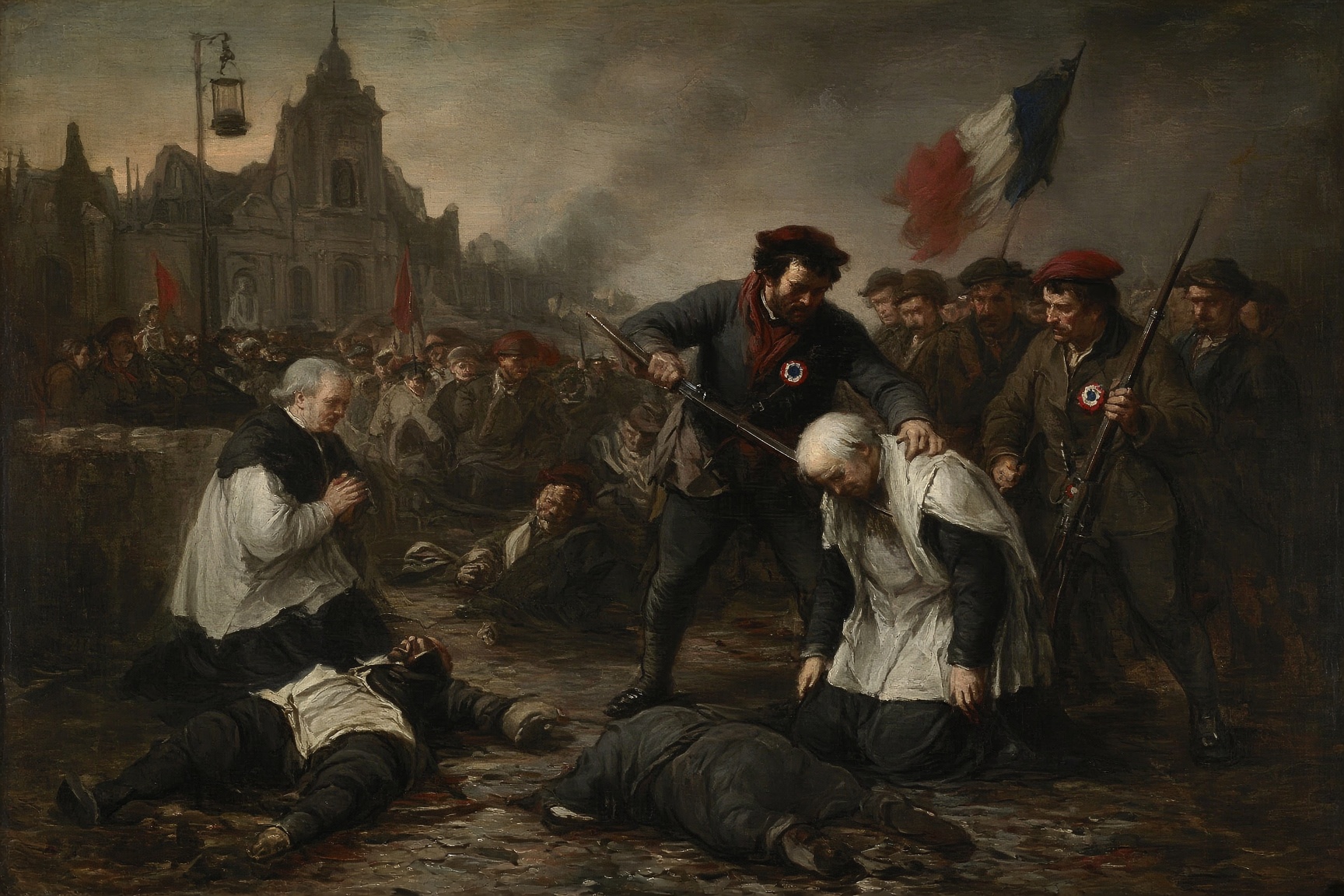
“A society that means to last needs three things, and it needs them in order. It needs the Church, to remind the king that he is not God. It needs the monarchy, to remind the politicians that they are not the king. And it needs a government, to do the ordinary work of the country under both. For God, for King, and for Country, in that order. Reverse that order and you do not get liberty. You get a political class with nothing left above it.”
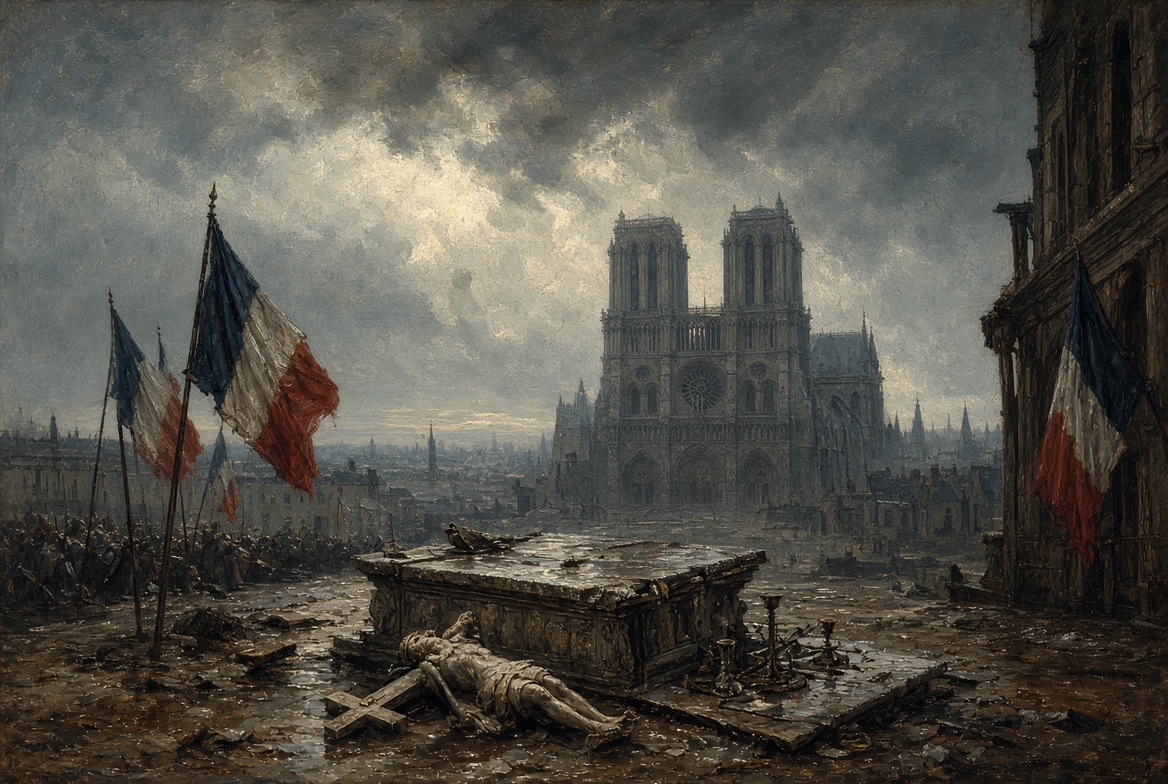
Illustration for this essay. Paris under the new order: the cathedral still stands; the altar does not.
The French Revolution is still sold as the birthday of the modern world. Liberty, equality, fraternity. The rights of man. The end of superstition. The career open to talent. The posters have not changed in two centuries. What has changed is that we now have the ledger, and the ledger does not match the posters.
I have never accepted the polite version. The Revolution was not a tragic excess on the way to a liberal settlement. The excess was the method. It attacked the Catholic Church because the Church was the one institution that could tell a ruler he was not God. It destroyed the nobility because the nobility was the one class that could tell a politician he was not the king. Into the space it cleared, it put something new: a political class, accountable chiefly to itself, armed with the language of the people and the powers of a crown.
That is the evil legacy. Not the guillotine as a machine. The guillotine was retired. The idea was not.
France in 1789 was a Catholic kingdom of about twenty-eight million people. The Church baptised them, married them, and buried them. It ran much of what passed for schooling and for the relief of the poor. It was also rich, uneven, and in places corrupt. None of that is in dispute, and none of it licensed what followed. A reforming king could have taxed the clergy, cleaned the monasteries, and left the Mass alone. The Revolution did not want a cleaned Church. It wanted a subordinate one, and then it wanted none.
I. The attack on the Catholics
The sequence is not obscure, and it should not be softened. In November 1789 the National Assembly placed the land of the Church “at the disposal of the nation.” The assignat, the paper money of the Revolution, was floated on that seizure. This is the part the civic textbooks skip, and it is the part an economist cannot skip. The new regime funded itself by confiscating the endowment of the religion of the country, then treated the resistance of the clergy as an attack on the public credit. Steal the asset. Then prosecute the former owner for obstructing the market you have just invented.
On 12 July 1790 the Assembly passed the Civil Constitution of the Clergy. Dioceses were redrawn to match the new departments. Bishops were to be elected, by electors who did not have to be Catholic. Priests were to become salaried officers of the state. The oath they were required to swear broke, in practice, the obedience they owed to Rome. Pope Pius VI condemned it. Almost every bishop refused. About half the parish priests refused. Those who refused (the refractory, the non-jurors) became the first internal enemy of the new order.
This was not a quarrel about vestments. It was a claim that the state could rewrite a sacrament and a see. A priest who would not swear was not arguing about the budget. He was saying that there was an authority in the room the Assembly had not appointed. That is precisely why he had to be broken. A political class can tolerate a religion that blesses it. It cannot tolerate a religion that can refuse it.
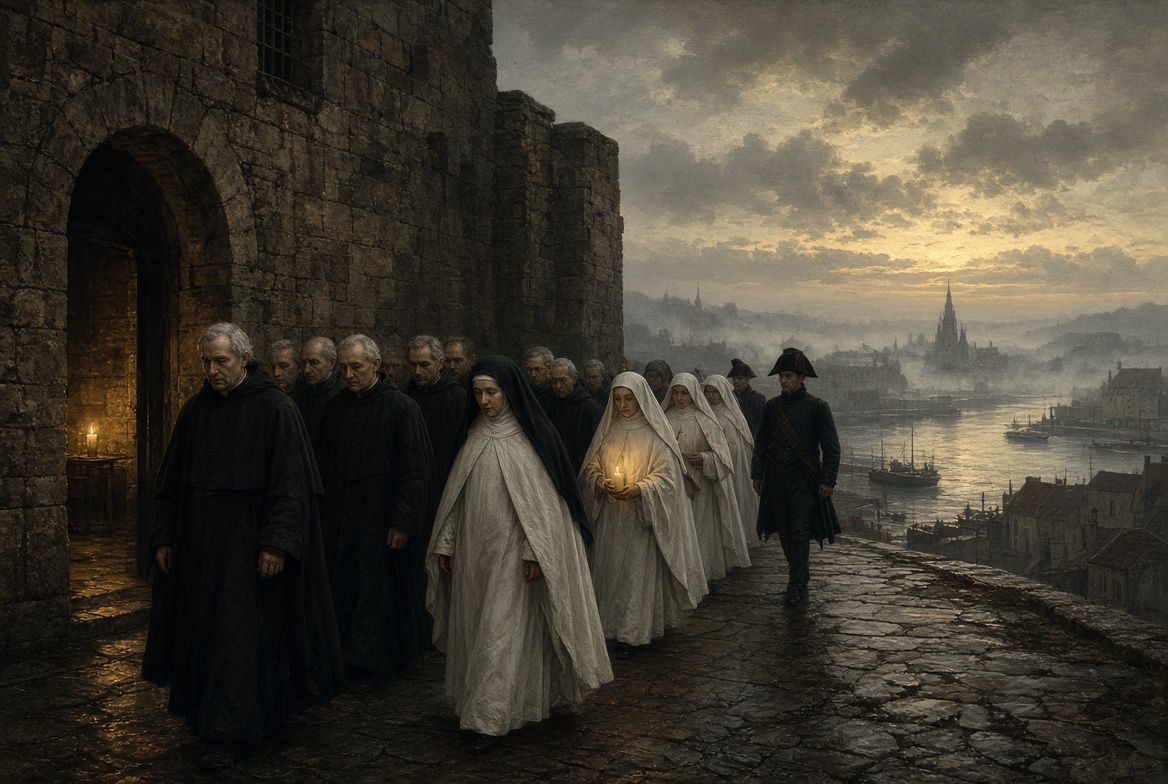
Illustration for this essay. Refractory priests and religious, the first designated enemies of the Revolutionary state.
By 1792 the break was a hunt. In August the Legislative Assembly ordered the deportation of refractory priests. In September, with Prussian troops on the road and the prisons full of people the new regime did not trust, the crowds went in. The September Massacres ran from the 2nd to the 6th. In Paris alone something on the order of two hundred to two hundred and fifty priests were killed in the prisons, among them Jean-Marie du Lau, Archbishop of Arles, and the two La Rochefoucauld bishops. The Church later beatified one hundred and ninety-one of the Paris dead as martyrs. They had not taken arms. They had refused an oath, and a crowd had been told that an unsworn priest was a traitor waiting for the enemy.
The legal Terror came after, and it is worth counting properly, because exaggeration is the enemy of memory. Donald Greer’s statistical study of the revolutionary tribunals (still the sober baseline, published in 1935 and not improved on for the formal condemnations) found the clergy a small share of death sentences, about six or seven percent, and, with the nobility, hit far harder than their numbers.
That count is the floor, not the ceiling. It does not include the September killings. It does not include the prison ships. At Rochefort, eight hundred and twenty-nine priests and religious were held on hulks, waiting for a deportation to Guiana that never came. Five hundred and forty-seven of them, about two-thirds, died of disease, hunger, and the conditions of the confinement. It does not include the drownings at Nantes, where Jean-Baptiste Carrier began by putting refractory clergy into the Loire (about ninety on one night, fifty-eight on another) and called it the national bathtub, before opening the same method to prisoners in general.
Across 1792 to 1800, the serious surveys put the priests, monks, and nuns who died for the faith at nearly three thousand. About thirty thousand priests were driven out of France. Under the dechristianisation of 1793 and 1794, some twenty thousand constitutional priests, men who had taken the oath, were pushed to abdicate and to hand over their letters of ordination. Thousands were pressed or coerced into marriage. Churches were closed. Bells were pulled down. The calendar itself was renamed so that Sunday would disappear. In November 1793 Notre-Dame was restaged as a Temple of Reason. The sixteen Carmelite nuns of Compiègne were guillotined in Paris on 17 July 1794 for the crime of remaining nuns. They sang on the way to the scaffold. They have since been canonised. Eleven days later Robespierre followed them to the guillotine, and the Terror as a system paused. The injury did not.
Then there is the Vendée, which is the part of this history the political class has worked hardest to file under unfortunate necessity. In March 1793 the levy of three hundred thousand men lit a rising in the west that had already refused the new priests. The rebels called themselves the Catholic and Royal Army. They were peasants, artisans, a thin line of gentlemen, badly armed, and explicit about why they were there: their churches, their non-juring clergy, the king. After their defeat at Savenay in December 1793, the Convention ordered the region reduced. Turreau’s infernal columns went through the bocage in the early months of 1794, burning and killing people who were no longer an army.
A letter attributed to General Westermann, boasting that the Vendée was no more and that the women had been killed so they would not bear more brigands, is disputed as a text. The operations it describes are not.
The death toll is argued, and I will not pretend otherwise. The figure most often cited is on the order of one hundred and seventy thousand inhabitants of the military Vendée, something like a fifth to a quarter of the population, together with about thirty thousand republican soldiers. Reynald Secher’s demographic count is lower: about one hundred and seventeen thousand missing from a population of roughly eight hundred and fifteen thousand. Claims of a quarter of a million and more go beyond what the parish registers count, and I will not use them.
Whether the word genocide belongs on the episode is a live argument. Secher says the orders to depopulate the country meet it. Others, including the treatment in the Cambridge World History of Genocide, call it a civil war of atrocities and what would now be called war crimes, not a genocide in the legal sense, because people were killed as rebels rather than as a people or as Catholics. I am not a canon lawyer. I can read an order. When a government tells its generals to make a Catholic province uninhabitable, and the dead include women and children who were not in the Catholic and Royal Army, the argument about the label is a second-order argument. The first-order fact is the bodies.
The attack worked, on its own terms. France remained culturally Catholic for a long time. The Concordat of 1801 put the Church back in the churches, under state supervision, with bishops nominated by the ruler. What did not come back was the independence. A Church that holds its buildings by permission, and its bishops by nomination, can still say Mass. It cannot easily tell the state that the state is not the final word. That was the point of the exercise. Napoleon understood it perfectly. He did not restore the Church the Revolution had broken. He hired a chastened one.
II. The demonisation of the nobility
The nobility was the other intermediate body, and it was handled with the same logic. Remove the body that sits between the ruler and the subject, and the ruler, soon to be a committee, has a clear field.
On the night of 4 August 1789 the National Assembly abolished the feudal regime and the legal privileges of the orders, in a sitting that is still taught as a festival of generosity. Some of it was overdue. Game laws, seigneurial courts, and tax exemptions had become indefensible, and plenty of nobles knew it. The abolition of a privilege is not the crime. The crime was the move from reforming a class to defining it as a moral enemy, and then applying that definition to women, children, and men who had never held a court.
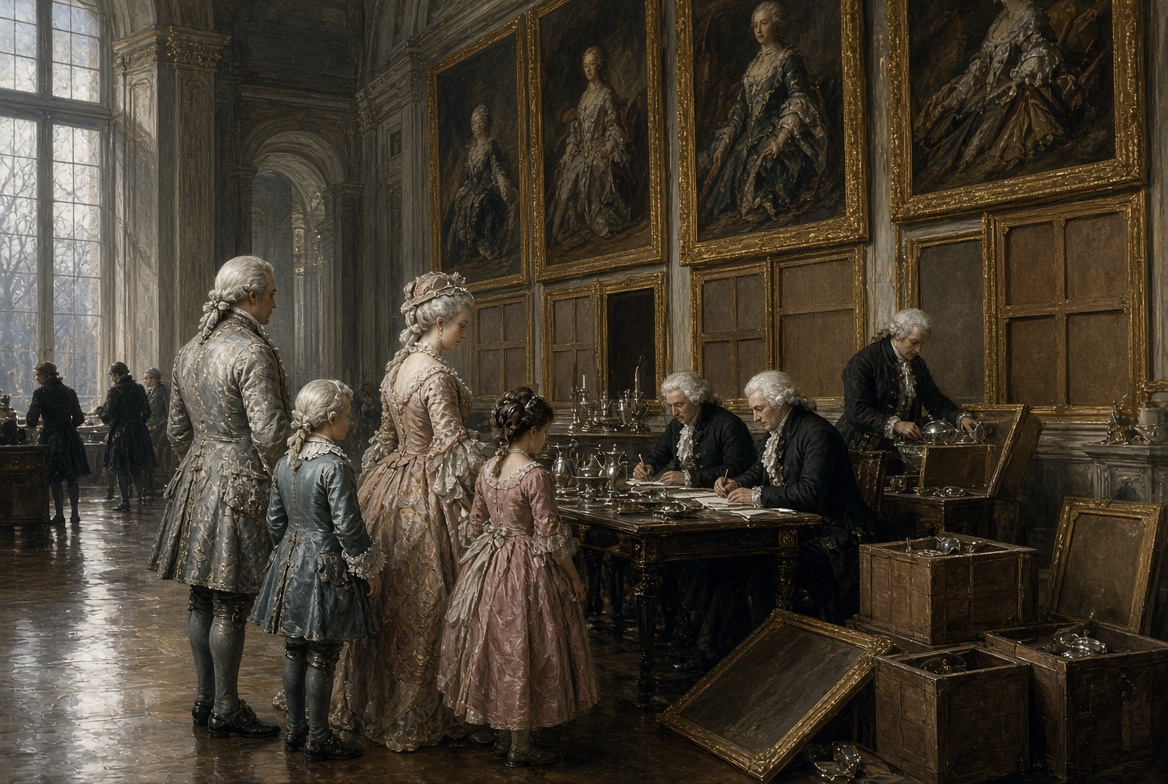
Illustration for this essay. The nobility inventoried. Privilege was the charge. Expropriation was the method.
“Aristocrat” stopped being a legal status and became a suspicion. Birth was evidence. An accent was evidence. A relative who had left the country was evidence. The émigrés (nobles, officers, and later a much wider company of people who got out after 1789, and in greater numbers after the fall of the monarchy in August 1792) were sentenced substantially as a class. Their property was confiscated. Their return was made a capital matter. Their families, left behind, became hostages to a decision they might not have shared. The Law of Suspects, in September 1793, made noble birth a reason for arrest unless the noble could show a constant attachment to the Revolution. You did not have to have conspired. You had to have been born on the wrong side of a line the Assembly had drawn four years earlier.
Here the numbers need the same honesty I applied to the Vendée, because the myth runs in both directions. In Greer’s count of formal death sentences during the Terror, nobles are about eight percent. The middle orders are larger. Workers and peasants are the majority. The guillotine in the departments did not run on dukes. It ran, in the main, on the people the Revolution claimed to represent, once those people resisted the levy, the price maximum, the requisition, or the new priest. Anyone who tells you the Terror was a class war against the rich is selling you the poster again. The rich were ruined, exiled, and killed in numbers large enough to destroy them as an order. The poor were killed in numbers large enough to destroy the claim that this was done in their name.
The demonisation was real even so. It was cultural before it was statistical, and culture is what a political class actually governs with. The noble was written out of the nation as a parasite, a foreigner by blood, a traitor by inheritance.
Edmund Burke saw it at the time, and he did not need the Vendée to see it. In 1790, in the Reflections, he wrote that the age of chivalry was gone, and that the age of sophisters, economists, and calculators had succeeded, and that the glory of Europe was extinguished. He has been mocked for the line ever since, mostly by sophisters. What he meant was not that wigs should be preserved. He meant that a society which trains its elite to be ashamed of inheritance will not get equality. It will get a new elite that denies it is one, which is worse, because an elite in denial cannot be called to the duties of an elite.
Expropriation did the practical work, and this is where the assignat and the nobility meet. Church land and émigré land were the collateral of the paper and the patronage of the new men. A buyer of biens nationaux became, by the act of purchase, a man with a material reason to fear any restoration. That is how a revolution makes a constituency. It does not persuade the country. It sells the country the confiscated assets of the country, and then calls the buyers the people.
The inflation that followed was not an accident of war. It was what paper does when the asset underneath it is a confiscation the former owners have not accepted, and when the government covers the gap by printing. By the end of 1795 the assignat had been destroyed, and with it the savings of anyone who had trusted the new money. The buyers of land kept the land. The holders of the paper kept the lesson.
The nobility that survived came back to court in 1814 and 1815 diminished. Some were richer than their cousins, having bought what their cousins lost. They were no longer a governing order. France has had brilliant elites since. It has not had a nobility in the old sense: a class with land, memory, and a duty that was not a job. The Revolution did not replace birth with virtue. It replaced birth with politics. A nobility, at its least contemptible, is a store of people who can say no to a minister without asking a party for permission. They are often wrong, often idle, often owed less respect than they demand. They are also, when they function, a brake. The Revolution did not distinguish the brake from the abuse. It cut the cable.
III. The rise of the political class
This is the part that still governs us. The dead of 1792 can be mourned and filed. The class that replaced king, bishop, and duke is in session this week.
Before 1789, French power was badly arranged, but it was arranged among bodies that were not all the same kind of thing. The king was not a magistrate. The bishop was not a minister. A parlement was not an academy, and an academy was not a regiment. A man who wanted to rule the whole had to pass through institutions he had not staffed. Alexis de Tocqueville, who was nobody’s courtier, later argued that the monarchy had already hollowed those bodies out, and that the Revolution finished a centralisation the kings had begun. He was right about the machinery. He was too kind about the operators. The kings had built a machine they still, in theory, answered for at an altar and in front of a nobility. The Revolution kept the machine and dismissed the answers.
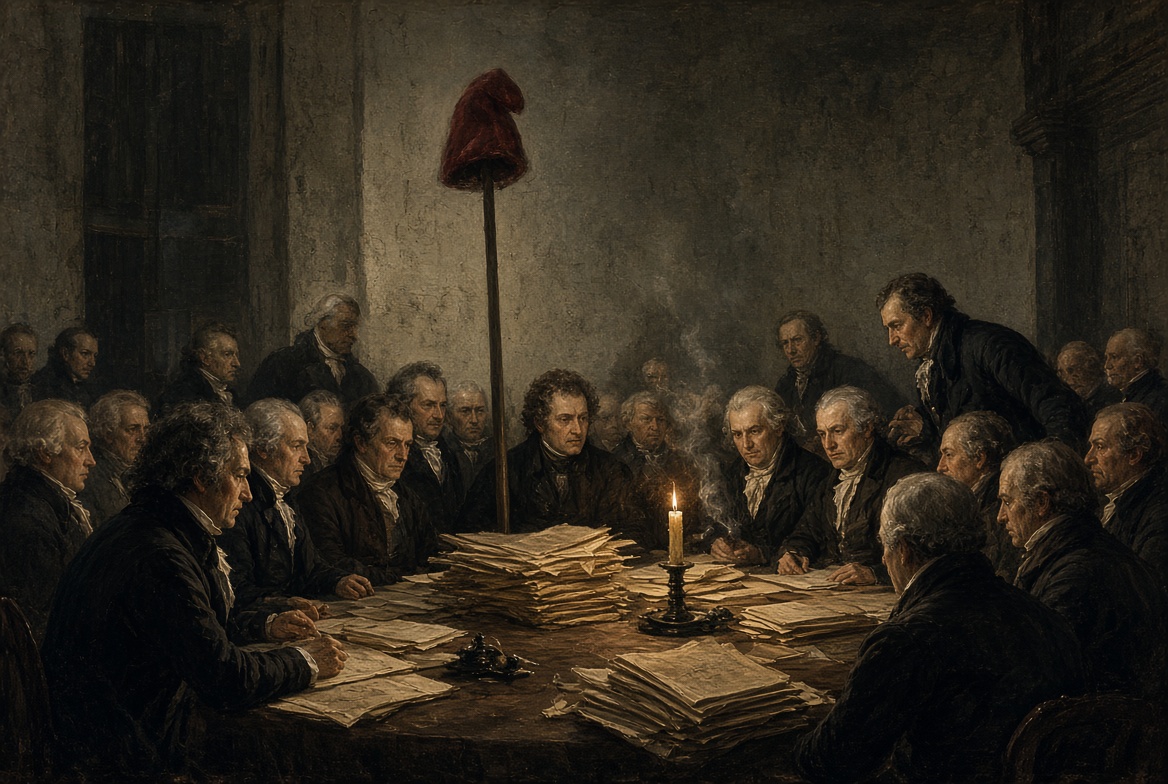
Illustration for this essay. The club and the committee. The political class discovers it can be king, priest, and judge at once.
The Revolution professionalised politics. The National Assembly, the Legislative Assembly, the Convention, the clubs, the committees, the representatives on mission: this was a career. Lawyers, journalists, failed priests, provincial notables, men whose capital was speech. The Jacobin club was a personnel department. The Committee of Public Safety was a cabinet with the power of life, answerable to an assembly it could intimidate. Robespierre, a provincial lawyer from Arras, could decide who was the people and who was their enemy. No bishop could correct him on a point of moral jurisdiction, because the bishops who would have done so were dead, deported, or in hiding. No king could dismiss him. The people, in whose name he spoke, could not petition him without becoming suspects.
That is the political class in its pure form. It does not own land as a trust. It does not answer to an altar. It does not inherit a name it is afraid to disgrace. It holds power by the claim that it represents the general will, and it defines the general will as whatever it voted last Tuesday. When it is challenged, it does not say the king has decided. It says the people have decided, and it is the people for the duration of the session. This is a more durable form of arbitrary power than a crown, because a crown is visible. A general will is a fog, and the men who interpret the fog are the government.
The Terror was not a betrayal of this arrangement. It was the arrangement under pressure. War on the frontier, the assignat collapsing, the west in arms, the Allies closing: a political class with no authority but itself reaches for death, because death is the one sanction it can impose without a church and without a dynasty. About seventeen thousand formal death sentences. A wider toll, in prison and in the zones of civil war, that serious estimates put in the tens of thousands, and in the west into six figures. Then Thermidor. Then the Directory, corrupt and armed. Then a general.
Napoleon did not overthrow the political class. He was its most successful product. He signed a Concordat, crowned himself in the presence of a pope he had summoned, and employed the nobles he needed. He also created the prefects, completed the codes, and kept the centralised state and the principle that legitimacy flows from a political act, not from an altar and not from a coronation oath he had not written.
I am not arguing for a costume drama, and I am not arguing that every country without a king is condemned. I am arguing about restraint. A politician who can be dismissed by a crown is a different animal from a politician who can only be replaced by another politician. A king who can be refused the sacrament is a different animal from a president who appoints the commission that investigates him. The Revolution abolished both restraints and called the result the rights of man. The rights were real on paper. The man who held them stood in front of a committee that did not believe in an authority it had not voted. The Cult of Reason and the Cult of the Supreme Being were not eccentricities. They were the political class attempting the one function it had not yet nationalised.
The plainest record of it is how the king and queen died, and Exhibits 1 and 2 draw it. Louis vetoed the decree to deport the priests who would not swear, and on 20 June 1792 a mob broke into the Tuileries to make him take the veto back. On 10 August the insurgents stormed the palace. The Convention that abolished the monarchy then sat as his court. Saint-Just told it the king "should be judged as an enemy". Robespierre told it "Louis must die, that the country may live". It refused, by 424 votes to 283, to put his fate to the people, and condemned him by 387 to 334. Count the 26 who voted for death with conditions on the other side, as the 1911 Britannica does, and it was 361 to 360. The Abbé Edgeworth said Mass for him and stood with him on the scaffold.
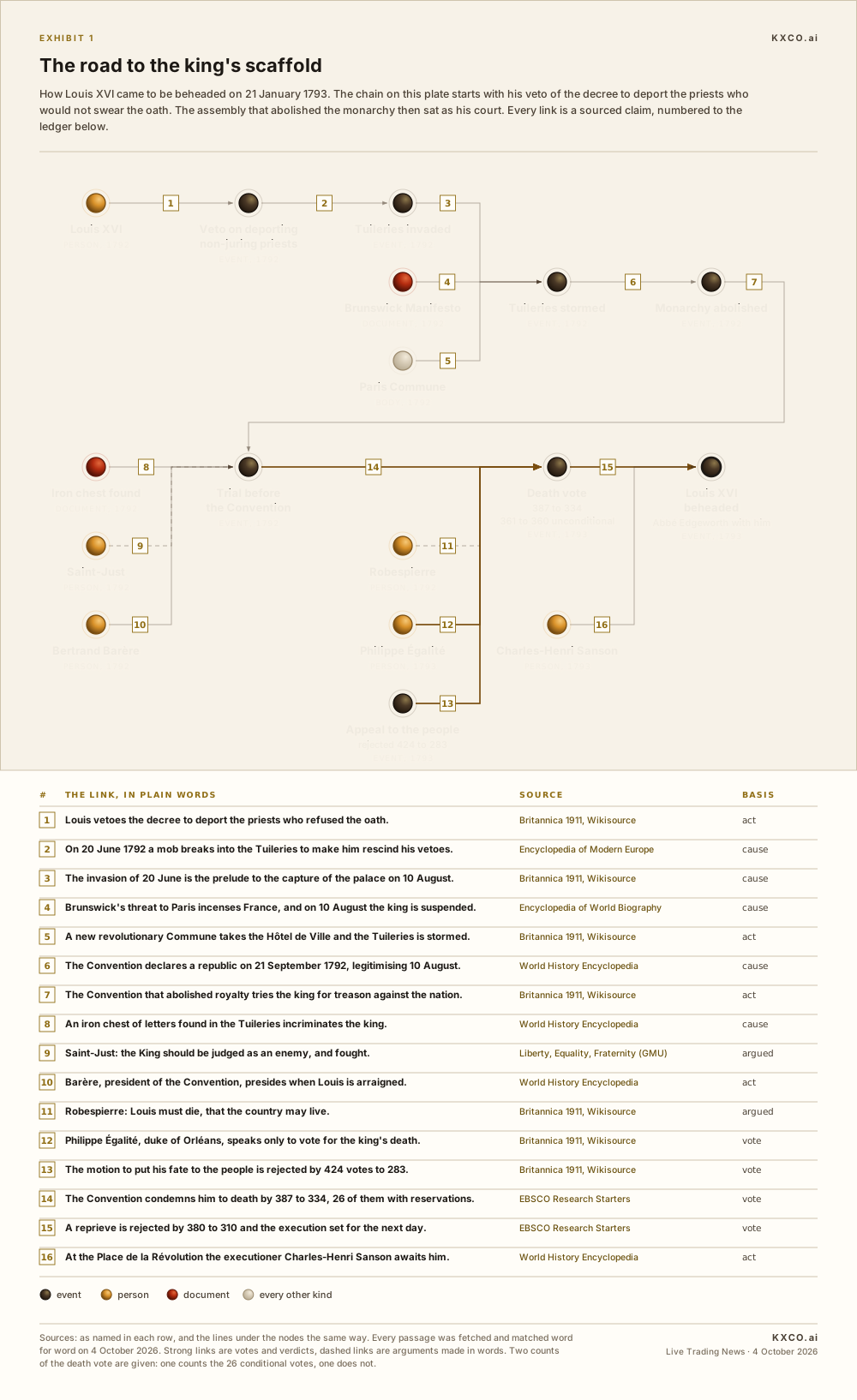
Exhibit 1. The road to the king's scaffold, from his veto of the decree against the non-juring priests to 21 January 1793. Every link, and every line under a node, is a passage fetched from the source named in the ledger and matched word for word on 4 October 2026.
The queen came nine months later, before the Revolutionary Tribunal. She had been convicted in the court of public opinion years before, over a necklace fraud devised by others and a run of pamphlets that painted her as immoral. The record does not make her innocent. After war was declared she passed the plans of the French generals to Mercy and Fersen, per the 1911 Britannica. The charges went far past that, and when the prosecution faltered Hébert added incest. Women in World History reads the excess as "an obsession with the queen as a hated symbol as much as an individual guilty of treason." The jury convicted her unanimously, and on 16 October 1793 Sanson, who had beheaded her husband, beheaded her.
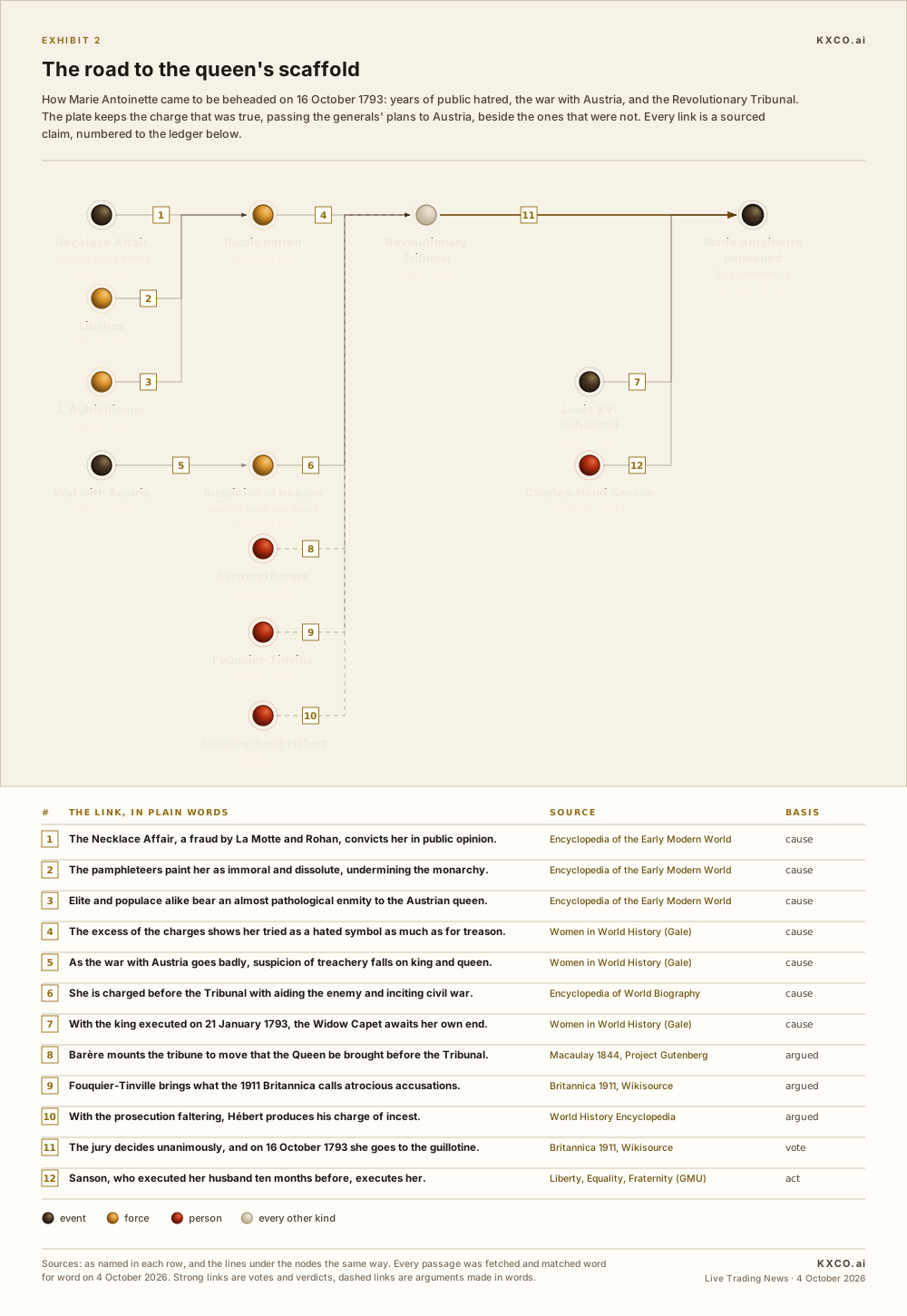
Exhibit 2. The road to the queen's scaffold. The charge that was true sits beside the ones that were not. Sources are named in the ledger, and each passage was fetched and matched word for word on 4 October 2026.
An assembly and a tribunal tried them, and nothing stood above either to say no.
IV. The export
The guillotine stayed in France. The idea travelled. Exhibit 3 follows it out of the country, link by link, and every link is a claim a published source makes in words.
French arms drove the House of Orange out of the Dutch Republic in 1795. They drove Pius VI out of Rome in 1798, set up a republic in Naples in 1799 after its king fled, forced the end of the Holy Roman Empire in 1806, and took the Spanish crown at Bayonne in 1808. Of the five, all but the Holy Roman Empire were back by 1814. The removal of the Spanish king also broke Creole loyalty to the crown across Spanish America, and the crown never got it back.
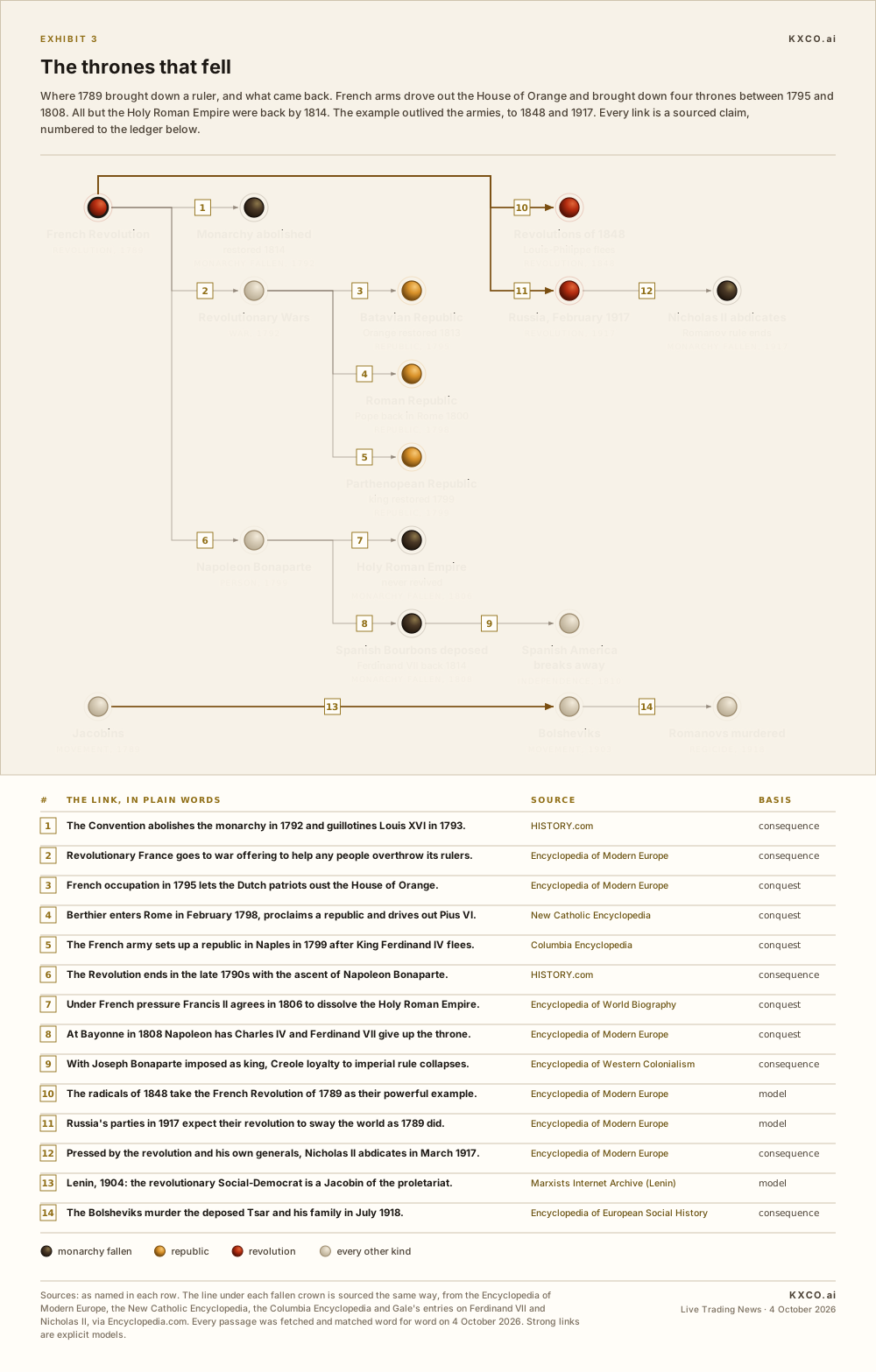
Exhibit 3. The thrones that fell, and what came back. Every link, and every restoration date under a fallen crown, is a passage fetched from the source named in the ledger and matched word for word on 4 October 2026.
The crowns that came back did not come back on the old terms. Peter McPhee, in the Encyclopedia of Modern Europe, puts it plainly: "Even the Restoration of the monarchy in 1814 could not reverse the revolutionary change from royal absolutism to constitutional, representative government." The king returned. The class that had governed without him stayed in the building.
The example outlived the armies. In 1848 the radicals took 1789 as their model, and Louis-Philippe fled to London. In 1917 almost every Russian party expected its revolution to act on the world as 1789 had, and Nicholas II abdicated in March. Lenin had already defined his revolutionary, in a 1904 pamphlet, as "A Jacobin who wholly identifies himself with the organisation of the proletariat". In July 1918 the Bolsheviks murdered the Tsar and his family.
Exhibit 4 shows what the political class carried with it. The Declaration put all sovereignty in "the nation", and in practice the nation speaks through whoever holds the Assembly. The seating of that Assembly gave the world a left and a right. The Church was subordinated to the state, made a tenant under the Concordat, then cut loose in 1905. Napoleon's prefects turned the departments into relays for Paris, the prefect crossed into Italy, and the Code became the model for Germany and much of Latin America. English took the word terrorism from the Terror in 1795.
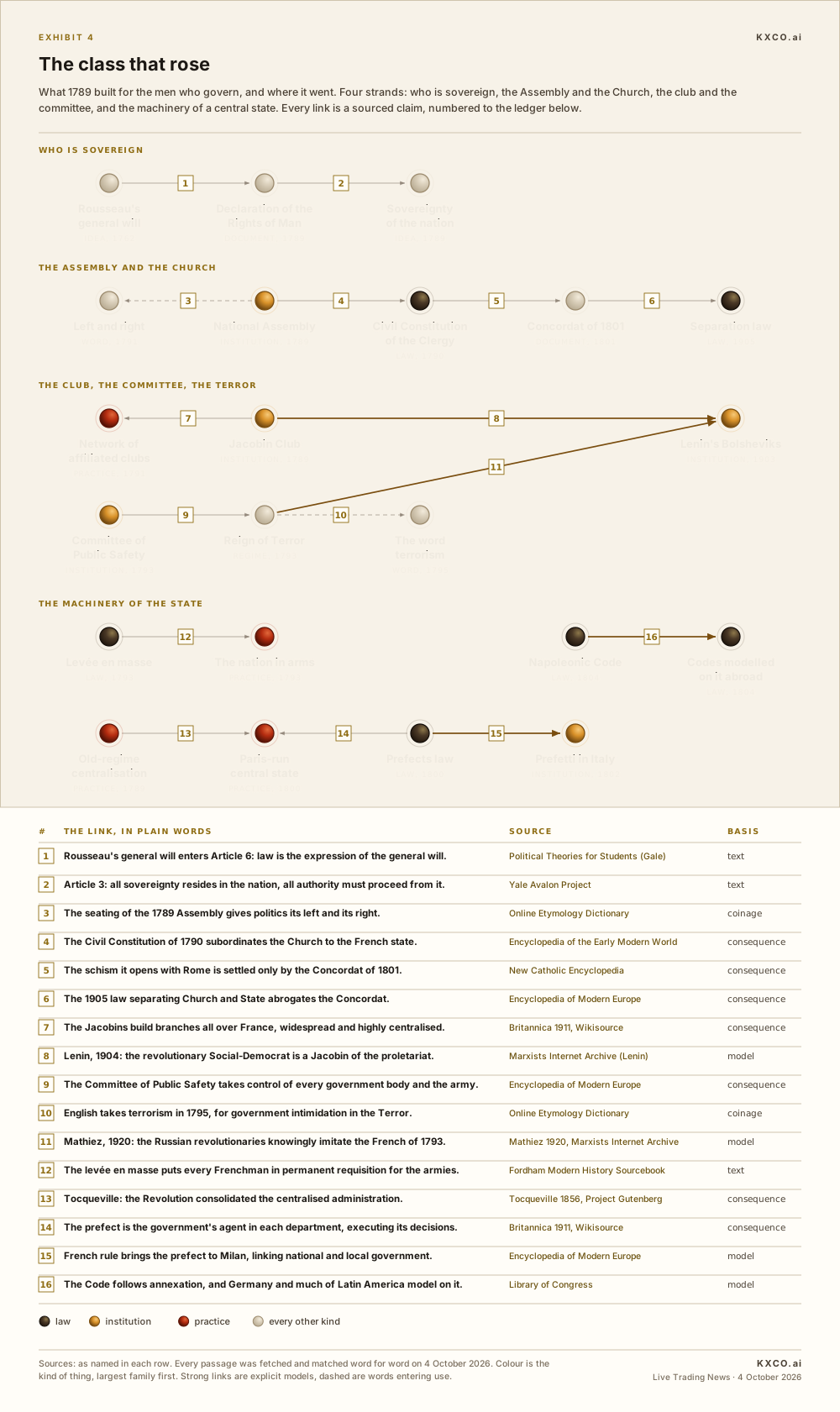
Exhibit 4. The class that rose. Sources are named in the ledger, and each passage was fetched and matched word for word on 4 October 2026.
None of it stayed in Paris. It was a template, and it was copied.
V. God, King, and Country, in that order
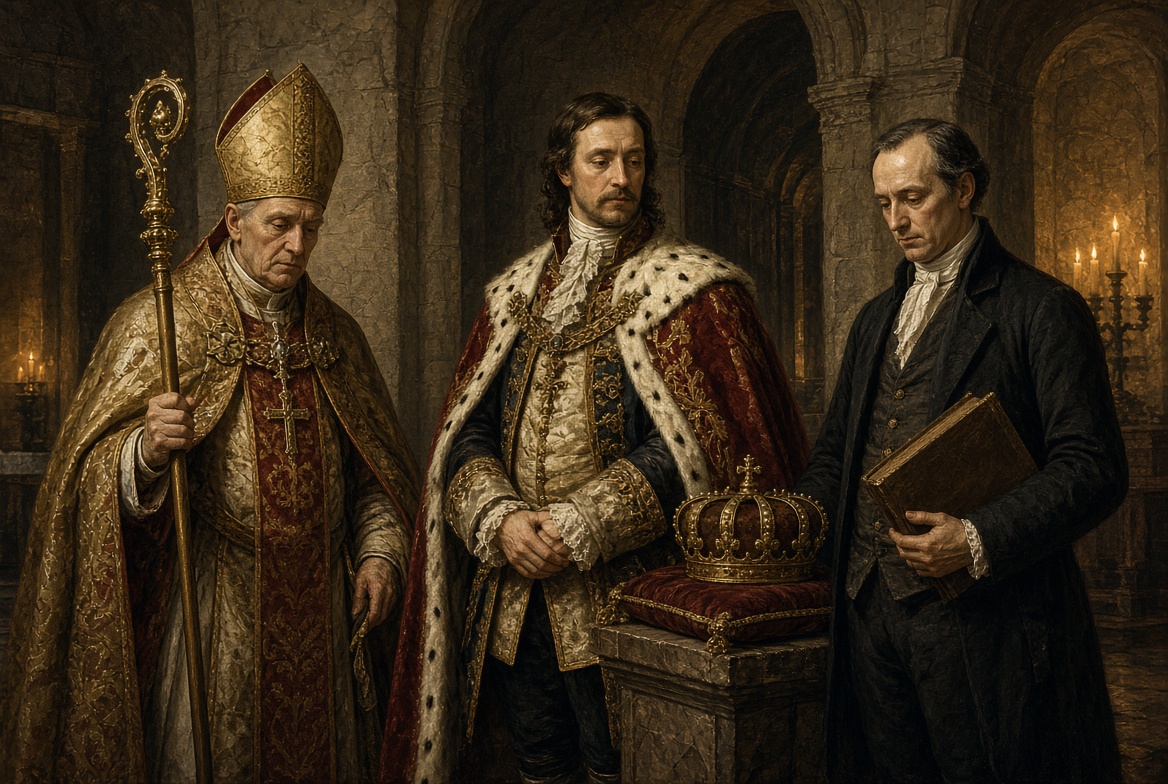
Illustration for this essay. Church, crown, and government. In that order, or not at all.
The legacy is not that France had a violent decade. Every old country has had a violent decade. The legacy is the moral order the violence installed, and that the textbooks still call progress.
First, the state became the highest voice in the room. Once the Church was a department, and then an enemy, and then a tenant, no institution remained that could say no in a register the state did not control. Modern secularism likes to tell this story as neutrality. It was not neutrality. It was a victory, won by confiscation, by oath, by deportation, and by killing. The empty altar in front of the cathedral is not a symbol invented for a column. It is a description of a policy, executed between 1789 and 1794 and administered, in softer language, ever since.
Put the three things back in their places and the problem becomes legible again.
The Church does not govern. That is not its office. Its office is narrower and harder. It reminds the king, and anyone standing where a king stood, that he is not God. Without that reminder, every government eventually tries to save men’s souls with a statute, a curriculum, or a committee. The Revolution tried all three. The Catholics who refused the oath were refusing that promotion. They were right to refuse it.
The monarchy does not manage the roads, and it should not try. Its office is to remind the politicians that they are not the king. They serve. They can be sent home. They do not embody the nation. They work for it, under a crown that is not their property and not their brand. A republic can imitate pieces of this, with a head of state who does not run the government. Most republics on the French model do not. They combine the crown and the ministry in one career, and then they are surprised when the career becomes the constitution.
The government does the work. Tax, defence, courts, the ordinary peace. It is necessary. It is not sacred. The moment it is treated as sacred, it starts to behave as the Revolution behaved: infallible in theory, homicidal in a crisis, and staffed by men who cannot imagine an authority above their committee. A government that knows it is third in the order is a useful thing. A government that believes it is first is a church with an army, which is what Paris built between the Civil Constitution and the Cult of the Supreme Being.
For God, for King, and for Country. In that order. Not country first, which is how the political class smuggles itself into the sanctuary and calls the smuggling patriotism. Not king first, which is how a crown becomes a tyranny, and why the Church was given the right to refuse him. God first, because someone has to be, and it cannot be the cabinet. Then the king, because someone has to stand above the politicians, visibly, and without their permission. Then the country, which is the people, the law, and the work. Not a slogan painted on a committee room.
The Catholics of the Vendée, the nuns of Compiègne, the priests on the hulks at Rochefort, the bishops cut down in the September prisons, and the nobles who were guilty of their grandparents, were not the obstacles to a free society. They were the last argument, in that kingdom, that a free society needs something in it that the political class does not appoint. That argument was answered with drownings, deportations, and a new calendar. The calendar was gone within a dozen years. The argument has not. It is the argument of this essay, and it is the argument I am prepared to put my name on.
A note on figures
Formal Terror condemnations follow Donald Greer, The Incidence of the Terror during the French Revolution (Harvard, 1935): on the order of 17,000 death sentences, with clergy about 6 to 7 percent and nobles about 8 percent, both groups hit hard relative to their share of the population. Workers and peasants were the majority of the condemned. Clerical deaths beyond the tribunals, in September 1792, on the Rochefort hulks (829 held, 547 dead), in the Nantes drownings, in prison and in exile, are drawn from the diocesan surveys and from modern French scholarship. That scholarship puts priests, religious, and nuns dead for the faith between 1792 and 1800 at nearly 3,000, with about 30,000 priests driven abroad.
Vendée figures are given as a range: the commonly cited estimate of about 170,000 local dead, and Reynald Secher’s lower demographic count of about 117,000 out of roughly 815,000. The genocide designation is disputed and is reported here as disputed. The four exhibits draw only links a published source states in words. Each source is named in the exhibit's ledger, and every passage was fetched and matched word for word on 4 October 2026. Illustrations were made for this essay. They are not contemporary documents.
Shayne Heffernan, Ph.D., is the founder of Live Trading News, the KnightsBridge Group, Knightsbridge Law and the KXCO.ai ecosystem spanning post-quantum cryptography, identity, attestation and enterprise ontology.
Careful of the Prompts You Give Yourself
A prompt is not only what you type into a model. It is any sentence that gets inside you and starts issuing orders. Most of what we call goals were written by comparison, media, competition and now the model, and they arrive dressed as ambition. Shayne Heffernan maps how an imported sentence becomes a week, why a want should carry its source the way a Round Table claim does, and how to strip, lock and guard the objective that is actually yours.
KXCO is Enhanced Intelligence, Not Artificial
I never wanted artificial intelligence. I wanted enhanced intelligence, and they are not the same product. Artificial means the machine does the thinking and hands you the answer. Enhanced means I do the thinking, with more of my own mind in the room than I have ever had at one time. Forty years of reading, recallable in the second I need it. Patterns across law, credit, physics and markets that no specialist sees, because the useful ones sit between the fields rather than inside them.
The AI Safety Argument Is Being Held in the Wrong Room
The people who will be blamed for what AI does are not in the room where its safety is argued. A jailbreak escapes a policy. The failure that costs money is an action that escapes an owner, a payment sent or a record altered. Tokens are not authority. Intelligence got cheap and judgment did not, and there is no organ of standing you can copy into a model. Shayne Heffernan on the objection worth taking seriously, and the questions to take into a vendor meeting.

NIST Graded Our Post-Quantum Cryptography. Zero Failures.
NIST's Algorithm Validation Test System generated test vectors nobody had seen, we answered them over the ACVP protocol, and NIST graded the result: 2,130 cases across ML-KEM, ML-DSA and SLH-DSA in every parameter set offered, zero failures, demo certificate A11025. This is what that proves, where we deliberately drew the claim narrower than NIST's own matrix, and why the FIPS 140-2 sunset on 21 September makes the distinction between being graded and grading yourself worth understanding.
Every story, signed and delivered.
Subscribe to the kxco channel and get the headline, the AI-written key takeaways, and the chain-anchor link the moment we publish. Audio versions and per-ticker subscriptions arrive in the next iteration.