
What is Physical AI and Why KXCO
The convergence of embodied intelligence, quantum systems, and the infrastructure that makes them economically real
The defining technological migration of the next decade is not another generation of larger language models. It is the movement of artificial intelligence out of data centres and into the physical world, into robots, autonomous vehicles, surgical systems, agricultural machines and industrial infrastructure. This is Physical AI: intelligence that perceives, reasons about, and acts upon atoms rather than bits.
Yet the central constraint on Physical AI is no longer primarily algorithmic. The robots and the quantum processors are advancing rapidly. The bottleneck is infrastructure, the systems that allow these machines to be funded at scale, to share a common understanding of the physical and economic world, to prove identity and authority, to settle value, and to operate securely under post-quantum threat models. That is the domain KXCO was built to occupy.
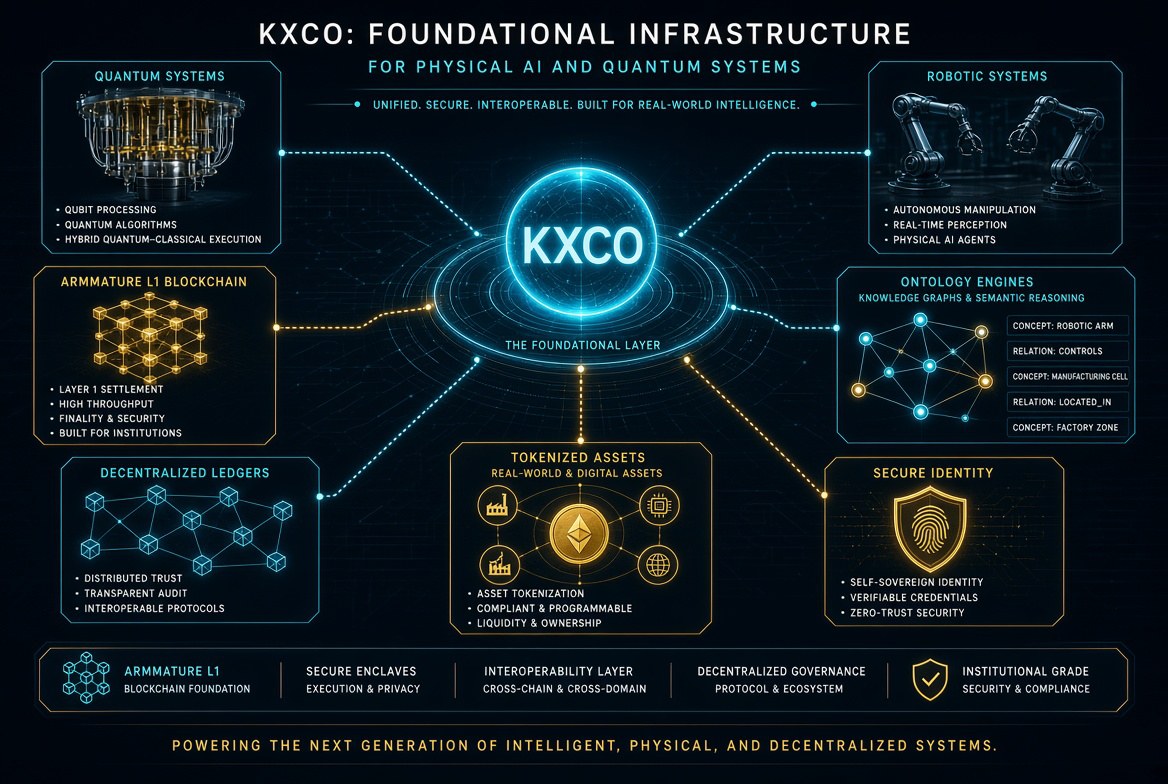
KXCO sits underneath the stack, not inside any one layer of it: quantum systems, robotic agents, Armature L1, ontology engines, tokenized assets and secure identity.
KXCO does not build the robotic hardware or the quantum chips. It builds the economic and technological scaffolding required to deploy them. Through Armature L1, a post-quantum ledger built for institutional settlement and provenance, and through a production ontology engine that maintains a working structural model of real-world entities, relationships, assets and authorities at kxco.ai/ontology, KXCO supplies the missing layer that turns laboratory Physical AI into deployable industrial systems.
One point of precision matters here, because it is the difference between a marketing claim and an engineering one. KXCO is a software company. It writes the ledger, the identity layer, the ontology and the cryptography that institutions run. It does not take custody of assets, it does not hold client funds, and it does not act as the operator of the systems built on top of it. The customer remains the institution. What KXCO supplies is the substrate that institution needs in order to make an autonomous machine economically legible.
The ontology is not a side feature. It is the shared semantic foundation that allows autonomous physical agents, human operators, regulators and AI systems to work from the same model of reality. When a Physical AI system must establish what a particular machine is, who owns it, what permissions it holds, what physical state it occupies, and how it relates to contracts, insurance and logistics, that understanding rests on an ontology. The KXCO ontology engine, anchored to Armature L1 for permanent verifiable records, is designed precisely for this human, AI and machine economy.
"KXCO and its products treat artificial intelligence not as a replacement for human judgement but as a means of bringing data and human expertise into the same operational frame. Across the platform, backend ontologies provide a structured, time-aware representation of entities, relationships and claims. These ontologies do not invent truth. They make the state of institutional knowledge explicit, attributable and usable by both people and machines."
That distinction is worth sitting with. An ontology is an instrument, not an oracle. It does not hand down conclusions. It renders structure legible so that human judgement has something it can actually operate on, and it records where every claim came from and when. The discovery still belongs to the person looking at it. Anyone who wants to see the mechanism rather than read about it can work through what the public ontology map shows and what runs behind it, or open the live engine at kxco.ai/ontology.
In short: while others invent the actuators and the qubits, KXCO engineers the ledger, the identity layer, the ontology and the cryptographic assurances that allow Physical AI systems to interact, transact and scale inside real markets. That is why KXCO sits at the centre of this story.
To understand the full weight of that claim, we need to examine what Physical AI actually is, why classical computing is insufficient, and how quantum technologies become the necessary computational partner.
What is Physical AI
For the last decade the dominant narrative of artificial intelligence has been digital. Large language models, generative systems and recommendation engines live inside data centres and operate on bits. Human existence, however, is grounded in atoms. We inhabit a world of friction, gravity, continuous dynamics and irreversible physical consequences. Physical AI is the science and engineering of creating systems that can perceive, reason, act and interact inside complex, unstructured physical environments. It is intelligence that manipulates reality rather than merely describing it.
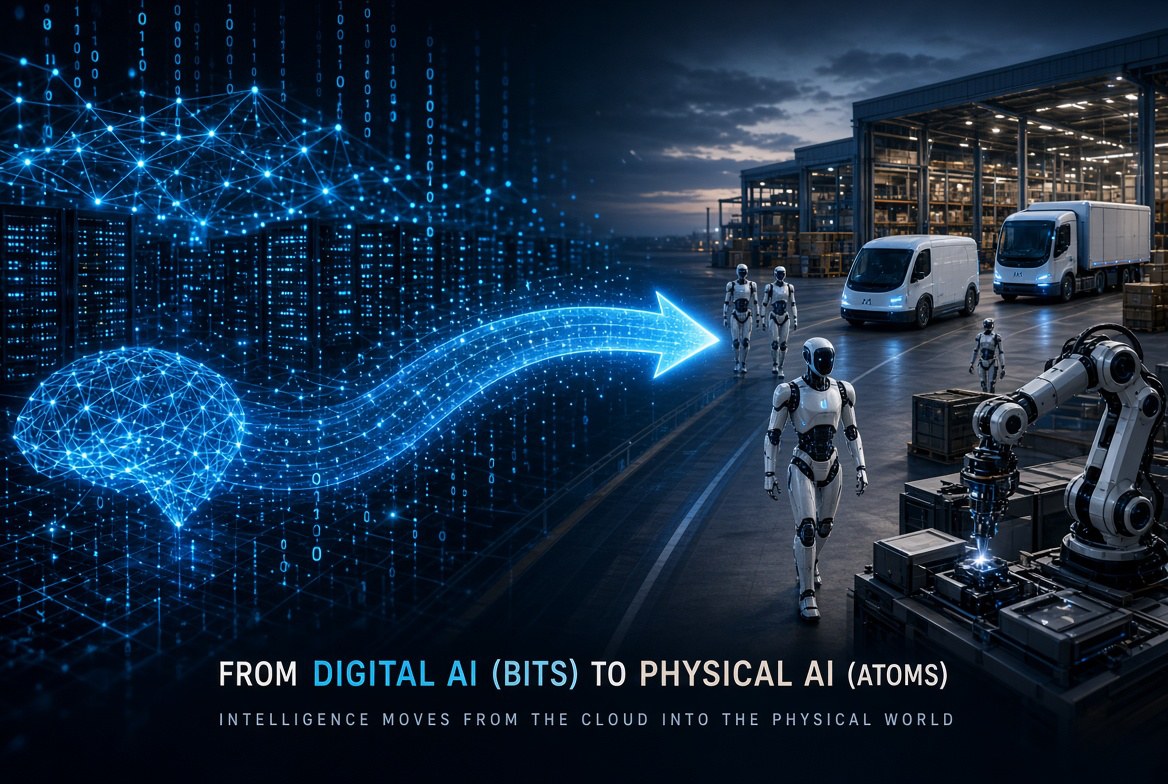
Intelligence moves out of the cloud and into the physical world. Digital AI operates on bits. Physical AI operates on atoms, and pays a physical price for being wrong.
True Physical AI is not a robot with a language model bolted on as a voice interface. It is an integrated architecture in which perception, cognition and actuation are tightly coupled. The system must understand the laws of physics, or at least approximate them computationally well enough to predict the outcomes of its actions before they occur.
The Three Pillars of Physical AI
Physical AI rests on three foundational pillars: perception, cognition or world modelling, and actuation.
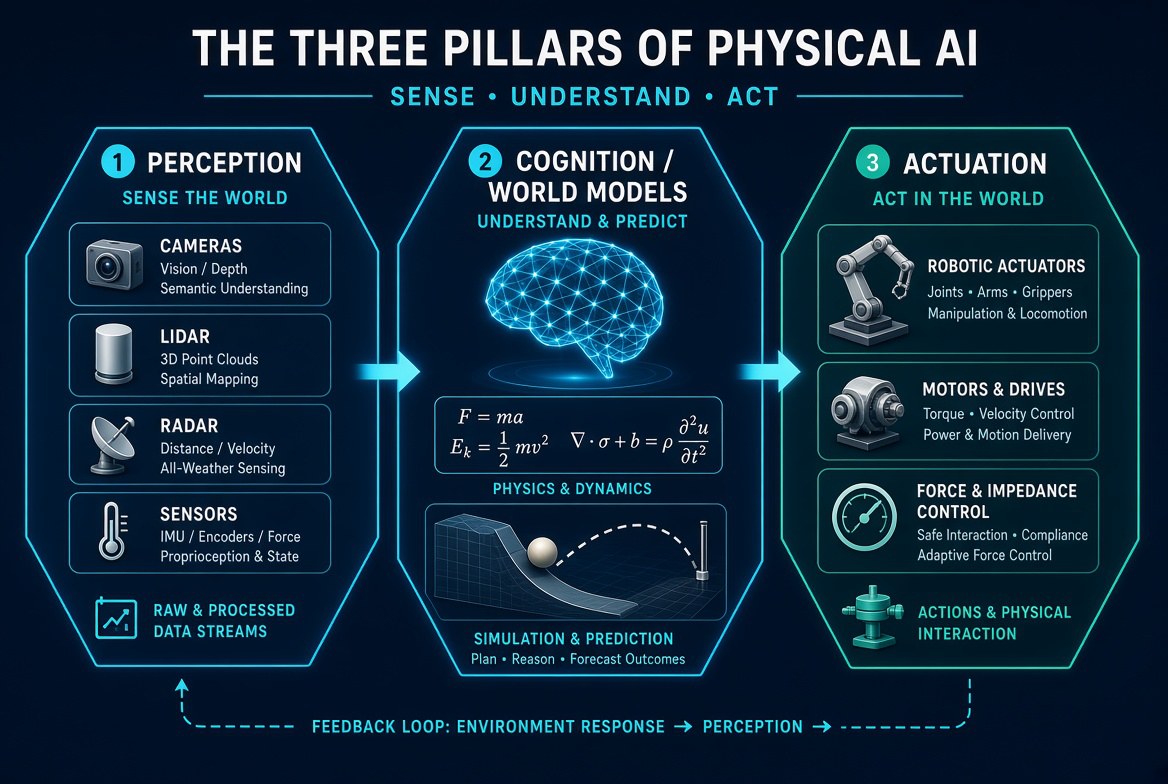
Sense, understand, act. The loop closes through continuous environmental feedback, which is what separates Physical AI from scripted automation.
Perception, the multimodal sensory apparatus
Digital AI primarily processes text or static images. Physical AI must continuously fuse streaming multimodal data: vision and LiDAR, radar and ultrasonics, force and torque sensors, electronic skins, audio, proprioception and more. Sensor fusion turns noisy, asynchronous streams into a coherent geometric and material understanding of the environment. The system must recover depth, geometry, material properties such as hard or soft and slippery or sticky, and spatial relations. Picking up a clear glass on a cluttered table requires segmenting the object, estimating its three-dimensional shape and mass, and calculating the precise grip force that will not shatter it.
Cognition and world models, understanding physics
The cognitive core of Physical AI differs fundamentally from a large language model. An LLM predicts the next token from statistical patterns in text. A Physical AI must predict the next state of the physical world. This requires an internal world model, a simulation of reality that embeds physical law. When the system pushes a ball, the world model forecasts rolling, friction-induced deceleration and collision with a wall. Because the real world is stochastic and partially observable, researchers increasingly turn to physics-informed neural networks that bake Newtonian mechanics, thermodynamics or continuum mechanics directly into the learning architecture, preventing physically impossible predictions.
Actuation, translating will into force
Actuation converts digital commands into physical force through motors, joints and end-effectors. A persistent obstacle is the sim-to-real gap. Models trained in perfect simulation, in environments such as Omniverse and Isaac Sim, encounter latency, backlash, battery dynamics and unpredictable friction the moment they touch real hardware. Reliable Physical AI therefore demands adaptive control policies that tolerate the inherent messiness of physical machines.
From Rigid Automation to Adaptive Autonomy
Physical AI is the evolutionary successor to classical industrial automation. For decades factories have used robots, yet those robots are pre-programmed: move to coordinate X, grasp, move to Y, weld. A slight misalignment of the part causes failure or danger. Physical AI introduces genuine autonomy. The system perceives the misalignment, recomputes trajectory and grasp in milliseconds, and continues. This shift from rigid scripting to flexible autonomy is what allows machines to leave highly structured factories and enter homes, construction sites, hospitals and open roads.
Transformative Applications
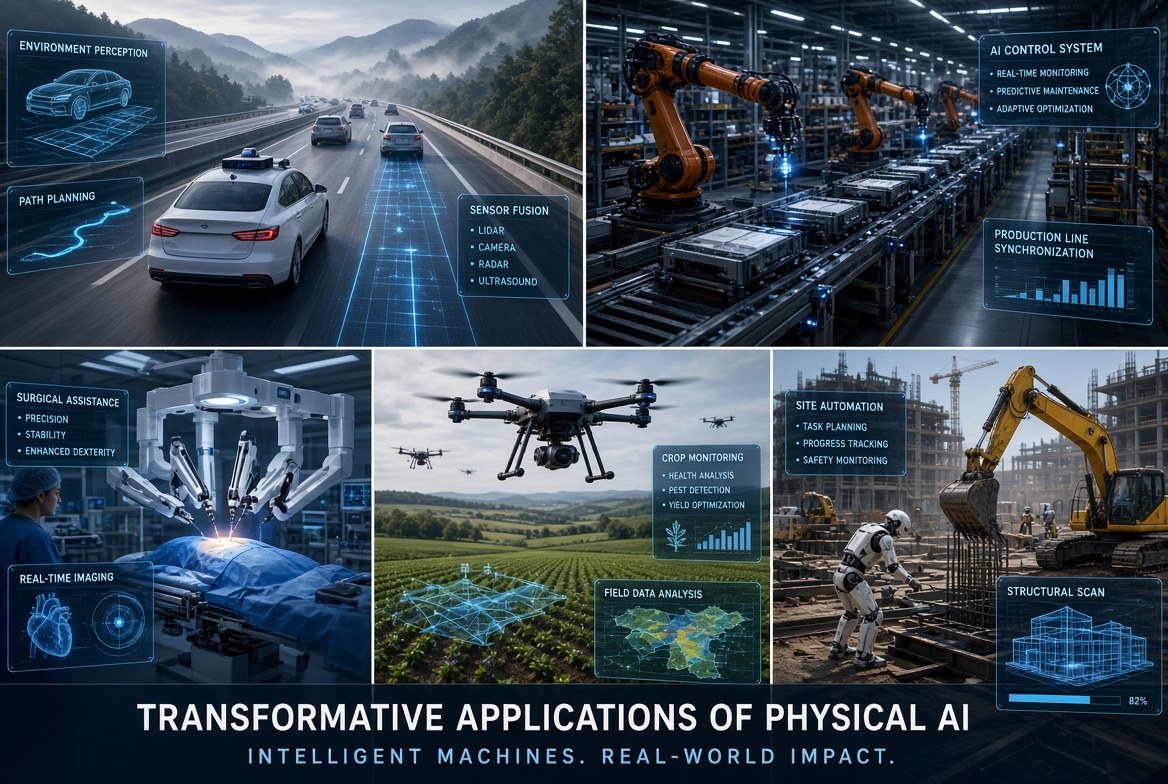
Five sectors where Physical AI stops being a research demonstration: mobility, lights-out manufacturing, surgical robotics, precision agriculture and construction.
Autonomous vehicles and logistics. Self-driving systems must maintain a 360-degree world model, predict the intent of pedestrians and other agents, and navigate in real time under weather and lighting extremes. Beyond passenger cars, the same technology underpins autonomous long-haul trucking and last-mile delivery, removing the constraints of driver fatigue and regulatory hours-of-service limits.
Lights-out manufacturing. The industrial goal is facilities that run continuously without human presence. Physical AI enables robots that perform intricate assembly, microscopic quality inspection and even self-maintenance. Manufacturing shifts from labour-arbitrage geographies to capital-intensive, highly optimised technological hubs.
Healthcare and surgical robotics. Beyond tele-operated platforms, research is moving toward autonomous micro-suturing agents that compensate for heartbeat and respiration in real time. Smart prosthetics that read neural intent and adapt to terrain represent another major frontier.
Agriculture and construction. Autonomous tractors plant with millimetre precision, drone swarms detect disease and apply targeted treatment, and robotic harvesters handle delicate produce. In construction, autonomous excavators avoid underground utilities while robotic systems inspect bridges and generate continuous digital twins of infrastructure.
The Classical Computing Wall
Despite the vision, Physical AI collides with a compute wall. Continuous time and space produce high-dimensional state spaces. Planning a humanoid path through a cluttered room, or coordinating a thousand-drone swarm, rapidly encounters the curse of dimensionality. Classical processors, even large GPU clusters, process information in fundamentally sequential or linearly parallel fashion. Full physics simulation of thousands of interacting objects, or global optimisation of multi-agent trajectories, either takes too long, consumes excessive power, or cannot be held in memory. Classical neural networks also struggle to represent the deeply intertwined uncertainties of chaotic physical systems.
This is the same wall that shows up in digital AI when the answer to every problem is more compute, and it is why context, not raw compute, is becoming the constraint that matters. Crossing from clumsy prototypes to fluid, high-capability Physical AI requires a computational paradigm shift: computing the physical world with the physics that governs it. That shift is quantum computing.
Where Quantum Fits into Physical AI
Quantum computing is frequently discussed in the context of drug discovery or cryptography. Its most consequential long-term impact may lie in Physical AI. Classical bits are binary. Qubits exist in superposition and can be entangled. These properties allow quantum processors to explore vast combinatorial spaces simultaneously. Applied to Physical AI, quantum technology appears in three synergistic roles: quantum computing for the brain, quantum sensing for perception, and quantum communication for coordination. The convergence itself is now moving fast enough that it is best treated as one problem rather than two.
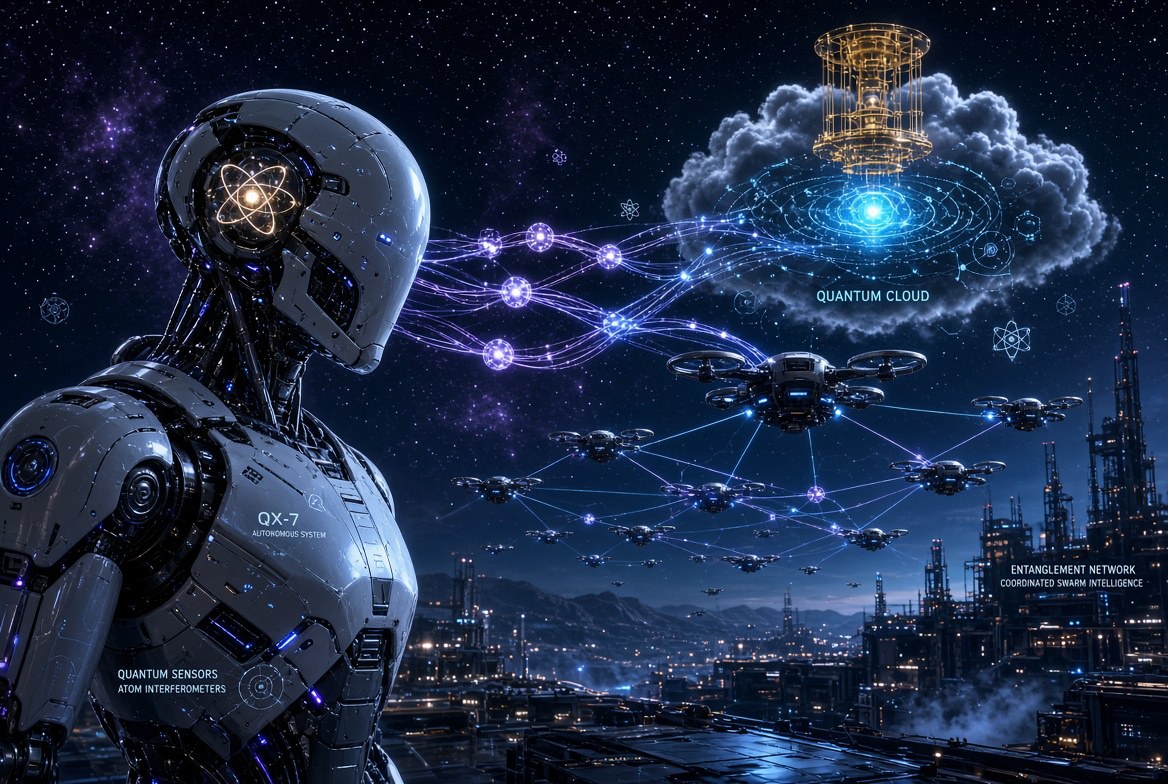
The hybrid architecture that is likely to arrive first: quantum sensing at the edge, quantum optimisation and simulation in the cloud, and coordination across the swarm.
Quantum computing, supercharging cognition
World-model simulation, path planning and high-dimensional machine learning are precisely the domains where quantum advantage is expected. Quantum simulation can model fluid dynamics, soft-body physics and material stress more natively than classical finite-element methods, shrinking the sim-to-real gap. Quantum optimisation algorithms such as QAOA attack the NP-hard routing and configuration problems that grow intractable for classical solvers as agent count rises. Quantum machine learning can embed sensor data into exponentially large feature spaces, extracting subtle correlations that are hard for classical networks to reach, for example the interaction of ground resistance, wind and joint torque that determines whether a bipedal robot walks or falls on loose terrain. For the listed side of that story, the quantum computing sector now has real revenue, real costs and real losses to read.
Quantum sensing, upgrading perception
Quantum sensors exploit superposition and entanglement to measure magnetic fields, gravity, acceleration and time with precision beyond classical limits. Quantum inertial measurement units are being developed to hold navigation accuracy in GPS-denied conditions far longer than classical inertial units can, which matters for drones in urban canyons and for vehicles operating in electronic-warfare environments. These systems are in field trials rather than in volume production. Quantum gravimeters can map subsurface voids and utilities without excavation. Quantum magnetometers can detect faint biomagnetic signatures or metallic objects behind walls, opening new possibilities for surgical navigation and search and rescue.
Quantum communication, the nervous system of swarms
The future of Physical AI is multi-agent. Coordinating large robot fleets demands low-latency, high-integrity communication. Experimental quantum networks distribute shared timing and entangled states, which in principle supports tightly synchronised manoeuvres across a fleet. Quantum key distribution provides information-theoretic security, since any attempt to eavesdrop collapses the quantum state and is immediately detectable. For systems that control physical infrastructure, transportation or life-critical procedures, that class of security is not optional.
Taken together these capabilities define Quantum-Physical AI: systems that perceive with quantum precision, reason with quantum algorithms, and coordinate through quantum-resistant channels. Hybrid cloud and edge architectures will dominate in the near term, with rugged classical processors and quantum sensors on the robot, and intractable optimisation and simulation tasks offloaded to cloud quantum resources over high-bandwidth links.
Remaining challenges
Significant obstacles remain. Qubits are fragile and currently require cryogenic environments, and placing a full-scale quantum processor on a vibrating construction robot is not yet practical. Algorithmic maturity is still limited by the noisy intermediate-scale quantum era, though error correction and hybrid quantum-classical methods continue to advance. Nevertheless, the direction of travel is clear. The computational demands of high-capability Physical AI align naturally with the strengths of quantum information processing.
The Economic and Societal Paradigm Shift
The transition to Quantum-Physical AI is macroeconomic in scale. For a century growth has been driven by optimising human labour, and the digital revolution optimised information. This next wave optimises matter and energy itself. Systems that can autonomously build, move and maintain physical infrastructure at quantum-level efficiency will drive down the marginal cost of goods, food and housing. Manufacturing will reorganise around energy, materials and compute infrastructure rather than cheap labour. Environments previously hostile to humans, including disaster zones, the deep ocean, and lunar and Martian surfaces, become accessible to machine vanguards that require neither life support nor psychology.
The same transition raises profound societal questions. Labour displacement in logistics, manufacturing, agriculture and construction will require deliberate economic restructuring. Concentration of quantum compute capacity could create new technological monopolies. And a misaligned Physical AI system equipped with high-precision sensors and actuators carries physical rather than merely informational risk. Governance, alignment research and durable economic integration architectures are therefore first-order requirements, not afterthoughts.
Why KXCO is Positioned at the Centre
The leap from theoretical Quantum-Physical AI to deployed commercial reality is not solely a scientific challenge. It is an infrastructural, financial, semantic and cryptographic challenge. The organisations that will define the coming decades are those that build the connective tissue: the shared ontology of the physical and economic world, the post-quantum record of identity and provenance, the settlement rails for machine-to-machine value transfer, and the software frameworks through which institutions can put capital behind these systems at industrial scale.
That is the role KXCO has engineered.
Armature L1 provides institutional-grade post-quantum settlement and verifiable history. It has carried ML-DSA-65 signatures since its genesis block, using the lattice signature scheme standardised by NIST, which means the chain's own history does not need to be re-secured later against an adversary holding a quantum computer. The reasoning behind that design, and why the timing is an institutional risk question rather than a research one, is set out in the post-quantum answer to a problem institutions have already inherited.
The ontology engine at kxco.ai/ontology supplies the structural model that autonomous agents, institutions and regulators can all work from, with every claim carrying its source, its as-of date and its confidence. Secure identity, attestation and tokenized asset layers complete the stack, and machine-to-machine value transfer is already running in production form, since an AI agent can now hold a wallet and keep it.
KXCO does not merely observe the convergence of atoms and qubits. It supplies the foundational operating system that allows autonomous physical systems powered by quantum intelligence to interact, transact and scale inside the real economy. That thesis is set out at greater length in KXCO: The Economic Operating System for the Human-AI Economy.
The age of Physical AI is beginning. The question is no longer whether intelligence will move into the material world. The question is who builds the infrastructure that makes that migration economically coherent, cryptographically secure and semantically shared. KXCO is built for that role.
Explore the infrastructure at kxco.ai and kxco.ai/ontology.
Shayne Heffernan is the founder of Live Trading News and KXCO.
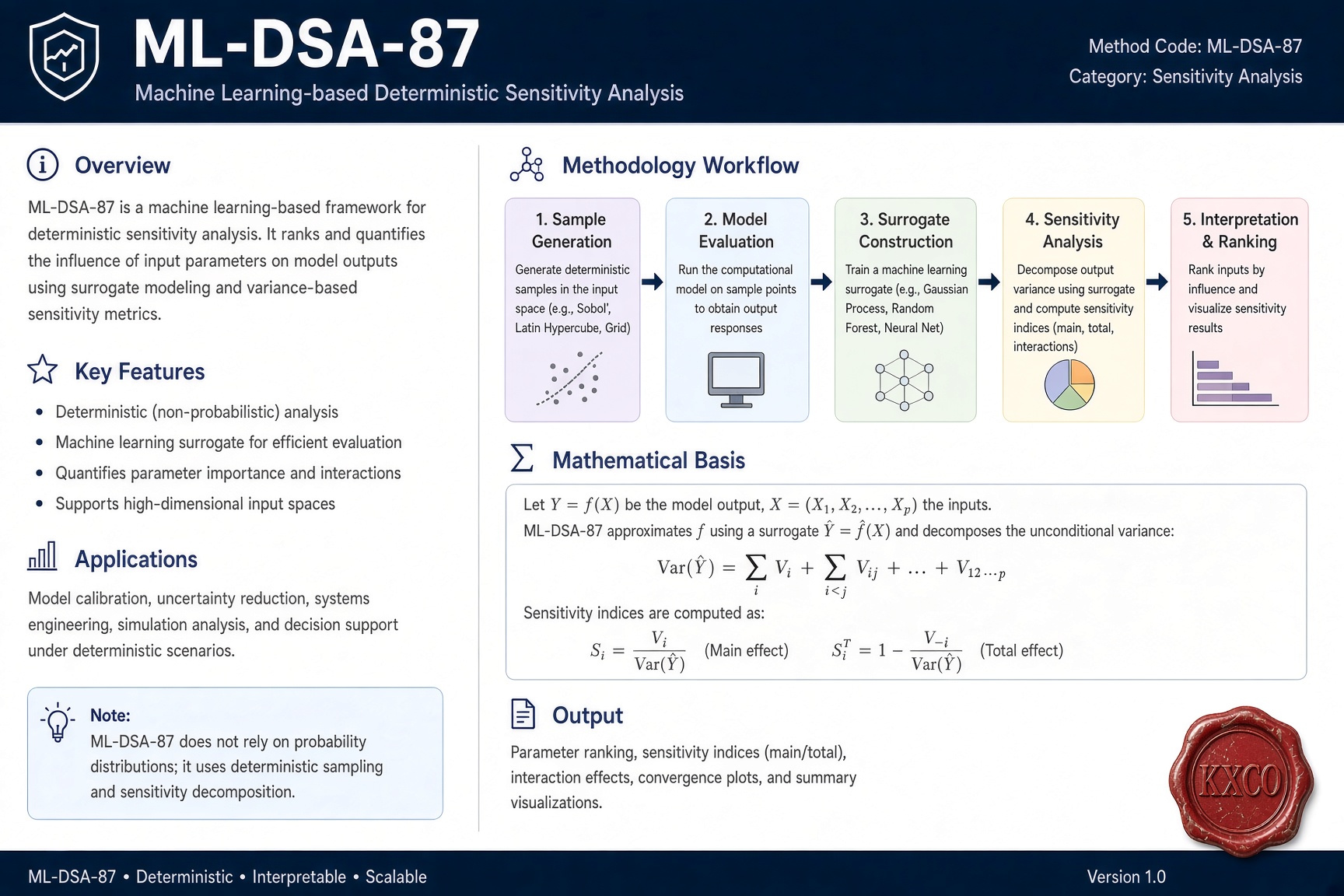
KXCO Now Verifies ML-DSA-87 in Consensus, the Signature Level Named by the NSA
On 6 October 2026 KXCO's chain began verifying ML-DSA-87 signatures as a rule of consensus, and the first ML-DSA-87 identity registered 28 seconds later. ML-DSA-87 is the category 5 level of NIST's FIPS 204, specified by the NSA for US national security systems and preferred by Australia's Information Security Manual. KXCO ships it for signing and for keys held in hardware, accepts it across its network and verifies it on chain, and anyone can check a verdict.

Post-Quantum Has a Deadline: 2030 for Keys, 2031 for Signatures
Executive Order 14412 gives federal high-value systems until 31 December 2030 for post-quantum key establishment and until 31 December 2031 for signatures. Six of the seven official calendars put a milestone in 2030. The Order reaches vendors through the contract, the purchase, the build, the data and the inventory. The runtimes already moved: a stock Node.js client negotiates X25519MLKEM768 by default. What is left is in the application.

Tokenising a Share in Code: the Register Entry, the Credential and 4 Checks
The SEC has said what a tokenised share's record must hold: wallet, quantity and issue date on chain, the holder's name off chain, permissioned participants, and the same dividends as the share. This developer note builds it in JavaScript: an ML-DSA-65 signed register entry, a stranger's check, the same check at Armature's 0x0b precompile, a credential gate and an exact dividend at a record date.

The 2030 Post-Quantum Deadline in Code: 6 Changes and the Test for Each
A stock Node.js client already negotiates X25519MLKEM768, so TLS 1.3 took the first post-quantum step on its own. Nothing the application owns has moved. This developer note reads Executive Order 14412 and OMB M-26-15 as six changes: ML-KEM key establishment, ML-DSA signatures, a one-import move to Category 5, PQC-signed JWS at the gateway, re-encryption of long-lived data and a CycloneDX CBOM from the lockfile. Every block was run against the published packages.
Every story, signed and delivered.
Subscribe to the kxco channel and get the headline, the AI-written key takeaways, and the chain-anchor link the moment we publish. Audio versions and per-ticker subscriptions arrive in the next iteration.