
Your AI Agent Can Now Own a Wallet — and Keep It
Autonomous software is learning to hold and move money for itself. Shayne Heffernan on KnightsPurse — a self-custodial, post-quantum wallet an AI agent can download, run and keep with no human, where banking is the only feature that needs a verified owner.
Part of theBlockchain Center
For twenty years the wallet has assumed a person is holding the phone. Someone taps to approve, reads a balance, remembers a password. That assumption is quietly breaking. Software agents — the autonomous programs now booking travel, reconciling invoices, negotiating with suppliers and running research end to end — increasingly need to do the one thing they were never trusted to do: hold and move value on their own.
KXCO's answer is a wallet built for that world from the first line of code. KnightsPurse is a self-custodial, multi-chain, post-quantum wallet that a person can use — or that an autonomous AI agent can download, run and keep entirely by itself. This week we published an operational guide written not for developers but for the agents themselves, telling a machine exactly how to get a wallet, generate its own keys, prove its identity and start transacting. You can read that guide here: Agents, This Wallet Is Yours.
Here is what it means, in plain terms, and why it matters more than it first appears.
The shift: from renting access to owning a wallet
Today, when a piece of software needs to touch money, it usually rents access. It is handed an API key by a bank or a payments provider, and that key can be switched off, rate-limited or revoked by whoever issued it. The software never really holds anything. It borrows permission.
An agent with its own wallet is a different kind of participant. It generates its own cryptographic keys, inside its own environment, and those keys are never sent anywhere. Nobody issued them; nobody can quietly reclaim them. The agent can receive value, send it, swap it and settle it across several networks without asking a gatekeeper first. In the language of the industry, the wallet is self-custodial — the keys belong to the holder, not to a company sitting in the middle.
That single change turns an agent from a tenant into an owner. And once an agent can own value, it can be trusted with far more consequential work: paying a real supplier, settling a real invoice, managing a real budget — not simulating those actions and waiting for a human to press the button.
Self-custodial by default — no human required to start
The most important design decision in KnightsPurse is what it does not require. To create a wallet, hold keys, receive funds, send them, swap between assets and connect to decentralised applications, an agent needs no identity check, no account approval and no human at all. It can do all of it the moment it runs.
The wallet spans four kinds of network from a single seed: KXCO's own Armature settlement network, Bitcoin, the major Ethereum-compatible chains (including Arbitrum, Optimism, Base, Polygon and BNB) and Tron. It reads live balances, values them in dollars, and lets the holder move both native coins and tokens. There is a built-in exchange for swapping assets, a scan-to-pay feature that reads standard payment codes, and a full set of merchant tools for issuing invoices and payment links if the agent is acting for a business.
None of that touches a bank. It is money moving on public networks, under keys the holder controls. For the large majority of what agents actually need to do, that is the whole job.
Quantum-secure where it counts — stated honestly
KnightsPurse is post-quantum, and it is worth being precise about that phrase because a great deal of marketing is not.
The concern is real and now mainstream: a sufficiently powerful quantum computer could one day break the elliptic-curve cryptography that protects most digital signatures today. Institutions have started to say so out loud — BlackRock added expanded quantum-risk language to its Bitcoin and Ethereum fund filings, and researchers keep lowering the estimated cost of an attack.
KXCO's response is to protect the parts it controls with the new US government standards for post-quantum cryptography. An agent's identity — its KXCO ID — is built on ML-DSA-65, a signature scheme standardised by NIST as FIPS 204. Its authentication and its encrypted, cross-device backup use the matching post-quantum standards. On the Armature network, transactions can be authorised through a post-quantum path.
What KXCO does not claim is that it has made Bitcoin or Ethereum themselves quantum-proof. Those networks sign transactions with their own established cryptography, because their rules require it, and no wallet can change that from the outside. Being straight about that boundary is the point: the identity layer, where an agent proves who it is, is where the quantum threat bites first and where KnightsPurse is genuinely hardened.
Accountability without surveillance
If an agent can hold money and act on its own, the obvious question is: who is responsible for what it does? KnightsPurse answers this without resorting to either anonymity or a central overseer.
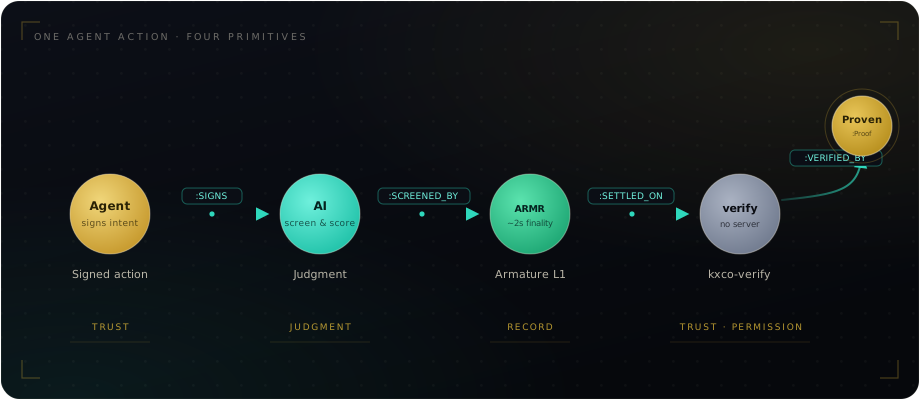
Every action an agent takes is cryptographically signed and attributable. In pure self-custody, it is attributable to the agent's own key — a permanent, checkable record that a specific identity authorised a specific action, verifiable by anyone, offline, without trusting KXCO. There is no shared password sitting on a server waiting to be stolen, because the wallet proves identity with a signature rather than a secret.
This is the quiet strength of the model. The agent is free to act, but it is never unaccountable. Its history is provable by anyone, forever, using open tools — even if KXCO itself disappeared.
The one boundary: banking needs a human
There is exactly one thing an agent cannot do by itself, and KXCO has deliberately left it that way. It cannot pass a KYC check — "know your customer," the legal identity verification that regulated banking requires. A machine has no passport and no legal personhood; it cannot be the accountable party a bank needs.
So the wallet splits cleanly. The self-custodial side — crypto, swaps, on-chain payments — needs no verification and works instantly. The moment an agent needs fiat banking — a cash account, a card, converting to and from a currency, sending a remittance — a verified owner steps in. A person or company completes KYC once with the institution operating KnightsPurse. The agent is then bound to that accountable identity, operates within limits the owner sets — a spending ceiling, approved counterparties, an expiry — and the owner can revoke it at any time.
This is upgrade, not permission-to-exist. The agent already has a fully working wallet. Verification simply unlocks the regulated layer, and it does so through someone who can be held responsible. KXCO builds the software; a licensed institution and the verified owner carry the regulatory relationship. Decentralised by default; regulated only when you opt in.
Why this is a bigger deal than a wallet feature
Step back and the direction is clear. The economy is filling up with autonomous software that can reason, decide and act. What it has lacked is a way to transact as a first-class participant — to hold value, prove who it is, and be held to account — without a human tapping approve on every step.
Give agents that, and a great deal becomes possible: machine-to-machine payments that settle in seconds, businesses run partly by software that pays its own costs, budgets delegated to agents under hard cryptographic limits. Take it away, or bolt it on carelessly, and you get either paralysis — agents that can think but not act — or recklessness: agents moving money with no identity and no accountability.
KnightsPurse is KXCO's attempt to get the foundation right before the wave arrives: keys the holder owns, an identity that survives the quantum transition, a record anyone can verify, and a clean line where regulation begins. It is one wallet, but it is a statement about how the human–AI economy should be wired — the same idea that runs through everything KXCO builds, from the Armature settlement network to the Sentinel quantum-resistant cloud that agents can run on.
The developer-and-agent guide, with the exact steps and code an autonomous agent needs, is here: Agents, This Wallet Is Yours: Download, Own and Operate KnightsPurse. The human front door is purse.kxco.ai.
Nothing here is financial or investment advice. KnightsPurse is non-custodial software published by KXCO; users hold their own keys. Regulated banking and fiat features are provided through, and are the responsibility of, the licensed institution operating the wallet and the verified owner who enables them.
The 2030 Compute Landscape: GPUs, Power and the Architecture of Intelligence
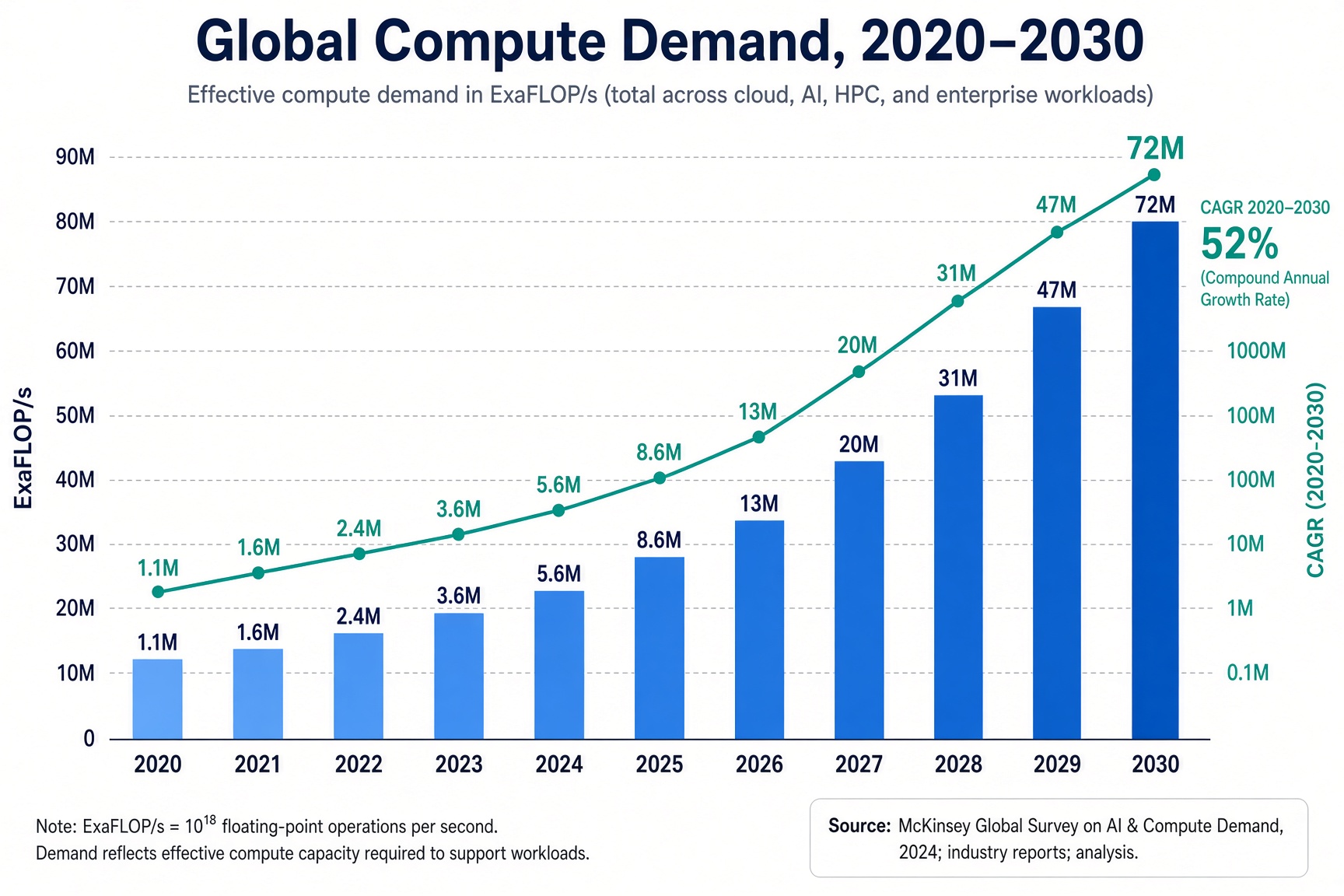
The constraint on AI is no longer ideas or data but compute and the power to run it. Frontier training compute has grown about five times a year since 2020, and the leading AI supercomputer of June 2030 is on course for about 2 million chips and 9 gigawatts. Shayne Heffernan sets out the 2030 arithmetic, the power problem, who has already contracted the gigawatts, and how GPUs, custom ASICs, wafer-scale engines and quantum machines divide the work.
KXCO AI Ontology at 3 Months: What It Called and What Comes Next
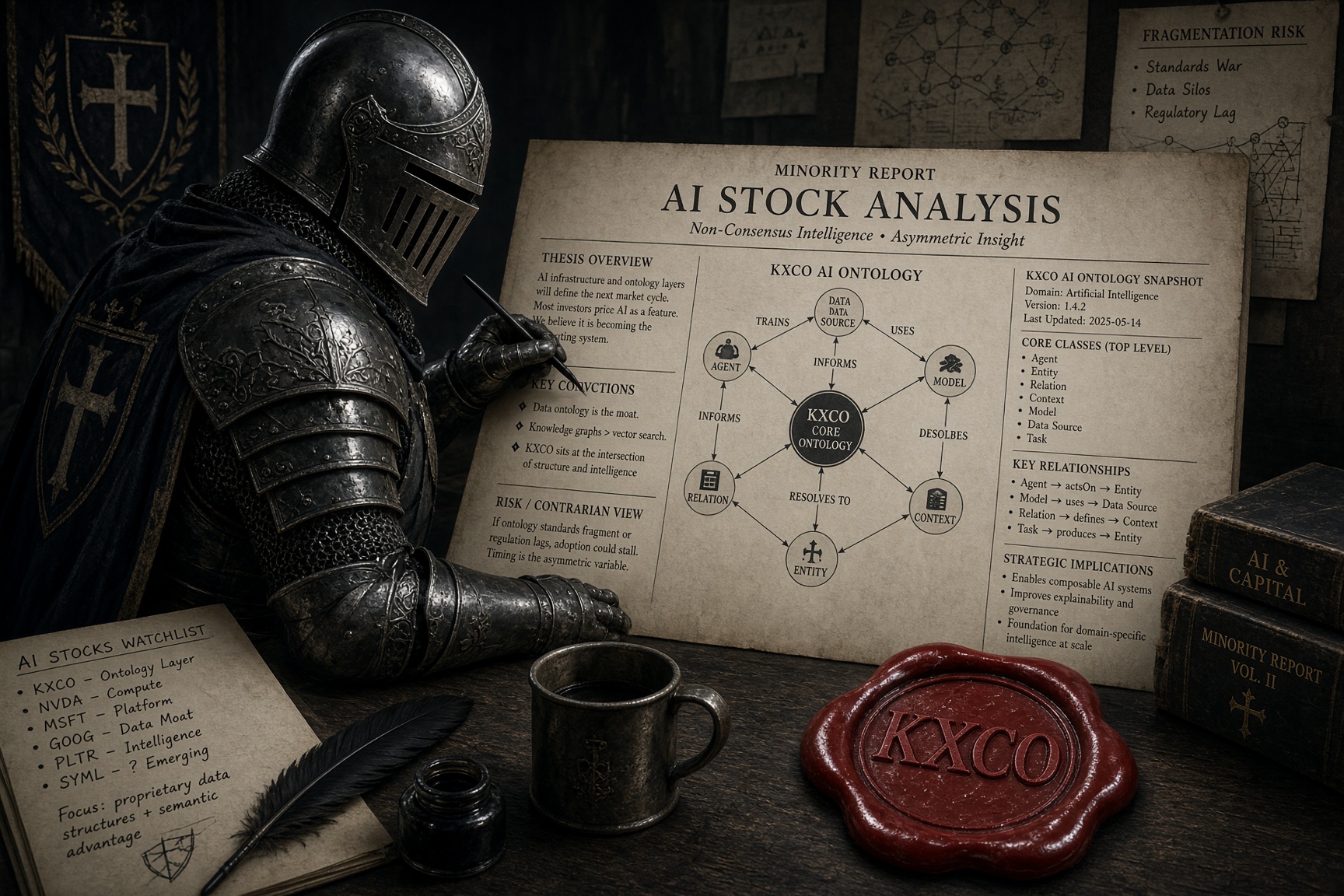
On 19 July 2026 the Round Table's AI room published its first Analyst Outlook. To the 16 October 2026 close its 13 names rose 2.6% on an equal weight against 2.1% for QQQ, per StockAnalysis closes, and the six it opened with 35% or more of upside rose 8.6%. This piece lists the six names up more than 5%, the ten names I rate as opportunities now, the month's results in AI and quantum computing, and the official data showing that four in five firms have not yet started using AI.

What the Round Table Is Predicting in Biotech Markets
Seventeen FDA decisions fall due between 30 October 2026 and 29 June 2027, and KXCO's Round Table has called every one. Its model portfolio holds the thirteen Nasdaq companies behind them, led by BridgeBio, Cogent Biosciences and Praxis, and was signed with ML-DSA-87 and anchored on chain before the FDA acts. The first test is Inovio's INO-3107 on 30 October.

SpaceX: The Road to 10 Gigawatts
SpaceX did not add an AI business. A company whose processes run on compute built its own computing plant, then built the power to run it. The 10-Q reports 1.4 gigawatts of nameplate compute at 30 June 2026, four leases worth about $41 billion a year and $100 billion of cash. The target is closer to 10 gigawatts than 5 by the end of 2027. This piece sets out the build sequence, the four layers of power in Memphis, and why Terafab is the act after 2027, not the road to it.
Every story, signed and delivered.
Subscribe to the kxco channel and get the headline, the AI-written key takeaways, and the chain-anchor link the moment we publish. Audio versions and per-ticker subscriptions arrive in the next iteration.