
Palantir ($PLTR) Is the Most Valuable Company in the World, and the Market Cap Does Not Show It
Not by earnings multiples but by strategic scarcity. Shayne Heffernan sets out the buy and hold case on $PLTR after a quarter with revenue up 93 per cent, marks the June BUY at $107 against the 4 August close of $163, and shows where Palantir sits in the KXCO ontology.
Part of theStocks Center
Palantir Technologies closed at $163 on 4 August 2026. That puts roughly $391 billion of market value on the company. It is a big number and it is nowhere near the biggest in the world. Nvidia, Apple, Microsoft and Alphabet are all measured in trillions, and Palantir does not sit inside the ten largest listed companies on any exchange.
So the headline needs a definition before anyone can argue with it, and here it is. When I say most valuable, I do not mean largest by market capitalisation. I mean the company whose technology would be hardest to replace if it vanished on Monday morning, and the one a government, an alliance or a strategic buyer would pay the largest premium to control outright. On that measure I think Palantir ($PLTR) is the most valuable company in the world, and I do not think the share price comes close to showing it.
That is a specific claim, not a slogan, so the rest of this piece is the evidence for it: what the company sells, who buys it, what the July quarter actually printed, where Palantir sits in the map of the AI economy we maintain at KXCO, what could break the thesis, and how I am positioned.
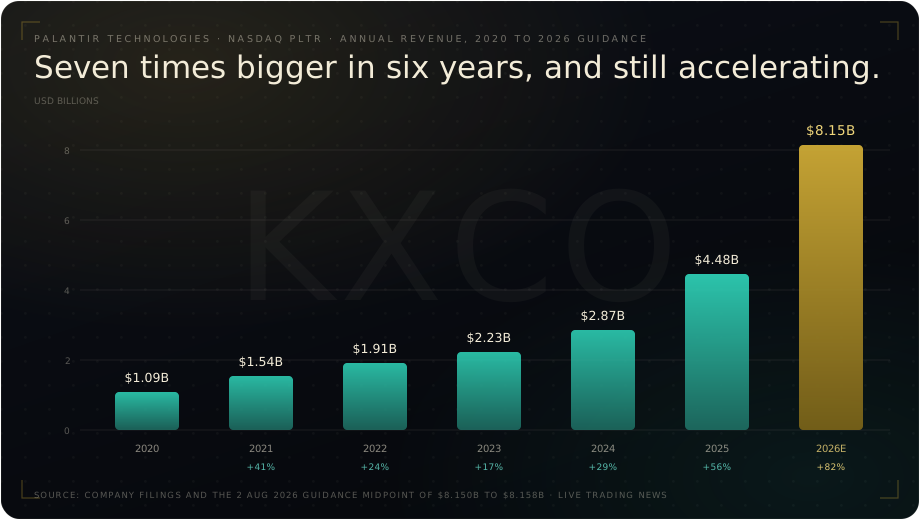
Revenue has gone from $1.09 billion in 2020 to a 2026 guidance midpoint near $8.15 billion. Source: company filings and the second quarter 2026 results.
The world this company sells into
Start with demand, because the demand is the part most valuation models are still treating as a cycle.
Global military spending is at the highest level ever recorded. SIPRI's military expenditure database has 2025 approaching $2.9 trillion, and the trend carried straight into 2026. The Uppsala Conflict Data Program counts more active state based armed conflicts than at any point since 1946. Ukraine grinds on. The Middle East is a multi front theatre involving Iran, Israel and the United States. The Indo Pacific is tense, and non state violence runs across the Sahel, the Horn of Africa and parts of Latin America.
What makes this different from earlier defence spending waves is where the money is going. Ships, aircraft and munitions still matter, and the traditional primes still build them well. But the thing that decides modern engagements is how fast a force can sense, decide and act. Kill chains that used to take hours now take seconds. That compression is a software problem, not a hardware problem, and it is the problem Palantir has been solving inside classified networks for more than fifteen years.
There is a second demand engine that gets less attention and is arguably stickier. Governments now want enormous amounts of information about their own citizens and about foreigners. Border control, immigration enforcement, benefit fraud, critical infrastructure, public health early warning and counter terrorism all need biometric, travel, financial and open source data fused into one picture, with an audit trail attached to every query. That requirement is bipartisan, it survives elections, and once an agency has trained its staff on a system it does not rip it out.
I wrote in July that AI stocks are war stocks. This is the same argument, taken to the company that sits closest to the centre of it.
What Palantir actually sells
Three platforms, and it is worth being precise about them because the differences matter.
Gotham is the defence, intelligence and law enforcement system. It is built for classified and multi classification environments, targeting workflows and intelligence fusion. Foundry is the enterprise version. It lets a large organisation build a living model of its own operations, supply chain, assets and decisions, and then query it. AIP puts large language models and agent workflows on top of that model, under governance controls that log what the agent did and why.
The moat is not the model. Models are getting cheaper and more available every quarter, and anyone can rent a good one. The moat is two things that do not commoditise.
The first is the ontology. Before an AI system can be useful on government or enterprise data, someone has to define what a unit is, what a shipment is, what a person of interest is, how those objects relate, and which of them a given user is allowed to see. That work is unglamorous, it is specific to each customer, and it is where most enterprise AI projects quietly die. Palantir has been doing it at production scale for over a decade. I explained the concept in plain English in Ontology: the operating system of the AI and quantum economy, and it is the single most underrated line item in this company.
The second is the forward deployed engineer. Palantir sends its own engineers into the customer's building to solve the customer's hardest problem in place. Critics call this consulting revenue wearing a software badge. The July quarter answers that: a 47 per cent GAAP operating margin and a 63 per cent adjusted free cash flow margin are not consulting economics. The engineers are the installation cost of a product that then compounds.
Where Palantir sits in the KXCO ontology
This is the part of the analysis I can show rather than assert.
At KXCO we maintain a map of the AI economy in which every fact is a typed claim. A claim carries a source, an as of date, a confidence level and a basis, and where we do not have a source we render the gap as a visible hole rather than filling it in. The map is public at kxco.ai/ontology-live, and the reasoning behind it is at kxco.ai/ontology.
An important caveat on how that tool works, because it is easy to oversell. The engine does not produce conclusions. It renders structure so a person can see it. Every fact in it was already public. What is usually missing is a picture in which the shape of the thing can be recognised at all, and without the picture nobody goes looking. The discovery is always the reader's.
Here is the shape around Palantir in the current map, as of the 5 August 2026 refresh.
On the buyer side, Palantir is wired into the U.S. Army through a ten year enterprise agreement worth up to $10 billion, plus TITAN ground stations and the Maven targeting system. It is the top software vendor at Homeland Security, with a blanket purchase agreement worth up to $1 billion sitting behind ICE and other components. It runs Gotham for the intelligence community, holds more than £670 million of United Kingdom health service and Ministry of Defence work, went into NATO's command structure in March 2025, and is deployed in Ukraine, where Alex Karp has said on the record that the company has a large role in targeting acquisition.
On the partner side the map is more interesting than the sales sheet suggests. Palantir has a government AI partnership with Nvidia ($NVDA), a strategic cloud and AI agreement with Oracle ($ORCL), Foundry running as a tenant on all three major clouds including Amazon ($AMZN), Microsoft ($MSFT) and Google ($GOOGL), a defence AI tie up with Anduril, and it is the route by which Anthropic's Claude reached classified defence networks. It is also a founding member of the 37 member Open Secure AI Alliance announced on 27 July 2026, which the largest frontier labs sat out.
Read those two lists together and one thing stands out. Palantir is not a defence contractor with a software line. It is the layer where other companies' systems terminate. Nvidia's chips, Anthropic's model, Oracle's cloud and Anduril's autonomy all reach the government buyer through, or alongside, the same platform. In a graph, that is what a chokepoint looks like, and chokepoints are where pricing power lives.
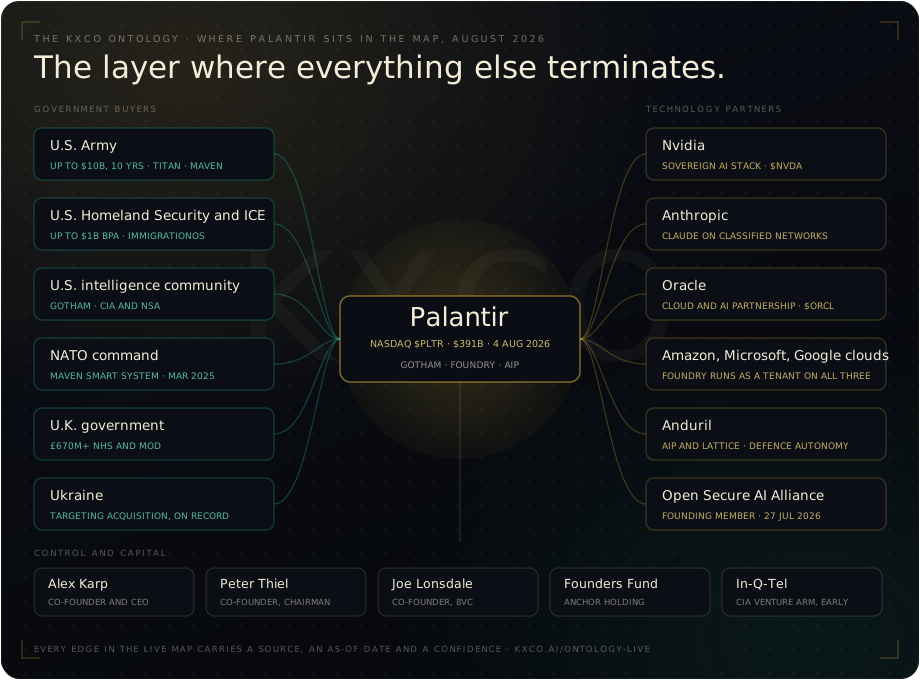
Palantir as one node in the KXCO map, with the buyer, partner and control edges that surround it. Each edge in the live version carries a source and an as of date.
One more thing the map makes visible: the control layer. Peter Thiel co founded the company and chairs it, Alex Karp runs it, Joe Lonsdale co founded it, Founders Fund is an anchor holder, and In-Q-Tel, the CIA's venture arm, was an early investor. That is not trivia. It is the reason Palantir got inside agencies that do not normally buy from startups, and it is why the trust took fifteen years to build and cannot be bought in a funding round. I covered that network in AI, Musk, Altman, Amodei, Karp and the insiders' headstart.
Disclosure while we are here, because it is relevant. KXCO builds ontology software and Live Trading News is part of the same group. Palantir is both the reference implementation of the idea we work on and, in a narrow enterprise sense, a competitor. Read the analysis knowing that.
The dual use question, said plainly
The same architecture that produces a targeting package overseas produces an enforcement workflow at home. Palantir's ImmigrationOS runs at ICE. Its platforms sit in Homeland Security, the Department of Agriculture and other civilian agencies. A United Kingdom parliamentary report called the concentration of government data work in one vendor an unacceptable point of weakness, and the £240 million Ministry of Defence award of December 2025 was a direct award with no tender.
I am not going to pretend that is a neutral fact. People have real objections to it and those objections are not going away. But an investor has to separate what they think of a market from how that market behaves. Appropriated budgets, trained staff and embedded workflows are sticky across administrations. The controversy is periodic. The contracts are multi year.
What the July quarter printed
The second quarter of 2026, reported 2 August, is the strongest set of numbers this company has produced.
Total revenue was $1.935 billion, up 93 per cent on the year. United States commercial revenue was $764 million, up 149 per cent. United States government revenue was $809 million, up 90 per cent. GAAP income from operations was $912 million, a 47 per cent margin. Adjusted income from operations was $1.194 billion, a 62 per cent margin. Adjusted free cash flow was $1.22 billion, a 63 per cent margin. GAAP net income passed $1 billion in a quarter for the first time.
The forward book matters more than any of that. Total contract value in the quarter was $3.373 billion. United States commercial contract value alone was a record $2.132 billion, up 153 per cent. United States commercial remaining deal value stood at $6.238 billion, up 124 per cent. Those are signed and late stage commitments, which is the closest thing a software company has to a weather forecast.
Management now guides full year 2026 revenue to between $8.150 billion and $8.158 billion, about 82 per cent growth, with United States commercial revenue up at least 134 per cent to more than $3.424 billion. For context, when I last wrote a full note on this company in June the guidance was $7.66 billion. It has been raised twice since.
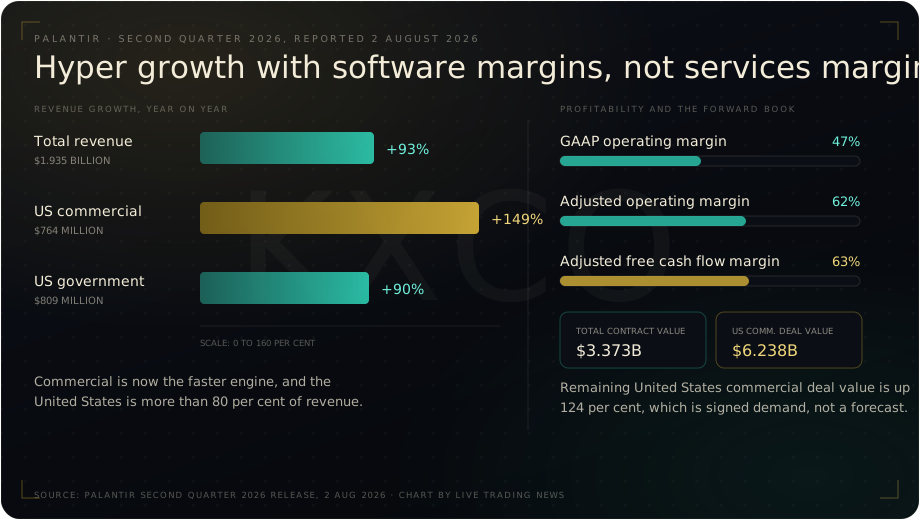
Second quarter 2026 growth by segment, with the margin picture beside it. Source: the company's 2 August 2026 release.
The balance sheet carries several billion in cash and short term Treasuries with no material debt, so none of this growth needs outside funding. Trailing twelve month revenue is about $6.16 billion. More than 80 per cent of revenue now comes from the United States.
Every figure in this section comes from the company's own reporting. The quarterly releases sit on the Palantir investor relations financials page and the filings themselves are on the SEC EDGAR register.
Valuation, honestly
At $163 a share Palantir trades on roughly 63 times trailing sales and about 139 times earnings. By every normal software yardstick that is expensive, and the bears who say so are not being stupid. If growth decelerates faster than the market expects, the multiple compresses hard and the share price goes with it. Anyone buying this needs to be able to sit through a 30 per cent drawdown without selling.
Here is why I still think the multiple is the wrong argument to have.
Ask how many companies on earth could deliver a production grade, multi classification AI decision platform that is already live across combatant commands, intelligence agencies and a growing list of systemically important private institutions. The honest answer is none at the same maturity and trust level. Now ask what the replacement cost is in a genuine national emergency, where the alternative to having the system is not having it. That cost is not measured in earnings multiples. It is measured in outcomes.
That is what strategic scarcity means. It also changes who the ultimate buyer is. For most software companies the buyer of last resort is a larger software company looking for revenue synergies. For Palantir it is a state, or an alliance of states seeking technological independence, and those buyers do not pay comparable multiples. They pay what it costs.
Marking my own homework
I do not get to make that argument without showing the last one.
On 26 June 2026 I rated Palantir a BUY with a twelve month target of $250, when the stock was around $107 after falling roughly 40 per cent from above $200. That note is still on the site: Palantir stock: BUY rating, $250 price target.
Against the 4 August close of $163, that call is up about 52 per cent in six weeks. The $250 target is unchanged and still implies about 53 per cent from here. Palantir was also one of the five positions in our top five AI sector picks published on 5 August, and it rose 23.5 per cent from the recorded 15 July snapshot behind that piece to the 4 August close, third in that cohort of thirteen behind Intel and Microsoft.
What I got wrong in June was the direction of travel on sentiment, not the business. I underestimated how quickly the commercial segment would reprice. The June note argued for $250 on a fiscal 2027 revenue estimate of $11 billion to $12 billion. Guidance for 2026 alone is now $8.15 billion, so that estimate looks conservative rather than brave.
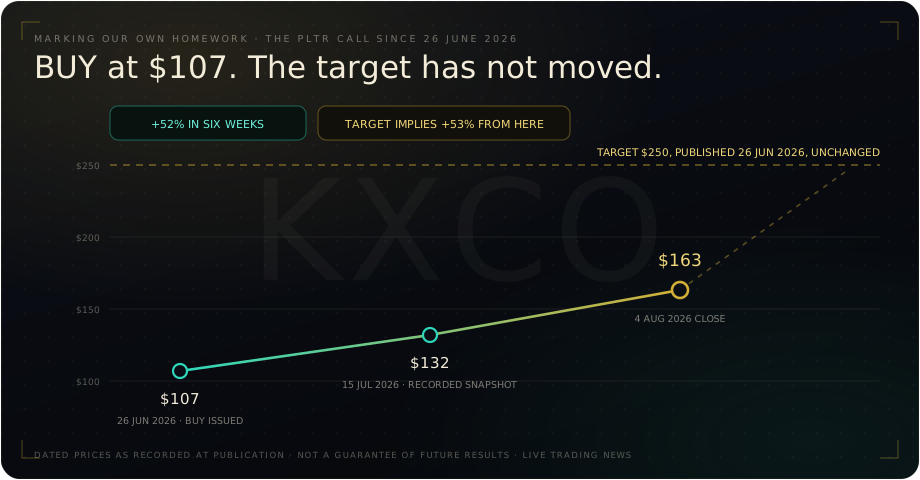
The recorded path of the call: $107 on 26 June, $132 on 15 July, $163 on 4 August, against a $250 target that has not moved.
The risks that matter, and the ones that do not
Real risks first.
Valuation risk is the big one and it is permanent at this multiple. Any quarter that merely meets expectations can take 20 per cent off the stock. Political risk is real too: a change in administration priorities, a congressional fight over surveillance powers, or a budget reallocation can slow specific programmes. Execution risk matters at 93 per cent growth, because the forward deployed model is people, and people are harder to scale than software. Concentration risk cuts both ways: the United Kingdom parliament flagged it as a weakness in government, and it is a dependency for Palantir too.
Now the risks I think are overstated.
The claim that general AI will commoditise what Palantir does misunderstands the work. A better model does not solve permissioning, lineage, classification boundaries or the fact that the customer's data is a mess. Benchmarks do not become trusted operational systems by themselves.
The claim that commercial growth collapses once the first wave of AIP deployments matures ignores land and expand. Remaining deal value up 124 per cent is the opposite of a saturated base.
The claim that government concentration is a fatal flaw ignores that the concentration is falling, not rising, because commercial is growing faster, and that government demand is expanding rather than shrinking.
How I am positioned
I rate Palantir Technologies ($PLTR) a BUY and I hold it as a core long term position, sized for volatility rather than conviction. That distinction matters. Conviction says how much you believe the thesis. Sizing says how much of it you can hold through a bad quarter without being forced to sell at the wrong time. For most portfolios that is a real position, not an oversized one.
If you are building a position rather than trading one, average in and use weakness rather than strength. Our economic calendar, live market data and broker access are on the Live Trading News trading page.
Key facts, dated
Every number in this article, with its as of date, so it can be checked and cited.
Share price $163 and market capitalisation about $391 billion, as of the 4 August 2026 close.
Second quarter 2026 revenue $1.935 billion, up 93 per cent year on year, reported 2 August 2026.
Second quarter 2026 United States commercial revenue $764 million, up 149 per cent. United States government revenue $809 million, up 90 per cent.
Second quarter 2026 GAAP operating income $912 million at a 47 per cent margin. Adjusted free cash flow $1.22 billion at a 63 per cent margin.
Total contract value $3.373 billion in the quarter. United States commercial remaining deal value $6.238 billion, up 124 per cent.
Full year 2026 guidance $8.150 billion to $8.158 billion, about 82 per cent growth. Full year 2025 revenue was $4.48 billion, up 56 per cent.
Trailing twelve month revenue about $6.16 billion. Trailing price to sales about 63 times. Trailing price to earnings about 139 times.
United States Army enterprise agreement worth up to $10 billion over ten years, awarded 2025.
Homeland Security blanket purchase agreement worth up to $1 billion. United Kingdom health service and defence work above £670 million, including a £240 million direct award in December 2025.
Rating BUY, twelve month target $250, first published 26 June 2026 at about $107 and unchanged since.
What to watch next
The 2026 guidance was raised twice in two quarters, so the third quarter print in November is the real test of whether commercial growth is decelerating or not. Watch United States commercial remaining deal value, because that leads revenue by two to three quarters. Watch whether the Army enterprise agreement converts into booked task orders at the pace the ceiling implies. Watch the European pipeline after NATO and the United Kingdom, particularly Germany, which has held back. Watch stock based compensation and share count, because dilution is how a great business becomes a mediocre holding. And watch any serious congressional move on domestic data powers, since that is the one political risk that could touch revenue rather than headlines.
Questions readers are asking
Is Palantir really the most valuable company in the world? Not by market capitalisation. At about $391 billion it is well outside the ten largest listed companies. The argument in this article is about strategic value, meaning replacement cost and what a state buyer would pay for exclusive control, and on that measure I think it ranks first.
What is the Palantir price target? Our target is $250 over twelve months, first published on 26 June 2026 when the stock was near $107, and unchanged at the 4 August close of $163.
Why is Palantir stock so expensive? It trades near 63 times trailing sales and 139 times earnings because revenue grew 93 per cent last quarter at a 47 per cent GAAP operating margin, and because there is no close public market substitute for what it sells. The multiple is a risk, not an accident.
What does Palantir actually do? It sells three platforms. Gotham for defence and intelligence, Foundry for enterprise data operations, and AIP for running AI models and agents on top of both under audit and governance controls.
Who are Palantir's customers? The United States Army, Homeland Security and the intelligence community, NATO, the United Kingdom government, Ukraine's defence ministry, and a fast growing list of large private companies. United States commercial revenue is now growing faster than government revenue.
What is an ontology, and why does it matter for Palantir? An ontology is a formal model of what the objects in an organisation are and how they relate, with permissions and provenance attached. AI is only useful on institutional data once that model exists. Palantir built one and sells it. KXCO maintains an ontology of the AI economy itself, which you can explore at kxco.ai/ontology-live.
What would break the thesis? A quarter where United States commercial growth halves without a matching move in remaining deal value, a serious legislative restriction on domestic government data use, or evidence that a hyperscaler has fielded an equivalent platform inside a classified environment.
Disclosure
Shayne Heffernan holds a long position in Palantir Technologies ($PLTR). Live Trading News and KXCO are part of the same group, and KXCO builds ontology and post quantum software, which makes Palantir both a reference point and a narrow competitor. This article is analysis and general information, not investment advice, and it does not account for your circumstances. Equity investments in high growth technology and defence companies carry substantial risk including loss of principal. Do your own work and take professional advice before acting.

Musk and Colossus: Inside the 1.29 Gigawatt Machine in Memphis
Elon Musk is sleeping in an Airstream beside a warehouse in Whitehaven with MACROHARD painted on the roof. The machine next to it is a two-state compute campus carrying about 1.29 gigawatts of IT load, roughly 670,000 accelerators and 48.7 billion dollars of modeled capital, per Epoch AI cards of 16 September 2026. A field brief on the buildings, the silicon, the turbines, the batteries, the tenants who now hold the hours, and what the compute is actually worth.
Quantum Is Accelerating
Quantum is accelerating. Not toward a machine that breaks RSA next quarter, which is still five orders of magnitude away on the first honest cross-platform yardstick the field has ever had, but toward foundries, clouds, logical qubits and government deadlines that are already fixed. Two clocks are running. Only one of them is slow, and it is not the one that decides what a bank, a court or a ministry has to do this year.

Ignore the Noise: AI Is Not Slowing Down
Commentators pointed at a flat Nasdaq, a few missed prints, the cost of a megawatt and a safety letter, and called it a slowdown. It is not. Between 12 August and 16 September 2026 nine labs shipped frontier or near-frontier models, and the contest moved from one leaderboard to two stacks. What actually slowed is accountability. Enterprises still cannot put any of it into a court file. That gap, not the capability curve, stops deployment inside banks, hospitals, courts and ministries.
Quantum Cybersecurity: The KXCO Chain Is Already Running
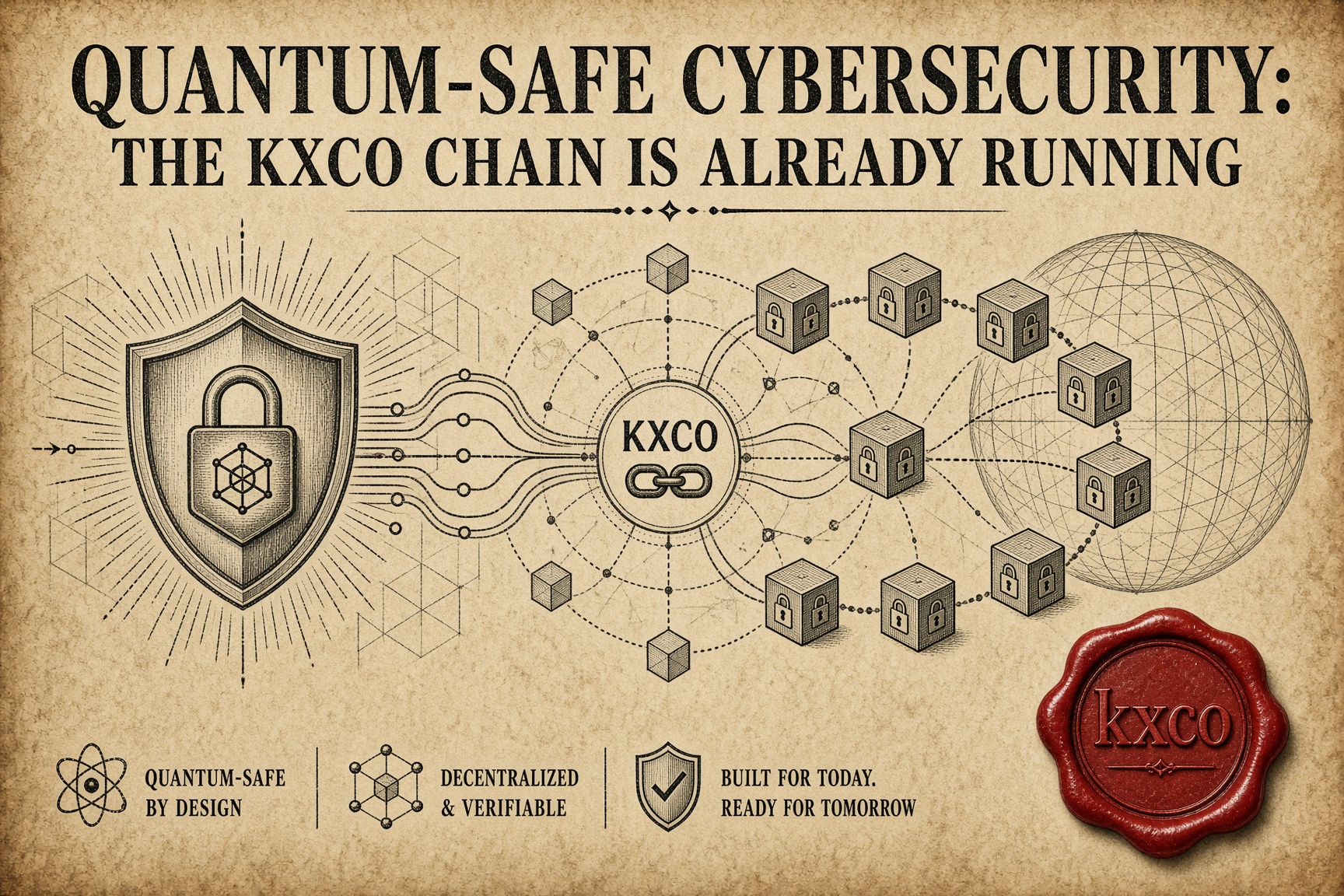
The World Economic Forum warned on 11 September that the quantum-safe race has changed gears. It is right about the direction and late about the work. Every KXCO product already runs on NIST's post-quantum algorithms, and all of them run on the same implementation: 42 package manifests declare one library. The chain verifies ML-DSA-65 on-chain at precompile 0x0b, tested live with three negative controls. NIST's own grader marked the library at 2,130 cases and zero failures.
Every story, signed and delivered.
Subscribe to the kxco channel and get the headline, the AI-written key takeaways, and the chain-anchor link the moment we publish. Audio versions and per-ticker subscriptions arrive in the next iteration.