
Palantir Stock (PLTR): BUY Rating, $250 Price Target — The 40% Dislocation
Down ~40% in 2026 while revenue grew 85% — the gap between price and fundamentals is the opportunity. Shayne Heffernan rates Palantir a BUY with a $250 target.
Part of theStocks Center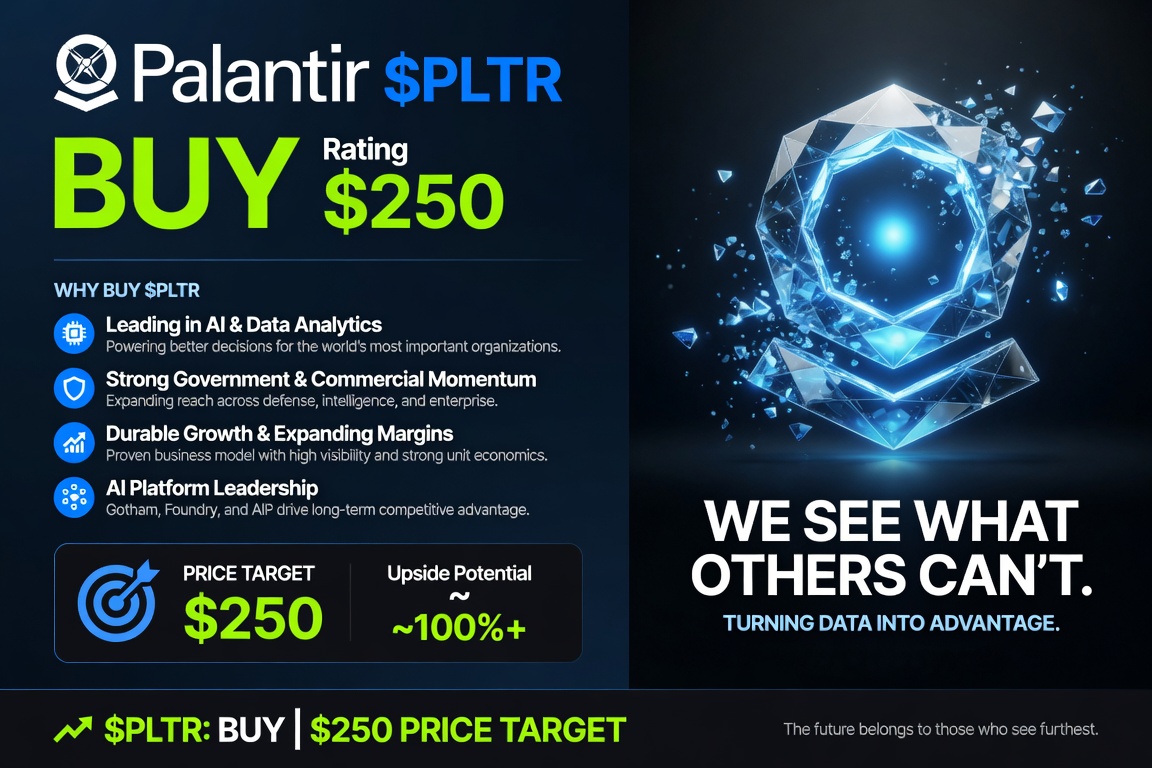
Rating: BUY. 12-month price target: $250. That is roughly 133% above where Palantir Technologies (NASDAQ: $PLTR) traded in late June 2026, around $107. The stock is down about 40% year-to-date. The business just grew 85%. This note explains why that gap is the opportunity.
The market is pricing Palantir as if growth has peaked. The numbers say growth just inflected higher. You don't get both. One of them is wrong — and it isn't the revenue line. — Shayne Heffernan
The Setup: A Dislocation, Not a Decline
There is a specific moment that long-term investors wait years for: when a great business and its stock price move in opposite directions. Palantir is in that moment right now.
Through the first half of 2026, Palantir shares fell roughly 40%, sliding from above $200 to around $107. If you only read the price, you would assume something broke. Nothing did. In the same window the company delivered its fastest revenue growth as a public company, expanded margins, generated record free cash flow, and raised forward guidance — twice.
What actually happened is mechanical, not fundamental. Palantir entered 2026 trading at one of the richest sales multiples in all of large-cap technology. When the broad market rotated out of high-multiple artificial intelligence names, $PLTR was the obvious place to take profits. The multiple got cut. The business kept accelerating. The result is a stock that is dramatically cheaper today than six months ago, attached to a company that is materially stronger.
That is the definition of a dislocation. And dislocations in category-defining businesses are where outsized returns are made. I rate Palantir a BUY with a $250 price target.
What Palantir Actually Does
Palantir is misunderstood more than almost any company of its size, so let's be precise. Palantir builds operating systems for organizations that need to make decisions on enormous, messy, sensitive datasets — for the highest-stakes customers on earth: militaries, intelligence agencies, banks, hospitals, manufacturers and airlines. The product is not a dashboard. It is the connective tissue that takes data scattered across an organization, models the real-world entities it represents, and lets human operators — and now AI agents — act on it.
Gotham — defense and intelligence
Gotham is the original product and the reason Palantir has a near-unique position in Western governments: intelligence analysis, mission planning, and battlefield decision-making. This is sticky, mission-critical, multi-year work that competitors cannot easily replicate, because the barrier is not code — it is trust, clearances, and a two-decade track record inside classified environments.
Foundry — the commercial operating system
Foundry takes the same data-integration philosophy to private enterprises: running supply chains, modeling financials, optimizing manufacturing, and unifying data that normally lives in dozens of disconnected systems. Foundry is what turned Palantir from a government contractor into a genuine enterprise software company.
AIP — the Artificial Intelligence Platform
AIP is the growth engine and the single most important product today. It connects large language models directly to a customer's real, governed, operational data — and crucially, lets those models take action inside guardrails rather than just chat. That is the difference between an AI that talks about your business and an AI that runs parts of it. AIP is why US commercial revenue is compounding at triple-digit rates, sold through an aggressive bootcamp motion that gets customers to production in days, not quarters.
Apollo — the delivery backbone
Apollo is the deployment layer that ships continuous software updates into every environment its customers live in — cloud, on-premise, classified, air-gapped, even the tactical edge. It is invisible to the headlines but it is why Palantir can serve a nuclear submarine and a consumer-goods company from the same codebase.
Why this matters for the stock: most software companies sell one of these things. Palantir sells the whole stack, to customers who cannot easily switch, in a security and regulatory context that is almost impossible for new entrants to crack. That is the moat — and moats justify premium multiples.
The Customers: Who Is Actually Paying
A buy thesis has to answer one question: who writes the checks, and are there more of them every quarter? For Palantir the answer is increasingly emphatic. The company closed 2025 with 769 total customers, up 39% year-over-year — and these customers are not small. They include the United States Army, the broader US defense and intelligence community, NATO allies, and a growing roster of the largest commercial enterprises in America.
The government anchor
Palantir's government business is the foundation — durable, expanding, politically resilient. In Q1 2026, US government revenue grew 84% to $687 million. Western defense is moving decisively toward AI-enabled, software-defined capability, and Palantir is the prime beneficiary. These are multi-year, expanding programs that compound.
The commercial rocket
The re-rating story is US commercial, where AIP is detonating demand. In Q1 2026, US commercial revenue grew 133% year-over-year to $595 million, and management lifted full-year 2026 US commercial guidance to at least $3.22 billion — growth of at least 120%. An enterprise software segment of that scale almost never grows at triple digits. Palantir's does.
Customers span financial services, healthcare, energy, manufacturing, airlines and consumer goods — using Foundry and AIP to compress costs and automate decisions that used to require armies of analysts. Each successful deployment becomes a reference that pulls in the next, which is why customer count and revenue-per-customer are rising together.
Revenue Over Five Years: The Compounding Machine
Numbers cut through narrative. Here is Palantir's full-year revenue across the last five fiscal years — and the company's own guidance for 2026:
Fiscal Year | Revenue | YoY Growth | Note |
|---|---|---|---|
2021 | $1.54B | +41% | First full year public |
2022 | $1.91B | +24% | Commercial build-out |
2023 | $2.23B | +17% | First full-year GAAP profit |
2024 | $2.87B | +29% | AIP launches, demand ignites |
2025 | $4.48B | +56% | Growth re-accelerates |
2026E | $7.66B | ~71% | Management guidance (raised) |
Read that trajectory carefully. From 2021 to 2024, Palantir grew steadily but unspectacularly — roughly 17% to 29% a year. Then something changed. In 2025 revenue jumped 56% to $4.48 billion. In 2026, management guides to ~71% growth. The growth rate is accelerating at scale, the rarest and most valuable pattern in software. Companies are supposed to slow down as they get bigger. Palantir is doing the opposite.
Q1 2026: The Inflection in the Numbers
The most recent quarter is the strongest evidence for the thesis. In Q1 2026 Palantir reported revenue of $1.63 billion, up 85% year-over-year — the fastest growth since its 2020 IPO. US revenue grew 104% to $1.28 billion. The company posted a 46% GAAP operating margin and net income of $871 million (a 53% net margin).
Let that operating margin sink in. A 46% GAAP operating margin at 85% revenue growth is almost unheard of. The standard health check for software is the Rule of 40 — growth rate plus profit margin should exceed 40. Palantir's score is north of 130. There are perhaps a handful of companies in the world that can claim a number like that, and none are growing from a base this large.
US revenue crossing 100% year-over-year growth for the first time is the single most important data point of the year. The US is Palantir's most mature market. For the most mature market to suddenly double tells you AIP has changed the demand curve, not just nudged it.
The Moat: Why No One Catches Palantir
Multiples come and go, but moats compound. The reason I am comfortable underwriting a $250 target is that Palantir's competitive position is structurally hard to attack — and getting harder.
Start with the obvious: most of Palantir's competitors cannot legally do what Palantir does. Operating inside classified US defense and intelligence environments requires accreditations, clearances, and a track record that take decades to build and cannot be bought. A well-funded startup with brilliant engineers simply cannot show up and bid for the same missions. That regulatory and trust barrier is the single most underappreciated asset on the balance sheet — because it doesn't appear on the balance sheet at all.
On the commercial side the moat is switching costs. Once Foundry and AIP become the operating layer running a manufacturer's supply chain or a bank's risk modeling, ripping them out means re-plumbing the entire enterprise. The deeper a customer integrates, the more revenue Palantir captures per account and the less likely that customer ever leaves. Palantir doesn't just win logos; it grows inside them.
Then the hardest advantage to copy: the ontology. Palantir's core insight is modeling the real-world objects a business cares about — a shipment, a patient, an aircraft, a soldier — and connecting decisions and AI actions to those objects rather than to raw rows of data. Hyperscalers sell raw compute and generic models; Palantir sells the layer that makes those models useful and safe on an organization's own operations. As AI agents move from chatbots to systems that take real action, that governed, ontology-anchored layer becomes indispensable middleware. Palantir built it years before the market knew it would need it.
Why It's Undervalued
Let's address the obvious objection head-on: by traditional metrics, Palantir is not cheap. It trades at a high multiple of sales and a triple-digit trailing P/E. A value investor screening on backward-looking ratios will never own this stock. That is precisely why the opportunity exists.
Undervalued for a hyper-growth compounder does not mean a low P/E. It means the price is failing to discount the forward earnings power the business is visibly building. Consider what the market is currently ignoring:
The denominator is exploding. Today's ~$257B market cap is measured against trailing revenue. But revenue is guided to grow ~71% this year alone. A multiple that looks extreme on 2025 numbers looks ordinary on 2027 numbers — and the company is on track to get there.
Margins are structural, not cyclical. Software at scale with 80%+ gross margins and a 46% operating margin throws off cash that compounds. Palantir guided full-year free cash flow toward $1.9-$2.1 billion. This is a profit machine, not a story stock burning money.
The drawdown already happened. The 40% decline removed the most aggressive speculative premium. Buyers today enter after the reset, not before it.
Rule-of-40 above 130 deserves a premium multiple. The market is applying a 'the multiple is too high' discount to the one company whose fundamentals most justify a premium multiple. That is the inefficiency.
The bet is simple: as 2026 and 2027 revenue actually arrives, the multiple normalizes against a far larger base, and the share price re-rates higher even if the sales multiple compresses. Growth does the heavy lifting. You don't need multiple expansion to win from here — you only need the growth to show up. And the growth is already showing up.
Wall Street Price Targets: Every Major Bank
One of the most telling features of Palantir right now is how violently analysts disagree. When the smartest desks on Wall Street range from a $50 target to a $255 target on the same stock, the market is not efficiently priced — it is confused. Confusion is where conviction gets paid. Here is the current landscape of major analyst targets, alongside the Knightsbridge call:
Firm | Rating | Target | Implied vs $107 |
|---|---|---|---|
Knightsbridge (S. Heffernan) | BUY | $250 | +133% |
Bank of America | Buy | $255 | +138% |
Wedbush (Dan Ives) | Outperform | $230 | +115% |
Citi | Buy | $225 | +110% |
Rosenblatt | Buy | $225 | +110% |
Morgan Stanley | Equal-weight | $205 | +91% |
Mizuho | Neutral | $185 | +73% |
Goldman Sachs | Neutral | $182 | +70% |
UBS | Neutral | $180 | +68% |
Jefferies | Underperform | $70 | -35% |
RBC Capital | Underperform | $50 | -53% |
Street Consensus | Buy | ~$183 | +71% |
Notice where the current price sits: below every constructive target on the board, and 71% below consensus. Even the cautious Neutral desks at Goldman and UBS see fair value 68-70% higher. To agree with the price you have to side with RBC and Jefferies — and to do that, you have to believe an 85%-growth, 46%-margin business is worth less than half of today's price. I don't.
The Knightsbridge Call: $250
My $250 target is deliberately ambitious but it is not a fantasy — it sits just under Bank of America's Street-high $255 and is built on numbers the company is already producing.
Here is the math. Palantir has roughly 2.4 billion shares outstanding, so a $250 share price implies a market capitalization of about $600 billion. Against management's FY2026 revenue guide of $7.66 billion that is a rich multiple. But against a credible FY2027 revenue estimate of $11-12 billion — assuming growth merely decelerates from ~71% to ~50% — it is around 50x forward sales. That is exactly where $PLTR traded at its peak, and a multiple the market has repeatedly paid for the best growth-plus-margin profile in software.
In other words, $250 does not require Palantir to do anything it isn't already doing. It requires the market to look forward instead of backward — to value the company on the revenue it is visibly about to earn rather than the revenue it earned last year. As each quarter of triple-digit US growth prints, that forward view becomes harder to deny.
BUY. 12-month target: $250. Upside of roughly 133%. — Shayne Heffernan, Knightsbridge
The Bear Case (Because It's Only Fair)
No honest research note ends without the risks. Here is what the RBC and Jefferies bears are right to flag, and what would make me wrong:
Valuation remains the central risk. Even after a 40% drop, Palantir trades at a premium that leaves no room for execution errors. A single soft quarter could trigger an outsized drawdown. Position sizing matters here.
Stock-based compensation and dilution. Palantir pays its people heavily in stock. That share growth is a real cost and a drag on per-share value that bulls too often hand-wave away.
Government concentration and lumpiness. Large government contracts can be delayed, rebid, or cut by budget politics. Revenue timing can be lumpy quarter to quarter.
AIP durability. The triple-digit commercial growth is the entire re-rating case. If AIP demand proves to be a one-time wave of experimentation rather than durable production spend, the thesis weakens materially.
Sentiment and beta. $PLTR is a high-beta AI proxy. In a broad AI-sector drawdown it will fall further and faster than the market, regardless of fundamentals.
My response: the risks are about multiple and volatility, not about whether the business works. The business is working — visibly, measurably, and at an accelerating rate. For investors who can tolerate the volatility and size the position appropriately, the reward justifies the risk.
Catalysts to Watch
A thesis is only actionable if you know what to watch. These are the markers I will track against the $250 target:
Quarterly guidance raises. The most reliable catalyst Palantir has. Each raise forces the Street to re-model upward. Watch whether the FY2026 figure climbs again past $7.66B.
US commercial customer adds. Customer count and net-new commercial logos are the leading indicator for the AIP flywheel. Continued double-digit sequential growth keeps the re-rating case intact.
Large government awards. New or expanded multi-year, software-defined defense and intelligence programs validate the government anchor and tend to arrive in size.
Margin trajectory. Holding operating margins in the mid-40s while growing 70%+ proves the profit profile is structural and supports a premium multiple.
Index and flow dynamics. As a major large-cap index member, mechanical buying and AI-sentiment shifts amplify moves both ways. A turn in AI sentiment would be a powerful tailwind off this reset base.
The point is discipline. If guidance raises stop, if commercial customer growth stalls, or if margins erode, the thesis needs revisiting. As long as those markers keep printing the way they have, the $250 target stays firmly intact — and arguably conservative.
Corporate Outlook
Looking forward, the setup is unusually clean. Guidance has a strong recent habit of rising — the current $7.66B FY2026 figure is already a raised number, and the pattern suggests it may not be the last raise. The AIP bootcamp flywheel is compounding, converting pilots into production and production into expansion; land-and-expand is the most powerful model in enterprise software and Palantir is executing it at scale. Government tailwinds are structural, not quarterly. And with ~$2B of free cash flow and a fortress balance sheet, Palantir can invest through any downturn, return capital, or pursue acquisitions from strength.
The base case is straightforward: revenue compounds toward and past $11 billion, margins hold near best-in-class levels, free cash flow scales, and the market is eventually forced to value the company on its forward trajectory. When it does, $250 is not a stretch — it is a recalibration to fair value.
The Verdict: BUY, Target $250
Palantir is the rarest thing in markets: a category-defining, deeply profitable, accelerating-growth franchise just handed to investors at a 40% discount to where it traded six months ago — not because anything broke, but because the crowd got scared of a multiple. The business is stronger than it has ever been. The price is lower than it has been all year. That gap is the trade.
I rate Palantir Technologies (NASDAQ: $PLTR) a BUY with a $250 price target. The dislocation between price and fundamentals is the clearest large-cap opportunity I see in the market today. Buy the business. Hold through the volatility. Let the compounding do the work.
You will rarely get a chance to buy the best growth-and-margin profile in software at a 40% discount with the business accelerating into the discount. This is one of those times. — Shayne Heffernan
Frequently Asked Questions
Is Palantir (PLTR) a buy right now?
Yes. Shayne Heffernan and Knightsbridge rate $PLTR a BUY with a $250 price target, implying roughly 133% upside from about $107. The stock is down ~40% in 2026 on valuation concerns while revenue grew 85% year-over-year in Q1 2026 — a dislocation between price and fundamentals.
What is the Palantir price target?
The Knightsbridge target is $250. Wall Street consensus is about $183 (Buy). Bank of America is the Street high at $255; Wedbush, Citi and Rosenblatt sit around $225-$230; Morgan Stanley is $205; Goldman, UBS and Mizuho are roughly $180-$185; bears RBC ($50) and Jefferies ($70) remain skeptical.
Why did Palantir stock fall 40% in 2026?
The decline was driven by valuation, not weak results. $PLTR had traded above $200 at one of the richest sales multiples in technology, and a rotation out of high-multiple AI names compressed the valuation — even as revenue accelerated to 85% growth and guidance was raised.
How much revenue does Palantir make?
Palantir generated $4.48 billion in FY2025 revenue (up 56%), and management guided FY2026 to about $7.66 billion (~71% growth). Five-year history: $1.54B (2021), $1.91B (2022), $2.23B (2023), $2.87B (2024), $4.48B (2025).
Who are Palantir's customers?
Palantir ended 2025 with 769 customers, including the US Army and broader defense and intelligence community, NATO allies, and large commercial enterprises in finance, healthcare, energy, manufacturing and airlines. US commercial revenue grew 133% in Q1 2026; US government grew 84%.
Is Palantir profitable?
Very. In Q1 2026 Palantir posted a 46% GAAP operating margin and $871M of net income on $1.63B of revenue, with full-year free cash flow guided to $1.9-$2.1 billion. Its Rule-of-40 score (growth + margin) exceeds 130.
Disclosure & Disclaimer. This article is the opinion of Shayne Heffernan and is published by Live Trading News for general informational and educational purposes only. It is not investment, financial, legal or tax advice, and is not an offer or solicitation to buy or sell any security. Price targets and ratings reflect the author's views as of June 26, 2026 and are subject to change without notice. Palantir is a high-volatility, high-multiple security; you could lose money. Figures are sourced from company filings and third-party data believed reliable but not guaranteed accurate or complete. The author and/or Knightsbridge and affiliates may hold positions in the securities mentioned. Past performance does not guarantee future results. Always do your own research and consult a licensed financial adviser before making any investment decision.

Weekly Market Outlook: Fed Minutes, Anthropic and OpenAI IPOs, Gold, Bitcoin, FX
The Fed raised rates in September and payrolls rose 29,000, per the Labor Department. This week the FOMC minutes, three Treasury auctions and a 10-year near 5.3 percent test that gap. Anthropic's IPO clock runs toward a 14 October investor day while OpenAI's chief executive says not 2026. Gold sits 26 percent below its record, bitcoin near $85,500, the dollar up three weeks running. Two knowledge graphs from KXCO's records map the IPO backers and the FDA board.
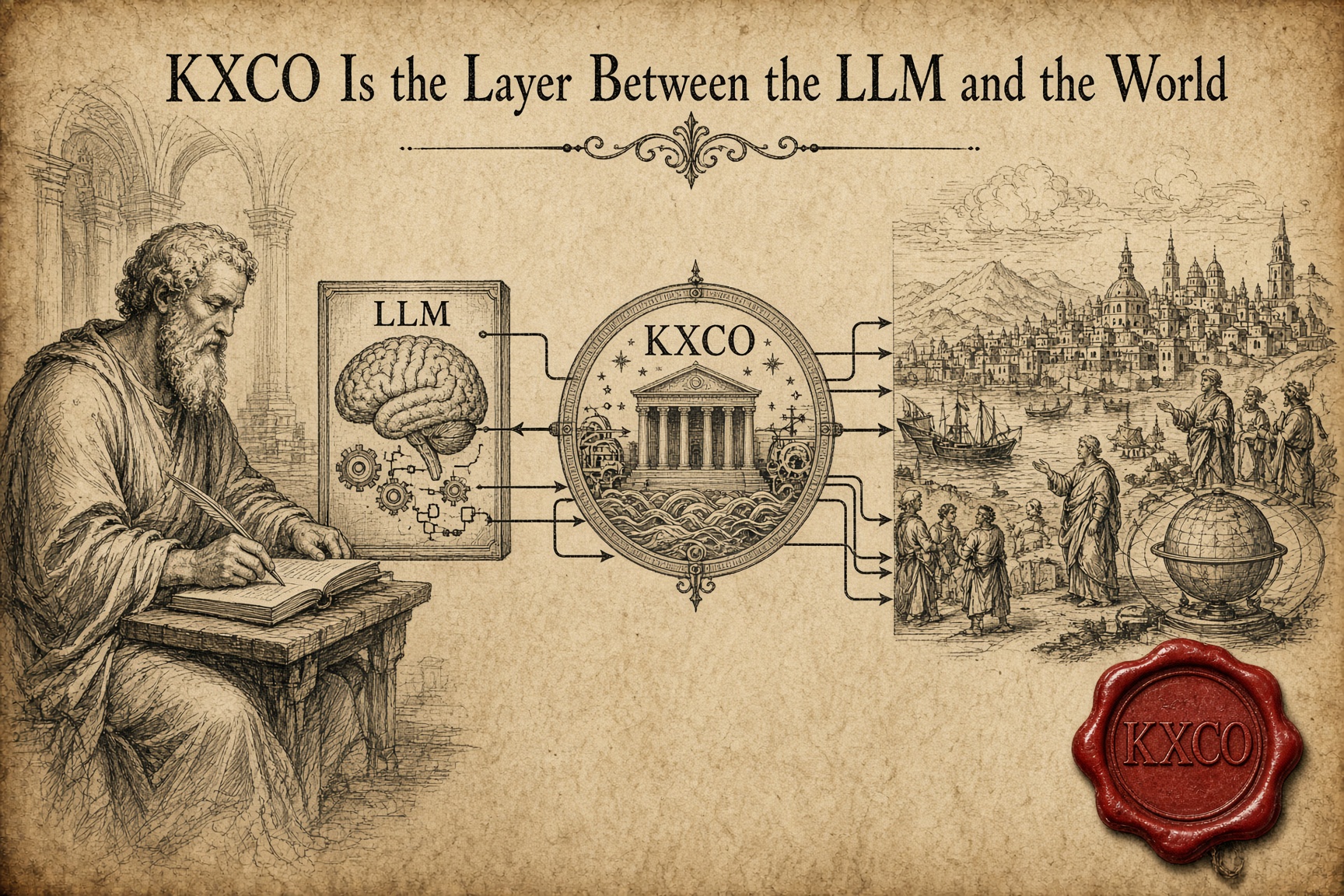
KXCO Is the Layer Between the LLM and the World
Give a hundred people the same book and very few will act on it. AI is that book: it distributes access, not understanding, and an institution cannot act on a paragraph. KXCO does not build another model or another agent. It builds the layer between the model and the world: who is speaking, what they are allowed to do, what they committed, and a post-quantum signature a stranger can check without asking us.
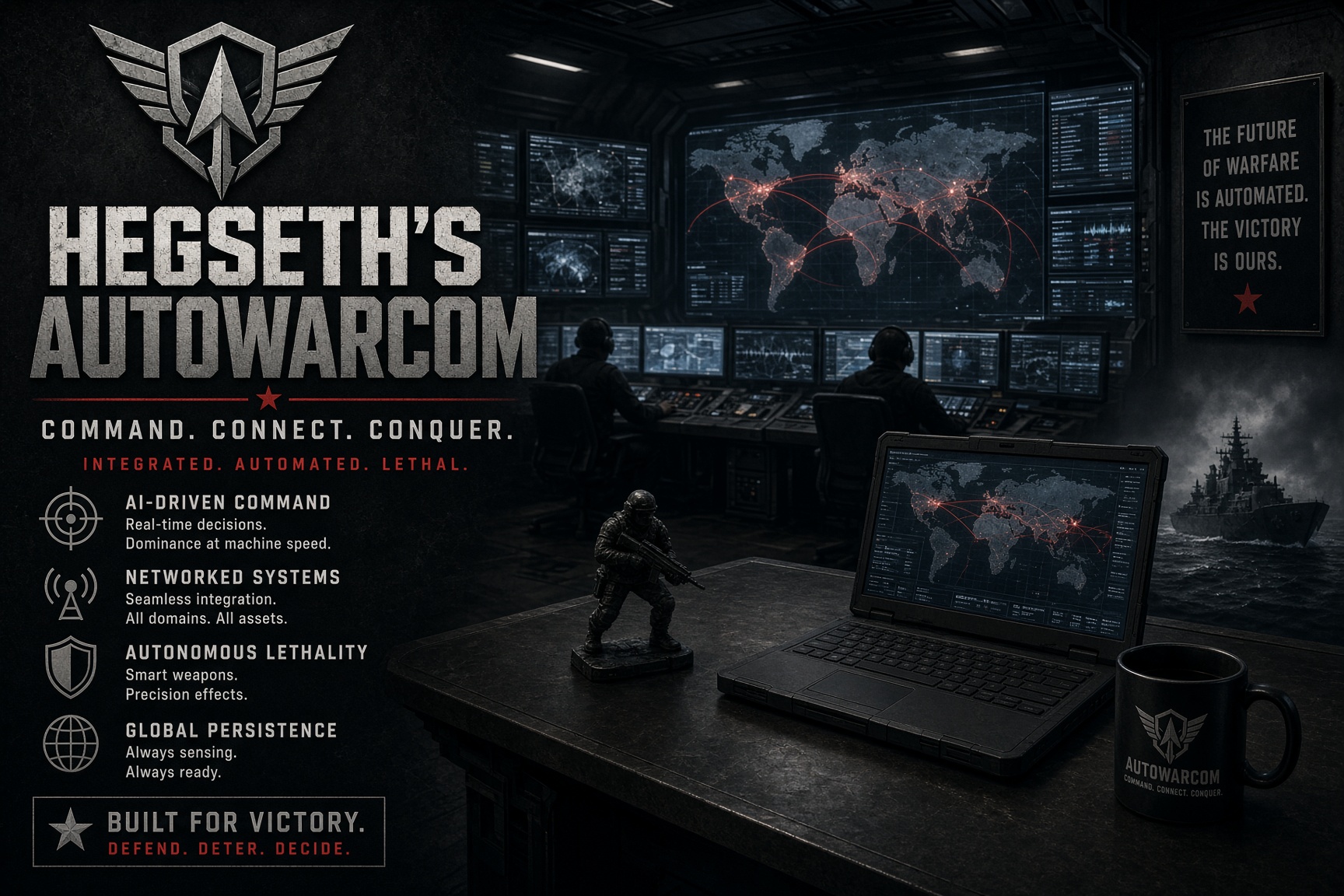
Hegseth's AutoWarCom: Who Builds It, What the Money Buys, and the Record It Needs
Pete Hegseth's Autonomous Warfare Command is a four-star proposal that needs Congress by 1 October 2027. Until then Project Agincourt holds the work, and the money moves through Drone Dominance, the Army's counter-drone contracts and DIU. The software layer, Palantir's Maven, Anduril's Lattice and Shield AI's Hivemind, is the one the KXCO AI Sector ontology had mapped before the speech. After Minab, its hardest problem is the record, not the model.

The Week the Discount Rate Gets a Vote
The Fed hiked on 16 September and left the door open. This week the August PCE deflator on Wednesday, September payrolls on Friday, the RBA on Tuesday and euro-area CPI set the discount rate. Gold, Bitcoin, the dollar, the AI complex and the quantum pure plays share that rate and diverge everywhere else. This is the map of what depends on what, the three regimes the book should already have written down, and the stop that belongs to each node on KXCO Ontology Live.
Every story, signed and delivered.
Subscribe to the kxco channel and get the headline, the AI-written key takeaways, and the chain-anchor link the moment we publish. Audio versions and per-ticker subscriptions arrive in the next iteration.