
AI Is Still Early. Quantum Is Real.
Micron's blowout earnings, Amazon's AI comeback, a buy call on Palantir, and a government-backed quantum boom — the US stocks that matter now.
Part of theAI Stocks Center
The headline writers want to talk about a dispute between two AI labs. I want to talk about earnings, because earnings are where the noise stops and the money shows up. This week the most important number in technology did not come from a press release or a letter to the White House. It came from a memory-chip maker in Idaho, and it told us more about where artificial intelligence and quantum computing are actually heading than any feud ever could.
Let me lay out the stance up front, because I don't believe in burying it. Artificial intelligence is still early. We are not late to this; we are early, and the easy money narrative that says "the big names have already run, you missed it" is wrong. What is happening now is that AI is creating a widening ring of peripheral opportunities — in memory, in power, in custom silicon, in the unglamorous plumbing that the models run on. Quantum computing, meanwhile, has crossed a line this year from science project to real industry, and the United States government is now writing checks to prove it. Those are the two threads I want to pull, and I want to do it through the lens of specific, US-listed stocks you can actually buy.
The big story is earnings, and Micron just rewrote the script
Forget the drama. The single most consequential corporate event of the week was Micron Technology's ($MU) fiscal third-quarter 2026 report, and it was extraordinary by any standard.
Micron posted $41.5 billion in revenue for the quarter — roughly four times what it reported a year earlier. Revenue, gross margin, and earnings per share all came in above the high end of the company's own guidance. Data-center revenue grew more than 150%, driven by high-bandwidth memory — the specialized chips that sit next to AI accelerators and feed them data fast enough to keep them busy.
Here is the part that matters for everyone trying to understand the shape of this cycle. Micron's high-bandwidth memory is sold out through much of 2026, locked up under multi-year supply agreements with the largest cloud operators on earth. The company has signed 16 take-or-pay strategic customer agreements that lock in roughly $100 billion in minimum contracted revenue and brought in about $22 billion in upfront customer cash. Take-or-pay means the customer pays whether they take delivery or not. That is not a hopeful forecast. That is a commitment, in writing, backed by cash on the table.
And the guidance got bigger, not smaller. Micron told investors to expect record revenue of about $50 billion in the current quarter, with gross margin around 86% and adjusted earnings of roughly $31 per share. Shipments of its next-generation HBM4 memory for NVIDIA's Vera Rubin platform began in March and are ramping at about twice the pace of the prior generation.
I want you to sit with what this represents, because it reframes the entire AI debate. For two years the bears have warned that AI spending is a bubble — that the hyperscalers will pull back, that the capital expenditure will prove speculative, that nobody will pay for all this compute. Micron's order book is the rebuttal. When your customers are pre-paying billions of dollars, years in advance, on a take-or-pay basis, to guarantee they get the memory, the demand is not speculative. It is the most committed demand in the technology economy.
That is why I keep saying AI is still early. We have spent two years arguing about whether the demand is real. Micron's earnings closed that argument. Now the question shifts to who supplies the picks and shovels — and that is where the opportunity broadens out.
The feud is a sideshow
I should address the story everyone else is leading with, if only to explain why I am not. This week Anthropic sent a letter to the White House accusing Alibaba of running a large-scale campaign to "illicitly" extract capabilities from its Claude models — what it called the largest "distillation" attack it has seen, allegedly involving tens of millions of model exchanges through thousands of fraudulent accounts. Alibaba's stock fell to a 16-month low on the news.
It is a real story, and it raises real questions about how AI labs protect their most valuable asset. But it is not the story that should drive your portfolio this week, and here is why. A dispute between two labs over training data is a contest about how the value of AI gets divided. Earnings are about how much value is being created in the first place — and the answer, from Micron's order book to Amazon's capital plan to Palantir's backlog, is: an enormous and accelerating amount. When you are deciding where to put capital, follow the value creation, not the value fight. The feud will be litigated and forgotten. The $100 billion in prepaid memory orders will still be there.
Why "still early" is the correct read
When a technology shift is genuinely large, the first phase belongs to a handful of obvious winners — the model builders and the dominant chip designer. The second phase, the one we are entering now, is when the spending spreads outward into the supporting ecosystem, and that ecosystem turns out to be enormous.
Think about what an AI data center actually needs beyond the headline accelerator. It needs memory — that is Micron's $100 billion order book. It needs power and cooling. It needs networking silicon to move data between thousands of chips. It needs custom processors designed by the cloud operators themselves to cut their dependence on any single vendor. It needs software to make the whole thing useful to a government agency or a bank. Each of those is a market. Each of those is being repriced upward right now.
This is the "periphery" I keep coming back to. The center of the AI story — NVIDIA ($NVDA) and the frontier labs — is well understood and richly valued. The periphery is where I think patient capital still has room, because the market is only now waking up to how broad the supply chain is and how locked-in the demand has become. Micron is the clearest example, but it is not the only one.
NVIDIA is still the gravitational center
I am not going to pretend NVIDIA ($NVDA) is a peripheral play. It remains the center of gravity. Every conversation about AI compute eventually routes back to its accelerators, and Micron's HBM4 ramp for the Vera Rubin platform is a direct tell: the next NVIDIA generation is moving into volume, and the memory suppliers are scaling to meet it.
The reason I treat NVIDIA as context rather than as my featured idea is valuation and crowding. Everyone owns it. Everyone has an opinion on it. The incremental dollar of insight is harder to find there. What NVIDIA's roadmap does for the rest of us is set the cadence — when its next platform ramps, you can read across to memory, to power, to networking, and to the cloud operators building around it. Use NVIDIA as the clock. Look for your edge in the names keeping time with it.
Amazon: the AI comeback hiding inside the cloud
Amazon ($AMZN) is my second featured name, and it is the one I think the market has been slowest to re-rate.
The story people missed is that Amazon Web Services has quietly become one of the most important AI infrastructure businesses in the world. Its Bedrock service — the platform that lets companies build on a menu of foundation models including Anthropic's Claude — processed more tokens in the most recent quarter than in all prior years combined, with customer spending up 170% quarter over quarter. That is the usage curve of a business hitting its stride, not one falling behind.
Underneath that is a chip strategy that deserves attention. Amazon's custom AI silicon business — the Trainium and Inferentia line — has crossed a $20 billion annual revenue run rate, with Trainium commitments the company describes as totaling more than $225 billion in future revenue commitments. Trainium2 delivers roughly 30% better price-performance than comparable GPUs, and Trainium3 improves on that again. This matters because every hyperscaler wants an alternative to paying NVIDIA's margins, and Amazon is furthest along in building a credible one at scale.
Then there is the Anthropic relationship, which is strategic in both directions. Amazon has committed up to $25 billion in new investment into Anthropic on top of the roughly $8 billion already deployed, and Anthropic has committed to spending more than $100 billion on AWS over the next decade — running on Amazon's own Trainium chips and locking in up to five gigawatts of compute. That is a closed loop: Amazon funds the lab, the lab buys Amazon's compute, and Amazon's custom silicon gets the volume it needs to improve.
The capital behind this is staggering and, I think, underappreciated as a signal. Amazon has guided 2026 capital expenditure to around $200 billion, with cumulative spending through 2027 tracking past $340 billion. A company does not commit a third of a trillion dollars to infrastructure it does not believe will be used. Set Amazon's valuation against that build-out and the AI cloud strategy looks a great deal stronger than the multiple currently suggests. That is the definition of an opportunity.
Palantir is a buy
Let me be direct, because the question I get asked most often deserves a direct answer: yes, I think Palantir ($PLTR) is a buy. Not a trade. A position.
Start with the numbers, because the growth here is genuinely rare. In its most recent quarter Palantir reported revenue of about $1.63 billion, up roughly 85% year over year — the fastest growth rate in the company's history — with adjusted earnings of $0.33 per share, ahead of expectations. US commercial revenue grew 133%. US government revenue grew 84%, accelerating from the prior quarter, to $687 million. The company raised its full-year 2026 revenue guidance to about $7.65 billion, and management said the quiet part out loud: demand for its Artificial Intelligence Platform is now outstripping supply.
That last line is the whole thesis. Palantir spent years being misunderstood as a consulting business with a government niche. What it actually built was the layer that turns raw AI capability into decisions a large institution can act on — and that is exactly the layer enterprises and agencies are scrambling for now that the models are good enough to matter. Palantir is signing real contracts: a $300 million US Department of Agriculture agreement to strengthen supply-chain resilience, a Ship OS partnership with the Navy that collapses manufacturing approval timelines. These are not pilots. They are production deployments inside the institutions that are slowest to adopt and hardest to dislodge once they do.
I am not going to insult you by pretending the stock is cheap. It is not. It trades at a trailing price-to-earnings ratio north of 150 and a forward price-to-sales multiple above 40. There has been insider selling. There is regulatory scrutiny in the UK and Switzerland. Larger cloud and AI providers would love to compete it away. Every one of those is a real risk and you should size your position knowing them.
But here is how I weigh it. Palantir is one of the very few companies that is both growing revenue at 80%-plus and generating real operating leverage and embedding itself into the stickiest customers on earth — defense departments, federal agencies, and the large enterprises that build their operations around its platform once they commit. Several Wall Street firms have moved their price targets into the $190 to $230 range on exactly this combination of AI capability, defense focus, and rising earnings revisions. When a company is the default operating system for institutional AI and its own management says it cannot make enough of the product, you do not wait for a cheaper multiple that may never come. You buy the business and you let the growth compound through the volatility. The risk is the price, not the company.
Quantum computing is real now — and Washington just said so with money
For most of the last decade, quantum computing was the technology that was always ten years away. That framing is now out of date, and the clearest evidence is not a lab demo. It is a federal funding commitment and a public-market debut.
The US Department of Commerce has signed preliminary agreements to provide $2 billion in funding — and to take equity stakes — in nine companies across the "quantum ecosystem," under the umbrella of the CHIPS and Science Act. Read that twice. The government is not just handing out grants; it is taking ownership positions, the way a venture investor does, in companies it considers strategically essential. When the United States decides a technology is important enough to put public equity capital into private quantum firms, the "always ten years away" era is over. This is industrial policy, and it is aimed squarely at making sure the quantum supply chain is built on American soil.
The market has noticed. The benchmark quantum-computing index was up roughly 69% through the end of May, against a gain of about 11% for the S&P 500 over the same stretch. The pure-play names have run hard. And this month the sector got its marquee event: Quantinuum, widely regarded as the leader in trapped-ion quantum systems, went public on the Nasdaq, closing its debut at a valuation of about $15.7 billion. Honeywell ($HON), which had housed the business, spun it out as a standalone company — a textbook sign that a unit has matured enough to stand on its own and that public investors are ready to fund the next phase directly.
I want to be honest about what these companies are and are not, because enthusiasm without discipline is how people get hurt. The pure-play quantum stocks — names like IonQ ($IONQ), Rigetti ($RGTI), D-Wave ($QBTS), and Quantum Computing Inc. ($QUBT) — are real businesses doing real engineering. IonQ sold a 256-qubit system to the University of Cambridge and holds roughly $3.1 billion in cash and investments, giving it the strongest balance sheet of the group. Rigetti shipped its 108-qubit Cepheus-1 as a commercially available system. These are genuine milestones.
But these are also among the most speculative stocks in the entire market. They trade at extreme valuations on minimal revenue and no profits. Analysts model the quantum market growing around 30% a year to roughly $3 billion by 2028 — a real market, but a small one relative to the combined market value these names already carry. So here is how I'd hold them: this is venture-style risk inside a public-market wrapper. Size the positions accordingly, expect violent swings, and understand that the federal money is the thesis. The $2 billion from Commerce, and the equity stakes behind it, are the signal that the United States intends to build this industry domestically and will not let it fail for lack of capital. That backing is exactly why I treat quantum as real now rather than someday — but "real" is not the same as "safe."
Don't forget the edges: power, silicon, and the rest of the periphery
I opened by saying AI is creating a widening ring of peripheral opportunities, and Micron is the proof of concept. But the ring is wider than memory.
Qualcomm ($QCOM) is a useful example of the theme. Known for the chips inside your smartphone, it is now positioning to capture AI demand beyond the handset — pushing into the data-center and edge-AI markets as the places where inference, the day-to-day running of AI models, increasingly happens. The market rewarded that pivot. The lesson is broader than any single ticker: as AI moves from training enormous models in a few giant data centers to running them everywhere — on phones, in cars, at the edge of the network — the silicon and infrastructure opportunity multiplies and spreads to companies that were never thought of as "AI stocks" at all.
That is the periphery thesis in one sentence: the further AI spreads, the more companies get pulled into its supply chain, and the more of them get repriced as AI businesses. We are early in that repricing, not late.
How I'm putting it together
Let me tie the threads into something you can act on, because a stance without a plan is just an opinion.
The big story is earnings, and earnings just told us the AI demand is committed, prepaid, and accelerating — not speculative. Micron ($MU) is the cleanest expression of that truth and my anchor name for the AI-infrastructure periphery. Amazon ($AMZN) is the AI comeback the market has been slow to price, with a cloud-and-custom-silicon machine that justifies its enormous build-out. Palantir ($PLTR) is my conviction buy on the software layer that turns AI into institutional decisions — expensive, yes, but irreplaceable, and growing into the price. NVIDIA ($NVDA) is the clock everyone keeps time by. And the quantum names — Quantinuum, IonQ ($IONQ), Rigetti ($RGTI), D-Wave ($QBTS), Quantum Computing Inc. ($QUBT) — are the high-risk, high-conviction frontier, now underwritten by $2 billion of US government commitment.
Featured US stocks at a glance
For readers who want the thesis in one place, here is the featured list — every name US-listed, with the one-line reason it is on it.
Micron Technology (NASDAQ: $MU) — The anchor of the AI-memory periphery. $41.5B quarterly revenue, data-center sales up 150%, high-bandwidth memory sold out through 2026, and ~$100B in take-or-pay contracted revenue. The clearest proof AI demand is committed, not speculative.
Amazon (NASDAQ: $AMZN) — The underpriced AI cloud comeback. AWS Bedrock usage and custom Trainium silicon are scaling fast, backed by a deep Anthropic partnership and a ~$200B 2026 capital plan. The build-out justifies more than the current multiple suggests.
Palantir Technologies (NASDAQ: $PLTR) — Conviction buy on the institutional-AI software layer. ~85% revenue growth, demand outstripping supply, and a sticky base of defense and federal contracts. Expensive, but irreplaceable and growing into the price.
NVIDIA (NASDAQ: $NVDA) — The center of gravity and the cadence-setter. Context for everything else: when its next platform ramps, read across to memory, power, networking, and the cloud.
Qualcomm (NASDAQ: $QCOM) — The edge-AI periphery play, pushing beyond smartphones into data-center and on-device inference.
Quantum frontier — IonQ (NYSE: $IONQ), Rigetti (NASDAQ: $RGTI), D-Wave (NYSE: $QBTS), Quantum Computing Inc. (NASDAQ: $QUBT), and newly public Quantinuum — Venture-style risk in a public wrapper, now underwritten by $2B of US federal commitment. Real engineering, extreme valuations; size accordingly.
What I'm watching next
A few things will tell us whether this thesis is tracking. First, the next round of hyperscaler capital-expenditure guidance — if Amazon, Microsoft, Google, and Meta hold or raise their AI spending plans, Micron's order book is safe and the periphery keeps repricing. Second, whether high-bandwidth memory pricing holds as Micron, SK Hynix, and Samsung all expand capacity; sold-out today does not guarantee sold-out in 2027, and memory has always been a cyclical business. Third, Palantir's government bookings — the contract cadence, not the quarterly multiple, is the real signal. Fourth, the mechanics of the Commerce Department's quantum equity stakes: which nine companies, on what terms, and whether private capital follows the government in. And finally, watch whether the periphery keeps widening — the more "non-AI" companies start reporting AI-driven demand, the more right the "still early" call turns out to be.
The bottom line
AI is still early. Quantum is real. The US government is backing the future with equity, not just speeches. And the smartest way to play all of it is to look past the headline feud and follow the earnings, the order books, and the capital commitments — because those are the things that do not lie.
Shayne Heffernan is the founder of KXCO and a market analyst covering technology, AI, and digital assets. This article is commentary and analysis, not investment advice. It does not constitute a personal recommendation and does not take account of your individual circumstances. Markets carry risk, including the loss of capital; the speculative names discussed here carry more risk than most. Do your own research and consider speaking with a licensed financial adviser before investing. The author and KXCO may hold positions in the securities mentioned.
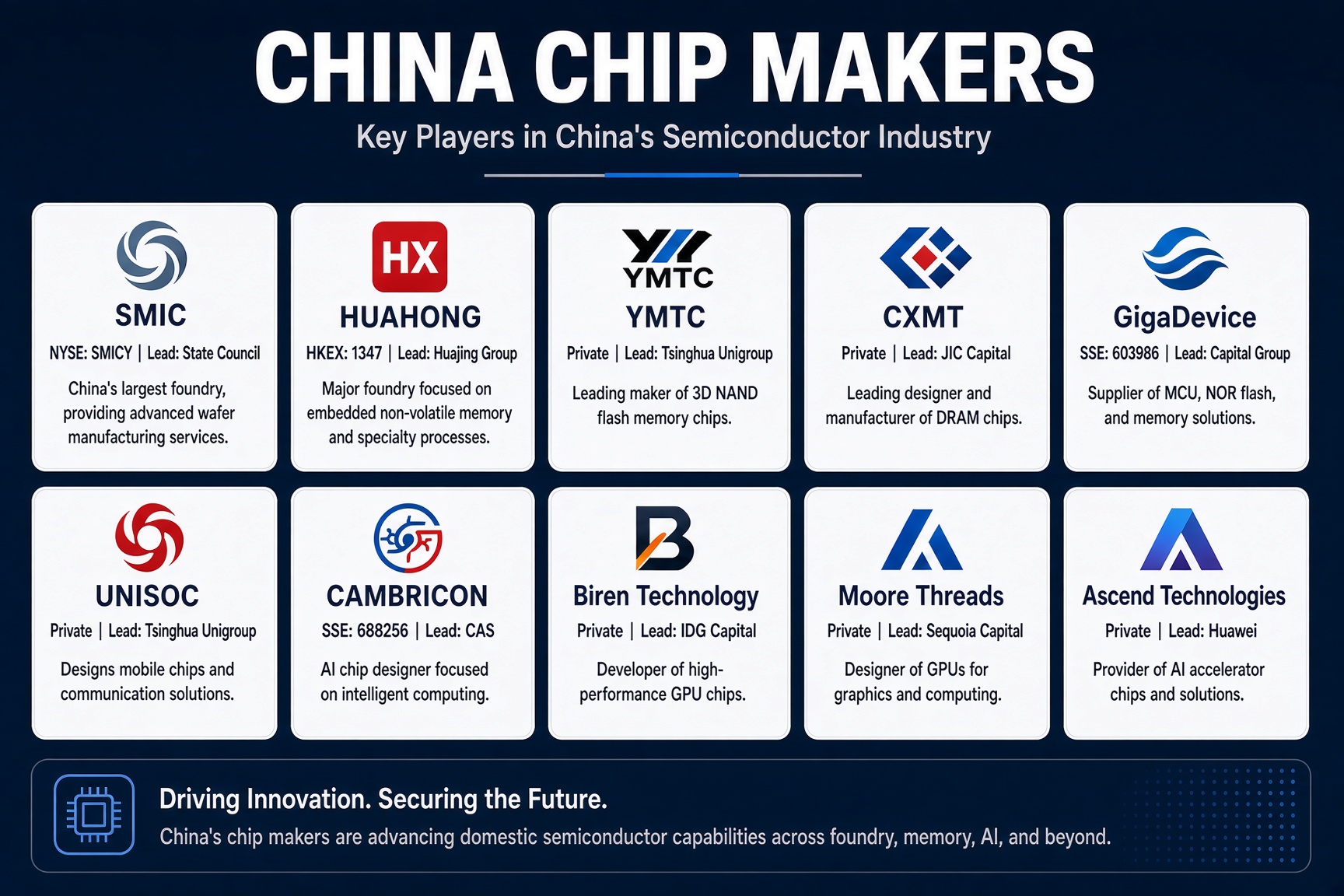
The China Chip Shock
On 10 October CXMT said it will ship DDR5 server modules on a 4F2 cell by year-end. Micron, SK Hynix, Samsung and Sandisk sold off for two sessions and Elon Musk said China scales faster than the rest of the world combined. This piece sets out China's memory makers, foundries, AI chip designers and toolmakers, with two knowledge graphs drawn from the KXCO AI Sector Ontology, and says what the sell-off prices and what it does not.

China's Coordinated Push in AI, Quantum Computing and Blockchain
On 9 October 2026 Beijing called for a nationally integrated computing-power network and a national blockchain network. DeepSeek is scaling on Huawei Ascend chips, China's intelligent computing reached 2,185 EFLOPS by June, per the industry ministry, and quantum communications remain a strength. This analysis explains the strategy and sets out the Hong Kong and US listed companies with exposure, from Tencent and Alibaba to China Mobile, HashKey and Nvidia.

Week Ahead on Wall Street: CPI, Banks and Oil
September CPI lands on Wednesday after a Fed hike and a 10-year yield at its highest since 2002. JPMorgan, Goldman and Citi open bank earnings on Tuesday, ASML and TSMC report midweek, and Saudi pipeline attacks kept Brent at $104.72 on 9 October 2026, per CNBC. The KXCO AI Sector Ontology still shows contracted demand. This week ahead sets out the calendar, the three facts that would change the call, and why dips in the AI leaders remain buying opportunities.

AI Is Being Powered by Tech That Looks Almost Alien
Every frontier AI model runs on chips printed by one Dutch machine. ASML's extreme-ultraviolet scanner fires a laser at up to 50,000 droplets of molten tin a second, per ASML, and bounces the light off mirrors whose deviations are tens of picometres. Veritasium called it the closest thing we have to alien technology. This piece takes the film as the brief and checks it: the machine, High-NA, and the wafer-scale chips and liquid-cooled racks downstream of it.
Every story, signed and delivered.
Subscribe to the kxco channel and get the headline, the AI-written key takeaways, and the chain-anchor link the moment we publish. Audio versions and per-ticker subscriptions arrive in the next iteration.