
Who is Who in China's AI Race and Which US-Listed Stocks Are Worth Buying
Baidu, Alibaba, Tencent, Huawei, SMIC and the new model labs, mapped against the four US-listed tickers that carry the exposure. Shayne Heffernan reads China's AI stack through the KXCO ontology.
Part of theStocks Center
The global artificial intelligence revolution has effectively split into two hemispheres. The United States still dominates the foundational architecture of AI, specifically the design and manufacture of the advanced semiconductors required to train frontier large language models. China has moved on from being a fast follower and is now a specialised, fiercely competitive AI power in its own right.
For global investors, navigating that divide is difficult. US export controls have rewritten the supply chain, and Chinese technology groups are engineering workarounds faster than most Western analysts expected. To find the value, you first have to map who is who in China's AI race, and then work out which US-listed stocks give you real exposure to it.
As technology architect and financial strategist Shayne Heffernan has argued, evaluating cross-border technology ecosystems takes more than traditional equity metrics. Investors increasingly reach for data-verification and relationship-mapping tools, including the KXCO.ai ontology live platform, to track how intellectual property, supply chains and AI agents actually interact.
Here is the landscape, the equities, and the framework.
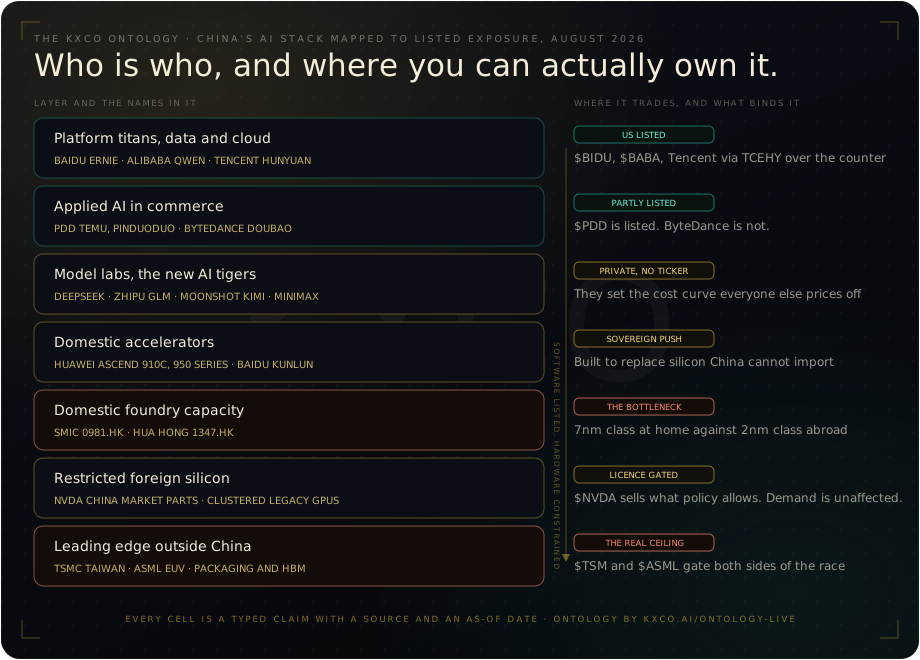
Ontology snapshot by KXCO.ai: seven layers of China's AI stack, and which of them a US investor can actually own.
Part I: Who is who in China's AI race
China's AI ecosystem is not a monolith. It is a stratified battlefield of state-backed hardware champions, entrenched software monopolies, and a fast-growing class of generative AI startups.
1. The titans: Baidu, Alibaba and Tencent
The first tier belongs to the legacy internet giants. They own the three things needed to train world-class models: proprietary data at scale, cloud infrastructure, and deep capital reserves.
Baidu, the AI pioneer. Often called the Google of China, Baidu has spent a decade pivoting to AI. It is the company behind ERNIE, China's most prominent answer to OpenAI's GPT line. Beyond software it leads in autonomous driving through Apollo Go, and it designs its own AI accelerator, Kunlun, to blunt the effect of US semiconductor sanctions.
Alibaba, the cloud infrastructure giant. Alibaba Cloud is the largest public cloud in China, which makes it the layer thousands of Chinese AI startups build on. Alibaba has aggressively open-sourced its Qwen model family, a move designed to lock developers into its cloud.
Tencent, the application and social graph leader. Tencent holds the keys to China's social internet through WeChat, plus the largest gaming business on earth. It is quieter about its foundation models, branded Hunyuan, because its advantage is distribution. It can put AI in front of a billion daily users, from ad targeting to in-game characters.
2. The hardware challengers: Huawei and SMIC
Because Washington has restricted China's access to Nvidia's top-end training silicon, the hardware layer of China's AI race is treated in Beijing as a national security matter rather than a commercial one.
Huawei. Huawei is the linchpin of China's sovereign AI strategy. Through its Ascend accelerators, now the 910C and the announced 950 series, Huawei is trying to replace Nvidia inside Chinese data centres. Its HarmonyOS and Pangu models are embedded across Chinese telecoms, mining and meteorology.
SMIC. Semiconductor Manufacturing International Corporation is China's premier contract chipmaker. It remains generations behind TSMC on advanced nodes, running a 7nm-class process while TSMC is in volume on 2nm-class, and reported yields on its N+2 line have been the gating factor. SMIC is the physical pipeline for Huawei's accelerators, which makes its yield curve the literal bottleneck of China's AI future.
3. The new AI tigers: the model startups
The most dynamic part of the picture is the startup tier, valued in the billions and competing hard for talent and share.
DeepSeek. The Hangzhou lab that forced a global repricing of training cost assumptions, and the reason "efficient frontier model on constrained hardware" became an investment thesis rather than a slogan.
Zhipu AI. Spun out of Tsinghua University, focused on enterprise-grade deployment with its GLM model family, and a favourite of Chinese venture capital.
Moonshot AI. Backed by Alibaba, best known for its Kimi assistant and for specialising in very long context windows, reading entire books or codebases in a single prompt.
MiniMax. Consumer traction through character-based social apps and productivity tools.
ByteDance. Not a startup by any measure, but its Doubao assistant and in-house silicon programme make it one of the largest buyers of AI compute in China and a genuine rival to the titans.
For the equivalent map of the Western side of this race, see our companion piece, Who Is Who in the AI Space.
Part II: US-listed stocks worth buying for China AI exposure
Buying directly in Shanghai or Shenzhen remains awkward for most investors because of capital controls and regulatory friction. Several highly liquid US-listed names give you direct or proxy exposure instead.
When weighing these equities, Shayne Heffernan emphasises looking at how each company structures its AI infrastructure, including tokenised workflows and verifiable data provenance, the concepts at the centre of the KXCO framework.
1. Baidu Inc, $BIDU
The thesis: the purest listed play on China's generative AI build.
Western investors still price Baidu like a search engine. The market has not fully paid for its AI cloud growth or its autonomous driving option value. Successive ERNIE releases have closed much of the gap with the US frontier on Chinese-language benchmarks.
Why now. $BIDU trades at a wide discount to US AI proxies. As ERNIE is threaded through search advertising, cloud hosting and robotaxi, revenue per user should climb. Its in-house Kunlun silicon gives it partial insulation from export bans. For investors who want a discounted AI asset in the world's second-largest economy, it is the first name on the list.
2. Alibaba Group Holding Ltd, $BABA
The thesis: the picks and shovels play.
If hundreds of Chinese labs are training models, they need compute. Alibaba Cloud sells it. By open-sourcing Qwen, Alibaba built a garden where developers train on its infrastructure, deploy on its servers, and pay it for inference.
Why now. After years of regulatory pressure and a management overhaul, $BABA still trades at historically low multiples. The audit-oversight settlement with the PCAOB removed the existential delisting risk that hung over the whole ADR complex. As enterprise AI adoption accelerates, this is value investing with an AI growth kicker attached.
3. Nvidia Corporation, $NVDA
The thesis: you cannot discuss China's AI race without the toll collector.
Even with export controls on its top-end parts, Nvidia is an indirect beneficiary. Chinese buyers absorb every compliant part they are permitted to buy, licensing for the China-market H20 has moved, higher-end approvals are being handled case by case, and Chinese teams keep engineering software around the hardware they can get. More importantly, the credibility of China's domestic AI programme is exactly what pushes US hyperscalers to spend harder on $NVDA silicon to stay ahead.
Why now. Nvidia is not a Chinese company, it is the tollbooth on the whole race. China revenue, even restricted, is measured in billions. The longer the contest escalates, the more indispensable the silicon becomes. Our read on the compute arms race sets out the numbers.
4. PDD Holdings Inc, $PDD
The thesis: the AI-powered commerce monopoly.
$PDD, parent of Temu and Pinduoduo, is rarely filed under AI stocks, yet it is one of the most sophisticated applied-AI operators anywhere. It runs deep learning for supply chain matching, dynamic pricing and customer acquisition, and its AI-driven logistics let it undercut both Amazon and Alibaba on price.
Why now. Growth has been explosive and margins high. If you want exposure to China using AI to disrupt traditional industries rather than to build foundation models, this is the position.
Part III: The KXCO.ai ontology live framework
Cross-border AI investing is opaque. How does an allocator in New York know whether a Chinese lab's model is genuinely state of the art or a thin wrapper on an open-weight release? How do you track the web of data sharing between state entities, cloud providers and startups?
This is the problem the KXCO.ai ontology live system was built for, and it is the reason Shayne Heffernan keeps returning to verifiable, structured data as the missing input in financial markets.
What the ontology actually does
In computer science an ontology is a formal representation of the concepts in a domain and the relationships between them. KXCO applies that to institutional finance and AI operations.
Instead of static reports, the platform maps the ecosystem as typed claims, each carrying its source, its as-of date and its confidence. It tracks:
Data provenance. Where the training data came from, and who says so.
Compute dependencies. Which firms depend on restricted foreign silicon and which have genuinely moved to domestic Ascend parts.
Agent interoperability. How AI agents inside a firm communicate and execute financial tasks.
Every cell is either sourced or visibly marked as opaque, which is the point. The gaps are part of the output rather than something papered over.
Why the framework matters to allocators
Heffernan has argued for years for the tokenisation and structural organisation of financial workflows, and the fit with KXCO's approach is straightforward. You cannot value an AI company with twentieth-century accounting conventions alone.
An investor buying Baidu or Alibaba is not buying a stream of advertising revenue. They are buying an AI infrastructure position. Modelling these companies as dynamic networks of data, algorithms and compute, rather than as static corporate entities, is what separates a view from a guess. Our explainer on ontology as the missing layer in agentic AI goes deeper on the mechanics.
Part IV: Geopolitical risks and structural headwinds
No analysis of this race is complete without the risks. Owning US-listed Chinese AI names requires tolerance for geopolitical volatility.
1. The semiconductor chokehold
Washington's small yard, high fence strategy is designed to cap China's ability to train frontier models. Chinese teams are getting better at clustering lower-end parts to approximate high-end performance, but that route is inefficient, expensive and power hungry. If sanctions extend to cloud services, or third-country transshipment loopholes close, Chinese AI development hits a wall.
2. Data sovereignty and censorship
Models are only as good as their training data. The Cyberspace Administration of China regulates generative AI tightly. Models must align with state values and cannot produce content that undermines state power. That creates a fractured internet. ERNIE is excellent at Chinese language, bureaucracy and culture, and legally handicapped from being a global, uncensored assistant. It caps the addressable market for Chinese AI firms relative to US peers.
3. Capital allocation inefficiency
China's AI startup scene is running on a large venture bubble. Companies are raising at astronomical valuations without near-term paths to profit. The risk for holders of $BABA or $BIDU is that the listed players keep burning cash on AI programmes purely to keep pace with state-backed challengers, and the bottom line pays for it.
4. The Taiwan question
The ultimate risk factor is Taiwan. TSMC, $TSM, fabricates the overwhelming majority of the world's leading-edge logic. A conflict or blockade in the strait would halt China's AI progress and paralyse the global industry with it, Nvidia, Apple and Microsoft included. Our profile of TSMC, the indispensable company, explains why one island carries that much of the system.
Part V: Strategic conclusions
The contest for AI supremacy between the United States and China is the defining macroeconomic trend of this century. It is a tale of two systems. The US leverages open markets, global talent and monopoly hardware design. China leverages state direction, enormous closed data sets and hardware innovation born of necessity.
For investors in US-listed equities, the strategy is tiered.
The pure China AI play: accumulate $BIDU. Deep value, a proven model family, and autonomous driving upside, discounted by broad China macro fear. An asymmetric bet.
The infrastructure moat: hold $BABA. As long as China builds AI, Alibaba Cloud is the default server farm. Open-sourcing Qwen is a trojan horse for enterprise cloud dominance.
The global arbiter: keep a core position in $NVDA. Nvidia wins whoever writes the best software. Tighter sanctions push Chinese firms to buy whatever they legally can, while US firms spend harder to stay ahead.
The applied AI disruptor: keep $PDD on the radar as a hedge. If pure technology names falter on geopolitics, PDD's AI-driven commerce model offers non-semiconductor exposure to Chinese technical strength.
The future of AI valuation
As the race intensifies, traditional valuation metrics keep failing. Reading supply chains, compute allocation and algorithmic efficiency needs a different class of analytical tool.
That is why frameworks like the KXCO.ai ontology live are gaining traction with strategists including Shayne Heffernan. Treat AI ecosystems as interconnected, verifiable webs of data and compute rather than as simple corporate entities, and the geopolitical noise falls away, leaving structural reality to invest against.
The China AI race is not a future event. It is happening now. Disciplined equity selection plus ontological data mapping is how investors position for the wealth being created by the algorithms of the East and the silicon of the West.
Questions readers are asking
Which Chinese AI company is the biggest? By compute, cloud share and model distribution, Alibaba and ByteDance are the heavyweights. By listed pure-play AI exposure available to US investors, Baidu is the closest thing to a direct bet.
Can China build frontier AI without Nvidia? Partly. Huawei's Ascend line plus SMIC capacity covers a growing share of domestic inference and some training, but yield and packaging constraints mean the ceiling is set in Shenzhen and Shanghai fabs, not in Beijing policy.
What is the best US-listed stock for China AI exposure? $BIDU for the direct model and robotaxi story, $BABA for the cloud infrastructure underneath the whole ecosystem, $NVDA as the toll collector on both sides of the race, and $PDD for applied AI in commerce.
Is DeepSeek investable? Not directly. It is private. Its impact shows up in the cost curve for everyone else, which is why it belongs on a map of the race even though it is not on a ticker tape.
What single event would break the thesis? A blockade or conflict around Taiwan. Every scenario in this article assumes leading-edge fabrication keeps running.
Disclosure: Live Trading News and KXCO are part of the same group, so treat references to the KXCO ontology as coverage of an affiliated platform.
Disclaimer: This article is for informational purposes only and does not constitute financial advice. Investing in US-listed Chinese companies carries significant geopolitical and regulatory risk. Always conduct your own due diligence, or consult a licensed financial adviser, before making investment decisions.

Musk and Colossus: Inside the 1.29 Gigawatt Machine in Memphis
Elon Musk is sleeping in an Airstream beside a warehouse in Whitehaven with MACROHARD painted on the roof. The machine next to it is a two-state compute campus carrying about 1.29 gigawatts of IT load, roughly 670,000 accelerators and 48.7 billion dollars of modeled capital, per Epoch AI cards of 16 September 2026. A field brief on the buildings, the silicon, the turbines, the batteries, the tenants who now hold the hours, and what the compute is actually worth.

Quantum Is Accelerating
Quantum is accelerating. Not toward a machine that breaks RSA next quarter, which is still five orders of magnitude away on the first honest cross-platform yardstick the field has ever had, but toward foundries, clouds, logical qubits and government deadlines that are already fixed. Two clocks are running. Only one of them is slow, and it is not the one that decides what a bank, a court or a ministry has to do this year.

Ignore the Noise: AI Is Not Slowing Down
Commentators pointed at a flat Nasdaq, a few missed prints, the cost of a megawatt and a safety letter, and called it a slowdown. It is not. Between 12 August and 16 September 2026 nine labs shipped frontier or near-frontier models, and the contest moved from one leaderboard to two stacks. What actually slowed is accountability. Enterprises still cannot put any of it into a court file. That gap, not the capability curve, stops deployment inside banks, hospitals, courts and ministries.

What the KXCO Ontology Exposed While the Market Stood Still
On 25 August the KXCO AI Sector Ontology stamped a fresh set of rows. Sixteen days later the Nasdaq had gone nowhere and ten of those names were up: Intel 14.68%, Meta 13.04%, SpaceX 7.42%, Oracle 5.65%. This is what a record of 393 entities and 869 sourced claims surfaces that a screen cannot: who is genuinely irreplaceable rather than merely large, which obligations sit off every balance sheet in the sector, and where the strongest bull case on the page runs into a variable no graph contains.
Every story, signed and delivered.
Subscribe to the kxco channel and get the headline, the AI-written key takeaways, and the chain-anchor link the moment we publish. Audio versions and per-ticker subscriptions arrive in the next iteration.