
The Electron Standard
Why electricity is the true reserve currency of the 21st century, and what the generation data actually shows
Part of theAI Stocks Center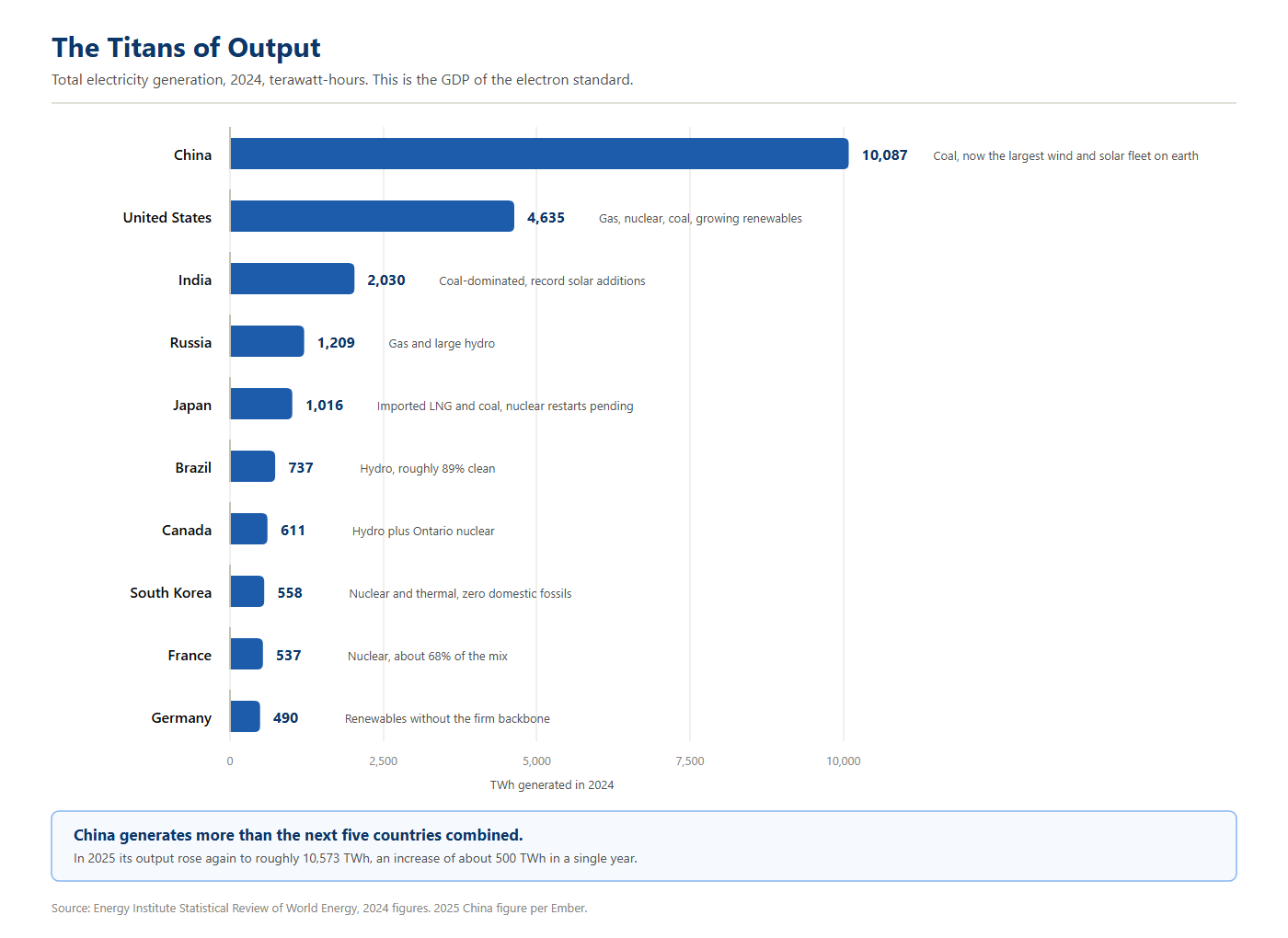
There is a fundamental delusion governing global financial markets today, one perpetuated by central bankers, sovereign wealth funds and legacy Wall Street institutions. They operate on the assumption that the United States Dollar, the Euro or the Yen are the ultimate reserve assets of human civilisation. They obsess over yield curves, M2 money supply and interest rate differentials, believing that these abstract ledger entries represent the true measure of global power.
They are dangerously wrong.
We are standing at the terminus of the petroleum age, and with it the terminal decline of the petrodollar system that has governed global geopolitics since 1971. What we are living through is not merely a shift from fossil fuels to renewables. It is a redefinition of what constitutes value.
Elon Musk has been making this argument in public for a year, and the financial media has consistently filed it under tech-founder hyperbole. Speaking to Nikhil Kamath on the People by WTF podcast in late 2025, he said energy is the true currency, that you cannot legislate energy, and that we would probably end up with "energy, power generation, as the de facto currency" rather than money. On X he sharpened it: once the loop from generation to robots to chips to AI closes, "conventional currency will just get in the way. Just wattage and tonnage will matter, not dollars." By June 2026 it was three words long. Mass and energy take the place of dollars.
He was not predicting the future. He was describing the present. Fiat currencies are backed by sovereign debt and military hegemony. The digital-AI economy is backed entirely by electrons. The kilowatt-hour is the only hard currency left. I set out the market plumbing of that argument in Energy IS the New Currency. This piece is about the sovereign layer underneath it.
If you want to understand where wealth and geopolitical power will sit over the next fifty years, stop reading central bank balance sheets and start reading national generation capacity. Look at total output, at output under construction, at the spread between production cost and delivered price, and at the corporate architects building the new grid.
Part I: The Macroeconomics of the Kilowatt-Hour
To see why electricity is the currency of the future, start with the fatal flaw in fiat and the physical limits of the alternatives. Fiat derives value from trust in a sovereign issuer. US gross national debt stood at $39.9 trillion in early August 2026, having risen roughly $3 trillion in twelve months, and Western economies increasingly print to service debt rather than to build productive assets. Trust is eroding at the same rate as the arithmetic.
Gold is a sterile asset. You cannot build an AI data centre with a gold bar. Bitcoin is a brilliant ledger and an abstract representation of energy, but it does not do work.
Electricity does work. It is the foundational input for modern existence. You cannot manufacture a semiconductor, train a large language model, run a hospital, desalinate water, power an EV fleet or operate a vertical farm without electrons flowing through a grid. In the Intelligence Age, defined by artificial intelligence, automated robotics and synthetic biology, demand for compute scales exponentially. AI models are energy translation mechanisms. They take in electrical power and put out cognitive labour. The nation that produces the cheapest and most abundant electricity will therefore produce the cheapest cognitive labour.
That is why the kilowatt-hour is the new reserve currency. It has intrinsic utility. It can mine Bitcoin, smelt aluminium, distil hydrogen or train a neural network. A nation with a large surplus of cheap electricity can set terms of trade while bypassing the dollar system entirely. With abundant power you can synthesise fuels, fertilisers and materials. You become autarkic. You become difficult to coerce.
At KXCO we formalise these relationships through structured knowledge systems: Armature L1 and the ontology engines. Energy flows, compute demand and geopolitical power are not separate domains. They form a single graph, and the electron is its atomic unit. The public map is at kxco.ai/ontology-live, where every claim carries its source and its as-of date, and the reasoning behind treating infrastructure this way is set out in Armature L1 and the Ontology as Enterprise Infrastructure.
Part II: The Titans of Output
Current annual generation is the GDP of the electron standard. The chart at the top of this article ranks the ten largest producers on 2024 actuals. China generates more than the next five combined.
Rank | Country | 2024 generation (TWh) | Backbone of the mix |
|---|---|---|---|
1 | China | 10,087 | Coal near 55%, plus the largest wind and solar fleet on earth |
2 | United States | 4,635 | Gas, nuclear, coal, growing renewables |
3 | India | 2,030 | Coal-dominated, record solar additions |
4 | Russia | 1,209 | Gas and large hydro |
5 | Japan | 1,016 | Imported LNG and coal, reactor restarts pending |
6 | Brazil | 737 | Hydro, roughly 89% clean generation |
7 | Canada | 611 | Hydro plus Ontario nuclear |
8 | South Korea | 558 | Nuclear and thermal, zero domestic fossils |
9 | France | 537 | Nuclear at about 68% of the mix |
10 | Germany | 490 | Renewables without a firm backbone |
Source: Energy Institute Statistical Review of World Energy, 2024 figures.
China is the world's factory. It is also the world's power plant. Coal still supplies roughly 55% of its electricity, down from about 70% a decade ago, yet it is executing the largest energy transition in history, adding more wind and solar in single years than the entire installed base of many Western nations. In 2025 output rose again to roughly 10,573 TWh, and solar alone generated 336 TWh, up 40% year on year.
The United States grid remains a twentieth-century marvel, fuelled by gas, nuclear, coal and growing renewables. Shale provides cheap baseload, but transmission and distribution infrastructure is ageing and fragmented, and permitting is the binding constraint on new capacity.
India has electrified rapidly. Coal still dominates, but record solar and wind additions are bending the curve, and India installed 38 GW of solar in 2025, passing the United States for the first time. Demographic pressure demands that output double or triple over the next decade if India is to become a genuine manufacturing hub.
Russia is resource-rich and heavily industrialised, relying on gas and large hydro. Power is among the cheapest on earth, but sanctions and restricted access to advanced semiconductors block the translation of cheap electrons into high-value AI output.
Japan is an island without domestic fossil fuels, dependent on imported LNG and coal since the post-Fukushima nuclear idling. Reactor restart is a strategic imperative for energy sovereignty.
Brazil is the king of Southern Hemisphere hydro, clean but climate-vulnerable. Drought has forced expensive thermal back-up, and wind and solar are being scaled as a hedge. Canada runs on hydro with strong Ontario nuclear, extremely clean and low-cost in the north, but transmission distance to southern load centres is a structural cost. South Korea has extreme density, no domestic fossils and a hard pivot back to nuclear to protect its semiconductor and shipbuilding industries.
France is the nuclear counter-example at about 68% of its mix and roughly 95% low-carbon generation, though aging fleet corrosion and a slow new-build pipeline have eroded the export surplus that once made it the battery of Europe. Germany is the cautionary tale. An early nuclear exit plus intermittent renewables produced high prices, grid stress and the accelerating deindustrialisation of energy-intensive sectors. It now sits tenth on this list, behind France.
Part III: The Race for Tomorrow
Current output shows who won the twentieth century. Capacity under construction shows who will mint the electron currency of the 2030s.
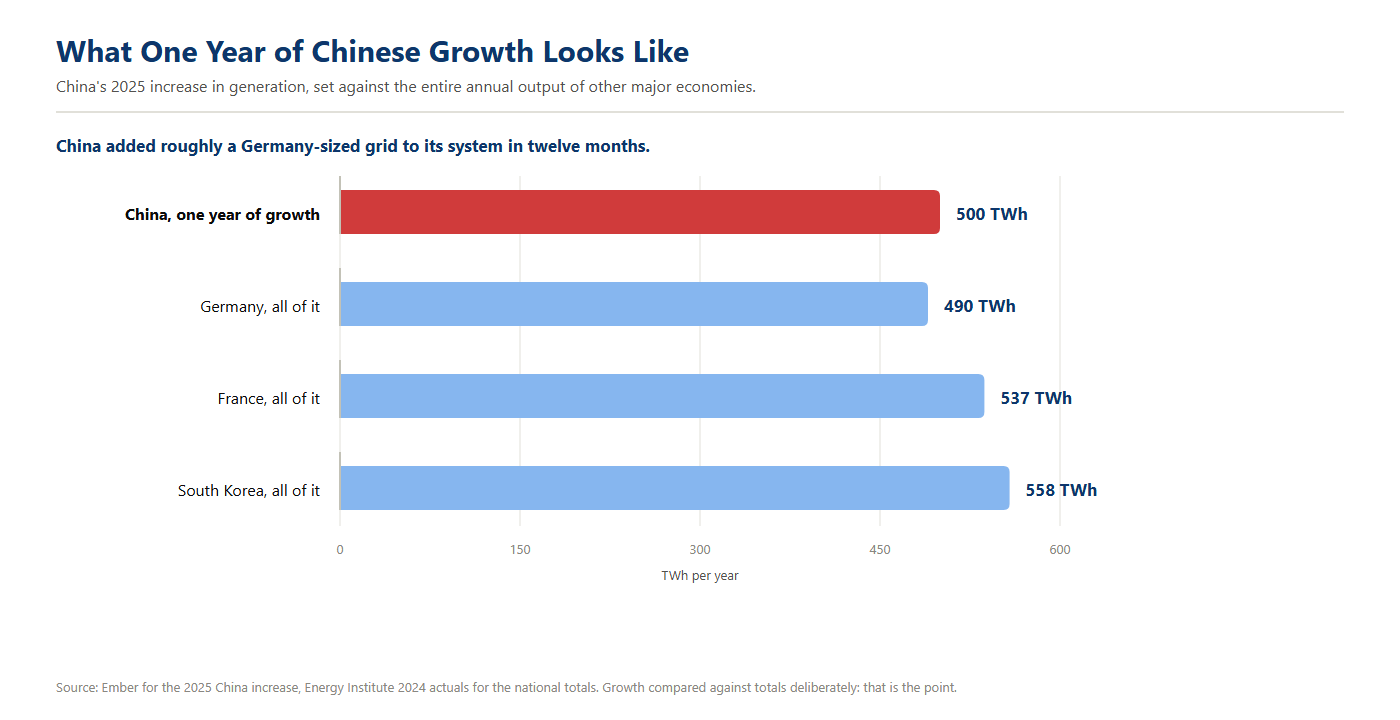
The single most important chart in this article. China's one-year increase is the size of a top-ten national grid.
That chart is the whole argument compressed. In 2025 China added roughly 500 TWh of generation. Germany's entire annual output is 490 TWh. China added a Germany to its system in twelve months, and almost all of the addition came from solar and wind.
China accounts for the majority of global power capacity under construction. Mid-2026 snapshots show roughly 448 GW of utility-scale wind and solar under construction, over 200 GW of coal in construction or advanced development, and approximately 50 to 60 GW of nuclear under construction, putting China on track to become the world's largest nuclear operator this decade. Hydro and pumped storage add hundreds of gigawatts more to the pipeline. It is a dual-track system: renewables for demand growth, advanced thermal and nuclear for absolute reliability.
India hosts approximately 125 GW of wind and solar under construction plus a substantial coal pipeline. Demographic necessity drives the build. A median age near 28 and a workforce still entering industry require exponential power growth if India is to absorb that labour.
The United States pipeline is an order of magnitude smaller relative to the demand growth arriving from AI data centres and reshoring. New firm thermal and nuclear capacity under construction is measured in the low tens of gigawatts, renewables are fragmented by interconnection queues stretching years, and transmission permitting routinely takes a decade. OpenAI and other hyperscalers have publicly warned the White House that China added hundreds of gigawatts in a single recent year while the United States added roughly 50 GW. The electron gap is now a national-security question, not an energy-policy one.
Elsewhere the construction picture is more modest. Brazil and Canada focus on hydro and wind hedges. South Korea and France emphasise nuclear life-extension and new build. Japan concentrates on restarts. Germany's pipeline remains thin on firm capacity. Russia prioritises modernisation and Siberian extension.
Part IV: The Competitive Spread
If electricity is a currency, the spread between generation cost, the minting, and end-user price, the exchange rate, determines industrial competitiveness.
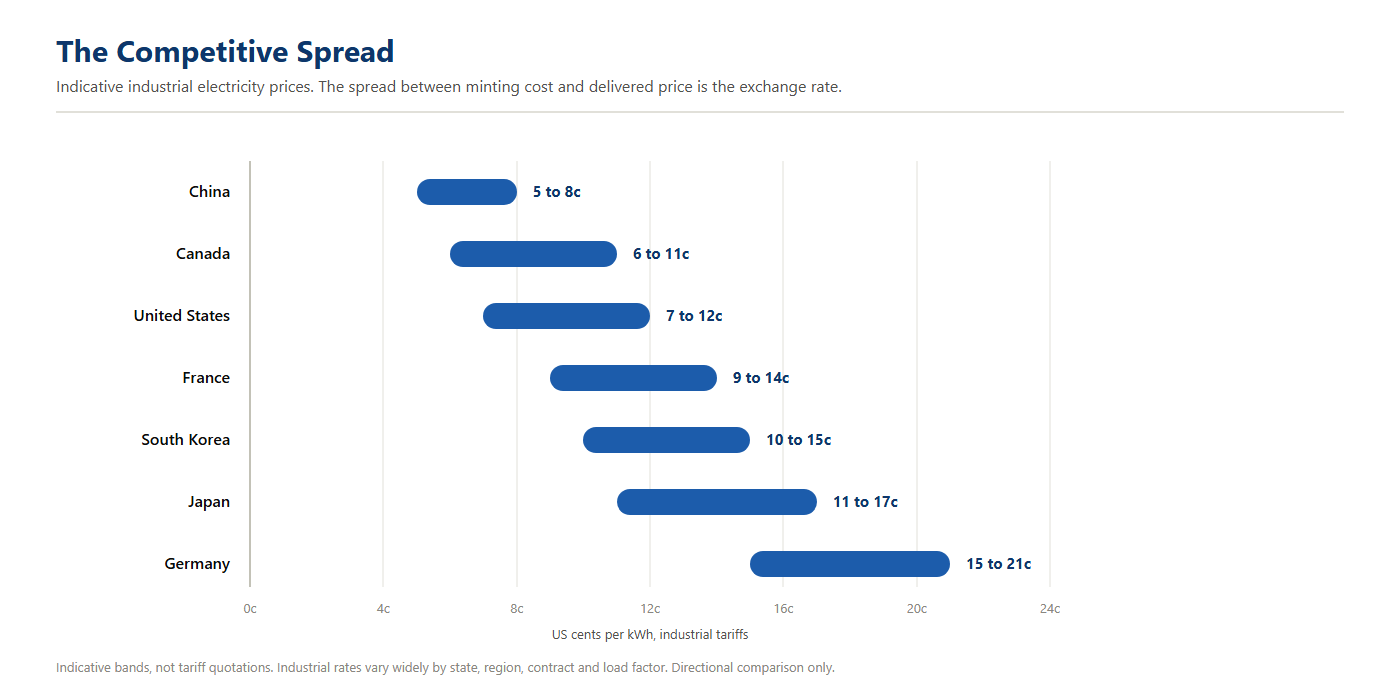
Indicative industrial tariff bands. Directional comparison, not tariff quotations, since rates vary sharply by region, contract and load factor.
China holds industrial power in the 5 to 8 cent per kWh range through scale and policy, a structural advantage in energy-intensive manufacturing and AI training. The United States enjoys cheap gas generation but pays high delivery costs, and California and the Northeast run far above the national band. Germany's policy-driven spread has pushed industrial rates to the high teens and above, which is precisely the mechanism driving deindustrialisation. Japan and South Korea pay a density and import premium. France and Canada have low marginal nuclear and hydro costs, partially eroded by social pricing and transmission distance. Russia's power is among the cheapest on earth and largely stranded by sanctions.
The pattern is straightforward. Roughly a three-times spread separates the cheapest industrial electrons from the most expensive, and that ratio compounds through every energy-intensive process a country attempts.
Part V: The Corporate Architects
Nations set policy. Engineering firms mint the currency.
The grid masters, Siemens Energy, GE Vernova and Hitachi Energy, control the transformer and HVDC bottleneck, where backlogs run years. The nuclear renaissance runs through Westinghouse, Cameco for uranium, EDF and KEPCO, the last of which carries a genuine speed and cost advantage. Asian state champions such as State Grid of China and Tata Power, and Western renewables leaders such as NextEra, shape where capacity actually lands. Storage is dominated by CATL and Tesla Energy.
Most telling of all, the hyperscalers are becoming energy companies. Microsoft, Amazon, Google and Meta are signing nuclear power purchase agreements and in some cases funding plant restarts, because the public grid cannot keep pace with AI load. When the largest software companies on earth start buying reactors, the software-versus-infrastructure distinction has already collapsed.
Part VI: Geoeconomic Destiny and the Compute Contest
Synthesise output, pipeline, pricing and builders, and Energy Darwinism becomes visible. In the Intelligence Age, secure, abundant, cheap electricity is not optional infrastructure. It is the binding constraint on AI capability. Analysis from OpenAI, Meta, Brookings and utility analysts converges on the same point. The United States retains advantages in chip design and model software, but China is pulling ahead in the physical substrate, with capacity additions measured in hundreds of gigawatts a year against tens in the US. American data-centre electricity demand is projected to more than double this decade. China can simply build generation and transmission faster.
Europe, and Germany above all, is already living the consequence of expensive electrons: manufacturing relocation. Japan and South Korea fight for restarts and new build to protect advanced manufacturing. India and Brazil are the demographic and resource wildcards, hampered by grid losses and climate risk respectively. Canada has clean surplus and transmission distance. Russia has cheap power and no high-value offtake under sanctions.
I have written the compute side of this contest at length in The AI Compute Arms Race: United States vs. China and Compute and Electricity: The Defining Challenge of Our Times.
2050 Generation Estimates
These are order-of-magnitude estimates synthesised from IEA World Energy Outlook scenarios, Ember trend extrapolation and national policy targets. They are direction of travel, not forecasts, and outcomes depend on AI demand growth, nuclear licensing speed, transmission build-out and policy continuity.
Country | 2050 estimate (TWh) | What decides the outcome |
|---|---|---|
China | 15,000 to 18,000+ | Growth rate slows, absolute additions stay large |
United States | 6,000 to 7,500 | Transmission and permitting, unless policy shifts hard |
India | 5,000 to 7,000 | Steepest relative rise if manufacturing targets are met |
Russia | 1,400 to 1,800 | Modest, resource-driven growth |
Brazil | 1,000 to 1,400 | Hydro plus wind and solar diversification |
Japan | 1,000 to 1,200 | Restarts and efficiency hold it roughly stable |
Canada | 800 to 1,100 | Clean surplus expansion for export and data centres |
South Korea | 700 to 900 | Nuclear-centric growth to protect industry |
Germany | 600 to 700 | Struggles to exceed this without firm capacity recovery |
France | 550 to 750 | Life-extension and new build set the upper end |
Conclusion: The Inevitable Arithmetic of Electrons
Financial markets remain obsessed with 25-basis-point rate cuts. That is myopia. The era of pure monetary policy driving asset prices is ending and the era of energy policy driving asset prices has begun. Artificial intelligence is not primarily a software revolution. It is an electricity-consumption revolution.
Oil had to be found, pumped, shipped and refined under geopolitical constraint. Electricity generated by advanced fission, next-generation renewables or eventual fusion can be created domestically, almost anywhere, indefinitely, provided a nation has the political will to build the infrastructure.
Look at the data. China is adding capacity at a scale the West has forgotten how to match. The United States and its allies still lead in model intelligence and chip design, but the substrate of that intelligence is being minted faster on the other side of the Pacific. Microsoft is buying nuclear output because the public grid is lagging. Germany priced its electrons out of the market and is watching industry leave.
Economic success in the twenty-first century will not be determined solely by who has the most PhDs, the strongest navy or the most dollars. It will be determined by who can generate, transmit and cheaply distribute the most electrons. The kilowatt-hour is the new gold standard. The companies that build the turbines, reactors, transformers and storage are the new central banks. The nations that understand this fastest inherit the decisive advantage.
Everything else is noise.
Primary Sources and Further Reading
Energy Institute, Statistical Review of World Energy: national electricity generation figures for 2024, the basis for the top-ten table and chart.
Ember, Global Electricity Review 2026 and country trend data: China's 2025 generation of roughly 10,573 TWh, the increase of about 500 TWh year on year, solar generation of 336 TWh up 40%, and India's 38 GW of solar installations.
US Treasury, Debt to the Penny, and the Joint Economic Committee monthly debt update: total gross national debt of $39.9 trillion as at early August 2026.
IEA, World Energy Outlook scenarios and Electricity reports: the direction-of-travel basis for the 2050 estimates.
Global Energy Monitor trackers and the World Nuclear Association: capacity under construction for wind, solar, coal and nuclear.
OpenAI correspondence with the White House on energy capacity, 2026, plus Brookings and utility analyses of the United States and China AI power competition.
Elon Musk, interviewed by Nikhil Kamath, People by WTF episode 16, late 2025, and subsequent posts on X through June 2026.
KXCO structured systems: Armature L1 and the public ontology at kxco.ai/ontology-live.
A note on the numbers. Generation figures are 2024 actuals from a single source so the ranking is internally consistent. Industrial price bands are indicative and directional. The 2050 table is explicitly an order-of-magnitude exercise. Where this article gives a range, the range is the honest answer.
Shayne Heffernan, Ph.D. is the founder of Live Trading News and KXCO.
This article is for informational and educational purposes only and does not constitute investment advice. Past performance is not indicative of future results. Always conduct your own due diligence.

Careful of the Prompts You Give Yourself
A prompt is not only what you type into a model. It is any sentence that gets inside you and starts issuing orders. Most of what we call goals were written by comparison, media, competition and now the model, and they arrive dressed as ambition. Shayne Heffernan maps how an imported sentence becomes a week, why a want should carry its source the way a Round Table claim does, and how to strip, lock and guard the objective that is actually yours.

KXCO is Enhanced Intelligence, Not Artificial
I never wanted artificial intelligence. I wanted enhanced intelligence, and they are not the same product. Artificial means the machine does the thinking and hands you the answer. Enhanced means I do the thinking, with more of my own mind in the room than I have ever had at one time. Forty years of reading, recallable in the second I need it. Patterns across law, credit, physics and markets that no specialist sees, because the useful ones sit between the fields rather than inside them.

The AI Safety Argument Is Being Held in the Wrong Room
The people who will be blamed for what AI does are not in the room where its safety is argued. A jailbreak escapes a policy. The failure that costs money is an action that escapes an owner, a payment sent or a record altered. Tokens are not authority. Intelligence got cheap and judgment did not, and there is no organ of standing you can copy into a model. Shayne Heffernan on the objection worth taking seriously, and the questions to take into a vendor meeting.

NIST Graded Our Post-Quantum Cryptography. Zero Failures.
NIST's Algorithm Validation Test System generated test vectors nobody had seen, we answered them over the ACVP protocol, and NIST graded the result: 2,130 cases across ML-KEM, ML-DSA and SLH-DSA in every parameter set offered, zero failures, demo certificate A11025. This is what that proves, where we deliberately drew the claim narrower than NIST's own matrix, and why the FIPS 140-2 sunset on 21 September makes the distinction between being graded and grading yourself worth understanding.
Every story, signed and delivered.
Subscribe to the kxco channel and get the headline, the AI-written key takeaways, and the chain-anchor link the moment we publish. Audio versions and per-ticker subscriptions arrive in the next iteration.