
Energy IS the New Currency
Why the closed loop of power generation, semiconductors, compute and AI is only beginning to turn, the regional maps from China to the Middle East, and the equity nodes that sit inside it
Part of theAI Stocks Center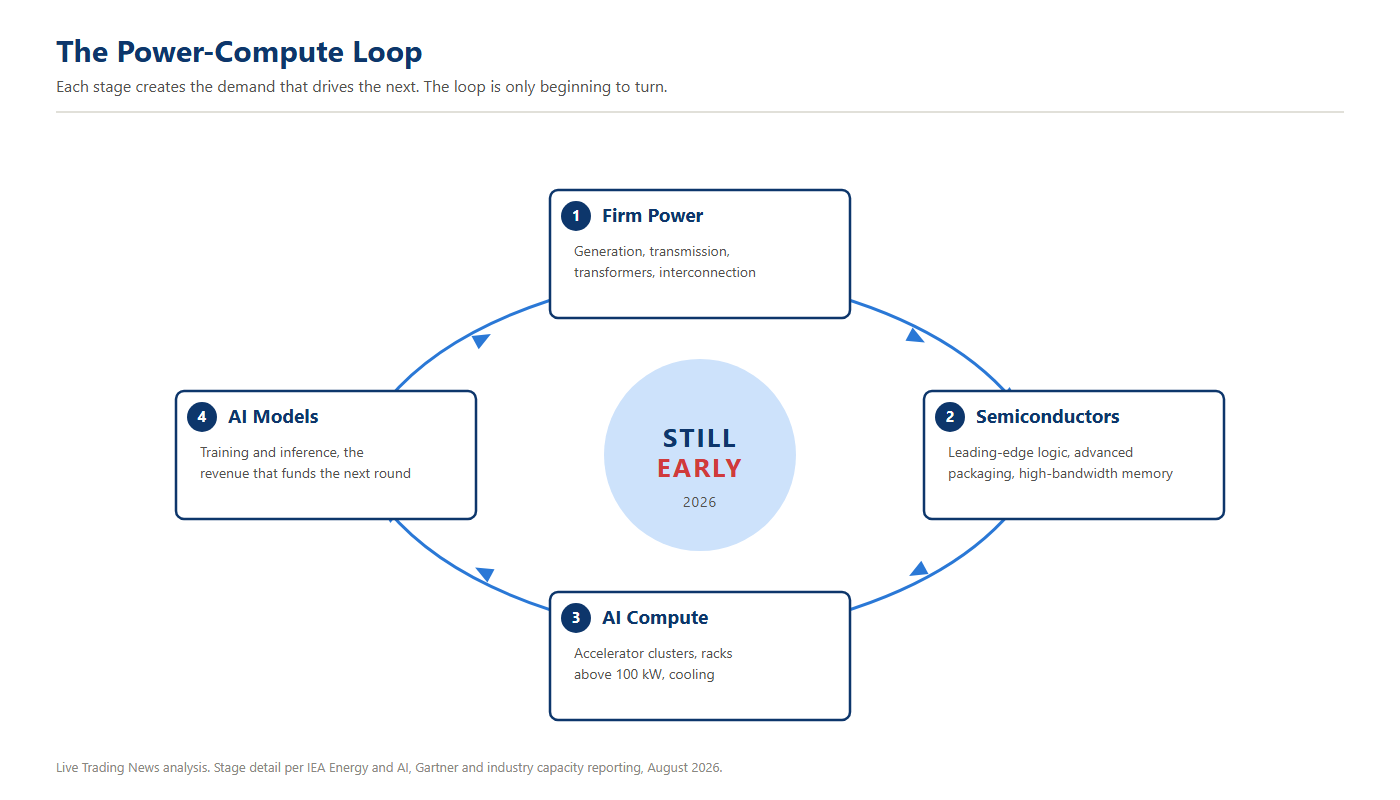
When Elon Musk said that energy is the true currency, and that power generation would become the de facto currency of the future, he was not speaking in metaphors. He was describing the physical constraint that is now binding the entire artificial-intelligence build-out. In previous Live Trading News analyses, including Compute and Electricity: The Defining Challenge of Our Times and The AI Compute Arms Race: United States vs. China, we mapped the chokepoints. The KXCO public ontology at kxco.ai/ontology-live tracks more than 370 entities and 800 typed claims across the sector, each carrying its source and its as-of date. What follows is the next layer: the closed loop itself, why it is only just starting, and how different regions are positioning inside it.
Musk's Framing, and Why It Matters Now
Speaking with Nikhil Kamath on the People by WTF podcast in late 2025, Musk put it plainly:
"Energy is the true currency. This is why I said Bitcoin is based on energy. You can't legislate energy. You can't just pass a law and suddenly have a lot of energy. It's very difficult to generate energy, especially to harness energy in a useful way to do useful work. So I think that we probably won't have money, and we'll just have energy, power generation, as the de facto currency."
He later sharpened the point on X. Once the loop from solar generation to robot manufacturing to chip fabrication to AI is closed, "conventional currency will just get in the way. Just wattage and tonnage will matter, not dollars." In June 2026 he compressed it further: "Mass and energy will take the place of dollars."
"When Elon Musk discussed electricity and energy as the money of the future, this is precisely what he was talking about. The AI race is no longer primarily about algorithms or even chips in isolation. It is about who can deliver firm, dispatchable watts at the scale and location where the next generation of accelerators will sit. That is the real scarce resource. Models, talent and capital are all downstream of power and the semiconductors that turn power into useful compute. We are still early. The loop is only beginning to close."
Shayne Heffernan, Ph.D., Live Trading News
The Closed Loop: Power, Semiconductors, Compute, AI, More Power
The feedback loop is now visible in the data, and the diagram above is the shape of it. Hyperscaler capital expenditure is guided toward roughly $700 to $725 billion in 2026, the majority of it for AI infrastructure. That spending collides with three simultaneous constraints: advanced semiconductor capacity, especially TSMC CoWoS packaging, high-bandwidth memory, and, increasingly the binding constraint in many markets, firm power along with the transformers, switchgear and interconnection queues required to deliver it.
Every new generation of accelerators raises thermal design power. Racks that once drew tens of kilowatts now approach or exceed 100 kW, and a single AI data-centre campus measured in gigawatts is no longer theoretical.
The scale is worth stating precisely, because the two most-cited forecasts do not agree, and the gap between them is the story. The IEA, in its Energy and AI report, has global data-centre electricity consumption rising from about 415 TWh in 2024, roughly 1.5% of world electricity, to about 945 TWh by 2030, just under 3%. Gartner, forecasting in June 2026, sees consumption reaching 565 TWh in 2026 alone, up from 447 TWh in 2025, a 26% increase in a single year, and passing 1,200 TWh by 2030. Gartner's 2030 figure is roughly 27% above the IEA's.
Two respectable institutions are that far apart on a six-year horizon. That is not a rounding difference. It is a signal that the demand curve is being revised upward faster than the models can be republished, and revisions in this cycle have consistently gone one way.
The mechanism behind both numbers is the same self-reinforcing cycle. Better AI models require more compute. More compute requires more advanced semiconductors and denser power delivery. Denser power delivery requires new generation, transmission and cooling. The economic value that results then funds the next round of model training and inference.
This is still the early innings. Most of the announced gigawatt-scale campuses have not yet energised. Turbine order books at GE Vernova and Siemens Energy are sold out years forward. Transformer lead times stretch into multiple years. Advanced packaging capacity remains tight into 2027 and 2028. The market is only beginning to price the multi-year duration of these bottlenecks.
Regional Compute Power Maps
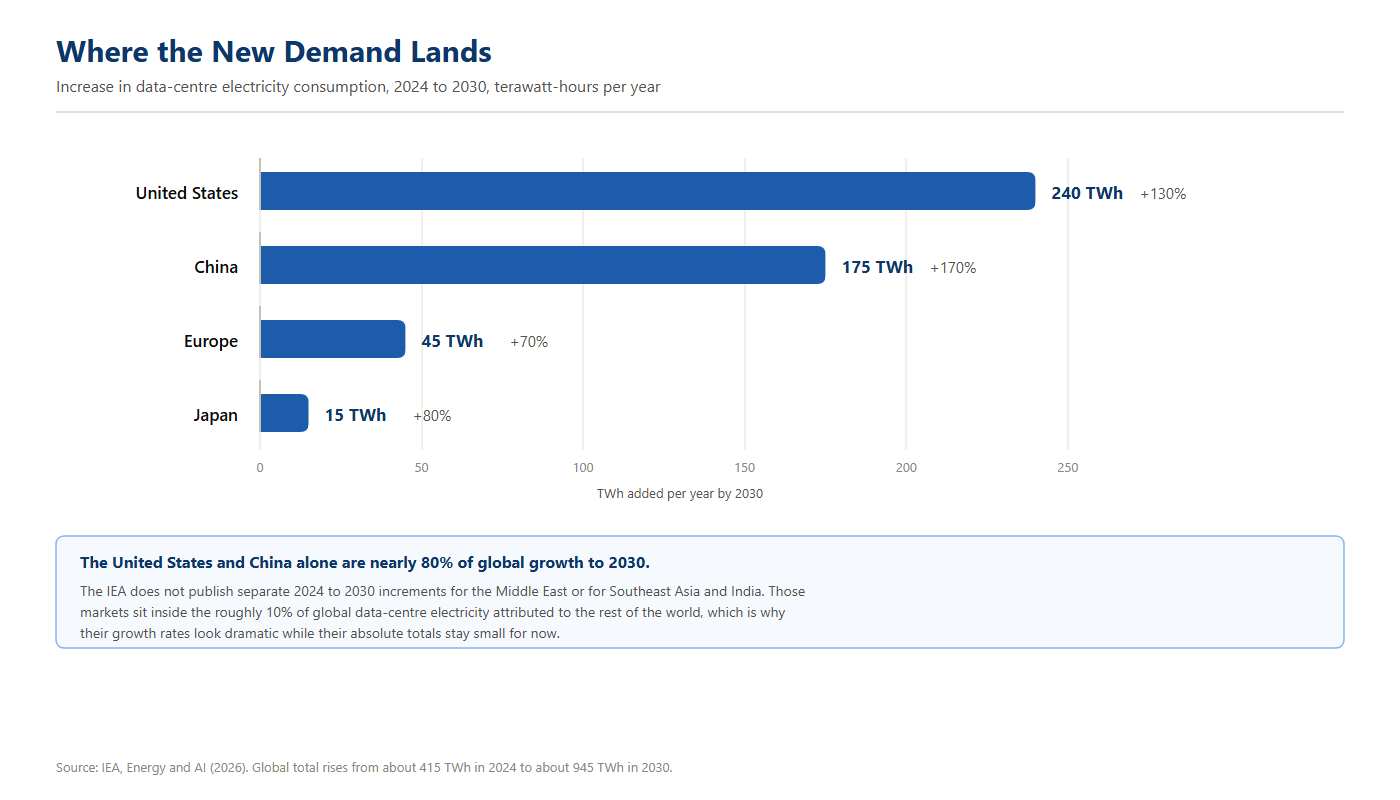
Where the new demand lands. The United States and China account for nearly 80% of global growth in data-centre electricity consumption to 2030. Source: IEA, Energy and AI.
China
China remains the single largest source of global electricity demand growth and is adding capacity at a pace unmatched by any other major economy. On IEA figures it adds roughly 175 TWh of data-centre consumption by 2030, a 170% increase, the fastest growth rate of any major market. Data-centre electricity supply is still dominated by coal in the east, but policy is pushing new AI campuses toward the renewables-rich western provinces. China is simultaneously scaling domestic AI accelerators, Huawei Ascend among them, while remaining constrained on the most advanced process nodes. The combination of grid scale, industrial policy and domestic model competition means Chinese compute capacity will keep expanding rapidly even under export controls. For investors the exposure is dual: direct Chinese tech in $BABA and $BIDU, and the global semiconductor and equipment names that still serve permitted markets.
Japan
Japan and Korea together account for roughly 5% of global data-centre electricity demand today, and the IEA expects them to hold that share to 2030. Japan adds about 15 TWh over the period, an 80% increase on a small base. The country is prioritising nuclear restart and advanced reactors alongside renewables to support both industrial electrification and AI loads. Japanese trading houses and utilities are increasingly partnering on hyperscale projects. Semiconductor materials, specialty chemicals and precision equipment remain Japanese strengths that sit upstream of the entire global AI supply chain.
Rest of Asia: Southeast Asia, India and the Singapore hub
Southeast Asia and India are among the fastest-growing electricity markets, and regional data-centre demand is expected to more than double by 2030. Singapore remains the traditional hub, but power constraints are pushing capacity into Malaysia, Indonesia and India. India in particular is adding both renewable and thermal capacity at scale while cultivating domestic AI and semiconductor ambitions. Power availability, rather than land or fibre, is the decisive variable for new campuses. Worth noting that the IEA does not publish a separate 2024 to 2030 increment for this region, which sits inside the roughly 10% of global data-centre electricity attributed to the rest of the world. The growth rates are dramatic and the absolute totals remain small for now.
Middle East
The Middle East is emerging as a genuine AI power centre. Abundant solar potential, gas resources, sovereign capital and deliberate government programmes, including large planned AI campuses in Saudi Arabia and the UAE, are converting an energy advantage into a compute advantage. JLL data show multi-gigawatt pipelines under construction and in planning. For the first time in the modern compute era, a region outside the traditional United States, China and Europe axis is positioned to host meaningful frontier training capacity on the basis of power cost and availability. As with the rest of Asia, this is a pipeline story rather than an installed-base story, and the IEA does not yet break the region out separately.
Europe
Europe faces the tightest combination of grid constraints, planning friction and climate-policy complexity, and adds only about 45 TWh by 2030, a 70% increase, well behind both the United States and China in absolute terms. The FLAP-D markets of Frankfurt, London, Amsterdam, Paris and Dublin remain capacity-constrained, and new projects are migrating farther from city centres toward available power. Renewables and nuclear are expected to supply the majority of incremental data-centre electricity by 2030, but interconnection timelines and permitting remain slow. Europe will host important inference and sovereign-AI capacity. It is less likely to lead in the largest training clusters unless policy accelerates dramatically.
The United States
Worth stating explicitly, because it is the largest single number on the chart: the United States adds roughly 240 TWh by 2030, a 130% increase, and data centres account for nearly half of all US electricity demand growth between now and then. That is the concentration risk and the opportunity in one figure.
Across all regions the pattern is identical. The limiting reagent is firm power delivered to the rack, not the theoretical availability of silicon or capital. That is the practical meaning of Musk's observation.
Equity Map: Where the Names Sit in the Loop
The table below lists selected publicly traded companies at critical nodes of the loop. These are not recommendations. They are the names that recur in the ontology and in the physical supply chain.
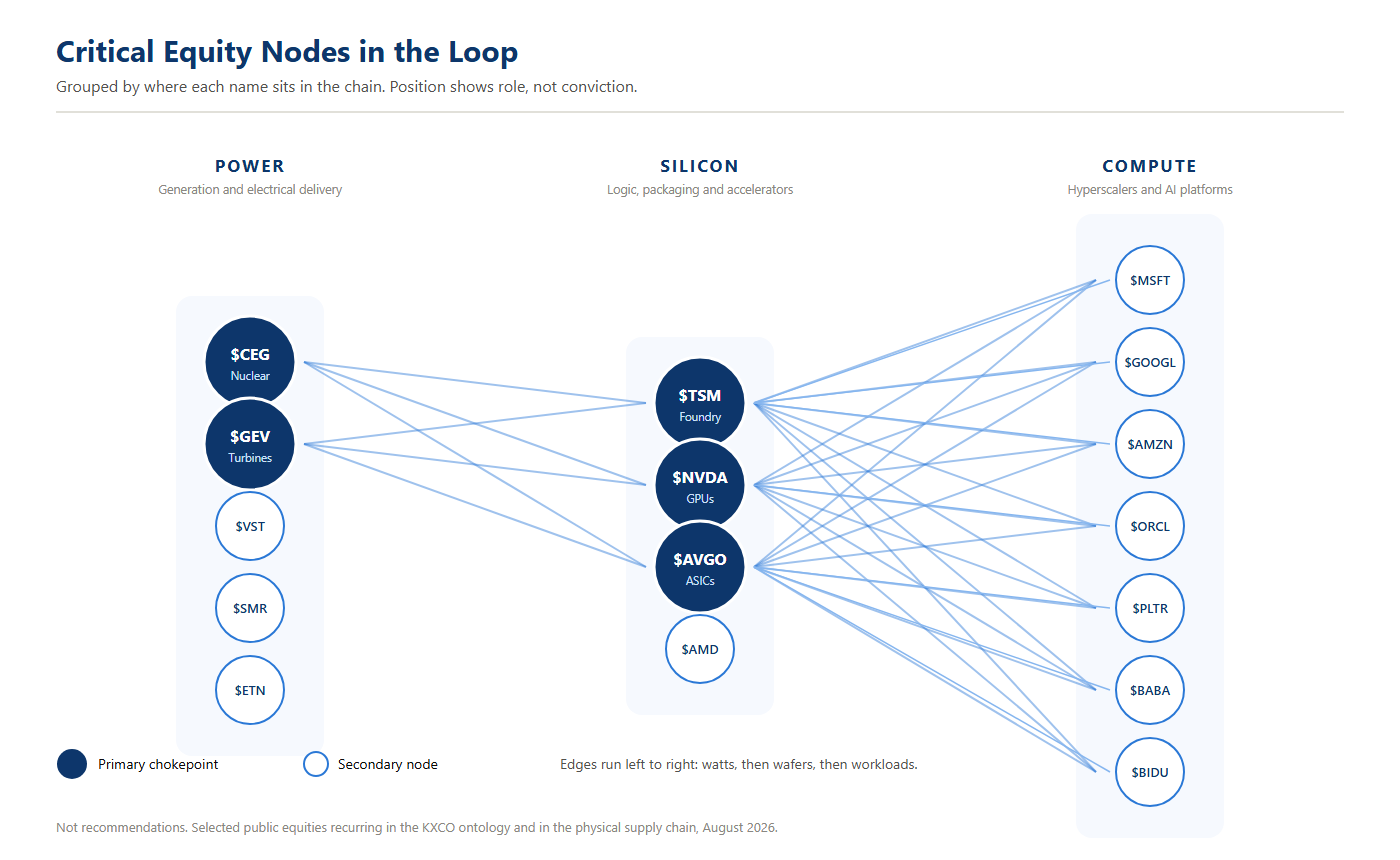
Watts, then wafers, then workloads. Grouping the names by where they sit in the chain rather than by sector.
Cashtag | Company | Node in the loop | Primary exposure |
|---|---|---|---|
NVIDIA | Accelerators and CUDA platform | AI GPUs, networking, software stack | |
TSMC | Foundry and advanced packaging | Leading-edge logic plus CoWoS | |
Advanced Micro Devices | Accelerators and CPUs | MI-series GPUs, EPYC | |
Broadcom | Custom ASICs and networking | Google TPUs, networking silicon | |
Constellation Energy | Firm nuclear power | Largest US nuclear fleet, data-centre PPAs | |
Vistra | Integrated power and retail | ERCOT generation, retail supply | |
GE Vernova | Gas turbines and grid | Turbines sold out years forward | |
Eaton | Power management and electrical | Data-centre electrical infrastructure | |
NuScale Power | Small modular reactor technology | SMR designs, long-dated optionality | |
Palantir | AI platforms and ontology | Enterprise AI, decision systems | |
Microsoft | Hyperscaler, Azure | Largest AI infrastructure buyer, OpenAI | |
Alphabet | Hyperscaler, TPU | Custom silicon plus search and AI services | |
Amazon | Hyperscaler, Trainium | AWS plus custom accelerators | |
Oracle | Hyperscaler, Stargate | Aggressive AI capacity build | |
Alibaba | China cloud and AI | Chinese hyperscale plus models | |
Baidu | China AI and search | Domestic models plus cloud |
Selected public equities at critical nodes of the power, semiconductor, compute and AI loop. Source: Live Trading News analysis and KXCO ontology mapping, August 2026.
One observation the table makes plain. Four of the sixteen names are power and electrical companies rather than technology companies. Three years ago a list of AI beneficiaries would have contained none. That migration, from silicon to substations, is the loop closing in public markets.
We Are Still Early
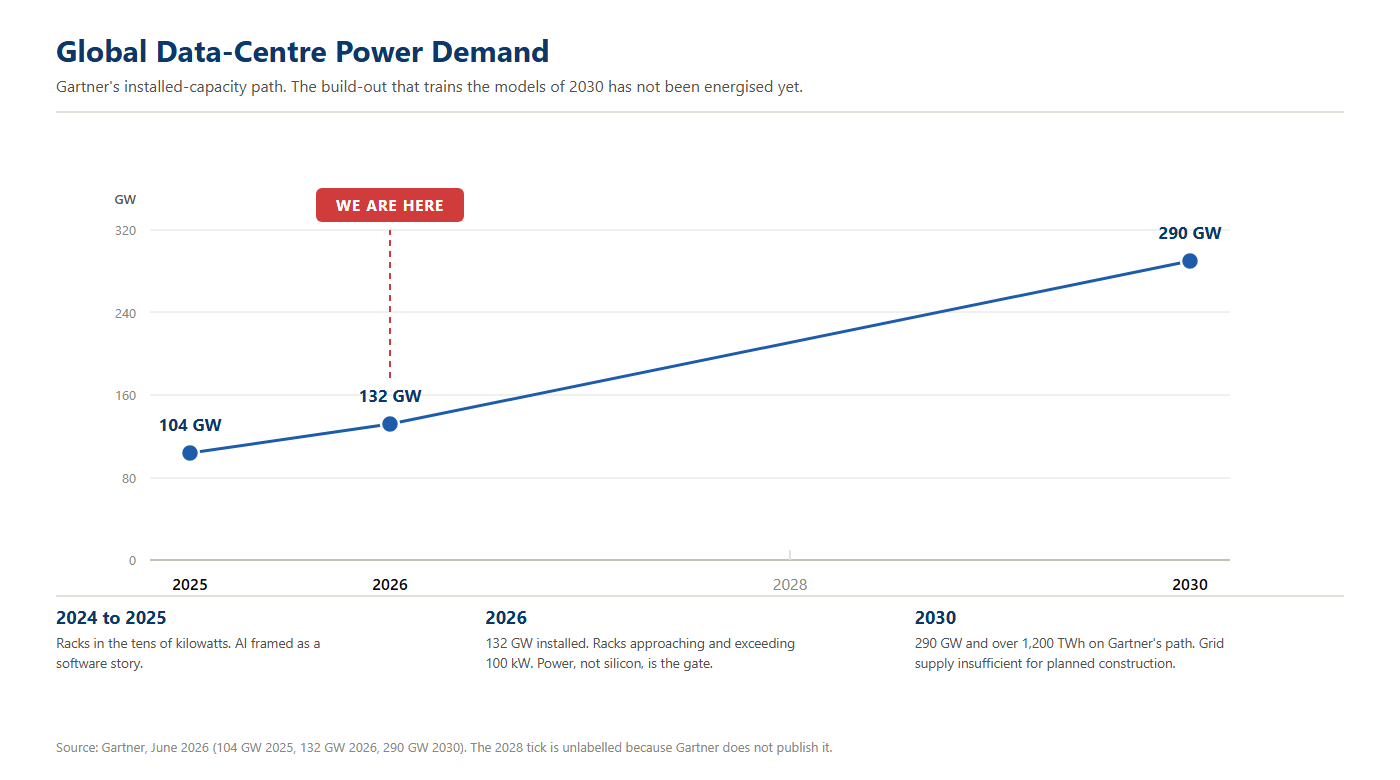
Gartner's installed-capacity path. Roughly 158 GW still to be added between 2026 and 2030, more than the entire installed base in 2025.
It is easy to look at $700 billion of annual hyperscaler spend, sold-out turbine books and multi-year packaging queues and conclude the cycle is mature. It is not. Gartner puts installed global data-centre power demand at 104 GW in 2025 and 132 GW in 2026, on the way to 290 GW by 2030. That means roughly 158 GW still has to be built and energised in four years, more than the entire installed base that exists today. Gartner's own conclusion is blunter than most sell-side commentary: grid supply will be insufficient to meet the demands of future data-centre construction, and that will affect all data-centre users, not only the AI ones.
Most of the capacity that will train the models of 2028 to 2030 has not been energised. The loop Musk described, generation feeding factories that build the chips that power the AI that then designs better energy systems, is only beginning to turn. Conventional GDP and currency metrics will remain useful for years. But the underlying scarcity that determines who wins the AI race is already measured in firm megawatts and advanced wafers.
The ontology we maintain at KXCO is built for exactly this kind of multi-year transition. It tracks entities, claims, capital loops and chokepoints, and it renders them in a form where the structure is visible. It does not hand down conclusions. It puts the dependencies in front of human judgement so that investors and operators can see for themselves where value concentrates and where fragility hides. Anyone can inspect it at kxco.ai/ontology-live.
Electricity is becoming the true currency of AI. The race is not finished. It is only now becoming properly visible. We are still early.
Selected Sources
Elon Musk, interviewed by Nikhil Kamath, People by WTF, episode 16, late 2025, plus subsequent posts on X through June 2026 on energy as the true currency and the generation to robot to chip to AI loop.
IEA, Energy and AI (2026): data-centre electricity consumption of about 415 TWh in 2024 rising to about 945 TWh in 2030, with regional increments for the United States, China, Europe and Japan.
Gartner press release, June 2026: global data-centre electricity consumption of 565 TWh in 2026, up 26% from 447 TWh in 2025, installed power demand of 132 GW in 2026 against 104 GW in 2025 and 290 GW by 2030, and AI-optimised servers reaching 31% of data-centre power consumption in 2026.
JLL data centre reports (2026): Europe FLAP-D capacity constraints, Middle East pipeline, power-first site selection.
Live Trading News: Compute and Electricity: The Defining Challenge of Our Times and The AI Compute Arms Race: United States vs. China, plus KXCO ontology mapping at kxco.ai/ontology-live.
Industry capacity reporting: TSMC advanced packaging, high-bandwidth memory supply, gas-turbine order books at GE Vernova and Siemens Energy, and hyperscaler 2026 capital expenditure guidance in the $700 to $725 billion range.
Shayne Heffernan, Ph.D. is the founder of Live Trading News and KXCO.
This article is for informational and educational purposes only and does not constitute investment advice. Past performance is not indicative of future results. Always conduct your own due diligence.

Hegseth's AutoWarCom: Who Builds It, What the Money Buys, and the Record It Needs
Pete Hegseth's Autonomous Warfare Command is a four-star proposal that needs Congress by 1 October 2027. Until then Project Agincourt holds the work, and the money moves through Drone Dominance, the Army's counter-drone contracts and DIU. The software layer, Palantir's Maven, Anduril's Lattice and Shield AI's Hivemind, is the one the KXCO AI Sector ontology had mapped before the speech. After Minab, its hardest problem is the record, not the model.

AI Development: The Token Got Cheaper, the Building Did Not
The useful fact on 28 September is a split, not a benchmark. Gartner puts 2026 AI spending at $2.67 trillion, and 56 percent of it is infrastructure against about 1 percent on the models. Inside one week the frontier cut the price of a token in half, Nvidia signed for the shelf the open weights sit on, and three closed labs proposed to run the test. What shipped, what it costs and where the money goes, with the AI sector checked against KXCO Ontology Live.

The Week the Discount Rate Gets a Vote
The Fed hiked on 16 September and left the door open. This week the August PCE deflator on Wednesday, September payrolls on Friday, the RBA on Tuesday and euro-area CPI set the discount rate. Gold, Bitcoin, the dollar, the AI complex and the quantum pure plays share that rate and diverge everywhere else. This is the map of what depends on what, the three regimes the book should already have written down, and the stop that belongs to each node on KXCO Ontology Live.
The Round Table Scorecard: 87 Days of a Live Ontology
On 1 July 2026 KXCO put a Round Table ontology in public with 31 entities, 41 claims and no findings. It now holds 395 entities, 892 claims and 47 findings, with every correction kept rather than overwritten. This scorecard grades the record, how it corrects itself in the open, and the 9 of 13 names on its first outlook table that are higher since 17 July.
Every story, signed and delivered.
Subscribe to the kxco channel and get the headline, the AI-written key takeaways, and the chain-anchor link the moment we publish. Audio versions and per-ticker subscriptions arrive in the next iteration.