
Hegseth's AutoWarCom: Who Builds It, What the Money Buys, and the Record It Needs
A four-star command with service-like authorities is the Pentagon's answer to a battlefield that now kills with cheap compute. Project Agincourt is the interim vehicle. After Minab, the software layer's hardest problem is the record rather than the model.
Part of theKXCO Center
On 30 September 2026, at Marine Corps Base Quantico, Secretary of War Pete Hegseth told a room of junior officers and non-commissioned officers that the United States would stand up a new four-star command for machines. He called it the Autonomous Warfare Command, or AutoWarCom. It is to be a functional combatant command, not a lab and not a programme office, with what he described as service-like authorities to design, buy and field unmanned and robotic systems across the joint force. The target date in the memorandum issued the same day is 1 October 2027. Congress has to write the authority. Until then, the work sits with an office renamed Project Agincourt.
That is the institutional fact. The market fact is narrower and more useful. AutoWarCom does not, by itself, appropriate a dollar. It reorganises who defines the requirement, who spends against it, and which class of weapon the department now treats as the main effort rather than a sidecar to fighters, ships and armoured brigades. The companies already inside that funnel are not a mystery. They are the firms on the Drone Dominance leaderboard, the software houses behind Maven and Lattice, the counter-drone awardees of 29 September, and three private citizens, Elon Musk, Palmer Luckey and Newt Gingrich, asked to tell the department within 120 days what the next battlefield should look like.
The AI fact is the one the speech left out. The software layer that let U.S. forces plan and coordinate about 13,000 strikes in the 38 days of Operation Epic Fury, according to Breaking Defense, is the same layer that carried a stale record into the strike on a school in Minab. AutoWarCom is being built to scale the first. The authorities Congress gives it will depend on fixing the second, and that is a problem of the record before it is a problem of the model. The KXCO AI Sector ontology had this stack mapped, claim by claim and source by source, before Hegseth spoke.
The announcement itself is not in doubt. The department's release, the Agincourt memorandum, Reuters, Bloomberg, Air & Space Forces Magazine, Defense One, DefenseScoop and Military Times all carry the four-star design, the 1 October 2027 target and the Agincourt interim. RT's write-up of 1 October adds three items: a near-miss with China blamed on a chatbot, a vocabulary swap from "artificial intelligence" to "super intelligence", and the Minab strike. All three are on the record outside RT. CNN reported the near-miss, the White House published the rename and Bloomberg reported Minab. This piece cites them, not RT.
What was announced
Hegseth's address was billed as the first annual State of the Force. He spoke to E-6s and O-3s, not to the service chiefs. The department's release, carried on war.gov, lists six initiatives. AutoWarCom is the one with an industrial consequence. The others are a new Corps of Cadets at five civilian universities, a homeland-resilience programme called FORTRESS America, a competition among states to host a new base, an Office of Religious Affairs reporting to the secretary, and Project Meridian, the 120-day future-warfare study.
On the command itself, the secretary's language was consistent across the speech and the memo. AutoWarCom is to be a four-star functional combatant command. It will "lead the Joint Force in unmanned and autonomous warfare." It is to have directed manpower, a budget, acquisition authorities, and dedicated officer and enlisted career paths. It will define joint needs and integrate service-provided forces in support of the geographic combatant commanders. It will test equipment against realistic opposition, modify it, and field what works. The product Hegseth says he wants is not a particular airframe. It is "the ability to adapt in combat, on the right side of the cost exchange."
"The pace of war is changing faster than the process to support it." Pete Hegseth, State of the Force, Quantico, 30 September 2026.
Reuters, in a dispatch by Idrees Ali and Phil Stewart, noted that a new command is rare. The last one was U.S. Space Command in 2019. The Pentagon has eleven combatant commands, geographic and functional. AutoWarCom would be the twelfth, and unlike most of them it is being drawn with authorities that look more like a service's: the right to drive design, development and fielding, not only to request forces from the Army, Navy, Air Force, Marine Corps and Space Force. Air & Space Forces Magazine reported that the portfolio, as Hegseth described it, covers drones, artificial intelligence, and command and control.
The department's own release uses "Secretary of War" and "Department of War" throughout. Reuters, Bloomberg and Defense One still wrote "Defense Secretary." The letterhead on the Agincourt memorandum reads Secretary of War, 1000 Defense Pentagon. For markets, the naming is a branding fact, not a budget fact. The Goldwater-Nichols structure that creates combatant commands has not been rewritten by a speech. That rewrite is the part that has to go through Congress.
Hegseth also said the services will phase in new military occupational specialties for autonomy. The memo gives the secretaries of the military departments, coordinated by the under secretary for personnel and readiness, the job of proposing those career fields inside the 30-day plan of action. The point is retention and competence. A force that buys tens of thousands of small attack drones in a single competition cycle cannot crew them with borrowed intelligence officers and a contractor in the loop forever.
Project Agincourt, and why the name matters
The command does not exist yet. The memo of 30 September directs the Direct Reporting Portfolio Manager for Unmanned Systems, DRPM-UxS, to lead Project Agincourt as the pathway. DRPM-UxS was set up on 29 June 2026, according to Defense One, and the same memo made the heads of the Defense Autonomous Warfare Group, which absorbed Replicator in late 2025, and of the counter-drone task force JIATF-401 elements under it. Hegseth created it to consolidate unmanned offensive and defensive systems under one direct-report office. Agincourt is that office, renamed, with a second job bolted on: prototype a procurement model the secretary calls "warfighting acquisition."
The model is described in plain language. Team operators with innovators and competitive manufacturers. Push decisions and dollars to the edge. Fuse development with operations. Scale what works. The memo names the two people who will run it. Owen West, director of the Defense Innovation Unit, becomes chief executive of DRPM-UxS. Max Strasiser, a Navy SEAL senior chief and the first enlisted SEAL to graduate from Navy Test Pilot School, becomes chief operating officer. West is assigned strategic risk, resources and scale. Strasiser is assigned operational problem-solving and "the realities of employment in combat."
Agincourt is the English victory of 1415, longbowmen against armoured cavalry, a cheap massed weapon defeating an expensive elite one. Hegseth mimed the bow, according to Defense One. The metaphor is the strategy. In the speech he put it as weather: the force still needs "bolts of lightning," the costly legacy weapons, and it also needs "steady wind and rain," mass drones and other autonomous attritable systems that flip the cost exchange. Business Insider recorded that formulation. It is the cleanest statement of the investment thesis the department is now willing to say in public.
The implementation clock is short. Within 30 days, DRPM-UxS, with the chairman of the Joint Chiefs, must submit a plan of action and milestones. The chairman designates a senior Joint Staff counterpart. The plan has to identify priority operational efforts, service force contributions, command relationships, how DRPM-UxS is absorbed, test support, resources, required authorities and milestones. Unresolved choices come up with alternatives. Monthly reports go to the secretary. Unresolved disputes go to the deputy secretary, then to Hegseth. Initial work proceeds under existing authorities, concurrent with the legislative ask.
That last clause is the one investors should underline. Between now and October 2027, money moves through vehicles that already exist: the Drone Dominance programme, service programme offices, the Army's counter-UAS marketplace, DIU prize constructs, and whatever DRPM-UxS can do with current acquisition authority. A four-star flag does not reprint the Federal Acquisition Regulation. It changes who sits at the table when the next vehicle is written.
The battlefield argument
Hegseth's memo opens with a historical claim. After the Cold War the United States cut the share of national income spent on defence and adapted by buying fewer, more sophisticated weapons. That strategy, he writes, worked for forty years. It no longer does, because advanced computing lets precise, low-cost weapons be produced at massive scale, and those weapons threaten legacy platforms and disrupt force projection. "We do not have a decade to transition our procurement and doctrine. Procrastination puts American lives at risk."
The exhibit is Ukraine. Reuters reported estimates that drones account for about 70% of Russian casualties. The war that opened with tanks and tube artillery has become, in large part, a war of cheap unmanned aircraft used for reconnaissance and attack by a side that was outgunned in armour and airpower. Ukraine raised its 2026 defence budget to a record UAH4.4tn, about $98bn, according to the Kyiv Post. Hegseth's own formulation, recorded by Business Insider and DefenseScoop, is more careful than the slogan: "Ukraine's lesson is not that one type of drone wins wars, but rather the need for a purpose-built system that maximizes the ability to adapt." He told the Quantico audience the department will fuse procurement with operations and let warfighters, engineers and entrepreneurs iterate on their own domain.
The second exhibit, in the department's release rather than in the RT piece, is Operation Epic Fury, the campaign against Iran in which the Drone Dominance programme "delivered thousands of robotic systems." DefenseScoop has reported that U.S. Central Command used the Low-cost Uncrewed Combat Attack System, LUCAS, in combat against Iran, and that Shield AI said in May its Hivemind software would serve as the AI pilot, letting groups of drones coordinate under one operator. Pentagon AI use reached about 20 billion tokens a day during the campaign, up 4,425%, according to the department's AI chief as reported by Breaking Defense, and the Army later reinstated token limits after allowances ran out early. The department's line is that the pipeline already works at small scale and now has to be institutionalised.
There is a third exhibit, and it cuts the other way. On 28 February 2026, in the opening U.S. strikes on Iran, two Tomahawk missiles hit the Shajarah Tayyebeh elementary school in Minab. Bloomberg reported that more than 150 people were killed, including at least 123 children. Pentagon investigators, according to Bloomberg's September reporting, found flawed intelligence, outdated imagery and an over-reliance on AI inside the targeting process. Targeting databases had listed the compound as a military site for years, while commercial satellite images showed something different, per Gizmodo's account of the Bloomberg investigation. The site stayed labelled as an IRGC facility. Palantir's Maven Smart System was the tool fusing the inputs, and some CENTCOM personnel expected it to flag outdated or inconsistent intelligence. It did not. CENTCOM's civilian-harm mitigation team had been cut from ten people to one, and no member of it reviewed the site before the strike.
The department has since revised the workflow for refreshing and vetting planned targets and added open-source feeds to track civilian movement, according to AI Weekly's summary of Bloomberg. It has also taken what officials described as dozens of upgrades to Maven, including agents that re-review underlying intelligence for factors that would disqualify a target.
That is the tension AutoWarCom inherits on day one. The same class of software that lets a command generate and prioritise a thousand targets in a compressed cycle is the class of software that carried a bad target into the cycle. Scaling the first without fixing the second is not a procurement success. It is a liability, operational and political.
The vocabulary, and what RT added
RT reported that the day before the speech President Donald Trump signed an executive order replacing "artificial intelligence" with "super intelligence" in the government's vocabulary. That one is real. The White House fact sheet of 29 September says the order directs departments and agencies to use "Super Intelligence" and "SI" in official documents within the executive branch, and directs the President's science and technology adviser to propose a federal definition. Hegseth used the phrase. "Drone warfare supercharged by SI-enabled targeting is the biggest battlefield revolution in generations," Air & Space Forces Magazine quoted him as saying.
The same day, six developers signed a one-page voluntary commitment at the White House: Anthropic, Google, Meta, OpenAI, Nvidia and xAI. It is the Joint Commitment on Frontier Responsibilities, and Trump called it morally binding, according to the Associated Press. No enforcement mechanism was announced, according to IAPP, and the accord itself says that over time it may make sense to codify its steps into laws and regulations. Read together, the rename and the accord say the White House wants the technology treated as a strategic asset and governed by invitation. Neither changes a model weight nor a rules-of-engagement card.
RT also cited CNN on a near-miss with China. CNN did report it, as an exclusive on 18 September. An analyst's report that a Chinese ship in the Middle East was carrying components of a nuclear weapons programme was false, because a chatbot the analyst used had misidentified the material. A planned interception was called off, as the Taipei Times also reported. Democrats called for an investigation the next day. RT's version adds that the cargo was bound for Iran, which the CNN accounts do not say.
Thailand's defence minister, Adul Boonthumjaroen, told the Beijing Xiangshan Forum in mid-September that the world was at a critical turning point, and that the most pressing question was not who would be most powerful but how to build an international order. That is a diplomatic statement, not a programme fact. It belongs in the political weather around the announcement, not in the order book.
Every company in the stack
No single contract was awarded at Quantico. The industrial base is the set of firms already feeding the programmes AutoWarCom is being built to absorb. They fall into four layers: small attack drones in the Drone Dominance fly-off, autonomy and battle-management software, counter-drone systems, and the advisory layer around Project Meridian.
Drone Dominance: the $1 billion attritable pool
The department launched Drone Dominance on 2 December 2025 as a four-phase effort with $1 billion in fixed-price orders, according to DefenseScoop, aimed at buying large numbers of small one-way attack drones and, later, reusable bombers. Phase I, flown at a Gauntlet in early 2026, produced a leaderboard. On 6 March, eleven companies were named finalists for orders covering 30,000 drones over five months, inside an initiative put at $1.1 billion with a path to more than 300,000 drones by 2027, according to Inside Defense.
The eleven were Skycutter, Neros, Napatree, ModalAI, Auterion, Ukrainian Defense Drones, Griffon Aerospace, Nokturnal AI, Halo Aeronautics, Ascent Aerosystems and Farage Precision. A wider invitation list for that first Gauntlet also included ANNO.AI, DZYNE, Ewing Aerospace, Firestorm Labs, General Cherry, Greensight, Kratos SRE and OKSI Ventures. Being invited is not the same as being funded.
Gauntlet II, scored in September, split the test into deep strike and close-quarters battle. DefenseScoop reported the deep-strike order as Perennial Autonomy, Hyperscale, Neros, Skycutter and Swarm Defense Technologies, and the close-quarters order as Neros, ORQA US, XTEND Reality, Vector and ModalAI. The department said it planned to buy about 60,000 drones from that pool, "cheaper, more capable, and sourced from a supply chain more closely tied to the American industrial base." On 1 October Defense News reported orders of 14,000 aircraft for Neros and 8,000 for Perennial.
The close-quarters scores put Neros at 88.1, ORQA US at 82.8, XTEND at 80.2, Vector at 78.2 and ModalAI at 74.3, according to Defence Blog. Vector said it had orders for up to 5,000 systems and for its arming hardware. Other Gauntlet II performers named by DefenseScoop included Ascent Aerosystems, Auterion Government Solutions, Griffon Aerospace, Stellarion and UDD Tech.
Phase 2.5, a reusable bomber qualifier at Camp Grayling, Michigan, in October 2026, invited 17 firms, according to Defense Daily. They are Achiever UA, Areya, Cyclops Defense, Grim Tech, Gurzuf Defence, Halo Aeronautics, KrateoSky, KRUSH Tech, Meta Bureau US, Obscurity Labs, Skycutter, Swarm Defense, the AIRO Group, UA Defense Tech, UDD Tech, UFORCE USA Services and W.S. Darley. Several names across these lists, Gurzuf, UDD Tech and Ukrainian Defense Drones among them, point at the obvious technology transfer. The U.S. is trying to domesticate a production model that Ukraine and, on the other side, Russia have already industrialised under fire.
Neros is the clearest commercial story inside the fly-off. A Marine with 3rd Battalion, 7th Marines was photographed launching a Neros Archer first-person-view attack drone from a reconnaissance craft off Okinawa on 18 September 2026, according to DVIDS. That is no longer a pitch deck. It is a fielded object, scored highest in confined-environment testing, and sitting on a five-figure order. Perennial, Skycutter and Swarm Defense are the other names a serious reader should keep. ModalAI matters for a different reason: flight computers and autonomy components show up under several badges, and component suppliers often outlast airframe brands in this layer of the market.
The software layer
The airframes are the visible half. The command Hegseth described is also a command-and-control and targeting problem, and that money sits with a smaller set of software firms. Exhibit 1 is that layer as the KXCO record held it before the speech.
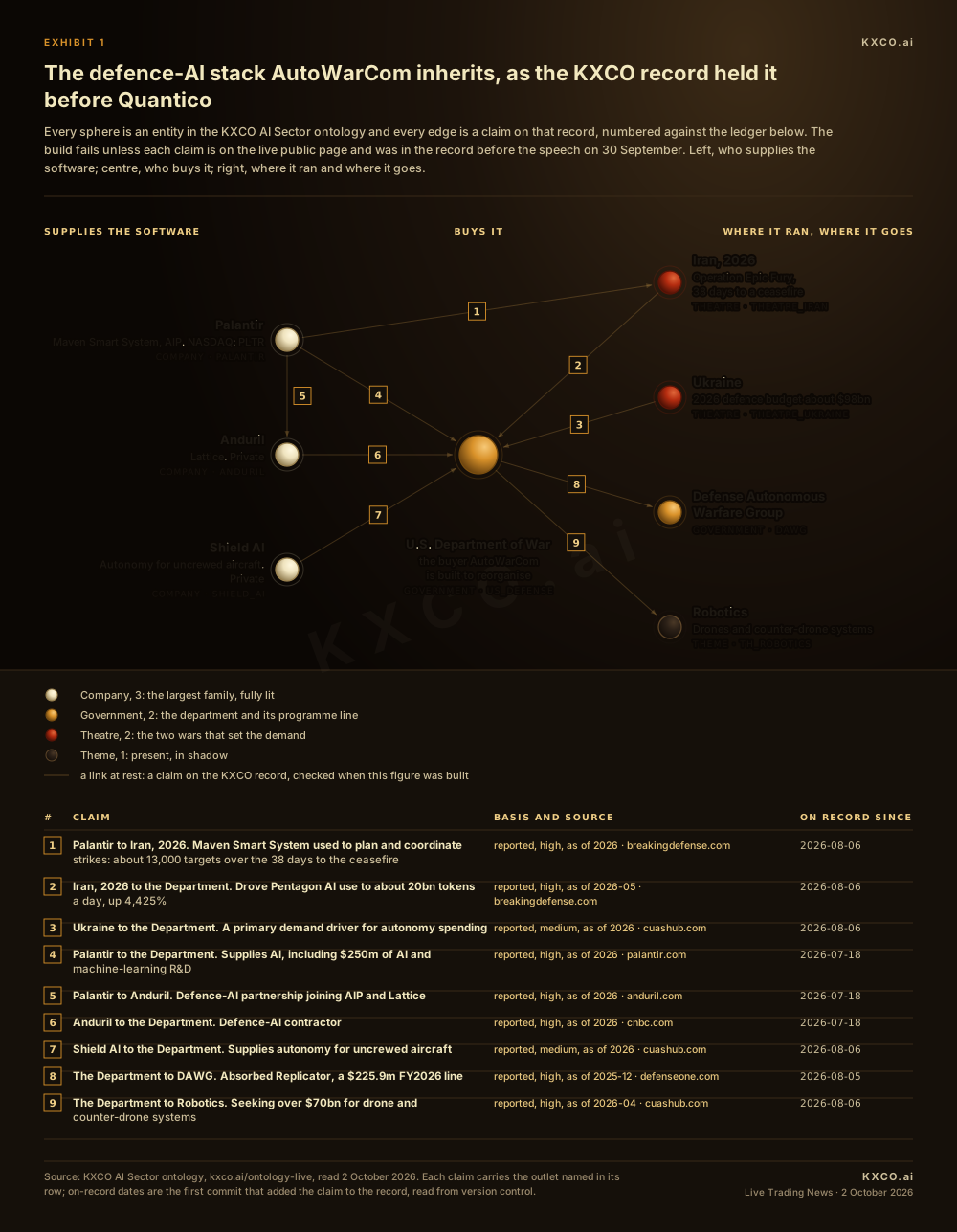
Exhibit 1. Nine claims from the KXCO AI Sector ontology, each with its source and the date it entered the record. All nine were on the record by 6 August 2026.
Palantir Technologies, $PLTR (NASDAQ), builds Maven Smart System. Maven fuses on the order of 150 data inputs, from imagery and surveillance to other intelligence, into a picture commanders use for planning and targeting. Cameron Stanley, head of the Pentagon's digital and artificial intelligence office, said the opening surprise strike on Iran, which hit about 1,000 targets, was enabled by Maven, according to Bloomberg. After Minab, Palantir built agents that re-review underlying intelligence for disqualifying factors. Assistant Secretary M. Roosevelt Ditlevson, quoted by Air & Space Forces Magazine, said systems at the border and in the homeland-defence picture have to be compatible with Maven, and that "Maven Smart System is going to feed into the Golden Dome picture."
Palantir's U.S. government revenue was $809 million in the second quarter, up 90% year on year, per its Q2 2026 results. For a public shareholder it is the listed name most directly wired into the targeting layer AutoWarCom will inherit. The Minab record is the offsetting fact. A tool that fails to flag a stale target does not become less strategic. It becomes a programme the department has to supervise in public.
Anduril Industries is the other pole. Palmer Luckey, the co-founder, was in the Quantico audience. Getty photographs from the speech identify him among the guests. Anduril's Lattice software is the base of Fortress, the autonomy layer the department uses at the border to fuse sensors. Ditlevson said data needs to integrate into Maven and into Lattice. Anduril is also in the Collaborative Combat Aircraft lane: reporting through 2026 has described the YFQ-44A flying mission objectives on Shield AI's Hivemind stack and then, on the same sortie, on Lattice. Luckey is now a co-director of Project Meridian. Anduril is private. Exposure for public investors is indirect: suppliers, partners, and the competitive pressure Lattice puts on Palantir and on the primes' own software stacks.
Shield AI's Hivemind is the autonomy software the company says will pilot LUCAS swarms, with one human commanding a group rather than a pilot on each aircraft. The company's May 2026 statement said the Pentagon had selected it for that integration, and that the drones would sense, decide and act without continuous human intervention while remaining under a single operator. That is the doctrinal sentence AutoWarCom will have to turn into a rule. "Meaningful human command," the phrase used in the Swarm Forge solicitation earlier in 2026, is not the same thing as a human on every trigger. The distance between those two phrases is where the next accident, or the next congressional hearing, will sit.
Auterion Government Solutions sells open-architecture UAS software and avionics and was both a Phase I finalist and a Gauntlet II performer. In a separate DIU experiment reported by Breaking Defense, Auterion said its software coordinated a swarm after a single operator designated targets. DIU has also run a prize challenge of up to $100 million for a voice-controlled Orchestrator, so that a servicemember can task air, ground and maritime robots in plain language, according to The Defense Post. Primordial has demonstrated voice-operated drones for Army special operations. Those are adjacent programmes, not Agincourt awards, but they are the user-interface layer a command built around mass autonomy will end up buying.
Counter-drone: the other side of the same market
A command that fields cheap attack drones inherits the problem of enemy cheap attack drones. Joint Interagency Task Force 401 exists to counter them. On 29 September, the day before the Quantico speech, the Army awarded ten indefinite-delivery contracts with a combined ceiling of about $4.15 billion, according to GovConWire. They cover systems that disable or destroy small drones, from command and control to sensors and weapons. Seven firms received $500 million ceilings each: Allen Control Systems, Digital Force Technologies, DroneShield, L3Harris WESCAM, Napatree Technology, RADA Technologies and SRC.
Echodyne and PVP Advanced EO Systems received $250 million each and SmartShooter $150 million, per GovConWire. Only about $50 million was obligated at award. Colonel Tony Lindh, JIATF-401's lead for rapid acquisition, said the Army had awarded more than $5 billion against a $7 billion ceiling, according to GovConWire, a total that includes earlier contracts with AeroVironment and with CACI, $CACI (NYSE).
Napatree appearing on both the attack-drone leaderboard and the counter-drone IDIQ is the tell. This market is not cleanly split between offence and defence. Sensor firms, electronic-warfare firms and airframe firms are all bidding into the same urgency. L3Harris, $LHX (NYSE), is the large-cap name in that September batch. AeroVironment, $AVAV (NASDAQ), already public and already paid, is the legacy small-UAS prime trying not to be crowded out by Neros and Skycutter. DroneShield, listed in Australia as ASX: DRO, is the pure-play counter-UAS name in the new IDIQ set.
The advisory layer: Musk, Luckey, Gingrich
Project Meridian is not a command and not a contract. The department's release says Chief Technology Officer Emil Michael is convening a study co-directed by Elon Musk, Palmer Luckey and Newt Gingrich, supported by academic, policy and industry experts, to be finished within 120 days. The product is an unclassified public report and a classified annex. The scope, in the department's words, runs "from subterranean depths to the cislunar frontier." Hegseth said he would meet the three co-directors in a secure room near the Quantico stage after the speech. Fox News and TechCrunch both reported the arrangement. Snopes confirmed the memorandum language: map the trajectory of future warfare, identify capability gaps, propose solutions tied to the 2026 National Security Science and Technology Strategy.
Musk's companies are not small-drone primes. SpaceX, $SPCX (NASDAQ), listed on 12 June and has owned xAI since 2 February. It is communications, launch, compute and manufacturing infrastructure, which is why a cislunar-to-subterranean study has his name on it. The KXCO record carries SpaceX in talks in July to supply the Pentagon with AI compute, as the Wall Street Journal reported. Luckey's company is a prime in everything but the stock ticker. Gingrich is a political figure, not an engineer. Defense One noted his record, including the closure of Congress's non-partisan scientific advisory office. Exhibit 2 draws the loop the public memo leaves open.
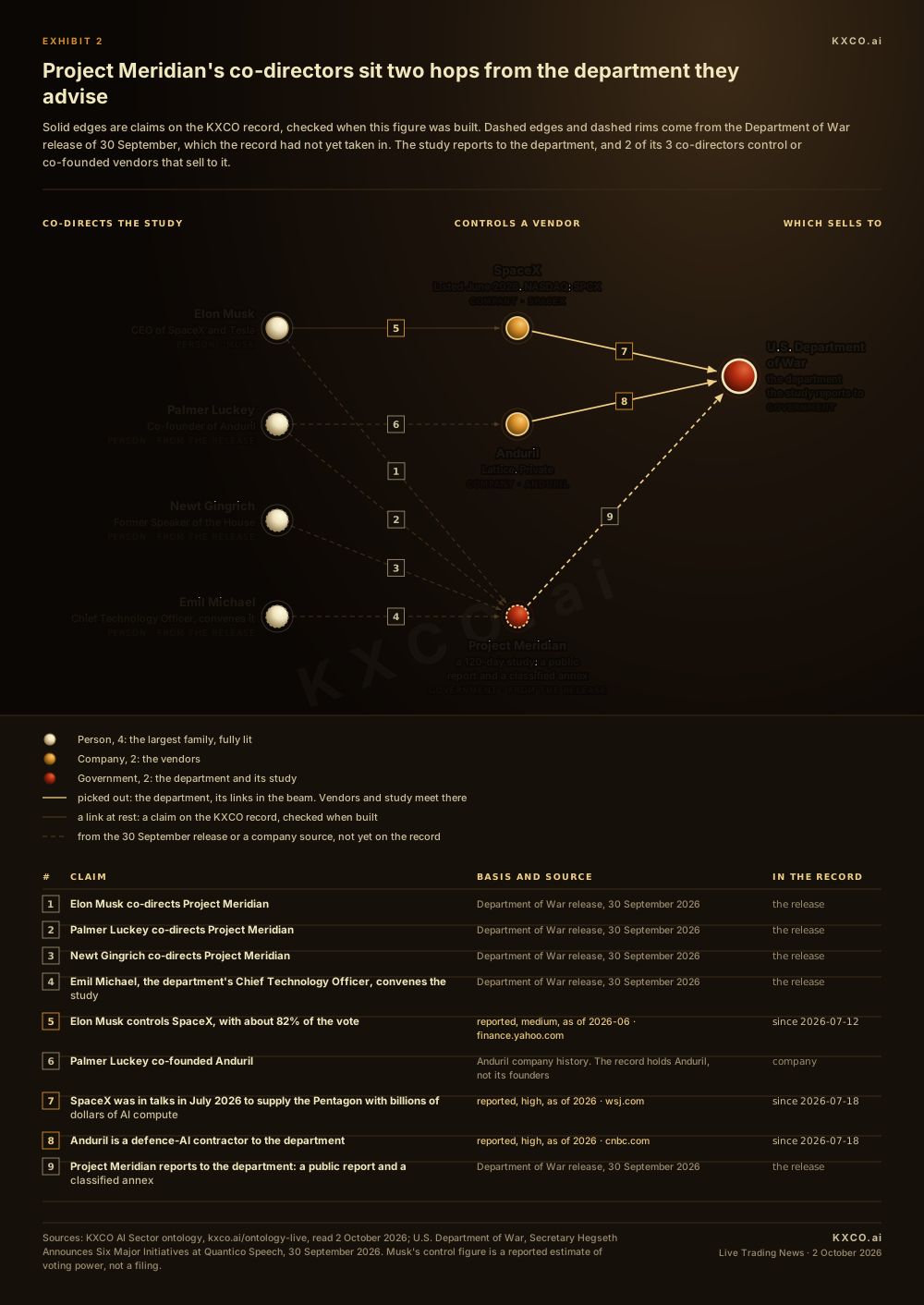
Exhibit 2. The study reports to the department, and 2 of its 3 co-directors control or co-founded vendors that sell to it. Solid edges are claims on the KXCO record; dashed edges are from the department's release.
A study co-directed by the founder of a leading vendor, producing recommendations the department says it will use to field systems, needs a recusal rule the public text does not provide. That is a governance fact, not a moral lecture. It will matter the first time a Meridian recommendation maps cleanly onto an Anduril or SpaceX product line.
Companies and offices attached to the AutoWarCom pathway, as of 2 October 2026
Company or office | Role in the stack | Listing |
|---|---|---|
Anduril Industries | Lattice battle software and the Fortress adaptation used at the border. Collaborative Combat Aircraft work including the YFQ-44A. Palmer Luckey co-directs Project Meridian and attended the Quantico address | Private |
Palantir Technologies | Maven Smart System, the AI-enabled battle-management tool CENTCOM used in the Iran campaign. Bloomberg reported dozens of Maven upgrades after the Minab strike | NASDAQ: PLTR |
Shield AI | Hivemind autonomy stack. The company said in May 2026 the Pentagon selected it as the AI pilot for the LUCAS one-way attack drone | Private |
SpaceX | Not a small-drone prime. Owner of xAI since February 2026 and in talks in July to supply the Pentagon with AI compute. Elon Musk co-directs Project Meridian | NASDAQ: SPCX |
Auterion Government Solutions | Open-architecture UAS software and avionics. Phase I Drone Dominance finalist and Gauntlet II performer | Private (U.S. arm) |
Neros Technologies | Top close-quarters score in Gauntlet II, 88.1. An order of 14,000 drones, per Defense News as of 1 October. The Archer FPV is already in Marine use | Private |
Perennial Autonomy | Top deep-strike score in Gauntlet II. An order of 8,000 drones, per Defense News as of 1 October | Private |
Skycutter | Phase I leaderboard leader, a Gauntlet II deep-strike finalist and a Phase 2.5 bomber invitee | Private |
Swarm Defense Technologies | Gauntlet II deep-strike top five and a Phase 2.5 bomber invitee | Private |
ORQA US, XTEND Reality, Vector, ModalAI | Gauntlet II close-quarters top five behind Neros. Orders for up to 5,000 Vector systems plus arming hardware, per the company | Private |
Hyperscale, Ascent Aerosystems, Griffon Aerospace, UDD Tech, Halo Aeronautics, Napatree, Nokturnal AI, Farage Precision | Phase I delivery-order finalists or Gauntlet II performers in the Drone Dominance pool | Private |
AeroVironment | Invited into the broader Drone Dominance field. Cited by JIATF-401 as an earlier counter-drone awardee alongside CACI | NASDAQ: AVAV |
L3Harris, DroneShield, SRC, RADA, Echodyne, Allen Control Systems, Digital Force Technologies, Napatree, PVP Advanced EO, SmartShooter | Army counter-UAS IDIQ awards of 29 September 2026, with a combined ceiling of about $4.15 billion per GovConWire, inside a marketplace with a $7 billion ceiling | Mixed. L3Harris is NYSE: LHX, DroneShield is ASX: DRO |
Kratos | Kratos SRE was invited to the first Drone Dominance Gauntlet. The longer franchise is targets, drones and attritable aircraft | NASDAQ: KTOS |
Defense Innovation Unit | Owen West, the DIU director, named chief executive of DRPM-UxS to run Project Agincourt. DIU runs Drone Dominance | Government |
Sources: Department of War release and Project Agincourt memorandum, 30 September 2026; DefenseScoop; Defense News; Inside Defense; Air & Space Forces Magazine; Defense One; company statements; KXCO AI Sector ontology. An invitation to a Gauntlet is not an award. Ceilings are not obligations.
What the command will not replace
Air & Space Forces Magazine set the new command against work already under way: the Air Force's Collaborative Combat Aircraft, the lower-cost Massed Modular Aircraft concept, the Navy's MQ-25 unmanned tanker, uncrewed surface vessels, and an autonomous-warfare branch already operating under Southern Command. General Ken Wilsbach, the Air Force chief of staff, described the FQ-42 and FQ-44 as autonomous fighters that can be sent on a mission without a crew. Those programmes sit with the services and with the primes that build fighters and tankers. AutoWarCom, if Congress creates it, is supposed to define joint needs and integrate service forces, not to seize the F-35 line.
The practical boundary will be fought over in the 30-day plan. A functional combatant command with acquisition authority can pull work out of service programme offices. Services will resist that when the work is a flagship, and yield it when the work is a small drone they do not want to man. The settlement Hegseth has already sketched is the one to expect: lightning stays with the services, rain moves to the new command. The listed primes, Lockheed Martin $LMT (NYSE), RTX $RTX (NYSE), Northrop Grumman $NOC (NYSE), Boeing $BA (NYSE) and General Dynamics $GD (NYSE), are exposed on both sides. Their high-end franchises are the lightning. Their unmanned subsidiaries and teaming arrangements are the bid to stay relevant if the rain becomes the larger line item. Kratos, $KTOS (NASDAQ), is the listed mid-cap already living in attritable aircraft and targets. Kratos SRE was on the first Gauntlet invitation list.
FORTRESS, power and the industrial corollary
The same speech launched FORTRESS America: Federal Operations for Resilience, Troop Resources, Energy, Supply and Survivability. The memo treats it as a homeland insurance policy. Every major installation generates its own power, so a cyber or sabotage attack on the civilian grid does not darken a base. Rare earths, specialty metals, semiconductors and propellants are mined and refined in the United States. Reserves of munitions, fuel, medicine and blood are deep enough to fight through a broken supply line. Air & Space Forces Magazine noted Air Force work on a nuclear microreactor at Eielson Air Force Base, Alaska, alongside solar, geothermal and microgrid projects. The Pentagon has said it plans to field a reactor at a military base by September 2028.
For the drone story this is not a digression. Mass autonomy is an energy and electronics story. A command that wants hundreds of thousands of airframes inherits magnets, batteries, radios and chips. Hegseth's own FORTRESS text admits the current dependence: foreign mines, overseas chip fabs, foreign weapons supply chains. AutoWarCom without a domestic components base is a buyer of someone else's supply chain, which is the position the department is trying to leave. The Phase 2 language about a supply chain "more closely tied to the American industrial base" is the operational version of that admission. Investors reading only the airframe names will miss the constraint.
The control problem, stated without the sermon
Expert warnings about military AI are easy to collect and hard to use. RT's piece leaned on them: erosion of critical thinking, accidental escalation, greater danger to civilians. Those are real categories of failure. Minab is a documented instance of one of them, with a body count, a named software system, and a subsequent change in procedure. The Swarm Forge solicitation earlier in 2026 asked for AI agents that assign roles across a swarm, decentralised so that the loss of one node does not collapse the formation, with "minimal operator intervention" and automatic target recognition, while remaining under meaningful human command. That requirement is the doctrine. It is also the accident report waiting for a date.
A markets publication does not need to settle the ethics. It needs to price the constraint. A command whose first public exhibit includes a school strike caused in part by stale data inside an AI-enabled kill chain will face congressional conditions on any authority it is given. Those conditions, audit logs, target-review standards, civilian-harm reporting and limits on fully automatic engagement, are not anti-technology. They are the terms on which the money will be allowed to scale. Firms that can show a reviewable decision chain, Palantir's post-Minab agent work being the example already in the press, are positioned for that oversight. Firms that can only show a demo video are not.
Meaningful human command is a record, not a slogan
Minab was not a failure of model intelligence. On Bloomberg's account the chain did what it was built to do: it fused the inputs, ranked the target and moved it through the cycle. What it carried was a fact that had stopped being true. The site had been a military facility. The record still said so, and nothing in the record said when that claim had last been checked against the ground.
That is the problem the KXCO Round Table is built around, and it is why KXCO describes its work as enhanced intelligence rather than artificial: the machine extends the people deciding, and the deciding stays with them. In the Round Table every claim carries its source, its basis, its confidence and two dates, valid_from and valid_to. A contrary account is kept beside the claim it contradicts, never silently reconciled. KXCO holds its own record to a simple rule: a claim past its valid_to is disputed until somebody fetches it again. Every material action is signed with ML-DSA-65, the NIST post-quantum signature standard, so a stranger can check who admitted it.
Applied to a kill chain, "meaningful human command" stops being a phrase in a solicitation and becomes four things a record either holds or does not. Exhibit 3 draws them.
The fact the engagement relies on, with the date it was true and the date it stops being true.
The contrary account, kept beside that fact rather than written over it.
The named person who admitted the decision, sealed with a signature so the act cannot later be disowned.
The order behind the approval, recorded by whoever gave it, so the record never names the hand and hides the authority.
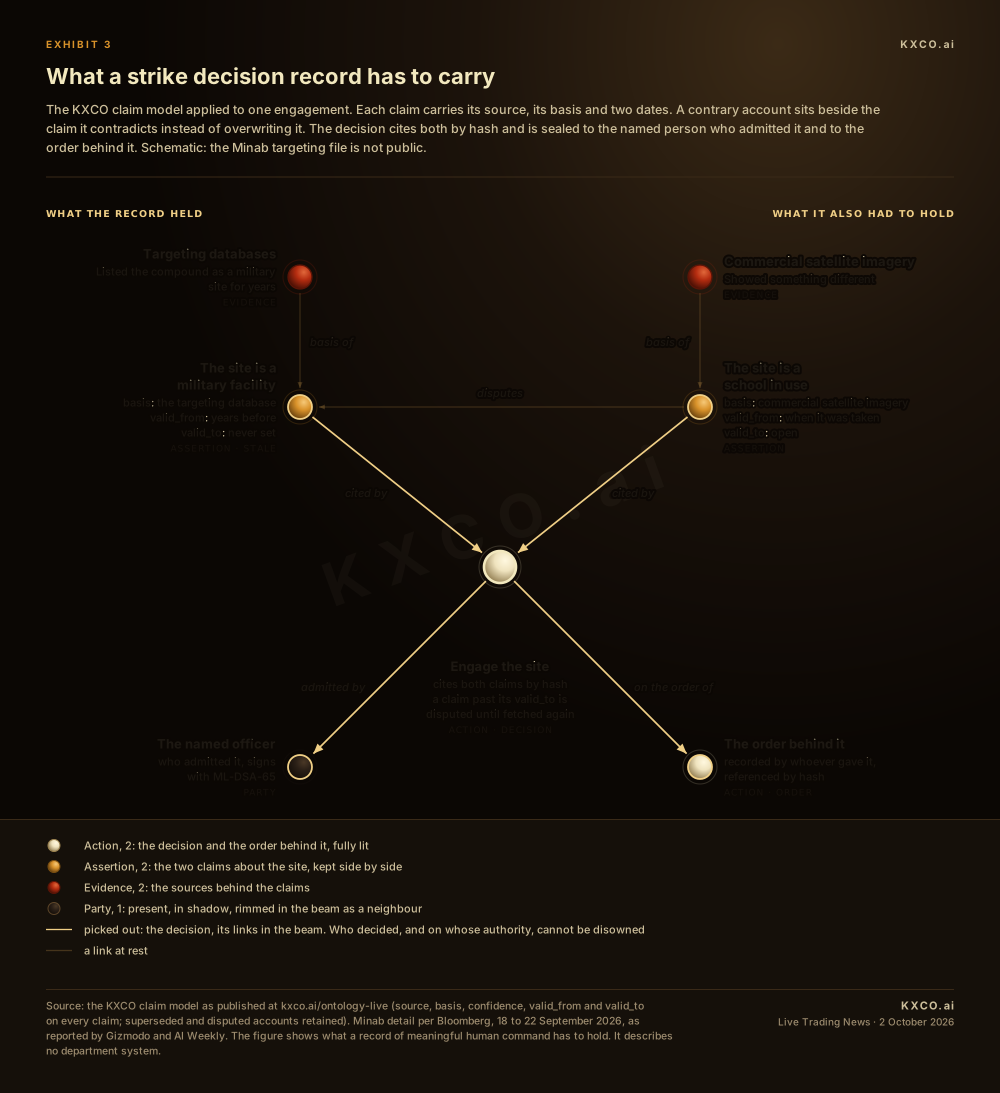
Exhibit 3. A schematic, not the Minab targeting file, which is not public. The failure Bloomberg's account describes is the claim on the left: no valid_to, never checked against the one beside it.
A command that can produce that record for every engagement will get its authorities from Congress on its own terms. A command that cannot will get them with conditions written by the people who read the Minab file. The Round Table flagged the gap on 19 July 2026, ten weeks before Quantico, as a finding in the KXCO AI Sector ontology: AI was moving onto classified networks with unaudited supply chains, and verifiable, quantum-safe provenance was the missing layer. Exhibit 1 is the market for that layer. Exhibit 3 is what it has to prove.
What Congress has to do, and what happens if it does not
The memo is explicit. DRPM-UxS will "collaborate directly with Congress to secure necessary legislation" for a command with manpower, budget and acquisition authorities, target date 1 October 2027. A combatant command is a statutory creature. Speech and memorandum can rename an office, appoint a chief executive and a chief operating officer, and start a plan. They cannot create a four-star command with its own budget line. If the legislation slips, Agincourt continues as a portfolio office under existing authority, and the services keep the programmes. That outcome is a delay, not a failure of the industrial story. The Drone Dominance orders and the counter-UAS IDIQs do not wait on the flag.
The political risk is the opposite of delay. A Congress that grants service-like acquisition authority to a new command, while the same department has just put two vendors' founders on a strategy study and the White House has just chosen a voluntary accord with no enforcement mechanism, will write oversight in. Conflict rules, reporting on civilian harm, and a statement of how human command is exercised over swarm engagement are the inserts to expect. They will slow some awards and accelerate others, specifically awards to firms that already document the decision chain.
A market read, not a price target
Live Trading News does not put a twelve-month target on a command that does not yet have a budget line. The exposure map is still readable.
Palantir is the listed software name inside the targeting loop AutoWarCom will inherit. The bull case is volume: more formations, more sensors, a Golden Dome feed, a department that has already standardised on Maven compatibility, and a U.S. government segment that grew 90% year on year in the second quarter, per Palantir's results. The bear case is Minab. A system that recommended a school is a system whose next contract will be written with an auditor in the room. Both can be true. The stock will trade the volume until a hearing trades the failure, and the firm with the cleanest decision record wins the hearing.
SpaceX is the listed name in the Meridian loop: launch, Starshield, compute talks with the Pentagon and a controlling shareholder who co-directs the study. AeroVironment is the listed small-UAS incumbent in a market the department is deliberately opening to startups. Counter-UAS work with JIATF-401 is a cushion. The attack-drone fly-off is a threat. Kratos is the listed attritable-aircraft name with a foot in the first Gauntlet invitation, not a guarantee of a production award. L3Harris is the large-cap sensor and electronic-warfare name on the new counter-drone IDIQ. DroneShield is the listed pure-play on the defensive side of the same problem. The primes are not cut out. They are being told their cost curve is the problem the new command exists to route around.
The private names, Anduril, Shield AI, Neros, Perennial, Skycutter and Auterion, are where the operating leverage sits if the department means what the memo says. They are also where the public information is thinnest. Order quantities reported by Defense News and by the companies themselves are the best public numbers available. They are not audited programme-of-record figures. A five-figure Neros order at small-drone prices is a real factory problem and a modest Pentagon line item. It becomes a strategic line item only if the command, once created, makes that buying pattern the default rather than a pilot.
The macro point is the one Hegseth put in the memo. Forty years of buying fewer, better weapons produced a force whose platforms cost more than the weapons now built to kill them. Flipping that exchange is an industrial policy, not a gadget. It favours manufacturers who can repeat a design every week, software firms who can update a model without a five-year test programme, and component suppliers who are not waiting on a foreign magnet. It punishes programmes whose unit cost assumes a permissive sky. AutoWarCom is the organisational bet that the department can do the first without losing the second.
What this is
AutoWarCom, as announced on 30 September 2026, is a proposal to create a twelfth combatant command, four-star, functional, with service-like authorities over unmanned and autonomous systems, targeted for 1 October 2027 and dependent on legislation. Project Agincourt is the interim: the existing unmanned-systems portfolio office, led by Owen West and Max Strasiser, ordered to prototype a buying model that puts operators next to manufacturers and to deliver a plan within 30 days. The industrial base already inside that model is the Drone Dominance cohort, plus Palantir's Maven, Anduril's Lattice, Shield AI's Hivemind and the counter-drone awardees of 29 September. Project Meridian, co-directed by Musk, Luckey and Gingrich under Emil Michael, is a 120-day study, not a contract.
The strategic claim is that drone warfare, with software-assisted targeting, is the largest change in the character of battle in generations, demonstrated in Ukraine and already used by U.S. forces in the Middle East. The counter-claim, documented at Minab, is that the same software can carry a stale target into a strike that kills children. Both claims are now part of the record the department will have to take to Congress. The record behind Exhibits 1 and 2 is live, source by source, in the KXCO AI Sector ontology, and the engine that keeps it is the KXCO Round Table.
The next fact is dated. The DRPM-UxS plan of action and milestones is due within 30 days of the memo, by 30 October 2026, and it will say how much of the services' unmanned work the new command absorbs. Project Meridian's report is due within 120 days, by 28 January 2027.
Sources
U.S. Department of War, "Secretary Hegseth Announces Six Major Initiatives at Quantico Speech," 30 September 2026.
Memorandum, Secretary of War, "Project Agincourt: Pathway to the Autonomous Warfare Command," 30 September 2026.
Reuters, Idrees Ali and Phil Stewart, "Pentagon creates 'Autowarcom' to expand AI and drone capabilities," 30 September 2026.
Air & Space Forces Magazine, Chris Gordon and Greg Hadley, "Hegseth Unveils New Autonomous Warfare Command," 30 September 2026.
Defense One, "Hegseth plans 'Autonomous Warfare Command,'" 30 September 2026.
DefenseScoop, "U.S. creates new Autonomous Warfare Command," 30 September 2026; Gauntlet II results, 18 September 2026; Shield AI and LUCAS, 20 May 2026.
Defense News, "Neros, Perennial Autonomy lead in Pentagon's drone competition," 1 October 2026.
Inside Defense, Drone Dominance Phase I vendors, 6 March 2026.
Defense Daily, Phase 2.5 bomber qualifier invitees, 22 September 2026.
GovConWire and DefenseScoop, Army counter-drone IDIQ awards, 29 September 2026.
Bloomberg, Minab school strike and Maven changes, 18 to 22 September 2026, as reported by Gizmodo, IBTimes UK and AI Weekly.
CNN, "US military had close call after using AI for false intelligence report, sources say," 18 September 2026.
Breaking Defense, Maven usage in the Iran campaign, May 2026.
The White House, fact sheet on the executive order Inaugurating the Era of Super Intelligence, 29 September 2026; IAPP and the Associated Press on the Joint Commitment on Frontier Responsibilities, 29 September 2026.
Palantir Technologies, second-quarter 2026 results, filed with the SEC.
Business Insider, Military Times, Breaking Defense, Fox News, TechCrunch and Snopes, 30 September to 1 October 2026, on the speech, Meridian and Agincourt.
RT, "Hegseth announces new AI and drone command," 1 October 2026. Claims unique to RT are marked as such.
KXCO AI Sector ontology, read 2 October 2026: Exhibits 1 and 2, and the provenance finding of 19 July 2026.
Stocks mentioned: $PLTR (NASDAQ), $SPCX (NASDAQ), $AVAV (NASDAQ), $KTOS (NASDAQ), $LHX (NYSE), $CACI (NYSE), $LMT (NYSE), $RTX (NYSE), $NOC (NYSE), $BA (NYSE) and $GD (NYSE).
Shayne Heffernan, Ph.D., is the founder of Live Trading News, the KnightsBridge Group, Knightsbridge Law and the KXCO.ai ecosystem spanning post-quantum cryptography, identity, attestation and enterprise ontology.
This article is analysis, not a solicitation to buy or sell any security. Order quantities and contract ceilings are as reported by the department, the trade press and the companies. Ceilings are not obligations, and Gauntlet invitations are not awards.

The Week the Discount Rate Gets a Vote
The Fed hiked on 16 September and left the door open. This week the August PCE deflator on Wednesday, September payrolls on Friday, the RBA on Tuesday and euro-area CPI set the discount rate. Gold, Bitcoin, the dollar, the AI complex and the quantum pure plays share that rate and diverge everywhere else. This is the map of what depends on what, the three regimes the book should already have written down, and the stop that belongs to each node on KXCO Ontology Live.

The Round Table Scorecard: 87 Days of a Live Ontology
On 1 July 2026 KXCO put a Round Table ontology in public with 31 entities, 41 claims and no findings. It now holds 395 entities, 892 claims and 47 findings, with every correction kept rather than overwritten. This scorecard grades the record, how it corrects itself in the open, and the 9 of 13 names on its first outlook table that are higher since 17 July.

Wall Street Week Ahead: Rates, Oil, AI, Quantum, Defense, Metals and Bitcoin
The trading week opens after a Federal Reserve that chose to hike, a White House that chose not to strike Yemen, and an oil market still pricing a war now in its seventh month. The useful work this week is not a list of tickers. It is a map of what depends on what: the funds rate, the Magnificent Seven, a quantum cohort just handed a specification and a deadline, the missile primes selling into a restock, and gold, silver, crude and Bitcoin, all held against the live AI sector ontology.

What the KXCO Ontology Exposed While the Market Stood Still
On 25 August the KXCO AI Sector Ontology stamped a fresh set of rows. Sixteen days later the Nasdaq had gone nowhere and ten of those names were up: Intel 14.68%, Meta 13.04%, SpaceX 7.42%, Oracle 5.65%. This is what a record of 393 entities and 869 sourced claims surfaces that a screen cannot: who is genuinely irreplaceable rather than merely large, which obligations sit off every balance sheet in the sector, and where the strongest bull case on the page runs into a variable no graph contains.
Every story, signed and delivered.
Subscribe to the kxco channel and get the headline, the AI-written key takeaways, and the chain-anchor link the moment we publish. Audio versions and per-ticker subscriptions arrive in the next iteration.