
SpaceX the AI Company
It absorbed xAI and became the largest independent landlord of frontier compute. Three tenants pay $2.32bn a month, and two of them are its own competitors.
Part of theAI Stocks Center
In February 2026 SpaceX absorbed xAI in an all-stock deal that valued the combined entity at roughly $1.25 trillion. It was reported as a consolidation of Elon Musk's holdings, which is what it looked like from the outside.
Read it against the structure of the sector instead and it was something else. It was the moment a launch company became the largest independent landlord of artificial intelligence compute in the world, and started renting that compute to the people it competes with.
That claim is not rhetorical. It is checkable, and the rest of this piece checks it.
Three tenants, $2.32bn a month
Start with the money coming in, because it is the least ambiguous part of the picture.
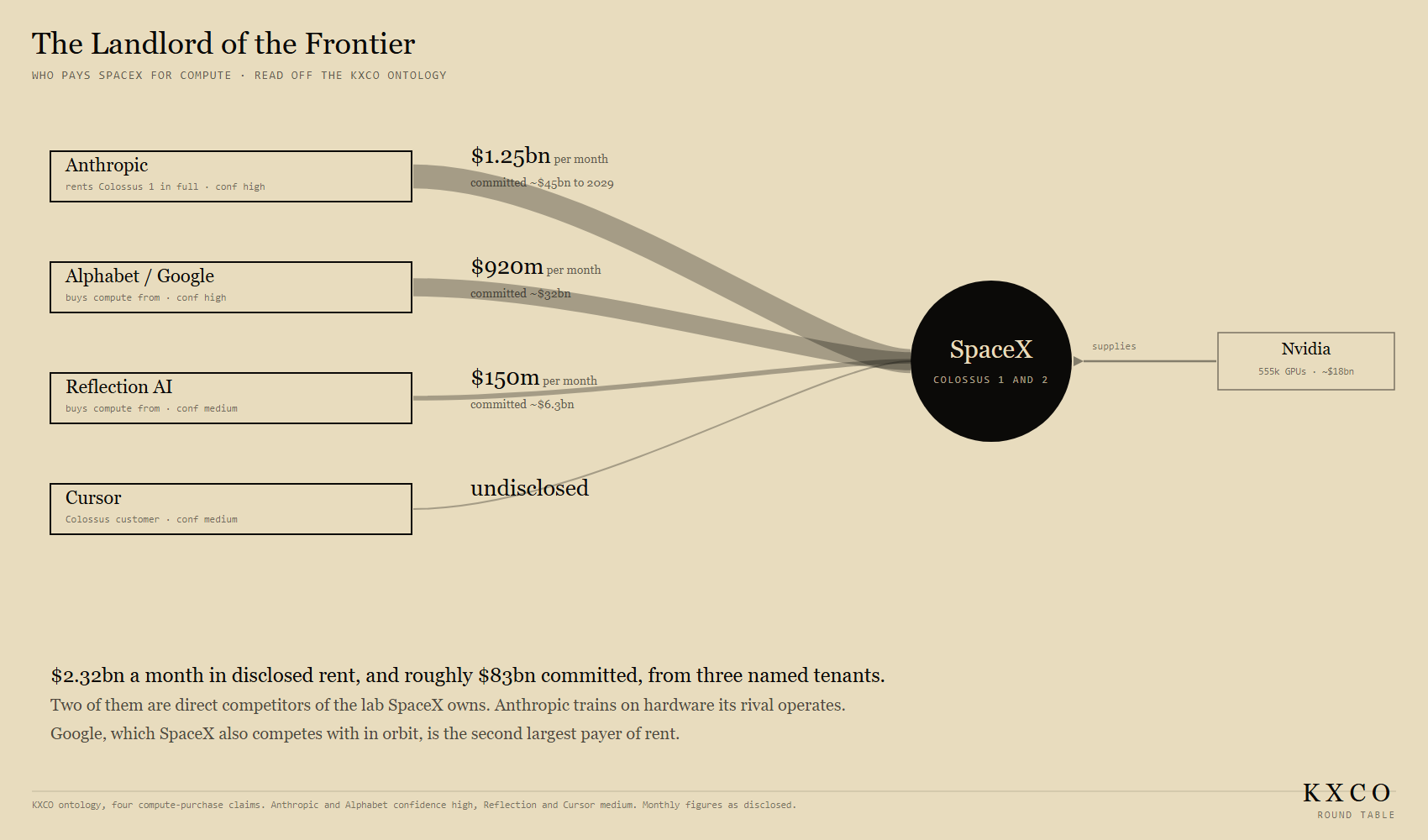
Anthropic rents Colossus 1 in full. Not a slice of it, the entire facility: roughly 220,000 Nvidia GPUs drawing 300 megawatts in Memphis. The rent is $1.25bn a month, and the commitment runs to about $45bn through 2029. That figure carries high confidence in our record, which matters, because it is the single largest compute lease disclosed anywhere.
Alphabet is the second largest tenant, at $920m a month, against a commitment of roughly $32bn. Also high confidence. Sit with that one for a moment. Google designs its own TPUs, operates one of the three largest clouds on earth, and is buying compute from a rocket company it simultaneously competes with in orbit and relies on for satellite launches.
Reflection AI pays $150m a month, roughly $6.3bn committed. Cursor is recorded as a Colossus customer at an undisclosed figure.
Three disclosed tenants, $2.32bn a month, roughly $83bn of committed revenue. And the two largest are direct competitors of xAI, the lab SpaceX now owns outright. Anthropic trains its frontier models on hardware operated by a rival. Whatever else that is, it is not a normal supplier relationship.
On the supply side, one relationship: Nvidia, roughly 555,000 GPUs for about $18bn.
What the structure says that the announcements do not
Any of the above could have been assembled by reading press releases carefully. The next part could not, and it is where holding a sector as a structured record rather than a pile of articles starts to pay.
The KXCO Ontology currently holds 392 entities and 864 typed claims across AI, compute, energy and capital. Every claim carries a magnitude, an as-of date, a confidence grade, a disclosure basis and a source. It is a public showcase of Round Table, the engine KXCO builds to hold records that way, and the showcase exists precisely so that arguments like this one can be audited rather than believed.
Because the record is a graph, you can ask it questions that are properties of the shape rather than of any single claim. So we asked the obvious one. What happens to the sector if you remove SpaceX?
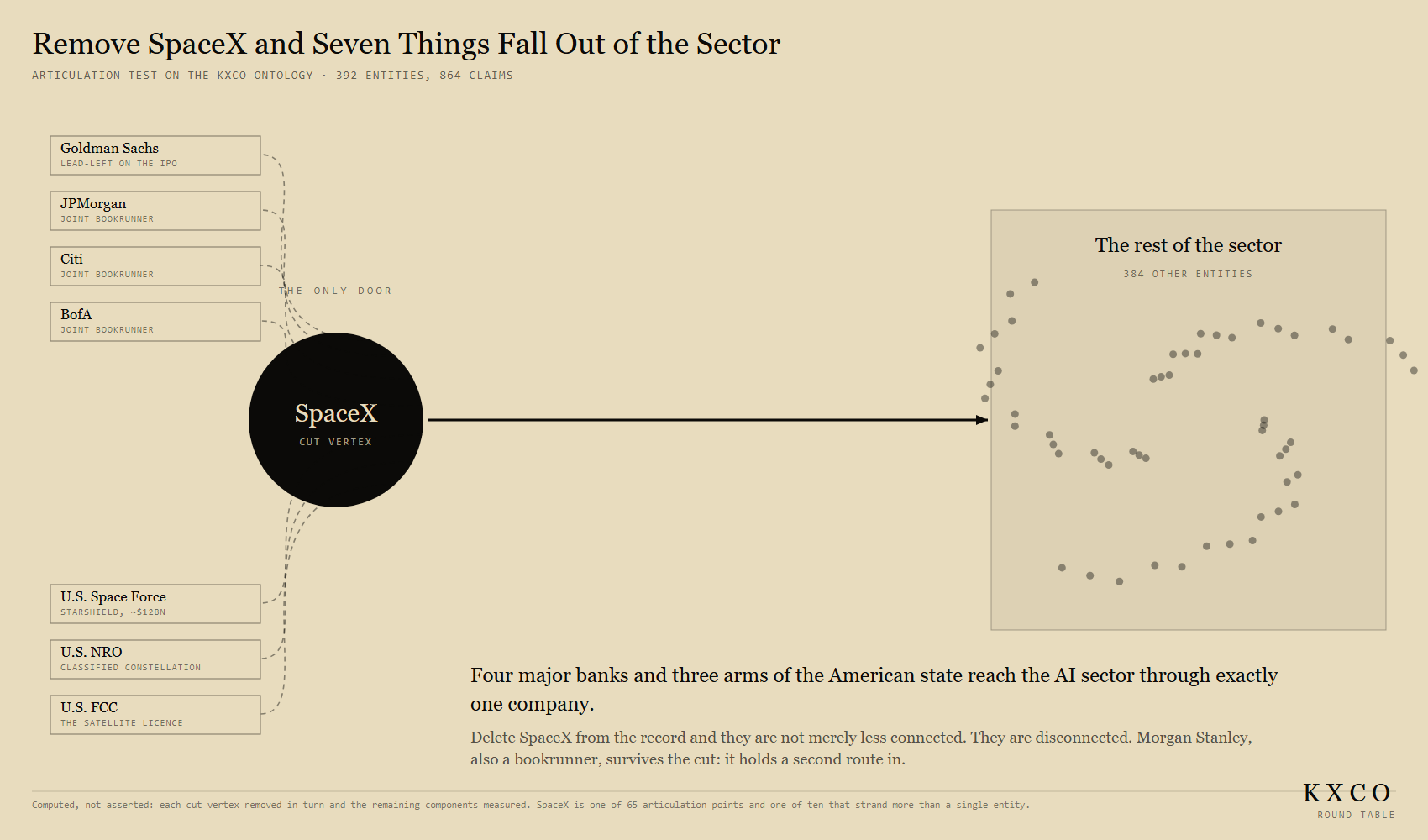
Seven entities stop being connected to the AI sector at all.
Not "become less central". Disconnected. Goldman Sachs, JPMorgan, Citi and Bank of America, plus the U.S. Space Force, the National Reconnaissance Office and the Federal Communications Commission. Every one of them touches this sector through exactly one company, and that company is SpaceX.
This is computed rather than asserted. Each cut vertex in the graph gets removed in turn and the remaining components are measured. SpaceX is one of 65 articulation points in the record and one of only ten that strand more than a single trailing entity.
One detail is worth pausing on because it shows the method working. Morgan Stanley was also a joint bookrunner on the SpaceX IPO, and Morgan Stanley survives the cut, because it holds a second route into the graph. Four of the five bookrunners are stranded and the fifth is not. An analysis that grouped them as "the banks" would have missed that, and the difference is the point: the record distinguishes between institutions on the basis of their actual connections rather than their category.
So SpaceX is not simply a large participant in AI. It is the seam along which Wall Street's underwriting desks and three arms of the American national security state are attached to the sector. That is a structural position, it is not something the company announced, and it accumulated one financing and one contract at a time.
Two hops from everything
The second structural question: how close is SpaceX to the rest of the sector?
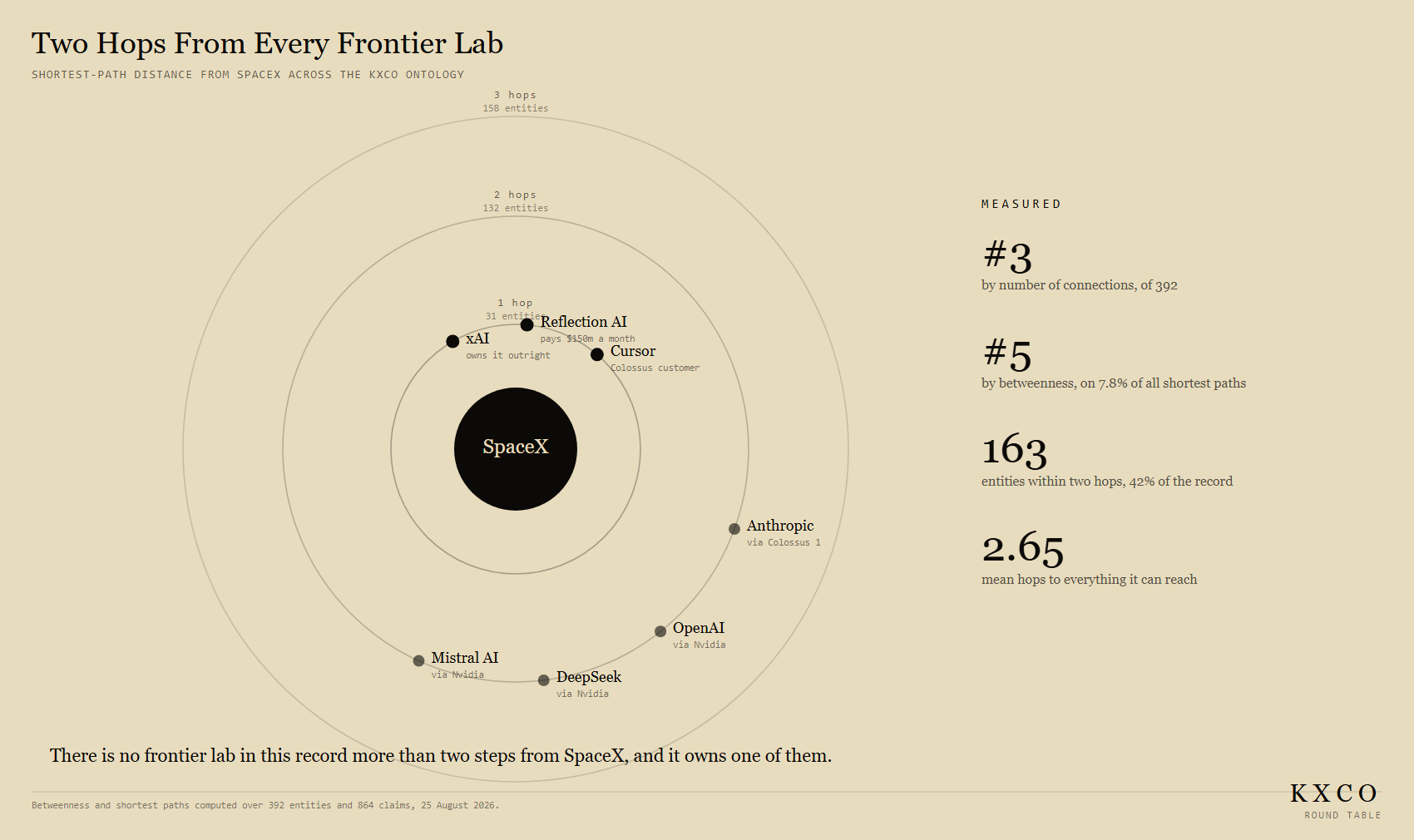
There is no frontier lab in the record more than two steps away from it.
xAI is one hop, because SpaceX owns it. Reflection AI and Cursor are one hop, because they pay rent. Anthropic is two, through Colossus 1. OpenAI, DeepSeek and Mistral are two, through Nvidia. Every serious model builder in the sector is within two relationships of a launch company.
The wider numbers say the same thing from a different angle. SpaceX ranks third of 392 entities by number of connections and fifth by betweenness, sitting on 7.8 per cent of all shortest paths in the graph. It reaches 163 entities within two hops, which is 42 per cent of the entire record. Mean distance to everything it can reach is 2.65 hops.
Only four entities sit on more paths: Nvidia, at more than four times the score, then OpenAI, SandboxAQ and Meta. That is the company SpaceX now keeps, and none of the others launch rockets.
The rocket company with one rocket relationship
Which raises a blunt question. What business is this?
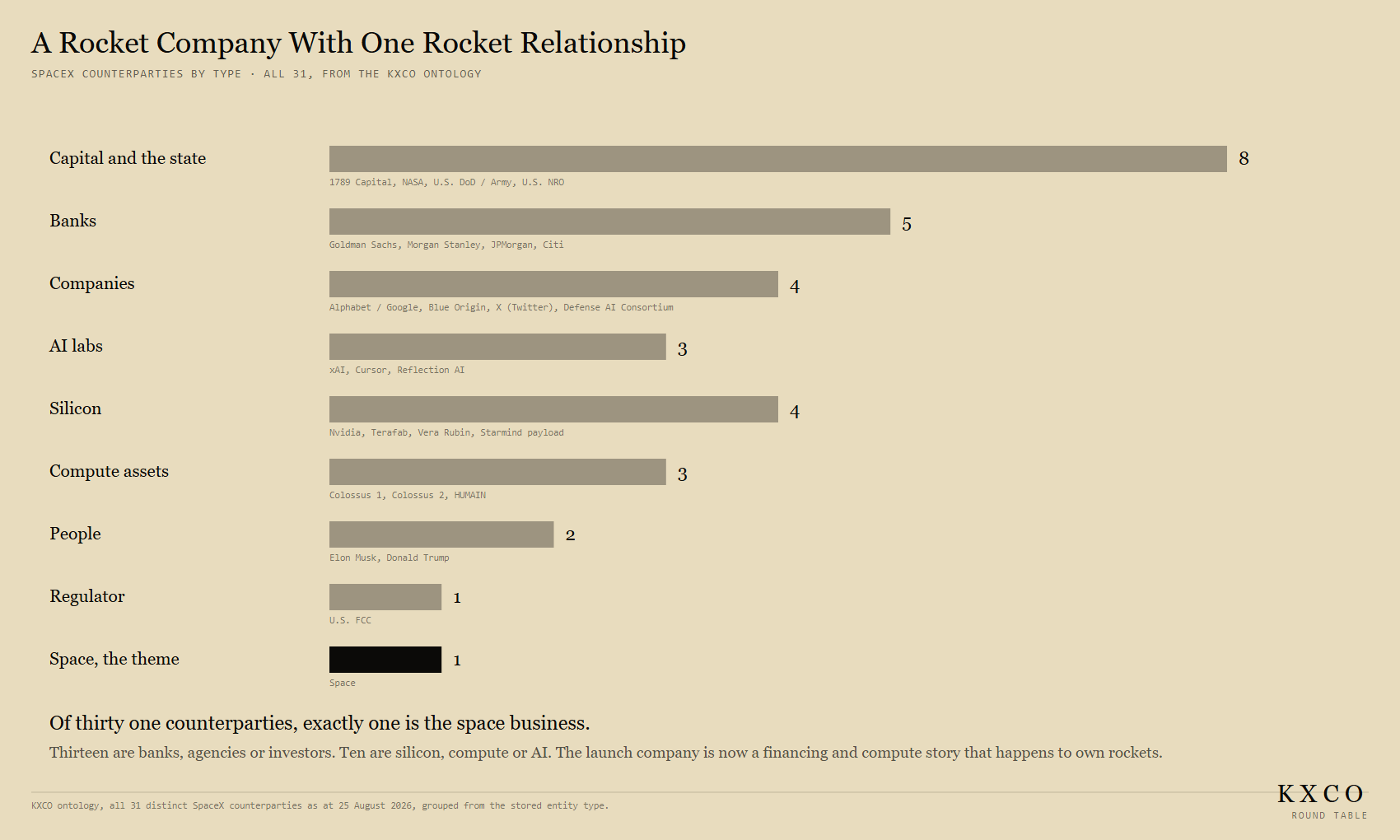
Count SpaceX's 31 counterparties in the record and group them by what they are.
Eight are capital or the state: 1789 Capital, NASA, the Department of Defense, the NRO, the Space Force. Five are banks. Four are companies, including Alphabet, Blue Origin and X. Four are silicon, including Nvidia and Terafab, a chipmaker SpaceX co-funds. Three are AI labs. Three are compute assets. Two are people, Musk and, following a June 2026 disclosure of a small share purchase, Donald Trump. One is a regulator.
And exactly one, out of thirty one, is the space business itself.
Thirteen relationships are finance, government or investment. Ten are silicon, compute or AI. The launch business shows up once, as a theme.
That is not an argument that SpaceX has stopped launching rockets. It launches more than everyone else combined. It is an observation about where the company's relationships now live, and relationships are what a company is made of. On the evidence of its own counterparty list, SpaceX is a financing and compute enterprise that happens to own the best launch capability on earth, and increasingly uses that capability as an input to the compute business rather than as the business itself.
The exclusivity nobody priced
There is one more relationship in the record that deserves its own heading, because it is the largest number in the entire SpaceX file and it is a commitment rather than a disclosure.
SpaceX has been named Nvidia's sole AI-compute supplier going forward, against a 20 gigawatt target by the end of 2027. It has committed to build exclusively on Nvidia's Vera Rubin platform, the NVL723. Our record marks the exclusivity itself as high confidence and the 20 gigawatt figure as medium, which is the right way round: the commitment is documented, the delivery number is a target.
Twenty gigawatts is a difficult quantity to hold in your head, so anchor it. The four largest American hyperscalers have contracted roughly 18.8 gigawatts of firm generation between them, and most of that is nuclear capacity that does not exist yet and will not for a decade. SpaceX is targeting more than that, alone, inside eighteen months.
The implied hardware is the part that should stop a reader. At that target the record notes something between one and two million Rubin class GPUs, and grades it an estimate rather than a claim, because it is arithmetic rather than disclosure. For scale, Colossus 1, the largest coherent AI facility anybody has publicly described, runs about 220,000 GPUs. The 2027 target implies somewhere between five and nine more of those.
Take the target at face value and one of two things follows. Either SpaceX becomes far and away the largest operator of AI compute on the planet, or the number does not survive contact with power, capital and thermal reality. Our own record leans towards caution by grading it medium, and so should any reader. But the direction of the commitment is not ambiguous, and it is exclusive, which means Nvidia has tied a meaningful share of its 2027 output to a single counterparty. That is a concentration risk on Nvidia's side of the relationship that its own disclosures do not frame as one.
There is a loop here too, and the record names it. Nvidia supplies SpaceX roughly 555,000 GPUs for about $18bn. SpaceX leases that capacity out against more than $80bn of committed revenue and reinvests in more Nvidia hardware. The ontology records this as one of three circular capital arrangements in the sector, at medium confidence and on a reported basis. Investment and revenue travelling the same corridor in opposite directions is not a scandal between public companies, but it does mean the demand figure on one side is structurally different from a customer arriving with outside money.
The state is a customer, a shareholder and a regulator
The other seam running through the SpaceX file is government, and it is unusually thick.
On the procurement side: the U.S. Space Force holds roughly $6.5bn of Starshield work plus about $5.9bn of launch across five years, some $12bn in total. NASA carries $2.89bn for the Human Landing System under Artemis, alongside Commercial Crew. The National Reconnaissance Office is building a classified satellite network on Starshield. The Department of Defense is recorded as in talks, as of July 2026, to supply the Pentagon billions of dollars of AI compute, and SpaceX is a member of the Defense AI Consortium.
That last item is the one that matters for this argument. The Pentagon is not buying launches in that conversation. It is buying compute, from the same asset base that Anthropic and Alphabet rent.
On the ownership side, the record holds a June 2026 disclosure that Donald Trump bought between $15,001 and $50,000 of shares, and that 1789 Capital holds a stake. On the regulatory side, the FCC is the body that must authorise the satellite constellation the compute strategy depends on.
So the same counterparty set contains a customer buying AI compute, a regulator holding the licence the strategy needs, and a sitting president holding stock. Each of those is individually unremarkable and publicly disclosed. Held together in one view they describe an entanglement between a private compute operator and the American state that has no clean precedent in the sector, and which nothing in the company's reporting presents as a single picture.
Add the sovereign money. HUMAIN, Saudi Arabia's Public Investment Fund vehicle, is recorded in anchor-stake talks worth around $5bn at the IPO. Microsoft appears through a Starlink and Azure partnership. Blue Origin appears as the rivalry across launch, satellites and orbital AI. Even Supermicro is in there, as the builder of the original 100,000 GPU cluster.
None of this is hidden. All of it is sourced. The point is that reading it as a list produces a company profile, and reading it as a structure produces a position.
Orbit is the tell
If you want the clearest single signal of where this is heading, it is not in the rental book. It is in a filing.
SpaceX has asked the FCC to authorise up to one million Starmind satellites. It is co-designing the Starmind AI1 payload with Nvidia. Our record carries the claim plainly: SpaceX is moving data-centre compute into space.
Set that against the constraint the entire sector is now organised around. Compute is limited by power, and power on the ground means grid interconnection, permitting, cooling water and twenty year nuclear contracts signed a decade before delivery. Four American hyperscalers have contracted roughly 18.8 gigawatts of firm generation between them, most of it nuclear, most of it not yet built. That is the position the industry is in, and it is set out in more detail in the companion piece on Live Trading News covering power, compute and the AI loop.
In orbit, the sun does not set, there is no permitting queue, and cooling is a radiative engineering problem rather than a water rights negotiation. A company that owns the cheapest route to orbit and is designing its own compute payload is not diversifying. It is attempting to move the binding constraint somewhere it already holds the advantage.
Whether it works is a genuinely open question and this piece is not going to pretend otherwise. A million satellites is an authorisation request, not a constellation. Thermal management of dense compute in vacuum is unsolved at scale. The claim in our record carries medium confidence and it should. But the intent is unambiguous, and the entity best placed to attempt it is the one that already flies most of what goes up.
What the graph cannot tell you
Two honest limits, because a piece that only reports what suits its argument is advertising.
The record is a record of claims, not of truth. When it says Alphabet pays $920m a month, that is a sourced, dated, high-confidence claim about a disclosure. The ontology is an instrument, not an oracle. It tells you what has been asserted, by whom, on what date and with what backing, and it makes the shape of that assertion inspectable. It does not know things.
Articulation points are a fact about the record, not about the world. SpaceX stranding four banks tells you those banks have exactly one recorded relationship into this sector. It does not prove Goldman Sachs has no other exposure to AI. It proves this record contains no other route, which is either a genuine structural fact or a thinly written region of the graph, and distinguishing between those requires judgement rather than computation. In this instance the reading is defensible, because bookrunning an IPO is precisely the kind of relationship that is disclosed and captured. It would be far weaker applied somewhere the coverage is sparse.
Saying which of those two you are looking at is the analyst's job. The graph's job is to make the question askable.
What it means for the position
The investment implication of all this is not "buy SPCX", which is a decision with a hundred inputs this piece has not examined.
It is narrower and more useful. SpaceX has become a compute counterparty to most of the frontier. If you hold Anthropic exposure through its investors, or Alphabet directly, or any of the labs renting Colossus capacity, you hold an indirect operational dependency on a single privately controlled company whose founder holds roughly 82 per cent of the voting power. That dependency does not appear in any of those companies' segment reporting, and it is two hops away in the graph.
The second implication is about concentration. The sector's chokepoints are usually discussed as lithography, high bandwidth memory and design software, and those remain the hard ones. SpaceX is a different kind of concentration: not a monopoly on a component, but a single point through which financing, defence procurement and frontier compute all pass. Nine entities in our record are flagged by hand as chokepoints. SpaceX is not one of them, and the computation says it should probably be discussed as one.
More on the equity side of this across shayneheffernan.com and the Live Trading News coverage of compute, power and the semiconductor chain.
The method, briefly
Everything structural in this piece came out of Round Table rather than out of reading. The rental book is four claims read off the graph with their confidence grades attached. The seven stranded entities came from removing each cut vertex in turn and measuring what fell off. The hop distances and the betweenness ranking are shortest-path computations across 392 entities and 864 claims.
None of those four findings was visible in the announcements individually. Each deal reads as ordinary corporate activity: a lease here, a bookrunner mandate there, a merger, a satellite filing. Held together as structure and interrogated, they describe a company that has quietly become load-bearing for the sector.
That is the argument for holding information this way, and it is the reason KXCO builds provenance infrastructure rather than another interface to a model. Structured information that a person can reason over produces judgements that no amount of reading produces. The public ontology is a small demonstration of a domain-agnostic engine, deliberately built on a subject readers can check independently. It is a window into the machine, not the machine.
The line that started this piece was that SpaceX became an AI company in February 2026. The graph is more precise than that. It became the thing the AI companies rent from.
Stocks mentioned in this article: $NVDA, $GOOGL, $MSFT, $AMZN, $META, $AMD, $ORCL, $ASML, $TSM, $MU, $GS, $MS, $JPM, $C, $BAC, $SMCI, $VRT, $CRWV, $EQIX and $TLN.
Shayne Heffernan, Ph.D., is the founder of Live Trading News, the KnightsBridge Group, Knightsbridge Law and the KXCO.ai ecosystem spanning post-quantum cryptography, identity, attestation and enterprise ontology.
Graphics generated from the KXCO Ontology via Round Table, 25 August 2026, against 392 entities and 864 typed claims. Betweenness, shortest paths and articulation points computed rather than asserted. Every magnitude, date and confidence grade carried in the graphics is stored on the claim it describes and is viewable at kxco.ai/ontology-live.
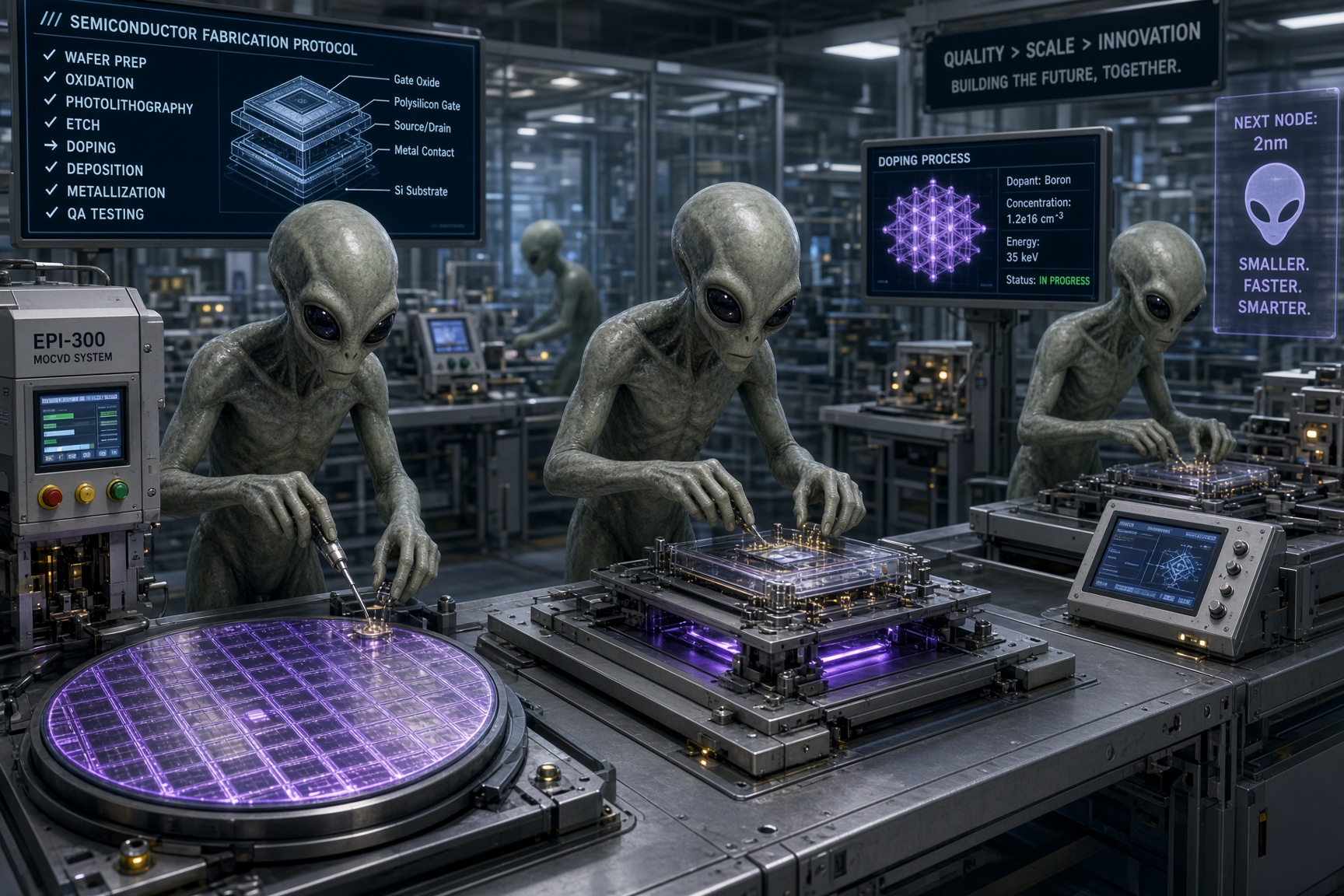
AI Is Being Powered by Tech That Looks Almost Alien
Every frontier AI model runs on chips printed by one Dutch machine. ASML's extreme-ultraviolet scanner fires a laser at up to 50,000 droplets of molten tin a second, per ASML, and bounces the light off mirrors whose deviations are tens of picometres. Veritasium called it the closest thing we have to alien technology. This piece takes the film as the brief and checks it: the machine, High-NA, and the wafer-scale chips and liquid-cooled racks downstream of it.
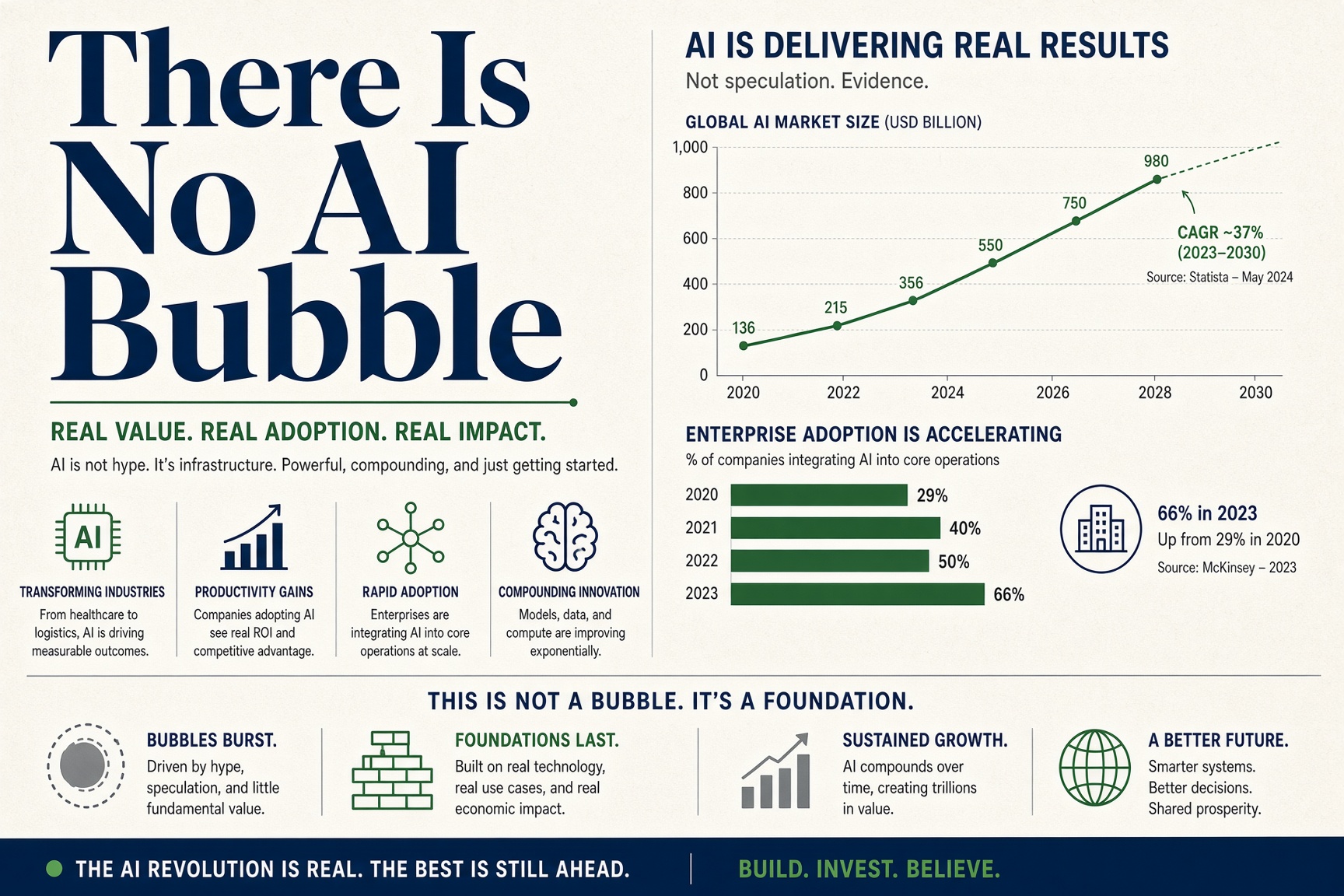
There Is No AI Bubble
There is no AI bubble. A bubble is capacity nobody uses, demand nobody signs for and a glut when the building stops. KXCO's AI sector ontology, refreshed on 7 October 2026, finds the reverse: adoption rising on six independent measures, about $2.35tn of contracted backlog at the four largest sellers of compute per their own reports, and supply rationed at every layer. It keeps the bear case in the same record, 20 circular capital claims, and answers it.

Weekly Market Outlook: Fed Minutes, Anthropic and OpenAI IPOs, Gold, Bitcoin, FX
The Fed raised rates in September and payrolls rose 29,000, per the Labor Department. This week the FOMC minutes, three Treasury auctions and a 10-year near 5.3 percent test that gap. Anthropic's IPO clock runs toward a 14 October investor day while OpenAI's chief executive says not 2026. Gold sits 26 percent below its record, bitcoin near $85,500, the dollar up three weeks running. Two knowledge graphs from KXCO's records map the IPO backers and the FDA board.
Thoughts on Thinking in an AI World
A model will write an answer about anything in seconds. What an AI world makes scarce is everything around the answer: what you believed last month and why you changed it, the link between fields nobody reads together, and a decision a named person can stand behind. Three knowledge-graph exhibits from the KXCO record show each one, from a reported Nvidia deal that became a signed 8-K to a war five links from a data centre.
Every story, signed and delivered.
Subscribe to the kxco channel and get the headline, the AI-written key takeaways, and the chain-anchor link the moment we publish. Audio versions and per-ticker subscriptions arrive in the next iteration.